Buying a Dota 2 Account in 2026: Everything You Should Know First

It’s one of the most searched topics in the Dota 2 community: “buy Dota 2 account.” Whether it’s a Herald player dreaming of an Immortal badge, a returning veteran who doesn’t want to grind through calibration, or someone whose main account was banned and wants a fresh start, the market for Dota 2 accounts is thriving in 2026. Sites, Discord servers, and forums openly advertise accounts at every rank, with prices ranging from a few dollars to several hundred.
But before you hand over your money, there’s a lot you need to understand. Buying a Dota 2 account carries significant risks — from outright scams to account recovery by the original owner, from Valve bans to the uncomfortable reality that a purchased rank won’t match your actual skill. This guide covers everything: the market, the risks, the pricing, what Valve says about it, the legal considerations, and — critically — the alternatives that might actually give you what you’re looking for.
This isn’t a buying guide. It’s an informed decision guide. By the end, you’ll understand the full picture and can decide for yourself what makes sense.
Table of Contents
- The Dota 2 Account Market in 2026
- Why People Buy Dota 2 Accounts
- Account Pricing: What Accounts Cost
- The Risks of Buying a Dota 2 Account
- Valve’s Official Stance and Enforcement
- Legal Considerations
- How to Verify an Account (If You Buy Anyway)
- What Happens After You Buy: The Skill Gap Problem
- Better Alternatives to Buying an Account
- Frequently Asked Questions
The Dota 2 Account Market in 2026
The Dota 2 account market is a mature, established gray market that has existed almost as long as ranked matchmaking itself. In 2026, accounts are sold through multiple channels:
Where Accounts Are Sold
- Dedicated gaming marketplaces: Sites like PlayerAuctions, G2G, EpicNPC, and others maintain dedicated Dota 2 account sections with buyer protections, escrow systems, and seller ratings.
- Discord servers: Numerous Discord communities facilitate account sales, often with middleman services and reputation systems.
- Social media: Reddit (r/dota2trade and related subreddits), Twitter, and Facebook groups host account sales, though with fewer buyer protections.
- Direct sellers: Individual boosters and account farmers sell directly through personal networks, Telegram channels, and WhatsApp groups.
- Dedicated Dota 2 account sites: Some websites specialize exclusively in Dota 2 accounts, offering inventory searchable by rank, heroes, cosmetics, and account age.
Types of Accounts Available
Not all accounts for sale are the same. The market offers several categories:
| Account Type | Description | Price Range | Risk Level |
|---|---|---|---|
| Fresh/Uncalibrated | New accounts with phone verification, ready for calibration | $5-15 | Low (but near-worthless for skipping the grind) |
| Calibrated Low Rank | Herald-Crusader accounts, often mass-produced | $10-30 | Low-Medium |
| Mid-Rank | Archon-Legend accounts | $30-80 | Medium |
| High-Rank | Ancient-Divine accounts | $80-200 | Medium-High |
| Immortal | Immortal rank accounts (various leaderboard positions) | $150-500+ | High |
| Immortal + Inventory | High-rank accounts with valuable cosmetics, rare items, Arcanas | $300-2,000+ | Very High |
| Aged/Trophy | Old accounts with TI compendiums, legacy items, Battle Cup trophies | $100-1,000+ | High |
How Accounts Are Created for Sale
Understanding the supply side helps you assess risk:
- Account farming operations: Large-scale operations in regions with cheap labor create accounts in bulk, calibrate them to various ranks, and sell them wholesale. These accounts often have thin match histories and generic hero pools.
- Boosted accounts: Regular players’ accounts that were boosted to a higher rank specifically for sale. The match history will show a sudden, dramatic improvement in performance — a red flag for Valve’s detection systems.
- Abandoned accounts: Former players who’ve quit Dota sell their legitimate, naturally-developed accounts. These are the highest quality and hardest to detect but also the most likely to be recovered by the original owner.
- Stolen accounts: Compromised through phishing, malware, or social engineering. Buying a stolen account means the original owner can recover it through Steam Support at any time, and you lose everything.
Why People Buy Dota 2 Accounts
The motivations for buying an account are varied, and understanding them is important because different motivations have different optimal solutions — and buying an account is rarely the best one.
1. “I Deserve a Higher Rank”
The most common reason. Players believe their true skill exceeds their current MMR and that bad teammates, bad luck, or the “trench” are keeping them down. They buy a higher-ranked account expecting to perform at that level. Reality: This almost never works. If you’re a 2,000 MMR player on a 5,000 MMR account, you will lose games rapidly until the account returns to your actual skill level. You’ll also ruin games for your teammates along the way.
2. Fresh Start After a Ban
Players whose primary accounts have been banned (for toxicity, cheating, or other violations) buy new accounts to continue playing. Reality: Valve’s hardware ID and behavioral fingerprinting systems are increasingly sophisticated. Banned players on new accounts are often flagged and re-banned, especially if the behavior that caused the original ban continues.
3. Smurf Account
High-ranked players wanting a secondary account to play with lower-ranked friends or to practice heroes without risking their main account’s MMR. Reality: This is the one use case where buying an account technically achieves its goal, but it’s also the one that most harms the Dota 2 ecosystem. Smurfing ruins games for the players at the lower rank.
4. Returning Player
Former players who lost access to their original account (forgotten credentials, linked to an old email, etc.) and want to skip the new account grind. Reality: Steam Support can often recover old accounts with enough verification. Buying someone else’s account is a poor substitute for your own history.
5. Cosmetic Collection
Some buyers are primarily interested in the account’s inventory — rare cosmetics, legacy items, retired Battle Pass rewards that can no longer be obtained. Reality: This is the most “legitimate” use case in terms of getting what you pay for, but the risks (account recovery, bans) still apply.
6. Status Symbol
Some players want an Immortal badge on their profile for social reasons — to impress friends, to feel accomplished, or to satisfy ego. Reality: The badge is meaningless if your gameplay doesn’t match. Your friends will notice. Your teammates will notice. And the rank will decay as you lose games.
Account Pricing: What Accounts Cost
The Dota 2 account market follows standard supply-and-demand economics, with price influenced by several factors:
Primary Price Factors
| Factor | Impact on Price | Why It Matters |
|---|---|---|
| MMR/Rank | Highest impact — roughly $15-30 per 1,000 MMR | The primary reason people buy accounts |
| Behavior Score | Moderate — high BS adds $10-30 premium | Low BS accounts are nearly worthless; 10K+ BS is expected |
| Account Age | Moderate — older accounts command 20-50% premium | Older accounts look more legitimate and are less likely to be flagged |
| Match History | Moderate — natural-looking history adds value | Accounts with 2,000+ games look more legitimate than 200-game accounts |
| Cosmetic Inventory | Variable — rare items can double the price | Arcanas, TI exclusives, and legacy items have independent value |
| Phone Verification | Small — adds $5-10 | Required for ranked play; saves buyer the hassle |
| Email Access | Critical — no email access is a scam red flag | Without email access, the seller can recover the account at any time |
| Steam Level/Games | Small to moderate | Higher Steam level and more games makes the account look legitimate |
2026 Price Guide (Approximate)
| Rank | Budget Account | Standard Account | Premium Account |
|---|---|---|---|
| Herald-Guardian | $8-15 | $15-25 | $25-40 |
| Crusader-Archon | $20-35 | $35-60 | $60-100 |
| Legend | $40-60 | $60-100 | $100-150 |
| Ancient | $60-100 | $100-160 | $160-250 |
| Divine | $100-160 | $160-250 | $250-400 |
| Immortal | $150-250 | $250-400 | $400-800+ |
“Budget” accounts are newer with thin histories and possibly lower Behavior Scores. “Standard” accounts have decent history, 10K BS, and phone verification. “Premium” accounts are older, have extensive natural-looking histories, good inventories, and maximum BS.
The Risks of Buying a Dota 2 Account
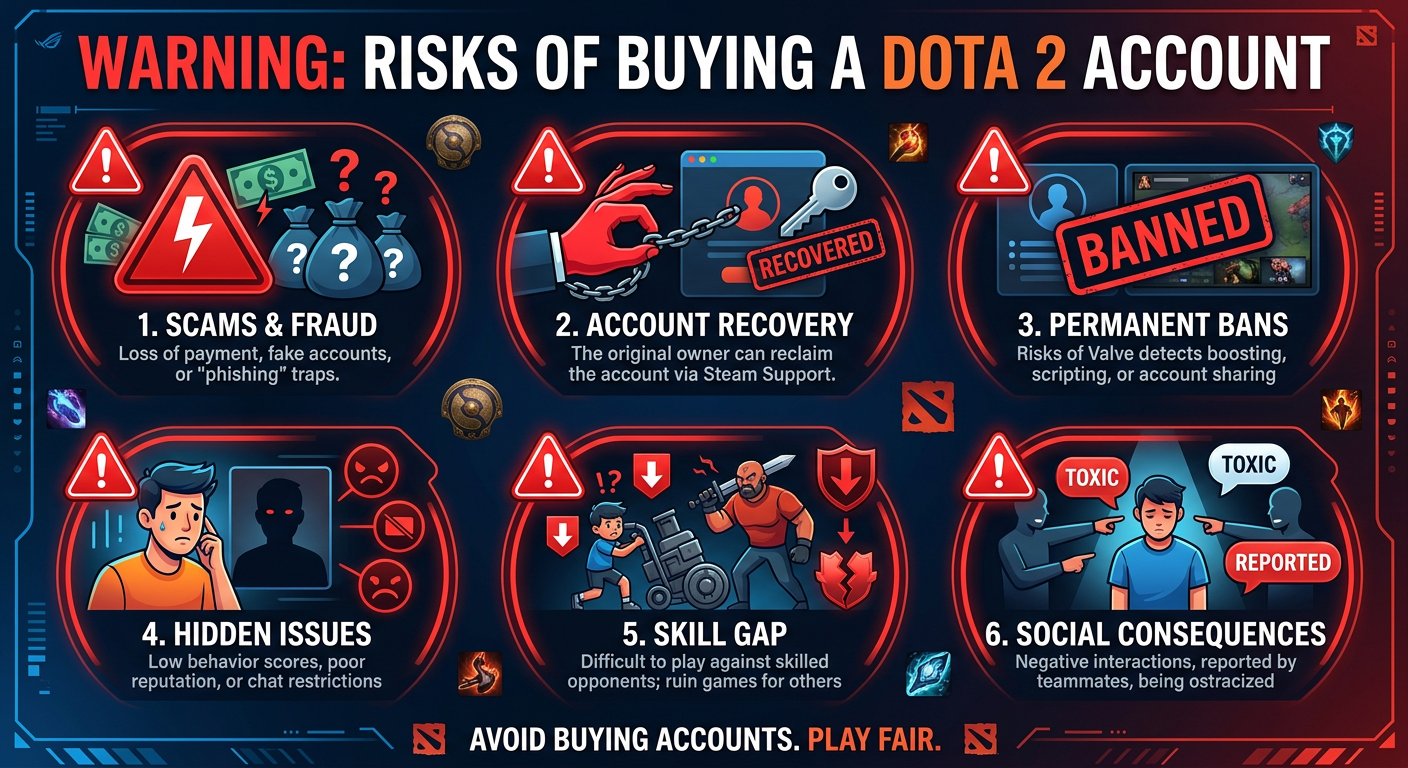
This is the section that matters most. The risks of buying a Dota 2 account are substantial, varied, and often underappreciated by buyers caught up in the excitement of getting a new rank.
Risk 1: Scams (Loss of Money)
The most straightforward risk: you pay and receive nothing. Common scam patterns include:
- Payment without delivery: The seller takes your money and disappears. Especially common on social media and unregulated forums.
- Fake screenshots: The seller shows screenshots of a high-rank account but delivers a different, lower-rank account.
- Delayed scam: The seller delivers the account, waits for the buyer protection window to expire (on marketplace sites), then recovers the account through Steam Support using the original email and purchase history.
- Middleman scams: Fake middleman services that take payment from the buyer and account details from the seller, then disappear with both.
Even established marketplace sites with escrow and buyer protection can’t fully prevent delayed recovery scams because the original account owner always has the strongest claim with Steam Support.
Risk 2: Account Recovery (Loss of Account)
This is the most devastating risk and it can happen months or even years after purchase. The original account creator can contact Steam Support and prove ownership through:
- The original email address used to create the account
- Purchase history (credit card records matching Steam transactions)
- CD keys from the original games activated on the account
- The original Steam account creation date and details
Steam Support will almost always side with the original creator over a subsequent buyer. Once recovered, the original owner has full access and you have nothing — no account, no rank, no cosmetics, and no recourse.
Risk 3: Valve Bans
Valve prohibits account trading in the Steam Subscriber Agreement. Purchased accounts can be banned if detected, and Valve has multiple detection methods:
- Sudden behavioral changes: If an account goes from playing in SEA to playing in EU overnight, or suddenly drops from 6K to 3K performance level, it’s flagged for review.
- Hardware fingerprinting: Valve tracks hardware IDs. If an account suddenly appears on completely different hardware in a different geographic location, it’s suspicious.
- Phone number changes: Changing the linked phone number — necessary for ranked play — is a flag.
- IP and login pattern analysis: Consistent login from a new IP, especially in a different country, triggers review.
- Mass-produced account patterns: Accounts from farming operations often share similar patterns (same heroes, same progression, similar match histories) that Valve’s systems can identify.
The ban wave approach means your account might seem safe for weeks or months before suddenly being caught in a detection sweep.
Risk 4: Low Priority and Behavior Score Issues
Many accounts sold online have undisclosed problems:
- Hidden Low Priority games pending
- Behavior Score lower than advertised (some sellers inflate this stat in their listings)
- Active communication bans or matchmaking restrictions
- Recent Overwatch convictions that haven’t fully processed yet
Risk 5: The Skill Gap Problem
Even if you successfully acquire and keep the account, you face a problem that no amount of money can solve: your skill doesn’t match the rank. We’ll cover this in detail below, but in brief — buying a Divine account when you play at Archon level means you’ll lose game after game, frustrating both yourself and your teammates, until the account settles at your actual MMR. You’ve paid $200+ to temporarily pretend to be a rank you’re not.
Risk 6: Social and Reputational Consequences
The Dota 2 community is smaller than you think. If your in-game friends know your real skill level and suddenly see you on a much higher-ranked account, the deception is obvious. In-game, teammates will notice your performance doesn’t match your badge. The social fallout — being called out as an account buyer in chat — is a surprisingly common and unpleasant experience.
Valve’s Official Stance and Enforcement
The Steam Subscriber Agreement
Section 1 of the Steam Subscriber Agreement is unambiguous: your Steam account is non-transferable. You cannot sell, transfer, or share your account with another person. Valve retains ultimate ownership of all Steam accounts — users are licensees, not owners.
Relevant excerpts (paraphrased for clarity):
- You may not sell or charge others for the right to use your account
- You may not transfer or share your account with any other person
- You are responsible for all activity on your account
- Valve may terminate your account at any time for violation of these terms
Enforcement Methods
Valve’s enforcement has become increasingly sophisticated over the years:
- Smurf detection systems (2020+): Machine learning models that identify accounts being played by users whose skill doesn’t match the account’s established patterns.
- Phone number linking: Requiring a unique phone number for ranked play makes mass account creation harder (though virtual numbers are still available).
- Hardware bans: Repeat offenders can receive hardware ID bans that prevent them from creating or using any Dota 2 account on that machine.
- Ban waves: Rather than banning accounts individually as they’re detected, Valve often accumulates detections and bans in waves, making it harder for sellers to identify which detection method caught them.
- Community reporting: The Overwatch system allows players to flag suspected account buyers and smurfs, providing human-verified data points for Valve’s detection systems.
Penalties
Penalties for account buying/selling can include:
- Permanent ban of the traded account
- Matchmaking bans on associated accounts
- Phone number blacklisting
- Hardware ID bans in severe/repeated cases
- Loss of all items, cosmetics, and progress on the account
Legal Considerations
Beyond Valve’s terms of service, there are broader legal considerations to account buying:
Terms of Service Violation
Violating the Steam Subscriber Agreement is a breach of contract. While Valve is unlikely to sue individual account buyers, the ToS violation means you have zero legal recourse if something goes wrong. You can’t sue the seller for scamming you (your transaction was already in violation of the platform’s terms), and you can’t appeal to Valve if your purchased account is banned.
Fraud Considerations
In some jurisdictions, selling access to accounts you don’t truly own (stolen accounts) constitutes fraud. Buyers of stolen accounts can be considered receivers of stolen goods, though enforcement of this in the context of virtual gaming assets is extremely rare.
Payment Fraud Risk
Many account transactions occur through payment methods with limited buyer protection (cryptocurrency, gift cards, direct bank transfers). If the transaction goes wrong, there’s often no chargeback mechanism. Using PayPal or credit cards provides more protection but also creates a paper trail of a ToS-violating transaction.
Tax Implications
For sellers (and this is worth knowing if you’re considering selling your own account), income from account sales may be taxable depending on your jurisdiction. Large-scale account selling operations are definitively taxable business income in most countries.
How to Verify an Account (If You Buy Anyway)
If after reading all the above, you still decide to purchase an account, here are the minimum verification steps to reduce (not eliminate) your risk:
Before Purchase
- Check the account on Dotabuff/OpenDota: Verify the rank, match history, and hero statistics match what the seller claims. Look for suspicious patterns — sudden rank jumps, geographic server changes, hero pool changes.
- Verify Behavior Score: Ask for a screenshot of the conduct summary. Better yet, ask for a screen share or video showing the profile in-client.
- Check for VAC/game bans: Use SteamDB or the Steam profile to check for any existing bans.
- Verify email access: The seller should transfer the email account linked to Steam, not just the Steam credentials. Without email access, you’re vulnerable to recovery.
- Check account age and game library: Older accounts with more games are less likely to be mass-produced farming accounts.
During Purchase
- Use a reputable middleman or marketplace with escrow
- Change ALL credentials immediately: Steam password, linked email, phone number, Steam Guard settings
- Record everything: Screenshot the purchase, the seller’s claims, the account state at time of transfer
After Purchase
- Enable Steam Guard immediately
- Change the email password if the original email was transferred
- Don’t make any purchases on the account for 30 days — if the account is recovered, you’ll lose any additional investment
- Monitor for suspicious activity — unauthorized login attempts, password reset emails, etc.
What Happens After You Buy: The Skill Gap Problem
This is the elephant in the room that account sellers never discuss: what happens when you start playing on an account ranked far above your skill level
The Inevitable MMR Decline
If you’re a 2,500 MMR player who buys a 5,000 MMR account, your games will be against 5,000 MMR opponents. These players are dramatically better than what you’re used to — their last-hitting is tighter, their map awareness is sharper, their team fight execution is cleaner, and their decision-making is faster.
You will lose. A lot. The numbers are stark:
- A player 1,000 MMR below their opponents’ level typically wins about 30-35% of games
- A player 2,000 MMR below wins about 20-25% of games
- A player 2,500+ MMR below wins about 15-20% of games
At a 25% win rate, playing 10 games means losing approximately 7-8. At ~30 MMR per game, that’s roughly 150-210 MMR lost per 10 games. The account will steadily descend toward your actual skill level, and the process will take dozens of frustrating games.
The Teammate Experience
During this descent, you’re ruining games for 4 other players in every match. They queued expecting a teammate at their rank level. Instead, they got someone significantly less skilled. This leads to:
- Reports against you (understandably)
- Behavior Score decline
- Increasingly toxic game environments
- Potential LP placement
The irony: you bought the account to have a better Dota experience, but the skill gap creates a worse experience than you had at your original rank.
The Psychological Impact
Playing consistently above your level is psychologically damaging. Every game feels hopeless. You’re outmatched in lane, outfarmed in the mid-game, and outplayed in team fights. The confidence and enjoyment you had at your natural rank is replaced by stress, frustration, and the growing realization that the rank badge on your account doesn’t reflect your ability.
Many account buyers report that the experience actually made them enjoy Dota less than before the purchase.
Better Alternatives to Buying an Account
For every reason someone considers buying an account, there’s a better alternative that achieves the underlying goal without the risks, ethical issues, and inevitable disappointment.
Alternative 1: MMR Boosting
If your goal is a higher rank, professional MMR boosting achieves this on your own account. The advantages over account buying:
- You keep your account: All your cosmetics, history, friends list, and Battle Pass progress remain intact
- No recovery risk: It’s your account — nobody can recover it from you
- Behavior Score improves: Professional boosters play cleanly, which often raises your BS alongside your MMR
- Custom targeting: You can boost to a specific rank rather than being locked to whatever rank an account happens to be at
- Ongoing relationship: If you need additional boosting later, the service provider already knows your account and preferences
The caveat: like account buying, if the boosted rank significantly exceeds your skill, you’ll face the same skill gap problem. The difference is that you’re still on your own account, and you can choose to boost to a more realistic target.
Alternative 2: Calibration Services
If you’re starting a new season and want optimal placement, calibration services ensure your placement matches are played at maximum performance. This is particularly valuable because calibration games have amplified MMR impact — winning most of your calibration games can place you significantly higher than losing them.
Alternative 3: Professional Coaching
If you genuinely want to be a higher-ranked player — not just have a higher-ranked account, but actually play at that level — professional coaching is the answer. A coach can:
- Identify the specific skill gaps holding you back
- Provide structured practice routines to address those gaps
- Review your replays and point out decision-making errors you don’t notice
- Develop your hero pool and role understanding
- Improve your mental game — tilt management, confidence, focus
Coaching takes longer than buying an account, but the results are permanent. A coached player who improves from 2,500 to 4,000 MMR is a 4,000 MMR player. An account buyer at 4,000 MMR is still a 2,500 MMR player with a slowly decaying number.
Alternative 4: Account Recovery
If you’re buying an account because you lost access to your original one, try Steam Support first. Valve can recover accounts with surprisingly old or limited information — purchase receipts, CD keys from decades-old games, credit card details, even the ISP you used when creating the account can help verify ownership.
Alternative 5: Fresh Start (Legitimately)
If your original account has unfixable problems (extremely low Behavior Score, hardware ID ban complications, etc.), creating a new account and going through the calibration process legitimately gives you a clean slate without any of the risks of buying. Yes, you’ll need to grind through the new player experience, but the time invested is still less than the time (and money) potentially lost to a scammed or banned purchased account.
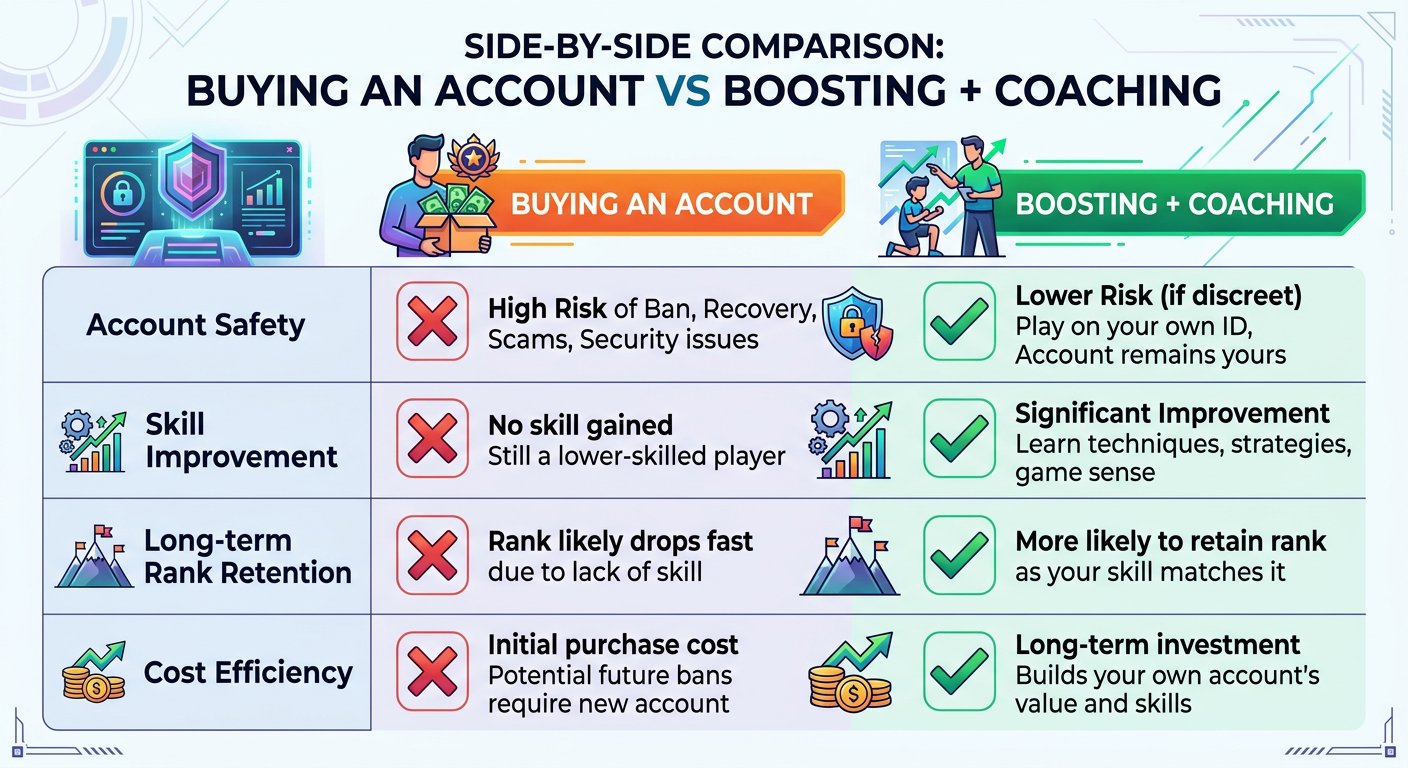
Cost Comparison
| Option | Cost | Risk | Long-Term Value | Skill Improvement |
|---|---|---|---|---|
| Buy Account (Ancient) | $100-200 | High (scam, recovery, ban) | Low (rank decays to actual skill) | None |
| MMR Boost to Ancient | $80-200 | Low (your own account) | Medium (rank may decay, but account is safe) | Minimal |
| Coaching (20 hours) | $150-400 | None | Very High (permanent skill gain) | Significant |
| Calibration Service | $30-80 | Low | Medium (optimal seasonal placement) | None directly |
| Boost + Coaching Combo | $200-400 | Low | Very High (immediate rank + lasting improvement) | Significant |
The most effective approach for most players is the boost + coaching combination. The boost provides immediate gratification and puts you in an environment where you’re challenged to improve, while coaching gives you the tools to maintain and build on the boosted rank. This combination from TeamSmurf delivers better long-term value than any purchased account.
Frequently Asked Questions
Ready to Improve Your Dota 2 Experience
Team Smurf offers professional Dota 2 services — Immortal-rank boosters, maximum safety, competitive pricing, and 24/7 support.