

Best Late-Game Scaling Heroes Dota 2 (2026)

Late-game scaling in Dota 2 is not the same as being a carry. A carry farms and fights from the 10-minute mark. A scaling hero is one whose kit, stat growth, and item payoff curve compound so steeply that each additional minute of game time increases their threat by a factor — not just by a flat increment. Some of them are position 1 carries. Others are position 2 mids, position 3 offlaners, or even position 4 tempo supports whose abilities become game-deciding past 30 minutes.
This guide covers the best late-game scaling heroes in Dota 2 for patch 7.41f, ranked by their actual scaling ceiling — the degree to which they transform from “strong hero” to “win condition” after the 30-minute mark. If you want a pure carry tier list, check the best carry heroes post — this list covers all roles.
Contents
What “Scaling” Actually Means in Dota 2
Every hero gets stronger with levels and items. Scaling is specifically about the rate of return on time investment. A hero with strong scaling has three properties working together:
- Stat growth that converts directly to fighting power (AGI giving attack speed and armor, INT giving spell damage and mana pool, STR giving HP and regen)
- Ability scaling — spells and passives whose numbers compound rather than plateau (Desolate true damage per nearby enemy, Mana Shield absorption as a percentage of a growing mana pool)
- Item investment payoff that is non-linear — each additional item slot multiplies rather than adds to their threat (Terrorblade illusions copying a six-slotted loadout, Naga illusions with Radiance and Mirror Image)
Heroes that check all three boxes are the ones below. Patch 7.41f has not dramatically changed the fundamental late-game hierarchy — the usual suspects remain dominant. What has shifted is the viability of several pos 3 and pos 4 scalers who benefit from the current item economy and reduced gold-per-minute variance.
The key question when drafting a scaler is: can your team survive long enough to reach that hero’s power window? For pos 1 scalers like Medusa and Naga, that window is 40-plus minutes. For pos 3 scalers like Wraith King and Underlord, the window opens as early as minute 28. Choose accordingly.
S-Tier: Pos 1 Carry Scalers
These heroes are not just good carries — they are draft-level threats at 40 minutes that most lineups cannot contain without specific counters built in from pick phase. Their common trait is a scaling mechanic that becomes proportionally stronger as the enemy team’s items increase.
1. Spectre
Spectre is the archetype of a late-game scaler. Her threat does not come from raw DPS in isolation — it comes from Haunt, which teleports a copy of her to every enemy hero on the map simultaneously, and Desolate, which deals true damage for each enemy hero not near an ally. Late game, when enemies are spread across the map farming or pushing, Desolate fires on every Haunt image dealing full true damage. Add Dispersion — a percentage-based damage reflection that scales with her HP pool — and you have a hero who becomes exponentially more dangerous as the game extends.
Key scaling items: Radiance (illusions burn), Manta Style (three Haunting images plus the real hero with Desolate active), Butterfly or Heart depending on matchup. In 7.41f, Spectre’s farm pace has been indirectly aided by the current meta’s tendency toward longer game states. Her 40-minute ceiling is among the highest in the game.
Peak timing: 35-45 minutes. Before 30 minutes, she is a liability unless her team buys her significant time through early aggression and tower defense.
2. Medusa
Medusa’s scaling comes almost entirely from Mana Shield. As her mana pool grows — via Linken’s Sphere, Eye of Skadi, Bloodstone, and her own base INT gain — the effective HP absorbed by Mana Shield compounds with each item slot. At 6 items with a 5,000-plus mana pool, she can survive fights that would kill any other hero outright. Split Shot combined with a full build turns every auto-attack into a multi-target DPS machine, and Mystic Snake provides lane sustain that keeps her farming without returning to base.
The critical counter to Medusa is ending the game before she is six-slotted, which is precisely why she scales — teams that fall behind against her cannot simply outfight her at minute 40 without draft-level preparation: hex chains, Orchid, burst damage that bypasses Mana Shield entirely. Her win rate above 45 minutes is among the highest in the game at all MMR brackets.
Peak timing: 40-50 minutes. Among the slowest farmers in Dota 2, but the highest ceiling of any hero on this list once items are complete.
3. Terrorblade
Demon Image creates illusions that copy Terrorblade’s full item set at 80 percent effectiveness. At 6 items, three Demon Image illusions plus the real hero effectively quadruple his DPS output in a fight. Sunder is a hard counter to physical burst — it swaps HP percentages, turning a potential kill into a suicide for the aggressor. Reflection creates a slowed illusion of the enemy that deals damage back, making him nearly unbeatable in laning against most matchups.
In 7.41f, Terrorblade’s Shard upgrade significantly improves Demon Image uptime, directly increasing his late-game illusion DPS. Key items: Manta Style (six total illusions), Dragon Lance, Skadi, Butterfly. He is arguably the fastest farmer among S-tier scalers and can reach his power window without sacrificing early-game safety.
Peak timing: 30-40 minutes. One of the fastest scalers on this list — already a win condition by minute 25 with two core items.
4. Naga Siren
Naga scales differently from other carries: her late-game value is primarily strategic rather than raw DPS. Song of the Siren is a game-resetting ultimate that nullifies any teamfight, forces Buybacks, or holds enemies while Roshan and objectives are taken. Mirror Image illusions with Radiance create a split-push threat that forces the enemy team to respond on every lane simultaneously — a logistical problem that most teams cannot solve at the 40-minute mark regardless of their hero lineup.
The scaling mechanism here is game-state manipulation: with Net and Song, Naga can control when fights happen, which is the highest-level version of “scaling” in Dota 2. Her farm efficiency with illusions also means she transitions from pos 1 to a six-slotted threat relatively quickly compared to Medusa or Spectre.
Peak timing: 35-45 minutes. Requires coordination to maximize Song utility, but her individual threat in that ultimate alone makes her viable even on lower-MMR teams.
5. Faceless Void
Chronosphere stops time for every unit caught inside it except Faceless Void and whatever ally he designates. Late game, with Mask of Madness or Mjollnir giving extreme attack speed inside Chrono, he can delete one or two heroes before the 6-second duration ends. Time Lock — his passive bash — benefits from attack speed items via PRD mechanics, meaning the more attack speed he builds, the more reliably Time Lock procs per second.
In 7.41f, the current meta’s prevalence of AOE initiation heroes (Enigma, Magnus, Tide) has slightly reduced Faceless Void’s blind-pick strength since those heroes tend to initiate before he can Chrono. He remains S-tier in drafts where he can pick after the opposing cores are revealed, using Chrono as a counter-initiation tool.
Peak timing: 30-38 minutes. Slightly earlier peak than other S-tier carries but a very high floor even from minute 25 with basic attack speed items.
A-Tier: Pos 2 Mid Scalers Who Win Late
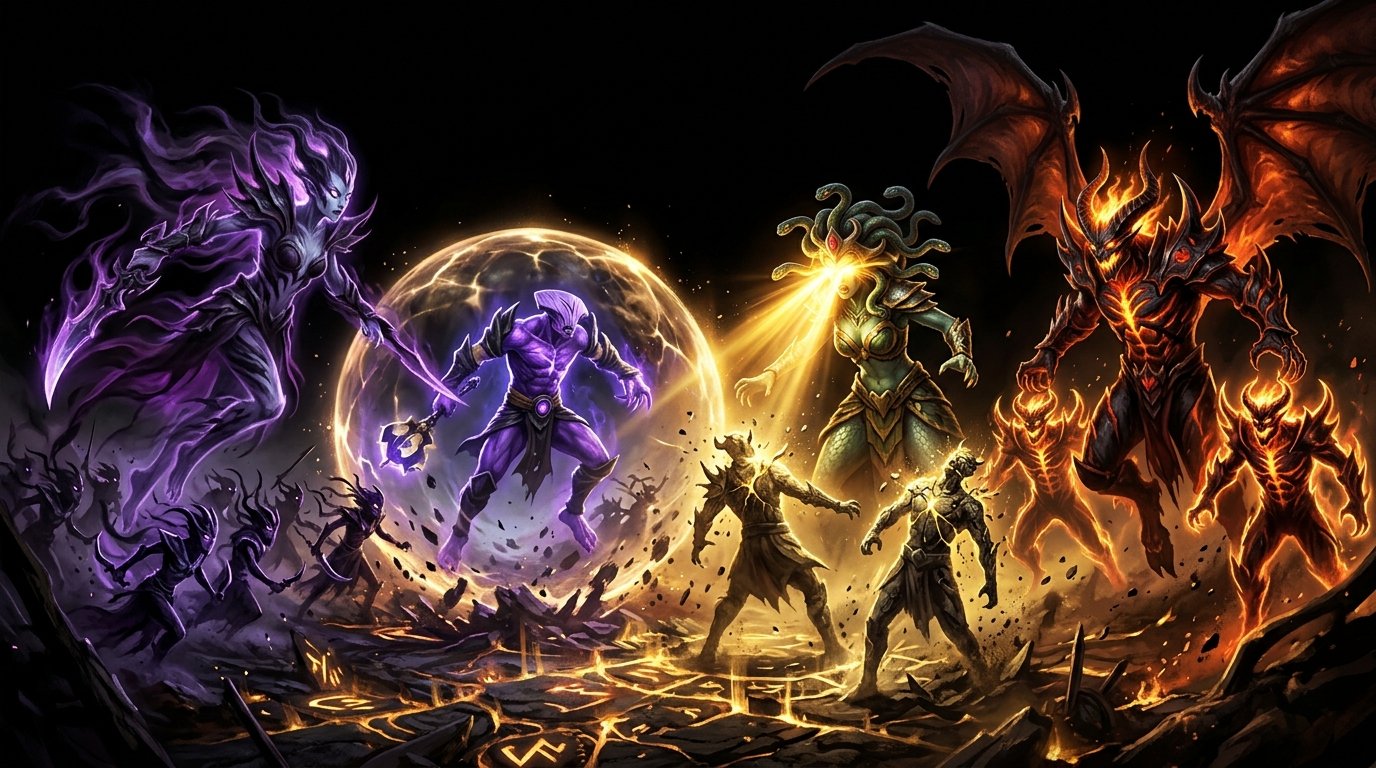
Position 2 heroes are typically expected to spike early and generate advantages through tempo. These three are exceptions — their kit and stat scaling mean they become harder to deal with at minute 35 than at minute 20, making them dangerous late-game investments from the mid lane.
6. Outworld Destroyer
Sanity’s Eclipse deals damage based on the difference between OD’s Intelligence and the target’s Intelligence. In the late game, after maxing INT stat items like Scythe of Vyse, Aether Lens, and Witch Blade, OD’s INT total can exceed even most INT heroes’ pools, meaning Eclipse becomes a near one-shot on the majority of heroes. Arcane Orb deals bonus damage equal to a percentage of his current mana pool — another pure-INT scaling mechanic where every additional INT item multiplies his damage output.
The key item for late-game OD is Scythe of Vyse, which provides massive INT that buffs both Arcane Orb and Eclipse while giving reliable hex control. Bloodstone extends the mana pool that powers both abilities. At minute 35 with four INT items, OD can solo most heroes in the game through a single ability combo.
Peak timing: 28-40 minutes. Relatively early spike for a scaler — with level advantage and three items, OD is already a threat in most matchups.
7. Storm Spirit
Storm scales through Ball Lightning cost reduction and Overload damage, both of which are INT-scaling mechanics. Each level of Ball Lightning reduces its mana cost per 100 units of travel, and Overload’s bonus damage on the next attack after casting a spell scales with his base attack damage — which scales with his INT. The result: a fully itemized Storm with Bloodstone, Linken’s Sphere, and Orchid or Kaya and Sange moves at near-infinite speed across the map, dealing massive burst into reliable follow-up auto-attacks.
The late-game strength of Storm is not just damage — it is his ability to cancel Buybacks, pursue fleeing heroes across the entire map, and win the game through macro pressure. A Storm Spirit with Bloodstone and Power Treads at level 18 essentially cannot run out of mana during a teamfight, and his mobility makes him impossible to escape from once he has a mana lead.
Peak timing: 30-40 minutes. Earlier peaks at level 18 with just Bloodstone and Power Treads in aggressive stomps.
8. Invoker
Invoker’s scaling is unique: each point of QUAS, WEX, or EXORT increases his stat pool (the game treats each orb level as attribute points), and his entire spell kit operates at those attribute values. Exort stacking gives raw attack damage; Quas gives HP regen and Forge Spirits stats; Wex gives attack speed and movement speed. As a Universal hero in the current system, Invoker benefits from stat investments in ways most mid heroes do not — all three attribute types contribute to his attack damage.
At 30-plus minutes with ten-plus levels across his orbs, Invoker’s Sunstrike, EMP, and Chaos Meteor deal substantially more damage than they did at level 10. He is one of the few heroes in the game whose spell damage at minute 40 is genuinely threatening without dedicated damage items, purely from stat compounding.
Peak timing: 35-45 minutes. The slowest scaling mid on this list, but among the highest late-game ceilings for a pos 2 in the right hands.
B-Tier: Pos 3 and Pos 4 Scalers That Define the 40-Minute Mark
This is the section that most “best late-game hero” guides miss entirely. Position 3 and 4 heroes are not supposed to scale — but these do, because their core mechanics become exponentially more powerful when enemies are six-slotted and the game state rewards large teamfights over individual skirmishes.
9. Wraith King (Pos 3)
Reincarnation gives Wraith King an additional life. Late game, this alone makes him nearly impossible to kill in isolation — the enemy team must expend twice the DPS to eliminate him from a fight, then deal with the slow aura on his reincarnation. Mortal Strike is a reliable critical strike at a high proc rate, which combined with high attack speed items becomes reliable late-game physical DPS. In 7.41f, Wraith King is one of the best pos 3 picks in the current meta because he scales into a late-game threat while providing early-game tanking and lane pressure that many pure-scaling heroes cannot.
Peak timing: 28-35 minutes. His scaling curve flattens after the 40-minute mark since he has no burst or escape mechanism, but Reincarnation keeps him threatening through sheer durability throughout extended fights.
10. Dark Seer (Pos 3)
Wall of Replica creates illusions of every enemy hero that runs through it — and those illusions copy the enemy’s full item set at high effectiveness. Late game, a Dark Seer’s Wall at minute 40 creates perfect copies of six-slotted carries and mids that fight for your team. A single Wall landing in a teamfight can create four or five enemy illusions that collectively have more DPS than any individual hero on the field. Combined with Vacuum — which pulls enemies into a single point — Wall of Replica becomes a fight-winning combo that scales directly with how strong your enemies are.
Peak timing: 35-45 minutes. Dark Seer’s early game is weak and requires support from the team. But he is one of the most punishing heroes in the game at minute 40 if he reaches that timing safely with positioning to land a clean Wall.
11. Enigma (Pos 3/4)
Black Hole is arguably the most game-defining ultimate in Dota 2 at the 35-minute mark. When five heroes are locked in a 4-second Black Hole — combined with Midnight Pulse, which deals a percentage of maximum HP per tick — the damage scales directly with the enemy’s HP pool. A 4,000 HP carry takes more Midnight Pulse damage than a 2,000 HP support. Late game when everyone has high HP pools and expensive buybacks, the percentage-based nature of Midnight Pulse becomes a true equalizer. Enigma’s Eidolons and Malefice provide jungle sustain and additional control to reach the late game comfortably from either a pos 3 or pos 4 role.
Peak timing: 30-40 minutes. Black Hole is always a game-deciding cooldown, but its impact peaks when enemy HP pools and buyback values justify the full Midnight Pulse duration.
12. Underlord (Pos 3)
Atrophy Aura permanently removes base damage from nearby enemies who die while the aura is active, giving that stolen damage to Underlord. In the late game — after winning early fights and defending against pushes — Underlord can accumulate 80-120 stolen base damage from creep and hero kills, which combined with his STR stat gain makes him a legitimate tanky physical threat. Firestorm provides wave-clearing at all stages of the game, and his ultimate Dark Rift enables global teleportation for his entire team — enabling cross-map plays that few pos 3 heroes can match.
Peak timing: 30-40 minutes. The Atrophy stacking means that Underlord in a 40-minute game has genuinely higher damage than he did at minute 20, unlike most supports whose relative threat decreases as carries scale past them.
13. Necrophos (Pos 2/3)
Ghost Shroud — especially with Aghanim’s Scepter — applies a massive healing amplification debuff while making Necrophos ethereal and unable to be targeted by physical damage. Late game against teams with strong physical damage cores, Ghost Shroud makes him nearly unkillable while his Death Pulse heals him for increasingly large amounts due to spell amp stacking. Reaper’s Scythe is an execute that scales with the enemy’s missing HP — against a 5,000 HP late-game carry below 40 percent, Scythe deals 3,000 damage, making it one of the few pos 3 abilities that scales proportionally with enemy items.
Peak timing: 30-38 minutes. Strongest window is the mid-to-late game before enemies have Linken’s Spheres and BKBs active simultaneously across all their cores.
14. Pugna (Pos 3/4)
Nether Ward punishes enemy spell casting by dealing damage equal to three times the mana spent — which at late game, when enemies are casting high-cost ultimates and full spell rotations, becomes terrifying. A single Nether Ward in a late-game teamfight can deal 2,000-4,000 damage if enemies cast their full combos without noticing it. Life Drain with Aghanim’s Scepter casts automatically on a nearby ally, functioning as persistent healing in sustained fights. Pugna’s INT gain is exceptional — making him both a high-burst hero and a passive area-denial tool whose value scales directly with how many spells enemies decide to cast.
Peak timing: 28-40 minutes. One of the few pos 4 heroes who becomes genuinely more threatening, not just differently useful, as the game extends past 30 minutes.
Full Late-Game Scaler Tier List (Patch 7.41f)
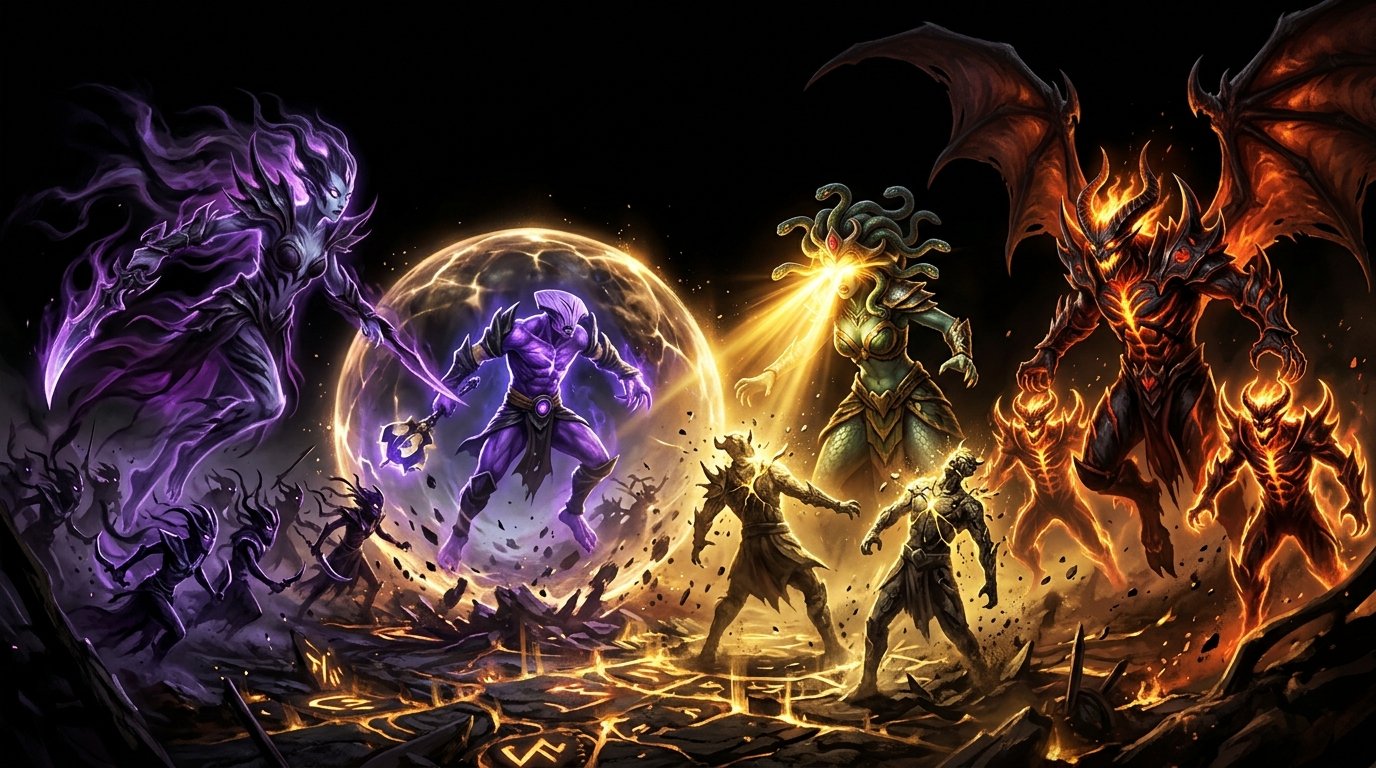
All heroes covered, ranked by late-game scaling ceiling with role and core scaling mechanic:
| Hero | Tier | Role | Core Scaling Mechanic | Peak Timing |
|---|---|---|---|---|
| Spectre | S | Pos 1 | Desolate true damage + Dispersion HP reflection | 35-45 min |
| Medusa | S | Pos 1 | Mana Shield absorbs % of mana pool size | 40-50 min |
| Terrorblade | S | Pos 1 | Demon Image copies 6-slot loadout at 80% | 30-40 min |
| Naga Siren | S | Pos 1 | Song of the Siren resets game state; illusion split push | 35-45 min |
| Faceless Void | S | Pos 1 | Chrono + Time Lock procs at high attack speed | 30-38 min |
| Outworld Destroyer | A | Pos 2 | Sanity Eclipse scales with INT differential | 28-40 min |
| Storm Spirit | A | Pos 2 | Ball Lightning cost drops; Overload scales with INT damage | 30-40 min |
| Invoker | A | Pos 2 | 14-spell kit; all stats compound with orb investment | 35-45 min |
| Wraith King | B | Pos 3 | Reincarnation doubles kill effort required from enemies | 28-35 min |
| Dark Seer | B | Pos 3 | Wall of Replica clones enemy 6-slot builds against them | 35-45 min |
| Enigma | B | Pos 3/4 | Midnight Pulse % HP damage scales with enemy pool size | 30-40 min |
| Underlord | B | Pos 3 | Atrophy permanently steals base damage from nearby kills | 30-40 min |
| Necrophos | B | Pos 2/3 | Ghost Shroud heal amp + Scythe execute scales with HP | 30-38 min |
| Pugna | B | Pos 3/4 | Nether Ward punishes late-game high-cost spell casts | 28-40 min |
Item Investment and Payoff Curves
Understanding why certain items push these heroes from “strong” to “game-defining” at the late-game mark helps you prioritize your farm progression correctly and recognize when your scaling window has opened.
Radiance: The Illusion Multiplier
For Spectre, Naga Siren, and Terrorblade, Radiance’s aura DPS is multiplied by the number of illusions active. A 60 DPS Radiance becomes 240 effective DPS when four units are in range burning simultaneously. No other item has this kind of compounding return for illusion-based heroes. In late-game teamfights when all 10 heroes are frequently in a tight area, the stacked Radiance aura from multiple illusions becomes a passive win condition — enemies take burn damage simply by existing in the fight area.
Eye of Skadi: The Universal Late-Game Item
Eye of Skadi is statistically one of the best late-game items for heroes that benefit from both stat types. The 25 percent movement and attack speed slow is particularly brutal against fast, mobile carries. For Medusa and Naga, the massive stat contribution compounds their existing scaling mechanics. For Spectre, the Skadi slow stacks with Haunt illusions to keep enemies immobile during the Desolate window. Among scaling carries, it is the item most likely to be present at the 40-minute mark regardless of the specific hero being played.
Bloodstone and INT Stacking
For Storm Spirit, OD, Pugna, and Necrophos, Bloodstone is the item that enables their late-game scaling by extending the mana pool that powers their key mechanics. A Storm Spirit with Bloodstone essentially cannot run out of mana during a teamfight, and the revival passive gives him a soft Reincarnation in extended fights. Each Bloodstone charge adds mana and speeds up charge regeneration — compounding value over a game that goes long.
Aghanim’s Scepter and Blessing Upgrades
Several heroes on this list have Aghanim upgrades that dramatically shift their late-game threat profile. Enigma’s Aghanim makes Black Hole dispel most buffs from trapped heroes. Necrophos’s Scepter adds Ghost Shroud’s healing amplification to Reaper’s Scythe. Naga’s Scepter adds a Song-on-attack component during Haunt. These upgrades represent the “ceiling unlock” that transforms these heroes from powerful to unstoppable — and they are consistently the highest-priority purchases in games that reach the 35-minute mark.
Using These Heroes in Ranked: Practical Advice
Choosing a late-game scaler in ranked games requires honest assessment of your team’s ability to reach the late game. Before picking Medusa or Naga Siren, answer these questions:
- Does my team have early-game heroes who can defend towers for 35-plus minutes?
- Is there a front-line tanker (Axe, Tidehunter, Centaur) to buy time for the scaling core?
- Does the enemy draft have sufficient early-game pressure to prevent the 40-minute timing?
If the answer to any of these is no, consider picking a mid-range scaler like Faceless Void or Terrorblade — heroes with a 28-35 minute peak that can still win games before the enemy snowball reaches critical mass. The difference between winning with Spectre and losing with Spectre in most ranked brackets is almost entirely the quality of early-game heroes drafted around her.
At lower MMR brackets (below 4K), games rarely go past 35 minutes unless both teams are passive. The “best late-game hero” is often irrelevant if your team loses two barracks before minute 30. For players trying to climb through brackets where late-game scalers consistently get denied their timing, the best Dota 2 boosting services listed on TeamSmurf are vetted specifically for safety and quality — and professional play on scaling heroes is the fastest way to understand what those heroes need from their teams to perform.
Late-Game Scaling Heroes vs. Best Carry Heroes — What Is the Difference?
The best carry heroes list focuses on position 1 heroes that farm efficiently and transition well from early to mid game. The distinction with this list is two-fold:
- Role coverage: This list includes pos 2, 3, and 4 heroes whose primary scaling mechanism is not farming efficiency. Enigma does not farm like a carry, but his teamfight ceiling at minute 35 is higher than most carries on the field. Dark Seer at minute 40 with a well-placed Wall creates more illusion DPS than most pos 1 heroes. These heroes are absent from carry tier lists but belong on any honest late-game scaling list.
- Scaling ceiling vs. consistent power: A carry like Phantom Assassin peaks at 25-30 minutes and remains strong but relatively flat thereafter. Spectre, Medusa, and Naga Siren get disproportionately stronger the longer the game goes. Their win rate increases meaningfully between the 30-minute and 45-minute marks — that is the statistical definition of a scaling hero, and it is what distinguishes this list from a standard carry tier list.
If you are picking specifically to go late and win the 40-plus minute game, this list is your reference. If you want efficient farming carries who win games across all time windows, the carry list is more appropriate for your draft needs.
Frequently Asked Questions
Want to Reach the Late Game More Consistently?
The heroes on this list only perform at their ceiling when you actually survive to the 35-plus minute mark. TeamSmurf offers expert coaching and MMR boosting to help you climb faster, fix early-game mistakes, and play the heroes you want in the bracket they belong in.
View Dota 2 Boosting Services Book a Coaching Session


