


Best First-Pick Heroes for Carry and Offlane: Safe Blind Picks That Can’t Be Countered

First-picking in ranked draft is a high-stakes decision. You reveal your role and general playstyle before the enemy has committed to anything, which means a bad first pick hands the opponent a free counter pick. A good first pick is one the enemy cannot exploit — a hero with no single hard counter, a flexible item build, and a win condition that does not depend on the enemy lineup being weak in one specific way.
This guide covers the safest first-pick options for the two positions where first-picking matters most: carry (pos 1) and offlane (pos 3). If you are looking for safe mid-lane blind picks, that list lives at our mid-lane blind pick tier list. Safe support picks are covered at our best blind support picks for random draft guide. For a broader look at how the whole draft works, read our Dota 2 drafting guide.
What You Will Find Here
What Makes a Hero Safe to First-Pick?
Not every strong hero is a safe first pick. A hero can be an S-tier pub stomp machine in the right game and a wasted slot if the enemy builds around it. True first-pick safety requires all three of the following properties at once:
- No single hard counter exists. If one hero pick completely shuts down your hero — either in lane or in team fights — the enemy will just pick that hero. Axe does not fear any single carry in lane. Juggernaut’s Blade Fury gives him a built-in counter to many disables. Neither has a “press F to counter” enemy pick.
- Flexible item build. A hero whose win condition depends on one specific item is readable. If the enemy sees Phantom Assassin, they know BKB and crits are coming. What they cannot prepare for is that PA’s build can shift into Satanic, Abyssal Blade, or even a more utility-oriented setup depending on what the game needs. Flexibility means the draft answer the opponent picks might not actually solve the problem.
- Useful in any lane state. A hero who needs to be dominant in lane to function is risky to first-pick because the enemy will simply put two dangerous laners against them. Safe first-picks either have strong laning tools on their own, or they recover from a rough lane well enough that the deficit does not matter — because their team fight or late-game utility is unconditional.
A fourth factor is patch stability. Some heroes sit at the center of the meta patch after patch because their core toolkit is simple and Valve rarely nerfs them into the ground. These are the true cornerstones of a safe first-pick pool. If you are climbing ranked and want to reduce variance on every draft, the heroes below are where to start.
Improving your MMR is not just about picking the right heroes — it is also about consistently executing under pressure. If you want personalized guidance on hero pool building and draft decisions, Dota 2 coaching from a high-MMR player is the fastest way to identify and fix the specific gaps in your game.
Carry (Pos 1) — The 7 Safest First Picks
Pos 1 first-picks need to do two things simultaneously: survive in a safe lane against whatever dual or trilane the enemy throws, and provide a late-game win condition that does not disappear when the enemy drafts around it. Every hero on this list does both.
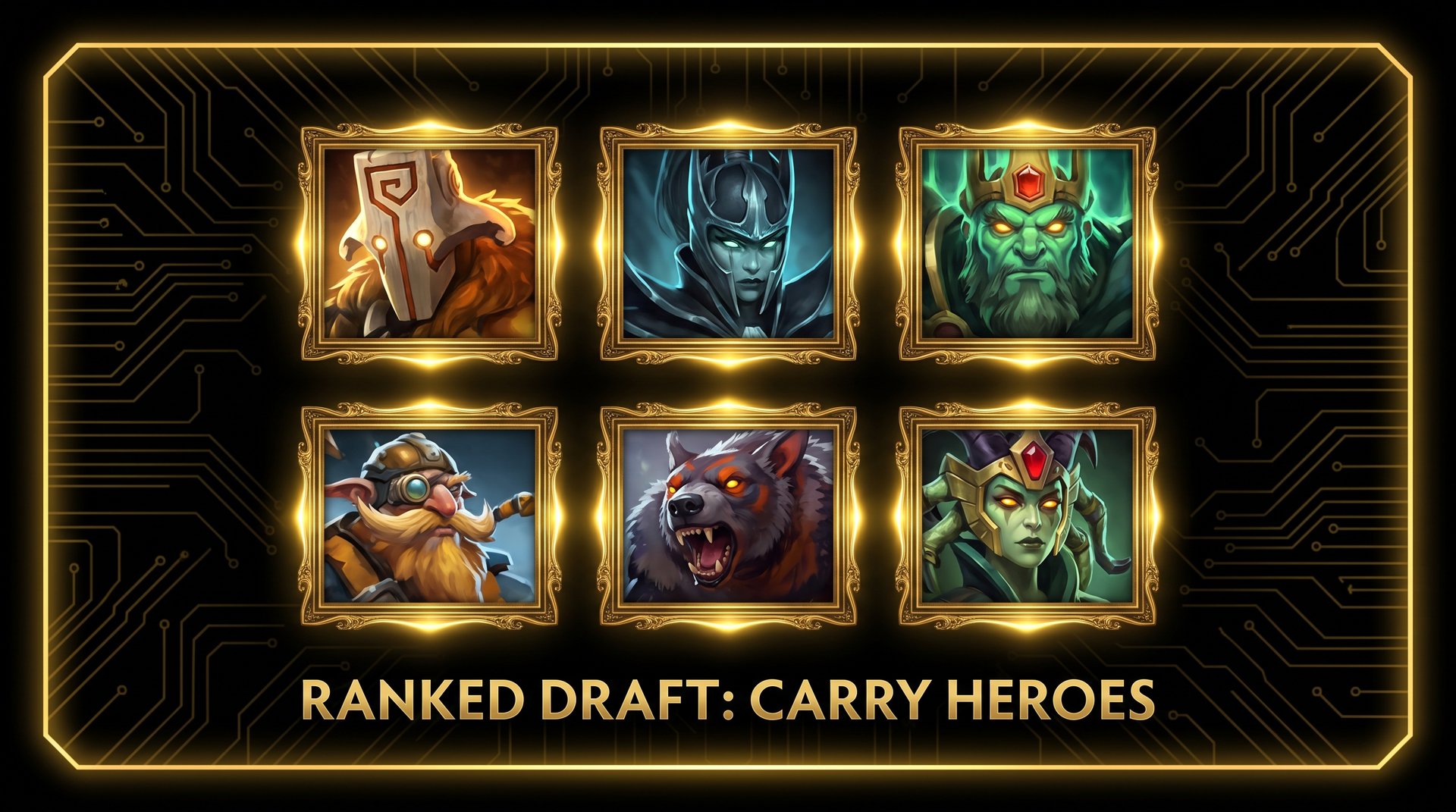
1. Juggernaut
Juggernaut is the most picked carry in pubs at almost every MMR bracket, and that is not a coincidence. Blade Fury gives him spell immunity for four seconds during the laning stage — the exact window when enemy supports want to throw their nukes and disables. This means the most common way to bully a carry out of lane (chain stuns plus damage nukes) simply does not work against Juggernaut when he plays around Blade Fury’s cooldown.
His item build is genuinely flexible. Phase Boots into Battlefury is the farming path. Phase Boots into Maelstrom into Butterfly is the fighting path. Phase into BKB into Assault Cuirass is the late-game durability path. The opponent cannot prepare for all three. Omnislash provides both an initiation tool and an escape in a single ability, making him hard to zone out in team fights even without BKB.
Juggernaut’s only genuine weakness is that he can be kited by heroes with strong repositioning or very long range. But “can be kited” is not the same as “has a hard counter” — it means you build Diffusal Blade or Phase Boots to reduce the kiting window. There is no single hero pick that simply negates Juggernaut’s presence in the game. At any MMR from Crusader to Immortal, Juggernaut is a legitimate and reliable first-pick carry.
2. Phantom Assassin
PA has one of the highest theoretical damage ceilings of any carry in the game. A Coup de Grace proc into a full combo can delete most heroes in two or three hits by the 30-minute mark. But what makes her a safe first pick specifically is that the enemy cannot simply draft “anti-crit.” There is no single hero ability that removes her threat — enemies must commit multiple items (BKB, Crimson Guard, or AC aura) to reduce her burst, and none of those fully counter her.
Stifling Dagger lets her harass from safe distance in the laning stage and applies Coup de Grace, meaning she puts pressure on supports even when playing from far away. Her laning phase is not dominant, but it is survivable. She recovers efficiently with Battle Fury and then becomes a threat the moment she has three items.
Blink Dagger is the natural addition when the enemy has crowd control — she becomes much harder to lock down once she can close distance instantly. Satanic turns her into a self-sustaining assassin who can fight through enemy heals. Abyssal Blade adds a disable for heroes that try to kite her. The build path adapts to the game state rather than demanding a specific lineup to function, which is the core requirement for a first-pick carry.
3. Wraith King
No carry in Dota 2 punishes overconfident enemies more reliably than Wraith King. Reincarnation — his passive death and revive — means the enemy team needs two separate kill windows to actually remove him from a fight. They burn cooldowns on the first kill, then face a re-spawned Wraith King with a full team still alive. This creates a natural disincentive to all-in into the fight, which is powerful in any draft.
His laning is among the sturdiest of any carry. Wraithfire Blast is a slow plus stun on a short cooldown. Vampiric Aura gives him sustain against harassment without spending salve charges. He farms safely, he does not die to accidental fights, and his Skeletons army (with Aghanim Scepter) gives him a farming tool, a pushing tool, and a teamfight presence that scales regardless of the enemy lineup.
Wraith King is the most beginner-friendly carry on this list but remains effective through Divine because his core toolkit is unconditional. The reason experienced players still first-pick him: Reincarnation does not care what heroes the enemy picked, and Mortal Strike crits work against any hero regardless of armor or damage type. His first-pick safety score is among the highest of any carry in the game.
4. Gyrocopter
Gyrocopter is one of the few carries whose damage output works against both tanky, high-armor lineups and fast, squishy lineups simultaneously. Flak Cannon auto-attacks hit all nearby units during its duration — against a spread-out team that stacks armor, you hit six targets at once. Against a low-hp team that tries to cluster, the same ability wipes them out before they reach your team. The ability is not situationally strong — it is strong against every formation.
Rocket Barrage provides strong early damage during the laning phase that makes Gyrocopter more aggressive than his range suggests. Call Down is a slow plus damage nuke that works in any teamfight positioning — narrow choke or open field, it does not matter. The full item build has multiple valid paths: Diffusal Blade into Daedalus for glass-cannon burst, Drum of Endurance into Aghanim Scepter for sustained teamfight utility, or Eye of Skadi into Butterfly for late-game durability.
Gyrocopter’s weakness is that he is relatively immobile, which means he can be targeted by high-burst assassin heroes. The counter is Eul’s Scepter (a common mid-game buy) or Kaya and Sange for mixed survivability. These are individual item choices, not full draft changes — so the enemy first-pick response to Gyrocopter is limited. Picking Gyrocopter first tells the enemy very little about your item plan for the game.
5. Ursa
Ursa’s entire design concept is that he beats individual heroes in a fight faster than almost any other carry, at any point in the game. Fury Swipes stacks on successive hits mean he can kill most heroes at level 6 without needing significant item support. Roshan at 10 minutes with a Soul Ring is not unusual. This gives him a timing-based win condition that no draft can fully neutralize — the enemy can try to contest Roshan, but they risk a fight against an Ursa who scales extremely well at that stage.
His laning phase is deceptively comfortable. Earthshock provides a slow to prevent enemy supports from trading freely. Overpower active lets him burst down any hero the moment they over-extend. He does not need a supportive dual lane — he can function in almost any lane state because his kill threat is so high that enemies play conservatively rather than trading into him.
Ursa requires BKB to function in team fights against disables, and buying Linken’s Sphere or Blink Dagger can be situational. The point is that these are self-contained item decisions Ursa makes — no single enemy hero removes his threat. If you want to understand how high-MMR players protect carries like Ursa through the early game phase, our Dota 2 boosting services page has context on how high-bracket games are approached differently from pub games.
6. Morphling
Morphling is the only carry on this list who can directly respond to counter-picks after the draft ends, because Replicate lets him copy the ability toolkit of an enemy hero during the game. If the opponent drafts a Rubick to steal Morphling’s Adaptive Strike or Waveform, Morphling can Replicate a different enemy hero entirely and change his effective hero identity mid-fight. This makes him uniquely resistant to counter-picking as a concept.
Attribute Shift is the mechanical tool that makes Morphling’s laning durable: shifting stats into Strength when taking heavy damage extends his effective HP pool in real time. Shifting back to Agility increases his attack speed and damage when fighting. This toggleable stat distribution means Morphling plays differently against every lineup without needing different items or a different strategy each game.
The standard build (Ethereal Blade plus Daedalus or Manta Style plus Eye of Skadi) works against tanky enemies and glass-cannon enemies alike. Waveform provides an escape from ganks without requiring Blink Dagger. If your draft decision-making feels like a weak point, working with a Dota 2 coach to identify which flex carries to add to your pool pays off significantly at every bracket.
7. Medusa
Medusa is the most extreme late-game carry on this list. She is not the safest laning carry and she is not the fastest farmer, but she earns her place as a safe first pick because her team fight contribution is unconditional. Stone Gaze — her ultimate — does not care if the enemy picked magic heroes, physical heroes, tanky heroes, or squishy heroes. It petrifies any hero that faces her direction for a meaningful duration. There is no draft configuration that removes that threat.
Mana Shield gives her an effective HP pool that is twice what her stat panel suggests, because a significant portion of incoming damage is absorbed by mana rather than health. This means the enemy cannot simply pick high-burst heroes to kill her in one combo — she is a mandatory focus-fire target who does not go down quickly. By the time she has Manta Style and Eye of Skadi, she is functionally unkillable without a full five-hero coordination that most pub teams cannot execute.
Her weakness is that she is slow to come online and relatively weak in the early game. This is a strategic weakness the team manages, not a draft weakness the enemy exploits. Read our MMR boosting guide for more on how high-bracket players protect slow carries in the early game, or consider whether Dota 2 boosting is right for your situation if ranking up consistently has become a challenge.
Offlane (Pos 3) — The 7 Safest First Picks
The pos 3 role is the most draft-dependent in the game. An offlaner’s job is to absorb pressure, create space, and provide initiation or follow-up in team fights — and the best first-picks do all three without needing the rest of the draft to be built around them. The heroes below have win conditions that work against any carry or support the enemy might pick.
1. Tidehunter
Ravage is the most reliable team fight ultimate in Dota 2. It hits every enemy hero in a large radius, dealing damage and stunning for a flat duration. There is no lineup that makes Ravage bad. The enemy picks fast heroes? Ravage hits them before they can reposition. They pick tanky initiators? Ravage gives your team free cast time against them. They pick split-push specialists? Ravage ends the team fight before it starts when you force one. The ability is unconditionally powerful regardless of enemy draft, and that is exactly what you want from a first pick.
Kraken Shell absorbs a flat amount of damage from every hit and removes debuffs at a threshold, which means Tidehunter is naturally resistant to physical burst, disables, and many slow effects. This passive tanking does not require specific item responses — it just works, against any hero the opponent picked.
In the lane, Anchor Smash reduces the enemy carry’s damage by 65% for five seconds on a short cooldown, making Tidehunter one of the most punishing lane presence heroes for any pos 1. He does not need a favored matchup to survive. Blink Dagger is his core item and it works in any game state — when you have Blink plus Ravage, the fight is decided in the first two seconds regardless of what the enemy drafted. Tidehunter is as safe a first pick as exists in Dota 2.
2. Mars
Mars brings reliable kill threat in lane plus an ultimate that is effective against every teamfight formation the enemy could run. Arena of Blood traps enemies in a circle for five seconds — any enemy hero caught inside takes knockback damage from spear throws, and enemy ranged heroes cannot attack through the walls. This creates an entirely contained fight zone that works against any hero, any item build, any positioning preference the enemy carries to the game.
Bulwark passively reduces damage from the front and sides, which means Mars is inherently difficult to burst in fights regardless of what the enemy carries. He does not need Shiva’s Guard or Blade Mail to be tanky early — his passive does real work from level one. This reduces the item pressure on his pos 3 timeline and lets him buy utility items (Blink Dagger, Veil of Discord) that benefit his whole team.
God’s Rebuke provides a strong auto-attack with a critical strike effect that clears waves and provides laning damage without a specific skill interaction. Spear of Mars gives him a targeted disable that works on any hero he wants to remove from a fight by pinning them to terrain. Mars is one of the few offlaners who remains relevant whether the game goes to 20 minutes or 60 minutes, because his toolkit does not get outscaled by specific late-game items the way some initiator offlaners do.
3. Dragon Knight
Dragon Knight’s appeal as a first-pick is simple: he has no hard counters at any point in the game. Dragon Blood passive gives him high HP regen and armor, making him tough to harass out of lane against any dual-lane composition. He does not die to a support duo throwing nukes at him — he tanks it and keeps trading. This passive durability means the enemy cannot bully him out of lane regardless of the supports they pick around their carry.
Elder Dragon Form transforms DK’s basic attacks depending on level: Frost Breath applies a slow on all enemies at ultimate level one, Corrosive Breath reduces armor at level two, and Splash damage hits multiple units at level three. All three of these effects are useful regardless of whether the enemy lineup is tanky or fragile, melee or ranged, physical or magic. Elder Dragon Form’s utility is truly unconditional.
DK’s item build is flexible. Blink Dagger into BKB is the reliable teamfight path. Aghanim’s Scepter into Refresher Orb is a second-team-fight path that can win games by itself. Armlet of Mordiggian gives him an HP-switching tool that makes him even tankier in the laning phase. None of these require a specific enemy lineup to be effective — Dragon Knight is one of the safest first picks in the entire game across all role positions.
4. Axe
Axe is defined by Berserker’s Call, which forces all nearby enemies to attack Axe for 3.2 seconds and grants him bonus armor during that window. This ability works regardless of what the enemy picked — it does not matter if they chose high-burst physical damage or magic nukers, because the armor bonus reduces physical damage and Counter Helix triggers on any attack that hits him. The only setup Axe needs to be dangerous is for the enemy to be close to him, which happens inevitably in a team fight.
Culling Blade is one of the strongest execution abilities in the game, and it permanently resets if it kills a target. Against any hero below the HP threshold, Culling Blade is an instant kill with a speed boost for the team. There is no item or ability the enemy can build that reduces the Culling Blade threat — they have to simply avoid being at low health near Axe, which is not always possible in a chaotic fight.
His laning phase is aggressive and self-punishing for any carry that tries to bully him. Counter Helix procs on being attacked, which means Axe actively rewards the enemy for trying to zone him out of lane. He does not need a carry matchup that is favorable — he wants any matchup where the enemy attacks into him. Blink Dagger is the mandatory purchase that turns him into a genuine team fight initiator regardless of the enemy lineup composition.
5. Dark Seer
Dark Seer is the utility offlaner who makes the rest of the draft stronger without needing a specific lineup to function. Ion Shell is one of the best farming and harassment tools in the game — placing it on an ally or himself creates sustained damage that does not interact with the enemy’s hero choices at all. Any hero that stands near an Ion Shell target takes significant damage per second, making Dark Seer excellent in any lane state.
Vacuum plus Wall of Replica is one of the most devastating team fight combinations in Dota 2. Vacuum pulls all nearby enemies into a point, breaking their positioning, and Wall of Replica places illusions of any enemy hero it hits. The damage output of these illusions scales with whatever heroes the enemy has — meaning Dark Seer’s ultimate literally gets stronger the stronger the enemy carries are. First-picking him punishes an enemy team that drafts high-stat late-game carries.
Dark Seer’s Surge ability provides a useful speed boost to any allied hero, which means he provides value regardless of how the rest of the draft develops. If your team ends up with slow melee heroes, Surge solves the positioning problem. This adaptability makes him particularly safe to pick before you know what your team is building. He is one of the most draft-flexible offlaners in the game.
6. Doom
Doom’s defining feature as a first-pick is that his ultimate ability works on any hero in the game without exception. Doom silences and deals damage over time — and no BKB or spell immunity in the game makes a hero immune to being Doomed. The Doom debuff is non-removable and bypasses BKB, meaning the enemy cannot draft around it at all. No matter what they pick, Doom will have a kill target that is silenced and taking damage every fight.
Devour lets Doom consume neutral creeps and gain their abilities, which means his toolkit during the laning phase changes based on what neutrals are available in his jungle. Scorched Earth provides self-healing during farming and fights. These abilities make him relatively self-sufficient — he does not need a favorable lane matchup to reach his timing spikes, because his jungling tool gives him income independence from the lane.
Doom’s biggest first-pick advantage is that he forces the enemy team to play around who gets Doomed each fight. That is a mental and positional tax on the enemy that exists entirely because of the draft choice, not the game execution. If you want to understand how high-MMR players exploit drafting advantages like this on a fight-by-fight basis, our MMR boosting guide has a full section on converting draft leads into game wins.
7. Centaur Warrunner
Centaur brings two things that no enemy draft can prepare for: Return passive and Stampede. Return deals pure damage back to any hero that physically attacks Centaur — including heroes who are supposed to be the enemy’s answer to him. If the enemy picks a high-attack-speed physical carry specifically to focus him, that carry takes hundreds of damage per second just from hitting Centaur. It is self-punishing to attack into him without items that prevent Return damage, which most carries do not prioritize buying.
Stampede is a global initiation that gives every allied hero — including your carry — bonus movement speed and the ability to trample and stun any enemy they run over. The enemy cannot position to avoid Stampede because it is global. The only counter is not being near any allied hero during the stomp, which is not practical in a team fight. This unconditional global initiation is what makes Centaur one of the safest first picks in the offlane position.
Hoof Stomp is a standard point-target stun, and Double Edge deals pure damage at the cost of Centaur’s own health. He does not need items to be threatening — he threatens every team fight from the moment Stampede comes off cooldown. For players who want to force rank gains while building their offlane hero pool, pairing a Dota 2 MMR boost with a solid offlane pool built around safe first-picks is an effective combination.
Quick Reference Table
| Hero | Role | First-Pick Safety | Lane Safety | Patch Stability | Key Reason |
|---|---|---|---|---|---|
| Juggernaut | Carry | Very High | High | Very High | Blade Fury spell immunity in lane |
| Phantom Assassin | Carry | High | Medium | Very High | No single hero negates burst threat |
| Wraith King | Carry | Very High | Very High | High | Reincarnation requires two kill windows |
| Gyrocopter | Carry | High | Medium | High | Flak Cannon damage is formation-agnostic |
| Ursa | Carry | High | High | High | Roshan timing forces reaction from any lineup |
| Morphling | Carry | Very High | Medium | High | Replicate adapts toolkit mid-game |
| Medusa | Carry | Very High | Low-Medium | Very High | Stone Gaze works vs any enemy composition |
| Tidehunter | Offlane | Very High | High | Very High | Ravage is unconditionally team fight-winning |
| Mars | Offlane | Very High | High | High | Arena of Blood traps work against any positioning |
| Dragon Knight | Offlane | Very High | Very High | Very High | No hard counter at any game stage |
| Axe | Offlane | High | High | Very High | Counter Helix punishes any physical attacker |
| Dark Seer | Offlane | High | High | High | Vacuum+Wall combo scales with enemy stat heroes |
| Doom | Offlane | Very High | Medium | High | Doom ability bypasses BKB — no draft answer |
| Centaur Warrunner | Offlane | Very High | High | High | Stampede global initiation, Return self-defense |
How to Evaluate a First Pick
Understanding which heroes belong in a safe first-pick pool helps you build your personal draft decision tree. Here is how to evaluate any hero you are considering adding to your blind-pick rotation:
Step 1 — Identify the Hard Counter
Every hero has something that makes it more difficult. The question is whether that something is a single hero pick or a systemic adjustment. Phantom Lancer is hard to deal with but a Diffusal Blade or AoE damage items solve it — those are item responses, not hero responses. Broodmother is notoriously strong but Viper, Huskar, or AoE disables deal with her cleanly — that is a hero counter. If the answer to “what beats this hero” is a specific hero pick the enemy can take in draft positions 2 or 3, do not first-pick that hero.
Step 2 — Check Item Build Flexibility
Write down three viable item builds for the hero that work against different enemy compositions. If you can name three builds that each solve a different problem — one for tanky enemies, one for squishy enemies, one for high-burst enemies — then the hero is flexible. If all three builds look identical regardless of enemy draft, the hero is less flexible and the enemy can itemize against you from the draft stage itself.
Step 3 — Assess Lane State Independence
Ask: can this hero function if it loses farm for ten minutes? Some carries can. Morphling’s Attribute Shift protects him regardless of gold income. Medusa’s Mana Shield functions at any timing. Others cannot — Anti-Mage needs an early Battlefury to reach his power spike or the game is effectively over. Heroes with low lane state independence carry more variance when first-picked, because the enemy can threaten your farming without committing a specific counter pick.
Step 4 — Check Patch State
A hero on this list today might be in a different spot in three patches. Check Dotabuff or Stratz for current win-rate trends. If a hero from this list has dropped below 46% win rate at Divine+ in the last week, there is likely a reason — a recent nerf to their core item or ability. The heroes in this guide are historically stable, but confirming their current patch state before a ranked game takes 30 seconds and can prevent a losing strategy.
For mid-lane blind picks, check our mid hero blind pick tier list for pubs which covers that role specifically. Our full Dota 2 drafting guide walks through how to use your blind picks as anchors for the rest of the draft. If you want to see how these picks perform at high MMR before committing to climbing on your own, understanding how Dota 2 boosting works is one place to start.
Frequently Asked Questions
Lock In Your Rank — Not Just Your Hero
Knowing the right first pick gets you into the game on good footing. Closing out those games consistently is what converts draft advantages into MMR. If you are stuck in a bracket where good picks still lead to losses, TeamSmurf’s high-MMR players can help you climb faster or show you exactly where the gap is.



