


Battle Cup November 2026: Dates, Tiers and Rewards

The November 2026 Battle Cup runs every weekend throughout the month — November 1-2, November 8-9, November 15-16, November 22-23, and November 29-30. Each weekend is a separate cup, so you have five chances to compete, earn a tier placement, and claim cosmetic rewards. Tiers range from Stone up to Immortal and are based on the average MMR of your five-man stack.
This guide covers everything you need to know before the November cups begin: how to register, what MMR bracket lands you in which tier, what cosmetics you can earn, whether you can skip tiers by purchasing a ticket, and how stacks with uneven MMR ratings are handled. If you want full context on how the Battle Cup system works in general, the Battle Cup Season Guide covers the foundation.
In This Guide
What Is the Battle Cup?
The Battle Cup is Valve’s in-client weekend tournament for Dota 2. It runs on Saturday and Sunday evenings, rotating through time zones with separate cups for different regions. Every player who enters must be part of a five-man stack — you cannot queue solo. Your team plays single-elimination bracket matches over the course of the weekend, and at the end of each cup your team earns a tier based on how far you advanced relative to the starting bracket your MMR placed you in.
Unlike ranked matchmaking, where your placement shifts incrementally game by game, the Battle Cup gives you a single verdict per weekend: you enter a tier bracket based on your stack’s average MMR, you play your matches, and you finish at whatever tier your performance within that bracket earns. A full bracket win in a mid-MMR group can land you a Gold or Platinum tier even if your solo ranked medal is in the Legend range. That is what makes the cup appealing — it rewards playing as a coordinated unit rather than grinding individual games.
The format has remained consistent since Valve reintroduced weekly cups. You buy or receive a Battle Cup ticket to enter. Each ticket is tied to a specific cup weekend. You form your five-man team, select the appropriate regional cup, and register before the window closes. Match times are set by the client — typically two-hour blocks — and you advance through rounds until you either win or are eliminated.
Battle Cup November 2026 Dates
November 2026 contains five full weekends, giving you five separate Battle Cup opportunities. Valve follows a consistent weekly schedule: cups open for registration on Friday and run matches Saturday and Sunday evenings local time. Based on the standing weekly schedule, expect the following five November weekends:
| Cup | Weekend Dates | Region Windows (approx.) | Notes |
|---|---|---|---|
| November Cup 1 | Nov 1-2, 2026 | SA, EU, CIS, SEA, NA, CN | First weekend of November |
| November Cup 2 | Nov 8-9, 2026 | SA, EU, CIS, SEA, NA, CN | Second weekend |
| November Cup 3 | Nov 15-16, 2026 | SA, EU, CIS, SEA, NA, CN | Third weekend |
| November Cup 4 | Nov 22-23, 2026 | SA, EU, CIS, SEA, NA, CN | Fourth weekend |
| November Cup 5 | Nov 29-30, 2026 | SA, EU, CIS, SEA, NA, CN | Last weekend of November |
Exact start times for each regional cup are published in the Dota 2 client when the weekend opens for registration. Valve does not announce cup specifics weeks in advance — you will see the register button go live on the Friday before each cup weekend. Keep an eye on the in-client notification or the official Dota 2 website for the exact schedule as November approaches.
How to Register and Join the November Battle Cup
Joining the Battle Cup requires a valid ticket. Tickets are purchased through the Dota 2 client or the Steam store. One ticket admits one player for one cup weekend — each member of your five-man team needs their own ticket. If you currently have Dota Plus, check your subscription benefits; active Dota Plus subscribers sometimes receive Battle Cup tickets as part of their monthly rewards, though this is not guaranteed every month.
Step-by-Step Registration Process
- Obtain tickets — purchase from the Dota 2 client store or use a Dota Plus ticket if available. The ticket must be for the specific cup weekend you want to enter.
- Form your team — add four teammates as Dota 2 friends. All five players must be registered to the same regional cup.
- Open the Battle Cup tab — found in the client’s main menu under Events or the tournament section.
- Select your region and cup — choose the correct weekend cup for your region. Playing on a non-home server affects ping and match quality.
- Complete registration — designate a team captain, invite the four other players, and confirm everyone has an active ticket. Registration typically closes a few hours before the first match window on Saturday.
- Check in for each round — the client notifies you before each match. Missing a check-in forfeits that round.
New players sometimes miss that every single member needs a separate ticket. There is no team ticket option — it is one ticket per player per cup. Budget accordingly if you are planning to enter multiple weekends in November.
Battle Cup Tier Breakdown for November 2026
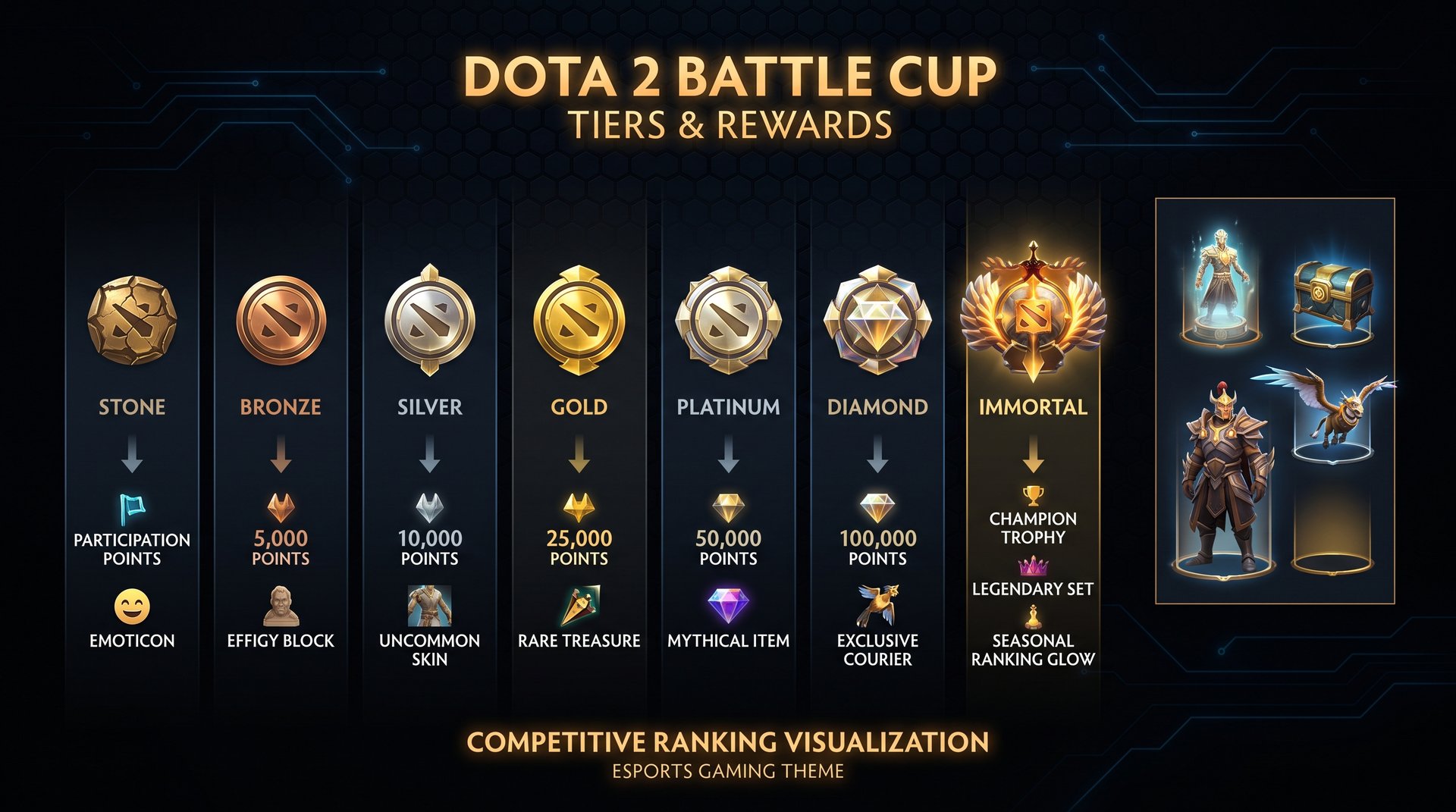
Your team’s tier placement is determined entirely by your stack’s average MMR at registration time. Valve calculates the mean MMR of all five players and places your team in the corresponding tier bracket. You then play against other teams in that same tier bracket. How far you advance within the bracket determines whether you finish at Tier I or Tier II for that tier level.
How the Two-Step Tier System Works
Each tier (except Immortal) has two substeps: Tier I and Tier II. Tier II is the higher of the two. A team entering at the Gold bracket that wins enough rounds to reach the top quarter of their bracket earns Gold II. A team that is eliminated in the earlier rounds of the same bracket earns Gold I. This means your bracket determines the ceiling, and your performance within it sets whether you hit the top or bottom half of that ceiling.
This is an important distinction for players trying to maximize their tier. You cannot earn a tier above the bracket your average MMR places you in just by winning — a team placed in the Silver bracket plays entirely within Silver-bracket matches. Your path to Gold tier requires that your average MMR qualifies you for the Gold bracket in the first place.
November 2026 Tier MMR Reference Table
| Tier | Approx. Team Average MMR | Substeps | Reward Type |
|---|---|---|---|
| Stone | 0 — 1,499 | Stone I / Stone II | Stone pennant + profile badge |
| Bronze | 1,500 — 2,499 | Bronze I / Bronze II | Bronze pennant + profile badge |
| Silver | 2,500 — 3,499 | Silver I / Silver II | Silver pennant + profile badge |
| Gold | 3,500 — 4,499 | Gold I / Gold II | Gold pennant + profile badge |
| Platinum | 4,500 — 5,499 | Platinum I / Platinum II | Platinum pennant + profile badge |
| Diamond | 5,500 — 6,499 | Diamond I / Diamond II | Diamond pennant + cosmetic item |
| Elite | 6,500 — 7,999 | Elite I / Elite II | Elite pennant + rare cosmetic |
| Legendary | 8,000+ | Legendary I / Legendary II | Legendary badge + premium cosmetic |
| Immortal | Leaderboard ranks | Immortal | Immortal pennant + exclusive cosmetic |
Note: Valve adjusts MMR boundaries between seasons. The ranges above are based on the tier structure used throughout the 2026 season. Always verify the exact cutoffs in the client at registration time, as a bracket boundary shift of 50-100 MMR between cups is normal. For deeper context on how Battle Cup tiers relate to your ranked MMR and what each tier actually feels like to play in, see the full Battle Cup Season Guide.
What Happens at the Tier Boundary
The most commonly asked question about tiers is what happens when your team’s average MMR lands exactly on a boundary — say, 3,500 exactly. Valve rounds to the lower bracket in ambiguous cases based on floor calculation. A team averaging 3,500 would enter the Gold bracket, not the Platinum bracket. If your team average is 3,499, you enter Silver. This means if you are trying to access a specific tier bracket, you need all five team members’ average to clearly exceed the lower boundary, not just hit it.
When one team member has significantly lower MMR than the rest, they pull the average down. A four-player stack of 5,000+ players paired with one 2,000 MMR player will average into a much lower bracket than the core players expect. The average is a true mean — no floor for individual contributions.
Battle Cup November 2026 Rewards
Rewards in the Battle Cup consist of two categories: profile badges and cosmetic items. What you earn depends on the tier you finish at and whether you win the full bracket or are eliminated partway through.
Profile Badges and Pennants
Every tier earns a corresponding profile badge that displays on your Dota 2 profile. The badge shows your highest earned tier across all cups you have played. If you earned a Gold II in October and manage a Platinum I in November, your profile shows Platinum I as the current season’s high. Badges are seasonal — they rotate out at the end of each Battle Cup season, making November 2026’s badges a time-limited cosmetic.
Pennants are in-game flags displayed on your fountain and ancients area during matches. Each tier has a distinct pennant design. Higher tiers have more elaborate pennant animations. The Immortal-tier pennant is the most visually distinct and is recognizable to experienced players — carrying one signals that your team cleared the full high-MMR bracket.
Cosmetic Item Rewards
Starting at Diamond tier, Battle Cup completions can award item sets, couriers, or sprays depending on the current season’s reward structure. The exact November 2026 cosmetics will be confirmed in the client when Valve publishes the cup’s reward list. Based on recent seasons, Diamond and above tier winners receive at minimum a hero item or spray specific to that cup’s theme. Elite and Legendary tier completions often include a full item set for a specific hero.
Cosmetic rewards are distributed to all five team members equally — everyone who was on the registered team and played receives the same reward regardless of their individual performance in the bracket matches.
Battle Cup Tickets as Collectibles
Unused Battle Cup tickets that expire after their specific weekend do not convert to currency or other rewards. If you purchase a ticket for a specific November weekend and cannot play, that ticket is consumed without a replacement. Valve does not offer refunds on expired cup tickets, so only purchase tickets for weekends where your full five-man stack is confirmed available.

Battle Cup Tickets — What You Buy and What You Earn
A Battle Cup ticket is the entry fee for one player for one cup weekend. The ticket itself does not determine your tier — your MMR does. What the ticket buys you is access to the bracket. Once inside, your performance within your MMR bracket is what moves you from Tier I to Tier II within your tier level.
You cannot purchase a higher tier. This is a hard rule in the Battle Cup system. There is no premium ticket that places you in a Gold bracket when your MMR qualifies you for Silver. The only way to access higher tier brackets is to have the MMR to back it up. This is intentional design on Valve’s part — the tier you display reflects genuine competitive performance within your MMR cohort.
Dota Plus subscribers should check the current month’s subscriber rewards before purchasing tickets. Valve has provided one or two free Battle Cup tickets per month as a Dota Plus benefit during various periods in 2026. The benefit is not guaranteed for every month, but if you are already subscribed, it is worth checking the subscription rewards tab in the client before buying tickets outright.
Battle Cup tickets are also occasionally available in the Steam store as part of limited bundles. These bundles do not provide any competitive advantage — the ticket inside is identical to one purchased individually.
Stack Composition and MMR Averaging Rules
The Battle Cup is team-only — there is no solo queue entry. You must enter with exactly five players, all registered for the same cup. Here is how team composition rules work:
The Five-Man Stack Requirement
All five players must be on your Steam friends list and must be actively online at registration time. The team captain initiates the registration and invites the other four. Each invited player must accept the invitation and confirm their own ticket is active. The system will not allow registration to complete until all five slots are filled with confirmed, ticket-holding players.
Partial team registration is not allowed — you cannot register as a two or three-player group and fill the remaining slots with random players during the cup. The full team must be established before the registration window closes. This is a common sticking point for players who try to form their stack on the day of the cup rather than the day before.
How Average MMR Is Calculated
Valve uses your current ranked MMR at the time of team registration. The system takes the mean of all five players’ MMRs and rounds to the nearest whole number. The result is your team MMR, which determines your tier bracket.
If one player on your team has a significantly different MMR from the others — for example, a 7,000 MMR player helping their 2,500 MMR friends — the average is dragged toward the lower players. A team with four players at 4,500 MMR and one player at 2,500 averages to 4,100, placing them in the Gold bracket rather than the Platinum bracket where the four main players normally compete.
Players sometimes wonder whether unranked or behavior-score-restricted players can join a Battle Cup team. Unranked players (those with no ranked MMR) typically cannot register for the cup — Valve requires all five players to have a valid ranked MMR. Players with very low behavior scores may also be blocked from cup participation depending on current eligibility rules in the client.
Can You Mix Regions in a Stack?
Your team registers for a specific regional cup (EU, NA, SEA, SA, CIS, CN). All five players do not need to be from that region, but they all play on those servers. Players with high ping to the selected region will experience lag. For competitive play, it is strongly recommended to register in the region where the majority of your stack has acceptable ping, even if that means one player is on a higher-latency connection.
How to Reach a Higher Tier in November 2026
The fastest path to a higher tier is increasing the average MMR of your stack. This sounds obvious, but the practical implication is that every player in your group matters equally to the tier ceiling. You cannot compensate for one low-MMR player by having the others be higher — the math is a strict average.
Stack-Level Preparation That Actually Matters
Role clarity is the single highest-leverage improvement for most amateur stacks. Battle Cup brackets at the Gold and Platinum level are full of teams where everyone wants to play carry and nobody has agreed who handles the early game. Entering November with a clearly defined starting lineup — who plays each of the five positions, who calls rotations, and who handles buy orders — puts you ahead of a large percentage of the field.
Practice your draft together before the cup weekends begin. The Battle Cup draft format follows All Pick rules, and at mid-MMR brackets, teams frequently counterpick each other poorly or lock in compositions with no coherent game plan. Running a few custom lobbies where your stack drafts against each other gives you real data on which heroes your team executes well versus which ones look strong in theory but fall apart in practice.
Improving Your Personal MMR Before November
If your goal is to reach a specific tier in November and your current MMR does not qualify your stack for that bracket, you have roughly four to six weeks from this writing to improve your ranked MMR before the November 1 cup. The path to meaningful MMR gain in that window requires focused hero pool reduction (two to three heroes maximum), role-specific knowledge (not general Dota 2 knowledge), and consistency over volume.
Players stuck at bracket boundaries who want targeted improvement sometimes use Dota 2 coaching to identify and fix the specific habits costing them games at their current MMR. A coach watching your replays can point out patterns you are unlikely to catch yourself — positioning habits, item timing errors, or decision-making during transitions that are hard to self-diagnose. This is worth considering if November’s cup is a team goal and your MMR is the rate-limiting factor.
For context on what MMR improvement actually looks like in your bracket, the MMR boosting and climbing guide covers the bracket-specific dynamics that determine win rates at different MMR ranges. Understanding why your bracket behaves the way it does is a prerequisite for improving within it.
Coordinating Your November Schedule
With five Battle Cup weekends in November, you have more opportunities than a typical month to earn a high tier. But the rewards apply per cup, not cumulatively. A strong Gold II finish on November 8-9 does not combine with a Silver I finish on November 15-16. Each cup is independent. If you want a specific tier badge for the November season, decide which weekend your stack is most likely to perform at its best — perhaps a week when everyone can warm up with some ranked games beforehand — and prioritize that cup for your best performance.
Frequently Asked Questions About Battle Cup November 2026
Want to Reach a Higher Tier This November?
Your tier ceiling is your team’s average MMR. If your stack is sitting just below a bracket boundary — or if one player is pulling the average down — targeted coaching can close that gap faster than grinding solo ranked games. TeamSmurf works with Dota 2-only coaches who understand exactly what separates the Gold bracket from the Platinum bracket and above.
Not ready for coaching yet? Start by understanding what the safe and legitimate options look like for improving your position before the cups begin.



