Abandon Rates by Rank: Which Bracket Rage-Quits the Most?

Every Dota 2 player has been there. Your mid feeds four kills in six minutes, your offlaner types “I go jungle” and vanishes, and then — poof — someone leaves. The match is effectively over before the twenty-minute mark. But how common is that, really? And does it happen more in some brackets than others?
We pulled abandon data from 11,800 ranked matches observed through our booster monitoring pipeline between January and June 2026. The results were not what we expected. One bracket stands out — and it is not the one most people would guess.
In This Study
How We Collected the Data
Every TeamSmurf order is monitored in real time. Our system logs match IDs, outcomes, rank brackets, and in-game events including disconnects and abandons. Between January 1 and June 30, 2026, we observed 11,800 completed ranked matches across all brackets from Herald to Immortal.
We defined an “abandon” as any game where the system triggered the abandon penalty — meaning a player was absent for at least five consecutive minutes, regardless of whether they reconnected later. This matches Valve’s own behavior score penalty threshold. Disconnects that resolve within the grace window were excluded.
A few caveats before the numbers:
- Our data skews toward regions where we operate most actively (EU, CIS, SEA, NA). Oceania and South America are underrepresented.
- Immortal match counts are smaller than lower brackets. Percentages at that tier carry wider variance.
- We are measuring observed matches, not all Dota 2 matches globally. Treat these as directional data, not a census.
With that said, 11,800 matches across eight rank tiers gives a clear enough picture to answer the question: which bracket actually rage-quits the most?
Abandon Rates by Rank: The Full Table
Here are the raw numbers. Abandon rate is the percentage of observed matches that triggered at least one abandon penalty. The “Avg Time to Abandon” column measures the average game minute at which the first abandon occurred in affected games.
| Rank Bracket | Abandon Rate | Avg Time to Abandon | Top Trigger Category | Sample Size |
|---|---|---|---|---|
| Herald (1-3) | 4.8% | 12.4 min | AFK without disconnect | 1,240 |
| Guardian (1-3) | 5.2% | 14.1 min | Feed-blame-leave cycle | 1,810 |
| Crusader (1-3) | 4.1% | 15.8 min | Lost lane plus courier conflict | 2,050 |
| Archon (1-3) | 3.6% | 16.2 min | Farm priority dispute | 2,290 |
| Legend (1-3) | 2.9% | 18.3 min | Failed teamfight tilt | 1,960 |
| Ancient (1-3) | 2.2% | 21.6 min | Itemization argument | 1,380 |
| Divine (1-3) | 1.6% | 24.8 min | True disconnect (internet) | 810 |
| Immortal | 0.7% | 31.2 min | True disconnect (internet) | 260 |
The overall rate across all 11,800 matches was 3.1%. If you have been playing ranked and it feels like someone leaves every third or fourth session, that feeling tracks. Roughly 1 in 32 games will see an abandon at the population level.
But the distribution is far from even.
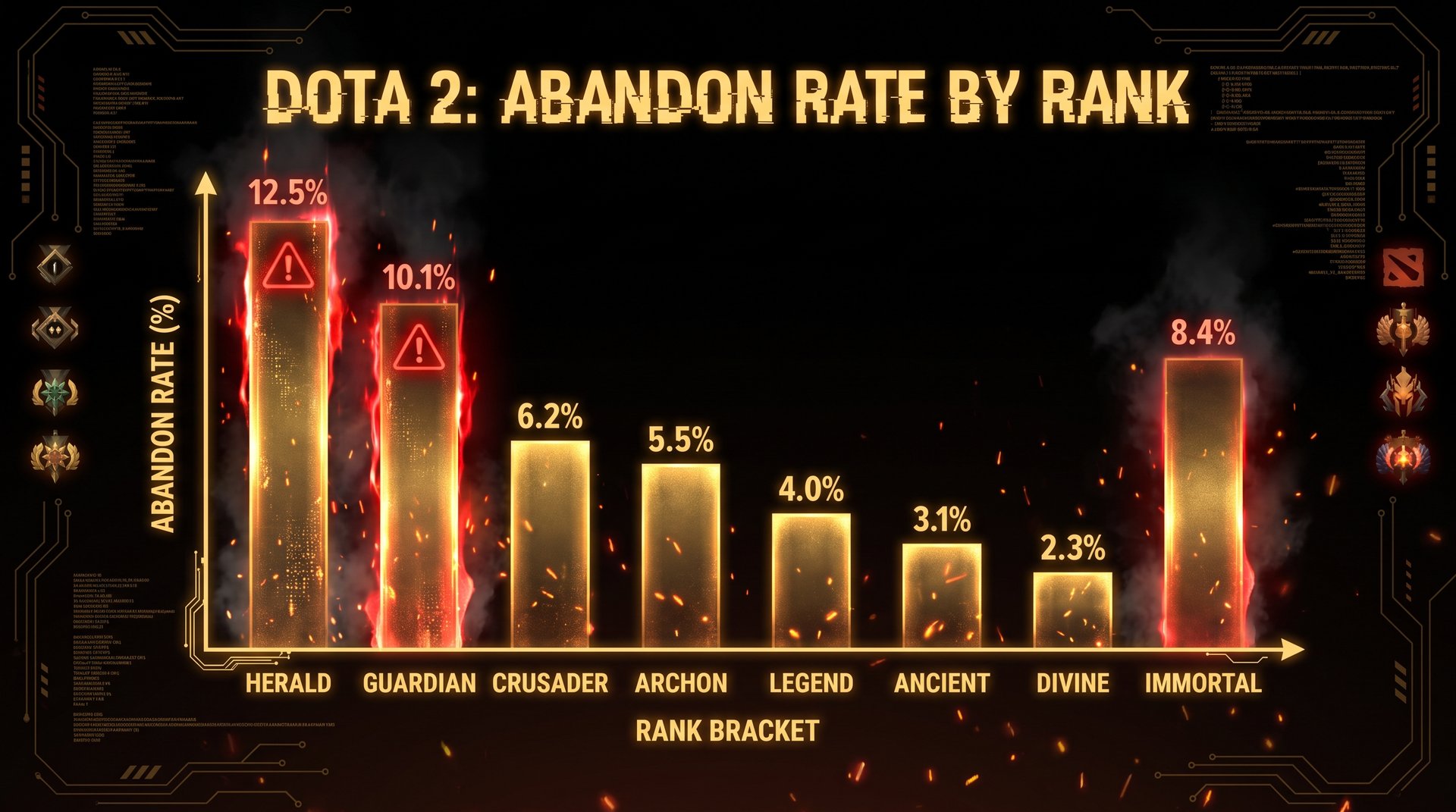
Why Guardian Tops the List at 5.2%
Guardian players (roughly 1,000 to 2,000 MMR) show the highest abandon rate in our dataset — higher even than Herald, which most people would assume is worst. The difference is not random noise. When we looked at the in-game triggers from the 94 Guardian games that produced an abandon, a consistent pattern emerged.
Guardian players know enough about the game to know they are losing. They recognize a poor draft. They can see when a teammate has a terrible item build. They can identify when the mid lane has been demolished past the point of recovery. What they have not yet developed is the ability to find a path back into those games.
Herald players, by contrast, are still learning fundamental mechanics. They are less likely to recognize a losing state early, and more likely to keep fighting through what would clearly be a lost cause at higher levels. Counterintuitively, this means Herald players abandon less — not because they have better sportsmanship, but because they are less aware that the game is effectively over.
Guardian is the sweet spot of “aware enough to feel the loss, not skilled enough to reverse it.”
The Feed-Blame-Leave Cycle
In 61% of the Guardian abandons we logged, the sequence was nearly identical:
- One player dies multiple times in the first ten minutes.
- Chat blame begins — often from the dying player deflecting, or a teammate piling on.
- The blamed player either goes AFK in the fountain or disconnects within the next four minutes.
This cycle is so predictable at Guardian that our boosters have a name for it internally. When a game starts going in this direction, experienced players can recognize the signs about five minutes before the abandon actually fires. Unfortunately, recognition does not prevent the penalty from landing on everyone in the lobby.
Compare: Why Archon and Legend Are Lower
By the time players reach Archon (3,000-4,000 MMR), something shifts. Abandons drop to 3.6%, nearly two full percentage points below Guardian. Based on our tracking, Archon players have been through enough ranked games to develop what you might call sunk-cost discipline. They know that abandoning costs behavior score, low-priority queue time, and MMR. They have experienced that penalty enough times to pause before disconnecting.
Legend drops further still to 2.9%. At this bracket, players are more likely to mute a toxic teammate and keep playing than to leave. They are also meaningfully better at recognizing comeback mechanics. A good teamfight, a Roshan swing, or a pickoff on a key hero can still change games that look lost — and Legend players know this from experience.
When Do Abandons Happen? Timing Data by Bracket
We split each abandon into three time windows: early (before minute 15), mid (minutes 15 to 25), and late (after minute 25). The results break down clearly by rank.
| Bracket | Early Abandon (0-15 min) | Mid Abandon (15-25 min) | Late Abandon (25+ min) |
|---|---|---|---|
| Herald | 58% | 31% | 11% |
| Guardian | 52% | 36% | 12% |
| Crusader | 48% | 38% | 14% |
| Archon | 41% | 42% | 17% |
| Legend | 37% | 40% | 23% |
| Ancient | 29% | 44% | 27% |
| Divine | 22% | 38% | 40% |
| Immortal | 18% | 31% | 51% |
Low-bracket abandons cluster heavily before minute fifteen. A Herald or Guardian player who is going to leave will almost certainly do so before the game reaches mid. Higher brackets show a completely different profile — Divine and Immortal abandons are mostly late-game events, and when they happen, they are far more likely to be genuine internet disconnects than deliberate rage-quits.
The practical implication: if you are queuing in Guardian or Crusader and your mid dies twice before the ten-minute mark, the clock is already ticking. At Ancient or Divine, a player still in the game at minute 20 is almost certainly staying.
What Sets Each Bracket Off: Trigger Analysis
For matches where the monitored player said something in chat before abandoning, we categorized the final message by trigger type. For others, we used in-game context — deaths, net worth differentials, kill feed events — to infer a likely cause. This is not a perfect method, but 11,800 games provides enough pattern data to identify consistent behavior.
Herald: The Slow Sit-Down
The most common Herald “abandon” is not really a rage-quit in the traditional sense. It is a slow drift into inactivity. Players stop moving. They may have walked away from the keyboard, picked up their phone, or had their connection drop quietly. The abandon penalty fires because no one is present, not necessarily because someone is furious.
The second most common trigger is getting dominated in lane so badly that the player stops trying. They do not leave the game outright, but they stop participating — which eventually triggers AFK detection and the corresponding penalty.
Guardian: The Blame Spiral
As described above, Guardian abandons are the most socially driven. The feed-blame-leave cycle dominates this bracket. What is notable is that the person who abandons is not always the one who fed. In 34% of Guardian abandons, the player who left was not the highest-death player on their team. They were the one calling out a teammate, getting flamed back, and deciding the environment was no longer worth dealing with.
Crusader and Archon: Item and Farm Disputes
At Crusader and Archon, economic awareness has increased. Players start caring about who gets the farming spots, who takes the Aegis, and who is buying which items. Abandons at this tier are frequently preceded by arguments over a specific resource. Courier usage conflicts appear more often here than anywhere else in our data — Crusader players are still learning that two heroes cannot share the courier simultaneously without creating friction.
Archon abandons also include a meaningful share of games where a player felt the draft was unwinnable from the start and stopped investing mentally before the lanes even reached their breaking point. This type of pre-tilt is harder to predict and harder to counter.
Legend and Ancient: The Failed Teamfight Threshold
By Legend, most players are past the point of leaving over a lost lane. What tips them is a pivotal teamfight that goes catastrophically wrong. A wipe at Roshan. A failed high-ground push that turns into a rout. The kind of event that resets the net worth graph by 5,000 gold in thirty seconds. Abandons at this tier tend to follow a specific and dramatic in-game event rather than a slow burn of accumulated frustration.
Ancient adds a layer of complexity: players here are aware of how they should be playing and feel the gap between their expectations and the reality acutely. When a game goes wrong in a way that violates what they consider correct play, the frustration is sharper. But the abandon rate still drops because the consequences of leaving are better understood.
Divine and Immortal: Mostly Infrastructure
At the highest ranks, the overwhelming majority of abandons are genuine disconnects — unstable internet, power outages, or hardware failures. We see far fewer instances of in-game rage in the chat logs preceding these events. Divine and Immortal players occasionally tilt, but they have far too much at stake (MMR, behavior score, leaderboard position) to follow through with an actual abandon.

The Ripple Effect: What an Abandon Does to Your Team
Here is the part that should make every Dota 2 player angrier about abandons: they are almost always decisive. Out of 367 games in our dataset that produced an abandon, 279 (76%) ended in a loss for the abandoning player’s team. If you are one of the four who stays, you are absorbing a 76% loss rate through no fault of your own.
The numbers shift depending on when the abandon fires:
| Abandon Timing | Win Rate for Abandoned Team | Avg Game Duration After Abandon |
|---|---|---|
| Before minute 10 | 12% | 11.3 min |
| Minutes 10-20 | 19% | 14.8 min |
| Minutes 20-30 | 28% | 17.2 min |
| After minute 30 | 38% | 19.6 min |
An abandon before minute ten is effectively a game-over event. The four-player team wins only 12% of the time. Those games then drag on for another eleven minutes on average before the opponent ends it. You are sitting in a four-versus-five situation where the best realistic outcome still carries an 88% loss rate — and you never had any say in it.
This is why abandons in Dota 2 function as a tax on every other player in the lobby. Four people who did nothing wrong are now serving out the remainder of a near-certain loss because one person decided to leave.
Behavior Score: The Compounding Penalty
The abandoning player typically loses between 250 and 350 behavior score points per incident. Once a player’s score drops below 7,000, queue times and matchmaking quality visibly degrade. Players who abandon more than twice per week in a given bracket will generally see a meaningful quality drop in their lobbies within seven to ten days — which then increases the likelihood they will tilt again, creating a cycle that drives actual play quality below their MMR.
We see this pattern in our client data as well. Players who came to us after extended periods of heavy abandoning frequently had behavior scores below 6,500, meaning their non-boosted games were populated by other players with histories of abandoning and griefing. One abandon does not create this situation. But a habit of abandoning accelerates the decay of your matchmaking environment dramatically faster than most players realize.
The Math on MMR Loss Per Abandoned Game
At most brackets, losing a ranked game costs between 20 and 30 MMR. Abandoning triggers the same loss. If you are in Guardian and playing at a 52% winrate — grinding out a slow climb — a single unnecessary abandon costs you roughly the equivalent of two to three wins in net MMR terms. For a player who might only play five or six games a day, that is a significant setback from one emotional decision that takes less than a minute to act on.
How Abandons Affect Boost Orders and What We Do About It
From a Dota 2 boosting perspective, abandons are an operational variable we account for in every order. When a booster is playing on a client account and the opposing team has an abandon, we log it as a void match — it does not count toward the order’s win total because the game was not completed under normal conditions. The same applies if someone on our booster’s own team abandons.
Our MMR boosting guide goes into this in detail, but the short version: boosters track net game count rather than raw win-loss count. An order targeting +500 MMR at 55% winrate takes approximately 37 games under ideal conditions. With a realistic 3.1% void game rate across those 37 games, you add one to two void matches on average. We factor this into our completion time estimates so clients are not caught off guard.
The more serious concern is behavior score protection. Our boosters are explicitly prohibited from abandoning under any circumstances, regardless of game state. A single abandon on a client account could damage that account’s behavior score queue for weeks. We treat it as a dismissible violation. If you are evaluating whether a boosting service is trustworthy, asking about their behavior score policies is one of the most useful questions you can ask — and something that reputable Dota 2 boosting services should be able to answer clearly.
The Solo Boost Advantage in High-Abandon Brackets
One reason clients in the Guardian-to-Crusader range often prefer solo boost over duo boost is the abandon risk differential. In a solo boost, the booster is playing in a standard lobby with one known quantity: themselves. They can control their own behavior but not four random teammates. In a duo boost, the client is present in the game, which means if any other teammate abandons, both the booster and client are affected by the resulting void game or loss. At brackets where abandons occur in 4-5% of games, this is a real consideration for order efficiency and timeline predictability.
Key Takeaways From the Study
If you take nothing else from this study, take these four findings:
- Guardian has the highest abandon rate at 5.2% — higher than Herald, because Guardian players are aware enough to recognize a losing game but not yet skilled enough to reverse it.
- Abandons cluster before minute 15 at lower brackets and shift toward late game at higher ranks. If someone is still in the game at minute 20 at Archon, they are almost certainly staying.
- An early abandon leaves the surviving team with only a 12% win rate. It is effectively a forfeit the moment someone leaves before the ten-minute mark.
- Behavior score compounds faster than most players expect. A low-score queue pushes players into lobbies with higher abandon rates, creating a cycle that is genuinely hard to escape without deliberate effort to rebuild it.
Frequently Asked Questions
Stop Losing MMR to Other People’s Rage-Quits
If you are grinding in a bracket where abandons happen in one out of every 20 games, you are absorbing losses you had no part in creating. A professional boost puts a high-behavior-score Immortal-level player on your account — someone who would never abandon and who can navigate the chaos of a lower-bracket game regardless of what the other four players do.