How to Master Invoker in Dota 2: The Ultimate Guide for Every Rank (2026)

Invoker is not just a hero — he is the ultimate test of mechanical skill, game knowledge, and decision-making in Dota 2. With 14 invokable spells built from three reagent orbs, Invoker has the deepest kit in the entire game. No other hero demands as much from the player or rewards mastery so generously.
In patch 7.40c, Invoker sits at a 53% winrate with a 16.1% pick rate in high-MMR games (7000+ MMR), making him the second most popular mid hero behind Storm Spirit. His performance trend is climbing — up 1.4% winrate and 2.3% pick rate over the last eight weeks. The hero is in an excellent spot right now.
This guide will take you from fumbling through spell combos to executing Invoker like a 7K MMR Immortal player. We cover ability mechanics most players never learn, item builds tailored to your rank bracket, lane-winning strategies, and the exact combo sequences pros use to delete entire teams. Whether you are a Herald picking Invoker for the first time or an Ancient player trying to break into Divine, every section has something for you.
Table of Contents
- Why Invoker Is the Most Rewarding Hero in Dota 2
- Abilities Deep Dive: All 14 Spells Explained
- Item Builds by Rank Bracket
- Laning Phase Masterclass
- Mid and Late Game Transitions
- Counters and How to Beat Them
- Heroes Invoker Destroys
- How Pros Play Invoker in 7.40c
- Rank-Specific Climbing Guide
- Tips and Tricks
- FAQ
Why Invoker Is the Most Rewarding Hero in Dota 2
Invoker is a ranged intelligence hero played almost exclusively in the midlane. His three core attributes — Quas, Wex, and Exort — are not just passive stat boosts. Each orb grants scaling bonuses: Quas provides HP regeneration and strength, Wex provides attack speed and movement speed, and Exort provides damage and intelligence. By combining these three orbs using the Invoke ability, Invoker creates 10 unique spells (14 total when counting facet variations), giving him unmatched versatility.
The hero identity breaks down into two primary playstyles that define how you approach every game:
- Quas-Wex (QW): Utility-focused. Prioritizes Tornado, EMP, Cold Snap, and Ghost Walk for aggressive ganking, mana burn, and team control. Peaks earlier, excels in fast-paced games.
- Quas-Exort (QE): Damage-focused. Prioritizes Sun Strike, Forge Spirits, Meteor, and Deafening Blast for lane dominance and massive burst combos. Scales harder, better in slower games.
In patch 7.40c, both playstyles are viable. QE has a slightly higher winrate at 54.1% in Immortal bracket games, largely because the Meteor Hammer timing around 10 minutes enables a devastating power spike that lower-rank players struggle to punish. QW remains the go-to in coordinated team environments where EMP can cripple entire lineups.
Invoker’s current meta position is strong. He is the second most picked mid hero in 7000+ MMR games behind Storm Spirit, with over 11,247 tracked matches in the last two weeks. His 57.5% winrate as a first-pick choice shows that even when the enemy team has time to counter-pick, skilled Invoker players still dominate.
Abilities Deep Dive: All 14 Spells Explained
Understanding Invoker starts with understanding his reagent system. You have three orbs — Quas (Q), Wex (W), and Exort (E) — each leveled independently up to 7. The Invoke ability (R) combines your three active orbs into a spell. You can hold two invoked spells at a time, plus Invoke itself, giving you three active abilities at any moment.
The Reagent Orbs
| Orb | Per Level Bonus | Max Bonus (Level 7) | Playstyle |
|---|---|---|---|
| Quas | +1.75 HP regen, +2 Strength | +12.25 HP regen, +14 Str | Survivability, control |
| Wex | +2% MS, +8 Attack Speed | +14% MS, +56 AS | Mobility, right-click |
| Exort | +4 Damage, +2 Int | +28 Damage, +14 Int | Lane dominance, burst |
Cold Snap (QQQ)
Your bread-and-butter disable. Each instance of damage on the target triggers a mini-stun (0.4 seconds) with a cooldown between procs that decreases with Quas level. At max Quas, the proc interval is 0.5 seconds, meaning any consistent damage source turns Cold Snap into a near-permanent stun lock.
Hidden mechanic: Cold Snap procs off ALL damage sources — including your allies’ attacks, creep damage, and damage-over-time effects like Urn. Forge Spirits are the best pairing because their attacks each proc Cold Snap independently. At level 7 Quas with two Forge Spirits attacking, the target is effectively perma-stunned for the full 6-second duration.

Ghost Walk (QQW)
Invoker’s invisibility escape. Slows both you and nearby enemies based on Quas and Wex levels respectively. Most players use this purely defensively, but high-level Invoker players use Ghost Walk aggressively — the enemy slow lets you position for ganks, and the spell has only a 35-second cooldown at all levels.
Pro trick: Ghost Walk does not break channeling. If you are channeling a TP scroll and get ganked, you can Ghost Walk without canceling the TP. This interaction has saved countless Invoker players at the highest level.
Ice Wall (QQE)
Creates a wall of ice perpendicular to Invoker’s facing direction. Enemies crossing the wall are slowed by up to 140% for up to 5 seconds. The DPS component scales with Exort level. Ice Wall is massively underused in lower brackets — it is one of the strongest area denial spells in the game during teamfights.
Hidden mechanic: The wall is always created perpendicular to where Invoker is facing, not where your cursor is. This means you need to position your hero model’s facing direction before casting. Shift-queue a move command in the direction you want the wall to face, then cast Ice Wall.
Tornado (WWQ)
Launches a cyclone that travels 3100 range at max Wex level, lifting enemies into the air for up to 2.9 seconds based on Quas level. The travel speed and distance scale with Wex, the lift duration with Quas, and the landing damage with Wex level.
Critical timing: Tornado’s lift duration is the key to landing every combo in Invoker’s kit. If your Tornado lifts for 2.0 seconds, you need to invoke and time your follow-up spells to land exactly as the lift ends. Casting Meteor too early means it passes underneath them while airborne. Too late and they walk away. Practice the timing at each Quas level — it changes every single level.
EMP (WWW)
After a 2.6-second delay, EMP detonates in a 675 AoE, burning mana equal to 100 + 50 per Wex level. At max Wex, that is 450 mana burned, and Invoker gains 50% of the mana burned from each hero hit as mana restore. In teamfights, hitting 3-4 heroes with EMP restores your entire mana pool while crippling theirs.
The Tornado-EMP combo: This is the bread and butter of QW Invoker. Cast Tornado, then immediately cast EMP. The timing works naturally — Tornado lifts enemies for approximately the same duration as EMP’s detonation delay. When enemies land from Tornado, they instantly lose mana and take damage. At level 15 with max Wex, this combo removes 450 mana from every enemy hit. That is enough to completely drain most support heroes.

Alacrity (WWE)
Buffs a target unit with bonus attack speed (based on Wex) and bonus damage (based on Exort). Often overlooked, Alacrity turns Invoker or an allied carry into a right-click monster. With the level 25 talent (+50 Alacrity Damage/Speed), this buff becomes absurd — over 100 bonus damage and 100 bonus attack speed on your carry.
Chaos Meteor (EEW)
Invoker summons a meteor that crashes down after a 1.3-second delay, dealing initial impact damage (based on Exort level) and leaving a damage trail that rolls forward 465/615/780/930/1095/1260/1410 range based on Wex level. Enemies hit continue to burn for 3 seconds after leaving the area. With the level 20 talent, Invoker summons 3 Chaos Meteors instead of one.
Devastation math: A single max-level Chaos Meteor with Aghanim’s Scepter deals roughly 750-900 damage if the target stands in the full path. With three meteors from the talent, that is 2,250-2,700 damage before reductions. Add Deafening Blast to push enemies along the meteor path, and you are looking at team-wiping damage.
Sun Strike (EEE)
Global pure damage nuke. After a 1.7-second delay, deals up to 475 pure damage in a small 175 AoE, split between all units in the area. This spell wins lanes across the map. Every time an allied hero ganks a side lane, you should be looking at the minimap for Sun Strike opportunities.
Pure damage matters: Unlike magical damage, Sun Strike ignores magic resistance entirely. That 475 damage is true 475 damage against every hero. Combined with an ally’s stun or slow, Sun Strike secures kills that no other mid hero can contribute to without leaving their lane.
Forge Spirit (QEE)
Summons a Forge Spirit (two with Aghanim’s Shard or when both Quas and Exort are at level 4+) that has scaling attack range, damage, HP, and armor. Forge Spirits also apply a -1 armor debuff per attack, stacking up to -10. Two Forge Spirits attacking a tower melt it in seconds while the armor reduction stacks make your right-clicks hit significantly harder.
Deafening Blast (QWE)
Invoker’s ultimate combo finisher. Deals damage based on Exort, knocks enemies back based on Quas duration, and disarms them based on Wex duration. At level 25 with the Radial Deafening Blast talent (91.4% pick rate — nearly universal), the blast fires in a 360-degree circle around Invoker instead of a frontal cone, turning it into one of the most powerful teamfight spells in the game.
Skill Build: QE (Recommended for Most Games)
| Level | 1 | 2 | 3 | 4 | 5 | 6 | 7 | 8 | 9 | 10 |
|---|---|---|---|---|---|---|---|---|---|---|
| Most Popular (50.9% WR) | E | Q | E | Q | E | R | E | Q | E | Q |
| Highest WR (54.6% WR) | E | Q | E | E | Q | R | E | E | Q | Q |
The highest winrate build rushes Exort to level 5-6 before balancing Quas. This maximizes your Sun Strike damage and Forge Spirit power during the critical 10-20 minute window. You sacrifice some Cold Snap proc frequency, but the damage output more than compensates.
Talent Choices
| Level | Option A | Option B | Recommendation |
|---|---|---|---|
| 10 | +50 Ice Wall DPS | -4s Tornado Cooldown | Ice Wall DPS (71.4% pick rate) — makes Ice Wall a real damage threat |
| 15 | +1 Facet Orb Level | -6s Cold Snap Cooldown | +1 Facet Orb Level (93.3%) — universally better, boosts all spells |
| 20 | +2 Chaos Meteors | +50 Alacrity Damage/Speed | +2 Chaos Meteors (97.6%) — the signature late-game teamfight talent |
| 25 | Radial Deafening Blast | +50 Alacrity Damage/Speed | Radial Blast (91.4%) — turns teamfights into guaranteed wins |
Item Builds by Rank Bracket
Invoker’s item build has converged significantly in 7.40c. The core path is clear, but how you get there differs by rank because the game tempo and available farm patterns change dramatically between brackets.
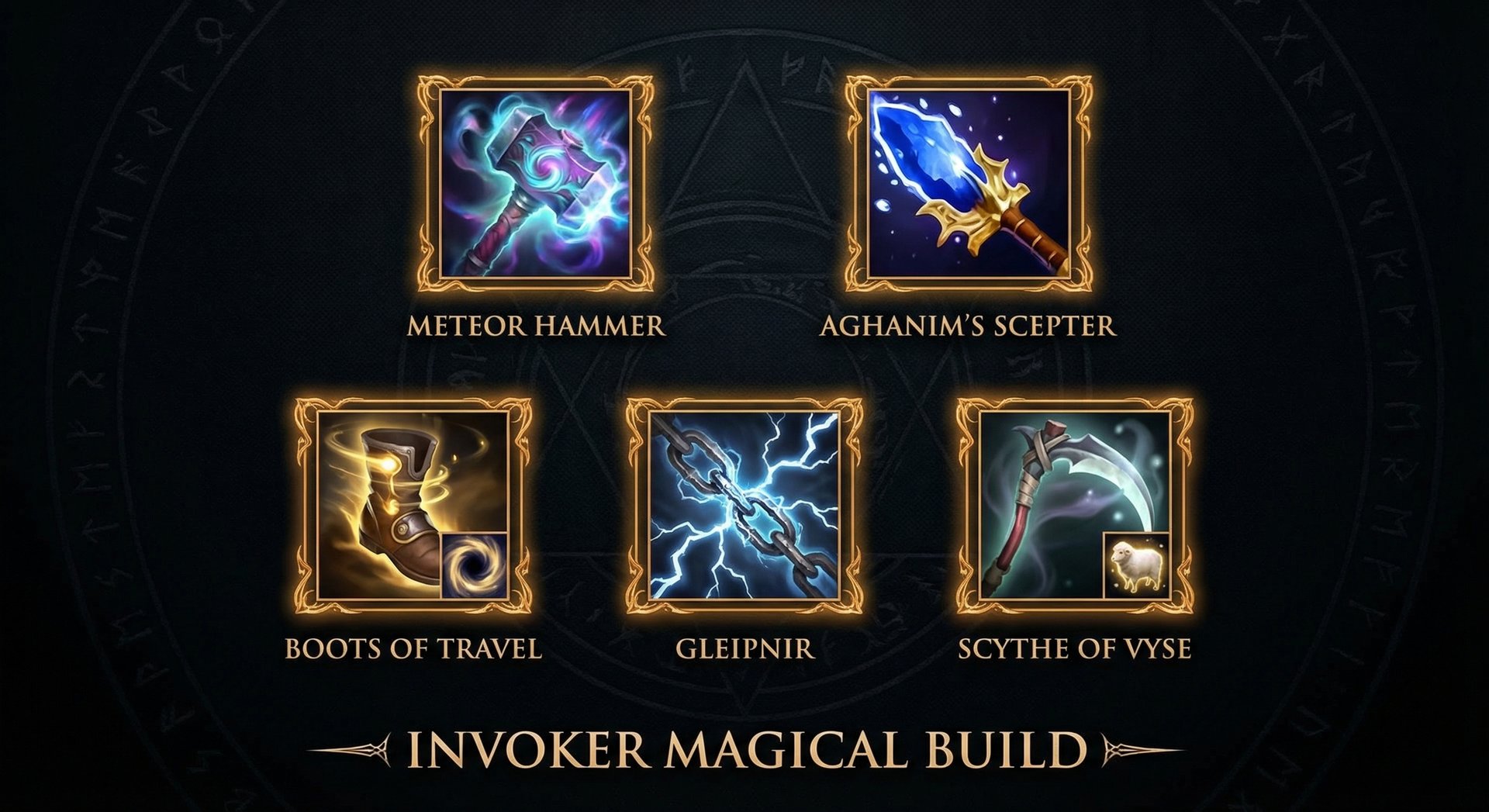
| Rank | Starting | Early (0-10 min) | Core (10-25 min) | Late (25+ min) |
|---|---|---|---|---|
| Herald – Crusader | 2x Circlet, Faerie Fire, Tango | Null Talisman, Magic Wand, Boots | Hand of Midas, Boots of Travel, Aghanim’s Scepter | BKB, Refresher Orb, Octarine Core |
| Archon – Legend | Null Talisman components, Tango | Null Talisman, Magic Wand, Kaya | Meteor Hammer, Aghanim’s Scepter, Boots of Travel | Gleipnir, BKB, Scythe of Vyse |
| Ancient – Divine | Null Talisman components, Tango | Null Talisman, Magic Wand, Meteor Hammer | Aghanim’s Scepter, Boots of Travel, Rod of Atos | Gleipnir, Scythe of Vyse, Refresher Orb |
| Divine – Immortal | 2x Mantle, Circlet, Tango, Branch | Null Talisman, Magic Wand, Meteor Hammer (10 min) | Boots of Travel (20 min), Aghanim’s Scepter (21 min) | Gleipnir/BKB, Scythe of Vyse, Refresher Orb |
Why Meteor Hammer Is Core
Meteor Hammer at 10 minutes (48.7% purchase rate, commonly rushed) might seem odd on a hero with 14 spells, but the math is compelling. Meteor Hammer channels for 2.5 seconds and deals 150 damage plus a 1.75-second stun. Combined with Cold Snap, the channel is guaranteed because the target cannot move. After the stun lands, you follow with Chaos Meteor and Sun Strike for a kill on nearly any hero at the 10-minute mark.
More importantly, Meteor Hammer gives Invoker wave clear and tower push that he otherwise lacks in the early-mid game. A single Meteor Hammer hit on a creep wave clears it instantly, letting you farm and split push while looking for ganks.
Why Boots of Travel Over Treads or Phase
Invoker is one of the few heroes in Dota 2 where Boots of Travel is the standard boot choice, purchased at an average timing of 20 minutes. The reasoning is simple: Invoker already gets movement speed from Wex orbs and does not benefit enough from Treads or Phase to justify delaying his global presence. With Sun Strike already giving global damage, adding BoT gives Invoker global presence — you can TP to any lane, push, get a kill, and be back in a fight within seconds.
Aghanim’s Scepter — The 21-Minute Spike
Aghanim’s Scepter on Invoker reduces Invoke cooldown to 2 seconds, lets you have two spells pre-invoked at all times, and upgrades several spells. The key upgrade: Deafening Blast fires its knockback in a wider cone and the Chaos Meteor rolls further. This is the item that turns Invoker from “strong mid hero” into “I can solo win this teamfight.” The average Immortal timing is 21 minutes — aim for that benchmark.
Late Game Decisions
Scythe of Vyse (29.1% purchase rate, ~37 min): When you need reliable single-target lockdown. Hex into Cold Snap into full combo kills anyone.
Refresher Orb (24.8% purchase rate, ~39 min): Double combo. Two sets of three Chaos Meteors with two Radial Deafening Blasts. This is how Invoker solo wipes teams in the ultra-late game.
BKB (38.5% purchase rate, ~32 min): Required when the enemy has point-click disables that prevent you from getting your combo off. Against heroes like Lion, Shadow Shaman, or Bane, BKB is non-negotiable.
Gleipnir (40.3% purchase rate, ~30 min): The most popular late-game pickup. Gives AoE root that sets up your entire combo without needing Tornado. Root into Meteor + Blast is cleaner and faster than Tornado setups.
Laning Phase Masterclass
Invoker’s laning phase is deceptively strong in 7.40c, despite the data showing a -4.7% lane advantage. That statistic is misleading because it includes all skill brackets. In Immortal games, Invoker’s laning is not about winning the lane outright — it is about maintaining farm while creating global pressure with Sun Strike.

Levels 1-3: Survive and Last Hit
Start with Exort first for the +4 damage per level. At level 1 with three Exort orbs active, you have +12 bonus damage on every right-click, which is higher than most mid heroes’ starting damage. Use this to secure every last hit and deny aggressively.
The triple-Exort last hit trick: Keep three Exort orbs active while last hitting, then switch to three Quas orbs between waves for regeneration. This toggle between damage and regen lets you sustain through harass while out-lasthitting your opponent. The switching takes practice but becomes automatic after 10-15 games.
Levels 3-6: First Blood Window
At level 3 with 2 Exort and 1 Quas, you have Cold Snap and Forge Spirits available. A single Forge Spirit plus Cold Snap at level 3 deals approximately 300 damage while keeping the target ministunned for 3 seconds. If your enemy mid hero is at 70% HP or below, this is a kill with right-click follow-up.
Simultaneously, watch side lanes. Your first Sun Strike opportunity usually comes between minutes 3 and 5 when enemy offlaners or supports overcommit. Communicate with your side lanes — tell them to ping when they go. A 250+ damage pure nuke from across the map at minute 4 tilts enemies and nets you gold and experience without leaving lane.
Levels 6-10: The Rotation Question
QE Invoker generally stays mid until Meteor Hammer is complete around minute 10. Your Forge Spirits plus Sun Strike provide enough global impact without sacrificing mid farm. The exception is when a guaranteed kill presents itself on a side lane — if your support has a reliable stun and the enemy is low, TP in with Cold Snap and Forge Spirits for an easy double kill.
QW Invoker rotates earlier, around level 6-7. Tornado + EMP is devastating against side lane heroes with small mana pools. Coordinate with your offlane or safelane support for a smoke gank at minute 7-8.
Lane Matchup Quick Reference
| Matchup | Difficulty | Strategy |
|---|---|---|
| vs Storm Spirit | Hard | Play safe, outscale. Storm kills you at 6 with full mana. Keep HP above 70%. Sun Strike other lanes. |
| vs Templar Assassin | Hard | Refraction blocks Cold Snap procs. Use Forge Spirits to burn Refraction charges first, then commit. |
| vs Shadow Fiend | Even | Contest razes with superior right-click damage. Sun Strike him if he tries to jungle stacks. |
| vs Puck | Even | Puck dodges Sun Strike with Phase Shift. Focus on Cold Snap when Phase Shift is on cooldown. |
| vs Sniper | Easy | Forge Spirits close the gap. Cold Snap prevents Sniper from running. Free lane after level 3. |
| vs Zeus | Easy | Quas regen outheals Zeus poke. Forge Spirits zone Zeus from last hits. Dominate after level 5. |
Mid and Late Game Transitions
Invoker’s power curve is unique. Unlike most mid heroes who either peak early and fall off or need 30 minutes to come online, Invoker has multiple power spikes throughout the game. Understanding these timings is what separates good Invoker players from great ones.

The 10-Minute Meteor Hammer Spike
Your first major spike. With Meteor Hammer, Cold Snap, Forge Spirits, and Sun Strike all available, you can solo kill almost any hero on the map. The combo: Cold Snap the target, immediately channel Meteor Hammer (Cold Snap prevents them from interrupting), then follow with Sun Strike on the stunned target. This deals approximately 800-1000 damage at level 10 and kills most supports and many core heroes.
Use this spike aggressively. Push out your mid wave with Meteor Hammer (it one-shots the ranged creep and damages the melee creeps), then rotate to a side lane or the enemy jungle. You should be getting at least 2-3 kills between minutes 10 and 15.
The 21-Minute Aghanim’s Scepter Spike
Aghanim’s Scepter transforms Invoker. With 2-second Invoke cooldown, you can cycle through 4-5 spells in a single teamfight instead of 2-3. Your combo execution ceiling skyrockets. The standard teamfight sequence becomes:
- Tornado to initiate (lifts enemies)
- EMP (detonates as they land)
- Invoke Chaos Meteor (crashes onto them)
- Invoke Deafening Blast (pushes them along the meteor path)
- Cold Snap on the priority target
- Invoke Alacrity on yourself or your carry for clean-up
That is six spells in roughly 4 seconds. No other hero in the game can output that many abilities in rapid succession.
The 35+ Minute Endgame
Late game Invoker with level 20 (+2 Chaos Meteors) and level 25 (Radial Deafening Blast) is one of the strongest heroes in Dota 2. Three simultaneous Chaos Meteors combined with a 360-degree Deafening Blast deals upwards of 3,000 magical damage in an AoE while disarming and knocking back every enemy. Add Refresher Orb and you can do it twice.
Your teamfight positioning in the late game is critical. You want to be at the edge of the fight, not in the center. Invoker’s spells have long cast ranges — Tornado reaches 3100 units, Chaos Meteor crashes from distance, and Radial Blast gives you a safety net if enemies dive you. Stay back, cycle your spells, and let the damage do the work.
Split Push Pattern
Between fights, Invoker is an exceptional split pusher. Boots of Travel let you TP to any lane, Forge Spirits and Meteor Hammer clear waves instantly, and Ghost Walk lets you escape if enemies respond. Push a lane, TP back to your team, fight, push again. This constant pressure is how Immortal Invoker players maintain 8,700+ net worth at 20 minutes (the Immortal average).
Counters: Heroes That Destroy Invoker
Every hero has bad matchups. Invoker’s weaknesses are well-defined: he is vulnerable to gap-closing heroes that prevent him from casting, heroes with BKB-piercing disables, and heroes that can purge or dodge his spell combos.
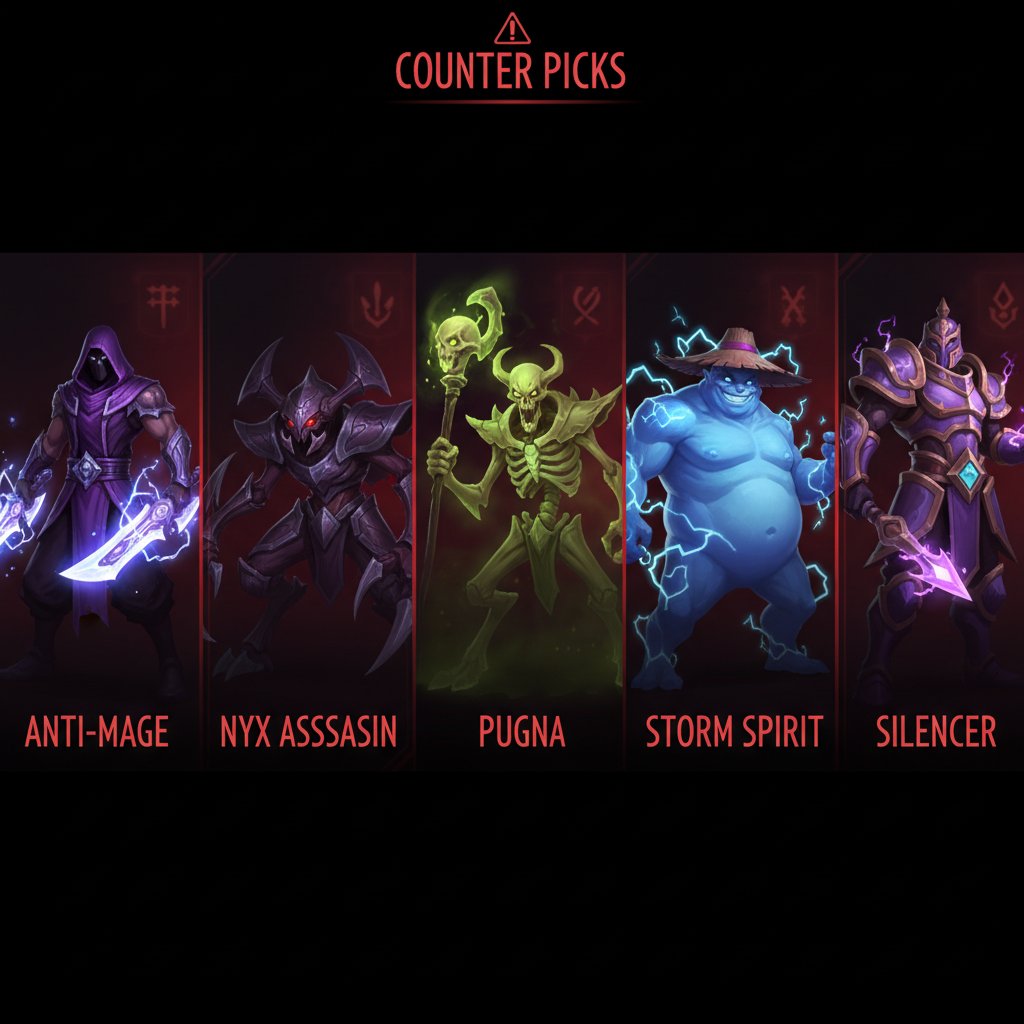
1. Anti-Mage
Anti-Mage is Invoker’s nightmare. Mana Break drains the massive mana pool Invoker depends on, Blink closes the distance instantly, Counterspell reflects Cold Snap (which then stuns Invoker), and Mana Void punishes Invoker’s naturally large mana pool for lethal damage. An Anti-Mage with Manta Style and BKB makes Invoker nearly useless.
How to play around it: End the game before Anti-Mage completes Battlefury + Manta. Invoker peaks at 20-30 minutes; Anti-Mage peaks at 35+. Force fights early, take objectives, and close the game before AM’s timing.
2. Nyx Assassin
Spiked Carapace reflects any Invoker spell back onto him, including Tornado and Chaos Meteor. Mana Burn deals massive damage to Invoker’s high intelligence pool. Vendetta’s break duration prevents Ghost Walk escape. Nyx is the classic “pick this if the enemy has Invoker” hero.
How to play around it: Buy Linken’s Sphere against Nyx. It blocks the initial Vendetta strike or Impale. Alternatively, always have Ghost Walk pre-invoked so you can disengage the moment Nyx appears. Nyx is weak in prolonged teamfights — he needs to pick you off alone.
3. Pugna
Nether Ward punishes every spell Invoker casts. With 14 spells to cycle through, Invoker triggers Nether Ward more than almost any other hero. The damage per mana spent adds up — a full Invoker combo near Nether Ward deals hundreds of damage back to Invoker. Decrepify also saves Pugna’s teammates from Cold Snap combos.
How to play around it: Kill the Nether Ward first. It has limited HP. Send a Forge Spirit to attack it before committing to a fight. Alternatively, itemize Gleipnir over Meteor Hammer — Gleipnir’s active costs less mana per damage than channeling Meteor Hammer near the ward.
4. Storm Spirit
Ball Lightning closes distance instantly and cannot be interrupted by Tornado or Cold Snap during the roll. Storm’s constant gap-closing prevents Invoker from maintaining the distance he needs to cast combos. Electric Vortex into Overload procs can kill Invoker before he finishes invoking his second spell.
How to play around it: BKB timing is everything. Pop BKB before Storm initiates, get your combo off, and kill him in the disable chain. Without BKB, you are Storm’s favorite target.
5. Silencer
Global Silence shuts down Invoker completely. During the silence duration, Invoker cannot invoke new spells, cannot cast any of his 14 abilities, and is reduced to right-clicking. Last Word also punishes Invoker for casting, and Arcane Curse stacks damage for every spell he uses. In team fights, a well-timed Global Silence after Invoker uses Tornado but before he can follow up is devastating.
How to play around it: Eul’s Scepter or BKB dispels silence. Alternatively, bait Global Silence by having a teammate initiate first, wait for Silencer to use it, then enter the fight 5 seconds later.
Heroes Invoker Destroys
Invoker excels against heroes who are slow, immobile, or reliant on channeling abilities. If the enemy team drafts heroes that want to stand still and hit things, Invoker has a field day.
1. Sniper
Sniper has no mobility, no escape, and no magic resistance. Tornado + Meteor + Blast from fog kills Sniper from full HP at level 15+. Cold Snap + Forge Spirits at any point in the game prevents Sniper from right-clicking. Sniper is Invoker’s favorite target — a free kill every time your combo is off cooldown.
2. Crystal Maiden
CM’s Freezing Field channel is instantly canceled by Cold Snap, Tornado, or Deafening Blast. Her 280 base movement speed means she cannot escape Ghost Walk slow or Ice Wall. Sun Strike snipes her during ganks on side lanes because she moves too slowly to dodge it. CM’s life is miserable against a competent Invoker.
3. Medusa
EMP destroys Medusa’s mana shield, stripping her primary survivability tool. A Tornado + EMP combination removes 450 mana at max level, which is equivalent to removing roughly 1,000 effective HP from Medusa. Without mana shield, Medusa is just a slow ranged creep with a bad stun.
4. Wraith King
Same EMP logic. Wraith King’s Reincarnation requires mana. A well-timed EMP before the kill removes his mana pool, preventing the second life. Cold Snap also prevents Wraith King from reaching Invoker, since WK has no gap-closer beyond Blink Dagger.
5. Drow Ranger
Drow’s Marksmanship is disabled when enemies are within 400 range. Forge Spirits and Cold Snap force close combat. Tornado disrupts Drow’s positioning. Drow wants to stand at max range and right-click — Invoker has five different spells that prevent that.
How Pros Play Invoker in Patch 7.40c
Invoker remains a staple pick in professional Dota 2. In the current DPC season and recent tournaments like DreamLeague Season 28 and PGL Wallachia Season 7, Invoker has maintained a strong presence with a 53% winrate across professional matches.

First Pick Priority
The data shows something remarkable: Invoker has a 57.5% winrate as a first pick in high-MMR games (2,849 matches tracked). This means pro and semi-pro players are confident enough to pick Invoker before seeing the enemy draft, and they are winning more than they lose. The hero’s versatility — able to go QW or QE depending on matchup — makes counter-picking him difficult.
Radiant Advantage
Invoker has a significant Radiant advantage: 58.0% winrate on Radiant vs 50.5% on Dire. This 7.5% gap is one of the largest in the game. The reason is map geometry — Radiant mid has easier access to both jungle quadrants for stacking and farming, and the high ground advantage in the mid lane favors ranged heroes with Exort’s bonus damage.
Professional Build Trends
The professional meta has converged on the QE build with Meteor Hammer rush into Aghanim’s Scepter. Key differences from pub builds:
- Earlier Meteor Hammer: Pros average 10-minute Meteor Hammer vs 12-13 minutes in lower brackets
- Skip Hand of Midas: Only 28.4% purchase rate. Pros prefer faster tempo items — Midas delays your first power spike by 3-4 minutes
- Aggressive BoT timing: Pros get Boots of Travel at 20 minutes to maximize split push pressure
- Gleipnir over Rod of Atos: Gleipnir’s AoE root (40.3% purchase rate) is preferred over Atos (51.4%) at the highest level because it provides farming acceleration and AoE setup
Match Duration Sweet Spot
Invoker’s winrate peaks in the 35-50 minute window at 56.0% (3,673 matches). He drops to 51.3% in games over 50 minutes. This tells us that Invoker’s strongest window is the mid-late game when he has Aghanim’s Scepter, level 20 talent, and either Gleipnir or BKB, but before enemy carries have full builds with multiple BKBs and defensive items.
Rank-Specific Climbing Guide
Herald to Guardian: Focus on the Basics
At this rank, do not try to learn all 14 spells at once. Focus on five spells: Cold Snap, Forge Spirits, Sun Strike, Tornado, and Chaos Meteor. That is enough to climb through Herald and Guardian.
Your priority is last hitting. With three Exort orbs, you should be getting 50+ last hits by minute 10. In Herald, most mid players get 25-30. Just winning the CS war gives you a massive gold advantage. Use Forge Spirits to secure ranged creeps and harass.
Practice Sun Strike in bot games. Set up the geometry in your mind: watch where enemies are moving, predict their path, and aim ahead. Even landing 1 out of 4 Sun Strikes is valuable — the 200+ pure damage kills enemies your teammates damaged.
Crusader to Archon: Adding Game Sense
At this rank, your combo execution should be consistent. Practice Tornado + Meteor + Blast in demo mode until you can do it with your eyes closed. The timing window changes with every level of Quas, so practice at multiple levels.
Start incorporating EMP into your rotations. Many Archon players skip Wex entirely on QE builds, but having 1-2 points in Wex by level 12-14 gives you access to Tornado and EMP for teamfight mana drain. The mana burn wins fights that raw damage cannot.
Buy Smoke of Deceit. At this rank, nobody smokes. If you smoke from mid and gank a side lane at minute 8 with Cold Snap + Forge Spirits, you will get a kill 90% of the time because the enemy has no wards on smoke paths.
Legend to Ancient: The Macro Leap
Legend and Ancient is where Invoker transitions from “hero I am learning” to “hero I am mastering.” At this rank, your combo execution should be fast enough that you do not need to think about which keys to press — it should be muscle memory.
Focus on map awareness and teleport efficiency. You should be Sun Striking at least 3-4 times in the first 15 minutes. Watch every fight happening on the map — if two heroes are trading hits in a side lane and one drops below 40%, that is your Sun Strike.
Learn Ice Wall placement. At this rank, nobody respects Ice Wall, and it is one of Invoker’s strongest spells. In a teamfight choke point, Ice Wall can slow the entire enemy team for 5 seconds at 140% slow. That is stronger than most ultimates.
Divine to Immortal: What Separates the Top 1%
At Divine and above, the difference is not mechanical skill — it is decision-making. Every Invoker player at this rank can execute combos. What separates a Divine 5 from an Immortal 2000 is knowing which spell to use and when.
Key differences at Immortal level:
- Pre-invoking the right spells: Before a fight, have Tornado + Meteor invoked. Mid-fight, you need to invoke on the fly. After a fight, have Forge Spirits + Alacrity invoked for pushing. Between fights, have Ghost Walk + Cold Snap for safety. The pre-invoke decision is subconscious for Immortal Invoker players.
- Facet awareness: Knowing when to activate your facet’s 2x Quas/Wex/Exort bonuses for specific situations
- Item timing benchmarks: Meteor Hammer by 10:00, Aghanim’s by 21:00, level 20 by minute 28. Hit these timings consistently and you will climb.
- Combo adaptation: Do not always open with Tornado. Sometimes Cold Snap + Urn is the correct initiation. Sometimes Alacrity on your carry is worth more than your entire combo. Read the fight.
Tips and Tricks Only High-MMR Players Know
1. The Invoke Queue
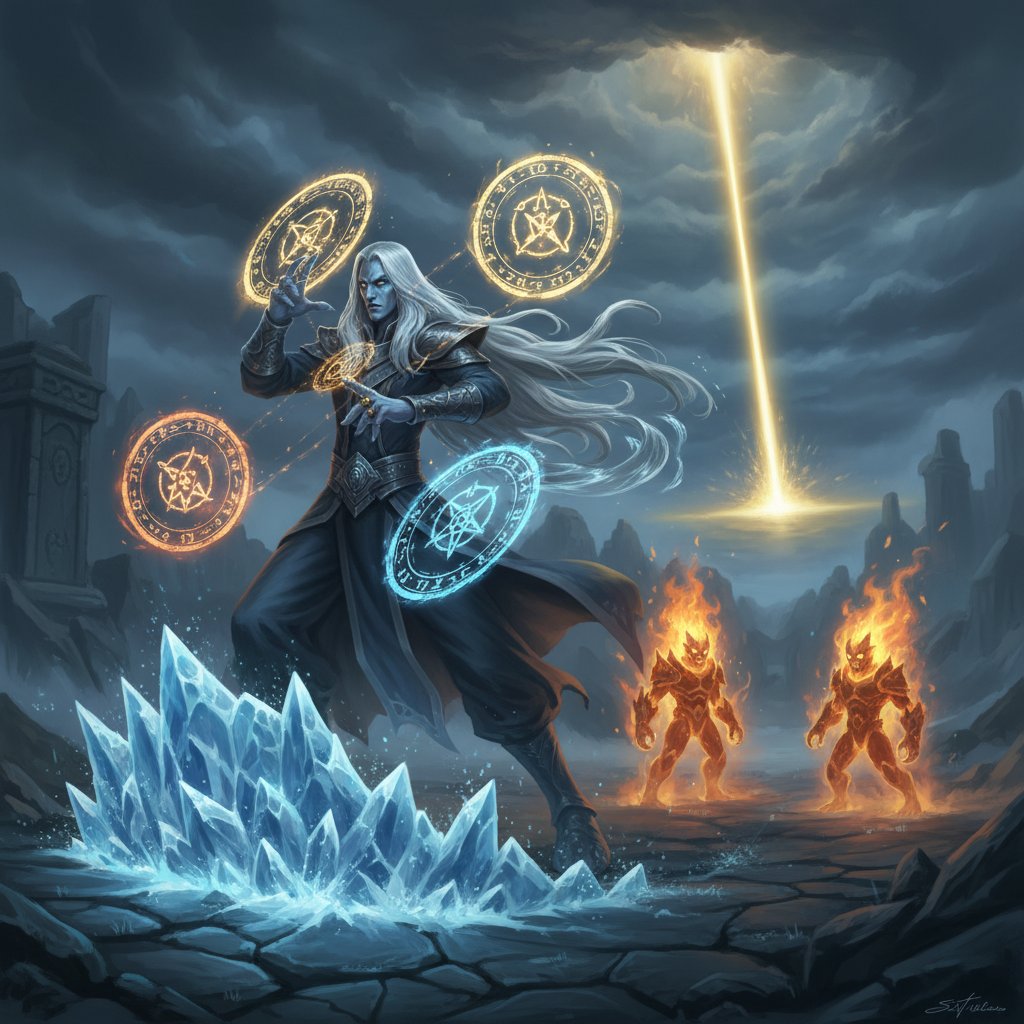
You can queue spell invocations during other spell cast animations. While Tornado is flying toward the enemy, start invoking your next spell (e.g., press E-E-W for Chaos Meteor, then R to invoke it). By the time Tornado lifts them, your Meteor is already invoked and ready. This saves 0.5-1 second in your combo, which is the difference between a kill and a near-miss.
2. Sun Strike Timing After Tornado
Sun Strike has a 1.7-second delay. Tornado lift duration at level 4 Quas is approximately 1.7 seconds. This means at level 4 Quas, you can Tornado an enemy and immediately Sun Strike their landing position for a guaranteed hit. This interaction is one of the cleanest combos in the game and requires zero enemy prediction — you know exactly where they will land.
3. Ghost Walk Into TP
As mentioned in the abilities section, Ghost Walk does not interrupt TP scrolls. If you are being ganked and have a TP scroll, start the TP first, then Ghost Walk. The invisibility protects you during the remaining channel time. Even if they have detection, the slow from Ghost Walk makes it harder for them to reach you in time.
4. Forge Spirit Micro
Forge Spirits can be controlled separately (select all other units). Use them to: scout Roshan, deward by attacking observer wards, stack jungle camps, and apply armor reduction on towers before you push. A single Forge Spirit attacking a tower for 10 seconds applies -10 armor, making your team’s push significantly faster.
5. Ice Wall Facing Direction
Ice Wall spawns perpendicular to the direction Invoker is facing, not your cursor. To place Ice Wall across a chokepoint, turn your hero to face the chokepoint direction, then cast. Most players struggle with this mechanic — practice it in demo mode. The best technique is to issue a move command in the direction you want the wall to face, then shift-queue Ice Wall.
6. Alacrity on Siege Creeps
Alacrity can be cast on siege creeps (catapults). A siege creep with +80 damage and +80 attack speed at level 15 becomes a tower-destroying machine. Your opponents will not expect the siege creep to hit for 150+ damage per attack while attacking 50% faster.
7. EMP Vision Trick
EMP provides vision in its area during the 2.6-second delay. Cast EMP into fog, Roshan pit, or over cliffs to check for enemies without risking your hero. If you see someone in the EMP area, follow up with Tornado before it detonates for the full combo.
Frequently Asked Questions
Invoker has the steepest learning curve in Dota 2, but that does not mean beginners should avoid him. If you are willing to invest 50+ games into learning the hero, the skills you develop — spell sequencing, map awareness, multi-tasking — transfer to every other hero in the game. Start with the QE build and focus on just 5 spells: Cold Snap, Forge Spirits, Sun Strike, Tornado, and Chaos Meteor.
QE has a higher winrate (54.1% vs 51.8%) in the current patch because Meteor Hammer synergizes perfectly with Exort’s damage scaling. QW is better in specific situations: against mana-dependent lineups (Medusa, Wraith King), when your team needs early game pressure, or when the enemy mid hero hard-counters QE’s passive laning style.
Expect 30-50 games to become comfortable with basic combos and spell invocations. Another 50-100 games to develop the muscle memory for mid-fight invoking and advanced combos. True mastery — knowing which spell to use in every situation — takes 200+ games. There is always more to learn with Invoker, which is part of what makes him so rewarding.
Only in lower brackets (Herald-Archon) where games run longer and nobody punishes your 10-minute farming item. In Ancient+ games, Midas delays your Meteor Hammer spike by 3-4 minutes, and the enemy team will punish you for it. The 28.4% purchase rate in Immortal games shows that even when pros buy it, it is situational — usually only when the game is slow and they have a free lane.
The highest damage combo in the late game is: Tornado (lift) into EMP (mana burn on land) into Chaos Meteor x3 (level 20 talent) into Deafening Blast (pushes enemies along meteor path) into Cold Snap (locks down survivors). With Refresher Orb, repeat the Meteor + Blast portion. This combo deals 4,000+ magical damage before reductions and disables the entire enemy team for 5+ seconds.
Technically yes, but it is suboptimal. Invoker needs levels desperately — his spells scale with orb levels, not just spell levels. A support Invoker stuck at level 8 while the enemy mid is level 12 has dramatically weaker spells. Stick to the midlane where you get solo experience and can hit your item timings. The 16.1% pick rate is almost entirely mid players.
Ghost Walk is your primary escape. Always have it ready to invoke (QQW). If you see enemies rotating to mid on the minimap, pre-invoke Ghost Walk. In the worst case, Tornado the enemy toward your tower for a 2+ second lift while you walk away. Buy Observer Wards for the mid ramps if your supports are not providing vision — the 75 gold investment saves your life repeatedly.
Master Invoker With Professional Coaching
Our Immortal-rank coaches have thousands of Invoker games. Get personalized combo training, lane matchup analysis, and game-by-game replay reviews tailored to your rank.