How to Unlock Ranked in Dota 2: Complete Requirements & Fast-Track Guide

So you want to play ranked Dota 2. Maybe you’re a brand-new player eager to test your skills against similarly-ranked opponents. Maybe you’re coming from another MOBA and want to jump into competitive matchmaking. Or maybe you’ve been grinding unranked for weeks and want to know exactly what’s left before you can queue ranked.
Whatever your situation, this guide covers everything you need to know about unlocking ranked matchmaking in Dota 2: the exact requirements, the fastest way to meet them, the best heroes to play during your unranked grind, how calibration works, and how to set yourself up for the best possible starting MMR.
Our team at TeamSmurf has helped thousands of players transition from unranked to ranked play, and we’ve distilled that experience into this comprehensive guide.
Table of Contents
- Ranked Requirements Overview
- The 100-Hour Requirement
- Phone Number Verification
- Account Level Requirement
- Behavior Score and Its Impact
- Fastest Way to Unlock Ranked
- Best Heroes for Unranked (Learning & Winning)
- Preparing for Calibration
- How Calibration Works
- Tips for Your First Ranked Games
- Common Mistakes New Ranked Players Make
- FAQ
Ranked Requirements Overview
Before you can queue for ranked matchmaking in Dota 2, you must meet several requirements. Valve has implemented these barriers to reduce smurfing, improve match quality, and ensure players have a baseline understanding of the game before entering competitive play.
| Requirement | Details | Approximate Time |
|---|---|---|
| Account Level | Must reach a minimum account level (currently varies; typically around level 20–25) | Varies with playtime |
| Phone Number | A unique, valid phone number must be linked to your Steam account | 5 minutes |
| Playtime | Approximately 100 hours of unranked gameplay | 100+ hours |
| Behavior Score | Must not be in extremely low behavior score territory | Ongoing |
| Calibration Games | 10 ranked matches to determine starting MMR | 5–10 hours |
Let’s break down each requirement in detail.
The 100-Hour Requirement
The single biggest barrier to ranked play is the approximately 100 hours of unranked gameplay required. This is Valve’s primary anti-smurf measure and serves as a baseline learning period.
What Counts Toward the 100 Hours
- Unranked All Pick: Yes — this is the most common mode for grinding hours
- Single Draft, Random Draft, All Random: Yes — all unranked modes count
- Turbo Mode: Yes, but with a caveat — Turbo games may count for reduced time (historically, Turbo games have counted as less than full games toward the requirement, though Valve’s exact calculation has changed over time)
- Bot matches: Limited credit. Playing against bots gives some credit toward playtime requirements but is not as efficient as unranked PvP matches.
- Custom games: No — custom games and arcade modes do not count
- Watching replays: No
- Demo mode: No
How to Track Your Progress
Your Dota 2 profile shows your total playtime. You can also check through Steam (right-click Dota 2 in library → Properties → check playtime). Note that Steam tracks total client time (including menus), while Dota 2’s internal counter focuses on in-match time. There may be discrepancies.
You’ll know you’ve met the requirement when the ranked matchmaking option becomes available in the game mode selection screen. If it’s still grayed out, you haven’t met one or more requirements.
Why 100 Hours
100 hours sounds like a lot — and it is. But Dota 2 is one of the most complex competitive games ever made. With 125+ heroes, hundreds of items, and dozens of mechanical concepts (last-hitting, pulling, stacking, creep aggro, warding, smoking, Roshan timing, power spikes, lane equilibrium), 100 hours barely scratches the surface.
Valve implemented this requirement primarily to combat smurfing — experienced players creating new accounts to stomp lower-ranked games. The time investment makes it costly to create new accounts, though dedicated smurfs still circumvent it.
Phone Number Verification
You must link a unique phone number to your Steam account to play ranked Dota 2. This is another anti-smurf and anti-cheating measure.
Key Rules
- One phone number per account. Each phone number can only be associated with one Dota 2 ranked account at a time.
- VOIP numbers may not work. Valve has blocked many virtual phone numbers (Google Voice, etc.) to prevent easy smurf account creation. Physical SIM cards generally work.
- Cooldown on number changes. If you remove your phone number from one account and add it to another, there’s a cooldown period before ranked is available on the new account.
- Steam Guard not required but recommended. While Steam Guard (two-factor authentication) isn’t strictly required for ranked, it provides additional account security.
How to Link Your Phone Number
- Open Steam client
- Go to Steam → Settings → Account → Manage Steam Guard Account Security
- Select “Get Steam Guard codes from the Steam app on my phone”
- Follow the prompts to link your phone number via the Steam mobile app
- Alternatively, you can add your phone number through the Dota 2 client when prompted
What If I Don’t Have a Phone Number
Unfortunately, you cannot play ranked Dota 2 without a valid phone number. If you don’t have access to one, you’ll be limited to unranked modes. Some players use prepaid SIM cards as a workaround — any valid phone number that can receive SMS verification works.
Account Level Requirement
Your Dota 2 account has a level that increases as you play games and earn experience (not to be confused with hero levels within a match). You need to reach a minimum account level before ranked becomes available.
How Account Levels Work
- You earn account XP by completing matches (win or loss)
- Longer games give more XP than shorter ones
- Winning gives a bonus over losing
- Dota Plus subscribers earn bonus account XP
- Trophy levels and achievements contribute to your profile level
Current Level Requirement
Valve has adjusted the exact level requirement over the years. As of 2026, the requirement is integrated with the overall playtime/games-played threshold. In practice, if you’ve played 100 hours of real games, you’ll almost certainly meet the level requirement as well. The two requirements are effectively linked — playing enough hours naturally levels your account sufficiently.
Behavior Score and Its Impact
Dota 2’s behavior score ranges from 0 to 12,000 and reflects your conduct in games. While there’s no strict behavior score minimum for ranked access, extremely low scores (below 3,000) may restrict matchmaking options.
How Behavior Score Works
| Score Range | Quality | Impact |
|---|---|---|
| 10,000–12,000 | Excellent | Best match quality, fastest queues, matched with similar-behaved players |
| 7,000–9,999 | Good | Normal match quality |
| 4,000–6,999 | Below Average | Longer queues, more toxic teammates, potential restrictions |
| 1,000–3,999 | Poor | Shadow pool, very long queues, high toxicity matches |
| 0–999 | Critical | Severe restrictions, potential ranked ban |
What Affects Behavior Score
- Positive: Completing games, receiving commends, playing without reports or abandons
- Negative: Abandoning games, being reported for toxicity/feeding/ability abuse, getting flagged by automated detection systems
Starting with a High Behavior Score
New accounts start at approximately 8,000–10,000 behavior score. To maintain or improve it during your unranked grind:
- Never abandon games. Even if the game is a stomp, play it out. Abandons are the fastest way to tank your score.
- Don’t flame teammates. Mute toxic players instead of engaging with them.
- Commend good teammates. While commending others doesn’t directly raise your score, it encourages a positive ecosystem.
- Play consistently. Regular play with clean behavior steadily increases your score.
If you’ve ended up in low priority due to abandons or reports, our LP Removal service can help you get back to normal matchmaking quickly.
Fastest Way to Unlock Ranked
Let’s be real — 100 hours is a grind. Here’s how to make it as efficient and productive as possible.
Optimal Game Mode for Grinding Hours
Unranked All Pick is the best mode for several reasons:
- You choose your hero (control what you play and learn)
- Games count fully toward the time requirement
- Most similar to ranked format (best practice for calibration)
- Largest player pool means faster queue times
Turbo Mode is tempting because games are shorter (15–25 minutes vs 30–50 minutes), but Turbo has downsides:
- May count for reduced time toward the ranked requirement
- The game pacing doesn’t teach you real Dota 2 timing (faster gold, faster XP, weaker towers)
- You develop habits that don’t transfer well to ranked (e.g., skipping laning fundamentals)
- Item timings and power spikes are different
Our recommendation: Play 80% Unranked All Pick and 20% Turbo for variety. The bulk of your learning should be in the mode that most closely mirrors ranked.
Time-Efficient Strategy
- Play 2–4 games per session. Each game averages 35–45 minutes. Three games per day ≈ 2 hours. At that rate, you’ll hit 100 hours in roughly 50 days.
- Focus each session on one skill. Don’t try to learn everything at once. Session 1: last-hitting. Session 2: map awareness. Session 3: ability combos. This focused practice is more effective than unfocused play.
- Pick a small hero pool (3–5 heroes). You learn faster by repeating heroes than by playing a different hero every game. Master a few heroes, then expand.
- Watch a guide video before each session. 10 minutes of Purge, BSJ, or Jenkins on YouTube teaches concepts faster than discovering them through trial and error.
Weekly Schedule Example
| Week | Focus Area | Heroes to Practice | Hours Target |
|---|---|---|---|
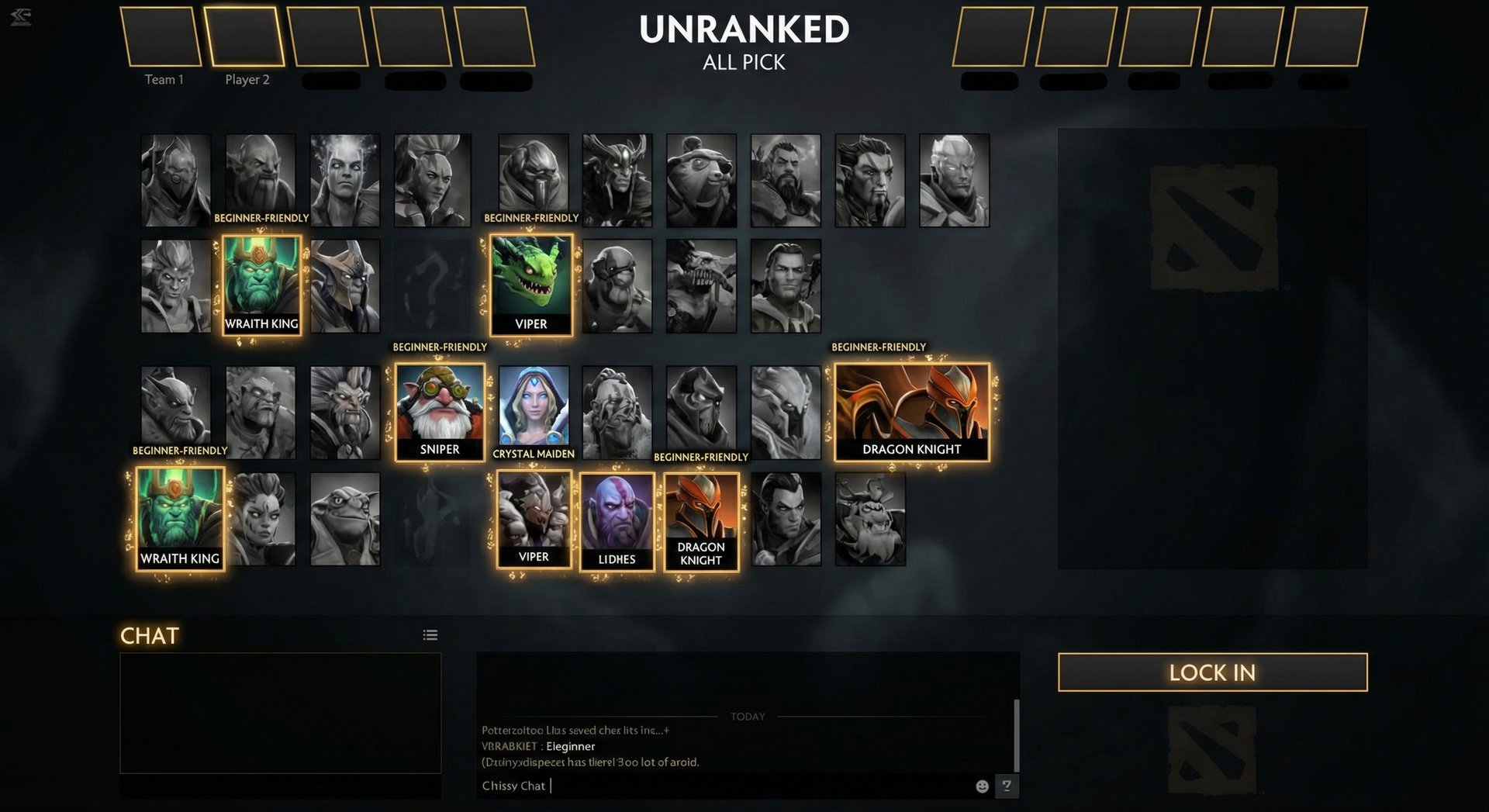
| Week 1–2 | Last-hitting and laning basics | Wraith King, Dragon Knight | 14 hours/week |
| Week 3–4 | Map awareness and warding | Crystal Maiden, Lion | 14 hours/week |
| Week 5–6 | Teamfighting and objectives | Juggernaut, Ogre Magi | 14 hours/week |
| Week 7 | All roles and hero flexibility | Mixed hero pool | 14 hours |
| Week 8 | Calibration preparation | Your best 3 heroes | Remaining hours |
This schedule gets you to 100 hours in about 7–8 weeks while building real skills for ranked.
Best Heroes for Unranked (Learning & Winning)
Choosing the right heroes during your unranked grind serves two purposes: learning the game efficiently and building a hero pool for ranked. Here are the best heroes for each role, optimized for new players.
Best Carry Heroes (Position 1)
| Hero | Why They’re Great for Learning | Key Skill They Teach |
|---|---|---|
| Wraith King | One active ability, tanky, forgiving ultimate (free reincarnation) | Last-hitting, basic farming patterns, right-click positioning |
| Juggernaut | Strong laning, Blade Fury provides safety, Healing Ward sustains team | Spell usage timing, when to fight vs farm |
| Phantom Assassin | Simple kit, high damage, teaches positioning because she’s squishy | Target selection, Blink Strike engagement, BKB timing |
| Faceless Void | Chronosphere is one of the best teamfight spells, easy to understand | Ultimate placement, patience, farming efficiency |
Best Mid Heroes (Position 2)
| Hero | Why They’re Great for Learning | Key Skill They Teach |
|---|---|---|
| Viper | Dominant laner, simple abilities, hard to lose mid with | Trading, lane dominance, pressing advantage |
| Dragon Knight | Very tanky, passive regen, ultimate transforms for pushing | Pushing timing, team fighting, objective-focused play |
| Zeus | High magic damage, global ultimate, teaches ability usage | Mana management, ability timing, map awareness (ult vision) |
| Sniper | Simple right-click hero, teaches positioning because of low mobility | Positioning (punished hard for mistakes), range advantage |
Best Offlane Heroes (Position 3)
| Hero | Why They’re Great for Learning | Key Skill They Teach |
|---|---|---|
| Tidehunter | Incredibly tanky, Ravage wins teamfights, hard to kill in lane | Teamfight initiation, offlane survival, BKB timing |
| Bristleback | Turn your back to enemies for damage reduction, spam spells | Lane aggression, trading mechanics, knowing limits |
| Underlord | AoE farm, tanky, team-saving ultimate | Wave clear efficiency, aura itemization, team utility |
| Axe | Strong initiator, Call forces enemies to attack you, high kill potential | Initiation timing, blink usage, aggression windows |
Best Support Heroes (Position 4/5)
| Hero | Why They’re Great for Learning | Key Skill They Teach |
|---|---|---|
| Crystal Maiden | Simple stun + slow, global mana aura, teaches support fundamentals | Warding, zoning, mana management for the team |
| Lion | Two disables (stun + hex), mana drain, high burst ultimate | Ability combos, target priority, disable chaining |
| Ogre Magi | Tanky for a support, simple spells, Multicast is exciting | Lane harassment, buff management, positioning as support |
| Lich | Easy laning with Frost Blast, Sinister Gaze for saves, tanky ult | Lane harass, ability placement, supporting from safe positions |
Hero Pool Strategy
Pick 2 heroes per role during your unranked grind:
- Carry: Wraith King + Juggernaut
- Mid: Viper + Dragon Knight
- Offlane: Tidehunter + Axe
- Support: Crystal Maiden + Lion
This gives you 8 heroes across all positions, which is enough for any draft situation. By the time you hit 100 hours, you’ll be comfortable on all of them.
Preparing for Calibration
Your calibration games determine your starting MMR, which sets the trajectory for your entire ranked experience. Preparing properly for calibration can mean the difference between starting at 1,000 MMR and starting at 2,500 MMR.
What to Do Before Your First Calibration Game
- Know your best 3 heroes cold. You should have 20+ games on each and feel completely comfortable with their abilities, item builds, and power spikes.
- Understand every role. Calibration games assign you different roles (if you queue all roles), so you need baseline competence everywhere.
- Learn basic warding. Even as a carry, knowing where wards go helps you farm safely and avoid ganks.
- Practice last-hitting. Spend 10 minutes in demo mode before your calibration session. Warm up your mechanics.
- Watch your own replays. Review your last 3–5 unranked games. Identify recurring mistakes and consciously avoid them.
- Fix your settings. Make sure your hotkeys, quickcast, and video settings are optimized. Don’t be fumbling with settings during calibration.
Mental Preparation
- Don’t play all 10 calibration games in one day. Fatigue leads to worse performance. Spread calibration over 3–5 days, playing 2–3 games per session.
- Warm up with one unranked game first. Don’t jump straight into calibration cold. Play one unranked game to get your mechanics flowing.
- Mute toxic players immediately. Don’t let tilted teammates affect your calibration games. Mute and focus.
- Accept that some games are unwinnable. Even if you play perfectly, some calibration games will be losses due to teammates. Focus on your individual performance.
How Calibration Works
Calibration in Dota 2 consists of 10 ranked matches that determine your initial MMR (Matchmaking Rating). Here’s what you need to know:
The Calibration Algorithm
Valve doesn’t publicly disclose the exact calibration formula, but based on community research and data analysis, calibration considers:
- Win/loss record: The most significant factor. Going 8-2 in calibration places you significantly higher than going 3-7.
- Performance metrics: KDA, hero damage, tower damage, healing, wards placed, and other statistics may influence your calibration MMR, especially when distinguishing between players with similar win rates.
- Unranked MMR (hidden): Dota 2 tracks a hidden MMR during your unranked games. Your unranked performance influences the skill level of your calibration matches and provides a baseline for calibration.
- Match difficulty: Winning against higher-MMR opponents counts more than winning against lower-MMR opponents.
Typical Calibration Results
| Calibration Record | Typical Starting MMR Range | Medal Equivalent |
|---|---|---|
| 8–10 wins | 2,500–3,500 | Archon to Legend |
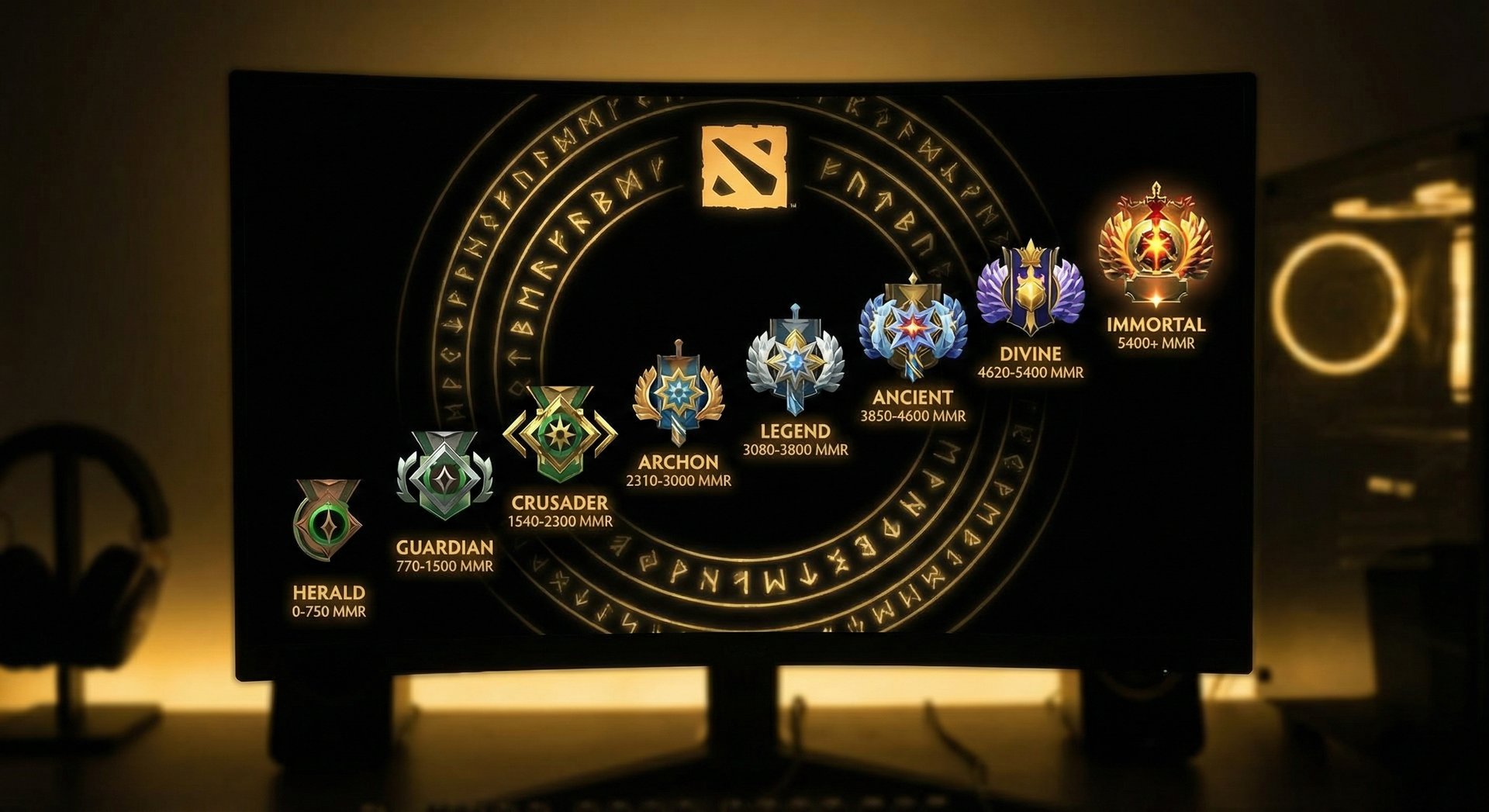
| 6–7 wins | 1,500–2,500 | Guardian to Archon |
| 4–5 wins | 800–1,500 | Herald to Guardian |
| 0–3 wins | 0–800 | Herald |
Note: These ranges are approximate and heavily influenced by your hidden unranked MMR. A player with high hidden MMR who goes 5-5 in calibration may still place at 2,500+.
Calibration Tips for Maximum MMR
- Play your best heroes. This is not the time to experiment. Pick the heroes you have the highest win rate on.
- Play impactful roles. Mid and carry have the most influence on game outcome. If you’re confident in these roles, prioritize them.
- Focus on not dying. Deaths are one of the most impactful negative metrics. A 5-1-10 score is better for calibration than a 15-12-5 score.
- Farm efficiently. High GPM and last-hit numbers indicate strong fundamental skills to the system.
- Participate in objectives. Tower damage and Roshan participation show game awareness.
- Ward and deward if supporting. These metrics are tracked and contribute to support-role calibration.
If you want to ensure your calibration goes as well as possible, our MMR Calibration service uses experienced Immortal players to calibrate your account at the highest possible starting MMR.
Tips for Your First Ranked Games
You’ve unlocked ranked, completed calibration, and have your starting MMR. Now what
Mindset
- Ranked is still Dota 2. The fundamentals don’t change. Last-hit, don’t die, take objectives, communicate.
- MMR anxiety is normal. Everyone feels it — the fear of losing precious MMR. Recognize it and don’t let it affect your play. If you’re too anxious, you’ll play passively and make worse decisions.
- Focus on improvement, not number. If you’re getting better, your MMR will follow. If you’re fixated on the number, you’ll plateau.
- Take breaks after losses. Two losses in a row Take a 15-minute break. Three losses Stop for the day. Tilt compounds — you play worse when tilted, lose more, tilt harder.
Communication
- Use voice chat for time-sensitive calls (“They’re Roshing!” “I need help top!”). Text for less urgent information.
- Ping missing heroes. If your lane opponent disappears, ping missing immediately. This simple habit saves teammates from ganks.
- Mute toxic players. Don’t argue, don’t defend yourself, don’t engage. Mute and focus. One toxic player can ruin your concentration for the entire game.
- Commend good teammates. Positive reinforcement improves match quality across the ecosystem.
Drafting
- Pick comfort over counter-pick. At low MMR, playing a hero you know well beats playing a “counter” you’ve never touched. Hero mastery matters more than draft composition below 3,000 MMR.
- Don’t last-pick carries. Counter-picking matters more for carries than supports. If you’re playing carry, try to pick later in the draft. If you’re support, picking early is fine.
- Have a backup hero. If your main hero gets banned or picked, you need a reliable alternative.
Game Pacing
Ranked games are generally more coordinated than unranked. Players take objectives more seriously, TP rotations happen more often, and there’s more pressure to perform. Adjust your expectations — ranked games feel “harder” not because the mechanics change, but because opponents try harder.
Common Mistakes New Ranked Players Make
1. Playing Too Many Heroes
In unranked, variety is fine. In ranked, playing a different hero every game means you never master any of them. Narrow your pool to 3–5 heroes for your main role. You’ll climb faster with deep hero knowledge than wide hero variety.
2. Ignoring Role Queue
Dota 2’s role queue lets you select which position you want to play. Use it. Always queue for your best role first. Don’t queue “all roles” to get faster queue times unless you’re genuinely comfortable everywhere — getting assigned support when you only know carry is a recipe for a loss.
3. Not Buying Enough Regen in Lane
New ranked players often buy greedy starting items (early stat items, skipping consumables) and get zoned out of lane. Bring enough tangoes and salves. A second set of tangoes costs 90 gold but can save your lane — and your lane is worth thousands of gold over 10 minutes.
4. Farming Without Purpose
Many new ranked players default to farming when they don’t know what to do. Farming is important, but farming the wrong areas (in dangerous positions, away from objectives, when your team needs you) loses games. Ask yourself: “Where is the most efficient place for me to be right now” The answer isn’t always “hitting jungle creeps.”
5. Blaming Teammates
Yes, your teammates will make mistakes. No, focusing on their mistakes won’t help you climb. Every game has something YOU could have done better. Focus on that, review your replays, and improve your own play. The teammates change every game; the only constant is you.
6. Never Buying BKB
Black King Bar (BKB) is the most important item in Dota 2 and new players almost never buy it. If you’re a carry or mid dying in teamfights to magic damage and stuns, buy BKB. It wins fights, it wins games, it’s not optional.
7. Poor TP Scroll Management
Always carry a TP scroll. Always. If you die and don’t have a TP scroll, you’re walking back to lane — wasting 30–60 seconds of potential farm time. Buy one after every death. Buy one when you have an empty slot. TP scrolls are the most gold-efficient item in the game.
Using Professional Services to Accelerate
While self-improvement is the core path to climbing in Dota 2, professional services can accelerate your journey:
- Dota 2 Coaching: An Immortal coach reviews your gameplay, identifies weaknesses, and gives you personalized improvement plans. The fastest way to learn because you’re getting expert feedback specific to YOUR play, not generic advice.
- MMR Boosting: Professional players play on your account to increase your MMR. Useful for getting past frustrating plateaus or reaching a rank that better reflects your skill level.
- Calibration Service: Professional players handle your 10 calibration matches to maximize your starting MMR. A higher starting point means less grinding to reach your target rank.
- Low Priority Removal: If abandons or reports land you in low priority, this service gets you out quickly so you can return to ranked.
Frequently Asked Questions
Ready to Climb Start Your Boost Today
Team Smurf is the #1 rated Dota 2 boosting service. Immortal-rank boosters, maximum safety, competitive pricing, 24/7 support.
Conclusion
Unlocking ranked in Dota 2 is a journey, not a checkbox. The 100-hour requirement, phone verification, and account leveling are barriers that also serve as your learning period. Use that time wisely — practice last-hitting, learn hero matchups, understand warding, and build a reliable hero pool.
When you do unlock ranked, approach calibration with preparation and a clear mind. Play your best heroes, focus on consistent performance over flashy plays, and don’t let individual game results tilt you. Your starting MMR is just a number — what matters is the trajectory.
If you want to accelerate any part of this process, from coaching during your unranked grind to professional calibration, TeamSmurf is here to help. And once you’re in ranked and climbing, our MMR Boost service can push you past any plateau.
Welcome to ranked Dota 2. Good luck out there — you’ll need it, but you’ll also love it.