Dota 2 Ranks Explained: The Ultimate Guide to Every Medal from Herald to Immortal (2026)

Dota 2’s ranking system can be confusing — especially if you’re new to the game or returning after a break. With eight distinct medal tiers, five stars within most tiers, hidden MMR numbers behind visible medals, and a completely separate Immortal leaderboard system at the top, there’s a lot to understand.
This is the most comprehensive guide to Dota 2 ranks you’ll find anywhere. We break down every single rank from Herald I to top-100 Immortal, including the MMR ranges, what percentage of the player base sits at each tier, the typical skill level you’ll encounter, the most common mistakes players make, and — crucially — exactly what you need to do to escape each rank and climb to the next.
At Team Smurf, our Immortal-rank boosters have played through every bracket thousands of times. This guide isn’t based on theory — it’s based on direct, firsthand experience from players who have climbed from Herald to Immortal on hundreds of accounts. Whether you’re looking for a professional MMR boost or trying to climb on your own, understanding the ranking system is your first step.
Table of Contents
- How the Dota 2 Ranking System Works
- Rank Distribution Overview
- Herald (0–770 MMR)
- Guardian (770–1540 MMR)
- Crusader (1540–2310 MMR)
- Archon (2310–3080 MMR)
- Legend (3080–3850 MMR)
- Ancient (3850–4620 MMR)
- Divine (4620–5420 MMR)
- Immortal (5420+ MMR)
- Medal Calibration & Recalibration
- Party vs Solo MMR & Medals
- Regional Differences
- The Immortal Leaderboard System
- General Tips for Climbing Any Bracket
- FAQ
How the Dota 2 Ranking System Works
Before diving into individual ranks, it’s important to understand the mechanics behind Dota 2’s ranking system.
MMR (Matchmaking Rating)
MMR is the hidden number that determines your actual skill level. Every ranked game you win adds approximately +25 to +30 MMR, and every loss subtracts the same amount. Your MMR is the real metric — medals are just a visual representation of your MMR range.
You have a single MMR value that applies to all roles. Previously, Dota 2 had separate solo and party MMR, but the system has been unified. Your MMR changes based on wins and losses regardless of whether you queue solo or with a party.
Medals vs MMR
Your medal (Herald, Guardian, Crusader, etc.) is determined by your peak MMR during the current season. This is a crucial distinction:
- Medals can only go up during a season — they never downrank
- If you hit Ancient 3 and then lose 500 MMR, your medal still shows Ancient 3
- Your actual matchmaking is based on your current MMR, not your displayed medal
- This means you can encounter a “Divine 2” player who’s actually playing at Legend-level MMR after a losing streak
Stars Within Each Medal
Each medal tier (except Immortal) has five stars (I through V). Each star represents approximately 154 MMR. So Herald I is 0-154 MMR, Herald II is 154-308 MMR, and so on. This breaks down as follows:
| Star | MMR Within Tier | Approximate Games to Next Star |
|---|---|---|
| (I) | 0–154 | ~6 net wins |
| (II) | 154–308 | ~6 net wins |
| (III) | 308–462 | ~6 net wins |
| (IV) | 462–616 | ~6 net wins |
| (V) | 616–770 | ~6 net wins (to next tier) |
Note: The exact MMR thresholds shift slightly between seasons. The values in this guide are based on the current 2026 season data.
Season Resets
Dota 2 resets medals periodically (typically every 6 months). During a reset, your medal is hidden and you must play calibration matches to receive a new medal. Your MMR doesn’t actually reset — calibration matches use your existing MMR as a baseline and adjust from there. More on this in the calibration section.
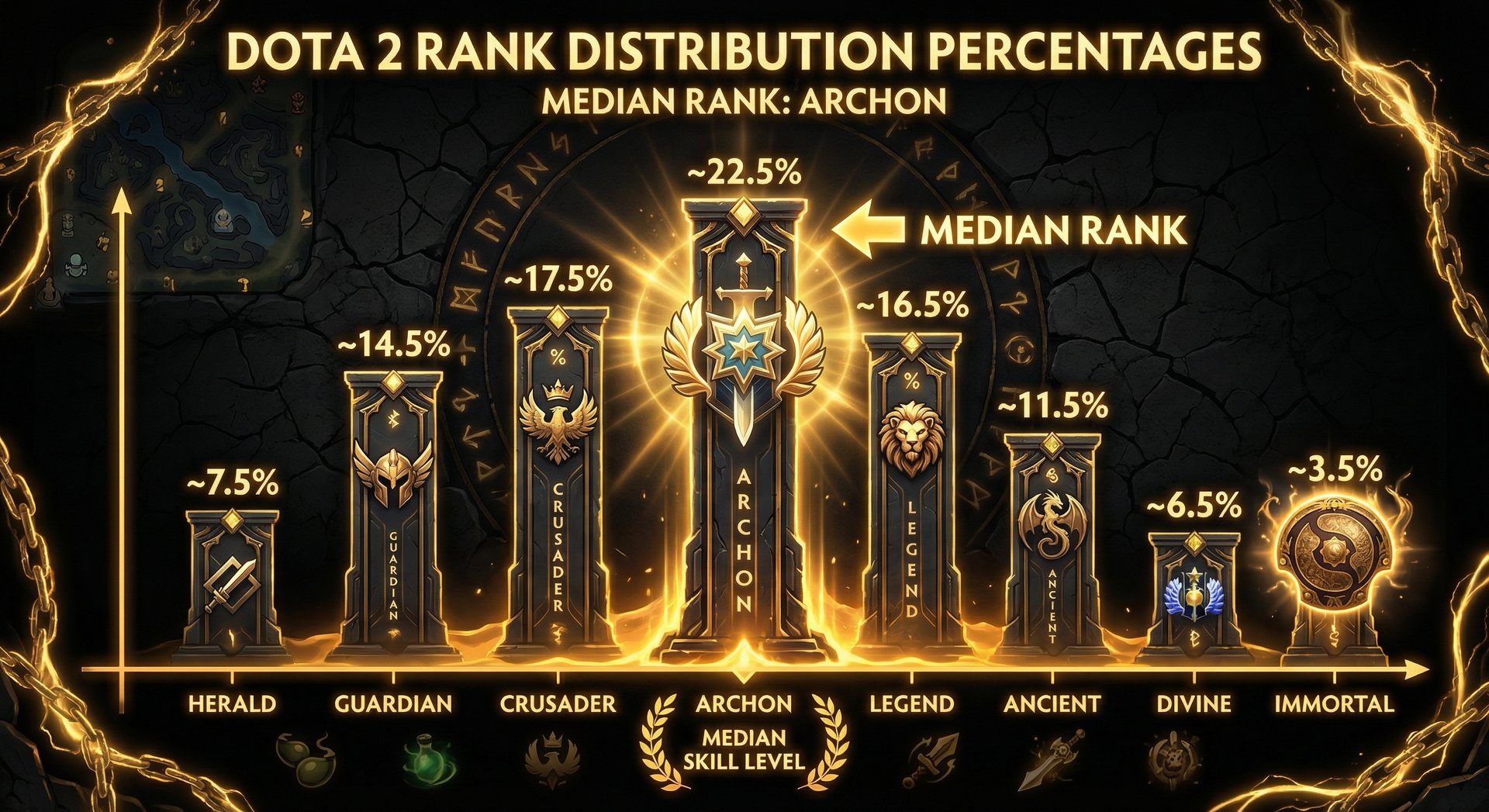
Rank Distribution Overview
Understanding where you fall in the overall player distribution helps contextualize your rank. Here’s the approximate distribution of active Dota 2 ranked players as of early 2026:
| Rank | MMR Range | % of Players | Cumulative % |
|---|---|---|---|
| Herald | 0–770 | ~5% | 5% |
| Guardian | 770–1540 | ~10% | 15% |
| Crusader | 1540–2310 | ~16% | 31% |
| Archon | 2310–3080 | ~19% | 50% |
| Legend | 3080–3850 | ~19% | 69% |
| Ancient | 3850–4620 | ~15% | 84% |
| Divine | 4620–5420 | ~10% | 94% |
| Immortal | 5420+ | ~6% | 100% |
The median Dota 2 player sits at approximately Archon 3 (~2700 MMR). If you’re Archon, you’re an average Dota 2 player — which is nothing to be ashamed of, given how complex the game is. If you’re Legend or above, you’re already better than the majority of the player base.
Want to jump from one tier to the next Our MMR boost service can get you to your target rank quickly and safely.
Herald (0–770 MMR)
Overview
Herald is the entry point of Dota 2’s ranked system. Players here are typically brand new to the game, transitioning from other MOBAs without understanding Dota’s unique mechanics, or simply playing very casually without focusing on improvement.
Percentage of players: ~5%
Star Breakdown
| Star | MMR | Description |
|---|---|---|
| Herald I | 0–154 | Absolute beginners, often still learning basic controls |
| Herald II | 154–308 | Understands basic gameplay but struggles with fundamentals |
| Herald III | 308–462 | Can play a few heroes competently |
| Herald IV | 462–616 | Starting to understand roles and lanes |
| Herald V | 616–770 | On the cusp of Guardian, developing basic game sense |
Typical Skill Level
Herald games are characterized by:
- Very low last-hit numbers (20-40 CS at 10 minutes for carries)
- No understanding of power spikes or timing windows
- Random itemization — players often follow a single build guide regardless of the enemy draft
- Minimal warding, no dewarding
- No concept of map control, smoke ganks, or Roshan timing
- Games frequently go 50+ minutes as neither team knows how to end
- Players often pick five carries with no support
Common Mistakes at Herald
- Not last-hitting: Herald players auto-attack the creep wave, pushing the lane and missing last hits. Learning to last-hit properly would instantly gain 200+ MMR.
- No TP scrolls: Players don’t carry TP scrolls, missing opportunities to respond to fights and ganks across the map.
- Fighting constantly: Herald players fight at every opportunity, even when it’s not advantageous. They don’t understand when to farm and when to fight.
- Ignoring objectives: After winning a teamfight, Herald players go back to farming instead of taking towers, Roshan, or barracks.
- No BKB: Black King Bar is the most impactful item in Dota 2, and Herald players almost never build it.
What You Need to Improve to Escape Herald
Focus on last-hitting. Seriously — this single skill improvement can take you from Herald to Guardian almost immediately. Practice in demo mode, aim for 50+ last hits at 10 minutes, and watch your MMR climb. Beyond that:
- Always carry a TP scroll
- Pick one role and learn 3-5 heroes for that role
- Buy BKB when the enemy has stuns and magic damage
- After winning a fight, hit the tower — don’t go back to jungle
Hero Recommendations for Herald
- Carry: Wraith King (simple, tanky, forgiving), Juggernaut (strong at all phases, Blade Fury is escape + damage)
- Mid: Sniper (long range, safe), Viper (dominates lane, easy to play)
- Offlane: Bristleback (tanky, hard to kill, punishes chasers), Axe (simple initiation, clears waves)
- Support: Crystal Maiden (mana aura helps team, clear spells), Ogre Magi (tanky, point-and-click stun)
Time Needed to Reach Guardian
With focused improvement on last-hitting and basic mechanics: 2-4 weeks (50-100 games). With our MMR boost: 1-2 days.
Guardian (770–1540 MMR)
Overview
Guardian players have grasped the absolute basics of Dota 2 but still have significant gaps in fundamental knowledge. They understand that supports should buy wards and carries should farm, but the execution is inconsistent. Guardian is where players start to develop habits — some good, many bad.
Percentage of players: ~10%
Star Breakdown
| Star | MMR | Description |
|---|---|---|
| Guardian I | 770–924 | Marginally better fundamentals than Herald V |
| Guardian II | 924–1078 | Starting to understand lane equilibrium |
| Guardian III | 1078–1232 | Improved last-hitting, occasional ward purchases |
| Guardian IV | 1232–1386 | Better hero understanding, still poor itemization |
| Guardian V | 1386–1540 | Approaching Crusader, developing game sense |
Typical Skill Level
- Improved last-hitting (30-50 CS at 10 minutes)
- Basic understanding of roles, though supports still often steal farm
- Occasional ward placement, but no strategic vision game
- Players start to understand that some heroes counter others, but can’t reliably counter-pick
- Team fights are chaotic — abilities are used randomly rather than strategically
- Players begin to understand power spikes but don’t play around them
Common Mistakes at Guardian
- Dying too much: Guardian players average 8-12 deaths per game. Reducing deaths to 5-6 would dramatically increase win rate.
- Inefficient farming patterns: Players farm one jungle camp, walk across the map, farm another. They don’t understand efficient farming rotations.
- No game plan: Guardian players react to what happens rather than playing proactively. They have no plan for how to win — they just play until something happens.
- Poor ability usage: Using ultimates on single targets in non-critical situations, missing skillshots, and wasting crowd control on already-dead enemies.
- Ignoring map awareness: Players rarely look at the minimap. They don’t react to missing calls and get ganked repeatedly.
What You Need to Improve to Escape Guardian
- Die less. Before every aggressive play, ask yourself: “Can I die here” If yes, don’t do it.
- Learn farming patterns — jungle camp routes that minimize downtime between camps
- Check the minimap every 5-10 seconds. Make it a habit.
- Start understanding when your hero is strong (power spikes) and play accordingly
- Buy detection (Dust, Sentries) against invisible heroes — this alone wins games in Guardian
Hero Recommendations for Guardian
- Carry: Phantom Assassin (high damage, exciting gameplay keeps you engaged), Lifestealer (built-in BKB with Rage)
- Mid: Zeus (global ultimate for assists, easy wave clear), Dragon Knight (extremely tanky, simple to play)
- Offlane: Tidehunter (game-changing ultimate, hard to kill), Centaur Warrunner (tanky, simple combo)
- Support: Lion (versatile disabler), Witch Doctor (Death Ward is devastating in low brackets)
Time Needed to Reach Crusader
With conscious improvement: 3-6 weeks (100-200 games). With coaching: 2-3 weeks.
Crusader (1540–2310 MMR)
Overview
Crusader is where Dota 2 starts to feel like an actual game rather than a chaotic brawl. Players at this rank understand the basic framework — lanes, roles, power spikes, objectives — but their execution remains inconsistent. Crusader is often considered the “beginner plateau” where players who learned the basics get stuck because they haven’t developed deeper mechanical or strategic skills.
Percentage of players: ~16%
Star Breakdown
| Star | MMR | Description |
|---|---|---|
| Crusader I | 1540–1694 | Solid basics, starting to develop game sense |
| Crusader II | 1694–1848 | Understands laning phase, improving farm efficiency |
| Crusader III | 1848–2002 | Can execute basic combos and teamfight strategies |
| Crusader IV | 2002–2156 | Better map awareness, occasional smart rotations |
| Crusader V | 2156–2310 | Approaching Archon, developing strategic thinking |
Typical Skill Level
- Reasonable last-hitting (40-60 CS at 10 minutes)
- Players understand their hero’s spells and can execute basic combos
- Support players buy wards consistently but placement is often suboptimal
- Carries understand the concept of farming efficiently but waste time
- Team fights are more organized — players group up before fights, though coordination is still limited
- Players start to understand drafting (picking heroes that synergize and counter enemies)
Common Mistakes at Crusader
- Tunnel vision in fights: Players focus on one target and ignore the bigger picture. They’ll chase a support through the enemy team while the carry kills them.
- Static farming: Carry players farm one area of the map and don’t rotate. They miss opportunities to push lanes and create space.
- Not using smoke: Smoke of Deceit is almost never purchased in Crusader. Teams fight without it, giving away their position on the minimap.
- Inflexible itemization: Players follow the same item build every game regardless of what the enemy is doing. They don’t adapt.
- Tilting: Crusader players are particularly prone to tilting — giving up after losing one or two fights and typing “gg” at 15 minutes.
What You Need to Improve to Escape Crusader
- Learn to use smoke of Deceit. Coordinated smoke ganks win games in Crusader because nobody expects them.
- Improve farming efficiency — aim for 60+ CS at 10 minutes and maintain 7+ CS per minute throughout the game
- Adapt your item build based on the enemy draft. Build Spirit Vessel against healers, Blade Mail against burst damage, etc.
- Stop chasing kills. If someone is running away, let them go and take an objective instead.
- Learn 2-3 heroes really well rather than playing 20 heroes poorly
Hero Recommendations for Crusader
- Carry: Faceless Void (Chronosphere wins teamfights), Slark (snowball potential, hard to kill)
- Mid: Queen of Pain (mobile, strong burst), Lina (versatile, can play any role)
- Offlane: Mars (team fight control, arena is intuitive), Underlord (tanky, global escape)
- Support: Shadow Shaman (push potential, reliable disables), Jakiro (strong laner, great teamfighter)
Time Needed to Reach Archon
With focused improvement: 1-2 months (150-300 games). With our Dota 2 coaching service: 3-4 weeks.
Archon (2310–3080 MMR)
Overview
Archon is the median rank in Dota 2 — roughly half of all ranked players are at or below Archon. Players here have a solid foundation but lack the deeper mechanical skill and strategic understanding needed to break into higher brackets. Archon is where many players spend the majority of their Dota 2 career, and it’s often where the most frustrating games happen because player skill variance within Archon is surprisingly wide.
Percentage of players: ~19%
Star Breakdown
| Star | MMR | Description |
|---|---|---|
| Archon I | 2310–2464 | Average player, solid understanding of the game |
| Archon II | 2464–2618 | Improved mechanical skills, better decision-making |
| Archon III | 2618–2772 | Median Dota 2 player — the “true average” |
| Archon IV | 2772–2926 | Starting to develop advanced understanding |
| Archon V | 2926–3080 | On the cusp of Legend, noticeably better than lower Archons |
Typical Skill Level
- Decent last-hitting (50-65 CS at 10 minutes)
- Players understand most hero abilities and can predict enemy spell usage
- Supports buy and place wards in reasonable locations
- Basic understanding of Roshan timing and its importance
- Team coordination exists but is inconsistent — sometimes brilliant, sometimes nonexistent
- Players understand drafting and will sometimes counter-pick
- Itemization is generally appropriate but not optimized
Common Mistakes at Archon
- Not pressing advantages: Archon players win a teamfight and then… farm. They don’t push towers, take Roshan, or invade enemy jungle. The advantage evaporates.
- Poor positioning in fights: Carries stand in front, supports hide in back. Positioning is often reversed from what it should be.
- Inconsistent lane performance: One game they dominate the lane, next game they lose it horribly. The difference is usually matchup knowledge — they don’t understand how different heroes interact.
- Overestimating their hero: Archon players frequently take fights they can’t win because they misjudge their hero’s current power level relative to the enemy.
- No shot-calling: Games often devolve into 5 players doing 5 different things. Nobody coordinates objectives or movement.
What You Need to Improve to Escape Archon
- Push after every won fight. Make it an iron rule: teamfight win → take an objective (tower, Roshan, barracks). Never just go back to farming.
- Learn proper positioning for your role. Carries should be behind the frontline, supports should be on the edges.
- Study hero matchups. Know which lanes your hero wins and loses, and adjust your playstyle accordingly.
- Start using the chat wheel or microphone to coordinate. Simple calls like “push now” or “back” make a huge difference.
- Watch replays of your losses and identify the moment the game slipped. Usually, it’s a single bad fight or a missed opportunity to push.
Hero Recommendations for Archon
- Carry: Phantom Lancer (strong late-game, punishes teams without AoE), Terrorblade (farming speed, strong pusher)
- Mid: Spirit Breaker (roaming mid, creates chaos), Puck (high skill ceiling, elusive)
- Offlane: Beastmaster (vision, strong push, reliable stun), Doom (removes any hero from fights)
- Support: Rubick (versatile, game-changing steals), Disruptor (Glimpse punishes Archon positioning)
Time Needed to Reach Legend
With dedicated improvement: 2-3 months (200-400 games). This is where climbing starts to get significantly harder because you need deeper understanding, not just mechanical improvement. Our coaching service is especially valuable at this rank.
Legend (3080–3850 MMR)
Overview
Legend players are above average. They understand the game at a meaningful level — they know how to draft, how to lane, how to farm efficiently, and how to take objectives. The issue isn’t knowledge — it’s consistency. Legend players have good games where they play like Ancients and bad games where they play like Crusaders. The difference between Legend and Ancient is consistency of execution.
Percentage of players: ~19%
Star Breakdown
| Star | MMR | Description |
|---|---|---|
| Legend I | 3080–3234 | Above-average player, competent at all phases |
| Legend II | 3234–3388 | Good mechanical skills, improving game sense |
| Legend III | 3388–3542 | Strong understanding of power spikes and timing |
| Legend IV | 3542–3696 | Consistent performance, approaching high-level play |
| Legend V | 3696–3850 | On the cusp of Ancient, noticeably skilled |
Typical Skill Level
- Good last-hitting (60-75 CS at 10 minutes for mid/carry)
- Understanding of drafting, including counter-picks and synergy
- Supports play the vision game — dewarding, strategic ward placement
- Players understand Roshan timing and contest it
- Smoke ganks happen occasionally
- Players can execute multi-step combos reliably
- Some understanding of map pressure and lane manipulation
Common Mistakes at Legend
- Inconsistency: The defining issue of Legend. Players perform well when comfortable but fall apart under pressure or in unfamiliar situations.
- Ego drafting: Picking their “main” hero regardless of the draft instead of what the team needs.
- Not playing around BKB timings: BKB charges deplete over the game. Legend players don’t track this or play around it.
- Poor high-ground play: Both attacking and defending high ground are weak points. Players either throw leads by diving into high ground or lose games by not defending it properly.
- Neglecting buyback: Not holding gold for buyback in critical late-game moments, leading to uncontested pushes when they die.
What You Need to Improve to Escape Legend
- Consistency. Play the same heroes, in the same role, with the same approach every game. Reduce variance in your performance.
- Master high-ground defense and siege. Know when to fight and when to wait for the next creep wave.
- Track enemy BKB charges. Know when the enemy carry’s BKB is down to 5 seconds and play around that timing.
- Always hold buyback gold after minute 30. Dying without buyback in the late game loses games.
- Review your replays. Specifically, watch the 5 minutes before you lost a game-deciding fight. You’ll find the mistake.
Hero Recommendations for Legend
- Carry: Morphling (extremely high ceiling, scales well), Naga Siren (split push, carries games)
- Mid: Storm Spirit (mobility, pickoff potential), Ember Spirit (versatile builds)
- Offlane: Enigma (game-winning Black Hole, strong farmer), Sand King (team fight, reliable stun)
- Support: Treant Protector (global heal, vision with Eyes in the Forest), Grimstroke (high damage, good setup)
Time Needed to Reach Ancient
With focused effort: 2-4 months (200-500 games). The Legend-to-Ancient gap is where many players plateau long-term. Consider coaching or a calibration service to get past this hurdle.
Ancient (3850–4620 MMR)
Overview
Ancient is where Dota 2 gets serious. Players at this rank have strong mechanical skills, good game knowledge, and a strategic understanding that approaches competitive-level play. Ancient is the rank where people start to “understand Dota” — not just know the mechanics, but comprehend the deeper strategic layer of the game.
Percentage of players: ~15%
Star Breakdown
| Star | MMR | Description |
|---|---|---|
| Ancient I | 3850–4004 | Strong player, understands advanced concepts |
| Ancient II | 4004–4158 | Consistent high-level play, good decision-making |
| Ancient III | 4158–4312 | Very skilled, approaching the top 20% of players |
| Ancient IV | 4312–4466 | Near-Divine level, strong in all phases of the game |
| Ancient V | 4466–4620 | On the cusp of Divine — top ~16% of players |
Typical Skill Level
- Strong last-hitting (70-85 CS at 10 minutes for mid/carry)
- Sophisticated drafting — understanding of meta, counter-picks, and team compositions
- Active vision game — dewarding with sentries, placing aggressive and defensive wards
- Smoke ganks are common and often well-executed
- Players understand and play around power spikes and item timings
- Team fights are more coordinated — players initiate with purpose and target correctly
- Roshan is regularly contested with both teams fighting over it
Common Mistakes at Ancient
- Overconfidence: Ancient players are good enough to pull off flashy plays — but they try them too often. The 50/50 play that works half the time is worse than the safe play that works 80% of the time.
- Poor support play: Even at Ancient, many support players don’t understand their role in the late game. They either play too aggressively (dying first in fights) or too passively (not using spells at all).
- Item timing awareness: Players don’t track enemy item timings. They get surprised by a Blink Dagger, BKB, or Linkens Sphere that they should have anticipated.
- Not punishing mistakes: Ancient players see enemy mistakes but don’t capitalize on them quickly enough. The window passes and the opportunity is lost.
- Emotional decision-making: Tilting, revenge plays, and ego-driven decisions still happen frequently at Ancient.
What You Need to Improve to Escape Ancient
- Play more safely. Reduce unnecessary deaths. Every death in Ancient is punished harder than in lower brackets.
- Track enemy item timings. Know when the enemy mid is about to finish BKB and play around it.
- Improve your support play if you queue support. Understanding late-game support positioning is a massive edge.
- Capitalize on enemy mistakes immediately. See an enemy out of position Punish it within 3 seconds or the window closes.
- Watch pro players play your heroes and study their decision-making, not just their mechanics.
Hero Recommendations for Ancient
- Carry: Anti-Mage (farming speed, split push), Spectre (global presence, late-game monster)
- Mid: Templar Assassin (tempo control), Invoker (versatility)
- Offlane: Puck (elusive, great initiation), Batrider (reliable pickoff)
- Support: Earth Spirit (high impact, roaming), Io (if you have a duo partner)
Time Needed to Reach Divine
With serious effort: 3-6 months (300-600 games). This is one of the hardest jumps in Dota 2 because the skills needed become very nuanced. Our MMR boosting service can handle this climb efficiently.
Divine (4620–5420 MMR)
Overview
Divine players are in the top 6-16% of all Dota 2 players. At this rank, you’re playing with and against people who genuinely understand the game at a deep level. Divine games feature organized team play, sophisticated drafting, efficient farming, coordinated smoke ganks, and strategic Roshan fights. The margin for error is slim.
Percentage of players: ~10%
Star Breakdown
| Star | MMR | Description |
|---|---|---|
| Divine I | 4620–4780 | Top-tier pub player, strong in all aspects |
| Divine II | 4780–4940 | Highly skilled, competitive-level understanding |
| Divine III | 4940–5100 | Near-Immortal play, very few weaknesses |
| Divine IV | 5100–5260 | Exceptional player, approaching leaderboard level |
| Divine V | 5260–5420 | On the cusp of Immortal — top ~6% of players |
Typical Skill Level
- Excellent last-hitting (80-95 CS at 10 minutes for mid/carry)
- Deep understanding of meta, drafting, and team compositions
- Organized team play with coordinated rotations and objective-focused decisions
- Strong vision game — both wards and counter-wards
- Players understand lane manipulation (creep pulling, aggro, equilibrium)
- Efficient farming patterns — carries maintain 8-10 CS per minute consistently
- Team fights are well-executed with proper focus fire and spell sequencing
Common Mistakes at Divine
- Mechanical limits: At Divine, game knowledge is no longer the bottleneck — mechanical execution is. Players know what to do but can’t always execute it perfectly under pressure.
- Meta rigidity: Some Divine players follow the meta too rigidly. They pick whatever’s popular without understanding why it’s strong, and can’t adapt when the meta shifts.
- Tilt spirals: The pressure of being close to Immortal causes many Divine players to go on massive losing streaks. Emotional management becomes critical.
- Not abusing opponent weaknesses: Divine players respect their opponents too much. They play “standard” Dota instead of exploiting specific weaknesses in the enemy draft or execution.
What You Need to Improve to Escape Divine
- Perfect your mechanics. Practice combos, last-hitting, and micro in demo mode. The Immortal edge is often pure mechanical superiority.
- Study the meta deeply. Understand why heroes are strong, not just which heroes are strong.
- Manage your mental state. Take breaks after losses. Don’t queue tilted. Stop playing after 2 consecutive losses.
- Find a consistent party to queue with. Coordinated play has a significant edge at this bracket.
- Specialize. Be the best at 3-5 heroes rather than good at 15.
Hero Recommendations for Divine
- At Divine, hero recommendations become less relevant — play what you’re best at and what fits the meta. The key is mastery of your chosen heroes, not hero selection.
Time Needed to Reach Immortal
With dedicated effort: 3-12 months (500-1000+ games). Many players spend years in Divine without reaching Immortal. It’s the hardest rank transition in Dota 2. Our MMR boost service handles Divine-to-Immortal climbs regularly.
Immortal (5420+ MMR)
Overview
Immortal is the pinnacle of Dota 2 matchmaking. Players here are in the top ~6% of all ranked players, and the top of Immortal includes professional players, streamers, and the best pub players in the world. Unlike other ranks, Immortal doesn’t have stars — instead, it has a leaderboard system that ranks the top players in each region.
Percentage of players: ~6%
MMR Ranges Within Immortal
| Tier | MMR | Description |
|---|---|---|
| Immortal (no number) | 5420–6000 | Entry-level Immortal — strong but not leaderboard |
| Immortal (numbered) | 6000–8000 | Leaderboard Immortal — ranked within the region |
| Top 1000 | ~7000+ | Elite players, many semi-professional |
| Top 100 | ~8500+ | Predominantly professional players and top streamers |
| Top 10 | ~10000+ | Best players in the region, all professional-level |
Typical Skill Level
- Near-perfect last-hitting (90+ CS at 10 minutes)
- Complete understanding of all game mechanics, hero interactions, and meta trends
- Excellent communication and team coordination
- Strategic depth — understanding of lane priority, map resources, and game tempo
- High APM (actions per minute) and mechanical proficiency
- Creative, unpredictable plays that exploit opponent habits
- Efficient use of every second — minimal downtime between actions
The Reality of Immortal
Reaching Immortal is the goal for many Dota 2 players, but it’s important to understand that Immortal has enormous skill variance within it. A 5500 MMR Immortal player and a 10,000 MMR Immortal player are separated by a skill gap that’s arguably larger than the gap between Herald and Ancient. The “Immortal” medal encompasses a massive range of skill levels.
If reaching Immortal is your goal, Team Smurf can help. Our MMR boost service is handled by players who aren’t just Immortal — they’re top-500, top-100, and even top-10 leaderboard players with years of competitive experience.
Medal Calibration & Recalibration
Initial Calibration
When you first play ranked Dota 2, you must complete 10 calibration matches. During these matches, the system evaluates your performance using metrics including:
- Win/loss results (the primary factor)
- Your hidden unranked MMR (used as a starting baseline)
- Personal performance metrics (KDA, GPM, damage, etc. — secondary factors)
After 10 matches, you receive your initial medal. Most new players calibrate between Herald and Crusader, depending on their prior MOBA experience and natural talent.
Seasonal Recalibration
Every season (typically every ~6 months), medals are reset and you must recalibrate. Here’s how it works:
- Your MMR is NOT reset to zero. Your existing MMR is used as the baseline.
- You play 10 recalibration matches
- Each match can adjust your MMR by approximately ±75 MMR (instead of the normal ±25-30)
- This means recalibration can swing your MMR by up to ±750 over 10 games
- Performance matters slightly more during calibration than normal matches
Recalibration is an opportunity to jump ranks if you’ve improved significantly since last season. It’s also why our calibration service is so popular — winning all 10 calibration matches can give you a significant MMR boost that would take 50+ normal games to achieve.
Tips for Maximizing Calibration Results
- Play your best heroes — don’t experiment during calibration
- Focus on winning, not personal stats (though stats can help at the margins)
- Play at your optimal time of day when you’re alert and focused
- Avoid queuing tilted — take a break between calibration losses
- Consider our calibration service if you want to ensure the best possible starting point
Party vs Solo MMR & Medals
Unified MMR System
As of the current system, Dota 2 uses a unified MMR. You have one MMR number regardless of whether you queue solo or with a party. This is a significant change from the old system that had separate solo and party MMR.
How Party Size Affects Matchmaking
- Solo queue: Matched with other solo players and small parties. Generally considered the “purest” measure of skill.
- 2-stack: Matched normally. One player queues core, one queues support.
- 3-stack: Can be matched with 2-stacks or a 3+2 combination.
- 5-stack: Matched exclusively against other 5-stacks. Games tend to be more coordinated and strategic.
Medal Display
Your medal represents your peak MMR during the season regardless of party size. However, when you’re in a party with players significantly above your rank, matchmaking adjusts the average MMR upward to compensate for the coordination advantage of partying with higher-ranked players.
Rank Restrictions
Dota 2 restricts party queuing for ranked based on rank disparity:
- You can only queue ranked with players within approximately 2800 MMR of your own
- Immortal players have additional restrictions on party size
- These restrictions prevent boosting through party queue
Regional Differences
Not all regions are created equal. The same MMR can represent different skill levels depending on the server:
| Region | Server | Skill Level Perception | Queue Times | Notes |
|---|---|---|---|---|
| Europe West | Luxembourg | High | Short | One of the strongest servers, many professional players |
| Southeast Asia | Singapore | High | Short | Very competitive, aggressive playstyle |
| China | Shanghai/Guangzhou | Very High | Short | Separate client, generally considered the strongest server |
| US East | Virginia | Medium-High | Short | Most popular NA server |
| US West | Washington | Medium | Medium | Smaller player pool than US East |
| South America | São Paulo | Medium | Short | Growing competitive scene |
| Russia | Stockholm | High | Short | Strong player base, aggressive play |
A 5000 MMR player on EU West or China is generally considered stronger than a 5000 MMR player on US West or South America, though this is debatable and varies by individual. The key factor is the size of the player pool — larger pools mean more competition and generally higher skill levels at equivalent MMR.
The Immortal Leaderboard System
How It Works
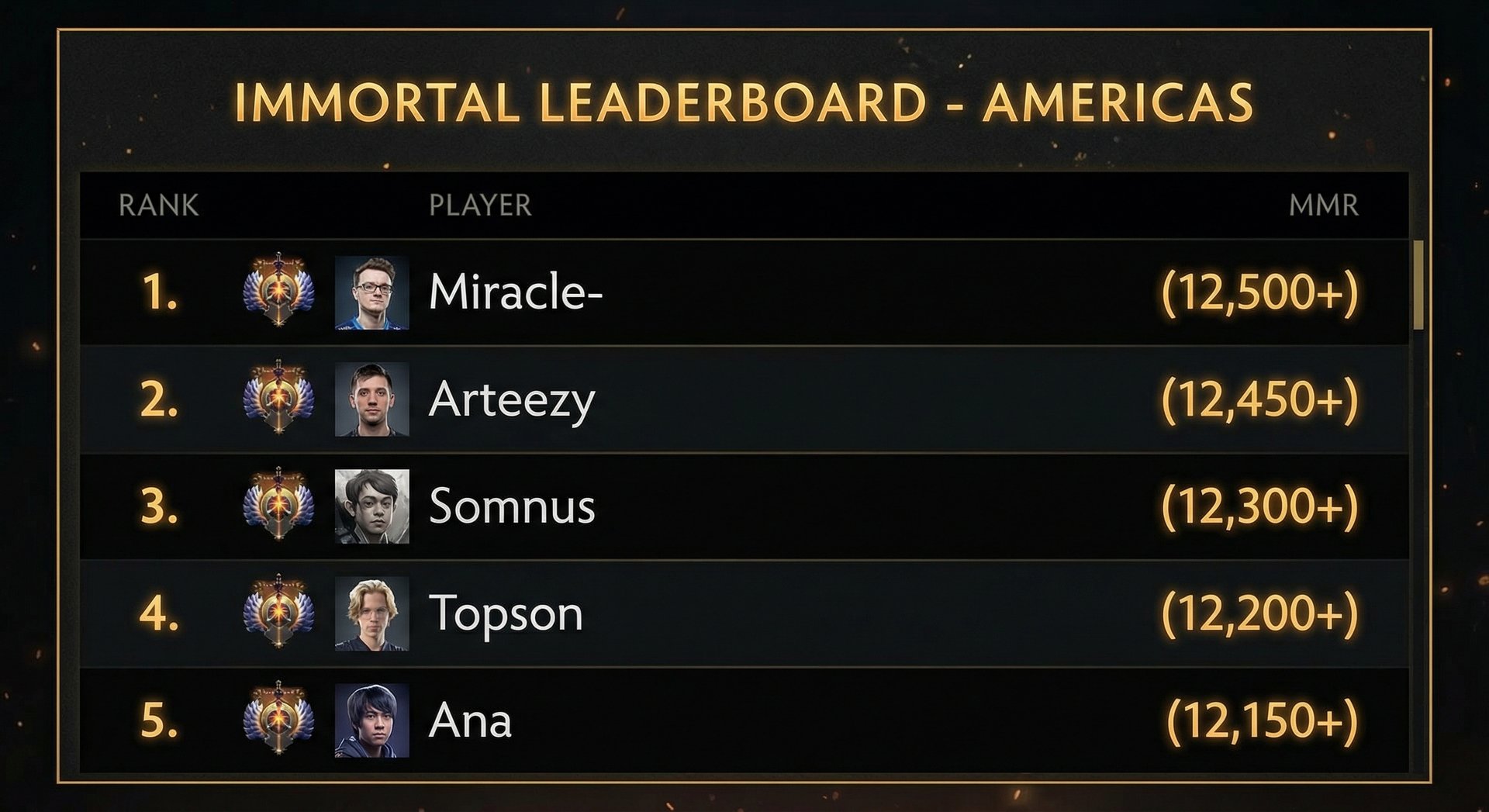
Once you reach approximately 6000+ MMR, you become eligible for the regional Immortal leaderboard. Your rank number is displayed on your medal (e.g., “Immortal #547”). The leaderboard ranks players within each region separately.
Requirements for Leaderboard
- Must have a connected phone number
- Must play at least 300 ranked matches in the current season
- Must be playing on the primary server for their region
- Profile must be set to public
- Must maintain a minimum game activity (play regularly)
How Rankings Are Determined
The leaderboard is based purely on MMR. Higher MMR = higher rank position. Rankings update in real-time as players win and lose games. The #1 player on each regional leaderboard is typically a professional player or dedicated full-time pub player with MMR exceeding 12,000+.
Leaderboard Seasons
The leaderboard resets with each ranked season. Players must recalibrate and meet activity requirements to appear on the new leaderboard. This prevents inactive players from holding top positions indefinitely.
General Tips for Climbing Any Bracket
Regardless of your current rank, these principles apply universally:
- Specialize in a role and 3-5 heroes. Versatility is overrated for climbing. Master a small pool and dominate with it.
- Play at consistent times. Queue at the same time each day for more consistent matchmaking quality.
- Stop after 2 losses in a row. Tilt is the #1 MMR destroyer. Take a 30-minute break minimum.
- Focus on objectives, not kills. Towers, Roshan, and barracks win games. Kills are just a means to take objectives.
- Watch your own replays. You’ll cringe, but you’ll learn. Focus on why you died and what you could’ve done differently.
- Mute toxic players immediately. Engaging with toxicity tilts you and wastes mental energy.
- Communicate positively. A simple “nice job” or “let’s push” goes a long way toward team morale and coordination.
For more detailed strategies on climbing MMR, check out our comprehensive guide on how our coaching service helps players rank up, or explore our MMR boost options if you want professional help reaching your desired rank.
Frequently Asked Questions
Ready to Climb Start Your Boost Today
Team Smurf is the #1 rated Dota 2 boosting service in 2026. Immortal-rank boosters, maximum safety, competitive pricing, 24/7 support.
Get MMR Boost
Calibration Service
Pro Coaching
Final Thoughts
The Dota 2 ranking system is one of the most comprehensive and nuanced in all of competitive gaming. From the chaotic trenches of Herald to the rarefied air of top-100 Immortal, each bracket represents a meaningful jump in skill, knowledge, and execution. Understanding where you stand, what you need to improve, and what the path forward looks like is the first step toward climbing.
No matter where you are in your Dota 2 journey, Team Smurf is here to help:
- MMR Boosting — Professional climbers take your account to your desired rank
- Calibration Services — Maximize your calibration matches for the best possible starting rank
- Coaching — Learn from Immortal-rank analysts who can identify and fix your weaknesses
- Low Priority Removal — Get back to ranked without wasting time
Written by Team Smurf’s Immortal-rank analysts — Rankings last verified February 2026