Dota 2 Calibration Guide: How to Maximize Your Placement Rank

Your calibration games are the highest-leverage matches you’ll play all season. Ten games. That’s it. And those ten games determine your starting MMR for an entire ranked season — a number that could take you hundreds of additional games to significantly change afterward.
Yet most players treat calibration like any other set of ranked games. They queue up casually, pick whatever they feel like, and then complain about their placement for the rest of the season. This is a massive mistake.
This guide is your complete calibration playbook. We’ll cover exactly how calibration works under the hood, which heroes give you the best chance of winning, how to prepare before your first calibration game, when to calibrate for optimal results, and the critical differences between new account calibration and seasonal recalibration. By the end, you’ll have a concrete strategy for maximizing every one of those ten crucial games.
And if you’d rather guarantee results TeamSmurf’s calibration service puts professional players on your account for those 10 games, ensuring you start the season at the highest possible rank.
Table of Contents
- How Calibration Actually Works (Deep Dive)
- New Account Calibration vs. Recalibration
- Pre-Calibration Preparation (Before You Queue)
- Best Heroes for Calibration by Role
- When to Calibrate: Timing Your Games
- During Calibration: Game-by-Game Strategy
- 10 Common Calibration Mistakes
- After Calibration: What to Do Next
- The Case for Professional Calibration
- FAQ
How Calibration Actually Works (Deep Dive)
Before we talk strategy, you need to understand the mechanics. Calibration isn’t magic — it’s a mathematical process with specific rules that you can exploit once you understand them.
The Starting Point: Your Hidden MMR
Calibration doesn’t start from zero. The system uses a starting estimate based on:
- For new accounts: Your unranked (hidden) MMR, which has been tracked since your very first unranked game.
- For recalibration: Your previous season’s ending MMR, with a slight uncertainty increase.
This means your calibration outcome is heavily anchored to where you already are. A player with 3,000 hidden MMR who goes 7-3 in calibration will not suddenly jump to 5,000. They’ll likely end up around 3,200-3,400. The 10 games adjust your starting point — they don’t override it entirely.
The Uncertainty Amplifier
As we covered in our MMR system explainer, the system uses uncertainty values (similar to Glicko-2’s Rating Deviation). During calibration, your uncertainty is set to a high value, which means:
- Each game’s result has a larger effect on your MMR than a normal ranked game.
- Estimated MMR change per calibration game: 50-150 MMR (compared to ~25-30 in normal games).
- Early calibration games may have slightly larger impact than later ones, as your uncertainty decreases with each game.
- Going 10-0 in calibration could potentially gain you 500-1,500 MMR above your starting estimate.
What the System Measures
During calibration, the system considers:
| Factor | Weight | Evidence Level |
|---|---|---|
| Win/Loss outcome | Primary (dominant) | Confirmed by extensive data |
| Individual performance metrics | Secondary (minor adjustment) | Suspected but not confirmed by Valve |
| Hero damage, tower damage, healing | Possible minor factor | Anecdotal evidence; disputed |
| KDA ratio | Possible minor factor | Anecdotal evidence; disputed |
| GPM/XPM relative to role | Possible minor factor | Suspected for role-specific calibration |
The bottom line: Winning is overwhelmingly the most important factor. If performance metrics play any role at all, they’re a small adjustment — maybe 50-100 MMR over the entire calibration. Don’t sacrifice winning for stat-padding.
The Mathematical Ceiling and Floor
Calibration has boundaries:
- New account ceiling: New accounts appear to be capped at approximately 6,000-6,500 MMR from calibration alone, regardless of how well you perform. This prevents instant Immortal placements.
- Recalibration range: Seasonal recalibration typically adjusts your MMR by no more than +/- 500-750 MMR from your previous season’s ending point.
- Minimum floor: You can’t calibrate below ~0 MMR (Herald 1).
New Account Calibration vs. Recalibration
These are fundamentally different processes, and your strategy should differ accordingly.
New Account Calibration
Who this applies to: Players creating a new account or playing ranked for the first time.
Key characteristics:
- High starting uncertainty — The system doesn’t know where you belong, so calibration games have massive impact.
- Anchored to unranked MMR — Your unranked performance sets the baseline. If you played 100 unranked games and performed at a 3,000 MMR level, calibration starts there.
- Wider possible outcome range — You could plausibly calibrate anywhere from 1,000 to 6,000+ depending on your unranked history and calibration results.
- Each game matters enormously — Each win or loss could shift your final placement by 75-150 MMR.
Strategy implications:
- Your unranked games matter. Before even touching ranked, ensure your unranked performance reflects your true skill level. Playing 50+ unranked games on your best heroes establishes a strong baseline.
- Go for wins at all costs. Performance metrics are a minor factor at best — focus entirely on winning those 10 games.
- Pick comfort heroes, not experimental ones. This is not the time to learn a new hero.
Seasonal Recalibration
Who this applies to: Existing ranked players at the start of a new season.
Key characteristics:
- Lower uncertainty than new accounts — The system already has extensive data on you.
- Tightly anchored to previous MMR — Your ending MMR from last season is the primary anchor.
- Narrower outcome range — Realistically, you’ll end up within ~500 MMR of where you started.
- Still more impactful than regular games — Each calibration game is worth roughly 2-3x a normal game.
Strategy implications:
- Treat it as an opportunity, not a formality. If you’ve improved during the off-season, this is your chance to jump without grinding hundreds of games.
- Don’t calibrate on day one. Wait for the meta to stabilize and the initial chaotic queue to settle (more on timing below).
- Spam your highest win-rate heroes. Check your recent stats — which heroes have you been winning the most on Those are your calibration heroes.
Pre-Calibration Preparation (Before You Queue)
The most overlooked aspect of calibration is what you do before you queue. Preparation can make the difference between calibrating at your deserved rank and calibrating 300-500 MMR below it.
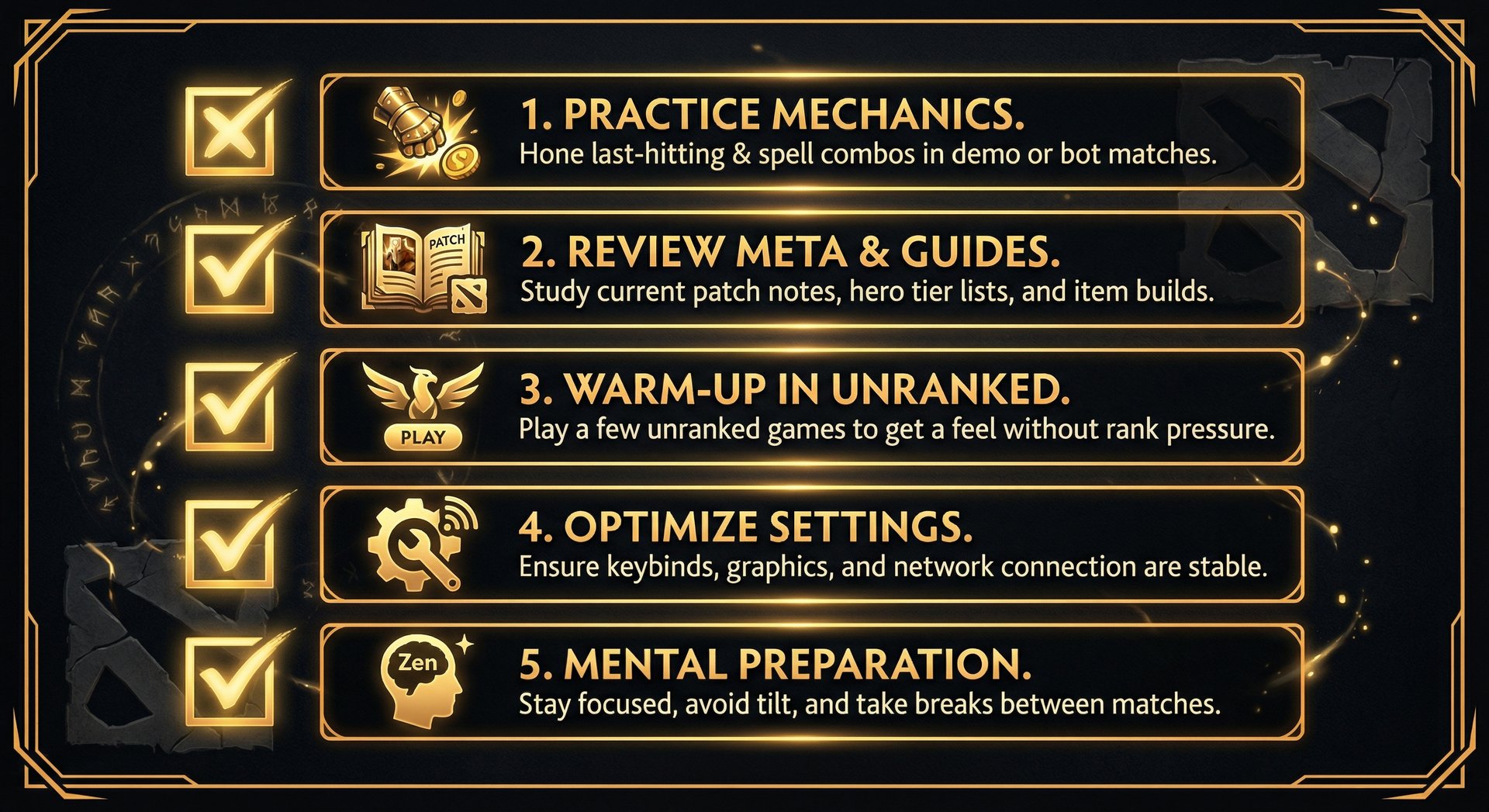
Step 1: Warm Up (2-3 Unranked Games)
Never go into calibration cold. Play 2-3 unranked or turbo games to:
- Get your mechanics warmed up (last-hitting, spell combos, camera control)
- Check your reaction times and decision-making
- Test your internet connection for stability
- Get into the right mental state
If your warm-up games feel terrible — you’re making mistakes, losing lanes, and getting frustrated — stop and try again tomorrow. Playing calibration in a tilted or unfocused state is the #1 cause of bad placements.
Step 2: Check the Current Meta
Before calibrating, spend 30-60 minutes reviewing the current meta:
- Check win rates on Dotabuff — Which heroes have the highest win rates in your bracket
- Read recent patch notes — Were any heroes buffed or nerfed since you last played
- Watch 1-2 high-MMR replays — What heroes and strategies are dominating at the top
- Check our hero tier list for climbing — Updated for the current meta.
Step 3: Prepare Your Hero Pool
Before calibration, identify 3-5 heroes per role that you’re comfortable on AND that are strong in the current meta. Create a short list:
| Role | Primary Pick | Secondary Pick | Backup |
|---|---|---|---|
| Carry (Pos 1) | Your best carry | Meta carry | Versatile pick |
| Mid (Pos 2) | Your best mid | Meta mid | Safe laner |
| Offlane (Pos 3) | Your best offlaner | Teamfight initator | Aura carrier |
| Soft Support (Pos 4) | Your best pos 4 | Roaming hero | Greedy support |
| Hard Support (Pos 5) | Your best pos 5 | Save/heal hero | Lane dominator |
The goal: no matter what role you get or what the draft requires, you have a practiced, comfortable hero ready.
Step 4: Optimize Your Setup
Technical preparation matters:
- Stable internet — Run a speed test. If your ping is above 80ms, consider switching servers or waiting for off-peak hours.
- No distractions — Close unnecessary programs, silence your phone, and make sure you won’t be interrupted for ~60 minutes per game.
- Comfortable environment — Proper lighting, comfortable chair, and a glass of water. This sounds trivial, but physical comfort directly affects focus and decision-making.
- Fresh mindset — Don’t calibrate after a bad day at work, an argument, or when you’re sleep-deprived. Your mental state affects your gameplay more than any hero pick.
Step 5: Check Your Behavior Score
Your behavior score affects the quality of teammates you get during calibration. Before starting:
- Ensure your behavior score is 9,000+ (ideally 10,000).
- If it’s below 8,000, play unranked games to improve it first.
- If you’re in low priority, get out before even thinking about calibration.
Best Heroes for Calibration by Role
The best calibration heroes share specific characteristics:
- High win rate in the current meta — Riding the meta wave gives you a statistical advantage.
- Game-carrying potential — Heroes that can take over games and secure wins even with underperforming teammates.
- Consistency — Heroes that perform well across a variety of drafts and matchups, without needing a perfect team composition.
- Your comfort level — A “B-tier” hero you’ve played 200 games on will outperform an “S-tier” hero you’ve played 5 games on.
Position 1 (Carry) — Best Calibration Picks
| Hero | Why for Calibration | Best At |
|---|---|---|
| Faceless Void | Chronosphere can single-handedly win teamfights regardless of team coordination | All brackets |
| Phantom Assassin | Snowball carry that can dominate once she gets BKB; punishes uncoordinated teams | Below Divine |
| Juggernaut | Safe laning phase, built-in magic immunity, strong at all stages of the game | All brackets |
| Wraith King | Simple to execute, hard to kill, punishes enemies who don’t focus you | Below Ancient |
| Luna | Fast farming, strong push, excellent teamfight with Eclipse | All brackets |
Position 2 (Mid) — Best Calibration Picks
| Hero | Why for Calibration | Best At |
|---|---|---|
| Spirit Void | High skill ceiling, dominates mid game if you can execute combos | Legend+ |
| Huskar | Lane dominator, early Roshan timing, crushes specific matchups | Below Divine |
| Zeus | Massive damage output, global presence, can carry from mid without perfect farm | All brackets |
| Templar Assassin | Lane winner, fast Roshan, snowball potential with early Desolator | All brackets |
| Invoker | Extremely versatile, strong in skilled hands, relevant at every stage | Ancient+ |
For a complete breakdown of mid heroes with matchup analysis, see our Best Mid Heroes tier list.
Position 3 (Offlane) — Best Calibration Picks
| Hero | Why for Calibration | Best At |
|---|---|---|
| Beastmaster | Aura + push + vision; provides value even when team isn’t coordinated | All brackets |
| Axe | Blink + Call wins teamfights; punishes grouped enemies | Below Divine |
| Tidehunter | Ravage is arguably the best teamfight ultimate; hard to mess up | All brackets |
| Underlord | Lane dominator, aura carrier, excellent push; highly self-sufficient | Below Ancient |
| Centaur Warrunner | Tanky, good initiation, Stampede saves your entire team | All brackets |
Position 4 (Soft Support) — Best Calibration Picks
| Hero | Why for Calibration | Best At |
|---|---|---|
| Mirana | Arrow stuns, Sacred Arrow sets up kills; transition into damage dealer | All brackets |
| Rubick | Spell Steal provides incredible outplay potential; high skill ceiling | Legend+ |
| Earth Spirit | Game-winning roaming if you’re skilled; dominates early-mid game | Ancient+ |
| Spirit Breaker | Global pressure, simple execution, constant ganking presence | Below Divine |
| Hoodwink | Long-range damage, Bushwhack stun, Scurry for survivability | All brackets |
Position 5 (Hard Support) — Best Calibration Picks
| Hero | Why for Calibration | Best At |
|---|---|---|
| Warlock | Fatal Bonds + Chaotic Offering is devastating; heals keep team alive | Below Ancient |
| Jakiro | Strong laning, excellent push, Ice Path is a powerful teamfight tool | All brackets |
| Dazzle | Shallow Grave prevents deaths, Weave is fight-winning, strong laner | All brackets |
| Shadow Shaman | Hex + Shackles for catch, Mass Serpent Ward for push; forces objectives | All brackets |
| Treant Protector | Global heal with Living Armor, Overgrowth for teamfights, excellent vision | All brackets |
When to Calibrate: Timing Your Games
Timing matters more than most players realize. When you calibrate within a season — and even what time of day you play — can affect your results.
Season Timing
Don’t calibrate in the first 48 hours of a new season. Here’s why:
- Everyone is calibrating simultaneously — The matchmaker is overwhelmed, leading to more imbalanced games.
- Smurfs and boosters are active — Many boosting services rush calibrations at season start, increasing the chance you’ll face them.
- Meta hasn’t settled — If a new patch dropped with the season, hero balance is uncertain.
- Emotional players everywhere — Anxiety about placement leads to more toxicity, tilting, and giving up early.
Optimal timing: 1-2 weeks into the season. By this point:
- The rush has died down and matches are better balanced.
- The meta has crystallized around clear strong picks.
- You’ve had time to watch what works and prepare your hero pool.
- Other players’ emotions have stabilized.
Time of Day
Your server’s peak hours (typically 6 PM – 11 PM local time) generally provide the best matchmaking quality because the larger player pool allows for tighter MMR matching. However, there’s a trade-off:
- Peak hours — Better match balance, but more competition and potentially more toxic players.
- Off-peak hours — Wider MMR ranges in matches, but often fewer toxic players and potentially higher chance of facing imbalanced teams (which you can exploit if you’re good).
Our recommendation: Calibrate during early peak hours (5-8 PM local time). Queue quality is good, players are fresh (not tired from late-night sessions), and the population is large enough for balanced matches.
How Many Games Per Day
Do NOT marathon all 10 calibration games in one session. The optimal approach:
- 2-3 games per session, maximum
- Stop after any loss — Tilt from losses carries into subsequent games. Take a break of at least 30 minutes.
- Stop after 2 consecutive wins — It’s tempting to ride the hot streak, but fatigue is real.
- Spread calibration over 3-5 days — This lets you approach each session fresh.
During Calibration: Game-by-Game Strategy
Once you’re in-game, here’s how to maximize your chances of winning each calibration match:
Draft Phase Strategy
- Communicate early — Mark your preferred role and hero in the pre-pick phase. Avoid role conflicts.
- Pick comfort over counter — If you have a choice between a “perfect counter-pick” you’ve played 10 times and your main hero that’s a neutral matchup, pick your main.
- Last-pick advantage — If you’re mid or carry, try to pick last. Counter-picking is worth approximately 2-5% win rate.
- Don’t first-pick easily countered heroes — If you’re picking early, choose versatile heroes that don’t have hard counters (Juggernaut, Jakiro, Centaur, etc.).
Laning Phase (0-10 minutes)
Win your lane. Full stop. Laning phase has the highest correlation with winning in ranked Dota. Focus on:
- Last-hitting efficiency — Aim for 50+ CS by 10 minutes as a core, or focus on denies/harassment as a support.
- Trading efficiently — Don’t take bad trades. Only harass when you can do so without taking more damage back.
- Rune control — Contest power runes, secure bounties for your team.
- Avoid dying — A death in lane gives your opponent a massive advantage. Play safe if you’re losing the matchup.
Mid Game (10-25 minutes)
- Take objectives after kills — Don’t just kill enemies and go back to farming. Push towers, take Roshan, secure outposts.
- Maintain vision — Buy wards, even as a core. One ward can prevent a team wipe.
- Play with your team — Calibration is about winning, and Dota is a team game. Group for objectives even if your team’s calls aren’t perfect.
- Don’t tilt or flame — Flaming teammates reduces their performance and yours. Mute and focus.
Late Game (25+ minutes)
- Don’t get picked off — A single death late game can lose the match. Stay with your team, carry TPs, and maintain map awareness.
- Focus on the win condition — Identify how your team wins (teamfight, split push, pick-offs) and play toward that condition.
- Buy back wisely — Save gold for buyback in close games. A clutch buyback defense can save a calibration game.
10 Common Calibration Mistakes
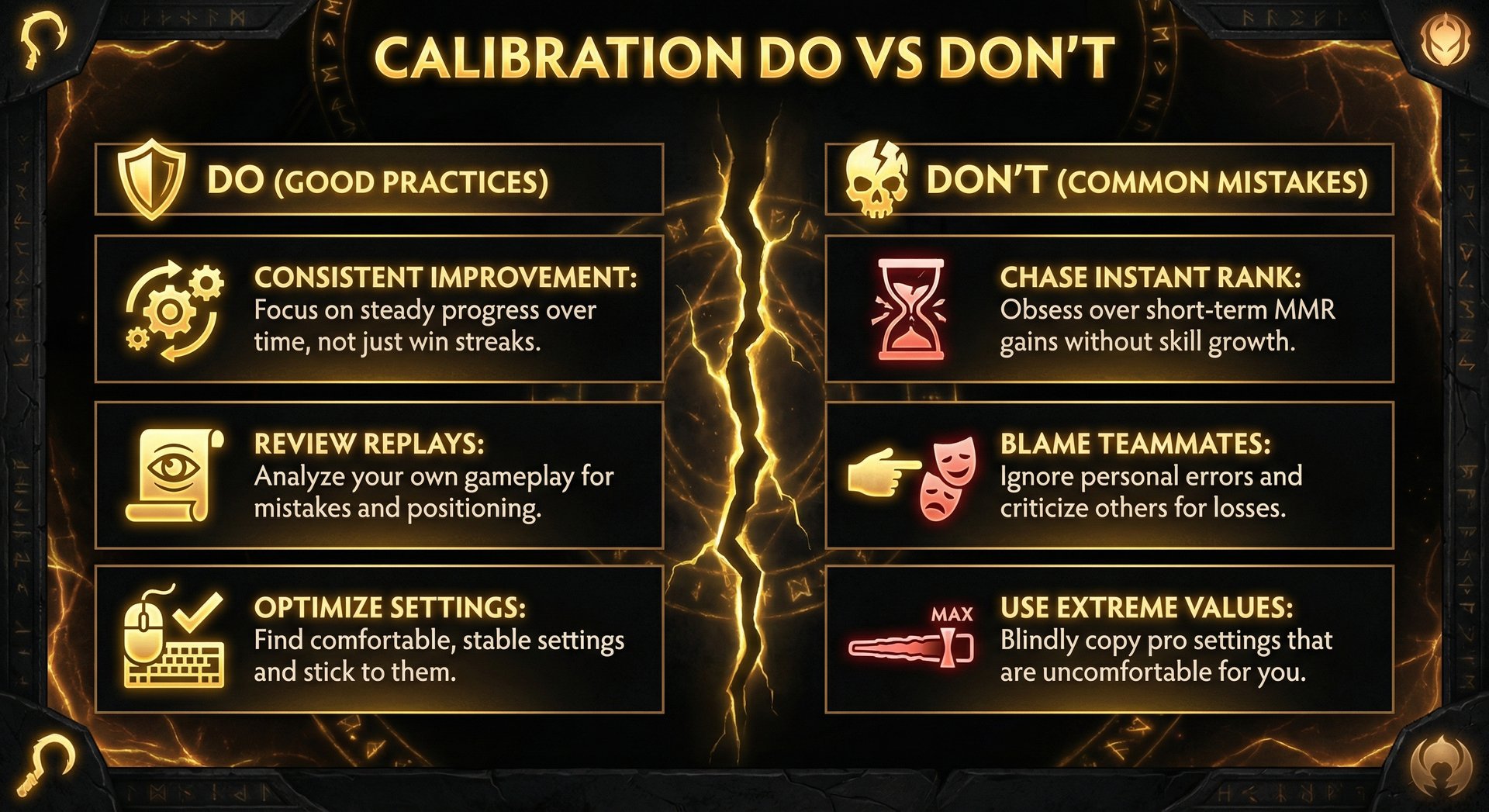
- Playing heroes you’re not comfortable on — Meta picks only help if you can actually play them. A 45% win rate meta hero is worse than a 60% win rate “off-meta” hero you’ve mastered.
- Calibrating while tilted — One bad game shouldn’t lead to a second. Take breaks between losses.
- First-picking niche heroes — Showing your Meepo, Broodmother, or Huskar in the first phase gives the enemy team 4 picks to counter you.
- Ignoring team composition — “I’m only picking my hero regardless of team needs” is a losing strategy. Flexibility wins games.
- Playing all 10 games in one day — Mental fatigue is real. Your 8th game will be significantly worse than your 1st.
- Not warming up — Jumping straight into calibration without warm-up games leads to sloppy early performances.
- Flaming teammates — Toxicity loses games. Period. Mute others if needed, but never flame.
- Calibrating at season start — The first few days are chaos. Wait for things to settle.
- Stat-padding instead of winning — Going for a high KDA while your team loses doesn’t help your calibration. Win the game, even if your stats look ugly.
- Giving up early — Comebacks happen frequently in Dota 2, especially at average MMR brackets where teams struggle to close games. Never give up during calibration — every game matters.
After Calibration: What to Do Next
You’ve finished your 10 games. Now what
If You Calibrated Higher Than Expected
Congratulations! But the work isn’t over:
- Keep playing the same heroes and style that got you here. Don’t suddenly switch to experimental picks.
- Focus on maintaining before pushing further. Your immediate goal is to stabilize your MMR at the new level.
- Expect some adjustment losses — If you calibrated at the high end of your skill range, you may lose some games before stabilizing. Don’t panic.
If You Calibrated Lower Than Expected
Don’t despair. Your options:
- Grind it out — You’ll naturally climb if you’re genuinely better than your bracket. It may take 50-100 games to correct a bad calibration.
- Get coaching — A professional coach can identify why your calibration went wrong and develop a targeted improvement plan.
- Consider a boost — If you calibrated significantly below your true skill (500+ MMR lower), a targeted MMR boost can correct the calibration without weeks of grinding.
- Review your calibration replays — Watch your losses. Identify the common factor. Was it hero picks, laning, decision-making, or just bad luck
If You Calibrated About Where You Expected
This is the most common outcome. The system works — over 10 games, it usually places you roughly where you belong. From here:
- Set a realistic improvement goal — Aim for +500 MMR over the season (roughly one full medal tier).
- Focus on improving one aspect at a time — Trying to fix everything at once leads to fixing nothing.
- Track your progress — Use Dotabuff or OpenDota to monitor your win rates, most successful heroes, and improvement trends.
The Case for Professional Calibration
Let’s be direct: professional calibration services exist because calibration has outsized impact. Ten games determining your starting rank for an entire season is a system design that creates natural demand for optimization.
Why Players Choose Calibration Services
- Anxiety — Many players experience genuine stress about calibration. Having a professional handle it removes that pressure.
- Time efficiency — A professional going 8-2 or 9-1 during calibration can save you 100+ hours of grinding to reach the same MMR through normal games.
- Consistency — Professional players don’t tilt, don’t make tilted decisions, and don’t lose games they should win. Their calibration results are far more consistent than the average player’s.
- Starting fresh — If you improved significantly during the off-season, a professional calibration ensures your new rank reflects your actual improvement.
How TeamSmurf’s Calibration Service Works
TeamSmurf’s calibration service provides:
- Professional players (typically 7,000+ MMR) play your 10 calibration games.
- High win rates — Our boosters average 80-90% win rates during calibration.
- Account safety — VPN matching to your region, normal play patterns, and no suspicious behavior.
- Fast completion — Typically 1-2 days for all 10 games.
- Transparent pricing — Check our homepage for current rates.
Frequently Asked Questions (FAQ)
Ready to Climb Start Your Boost Today
Team Smurf is the #1 rated Dota 2 boosting service in 2026. Immortal-rank boosters, maximum safety, competitive pricing, 24/7 support.
Conclusion
Calibration is the most impactful set of games you’ll play each season. With proper preparation, smart hero picks, optimal timing, and disciplined execution, you can maximize your placement and start the season at the highest possible rank.
Remember: 10 calibration games ≈ 30-50 regular ranked games in terms of MMR impact. Treat them with that level of seriousness. Prepare before you play, choose heroes you can win with, manage your mental state, and spread the games across multiple sessions.
If you want guaranteed results, TeamSmurf’s calibration service takes the uncertainty out of the equation. And for ongoing improvement after calibration, consider professional coaching or our MMR boost service to reach your target rank.
For more on how the underlying ranking system works, read our complete MMR technical guide. And to see where your calibration places you in the bigger picture, check the 2026 rank distribution data.
Written by Team Smurf’s Immortal-rank analysts — Rankings last verified February 2026