


Dota 2 Rank Icons and Medal Images: Every Medal and Star, 2017–2026

Every Dota 2 player sees their rank icon every time they open their profile. But the images themselves — which medal corresponds to which tier, what each star actually means, and how the whole visual system evolved from 2017 to today — are harder to find in one place than you would expect.
This guide covers every Dota 2 rank icon and medal in detail: what each one looks like as a stylised emblem, the MMR range it represents, how many stars each tier contains, and the full history of changes since Valve first introduced the medal system in 2017. Whether you want to understand where you sit, recognise an opponent’s rank at a glance, or trace the ranked system back to its roots, you will find everything here.
Table of Contents
What Dota 2 Rank Icons Are
A Dota 2 rank icon — also called a medal or badge — is the visual emblem displayed on your profile and in the match-loading screen that represents your current matchmaking rating bracket. Valve introduced the medal system in patch 7.06 in May 2017, replacing the raw solo/party MMR numbers that had been the only rank display for years. The intent was to give players a more meaningful visual anchor for their skill level rather than a number in the thousands that meant little without context.
Each medal corresponds to a specific MMR range divided into eight tiers. Within each tier, you earn stars by winning ranked games — each star typically corresponds to roughly 150-185 MMR, though the exact thresholds shift slightly each season. When you fill all five stars in a tier, you advance to the next tier’s Star 1. The visual design of the icon changes with each tier jump, giving you an instant at-a-glance read of whether an opponent is a seasoned high-bracket player or someone at a similar level to you.
The rank icon on your profile shows your peak medal for the current season. You can fall in stars within a tier from losses, but you cannot be demoted to a lower medal once you have earned it within a season — with some important caveats that the medal demotion rules guide covers in detail. Immortal is the only exception: it shows a live leaderboard rank rather than a static medal, and that number can move daily.
All Eight Rank Medals at a Glance
The table below lists every Dota 2 rank medal with its approximate MMR range, number of stars, and a one-line description of the visual design language Valve uses for each tier. The MMR figures are based on community data sources including Dotabuff and Stratz as of the 7.41f era — Valve does not publish official cutoff numbers, and they shift slightly between seasons.
| Medal | Approx. MMR Range | Stars | Design Language | Est. Player % |
|---|---|---|---|---|
| Herald | 0 — 760 | 1-5 | Dull iron shield, minimal glow | ~22% |
| Guardian | 770 — 1540 | 1-5 | Bronze shield, warm amber tones | ~20% |
| Crusader | 1540 — 2310 | 1-5 | Steel shield, silver-grey finish | ~19% |
| Archon | 2310 — 3080 | 1-5 | Silver-white crest, blue-white glow | ~18% |
| Legend | 3080 — 3850 | 1-5 | Gold-green emblem, twin-fan wings | ~13% |
| Ancient | 3850 — 4620 | 1-5 | Amber-gold rune shield, ornate border | ~5% |
| Divine | 4620 — 5420 | 1-5 | Radiant gold with large spread wings | ~2% |
| Immortal | 5420+ | Leaderboard rank | Blazing white-gold crown, trophy base | ~1% |
The percentage estimates are community-aggregated figures from opt-in Dotabuff data. Because Dotabuff’s user base skews toward more engaged players, the actual lower-bracket percentages in the full Dota 2 population may be higher. Valve has not confirmed an official distribution since the 2019 rank reset.
If your goal is to move up this table efficiently, the MMR boosting guide walks through every factor that influences MMR gain per game and how to maximise it — including role queue, hero pool, and consistency across a session.
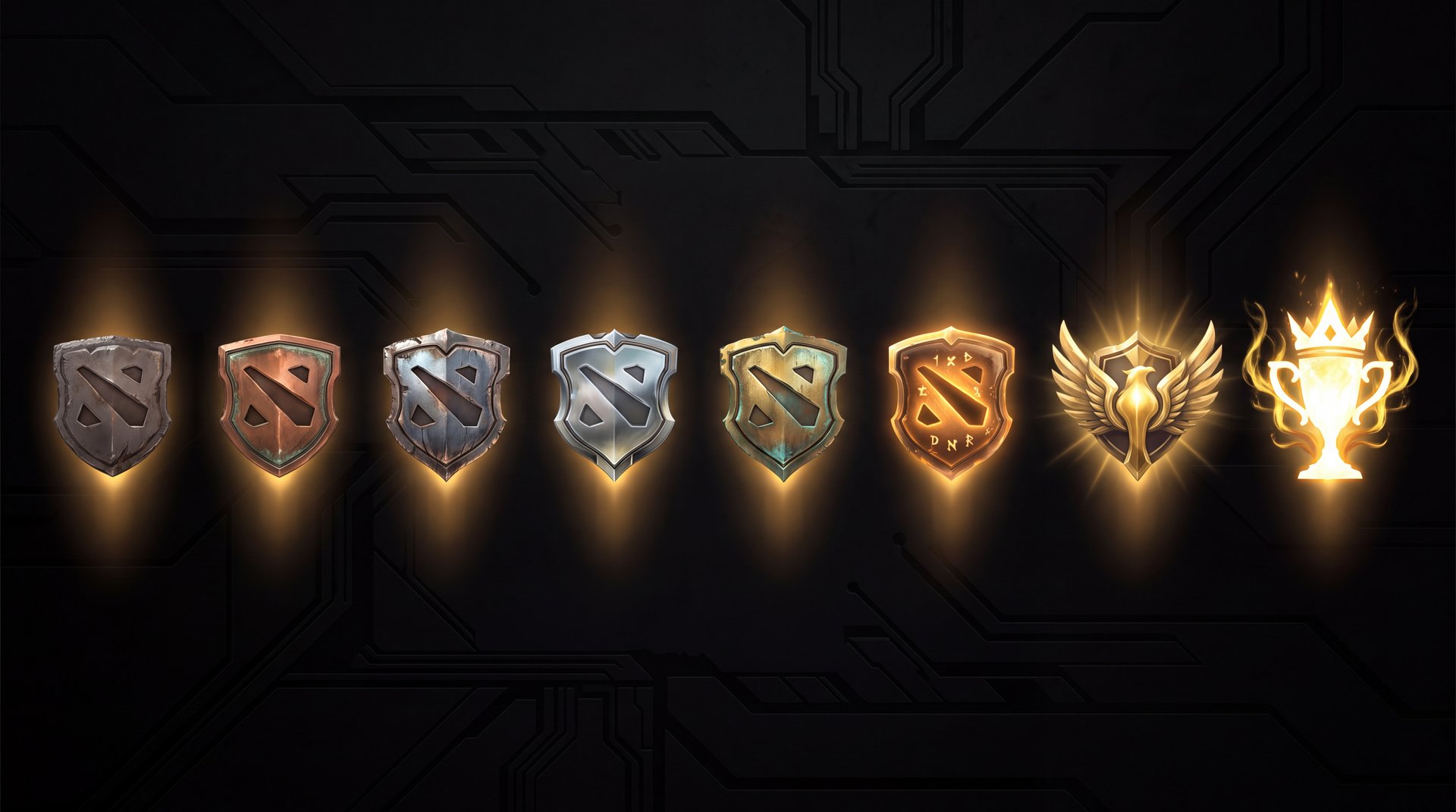
Herald, Guardian, Crusader & Archon — The Lower Bracket Medals
Herald (0-760 MMR)
Herald is the entry tier for players who are genuinely learning Dota 2. The icon uses a simple iron shield design without the decorative elements that appear on higher medals — it reads as plain and functional. In terms of gameplay, Herald games are characterised by missed last-hits, skipped item timings, and unfamiliarity with hero kits. The bracket covers five stars (Herald 1 through Herald 5), each representing roughly 152 MMR. A Herald 5 player sits around 760 MMR and is within reach of Guardian with a win streak.
Herald remains the most common bracket by raw player count. If you are here and want to leave faster, focus on one or two heroes with a clear win condition rather than trying to fill every role. One hero you understand at 80% winrate beats five heroes at 45%. The Dota 2 MMR boost service is also a direct route out for players who want a functional MMR floor before investing time in improvement.
Guardian (770-1540 MMR)
Guardian players have the fundamentals of last-hitting and early laning but regularly make strategic errors — taking bad fights, ignoring objectives, and failing to rotate after kills. The bronze shield icon has a warmer colour than Herald’s iron, with subtle amber highlights that distinguish the two tiers at a glance. Guardian spans approximately 770 MMR in total and requires five star increments of roughly 154 MMR each.
Guardian is where most players plateau on their first attempt to escape. The gap between Guardian and Crusader is often mechanical — players in this range know what they should be doing but lack the execution speed to do it consistently under pressure.
Crusader (1540-2310 MMR)
Crusader players understand rotations, item timings, and basic draft theory. The icon shifts to a steel-silver palette, suggesting a step up in both prestige and skill. Last-hitting is solid and rune tracking is present, but map vision and ward placement remain inconsistent. At Crusader 5 (roughly 2300 MMR) you are in the top 40% of Dota 2 players by community estimates — most people who try Dota 2 never reach this point.
The Crusader-to-Archon jump is where a significant number of players stall permanently. It requires internalising map awareness as a reflex, not a deliberate check. Players who make it through tend to have started tracking neutral spawns and rune windows automatically rather than reacting to them as reminders.
Archon (2310-3080 MMR)
Archon is the threshold where many players stop feeling like beginners and start feeling genuinely competitive. The silver-white crest with blue-white highlights is noticeably sharper than the lower tiers. Archon players understand the draft, can itemise reactively mid-game, and hold a lane without falling far behind. The skill gap between Archon and Legend is significant — crossing into Legend requires consistent high-tempo play across an entire game, not just good individual moments.
For context: reaching Archon 5 puts you in roughly the top 25% of the ranked Dota 2 player pool based on community opt-in data from Dotabuff. From here, you are playing against people who actively study the game, watch pro games, and understand basic networth advantage timings.
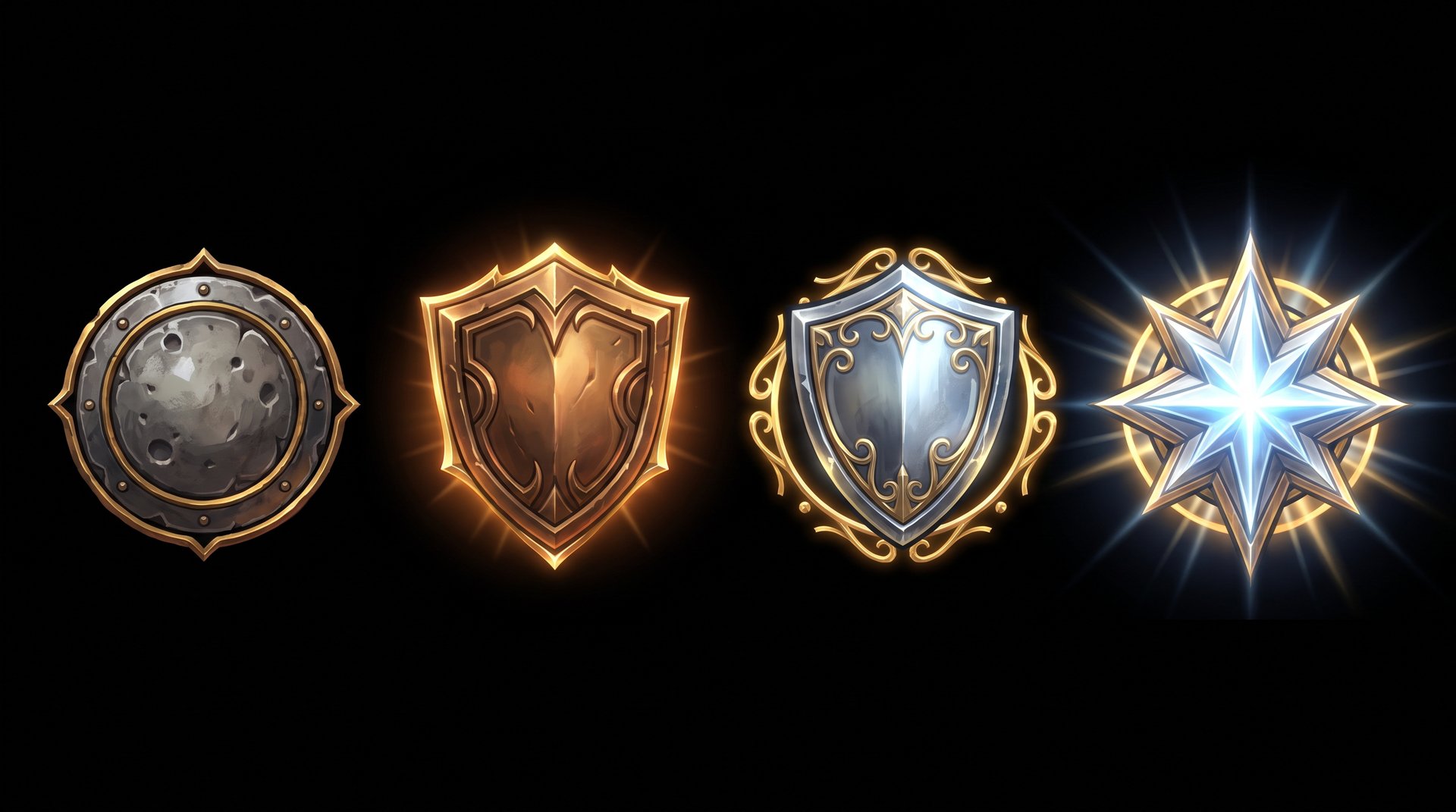
Legend, Ancient, Divine & Immortal — The Upper Bracket Medals
Legend (3080-3850 MMR)
Legend is where draft awareness and itemisation start to separate players sharply. The gold-green icon with its twin-fan wing motifs is visually distinct from anything below it — at a glance it signals a significant skill jump. Legend players hold their own in teamfights, track enemy cooldowns, and use vision aggressively. The gap between Legend 1 and Legend 5 spans roughly 770 MMR and represents a meaningful range of skill within the same tier.
If reaching Legend is your goal, working with a high-MMR teammate or coach is one of the fastest ways to compress the learning curve. The habits that let you hold Archon start working against you at Legend — farm-first patterns that were safe before become liabilities when opponents start punishing timing windows.
Ancient (3850-4620 MMR)
Ancient is the start of what most competitive players call “high MMR” territory. The amber-gold icon with its ornate rune border is one of the more visually detailed designs in the tier progression. At Ancient, players have deep hero pools, strong position-specific item knowledge, and can pilot off-meta picks effectively. Positioning in fights is nearly automatic — Ancient players are focused on macro decisions, not whether they will hit their abilities.
Ancient brackets are where the coaching impact is highest. Small adjustments to decision-making under pressure — which fight to take, when to split-push versus group — have outsized MMR effects that are hard to identify without external feedback. The Dota 2 coaching service pairs Ancient-bracket players with Divine and Immortal coaches specifically because this is where habit-based play stops working and deliberate strategy takes over.
Divine (4620-5420 MMR)
Divine is the top 2% of ranked players by community estimates. The radiant-gold icon with large spread wings is unmistakable — it is one of the most visually elaborate designs Valve created for the system. Divine players execute at a level where individual mechanical skill is largely assumed; the differentiator is decision-making density — how many correct calls can you make per minute of game time.
Divine 5 — the final star before Immortal — sits at approximately 5420 MMR by current estimates. Crossing it is a major threshold because Immortal is not just another tier: it changes how the rank is displayed entirely. You no longer see stars. You see a leaderboard position.
Immortal (5420+ MMR)
Immortal is the top 1% of the Dota 2 player base and the only medal that does not use stars. Instead of “Immortal 4” or “Immortal 5”, your profile shows your global or regional leaderboard rank. An Immortal player ranked number 1 globally is the top player on earth by Valve’s ranked MMR system. The blazing white-gold crown icon with a trophy pedestal is the most visually distinct design in the game — it signals immediately that you are playing against or alongside one of the best Dota 2 players in the world.
Leaderboard rank changes daily as players win and lose. At the very top, games are both rare (small player pool) and intensely watched — top-100 Immortal games are regularly broadcast by content creators and analysed in coaching contexts. Entry-level Immortal (leaderboard rank 1000+) plays significantly differently from top-500, which is itself a different game from the top 10.
The Star System Explained
Each tier from Herald to Divine contains five stars. You gain a star by winning ranked matches — in solo queue, the standard gain per win is roughly 30 MMR, meaning it takes five to six wins more than losses to move one star, depending on your performance metrics and any party penalty. Stars cannot be partially earned — you either hold a star position or you fall back.
The system displays stars as small icons layered on top of the medal image itself. A Herald 1 shows one star on the iron shield; a Divine 5 shows five stars on the gold-wing emblem. When you hover over your rank in the client, you can see the exact MMR number behind the star position, but the displayed rank icon always shows the tier and star count rather than a raw number.
| Stars Held | What It Signals | Path Forward |
|---|---|---|
| Star 1 | Just entered the tier; opponents near the floor of the bracket | 4 more star increments to reach Star 5 |
| Star 2 | Solid in lower range of tier; lane matchups feel even | 3 more increments to tier peak |
| Star 3 | Mid-tier, evenly matched across most games | 2 more increments |
| Star 4 | Near top of tier; opponents increasingly play like next tier | 1 increment to Star 5 |
| Star 5 | Peak of the tier; next win pushes to next tier Star 1 | Advance to next tier Star 1 on next win |
Stars earned within a season are protected at the tier floor — once you have earned a medal, you cannot be pushed back below that tier’s Star 1 within the same season. The protection does not extend across season resets. The demotion guide explains exactly which stars are protected and which are not for each tier, since the rules are not stated in-game and confuse many players.
Party queue star gains are generally lower than solo queue star gains, reflecting the coordination advantage of playing with friends. This is why most serious MMR climbers recommend solo queue as the primary path to a higher medal — the rating gains are both more consistent and more meaningful in terms of tracking individual skill development. Party queue carries a -25 MMR gain penalty per win versus the solo baseline in most brackets.
Dota 2 Rank Icon History: 2017 to 2026
The medal system did not arrive fully formed. Understanding how it evolved explains some design decisions that can otherwise seem arbitrary today. The system has gone through more changes than most players realise, particularly in the calibration rules and seasonal structure.
| Year | Version | Change to Rank Icons and System |
|---|---|---|
| Pre-2017 | No medals | Solo MMR and party MMR shown as raw numbers only on profile. No visual tier system existed. |
| May 2017 | Patch 7.06 | Medal system introduced. Eight tiers (Herald through Immortal) with five stars each. First visual rank display. Immortal leaderboard added. |
| Nov 2017 | Season 1 reset | First full seasonal rank reset. All players re-calibrated. Medal images unchanged; calibration game format introduced. |
| 2018 | Seasons 2-3 | Calibration adjusted to better anchor initial placement to prior MMR. Minor star threshold tuning in lower brackets. |
| 2019 | Role Queue launch | Role Queue introduced with separate rank tracks per role. Role MMR added a second visible rank icon per role in certain UI views. Core medal visuals unchanged. |
| 2020 | Seasons 5-6 | Immortal briefly split into non-leaderboard and Leaderboard tiers in some seasons, then unified. Herald-to-Guardian MMR gap adjusted. |
| 2021-2022 | Ongoing seasons | Calibration games reduced to 1 for returning players. Star protection rules refined. Lower-bracket MMR thresholds adjusted upward slightly. |
| 2023 | 7.34+ era | Battle Report integration showing per-hero rank alongside overall medal. Rank icon display expanded on Dota 2 companion app. |
| 2024 | 7.37-7.38 era | MMR threshold adjustments in the Guardian-to-Crusader range. No visual changes to medal artwork. |
| 2025 | 7.39-7.40 era | Rank icon display updated in UI alongside Dota 2 interface refresh. Seasonal cadence stabilised at two resets per year. |
| 2026 | 7.41f (current) | Current ranked system. Eight tiers, five stars per tier, Immortal leaderboard. No new tier added. Rank icons as described throughout this guide. |
One of the most significant moments in rank icon history is the 2017 launch itself. Before medals existed, MMR was the only visible rank signal. A 3000 MMR player had no idea whether that put them in the top 40% or top 10% — the number was contextless without knowing the full distribution. The medal system gave that context by assigning visual tiers to ranges, which is why the community adopted it quickly even though many veteran players initially resisted the change from the familiar raw-number display.
The 2019 Role Queue addition was the largest structural shift after launch. For the first time, players had a separate rank for their carry role versus their support role, which better reflected how differently people perform across positions. This added complexity to the rank icon system — your profile now shows a primary medal but the underlying MMR is role-specific.
For a detailed breakdown of every ranked season since the system launched, including the exact dates of each reset and what changed in calibration rules, the Dota 2 ranked season history guide is the most complete reference available.
Seasonal Resets and Recalibration
Dota 2 rank icons are seasonal — every major season reset requires a recalibration process before your full medal is shown. Currently (7.41f era), returning players after a reset complete one calibration game before being placed. This differs from the original 10-game calibration used when the system launched in 2017.
During recalibration, your profile shows a question mark or partial progress indicator rather than your previous medal. Once calibration completes, your new medal is calculated based on your pre-reset MMR plus the calibration game result and a performance modifier. Most players land within one star of their pre-reset medal, though a strong performance in the calibration game can bump you half a tier or more.
The seasonal structure exists to let the matchmaker recalibrate the entire player pool simultaneously, prevent MMR inflation from years of accumulated rating, and give players who have genuinely improved a chance to climb faster rather than grinding from an artificially hard floor. The reset also creates a burst of competitive activity at the start of each season that keeps the ranked player pool active and the queues filled.
If you want to maximise your recalibration outcome, the consensus from high-MMR coaching experience is to play your highest-winrate hero in a role where you have clear lane impact. Do not recalibrate in party queue if you can avoid it — the performance modifier in solo recalibration tracks individual contribution more cleanly. A first-game win after a reset gives you a noticeably better placement than a first-game loss, so treating that calibration game as your most important game of the season is not an overreaction.
Climbing Medals Faster: What Actually Works
The rank icon on your profile is a lagging indicator — it reflects past performance, not current skill. That gap between where you play and where your medal sits is either your opportunity (you are underranked) or your signal (you need more work). Either way, the medal itself tells you nothing you cannot diagnose from your winrate. Here is what genuinely moves the display forward.
Hero pool discipline: Two or three heroes you understand at a mechanically high level will outperform a ten-hero pool in ranked games. The mental overhead of switching heroes costs you decision-making bandwidth you cannot afford to lose at any bracket below Divine. Pick your two best heroes, learn their optimal item build for the current patch, and play them until the results are consistent.
Role queue and lane focus: Playing the role you are best at in solo queue every game produces more consistent results than filling. Role queue enforces this — use it for MMR games even when you are flexible enough to fill in non-ranked contexts. Winning your lane is statistically the single strongest predictor of individual game outcome below Ancient bracket.
Consistency over session length: Win rate in games 1-5 of a session is almost always higher than games 6-10. Most ranked players who tilt hard are playing past their effective session length. Short sessions with a forced stop after a loss keep your per-game average positive across a week of grinding.
VOD review with objective anchors: Reviewing replays without a question to answer produces almost no improvement. Watch with a specific focus — your positioning in one teamfight, your ward placement in the first 10 minutes — and compare it against what the outcome required. Unfocused review just reinforces what you already know.
For players who want to accelerate beyond what self-improvement can deliver in a reasonable timeframe, checking the Dota 2 boosting service options is worth understanding — not as a replacement for skill development, but as a way to reach a starting MMR floor that reflects your actual ability before you invest grinding hours. You can also read about whether boosting is safe if you have concerns about account security before deciding.
Frequently Asked Questions
Stuck on a Medal? TeamSmurf Can Help.
If your current rank does not reflect where you actually play, TeamSmurf’s Dota 2 specialists can close that gap. From a targeted MMR Boost to a precision Calibration Boost, our Dota 2-only team has delivered results at every bracket since 2015.



