


How Many Heroes Are in Dota 2 (2026)? Full Count by Attribute and Role, Plus the Newest

As of Patch 7.41f, Dota 2 has 128 heroes in its roster — per Liquipedia’s official hero grid, confirmed October 2026. That breaks down to approximately 37 Strength heroes, 35 Agility heroes, 34 Intelligence heroes, and 22 Universal heroes. Largo the Bard Frog is the most recently released hero with a confirmed launch date (December 15, 2025, Patch 7.40), and the roster reached 128 during the 7.41 cycle. Valve has never announced an upper limit, so the count will keep climbing.
Every one of those 128 heroes is free from day one. No paywall, no unlock grind, no rotation pool. You can queue into a game as any hero the moment you first open the client. What makes the roster genuinely complex is not the size but the depth — each hero plays a distinct role, scales off a different primary attribute, and can shift a game’s outcome even when 127 other options exist. That depth is precisely why hero selection and hero knowledge are the two highest-leverage skills you can improve at any bracket.
This page gives you the exact hero count, a full breakdown by attribute and by position, a table of the five most recently released heroes, and a look at how the roster has grown since 2010. We also answer the questions coaches hear most often about what that large roster means for your actual ranked games.
What’s on This Page
The Exact Dota 2 Hero Count in 2026
Dota 2 has 128 heroes as of Patch 7.41f (released September 15, 2026). Liquipedia’s hero grid lists all 128 explicitly for the current patch, and major community tools including Skycoach, Dotabuff, and Stratz reflect the same count as of October 2026.
You will occasionally see 127 cited on older pages that updated their hero lists before the most recent addition. Largo, the Bard Frog, was confirmed as the 127th hero when he launched with Patch 7.40 on December 15, 2025. The roster subsequently reached 128 during the Patch 7.41 cycle. For the current authoritative count, open the in-game hero select screen — every hero listed there is fully free to play and immediately accessible.
For context on where Dota 2 sits among MOBAs: League of Legends has roughly 170 champions, Smite around 130 gods, and Heroes of the Storm approximately 90 heroes. Dota 2’s 128 sits in a competitive mid-range, but the comparison that matters most is not roster size — it is depth per hero. Each Dota 2 hero has four unique abilities, a talent tree at levels 10, 15, 20, and 25, a facet modifier that shapes the hero’s identity from the very first second of every game, and an innate passive that is always active regardless of items. Learning a single hero to a genuinely high level takes far more investment in Dota 2 than in most comparable games, which is why a narrow, deeply practiced pool consistently outperforms a wide shallow one at every MMR bracket.
Dota 2 Heroes by Primary Attribute
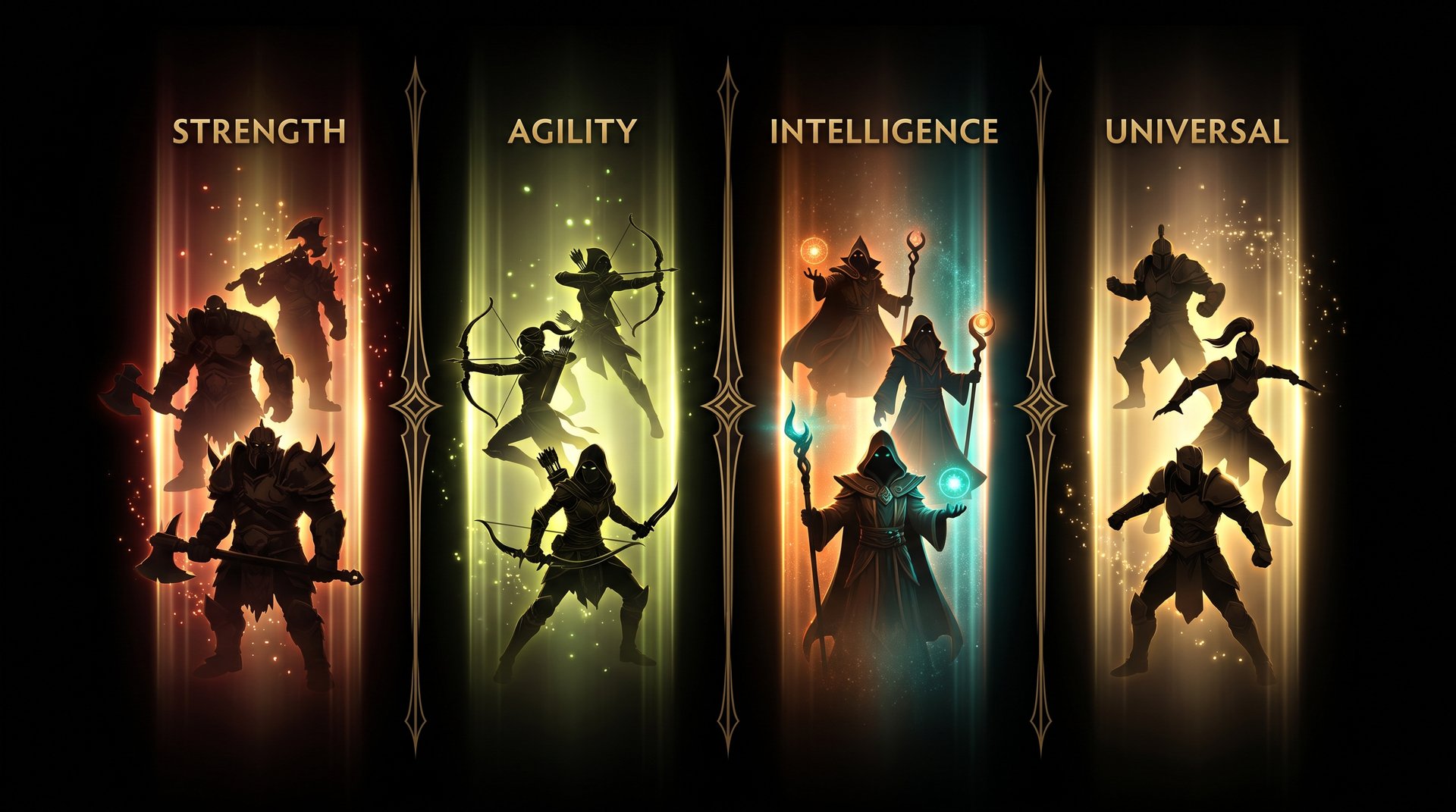
Every Dota 2 hero has one of four primary attributes: Strength, Agility, Intelligence, or Universal. Your primary attribute determines which stat gives the hero bonus attack damage — one point of Strength, Agility, or Intelligence adds 1 point of attack damage for the corresponding attribute type. Universal heroes gain attack damage from all three stats at a reduced rate of 0.7 per point. In practice, this system shapes who each hero is designed to be in the game.
The Universal attribute was introduced in Patch 7.32 (August 2022). Valve reclassified a number of existing heroes — including Sand King, Enigma, Windrunner, Dazzle, and others — from the classic three-attribute system into Universal, reflecting that these heroes did not cleanly optimize for a single stat. This did not add new heroes to the roster but fundamentally changed how those heroes scaled, how players built them, and how opponents drafted against them.
| Attribute | Hero Count | What It Means in Practice | Example Heroes |
|---|---|---|---|
| Strength | ~37 | Scales HP and regen; typical tanks, initiators, and durable carries | Axe, Pudge, Dragon Knight, Wraith King, Lifestealer, Primal Beast, Largo |
| Agility | ~35 | Scales armor and attack speed; primarily physical DPS carries | Anti-Mage, Juggernaut, Phantom Assassin, Drow Ranger, Morphling, Kez |
| Intelligence | ~34 | Scales mana pool; mages, nukers, and most traditional supports | Crystal Maiden, Lina, Zeus, Storm Spirit, Invoker, Ringmaster |
| Universal | ~22 | Gains damage from all three stats (0.7x each); flexible roles across the map | Windrunner, Sand King, Enigma, Dazzle, Nature’s Prophet, Beastmaster, Batrider |
| Total | 128 | Patch 7.41f, per Liquipedia. Per-attribute split from community trackers (Dotabuff/Stratz); may vary by 1 as trackers update. | |
The per-attribute counts above are aggregated from community tracker data (Dotabuff and Stratz) for Patch 7.41f. The exact split may vary by one hero as community databases update, but the total of 128 is confirmed by Liquipedia’s hero grid. For the complete list of every hero organized by attribute and role, our Dota 2 hero hub covers every hero with attribute, primary role, and a link to their individual guide.
Why Primary Attribute Matters More Than Most Players Think
New players often skip thinking about attributes entirely and focus only on ability descriptions. That is a significant gap in game knowledge that costs MMR at every bracket, not just low ones.
Strength heroes are built to absorb damage. Trading hits against a well-itemized Strength initiator before they have burned their active abilities is almost always a losing proposition — they are designed to soak the punishment that would kill an Agility or Intelligence hero. When you see a Strength tank buying Vanguard into Heart of Tarrasque, understand that their survivability curve is nearly vertical from mid-game onward, and plan your engagements around catching them before they reach that power spike rather than fighting them through it.
Agility carries scale exponentially in a way that other attribute types do not match on pure physical output. An Agility carry who hits three core items has attack speed, armor (which doubles as effective HP against physical damage), and damage bonuses all compounding at once. This makes their damage-per-gold-invested ratio the highest in the game during the window when those items come online. Recognizing that window — and knowing how to either force fights before it or extend the game past the point where the enemy carry’s advantage is irrelevant — is a core skill that coaching sessions focus on heavily.
Intelligence heroes and Universal heroes represent the game’s most varied design space. An Intelligence support who is 0-kills and low on gold is still contributing meaningfully with crowd control and saving abilities. A Universal hero like Enigma or Nature’s Prophet can transition from a farm-dependent early game into a fight-or-split-push threat on a smaller item investment than most. Understanding when those transitions happen is what separates a player who “reads the game” from one who just reacts to it. If you want to accelerate that understanding, reviewing replays with a high-MMR Dota 2 coaching session gives you targeted feedback on your specific decision patterns rather than generic advice.
Dota 2 Heroes by Position (Role)
Valve officially tags every hero with one or more role labels: Carry, Nuker, Disabler, Jungler, Durable, Escape, Support, Pusher, Initiator, Roamer. For practical purposes, the community maps these onto the five in-game positions: Pos 1 (safe lane carry) through Pos 5 (hard support). The table below shows approximate counts by primary position, based on Dotabuff community role classifications for the current meta (Patch 7.41f).
The most important caveat for this table: Dota 2 heroes are not locked to a single role. Pudge can go Pos 3 offlane or Pos 4 roaming support depending on the draft. Lina can go Pos 2 mid or Pos 4 support. Beastmaster has been played as Pos 1 carry, Pos 3 offlane, and Pos 4 support in high-level matches. The numbers below reflect the most common primary position each hero holds in current ranked play, not a hard classification.
| Position | Approx. Count | Primary Function | Example Heroes |
|---|---|---|---|
| Pos 1 — Safe Lane Carry | ~31 | Farms to power spike; determines late-game ceiling for the team | Anti-Mage, Juggernaut, Terrorblade, Morphling, Spectre, Kez |
| Pos 2 — Mid Lane | ~26 | Solo lane, hits levels fast, creates early pressure or rotates to enable kills | Storm Spirit, Invoker, Lina, Puck, Dragon Knight, Templar Assassin |
| Pos 3 — Offlane | ~28 | Soaks lane pressure, creates space, often the main teamfight initiator | Axe, Tidehunter, Dark Seer, Centaur Warrunner, Primal Beast, Bristleback |
| Pos 4 — Soft Support | ~29 | Roams early to set up kills; buys active items like Blink Dagger or Orchid | Earth Spirit, Bounty Hunter, Grimstroke, Ringmaster, Earthshaker |
| Pos 5 — Hard Support | ~22 | Prioritizes teammates; buys wards, early stacking, utility, saves | Crystal Maiden, Dazzle, Oracle, Largo, Abaddon, Shadow Shaman |
The total across all five positions adds up to more than 128 because a meaningful portion of heroes play two primary positions with roughly equal frequency. These figures are community-aggregated from Dotabuff and represent where heroes are most commonly picked in ranked play, not a definitive Valve classification. The in-game hero grid also provides official role tags, but they are intentionally broad and rarely updated to reflect meta shifts.
Which Role Has the Most Room to Climb
From a coaching perspective, Pos 2 mid is where individual mechanical skill is most visible and most quickly improvable. The hero pool for mid is the most contest-free at most brackets — your opponent is often on a predictable set of 10 to 15 heroes, your lane decisions (creep equilibrium, rune priority, rotation timing, level 6 kill windows) have an outsized impact on the entire game’s tempo, and the feedback loop between a mistake and its consequence is shorter than at any other position.
Pos 1 carry improvement tends to plateau until item timing and farming efficiency are genuinely tightened. You can learn every hero matchup in the game and still lose regularly because you are 4 minutes behind on a core item. Most Pos 1 players at Herald through Crusader benefit more from improving GPM and map awareness than from expanding their hero pool. If you are stuck in that bracket, our MMR boosting guide breaks down which positions and hero archetypes show the fastest bracket movement per bracket tier, backed by community win-rate data.
Pos 5 hard support is the most underrated role for climbing at mid-brackets (Archon to Legend). Because the role involves less mechanical complexity per minute than mid or carry, improvement compounds into better game-sense and macro decision-making faster. Players who reach Legend as Pos 5 specialists often have better teamfight timing reads than carry players at the same bracket — and those reads transfer to every role once you want to expand.
The 5 Most Recently Released Dota 2 Heroes
Valve releases new heroes at an irregular cadence — anywhere from two heroes in a year to gaps of over a year between additions. The five newest heroes in the current 128-hero roster represent a range of design philosophies, and three of them have left a measurable impact on the competitive meta since their release.
| Hero | Release Date | Patch | Attribute | Primary Role |
|---|---|---|---|---|
| Largo (the Bard Frog) | December 15, 2025 | 7.40 | Strength | Hard Support (Pos 5) |
| Kez (Kestrel) | November 7, 2024 | 7.37 (Crownfall Act IV) | Agility | Carry (Pos 1) |
| Ringmaster | August 2024 | 7.37 | Intelligence | Support (Pos 4-5) |
| Muerta | March 6, 2023 | 7.32e | Agility | Carry (Pos 1) |
| Primal Beast | January 6, 2022 | 7.30 | Strength | Offlane (Pos 3) |
Sources: Valve patch notes; escorenews.com (Kez release date); hotspawn.com (Largo release date); Liquipedia hero grid (attribute and role classifications).
Largo — The 127th Hero (December 2025)
Largo is a frog bard support who arrived with Patch 7.40 after a 403-day gap since Kez — the second-longest drought between hero releases in the game’s history. As a Strength-attribute hard support, he breaks the assumption that all Strength heroes are frontline brawlers. Largo sits back, provides utility and crowd control, and uses his Strength scaling to survive the poke that would kill a typical Intelligence support of similar item investment. His kit rewards players who can time their abilities reactively rather than proactively, which makes him a good fit for high-game-sense support players who are comfortable making decisions based on what the enemy does rather than forcing engagements.
Kez — The Dual-Weapon Agility Carry (November 2024)
Kez was the 126th hero and launched with the final act of the Crownfall event on November 7, 2024. He is an Agility carry who switches between a katana and a sai mid-fight, giving him a two-mode ability set that changes his damage output, range, and threat radius depending on which weapon is active. The mechanic requires active management and creates meaningful decision points that most other carries do not have — you choose the attack tool based on what the enemy is doing, not just what your build dictates. Kez was disabled in Captain’s Mode for several months after release, standard for mechanically complex new heroes, and only became available in professional play with Patch 7.38 in February 2025. At high MMR he is one of the more technically demanding carry heroes available, which makes dedicated hero coaching particularly valuable for players who want to add him to their pool.
Ringmaster — The Intelligence Support (August 2024)
Ringmaster is a ranged Intelligence support whose kit centers on crowd control, repositioning, and zone denial. His Escape Act ability boxes in himself or an ally inside a cage structure, granting untargetable status at the cost of mobility — a mechanic that creates specific counterplay windows and requires timing to use effectively in both offensive and defensive contexts. He was revealed publicly at The International 2023 in October 2023 and initially announced for early 2024, but shipped in August 2024 after the Crownfall event was already live. Both Ringmaster and Kez received their facet modifiers with Patch 7.38 in February 2025, which is when both heroes became genuinely competitive in ranked and professional play.
Muerta — The Agility Carry (March 2023)
Muerta arrived with Patch 7.32e in March 2023 and immediately reset the carry meta. She is an Agility hero with piercing shots that bypass a portion of magic resistance, letting her threaten enemies who would otherwise be protected by a Black King Bar. Her ultimate, The Dead Zone, toggles between a channeled damage field and a post-death flight mode that lets her continue dealing damage for several seconds after she would otherwise be dead. Despite launching with a fairly constrained build path, she has remained a meta presence across multiple patches because her kit punishes predictable defensive itemization in a way most carries cannot replicate.
Primal Beast — The Strength Offlaner (January 2022)
Primal Beast was the 123rd hero when he released on January 6, 2022. His kit is built around chain-stunning enemies through Uproar stacks, a mechanic that rewards sustained aggression and punishes passive play from both the user and their opponents. He occupies Pos 3 offlane as his primary role, though he has seen professional time as a Pos 4 roamer in specific metas. His Pulverize ability — lifting and slamming an enemy into the ground repeatedly — is one of the highest-skill-ceiling ultimates in the game, with a kill-confirm and disruption potential that scales with accurate read of enemy cooldowns rather than just execution speed.
How the Dota 2 Hero Roster Has Grown Since 2010
When Dota 2 entered closed beta in October 2010, it launched with 23 heroes ported from the Warcraft III custom map DotA Allstars. Valve’s strategy from day one was steady expansion rather than a flood of content at launch. The growth pattern since then shows several distinct phases that tell a broader story about how the game’s identity has evolved.
| Period | Heroes Added | Cumulative Total | Notable Additions |
|---|---|---|---|
| 2010 (beta launch) | 23 | 23 | Original beta roster: Anti-Mage, Axe, Crystal Maiden, Zeus, Pudge, and 18 others |
| 2011 | ~57 | ~80 | The majority of the classic DotA Allstars roster ported through the year |
| 2012-2015 | ~26 | ~106 | Visage, Naga Siren, Lone Druid, Medusa, Terrorblade, Arc Warden |
| 2016-2020 | ~16 | ~122 | Underlord, Monkey King, Pangolier, Dark Willow, Mars, Void Spirit, Hoodwink |
| 2021 | 2 | 124 | Dawnbreaker, Marci |
| 2022 | 1 | 125 | Primal Beast (January 6, 2022) |
| 2023 | 1 | 126 | Muerta (March 6, 2023) |
| 2024 | 2 | 127 (approx.) | Ringmaster (August 2024), Kez (November 7, 2024) |
| 2025 | 1 | 127 | Largo (December 15, 2025, Patch 7.40) |
| 2026 (7.41 cycle) | 1 | 128 | One new addition confirmed by Liquipedia hero count (October 2026) |
Sources: Valve patch notes; Liquipedia Heroes by Release Date; skinsbook.com Dota 2 hero list (September 2026); hotspawn.com Largo release article.
The Three Distinct Growth Phases
The first phase (2010 to roughly 2015) was the DotA Allstars backfill. Valve had a clear target — the full roster of heroes that had already been designed and balanced by the Warcraft III modding community — and they worked through it systematically. This is why hero releases during that period came in bursts rather than single additions: multiple heroes would arrive in the same patch because the foundation work for each one had already been done in the original game.
The second phase (2016 to 2020) was original design. Heroes like Pangolier, Dark Willow, and Void Spirit were conceived specifically for Dota 2 and had no DotA Allstars equivalent. Release cadence slowed because each hero now required full original design work from the ground up. The complexity ceiling also rose — post-2016 heroes tend to have more interactive mechanics and more decision points per game than the ported heroes from the early roster.
The third phase (2021 to present) is the slow-but-polished era. Valve releases one to two heroes per year and each one ships with full lore integration, custom animations for every ability, and in many cases a launch event or storyline connection. The 403-day gap between Kez and Largo was notable but not unprecedented — the Primal Beast to Muerta gap was 535 days, still the longest in the game’s history. Both of those droughts ended with heroes that were immediately competitive in ranked play, suggesting Valve strongly prefers to delay rather than release an underdeveloped kit.
What the Universal Attribute Reclassification Changed
One of the most consequential roster changes not captured in a simple hero count was the Patch 7.32 Universal attribute addition. Valve reclassified a number of existing heroes from their original attributes into the new Universal category in August 2022. This did not increase the hero count but fundamentally changed how those heroes scaled. A Universal hero that previously relied entirely on one attribute now gains partial benefit from all three, making them more resilient to ability-based stat stripping (Diffusal Blade burn, Pudge rot, some enemy dispels) and significantly more flexible in their item choices. The 22 Universal heroes currently represent some of the game’s most flexible drafting pieces, which is why they appear in high-level matches at a rate disproportionate to their raw count.
What the Hero Count Means for Your Matchmaking and MMR
128 heroes is a large pool, and it has direct consequences for how you should think about ranking up. The most common mistake new ranked players make is treating the full roster as a menu to sample equally — cycling through heroes frequently under the belief that versatility is an advantage. High-MMR players and every coach on the TeamSmurf roster will tell you the same thing: a narrow hero pool executed with genuine depth beats a wide pool played inconsistently at every bracket, every time.
Here is the practical reason why. Dota 2 matchmaking cannot guarantee you a favorable draft. On any given game, your team’s picks may force you onto a hero you have 40 hours on instead of 400. Players who built broad but shallow pools lose winrate whenever the draft pushes them off their best heroes. Players with three to five deeply practiced heroes lose winrate much less frequently — they understand the hero’s timing windows, item interactions, and matchup counters well enough to execute through difficult drafts, difficult lanes, and difficult game states consistently.
The roster size also affects how visible the meta actually is. With 128 heroes, any individual balance change in a patch affects less than 1% of the pool. Valve can change five heroes in a patch and the draft space barely moves for most players. This means the meta is more stable for casual and mid-rank players than the volume of patch notes suggests. The heroes that win pubs at Archon and Legend bracket are not particularly volatile patch-to-patch — the top carry win rate leaders in any given patch are almost always drawn from the same 20 to 25 hero set.
This stability is actually useful information if you are trying to climb. You do not need to track every hero in 128 — you need to track the 10 to 15 heroes in your role who consistently over-perform in your bracket, and then practice the two or three of those that suit your playstyle. If you want the rigorous version of that narrowing process applied to your specific games and bracket, a Dota 2 coaching session with a TeamSmurf specialist will give you a personalized shortlist faster than any amount of self-analysis on the same replays.
For players asking whether the climb is worth doing independently or whether external support makes sense, our detailed breakdown of whether Dota 2 boosting is safe covers the account security and policy considerations in full. And if you want to understand what the actual boosting options look like across providers and bracket targets, our Dota 2 boosting services guide covers the verified options with transparent assessments of what each service does and does not offer.
Frequently Asked Questions
Get Personalized Hero and Role Advice From a High-MMR Coach
Knowing the current hero count is useful. Knowing which 3 of those 128 heroes match your playstyle, your bracket, and your current skill gaps — that is what actually moves your MMR. Every TeamSmurf coaching session is recorded so you can rewatch the feedback and is led by a coach who specializes in your role and bracket.



