

Does KDA Affect MMR Gain in Dota 2? What Actually Moves Your Number

No — your KDA does not affect your MMR in Dota 2. Not even slightly. Your Matchmaking Rating moves for one reason and one reason only: whether your team wins or loses the match. You can go 20/1/30 and still gain the exact same MMR as your 2/8/4 support standing next to you. Both of you get +30. Both of you lose -30 if the game goes the other way.
This post answers a different question from our guide on what is a good KDA in Dota 2 — that one covers KDA benchmarks by role and rank. This one cuts straight to the MMR mechanic: does the score you post affect the number you gain? And if KDA does not move your MMR, what actually does?
Below you will find the full breakdown — how the MMR system calculates gains, where performance badges fit in, what the calibration period changes, and the exact levers you should focus on instead of padding your kills.
Table of Contents
- The Short Answer: KDA Does Not Move Your MMR
- How Dota 2 MMR Actually Works
- Why Players Confuse KDA With MMR Gain
- Performance Badges — The Closest KDA Gets to Mattering
- Behavior Score and Its Indirect Effect
- Party MMR: Does Your Team KDA Matter?
- The Calibration Period and Personal Performance
- What Actually Moves Your MMR Number
- Common KDA-MMR Myths Debunked
- How to Use KDA as a Climbing Tool
- Frequently Asked Questions
The Short Answer: KDA Does Not Move Your MMR
Dota 2 MMR is a pure win/loss system at the ranked level. Every ranked match that ends in a win adds approximately 30 MMR to your account. Every loss subtracts approximately 30 MMR. The kills, deaths, and assists you accumulate during that match play no role in the final number added or removed.
This is not a rumor or a community theory — it is confirmed by how Valve designed the system. The ranked MMR ladder uses a simplified rating model where the outcome of the match is the only input. There is no partial credit for heroic individual performance inside a losing game. There is no penalty for dying 12 times inside a winning game. You either win or you do not.
The question many players have is not just whether KDA affects MMR in isolation — they want to know if there is any indirect path. Does a great KDA feed into some hidden metric that eventually influences MMR? The answer is mostly no, with a few narrow exceptions we cover below. Understanding those exceptions will help you focus your energy in the right direction.
How Dota 2 MMR Actually Works
Valve uses a modified Glicko-style rating system under the hood. For most players in active ranked seasons, the visible MMR number moves by approximately 30 per game. What the system is actually doing is estimating your true skill relative to all other players and updating that estimate with each new match result.
The three variables that directly feed into MMR movement are:
- Match outcome: win or loss, binary, non-negotiable
- Uncertainty (sigma): how confident the system is in your current rating — high uncertainty means larger swings
- Expected result: how strong your team was versus the enemy team at match start — a win against a significantly higher-ranked team gains slightly more than a win against an equal team
None of these three variables involve KDA. The kill/death/assist scoreboard is not read by the MMR calculation engine at all during standard ranked matches. It sits entirely in a separate data layer used for performance badges, behavior tracking, and player profiles — but it never feeds back into the number your ranked medal is based on.
For a deeper look at how uncertainty and rating confidence interact, see our full guide on the MMR boosting guide which walks through the rating mechanics in detail.
Why Players Confuse KDA With MMR Gain
This confusion is completely understandable and it is not a sign that someone does not understand Dota. Here is why it persists so strongly:
The correlation trap
Good players tend to have both high KDA and high MMR. This creates a perceived link between the two metrics. In reality, the causal arrow runs differently: high-skill players win more games, and winning more games is why their MMR is high. Their good KDA is a byproduct of their skill, not the input to their MMR. Correlation is not causation, and this is one of the clearest examples in Dota.
Calibration confusion
During calibration seasons, Valve does look at your historical performance data to place you at a starting rank. If you have a long Dota history with strong performance indicators, you may calibrate higher than a fresh account. Players who finished calibration at a higher rank sometimes attribute this to their KDA — but what calibration actually reads is deeper behavior data, previous rank history, and win rates over many matches, not a single-game scoreline.
The old system memory
In older versions of Dota 2’s ranking system (pre-2018), Valve experimented with performance-based MMR adjustments where individual stats could influence gains. That system was abandoned. The current system does not work that way. Players who started playing before the overhaul carry a mental model that no longer matches reality.
Other games bleed into expectations
Games like League of Legends have at different points used performance metrics as tiebreakers in LP gain calculations. Players who have played those titles sometimes carry that assumption into Dota. Dota 2 has never used KDA as an LP-style adjustment in the current ranked system.

Performance Badges — The Closest KDA Gets to Mattering
Here is the one area where your in-game performance does get recognized within the Dota 2 system, even if it does not move your MMR number directly: performance badges.
After certain matches, Dota 2 awards performance badges — small icons displayed on the post-game screen that recognize exceptional individual play. Examples include high kill counts, impressive net worth totals, large XPM or GPM figures, most damage dealt, and lowest deaths in the team. These are cosmetic acknowledgments of a strong game, not MMR inputs.
Performance badges serve two practical purposes:
- Morale and culture: they help the player and their teammates recognize a standout performance within a match that was still lost
- Profile visibility: they show up in recent match history and can be seen by potential party members checking your profile
What they do NOT do: add or subtract MMR, trigger hidden MMR bonuses, protect you from MMR loss when you lose, or give you more MMR when you win. A badge is a cosmetic reward. The MMR outcome was already determined the moment the ancient fell.
Behavior Score and Its Indirect Effect
Behavior score is the one metric adjacent to in-game performance that does have a real, if indirect, effect on your MMR climb. It works as follows:
Your behavior score is a number between 0 and 12,000 (displayed as a range band rather than an exact number in the current UI). It is influenced by abandons, reports, commends, communication abuse flags, and — to a lesser extent — whether you participate actively in matches versus going AFK. Players with very low behavior scores are queued exclusively against other low-behavior-score players. The quality of teammates you receive at low behavior scores is demonstrably worse, which makes winning harder.
Where does KDA intersect? A player who consistently feeds intentionally or abandons matches damages their behavior score. But this is not a KDA measurement — the system cares about abandons and reports, not your kill-to-death ratio. You can go 0/20 in every game with full commitment and it will not hurt your behavior score. You can go 20/0 and abandon the next game and your behavior score drops immediately.
Bottom line on behavior score: keep it high not by padding your stats, but by staying in games to the end, avoiding reports, and communicating cleanly. A high behavior score means you queue with better teammates, which makes winning — the only thing that moves MMR — more likely.
Party MMR: Does Your Team KDA Matter?
When you queue as a party in ranked roles or unranked, the system adjusts how MMR is calculated to account for the coordination advantage parties have over solo players. Specifically, party MMR is a separate pool from solo MMR and gains/losses may differ from your solo rate.
But within the party MMR pool, the answer remains the same: win or lose is what moves the number. Your party’s collective KDA does not influence how much MMR each member gains or loses. The adjustment the system makes for party play is structural — it affects the expected outcome calculation and the pool your rating draws from, not the performance metric it reads.
One nuance worth noting: during the calibration phase for a fresh account or a seasonal recalibration, Valve does take some historical data about how you have performed in recent games. If you have been playing very poorly — not just losing but playing in ways that suggest your account might be placed incorrectly — the calibration can land you lower. But this is a one-time placement adjustment, not an ongoing per-game mechanic.
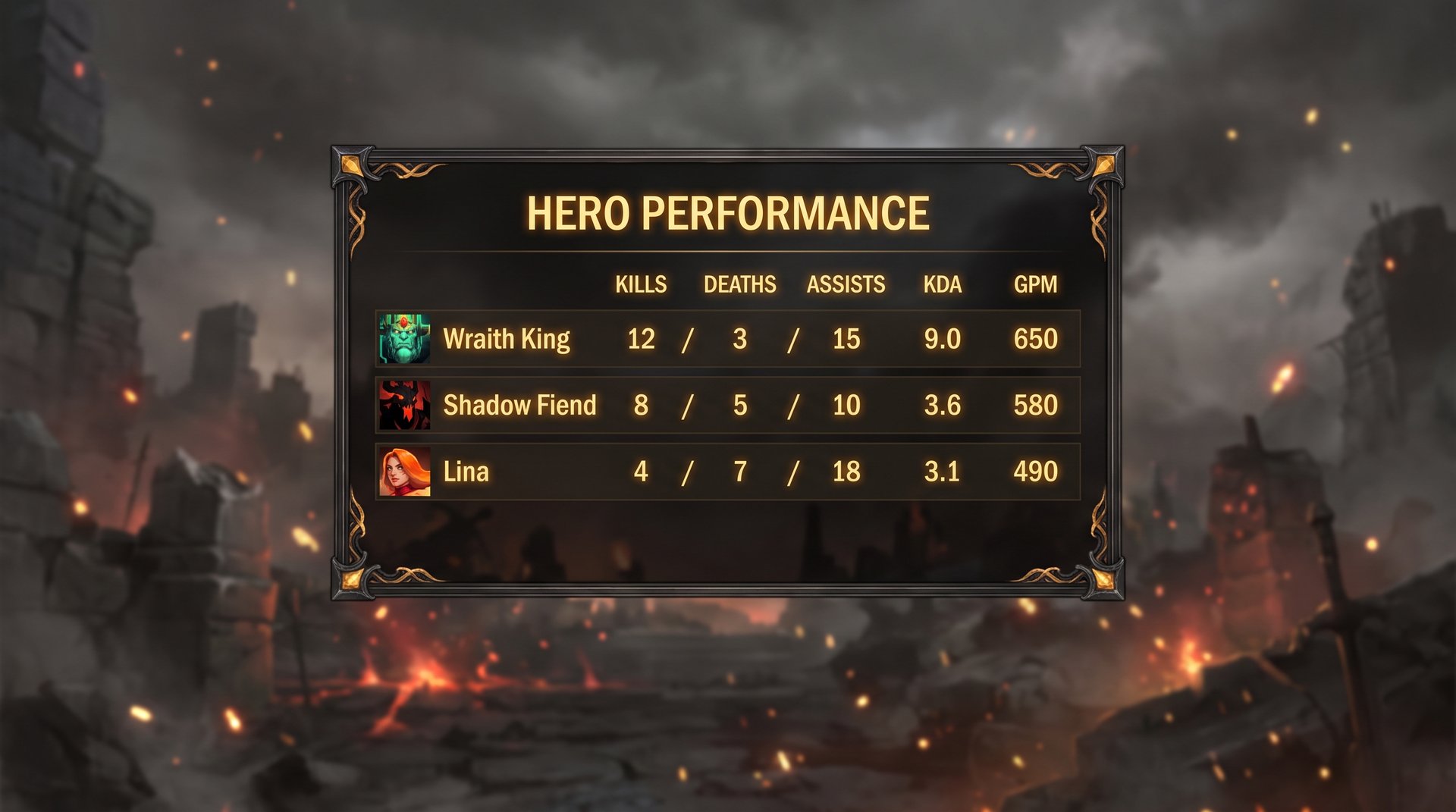
The Calibration Period — When Performance Gets Slightly More Weight
The calibration period at the start of each ranked season deserves its own section because this is where the “performance affects MMR” myth has the most grain of truth in it.
During calibration, your account uncertainty is deliberately set high. This means the system is less confident about your true MMR and is actively gathering data to place you. In this window, a few things happen that can feel like KDA is mattering:
- MMR swings per game are larger than the usual +30/-30 because high uncertainty amplifies the update
- Valve looks at your account history — past seasons, win rates over time, previous rank placements — not just the current calibration results
- If your account is brand new or was dormant, Valve may seed your starting point based on unranked game history and implicit signals, which can include overall game performance patterns across many games (not a single KDA)
What calibration does NOT do: read your KDA from each calibration game and scale your MMR gain by how well you played in that specific match. The input is still win/loss — just with a higher learning rate while uncertainty is elevated.
After calibration ends and uncertainty normalizes, the system settles back into the standard +30/-30 regime regardless of in-game performance. For a full breakdown of what happens during calibration games, see our guide on what happens if you win all 10 calibration games.
What Actually Moves Your MMR Number
Now that we have established what does not move your MMR, here is the definitive list of what does:
1. Winning ranked matches
This is the only primary input. Every win adds to your MMR. There is no shortcut around this. The fastest path to climbing is the highest win rate achievable, consistently, over a large sample of games.
2. Win rate over your opponent’s skill level
If your team’s average MMR is significantly below the enemy team’s, a win earns you slightly more and a loss costs slightly less. This is a small adjustment — usually a few points either way — but it compounds over many games. Playing against stronger opponents and winning is the highest-return path.
3. Account uncertainty (sigma)
Fresh accounts, accounts returning after long breaks, or accounts after seasonal calibration have higher uncertainty. This means each game result — win or loss — moves your MMR more than usual. This is neither good nor bad on its own: it means you can climb faster from a well-placed start, but it also means a bad start is more costly than usual.
4. Solo versus party queue
Solo and party MMR are tracked separately. Winning solo games adds to your solo MMR pool; winning party games adds to your party pool. Both matter for your overall rank display in the current season format, but they are weighted differently when Dota 2 calculates your visible rank medal.
5. Seasonal recalibration starting point
At the start of each ranked season, Valve applies a recalibration that moves everyone’s MMR toward a mean value before recalibration matches begin. Your finish from the previous season influences your starting position for recalibration. This is where the previous season’s total MMR — itself entirely determined by wins — feeds forward into the next season’s floor.
| Metric | Affects MMR Directly? | Notes |
|---|---|---|
| Win/loss outcome | Yes — primary input | Every ranked win: approx. +30. Every loss: approx. -30 |
| KDA (kills/deaths/assists) | No | Cosmetic only — shown in profile, feeds performance badges |
| Net worth / GPM | No | Performance badge material, not MMR input |
| Damage dealt | No | Post-game scoreboard stat only |
| First blood | No | Changes game state but does not adjust MMR directly |
| Behavior score (low) | Indirect | Very low score forces bad teammate pools — harder to win |
| Account uncertainty | Yes — scales swing size | High uncertainty = larger gain/loss per game result |
| Enemy team average MMR vs yours | Yes — small adjustment | Upsets earn slightly more; expected wins earn slightly less |
| Calibration history | Yes — placement only | Sets starting MMR for the season, not per-game gains |
Common KDA-MMR Myths Debunked
Years of community discussion have generated a set of persistent myths about how KDA interacts with MMR. Here are the most common ones, with each claim addressed directly.
Myth: “A good KDA proves you deserved the win, so you get more MMR”
Reality: Deserving a win and getting a win are two different things in Dota. The MMR system rewards outcomes, not effort. A 1/10 performance in a win still gets the full +30. Valve’s position is that over enough games, the player whose performance consistently leads to wins will climb to their correct MMR naturally through volume — not through per-game stat bonuses.
Myth: “If you int (intentionally feed) you lose less MMR on a loss”
Reality: Intentionally feeding does not trigger a reduced MMR loss. It does, however, trigger behavior score reduction and may result in a matchmaking ban. The MMR deduction for a loss is fixed regardless of how the game was played.
Myth: “High GPM heroes gain MMR faster because their performance is tracked”
Reality: GPM, XPM, and net worth are tracked as post-game statistics and inform hero performance analysis on third-party sites like Dotabuff and Stratz. They do not feed into the MMR calculation. A farming carry whose team wins gets the same +30 as the support who died 8 times protecting them.
Myth: “Valve secretly adjusted the system in a recent patch to include stats”
Reality: There have been no credible leaks or patch notes suggesting Valve reintroduced performance-based MMR adjustments since removing them. The post-7.00 ranked system operates on win/loss with uncertainty scaling. Any claim that “the new patch changed it” requires patch note evidence, and none exists as of the current season.
Myth: “Your KDA affects your next game’s matchmaking quality”
Reality: Matchmaking is based on your MMR number and behavior score. A single game’s KDA does not influence who you are matched with in the next game. The matchmaking algorithm does not read your last game’s scoreboard when forming lobbies.
How to Use KDA as a Climbing Tool
Dismissing KDA entirely is the wrong takeaway. KDA matters — just not the way most people think. The right relationship to your KDA when climbing MMR is to use it as a diagnostic signal, not a goal.
KDA as a proxy for decision quality
A persistently bad death count across many games usually signals a pattern: overextending for kills, poor awareness of map vision, bad positioning in fights. These are the same patterns that cause losses. Fixing them improves both your KDA and your win rate simultaneously. But the causal chain runs: fix decisions first, win rate improves, MMR goes up, KDA improves as a byproduct.
The death economy: dying costs more than a stat
In Dota 2, each death results in your hero going to the fountain for a duration that scales with game time and gold bounty. The true cost of a death is not the negative in your KDA — it is the lost actions during that respawn window. A carry who dies at minute 30 loses 60+ seconds of farming, fighting, and objective pressure. The opportunity cost of dying is what damages win rates, not the “D” in your score.
Players who understand this shift their focus from “not dying to avoid a bad KDA” to “not dying because a live hero is a useful hero.” The outcome looks the same on the scoreboard but the motivation is entirely different — and the second framing leads to better decisions in edge cases where a risky play might pad your KDA but costs the team a key objective.
Assists are underrated
In pubs, players frequently chase kills over assists because kills appear more prominently. But in Dota 2’s gold distribution model, assisting a kill generates meaningful gold and XP for your hero. From an MMR climbing perspective, high assists combined with win rate often indicate a player who creates opportunities for teammates — which translates directly into more wins.
If your KDA looks unimpressive but your win rate is strong, you are probably doing your job. Check your TeamSmurf coaching service for an objective analysis of whether your in-game decision patterns are win-oriented or stat-oriented.
Role-specific KDA benchmarks for self-assessment
If you want benchmarks to evaluate your own KDA performance, our guide on what is a good KDA in Dota 2 breaks down expected KDA ratios by role and rank bracket — carry, mid, offlane, soft support, hard support — so you can assess whether your current numbers match your bracket’s average or if there is room to improve your game sense.
Frequently Asked Questions
Stuck in MMR Purgatory Despite Playing Well?
KDA is not your bottleneck — win rate is. TeamSmurf’s Immortal coaches and professional boosters help you break through the rank ceiling that individual performance alone cannot crack. Every booster on our team is Immortal-bracket verified and Dota 2 specialists. No account sharing, no bots.


