Best Late-Game Heroes: Who Wins at 60 Minutes

Every game of Dota 2 comes with an unspoken question: will this one go to 60 minutes? And if it does, which heroes are still relevant — and which ones have already won? The gap between a hero that peaks at 20 minutes and one that peaks at 60 is enormous. Understanding that gap is one of the highest-leverage skills you can develop for MMR climbing.
Late-game heroes are not just about raw damage. They scale in ways that compound with every item, every minute, and every stacked camp cleared. At 60 minutes, a fully-itemized Spectre or Medusa is not just hard to kill — they actively punish the enemy team for existing on the same map. This guide covers the best late-game heroes in Dota 2 in 2026, why they win extended games, and exactly how to play them to maximize your MMR gains.
Whether you are a carry player looking to commit to the hyper-carry archetype, a support player asking which heroes still matter when the game goes long, or a drafter trying to understand when to draft for the late game versus when to end early — this is the guide that answers all of it.
In This Guide
Why the 60-Minute Mark Changes Everything
Most Dota 2 guides talk about the laning stage and the midgame. Very few discuss what actually happens at the 60-minute mark in a mechanical sense. Understanding this is the foundation for picking and playing late-game heroes correctly.
At 60 minutes, several things converge that make the game fundamentally different from anything that happened before. Buyback costs have scaled to a point where most heroes cannot afford them without sacrificing their next major item. Aegis timers are measured in minutes rather than seconds. Net worth gaps that seemed insurmountable at 30 minutes can close — or blow open further — in a single teamfight. A single Roshan kill, followed by a coordinated high-ground push, can end a game that looked stable for the last 20 minutes.
Late-game heroes exploit all of this. Their advantage is not that they deal the most damage at 35 minutes. Their advantage is that their damage, survivability, and utility scale so steeply with items and time that by 60 minutes the enemy team is effectively playing against a different category of opponent. A Spectre at 25 minutes is a nuisance. A Spectre at 60 minutes with Radiance, Manta Style, Skadi, and Butterfly is one of the most threatening units in any Dota 2 game — one that cannot simply be avoided because Haunt creates an inescapable global reach.
The math of the late game also favors certain types of scaling mechanics:
- Item scaling: Heroes whose abilities interact multiplicatively with their items — illusion heroes, percentage-based damage dealers, armor-stacking supports — grow faster than their item cost suggests. A 5,000-gold item on a hero that doubles its value through ability interaction is effectively a 10,000-gold purchase.
- Stack scaling: Atrophy Aura permanent damage bonuses, Radiance burn damage ticking through a teamfight, and other stacking effects compound over the course of a game. A hero with 40 stacks of Atrophy Aura is playing with a hidden item slot advantage that never shows up in the scoreboard.
- Buyback denial: Abilities that chain-kill or instantly delete a support — Mana Void, Laguna Blade, Finger of Death — become disproportionately powerful when every kill has a buyback decision attached to it. Forcing the enemy support to spend 2,000 gold on a buyback at 55 minutes is a massive setback for the enemy’s next Roshan or high-ground attempt.
One more important factor: late-game heroes punish poor resource usage. If the enemy team is spending gold inefficiently — overbidding on defensive items, itemizing for the wrong threat — your scaling carry gains compound advantages that never existed in the laning phase. Reading how the enemy is spending their gold is a high-MMR skill that pairs perfectly with a hyper-carry draft. At 60 minutes, the team with better item efficiency in the final slots typically wins regardless of individual mechanical skill.
With that foundation in place, let us look at which heroes actually execute on this framework in 2026 — and which carry slot options give you the best return on a long-game investment.
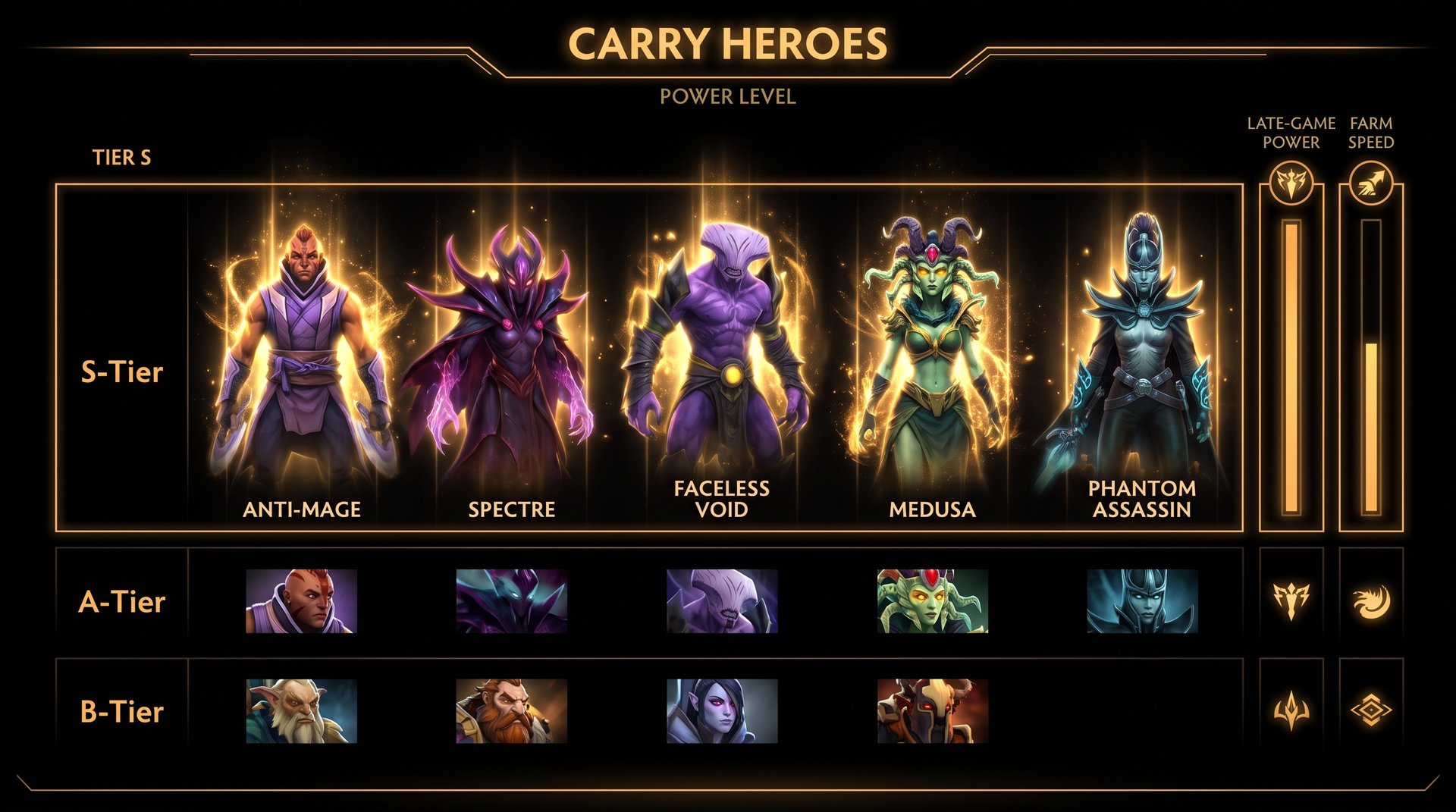
The Top 5 Late-Game Carry Heroes in 2026
These five heroes represent the clearest examples of hyper-scaling carries in the current Dota 2 patch. Each one has a different profile — different farm speed, different teamfight role, different item path — but all five share the property that every minute past the 30-minute mark makes them meaningfully more dangerous to face.
| Hero | Peak Timing | Core Items | Primary Scaling Mechanic | Difficulty |
|---|---|---|---|---|
| Spectre | 45-60 min | Radiance, Manta Style, Skadi | Haunt + Dispersion reflect | Medium |
| Medusa | 55-65 min | Linken’s Sphere, Manta Style, Skadi | Mana shield + six-item tankiness | Low-Medium |
| Terrorblade | 35-55 min | Sange & Yasha, Dragon Lance, Manta Style | Metamorphosis illusion damage | Medium-High |
| Anti-Mage | 40-55 min | Battle Fury, Manta Style, Abyssal Blade | Mana Void burst + Blink mobility | Medium |
| Phantom Lancer | 50-65 min | Diffusal Blade, Manta Style, Eye of Skadi | Illusion army overwhelming numbers | Medium |
Spectre — Haunt Becomes a Game-Ending Tool
Spectre is the archetype of the Dota 2 late-game carry. Her entire kit is designed around becoming more threatening as the game goes longer and as she acquires more items. At three items — typically Radiance, Manta Style, and Diffusal Blade or Skadi — she hits a point where any teamfight she joins via Haunt has a strong chance of producing multiple kills with zero risk to her physical safety.
The key mechanic is Dispersion. At max level, Spectre reflects 22% of any damage dealt to her back to the source. This number sounds modest until you consider that at 60 minutes, enemies are dealing thousands of damage per hit. A carry landing a 700-damage attack on Spectre just took 154 damage reflected back. In a teamfight where multiple enemies are targeting her simultaneously, Dispersion becomes a passive AoE damage source that scales with the enemy’s own power — one of the few scaling mechanics in Dota 2 that literally gets better as enemies become more powerful.
Haunt changes the geography of the late game entirely. Every enemy hero on the map is simultaneously a potential target, which means a 60-minute Spectre can punish overextension anywhere. The enemy carry farms the jungle at minute 57? Haunt fires, the illusion finds them, and the carry is forced to either fight a Spectre illusion alone or teleport out and abandon the farm. Neither outcome is good for the enemy.
For MMR purposes, Spectre rewards patience above all. The single biggest mistake Spectre players make is using Haunt reactively — to save themselves or respond to a fight that is already happening — rather than proactively at full farm when the cooldown can find kills and force simultaneous buybacks across the map. If you learn to Haunt into an uncontested position where two or three enemies are isolated from their team, your close rate at 60 minutes will improve dramatically.
In 2026, Spectre remains a strong pick because the current item options give her the flexibility to build against either physical or magical heavy lineups. Butterfly for physical-damage enemies, Radiance for an illusion-count play, or Revenant’s Brooch for spell-casting range — the adaptability is part of what makes her the safest late-game carry to draft into an unknown enemy lineup.
Medusa — Unkillable at Six Items
Medusa has the slowest farm speed of any hero on this list. Her laning phase is below average. Her early-game teamfight contribution is minimal. And yet she is consistently one of the highest win-rate carries at 60-plus minutes across most skill brackets. The reason is simple: once Medusa has six items, she is functionally unkillable by most compositions that exist in the game.
Mana Shield converts mana into a secondary health pool, absorbing 1.5 damage per 1 mana before any health is touched. At 60 minutes with a full mana pool from Linken’s Sphere, Manta Style, and Skadi, Medusa walks into the field with an effective health pool that puts most other heroes to shame. Stone Gaze paralyzes every enemy who looks at her during its duration, and Split Shot turns her right clicks into a multi-target damage machine that clears waves and controls space simultaneously.
The key to Medusa’s dominance at 60 minutes is that the enemy team has no clean kill path. Burst damage hits Mana Shield before health, meaning burst lineups burn through their cooldowns for less effective damage than they expect. Sustained damage runs into the same conversion rate. The only reliable way to kill Medusa at full farm is a combination of instant-lock hex, followed by a chain stun, followed by every burst ability in sequence — and even then, the fight often goes to her if she can Stone Gaze before the combo completes.
From an MMR perspective, Medusa players who win their games at 60 minutes rarely do so through outplaying the enemy team in mechanical exchanges. They win by existing — by forcing the enemy to make increasingly desperate plays to end the game before her farm reaches its ceiling, and by punishing those desperate plays when they overcommit. The strategy is fundamentally about patience and timing high-ground defense correctly, which makes Medusa one of the most consistent MMR-gain heroes for methodical players.
Terrorblade — The Most Dangerous Illusion Hero
Terrorblade hits his power spike earlier than Spectre or Medusa — usually around the 30-35 minute mark with his first two major items — but his potential at 60 minutes rivals both. The difference is that Terrorblade’s ceiling is shaped by his Metamorphosis duration and illusion management, which raises his skill floor compared to the other heroes on this list.
Metamorphosis transforms Terrorblade into a ranged siege unit with significantly increased base damage and attack range. During Metamorphosis, his illusions also transform, creating a line of high-range, high-damage ranged units that can effectively siege high ground from a safe distance. At 60 minutes with Manta Style and Dragon Lance, the illusion count and output make it genuinely difficult for defenders to push out and contest him without falling in range of his carries and supports waiting behind.
Sunder is the ability that defines Terrorblade’s late-game survivability. At high combined net worth, Sunder can swap his health with an enemy who has fewer effective hit points — essentially using his carry opponent as a health restore. When used correctly in a drawn-out teamfight, Sunder changes the kill condition entirely and forces enemies to itemize specifically around it, typically BKB.
For MMR climbing, Terrorblade is one of the most efficient carries to learn because his win condition is clearly defined and executable from almost any game state where he has two items. Once Manta Style and Dragon Lance are complete, the push template is reliable. The main skill investment is illusion micromanagement and knowing exactly when to use Metamorphosis for maximum siege pressure versus holding it as a defensive repositioning tool.
Anti-Mage — Mana Void Deletes Supports at 60 Minutes
Anti-Mage sits in a different late-game niche from the other carries on this list. Where Spectre, Medusa, and Phantom Lancer win through attrition and overwhelming presence, Anti-Mage wins through surgical execution. At 60 minutes, Mana Void becomes a kill-on-demand button against any hero whose mana pool has been burned down — which at full farm is every hero on the enemy team who does not have specific mana-restoration mechanics.
The math on Mana Void at 60 minutes: Anti-Mage passively burns mana with every right click through Mana Break. After a sustained engagement where AM has been attacking an enemy hero, that hero’s mana pool is severely depleted. Mana Void then deals damage equal to the missing mana converted to a physical damage hit. Against a hero with 2,000 mana burned, that is a devastating instant burst hit — enough to eliminate most supports and severely damage or delete most cores in a single cast.
Blink gives Anti-Mage one of the highest escape ratings in the game at full level, which means he can engage, burn mana, disengage, and re-engage repeatedly without dying. At 60 minutes with Abyssal Blade or Nullifier added to his build, he gains the control and dispel options needed to pin down high-priority targets who would otherwise use spells or items to escape his Mana Void followup.
His primary weakness — a fragile laning phase that requires carry-priority support — is also a training opportunity. Learning to farm efficiently as Anti-Mage is one of the most transferable skills in Dota 2. The discipline of jungle routing, stacking camps, and avoiding fights when behind translates directly to higher-level play regardless of which carry you play later. If you want to climb MMR as a carry player, Anti-Mage teaches the fundamentals better than almost any other hero in the pool.
For players studying Anti-Mage and other late-game carries at the Immortal level, our MMR boosting guide explains how professional players sequence their item timings and which small decisions compound into the massive net worth gaps that decide 60-minute games.
Phantom Lancer — Overwhelming Numbers
Phantom Lancer is the purest expression of the illusion army strategy. At 60 minutes with Diffusal Blade, Manta Style, and Eye of Skadi active, PL sustains an army of illusions that makes him impossible to single-target and lethal to AoE heroes who cannot clear illusions fast enough before the original Lancer finds them in the chaos.
The illusion count at full farm is genuinely staggering. Manta Style, Juxtapose, and passive Spirit Lance generation together create a field of units that forces enemies to choose between splitting their AoE damage across every unit or trying to identify and burst the real PL under fight pressure. At 60 minutes, both options are bad. AoE damage at this stage rarely clears a full illusion stack quickly, and identifying the real Phantom Lancer in a crowd of visual clones requires a level of focus that is nearly impossible to maintain while also playing the teamfight correctly.
Diffusal Blade on Phantom Lancer solves a traditional late-game problem: movement control and buff removal. Against Linken’s Sphere carriers, BKB users who overstay their duration, or enemies who rely on Ghost Scepter for physical immunity, Purge provides the control that makes PL’s otherwise slow playstyle into a kill machine in the final teamfight.
The weakness to note is that PL’s win condition requires time and sustained farm. He does not contribute meaningfully to early fights and is one of the weakest heroes in the game at contesting vision or taking objectives before his farm is complete. If you draft Phantom Lancer, your team needs to understand their role clearly: buy time, protect the carry, control Roshan, and trust that the 60-minute end state is worth the 40 minutes of careful play it took to get there.
Support Heroes That Scale Into the Late Game
Late-game scaling is not exclusive to carry heroes. Several supports have late-game contributions significant enough to change the outcome of 60-minute fights. These heroes do not scale the same way carries do — their output is not purely raw damage — but they bring crowd control, auras, summons, and global effects that become increasingly decisive the longer the game runs.
Warlock — Golem Army That Tanks Barracks
Warlock is one of the few support heroes in Dota 2 whose ultimate ability becomes strictly better as the game goes longer, independently of Warlock’s own gold and experience gain. Chaotic Offering summons two Infernal golems with scaling health and damage that grows over the course of the game. At 60 minutes with Aghanim’s Scepter granting an additional golem and reducing the cooldown, a well-timed Chaotic Offering can single-handedly tank a high-ground push through a T3 tower and into the barracks.
The structural advantage Warlock provides at 60 minutes is making high-ground pushes mechanically safer than they would otherwise be. Infernal golems absorb tower shots, tank enemy right clicks, and apply a ground-slam stun to nearby enemies that interrupts channeling abilities and breaks formation. A properly timed Chaotic Offering at the high ground means that even if the pushing team loses several heroes to buybacks during the push, the golems continue the siege autonomously until the wave clears or the barracks falls.
Fatal Bonds applies a damage link to multiple heroes simultaneously, meaning that any AoE damage hitting one linked hero is partially shared to all others in the link. In a teamfight that starts with Fatal Bonds connected, the enemy team cannot afford to group up tight — every AoE ability becomes a percentage amplifier multiplied across all linked targets. This synergizes powerfully with AoE damage carries like Dragon Knight, or with pure attrition heroes like Spectre whose Radiance burn hits all units simultaneously.
Warlock also provides one of the rare forms of global utility available to a support in the late game: Upheaval’s slow is large enough to catch fleeing heroes after a teamfight collapses, and the slow duration combined with golem presence gives teams that are winning a fight the time to finish kills and convert them into objectives before buyback timers expire.
Underlord — Atrophy Aura at Full Stacks
Underlord is almost exclusively a late-game hero, and his Atrophy Aura is one of the most powerful passive abilities in the game when given sufficient time to accumulate permanent damage stacks. Every enemy unit that dies near Underlord permanently increases his base damage by a flat amount. After 60 minutes of participating in kills, assists, and lane-pushing throughout the game, an active Underlord’s effective base damage is substantially higher than his stat sheet alone would suggest.
The aura itself reduces the base damage of every enemy within range by a percentage — effectively an armor equivalent that does not show up in anyone’s defensive statistics but changes every trade outcome. Against physical-damage-heavy lineups, which most carry-focused drafts are, this passive reduction means enemy carries deal less damage to everyone in Underlord’s presence. Combined with his own high armor from stat growth, Underlord creates a physical combat zone that strongly favors his team.
Firestorm and Pit of Malice remain relevant at 60 minutes because their effectiveness is tied to levels rather than items. Pit of Malice at late levels covers a large area and applies a multi-second root that is invaluable for catching fleeing enemies after a successful fight or preventing retreating carries from escaping a high-ground defense.
Dark Rift, Underlord’s ultimate, provides the cleanest possible execute on any open-map objective contest. At 60 minutes, the threat of a team-wide teleport forces enemies to play conservatively in any location where Underlord has vision. Well-used Dark Rifts create and convert gold leads by teleporting the team to take objectives the enemy cannot contest in time, creating the space and safety that late-game carries need to close out the game on their terms.
Witch Doctor — Death Ward at Maximum Stacks
Witch Doctor earns his place on this list through one of the highest single-target damage ultimates in the support hero pool. Death Ward at level 3 with Aghanim’s Scepter granting a bouncing-attack variant and improved bounce range deals enormous physical damage in its 8-second channel window. At 60 minutes, the bounced attacks frequently hit the same high-value target multiple times as the bounce geometry changes during the fight, making it one of the highest effective DPS abilities any support hero can deploy.
The critical skill at 60 minutes is protecting the channel. Death Ward does nothing if Witch Doctor is stunned or killed before it runs to completion. This means successful late-game Witch Doctor play requires explicit communication with your carry about peeling for him during the channel — a coordination habit that also generalizes to better teamfight communication across any hero pairing.
Maledict, Witch Doctor’s secondary damage spell, scales strongly against high health-pool targets. As the percentage of health missing increases over the duration, the tick damage accelerates. At 60 minutes against a fully-farmed carry with a large health pool, a Maledict applied before a Death Ward channel can add thousands of additional combined damage to the kill sequence, often eliminating a hero who would have survived the Ward alone.
Voodoo Restoration provides a passive healing aura that becomes surprisingly effective at 60 minutes for sustaining allies in drawn-out rax fights or extended siege situations where the enemy team cannot push out to contest without getting punished.
How to Draft and Play for a 60-Minute Win
Picking a late-game hero is not enough. You need a draft that supports the strategy and a game plan that actually gets you to 60 minutes in a position to win. Many players pick Medusa and lose at 45 minutes because their team drafted no hard disable and no way to survive long enough for the carry to reach her peak. The draft is the first game you play before the game starts.
The most important thing you can do when selecting a late-game carry is to communicate your intent before the game launches. In a ranked queue with enough chat time to coordinate, a simple note — “drafting for late, I need time” — aligns your team’s item choices, aggression level, and objective priorities. Teammates who know you are a 60-minute hero will buy more defensive items, control Roshan more consistently, and resist the impulse to take unfavorable teamfights in the 25-40 minute window where you are weaker than the enemy carry.
The draft itself needs three things working together:
- A hard disable: At least one hero with a long-duration stun, hex, or knockdown that stops enemies from instantly deleting your carry. Bane Elemental, Shadow Demon, Lion, or Beastmaster — any hero who can lock down the enemy’s damage dealer long enough for your carry to get out of range or secure the first kill.
- An answer to the early-game timing: The gap between your carry’s weak early game and their 60-minute peak is the window where most late-game drafts fail. Your team needs either a strong frontlaner to tank the early aggression, a defensive support with a guaranteed save ability, or Roshan control to maintain a gold buffer that discourages risky all-in plays.
- Vision control in the late game: Late-game teamfights are decided by vision. Gem of True Seeing on a frontliner, Sentry wards on the high ground during pushes, and Observer wards timed around Roshan — these are not luxuries in a 60-minute game, they are what enables your carry to engage with information and disengage safely when the fight goes wrong.
In terms of in-game decision-making, the most important discipline for late-game carry players is avoiding solo deaths in the minutes between 30 and 50. A single death at minute 40, with a buyback costing nearly 2,000 gold, can set your farm back far enough that the 60-minute power spike never fully materializes. Farm safe areas, use Aegis to take calculated risks, and defer teamfights until you have the item count to be confident in the outcome.
When the power spike arrives, the correct play is typically to apply pressure immediately rather than waiting for an imaginary perfect moment. The 60-minute window is not permanent — enemies are buying items too. When you have four or five items and the enemy team has no Aegis, no remaining save for your hero, and a support without buyback, that is the moment to force the fight, take the barracks, and convert the advantage into a closed game.
The Items That Define the 60-Minute Meta
Late-game items share common properties: they grant multiple benefits per slot so that six slots translate to more effective power than six single-purpose items, they interact with the hero’s primary scaling mechanic, and they provide enough survivability to ensure the carry actually completes the fight rather than dying before their damage is fully expressed. These are the items that most consistently define late-game carry success in 2026.
| Item | Best On | Why It Matters at 60 Minutes |
|---|---|---|
| Eye of Skadi | All carries | Cold Attack slows attack and movement speed; reduces enemy regen so dramatically that it neutralizes Lifesteal and Linken passive regen at high values — a complete anti-sustainability tool |
| Manta Style | Illusion heroes, AM, Spectre | Creates two illusions that multiply ability-based scaling; dispels many debuffs including silence and some stuns; the 3.5s cooldown generates constant illusion pressure that forces enemies to spend AoE ability charges |
| Butterfly | Spectre, Terrorblade, Phantom Lancer | 35% evasion at 60 minutes means physical-damage carries miss more than a third of their attacks; combined with a large health pool it creates a survivability ceiling most lineups without MKB cannot pierce |
| Satanic | Wraith King, Anti-Mage, Terrorblade | Unholy Rage active lifesteal during a teamfight can fully restore a large health pool in the time it takes the enemy team to cycle abilities — converts sustained fights into an overwhelming health advantage |
| Linken’s Sphere | Medusa, Anti-Mage | Blocks one targeted spell per cooldown; at 60 minutes this often denies the single hex or stun that enables the enemy team’s entire burst combo, buying the carry the window to reposition |
| Abyssal Blade | Anti-Mage, Terrorblade | Instant-cast bash stun on a short cooldown; provides the control deficit that most agility carries face against BKB users who would otherwise trade freely and disengage before Mana Void or Sunder resolves |
The single most common itemization mistake in the late game is building pure damage when you actually need survivability, or stacking survivability when the enemy team is too slow to kill you anyway and you need to close the game. At 60 minutes, a carry who survives five seconds longer in a fight will deal more total damage than one who is 10% higher DPS but dies earlier. Butterfly and Skadi are almost never wrong on physical carries because they extend the survival window more reliably than any raw damage item at the same cost.
Item slot prioritization also matters at 60 minutes in a way it does not earlier. When every slot is filled, every new purchase requires selling an existing item. Planning your six-slot endgame before you have your third item prevents the common mistake of buying situational items reactively and then being slot-locked away from the items you actually needed for the final fight of the game.
Late-Game Heroes and Your MMR: Making the Strategy Work
If you want to climb MMR, late-game carries offer a specific kind of value: high win rates in long games, a relatively clear game plan that does not require reading the enemy draft perfectly, and a forgiving execution pattern where your hero compensates for some individual mistakes through sheer power level at full farm. The tradeoff is that you need games to go long, and you need to survive the 20-40 minute window where you are weaker than most of the heroes you will face.
The best way to convert late-game carry games into consistent MMR gains is to pair the hero with a support who understands their role in the strategy. In lower brackets, a Witch Doctor or Warlock who knows to save their abilities for the carry’s benefit dramatically increases how many games reach the 55-minute mark where your hero is strongest. In higher brackets, the support skill floor goes up, but the coordination ceiling also rises — a five-person draft built around enabling a Medusa or Spectre is one of the most effective strategies in any ranked environment.
One approach many players find useful is tracking where their losses happen. If most losses on hyper-carry heroes come before 50 minutes, the issue is either draft execution or laning phase decision-making — both correctable with replay review and deliberate practice. If losses consistently happen after 50 minutes, the issue is teamfight execution or item sequencing, which requires seeing the same situations repeatedly with intentional focus rather than just playing more games.
If you are serious about climbing but want to reach your target bracket faster while you study the late game properly, consider the option of using a professional Dota 2 boosting service to establish a foothold in the bracket first. From there, reviewing replays of how Immortal players handle Spectre or Medusa at 60 minutes is the fastest way to identify the exact decision patterns that separate a winning power spike from one that stalls and gives the enemy time to equalize. You can review whether Dota 2 boosting is safe for your account before making any decision — our guide covers Valve’s actual enforcement approach and what practices are genuinely risk-free.
Our one-on-one coaching sessions pair you with an Immortal player who can review your late-game carries and give specific, actionable corrections to the decisions that are costing you wins. Many players find a single coaching session on their main late-game carry improves their win rate within the next 30 games because they stop making one or two systematic mistakes that were flipping close games from wins to losses.
Frequently Asked Questions
Ready to Reach Your Target MMR Faster?
Playing late-game carries correctly is one of the most reliable paths to consistent MMR gains in ranked Dota 2. If you want to study how Immortal players execute these heroes at the highest level — or if you want to reach your target bracket with a verified Immortal booster handling the games while you review the replays — TeamSmurf gives you a direct, safe path to both.