Ranked Anxiety Is Real: Why Players Fear Their Own Main Account

You have 2,400 hours in Dota 2. Your macro sense is decent, your hero pool is dialed in, and on an unranked account you stomp games with confidence. Yet when it comes to queuing ranked on your main — the one with four years of MMR history attached to it — your hand freezes over the button. Something tightens in your chest. You alt-tab to check Reddit instead.
This is ranked anxiety, and it is one of the most underreported barriers to improvement in competitive games. It is not a sign of weakness or inexperience. It is a predictable psychological response to high-stakes performance environments, and Dota 2’s design amplifies every one of its triggers. Understanding why it happens is the first step to breaking through it — and to actually climbing.
In This Article
What Ranked Anxiety Actually Is
Ranked anxiety is performance anxiety applied specifically to competitive matchmaking. It is not the same as being nervous before a game. It is a persistent, avoidance-producing fear response triggered by the social and identity stakes that ranked play introduces on top of the normal challenge of the game itself.
Performance anxiety in competitive contexts has been studied extensively in sports psychology. The core mechanism is simple: when the outcome of a performance is attached to identity, social standing, or something with lasting consequences, the brain activates threat-detection systems that interfere with fine motor control, working memory, and decision-making speed — all the things Dota 2 demands most heavily.
In casual Dota 2, a bad game is a bad game. You close the client and move on. In ranked, a bad game means a number permanently decreases. That number is visible to your friends, your party members, and anyone who checks your Dotabuff. It tells the world how good at Dota 2 you are — or at least, it tells you that it does, and that belief is enough to activate the threat response.
The important distinction is that ranked anxiety is separate from skill level. It affects beginners and experienced players. It affects people at 2,000 MMR who want to hit 3,000, and people at 6,000 MMR who are protecting their spot in the Immortal bracket. The specific fears are different across brackets, but the underlying mechanism is the same.
Why the Main Account Hits Different
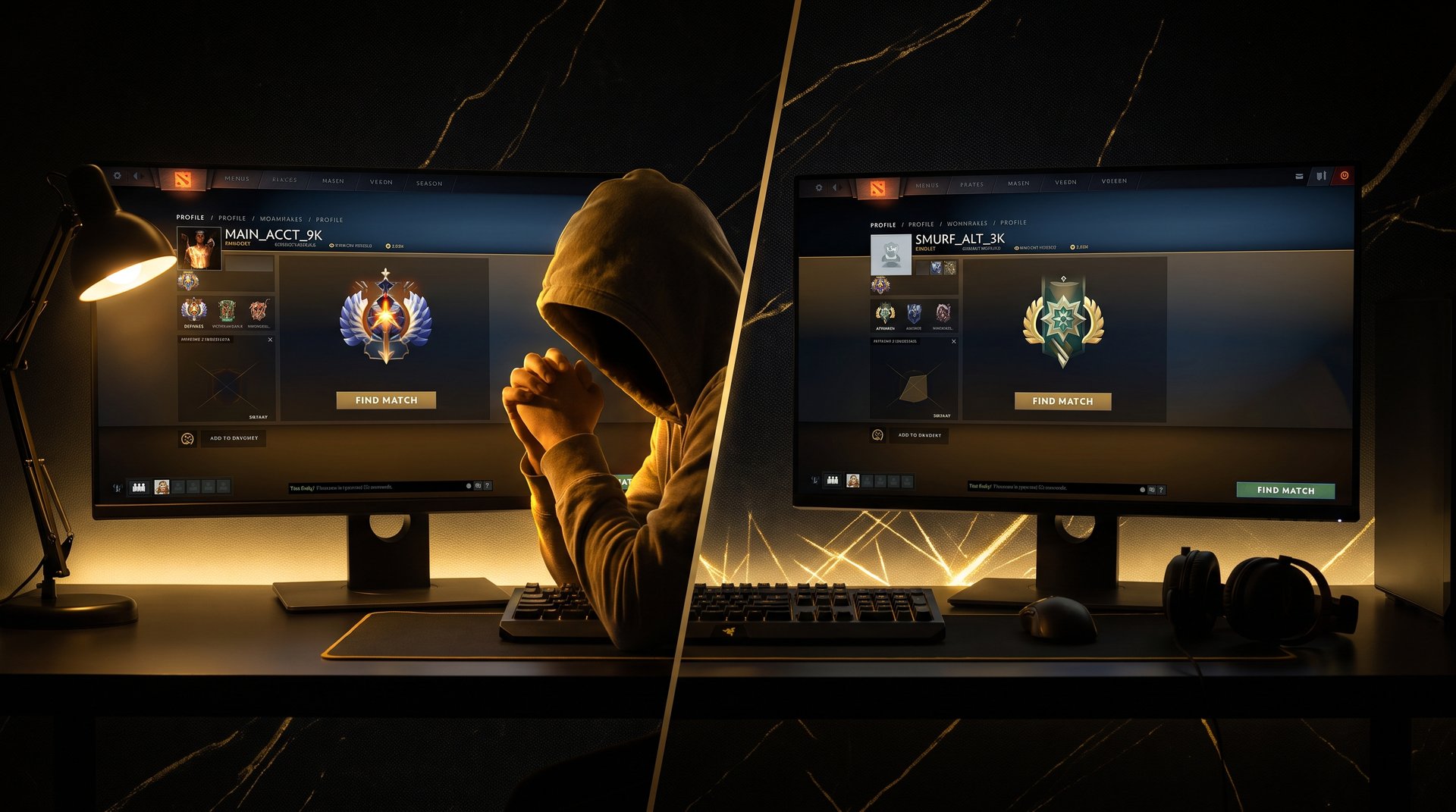
The most common form of ranked anxiety is not simply a fear of ranked play — it is a fear of ranked play specifically on the main account. Players who will queue ranked without hesitation on a fresh or alternate account suddenly become avoidant when it is their primary profile at stake.
This distinction matters because it reveals that the anxiety is not fundamentally about losing or performing badly. It is about identity exposure. Your main account is you. It carries your history, your peak, your friends list, and whatever rank you have worked years to achieve. Playing on it is not just competing — it is putting your identity on public display and risking a verdict.
The Accumulation Effect
Every game you have ever played on your main account has contributed to how you see yourself as a Dota 2 player. That account holds the memory of your best performances, your worst losses, the rank you grinded for three seasons. Losing games there does not just cost MMR — it feels like it revises that history downward.
Alt accounts and smurf accounts carry no such weight. They are blank slates with no identity attached. Losing five games in a row on a fresh account is a bad session. Losing five games in a row on your main is evidence of decay, of being a fraud, of no longer deserving the rank you hold.
The Peak MMR Problem
Every player has a peak MMR they remember. For many players, that peak is the most salient number on their profile — more vivid than their current rank. When your current MMR is below your peak, every ranked game carries an additional pressure: not just to win, but to claw back toward who you used to be. This makes the stakes of each individual game feel asymmetric. A win is a small step toward recovery; a loss is confirmation of decline.
Social Visibility
Dota 2 profiles are public. Your friends can see your rank, and tools like Dotabuff make your entire match history available to anyone who looks you up. This means ranked play on the main account is not a private performance — it is a public one. Every game is potentially observable. For players who have friends in higher brackets, or who have made claims about their skill level, this social exposure adds another layer of pressure that simply does not exist on anonymous alt accounts.
The Six Core Psychological Triggers
Ranked anxiety in Dota 2 is not one feeling — it is a cluster of overlapping triggers that compound each other. Understanding each one separately makes it easier to address them strategically.
1. Loss Aversion
Behavioral economics research established that losses feel roughly twice as painful as equivalent gains feel pleasurable. In Dota 2 terms, losing 25 MMR feels significantly worse than gaining 25 MMR feels good. This asymmetry is not rational — it is biological. It creates a natural bias toward avoiding ranked games because the potential pain of losing outweighs the expected pleasure of winning, even if your win rate is above 50%.
Loss aversion intensifies near bracket thresholds. When you are 30 MMR away from the next rank, losing is not just losing MMR — it is losing the rank you almost achieved. The closer you are to a milestone, the more acutely each loss registers.
2. Identity Fusion
Many long-term Dota 2 players fuse their self-concept with their rank. “I am a Legend player” or “I am high Ancient” becomes part of how they describe themselves, even outside the game. When rank becomes identity, each ranked game is a referendum on that identity. Losing feels like a personal verdict — not that you had a bad game, but that you are not actually as good as you thought you were.
3. Overthinking Under Pressure
Anxiety consumes working memory. The mental resources your brain would normally allocate to reading the minimap, tracking creep waves, and calculating rotations get partially hijacked by the anxiety response — monitoring for threats, running worst-case scenarios, preparing for failure. This is sometimes called “paralysis by analysis” in athletic contexts, but in Dota 2 it manifests as hesitation on item timing, late reactions to gank paths, and poor decision-making in team fights where split-second calls are everything.
The cruel irony is that the anxiety that comes from desperately wanting to play well is the same anxiety that makes you play worse. Players often notice they perform better in unranked or in games where they care less — this is not a coincidence, it is the pressure being removed.
4. Outcome Dependency
In ranked, your progression is tied directly to winning. This creates what psychologists call an “outcome-dependent” mindset rather than a “process-dependent” one. Players focused on outcomes (the MMR number) rather than processes (making good decisions each game) are more anxious because every game is framed as pass/fail. Process-focused players can have a losing game and still walk away satisfied that they executed well — outcome-focused players feel every loss as a failure regardless of how they actually played.
5. Teammate Dependency
Dota 2 is a five-player game. Even flawless individual play cannot guarantee a win if teammates underperform or throw. This lack of individual control amplifies anxiety because you can do everything right and still lose MMR. Players with ranked anxiety often fixate on this — “What’s the point of queuing if I might just get a feeder mid?” — and use it to rationalize avoidance. The uncertainty of teammate quality becomes a reason not to risk the MMR, even though it applies equally to opponents.
6. Recency Bias and Loss Streaks
Recent bad experiences with ranked are disproportionately influential on motivation to queue again. A four-game losing streak last week feels more relevant than a twenty-game winning streak two months ago. This recency bias means that a bad run at a critical time — the end of a season, right after hitting a new bracket — can create avoidance that lasts weeks or months, well past the point where the bad run has any statistical significance.
How Anxiety Actually Affects Dota 2 Performance
It is worth being specific about how ranked anxiety degrades Dota 2 performance, because it does not affect all skills equally. Understanding the performance gap helps players see what they are actually managing when anxiety is high.
| Skill Area | Anxiety Impact | Why It Happens |
|---|---|---|
| Last-hitting under pressure | High — timing degrades first | Fine motor precision drops with stress hormones |
| Minimap awareness | Very high — first thing that disappears | Working memory is consumed by anxiety monitoring |
| Item timing and build decisions | Medium — analysis paralysis kicks in | Overthinking slows decision speed |
| Communication and coordination | High — players go quiet or tilt faster | Social threat response increases friction with teammates |
| Hero mechanics (combos, positioning) | Low to medium — largely procedural memory | Deeply practiced skills are more resistant to pressure |
| Late-game decision-making | Very high — risk tolerance drops | Loss aversion makes players avoid necessary aggressive calls |
The pattern is clear: anxiety hits the cognitive skills hardest. The more automatic and practiced a skill is, the more resilient it is under pressure. The more it requires active attention and decision-making, the more it suffers. This is why mechanically strong players can still have anxiety-driven performance collapses in ranked — their finger skills hold up but their game-reading falls apart.
It also explains why players often feel like they play worse in ranked than in unranked despite the games being identical. They genuinely do play worse in some specific ways — because their cognitive resources are split between playing Dota and managing anxiety about playing Dota.
How Ranked Anxiety Drives Smurfing
Ranked anxiety is one of the primary drivers of smurf account creation. When the main account feels too high-stakes to play on, an alternate account offers an exit. You can still get the ranked experience — the competitive matches, the sense of progress — without the identity exposure that makes the main account feel so loaded.
From this perspective, smurfing is not primarily about ruining games for lower-ranked players (though that is a real consequence). It is a coping mechanism. Players use it to access competitive play in a lower-stakes environment, which is why it persists even among genuinely skilled players who could queue ranked on their main without needing an advantage.
The problem is that smurfing as an anxiety-management strategy does not actually address the anxiety. It sidesteps it. When you eventually return to your main — or when you care enough about the alt account’s rank to feel the same pressure there — the anxiety reasserts itself. The stakes just migrated to the new account.
This is the cycle many players recognize: create a new account to escape pressure, play comfortably for a few months, watch the alt account reach the same bracket and the same anxiety, and either create another alt or stop playing ranked entirely.
If you find yourself caught in this cycle, the right question is not “should I boost my alt or my main first?” — it is “what about ranked makes me avoid my main in the first place?” Answering that honestly is the starting point for actually solving the problem. You might find the guide on boosting main vs. alt first useful for thinking through the structural side, but the psychological dimension needs to be addressed separately.
How Ranked Anxiety Changes Across Brackets
Ranked anxiety is not uniform across MMR ranges. Its specific character shifts as players progress, and understanding those shifts helps target the right interventions.
Herald to Crusader (0 — 2,300 MMR)
At lower brackets, ranked anxiety often takes the form of impostor syndrome — a persistent feeling that your rank is higher than you deserve and that playing will expose you. Players at this level also face a genuine knowledge gap they are aware of, which makes the fear of “playing badly” acute. The anxiety here tends to be more generalized: the whole of ranked feels intimidating rather than specific triggers within the game.
Archon to Legend (2,300 — 3,700 MMR)
This is where outcome-dependency peaks. Players in these brackets understand the game well enough to know when they make mistakes, which makes individual errors feel more loaded. They can see exactly what they did wrong and extrapolate that seeing it means their opponents can too. Loss streaks in this range are common because this is the most contested portion of the curve, and they disproportionately trigger avoidance behavior.
Ancient (3,700 — 5,420 MMR)
At Ancient, social identity stakes intensify. Many players in this range consider themselves “serious” Dota 2 players and being an Ancient player is a meaningful self-descriptor. Dropping to Legend feels like a major identity demotion. The anxiety here is less about single games and more about bracket protection — the persistent low-grade avoidance of playing when you might be in a losing streak that threatens your bracket standing.
Divine and Immortal (5,420+ MMR)
At the highest brackets, the form of anxiety changes again. Concerns about social visibility are amplified because players at this level are often known within the community. Dotabuff profiles are actively monitored. Drops in rank are noticed. The pressure is less about personal identity and more about public reputation — which, for players who stream or participate in the Dota 2 community publicly, is genuinely consequential rather than imagined.
Immortal players also face the specific anxiety of the leaderboard: every game played near the leaderboard cutoff can shift your position among the top players in your region. The stakes at this level are as close to objectively real as they get in ranked play.
Breaking Through Ranked Anxiety: Practical Approaches
Acknowledging ranked anxiety as a real psychological phenomenon is more productive than trying to push through it by willpower alone. The following approaches are drawn from sports psychology research adapted for competitive gaming contexts.
Decouple Identity from MMR
The single most effective long-term intervention is to stop using MMR as a measure of who you are. This does not mean stopping caring about rank — caring about performance is healthy. It means recognizing that your rank at any given moment is a lagging indicator of your recent performance, not a permanent statement about your skill ceiling or your worth as a player.
A practical exercise: when you finish a game, write down one specific decision you made that was good and one that was improvable. Do this regardless of the match outcome. Over time, this builds a habit of process-evaluation that competes with the outcome-focus that drives anxiety.
Set Volume Goals Instead of Outcome Goals
Anxiety spikes when each game feels like it matters individually. It decreases when you zoom out to a longer time frame. Instead of “I need to win tonight,” set a goal of “I will play eight ranked games this week.” You have no control over individual outcomes; you have complete control over participation volume. Research in competitive performance consistently shows that volume goals reduce anxiety and, paradoxically, improve outcomes because they encourage engagement rather than avoidance.
For structured planning around MMR gains, the 30-day MMR sprint plan is a useful framework for converting that volume commitment into a structured improvement cycle.
Pre-Game Routine and Physical State
Physical arousal is physiologically similar to anxiety — elevated heart rate, heightened attention, muscle tension. The difference is interpretation. If you tell yourself “I am nervous,” your body reads that as a threat signal. If you tell yourself “I am activated and ready,” the same physical state becomes a performance enhancer. Research on competitive anxiety in sports calls this “re-appraisal,” and it has measurable effects on performance.
Before ranked sessions, develop a short consistent routine: a few minutes of controlled breathing (four counts in, four out), a warm-up game in turbo or unranked, and a brief review of your hero plan for the session. Consistency matters more than the specific content — the routine signals to your nervous system that this is a known and manageable situation.
Use the Diagnostic Approach
When you are in a losing streak, the anxiety-driven response is to blame teammates or bad luck and avoid the pain of honest self-assessment. A more productive response is to treat the streak as diagnostic data. The stuck MMR diagnostic tree provides a structured way to identify whether your losses are coming from mechanical errors, macro mistakes, or mental state issues — and to respond to each appropriately rather than just grinding more games in the hope that variance corrects.
Control the Controllables
Anxiety is amplified by perceived lack of control. In Dota 2, you genuinely cannot control your teammates, the enemy draft, or the server. What you can control is your own preparation, your hero selection, your attitude toward the game, and how you spend the time between games. Focusing explicitly and deliberately on the controllable variables — tracking your key stats week over week, narrowing your hero pool, studying replay footage — fills the space that anxiety otherwise occupies and gives you concrete evidence that you are progressing regardless of short-term MMR fluctuations.
Time Your Sessions Strategically
Not all hours are equal for ranked performance or for managing anxiety. If you are already fatigued, frustrated from other life stressors, or on tilt from a recent loss streak, queuing ranked on your main is likely to produce poor results and reinforce the anxiety. This is not avoidance — it is intelligent scheduling. The guide on timing your MMR push covers both the macro patterns (time of month, patch cycle) and the session-level decisions that separate players who climb consistently from those who grind themselves into losing streaks.
When Professional Boosting Is a Rational Response to Ranked Anxiety
There is a specific scenario in which professional MMR boosting directly addresses ranked anxiety rather than sidestepping it: when a player is trapped below their actual skill level due to a historical losing streak and the MMR gap between their rank and their real performance ability is creating a self-reinforcing anxiety loop.
This happens more often than it might seem. A player goes through a rough stretch — offline events, life stress, poor physical health during a key period — and drops from Crusader to Archon. At Archon, they are significantly above the lobby average, but the memory of the drop and the embarrassment of being visibly lower than they were creates anxiety that degrades their play. They perform worse than their actual skill level because the pressure of being “below where they belong” is constant. The result is a slow grind back that takes far longer than it should and carries a high psychological cost throughout.
In this context, using one of the best Dota 2 boosting services to close the gap to a rank that reflects your real skill level is not cheating the climb — it is removing an artificial obstacle created by external circumstances. Once the rank matches your actual ability, the anxiety of being “below where you belong” evaporates, and you can play from a place of confirmation rather than recovery.
The key questions to ask are:
- Is my current rank significantly below my historical peak due to specific circumstances rather than genuine skill regression?
- Am I consistently performing above the average for my current bracket when I do play?
- Is the anxiety I feel about ranked primarily tied to being at this specific rank rather than to ranked play in general?
If the answer to all three is yes, a targeted boost to close the gap is worth considering. If the anxiety is more fundamental — if you would feel it at any rank — then boosting changes the scenery but not the underlying pattern, and the psychological work described in the previous section is what actually needs to happen.
For players who are uncertain which applies to them, Dota 2 coaching through TeamSmurf’s coaching service offers a way to get honest external feedback on where you actually stand relative to your current bracket — which is often the missing piece that ranked anxiety prevents players from getting accurately from self-assessment alone. If you are unsure about the safety profile of these services, the detailed breakdown at is Dota 2 boosting safe covers the relevant considerations.
Stop Avoiding Your Main Account
Whether you need to close an MMR gap that anxiety has turned into a trap, or you want expert coaching to build the confidence to queue ranked consistently — TeamSmurf has options built for exactly this.
Boost My MMR Get Coaching