Dota 2’s Player Count in 2026: Dying Game or Just Aging?

Every few months someone declares Dota 2 dead. Forums fill with “peak was 2016,” Reddit threads ask whether it is worth starting, and Steam reviews from burned-out veterans use phrases like “ghost town.” Then the TI 2025 final pulls 961,000 concurrent players and everyone goes quiet for a while.
The truth is somewhere in between — and the actual numbers tell a much more interesting story than either the doomers or the cheerleaders admit. This article breaks down Dota 2’s real player count in 2026, where it has been, why it dropped, why it is climbing again, and what any of it actually means if you are deciding whether to play.
Table of Contents
The Numbers Right Now: 2026 SteamDB Data
As of early July 2026, Dota 2 sits comfortably among the top five most-played games on Steam. The live SteamDB dashboard shows concurrent player figures oscillating between roughly 400,000 and 700,000 depending on the time of day and day of the week, with the Eurasian peak window reliably pushing the number toward the higher end.
February 2026 was a standout month, recording a monthly average of 617,472 concurrent players — a figure that would have seemed optimistic even in 2024. The 24-hour peak during that same period hit 804,910, well above what casual observers expect from a game they keep reading is on its last legs.
| Metric | Figure (2026) | Notes |
|---|---|---|
| Peak concurrent (2026 so far) | ~805,000 | 24-hour peak, Feb 2026 |
| Monthly average (Feb 2026) | 617,472 | Highest monthly avg since 2022 |
| Daily range (last 12 months) | 288K — 694K | Low: off-peak hours; high: weekend evenings EU/SEA |
| Steam rank (by avg players) | Top 5 | Consistent throughout 2026 |
| TI 2025 peak (Sept 2025) | 961,289 | Near-record for a Dota event |
| All-time peak | 1,295,114 | March 6, 2016 |
| Gap to all-time peak | -37.9% | vs. current 2026 daily peak |
The key takeaway from this snapshot: Dota 2 in 2026 is not at its 2016 ceiling, but the trend line has been pointing upward for three consecutive years. That is a meaningful reversal after years of steady contraction.

Year-by-Year Player Count History
To understand where Dota 2 stands in 2026, you need to understand the full arc. The game launched on Steam in July 2013, and its growth in those early years was extraordinary — a MOBA at a time when the genre was exploding, backed by Valve’s distribution muscle and a devoted community that had migrated from Warcraft III mods.
| Year | Approx. Avg Concurrent | Peak Concurrent | Key Events |
|---|---|---|---|
| 2013 | ~300,000 | ~450,000 | Official launch July 2013; TI3 prize pool record |
| 2014 | ~600,000 | ~900,000 | Rapid growth; TI4 $10M prize pool shocks esports world |
| 2015 | ~820,000 | ~1,100,000 | Battle Pass era begins; TI5 $18M record pool |
| 2016 | ~870,000 | 1,295,114 | All-time peak March 6; Battle Pass frenzy |
| 2017 | ~740,000 | ~1,000,000 | Post-peak plateau; first signs of churn |
| 2018 | ~580,000 | ~850,000 | Artifact launch disappoints; attention fragmented |
| 2019 | ~435,000 | ~700,000 | Continued decline; Valve communication sparse |
| 2020 | ~480,000 | ~740,000 | COVID bump; TI delayed; players return indoors |
| 2021 | ~470,000 | ~760,000 | TI10 finally held; modest recovery |
| 2022 | ~415,000 | ~680,000 | Post-TI dip; near-low point of the cycle |
| 2023 | ~430,000 | ~720,000 | Recovery starts; new player onboarding improvements |
| 2024 | ~520,000 | ~810,000 | Strong TI season; patch cadence improves |
| 2025 | ~580,000 | 961,289 | TI 2025 spike; Monster Hunter collab drives Nov surge |
| 2026 (YTD) | ~615,000+ | ~805,000 | Highest sustained average in years |
The data above is sourced from SteamDB and SteamCharts historical records, presented as approximate annual averages. A few things jump out:
- 2016-2019 was a genuine decline of roughly 50% from peak average, not just hype vs. reality adjustment.
- 2020 actually helped — the pandemic kept players at home and Dota was a beneficiary of that unusual moment.
- 2022-2023 was the valley, and the recovery since then has been steady rather than explosive.
- 2025 was the clearest proof point that the downtrend had reversed: two separate 900K+ events in one calendar year.
The “Dying Game” Argument Examined
The “Dota 2 is dying” narrative has real roots. Dismissing it entirely would be dishonest. Between 2016 and 2022, the game shed roughly half of its average concurrent player count. That is not a blip — it is a sustained, multi-year contraction that touched every region except Southeast Asia, which remained relatively insulated.
Where the Decline Came From
Several factors compounded during those years. First, the genre itself peaked. The early 2010s MOBA boom — League of Legends dominating the West, Dota 2 holding prestige — gave way to a world where both games had essentially captured all the players willing to invest in that style of gameplay. The pipeline of new recruits dried up faster than existing players churned out.
Second, Valve’s communication was famously poor. Months would pass without a meaningful patch or developer update. The community had to reverse-engineer datamines to guess what was coming. Competing games like Valorant, Apex Legends, and later Fortnite offered shorter session lengths, lower skill ceilings, and more frequent content drops. For players on the fence, Dota 2 simply stopped winning those comparisons.
Third, Dota 2’s learning curve never got easier in any meaningful way. The game has over 120 heroes, each with four to eight relevant abilities. New players regularly face a minimum 200-hour investment before they understand what is happening. When friends leave the game, the social gravity that kept casual players around disappears.
The Real Problem: Smurf Accounts and Matchmaking
One underappreciated factor in the decline was matchmaking quality. As the playerbase shrank, queue times lengthened and the bracket spread widened to fill lobbies. Immortal-rank players — sometimes boosted accounts, sometimes genuine smurfs — ended up in lobbies with players hundreds of MMR below their actual level. New players regularly hit a wall where their experience felt unfair. This accelerated churn at the bottom of the skill pyramid, which is exactly where a game recruits its next generation of dedicated players.
So yes — Dota 2 did shrink. Anyone claiming otherwise is rewriting history. The question is whether the 2023-2026 trend changes the conclusion.
Why Dota 2 Is Growing Again
The recovery that started around 2023 is real, and it is not just one patch or one event. Several structural things changed.
Patch Cadence Finally Improved
Valve shifted from releasing massive game-overhauling patches months apart to a more regular cadence of balance updates. Players who had grown frustrated with stale metas — where the same five heroes dominated for three months at a time — got genuine variety back. The shift toward more frequent smaller patches is something League of Legends normalized years earlier, and Dota finally aligned with that expectation.
New Player Onboarding Got Attention
Dota 2’s tutorial has historically been a running joke. “The tutorial teaches you nothing” was a forum cliche for years. Valve invested in improved hero guides, updated bot AI for practice, and contextual in-game tips that help newer players understand why they died rather than just that they died. These are small changes, but they reduce the earliest wall — the “I don’t understand what just happened” frustration that kills retention in the first five hours.
The Competitive Scene Remained Healthy
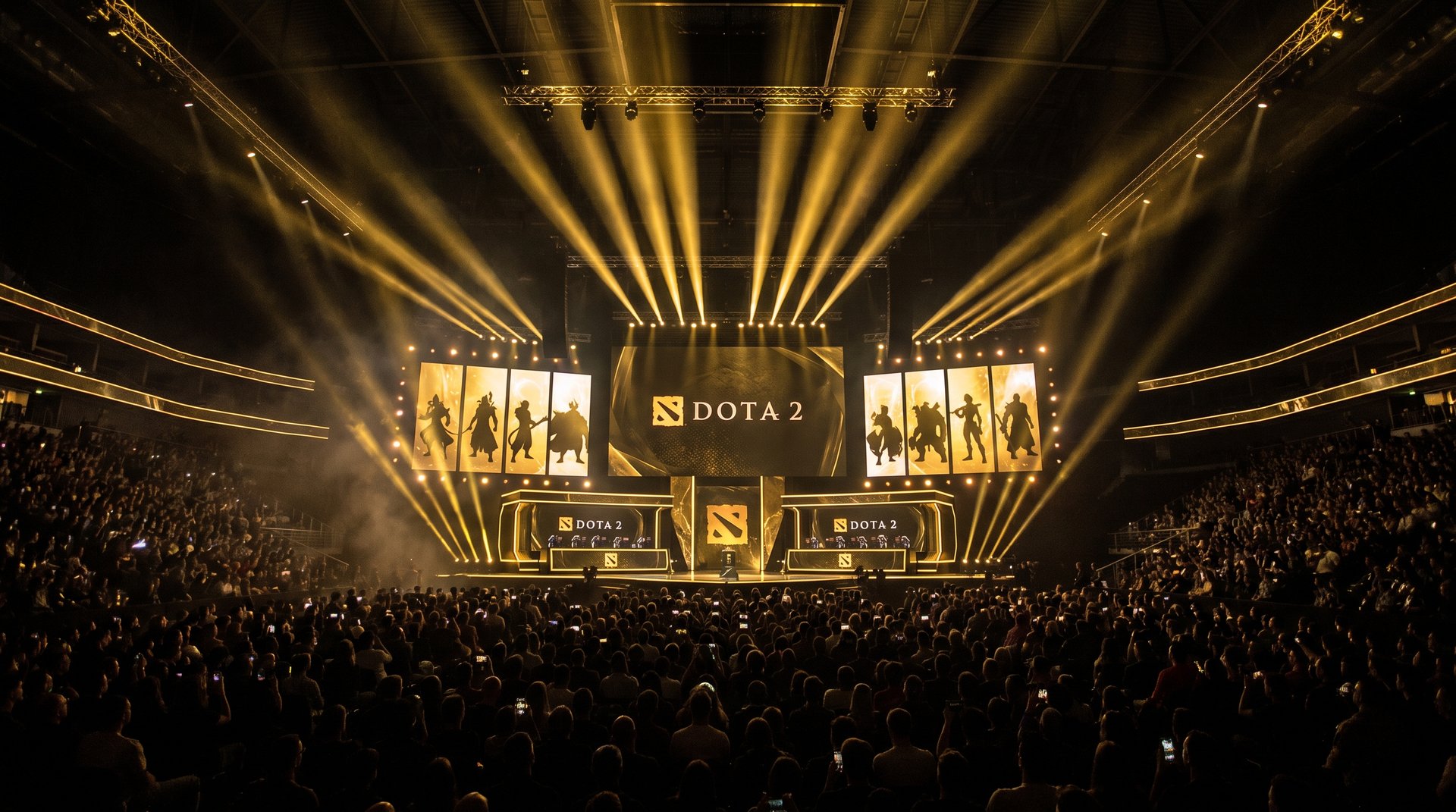
The International 2025 drew viewership numbers competitive with the game’s best years. The prize pool, the production quality, and the storylines around regional teams kept Dota 2 relevant in a way that purely casual metrics might miss. Esports viewership translates into player reinstalls — that TI 2025 spike to 961,289 concurrent players is direct proof. People watched the grand final, got hit by nostalgia, downloaded the client, and at least a fraction stuck around.
Content Collaborations Reached New Audiences
The November 2025 Dota x Monster Hunter collaboration was a case study in how a tactical collab can move the needle. The event pushed peak players above 910,000 in a month that historically sees player count drop after TI excitement fades. Monster Hunter’s audience and Dota 2’s audience have meaningful overlap — hardcore game players who invest serious time in progression systems — and the collab was well-designed enough to actually convert crossover interest into installs.
Spikes: Events, Patches, and Collabs
One of the most important patterns in Dota 2’s player count history is how dramatically the game responds to external catalysts. The day-to-day number is one thing; the spike ceiling tells a different story about the game’s latent audience.
| Event | Peak Players | Date | Type |
|---|---|---|---|
| All-time Steam peak | 1,295,114 | March 6, 2016 | Battle Pass launch |
| TI 2025 Grand Final | 961,289 | September 2025 | Major tournament |
| Dota x Monster Hunter collab | 910,000+ | November 2025 | In-game collaboration |
| TI 2024 peak | ~810,000 | Late 2024 | Major tournament |
| Feb 2026 24h peak | 804,910 | February 2026 | Sustained baseline |
What these events demonstrate is that the “sleeping giant” theory of Dota 2 has real support. There is a large pool of lapsed players — people who spent hundreds or thousands of hours in the game and left for one reason or another — who remain susceptible to coming back when something significant happens. The game’s latent reach is much larger than its daily concurrent count suggests.
The practical implication: if you are a new player joining in 2026, TI events and major updates are the ideal time to start. Queue times are shorter, the atmosphere is more energetic, and there are genuinely more players at every skill level going through the new-player experience simultaneously.
Regional Breakdown: Where Dota 2’s Players Actually Come From
Dota 2’s global distribution is dramatically uneven, and understanding it explains a lot about the game’s sustained health despite its Western perception as a declining title.
Southeast Asia: The Cornerstone Region
Southeast Asia — particularly the Philippines, Indonesia, Thailand, and Vietnam — has consistently been Dota 2’s largest and most engaged region. The game’s servers in Singapore and the dedicated SEA community mean that even during North American and European off-peak hours, SEA players keep the concurrent count from dropping into irrelevance. SEA also produces some of the game’s highest-skill players and has a deep grassroots competitive scene separate from the major circuit.
Eastern Europe and CIS
The CIS region (Russia, Ukraine, Kazakhstan, and neighboring countries) has historically been Dota 2’s stronghold in the West-adjacent world. Names like Navi, VP, and Team Spirit have won The International multiple times, giving the region genuine pride-of-place in the competitive scene. CIS players’ engagement with the game is tied heavily to both the professional scene and a strong regional solo-queue culture.
China
China’s Dota 2 history is complicated. The country had a massive dedicated playerbase that largely played through a separate Chinese client and server infrastructure. Over time, Chinese players have increasingly migrated to the international Steam ecosystem, contributing to global concurrent counts in ways that were not fully captured historically. The Chinese scene’s performance at TI events has been consistently elite.
Western Europe and North America
These regions have seen the steepest relative declines since 2016. Competition from League of Legends, followed by Valorant and other titles, pulled casual players away more effectively than in SEA or CIS. That said, both regions retain dedicated high-level communities and continue producing TI-caliber talent.
What the Player Count Means for Matchmaking Quality
Player count is not just an abstract number — it directly affects your in-game experience in measurable ways. Here is how the 2026 figures translate to actual matchmaking.
Queue Times
At 600,000+ average concurrent players, Dota 2’s global queue pool is healthy enough that most brackets in active regions should see sub-three-minute queue times during peak hours. The exception is very high MMR (top-1,000 player range) and very specific off-peak windows in smaller regions. For the vast majority of players in the Archon-through-Divine range, queue times are not a meaningful problem in 2026.
Match Quality and Bracket Integrity
Larger player counts mean the matchmaker can be more selective. When Dota 2 dipped to its 2022 lows, Valve’s matchmaker had to widen its acceptable MMR spread to fill games in reasonable time. This meant more mismatched lobbies — a 2,800 MMR player and a 3,600 MMR player sharing a carry/support lane is not a great experience for either.
The recovery since 2023 has meaningfully improved this. With more players in each bracket, the matchmaker can tighten its parameters. That translates to more balanced games, less stomping, and better retention — a virtuous cycle that sustains the growth trend.
The Smurf Problem in 2026
Smurfing remains Dota 2’s most discussed quality problem. High-skill players creating secondary accounts — either because they want an easier experience, because they enjoy the stomp, or because they want to play in a region other than their primary one — contaminates low-bracket matchmaking in ways that frustrate genuine new players.
Valve has taken more aggressive action against smurf accounts in recent patches, including phone verification requirements and behavioral pattern detection. The problem has not been eliminated, but it is less severe in 2026 than it was during the 2019-2022 trough. If you are a returning player who left because of smurf frustration, conditions are genuinely better.
If your current rank does not reflect your actual skill level — whether due to bad calibration, a rough streak with poor teammates, or just having improved significantly — Dota 2 boosting services offer a legitimate shortcut to the bracket where your games will actually be fair and enjoyable. Alternatively, Dota 2 coaching from an Immortal-rank mentor can help you climb legitimately without the frustration of hitting walls you don’t understand.
Dota 2 vs Other Games: Where It Stands
Context matters when evaluating any game’s player count. Dota 2’s 600,000+ concurrent average looks very different depending on what you are comparing it to.
| Game | Approx. Avg Concurrent (Steam, 2026) | Genre |
|---|---|---|
| CS2 | ~900,000+ | FPS (Shooter) |
| Dota 2 | ~615,000+ | MOBA |
| PUBG | ~400,000 | Battle Royale |
| Apex Legends | ~200,000 | Battle Royale |
| Path of Exile 2 | ~180,000 | ARPG |
Dota 2 is the second most played game on Steam by concurrent count. Behind CS2 and ahead of everything else. The framing of “dying game” is difficult to sustain when you are talking about a title that more people are playing simultaneously than Apex Legends, PUBG, and Path of Exile 2 combined.
The comparison that genuinely matters — and that Dota 2 partisans prefer not to dwell on — is League of Legends. Riot’s title does not publish SteamDB-style concurrent data, but estimates place its concurrent and monthly active user counts significantly above Dota 2’s figures. That is the one relevant comparison where Dota 2 clearly lost the long game.
But winning the war against LoL was never Dota 2’s stated goal, and the community that remained after the 2016-2022 contraction is, by most accounts, more invested and higher-quality than the average of a broader playerbase would have been. Dota 2 lost the casual player but retained the enthusiast.
Is Dota 2 Actually Dying? The Verdict
No. Dota 2 is not dying. It is aging — and aging well, by most metrics.
The game went through a genuine contraction that peaked around 2022. That contraction had real causes: genre saturation, Valve communication failures, matchmaking quality issues, and competition from newer titles with lower skill floors. Anyone who says the decline was not real is wrong.
But the recovery since 2023 is equally real. Three consecutive years of average concurrent growth, two separate 900K+ peak events in calendar year 2025, a TI scene that remains the most-watched esports event in its genre, and an active development team that has demonstrably improved patch cadence and onboarding — these are not the indicators of a game in terminal decline.
What Dota 2 in 2026 looks like is a game that has found its floor. It will probably never return to 1.2 million concurrent players. The genre’s window for mass-market recruitment closed years ago. But the game’s existing community is deeply loyal, the competitive scene is compelling, and Valve’s recent engagement suggests they are interested in sustaining rather than abandoning the title.
Bottom Line for Prospective Players
If you are thinking about starting Dota 2 in 2026: queue times are manageable, matchmaking quality is the best it has been since 2020, the patch cycle is more engaging than it was during the lean years, and the community — while intense — is not the wasteland some corners of the internet suggest. The investment is real. The game demands it. But the playerbase is there to play against, and the game at its ceiling is one of the deepest competitive experiences in gaming.
The “dying game” label made sense as a warning from 2017 to 2022. In 2026, it is outdated.
Struggling to Climb? Your Bracket Isn’t Your Ceiling.
If you are playing in 2026 but stuck at a rank that doesn’t reflect how good you actually are, TeamSmurf can help. We are Dota 2’s specialist boosting and coaching service — every booster is verified Immortal rank, every session is tailored to your bracket and goals.