When Calibration Boosting Is Actually a Good Idea

Calibration is the most emotionally charged moment in any Dota 2 player’s season. Ten games determine your starting rank for the next several months, and the outcome is shaped by factors that have almost nothing to do with your actual skill level: which heroes you can draft in a random ten-game window, whether your teammates in those games are calibrating up or down, and whether you are playing at peak form or coming off a two-week break. The result is that calibration MMR frequently does not reflect genuine skill, sometimes by hundreds of MMR points.
Calibration boosting — having a professional booster play your calibration games — addresses this misalignment directly. It is the most efficient version of boosting because calibration games have outsized impact on where you start and how long it takes you to reach your genuine rank through normal play. This guide explains specifically when calibration boosting is a good idea, when it is not, how it works mechanically, and what to realistically expect from the process.
This is not a pitch for calibration boosting in every situation. There are players for whom it is a genuinely good decision and players for whom the cost is not justified by the outcome. The framework below is designed to help you make that evaluation honestly.
Table of Contents
How Dota 2 Calibration Works in 2026
Valve’s calibration system uses your pre-calibration MMR as the anchor point and adjusts based on your win/loss record and individual performance in calibration games. The system is not a blank slate — if you ended last season at 4,500 MMR, you will not calibrate to 6,000 with a perfect calibration record. The calibration window is roughly +/-600 MMR from your ending rank depending on win rate and internal performance metrics.
What Calibration Games Actually Measure
Calibration games measure win/loss record, KDA ratio weighted by role, last-hitting efficiency relative to expected output for your role, and several internal metrics that Valve does not publish publicly but that correlate with hero damage share, net worth percentile among your team, and death count relative to role expectations. Playing well in losing games partially mitigates the MMR penalty. Playing poorly in winning games partially reduces the MMR gain. The system tries to account for game-state variance.
The Calibration Variance Problem
Despite these adjustments, calibration variance is real and significant. A player who calibrates during a weekend where they are sleep-deprived, playing unusual heroes, or running into an unusual number of smurfs can land 200-400 MMR below their genuine level. A player who calibrates in optimal conditions on their best heroes against normally-distributed opponents might land 100-200 MMR above their genuine level. The ten-game window is too small to fully average out these variables, which is why calibration MMR and “true MMR” often diverge.
When Calibration Boosting Is a Good Idea

Calibration boosting is a genuinely good decision in five specific scenarios. If your situation matches one or more of these, the ROI calculation typically favors the service over grinding back through normal play.
Scenario 1: You Have a Strong Track Record at a Higher Bracket
If your long-term MMR history shows that you consistently perform at Legend 4-5 but last season’s calibration dropped you to Legend 1 after a difficult calibration window, boosting calibration restores you to the bracket where your actual performance data says you belong. This is not inflating your rank — it is correcting a ten-game variance event that your 500+ game history contradicts. The evidence for this scenario is visible in your Dota profile: check your MMR trend over the last 2-3 seasons. If your mid-season peak consistently exceeds your calibration start by 400+ MMR, calibration variance is a systematic problem for your account.
Scenario 2: You Have Limited Play Time Per Season
Players who can only play 3-5 games per week face a severe calibration tax. If a bad calibration drops you 300 MMR below your genuine level, it may take 60-80 games to naturally claw that back — which at 4 games per week is 15-20 weeks. That is most of a season spent below your correct bracket. Calibration boosting eliminates that recovery period and ensures your limited weekly games are played at the right rank from week one. For low-volume players, the time cost of not boosting calibration is the most compelling argument for the service.
Scenario 3: You Are Transitioning Between Major Brackets
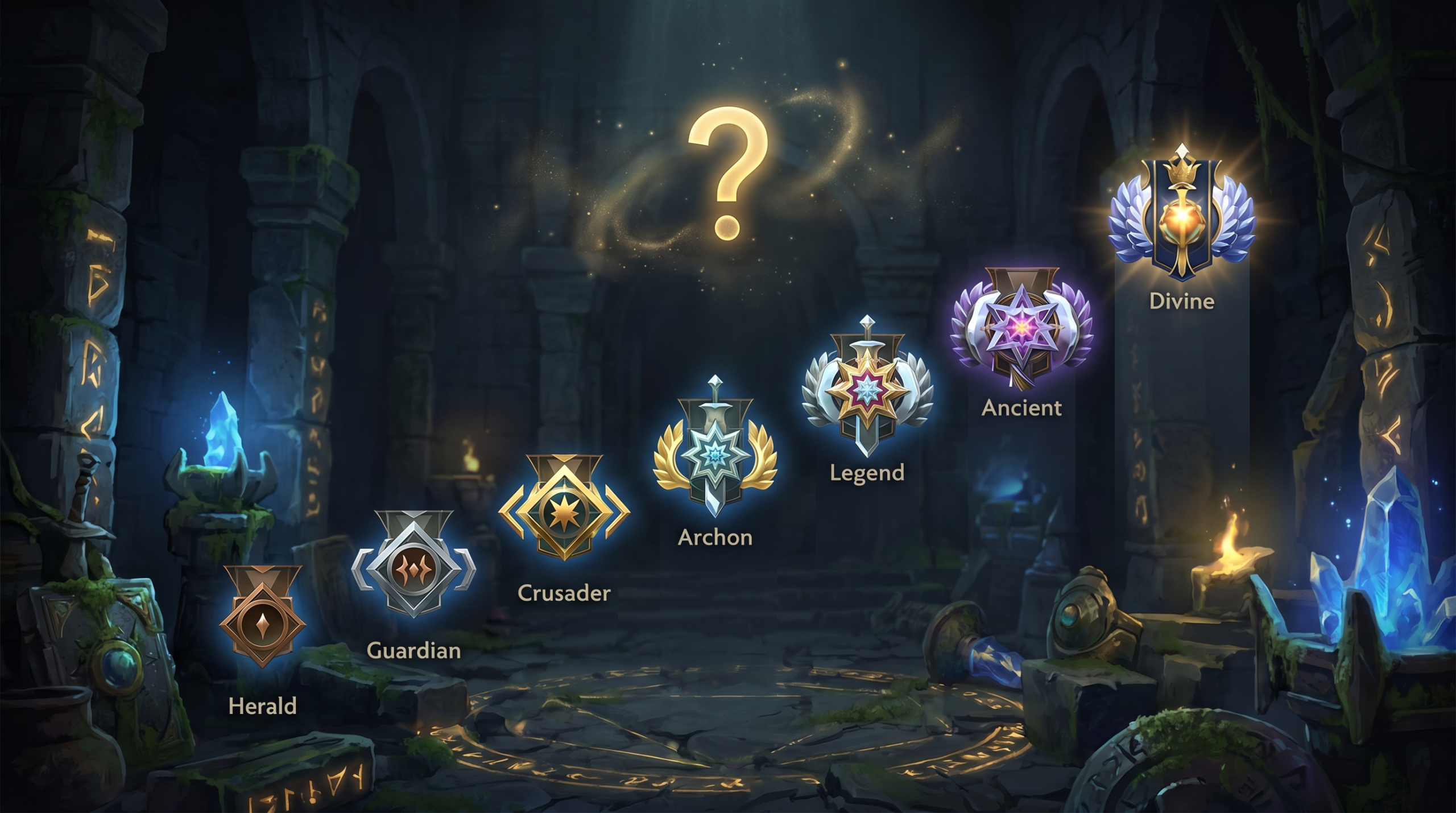
Players who ended last season near a rank boundary (within 200 MMR of an Archon-to-Legend or Legend-to-Ancient threshold) are particularly vulnerable to calibration landing them on the wrong side. A 200 MMR swing in calibration that puts you in Ancient instead of Legend means you start the season in a meaningfully higher-quality matchmaking pool with a meaningful disadvantage to overcome before your first rank badge update. Calibration boosting in this scenario ensures you start on the correct side of the threshold.
Scenario 4: You Are Preparing for a Ranked Event or Team Stack
If you are joining a team stack, participating in a ranked event, or have any external reason for needing a specific minimum rank at the start of the season, calibration boosting is the most efficient path. The alternative is calibrating normally (with variance risk) and then boosting the difference through standard play afterward — which costs more total time and potentially more money if the calibration lands low and requires a larger boost order to correct.
Scenario 5: Your Behavior Score Is Disproportionately Affecting Calibration
Players with behavior scores below 7,000 calibrate in a matchmaking pool with higher game variance. The booster can play calibration games with the improved behavior profile that comes with disciplined, non-toxic play, which pushes the account toward a higher behavior score pool for the calibration window. This is a secondary benefit of calibration boosting that players rarely consider but that has a measurable effect on calibration outcomes.
| Scenario | Good Fit? | Primary Benefit |
|---|---|---|
| History shows calibration consistently 300+ below peak | Yes | Corrects systematic variance |
| Only 3-5 games per week | Yes | Eliminates seasonal recovery grind |
| Near a major bracket threshold | Yes | Ensures correct starting pool |
| Team stack or ranked event deadline | Yes | Time-certain outcome |
| Low behavior score | Partial | Improved calibration pool quality |
| First-time calibrating in bracket | Neutral | No historical data to reference |
| MMR matches historical peak | No | No variance problem to solve |
When Calibration Boosting Is Not Worth It
Calibration boosting is not the right choice in every situation. Be honest about these scenarios before purchasing.
When Your Calibration History Is Consistent
If your calibration MMR over the last three seasons has been within 150 MMR of your season-ending rank, calibration variance is not a significant problem for your account. Paying for calibration boosting to gain 50-100 MMR over a consistent historical pattern is marginal ROI. The service is designed to address the variance problem — if the variance does not exist, the service’s value is limited.
When You Are First-Season at a New Bracket
If you climbed from Archon to Legend last season and are calibrating at Legend for the first time, there is insufficient historical data to know where your calibration will land. Your play history at the new bracket is short, and the calibration algorithm will use your previous bracket data as a significant input. In this case, calibrating naturally and then boosting if needed is often more economical than preemptively boosting calibration.
When Your Expected Calibration Gain Is Small
The calibration boost window is approximately +-600 MMR from your previous season ending. If you ended at 3,500 MMR, the maximum realistic calibration outcome with perfect performance is roughly 4,000-4,100. If you ended at 3,200 and want to calibrate to 4,000, calibration boosting cannot deliver that outcome regardless of how well the booster plays — you would need a standard MMR boost to close that gap. Calibration boosting is a tool for correcting variance within your natural range, not for vaulting to a significantly higher bracket.

How the Process Works
Calibration boosting follows the same account-access model as standard MMR boosting. The booster accesses your account at the start of the calibration window and plays the ten calibration games using heroes and strategies optimized for calibration performance metrics.
Hero Selection for Calibration
Experienced boosters select heroes that maximize the performance metrics Valve uses in calibration: high kill contribution, low death counts, and strong early-game net worth curves. For most brackets, this means playing position 1 or 2 on impact heroes — carries and mids that can solo-carry games and generate high individual performance stats even in losses. Support heroes generate fewer individual stats and are typically avoided during calibration unless the booster is specifically comfortable with a support-first approach.
VPN and Account Security
A professional calibration boost includes a residential VPN matched to your typical geographic login location. Calibration is a distinctive login period — ten games in rapid succession from a new device or location is a Valve red flag. Legitimate services manage this by matching your location profile and spacing game sessions to avoid patterns that trigger automated flags.
Communication During the Process
The booster should provide match IDs after each game so you can verify progress independently. Ten games at standard pace take approximately 3-5 days. You should be able to check your match history and see the calibration games in progress. Any service that goes silent after taking payment and only resurfaces after ten games are complete is operating with inadequate transparency.
What to Realistically Expect
A professional calibration boost with an Immortal booster typically delivers 8-10 wins out of ten games in the Archon through Ancient range. At Divine and above, realistic expectations are 7-8 wins due to higher opposition quality and game variance. Ten wins is the ceiling in any bracket because calibration game opposition includes other players who are also calibrating on fresh season accounts, including other boosted accounts.
Expected MMR Gain vs. Normal Calibration
Players who self-calibrate at their bracket typically win 5-7 games out of ten. A professional calibration boost at the same bracket delivers 8-10 wins. The expected MMR difference is roughly 200-400 MMR at most brackets, depending on how performance metrics factor into the final placement. This gap represents the realistic value the calibration boost delivers above a self-calibration baseline.
Guarantee Expectations
Professional services guarantee win rate outcomes, not specific MMR placements, because MMR placement is partially outside the booster’s control (it depends on Valve’s internal metrics and the specific opponents encountered). A guarantee of “8 wins out of 10 or we continue playing until you reach 8 wins” is realistic and enforceable. A guarantee of “you will calibrate at exactly 4,500 MMR” is not realistic and should be treated as a marketing claim rather than a binding promise.
What Happens After the Boost
A calibration boost delivers a starting point, not a destination. The season’s rank after calibration is where your play resumes — and if the boosted calibration significantly exceeds your genuine skill level, you will gradually drift back toward your natural MMR through normal play. This is the primary argument for combining calibration boosting with coaching or skill development: the boosted calibration is most valuable when your underlying skill can sustain the new starting point.
Maintaining the Calibrated Rank
Players who calibrate 200-300 MMR above their genuine skill level typically need 2-4 weeks of adjustment to either close the skill gap through active play at the new bracket or settle back toward their natural level. The best approach is to actively study the boost replays during this period — the calibration games show how an Immortal player performed at your specific bracket, which is a concrete reference for the decision quality needed to stay there.
Planning the Next Boost After Calibration
Some players treat calibration boosting as the first step in a two-part plan: calibrate at the top of their natural range, then book a standard MMR boost to push further into the next bracket. This sequence is more efficient than a single large boost because calibration boosting is cheaper per MMR than standard boosting at most brackets. If you are planning to boost at all this season, starting with a calibration boost and topping up with a standard boost afterward is typically the best cost-per-MMR outcome. Our calibration service and standard boost packages can be combined — contact our team to discuss the most cost-efficient sequence for your season goals.
The Calibration Math: Is It Worth the Cost?
The honest cost-benefit calculation depends on your personal MMR value and time cost assumptions.
Scenario: You typically calibrate 250 MMR below your natural level. Without a calibration boost, you spend the first 40 games of the season (at a 53% win rate) grinding back to your natural level. That is 30 hours of game time. At any valuation of your gaming hours above zero, there is a cost to that recovery period beyond the monetary price.
With a calibration boost at $90, you start the season at your natural level and skip the recovery grind. The 30 hours of recovery games become 30 hours of genuine rank advancement at your correct bracket. Over the course of a season, players who calibrate correctly tend to end the season 300-500 MMR higher than players who calibrate poorly and spend the first month recovering, simply because more of their games are played from a competitively accurate starting point.
The calibration boost pays for itself in saved recovery time for most players who experience systematic calibration variance. For players who calibrate consistently close to their natural level, the cost is harder to justify.

Preparing Your Account for Calibration
Whether you self-calibrate or use a professional service, several account preparation steps significantly improve your calibration outcome. These preparations take 1-3 days and are worth doing regardless of your calibration approach.
Behavior Score Pre-Calibration Optimization
Behavior score has a measurable effect on matchmaking quality during calibration. Players calibrating with a score above 9,000 queue into lobbies with more cooperative teammates and fewer disconnects, which gives your (or your booster’s) individual performance a cleaner environment to register. If your behavior score is below 8,000, spending 10-20 unranked games actively collecting commendations before calibration — and avoiding any behavior that generates reports — can push your score into a better queue range before the calibration window opens.
The improvement is not dramatic but it is real: a behavior score of 8,500 vs. 6,500 during calibration is likely worth 50-100 MMR in better-quality game environments over ten games. This is free improvement that requires only behavioral discipline, not any financial investment.
Hero Pool Narrowing Before Calibration
The two weeks before calibration games begin are an excellent time to narrow your ranked hero pool to your absolute best two or three heroes. Calibration performance metrics reward consistency — a player who plays the same hero across eight of ten calibration games and performs consistently is generating cleaner performance data than a player who samples five different heroes across the ten games. This consistency signal helps the calibration algorithm identify your genuine performance level at a specific hero rather than averaging across an inconsistent sample.
If you are self-calibrating, commit to playing your best hero in at least seven of your ten calibration games. Only deviate when the draft makes your primary hero completely unplayable (banned or countered by multiple enemy heroes simultaneously). If you are using a professional calibration boost, communicate your preferred hero restrictions to the booster so they can maintain a consistent hero signature that aligns with your historical account data.
Peak Performance Scheduling
Schedule your calibration games — or the calibration boost — during periods when you play best. For most people this is late morning or early afternoon on days when you are well-rested and have no competing time pressures. Avoid calibrating after late nights, after stressful events, or during periods when you are likely to be interrupted. For a professional calibration boost, communicate your time zone and preferred play schedule to the service so the booster can operate during your peak matchmaking hours (which vary by server and by time of day in terms of opponent quality).
Ready to Skip the Grind?
Team Smurf’s Immortal calibration boosters maximize your seasonal starting point with a written win-rate guarantee.
Get Calibration Boost Talk to Our Team