Dota 2 7.41c BKB Timing Guide by Role

Black King Bar is the most misunderstood item in Dota 2. Players buy it too late when they are already dying to spell combos, buy it too early when the enemy has no lockdown to punish, or buy it on the wrong hero entirely when a different defensive item would have done more work. Patch 7.41c has a specific meta context that changes optimal BKB timing for several roles — and getting it right is worth 10-15 minutes of game impact per match.
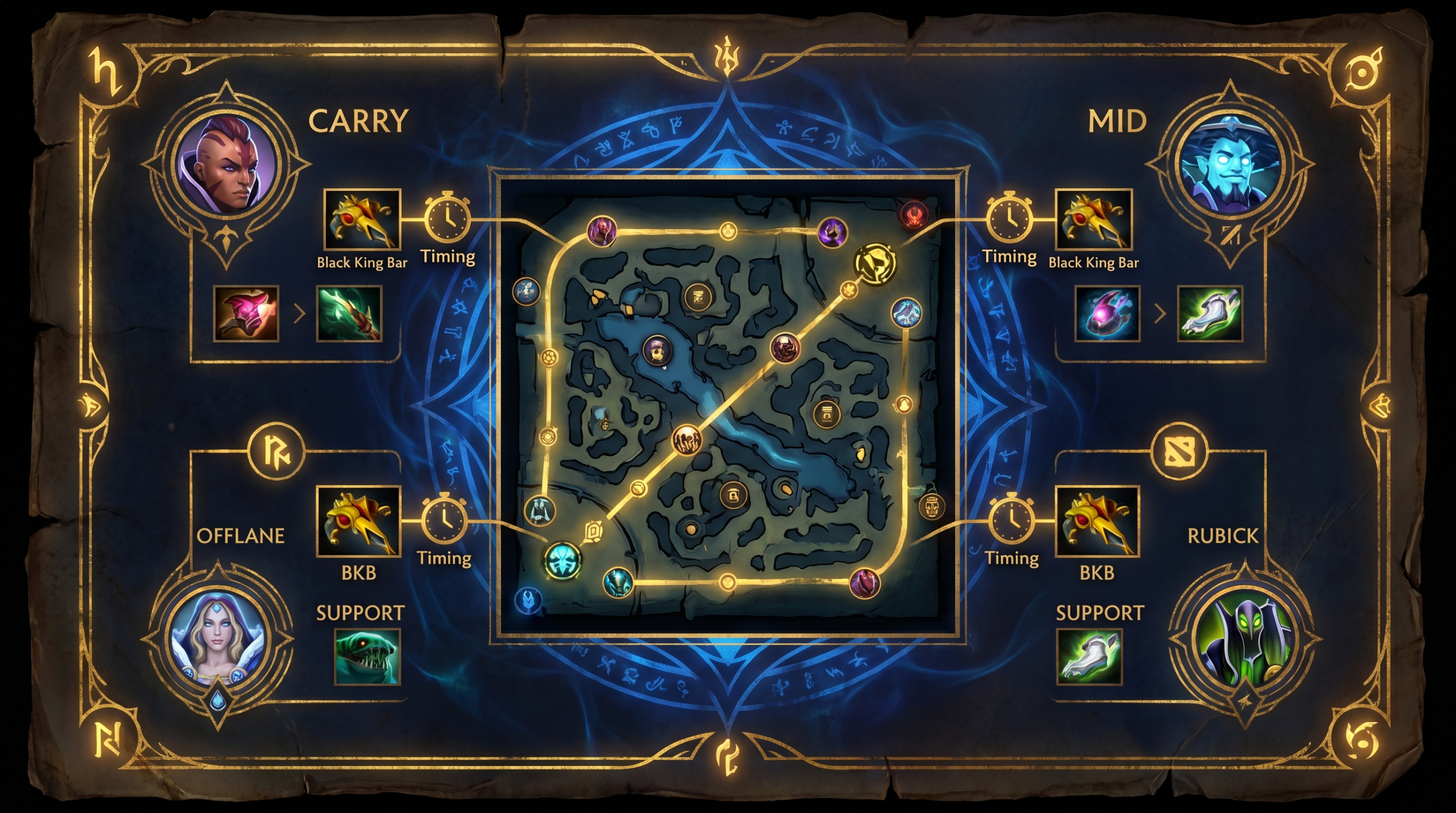
This guide covers BKB timing by role and hero archetype for the current patch. We will look at how 7.41c’s balance changes affect the item’s value window, what the correct timing benchmarks are for each role, how to read the game to decide whether your planned timing should accelerate or delay, and which heroes in the current meta genuinely need BKB versus which ones are being carried by player habit from previous patches.
All timings referenced below are from Rosh spawn (minute 8 is the standard benchmark) unless otherwise noted. Timings are based on typical net worth curves for their role and assume standard lane outcomes — not a stomped lane or an outlier snowball scenario.
Table of Contents
Why BKB Timing Is a Decision, Not a Default
The most common coaching note across Herald through Ancient is that players have BKB on their mental build template as a third or fourth item regardless of the game state. It is a defensive reflex built from watching high-rank games where BKB was bought and used correctly — but the context that made it correct in those games is rarely interrogated.
BKB timing is a decision with an opportunity cost. Every gold spent on BKB at minute 17 is gold not spent on Butterfly, Bloodthorn, Skadi, or a Shard. If the enemy team has no meaningful spell lockdown and you are buying BKB to play around a single Storm Spirit or Lion, you may have made a 5,100 gold decision that gave you less value than the next damage item would have. The item’s value is entirely contingent on what it blocks and when those spells are being used against you.
The Three BKB Scenarios
Before diving into role-specific timings, understand the three game scenarios that dictate BKB priority:
Scenario 1 — Reactive necessity: The enemy team has one or more heroes who can one-shot or disable you long enough that you cannot function in a fight without BKB. Examples: Bane, Disruptor, Jakiro, Legion Commander, Meepo. Buy BKB when you have enough farm to purchase it and the timing lines up with when fights will begin.
Scenario 2 — Proactive aggression: You need BKB not because you are dying, but because BKB lets you run through the enemy team and complete your spell rotation or right-click sequence without interruption. Examples: Axe going into a teamfight with BKB to guarantee Call of Duty lands, Gyrocopter buying BKB to rocket spam uninhibited. Here, timing is about fight windows, not survivability.
Scenario 3 — Soft buy: You buy BKB because the meta says to, but your specific game does not demand it. This is the scenario where the item underperforms. Learn to identify it and redirect that gold.
7.41c Changes That Affect BKB Value
Patch 7.41c introduced several changes that directly affect when and on whom BKB is optimal.
Reduced BKB Duration on Low-Count Uses
BKB’s duration decay has been modified in the 7.41x patch series. First use is 9 seconds (unchanged), but the decay to minimum duration (4 seconds) now happens over 7 uses instead of 6. This is a slight buff to the item’s longevity over a game with frequent teamfights. The practical implication is that buying BKB earlier in 7.41c is slightly more defensible than in the previous patch, since the item retains useful duration for one more use before hitting the floor.
Bloodthorn Rework Implications
Bloodthorn’s silence now has a slightly reduced duration. For carries who were using BKB specifically to counter Bloodthorn silence chains (common in last patch’s orchid-heavy midlane meta), this reduces the urgency of early BKB on right-click carries who are not facing spell lockdown. On the other hand, the Bloodthorn rework has made it more popular on mid-lane spell casters who benefit from the silence-to-burst pattern, meaning mid-lane BKB timing remains critically important.
Dagger Buff Impact on Offlane
Blink Dagger received a minor cooldown reduction in 7.41c. This indirectly increases the frequency of gap-closing and initiation from offlaners, particularly Axe, Centaur, and Mars. These heroes now initiate more frequently per game, which means supports on the opposing team are using their disables more liberally in response. If you are playing a carry against an offlane comp that includes Blink-Dagger initiators, your BKB timing should account for the increased fight frequency the Blink buff enables.
Outworld Destroyer Mid Prevalence
OD has been strong in 7.41c and his Astral Imprisonment places you entirely out of the fight for 3.75 seconds at max level. This is one of the best reasons in the current patch for carries and offlaners to hold a BKB charge specifically for the OD ultimate window. The timing implication: if the enemy mid is OD, your BKB should be completed before minute 20 regardless of your role.
Carry BKB Timing
Carry BKB timing varies significantly by carry archetype. The three broad archetypes are right-click carries, spell-reliant carries, and farming carries who join fights late.
Right-Click Carries (Juggernaut, Anti-Mage, Spectre, Phantom Assassin)
For right-click carries, BKB is typically a third or fourth item and the timing window is 22-28 minutes in a standard game. The variance comes from whether the enemy team’s lockdown is being used in fights during your early farm window. If Disruptor is setting up kills at minute 15 and you are the primary target, BKB may need to be second item after Power Treads. If you have survived the early game through positioning and your core items are intact, standard third-item timing is correct.
Juggernaut specifically: BKB is usually fourth or fifth item on Juggernaut in 7.41c because Omnislash already has a pseudo-invulnerability mechanic. BKB on Juggernaut is most valuable when the enemy has a Disruptor or Bane who can cancel Omnislash through Static Storm or Nightmare — specifically disable-based cancellation, not physical. Aghanim’s Scepter or Satanic often provides more value as item 4 if the lockdown threat is manageable.
Anti-Mage: BKB is rarely correct on AM. Mana Void deals spell damage, but AM’s mobility through Blink largely substitutes for BKB in most fight scenarios. Buy BKB on AM only when the enemy team has multiple hard disables that catch AM in Blink cooldown.
| Carry Hero | Typical BKB Timing | Priority Trigger | When to Skip |
|---|---|---|---|
| Juggernaut | Item 4-5, ~28 min | Disruptor/Bane/Warlock ult | No hard disables on enemy |
| Anti-Mage | Rarely needed | Multiple hard disables + no escape | Most games |
| Gyrocopter | Item 3, ~22-24 min | Any teamfight game | Split push or farm-heavy game |
| Phantom Assassin | Item 3, ~20-23 min | Enemy has silence (Bloodthorn, OD) | Pure right-click enemy, no spells |
| Medusa | Item 4-5, ~30 min | Magic damage heavy enemy | Mostly physical damage enemy team |
| Terrorblade | Item 3-4, ~24-27 min | Enigma, Disruptor, Void Spirit | Physical carry heavy enemy |
| Luna | Item 3, ~20-22 min | Any teamfight, Eclipse setup | Team provides enough peel |
Spell-Reliant Carries (Leshrac, Morphling, Void Spirit as carry)
Spell-reliant carries use BKB proactively — they need it to complete their rotation without interruption, not primarily for survivability. For these heroes, BKB timing is determined by fight windows rather than item slot. Leshrac buying BKB at minute 20 to set up a teamfight where his stun and pulse combo goes uninterrupted is a proactive purchase. The timing question is: when does the enemy team’s lockdown become the limiting factor on your spell rotation? That moment is when you should have BKB ready.
Late-Joining Farming Carries (Terrorblade, Medusa)
Farming carries who join fights late have more flexibility on BKB timing because their early game contribution is deliberately minimal. These heroes often need to ask: “Is there a specific fight window in the next 10 minutes where BKB blocks something lethal?” If the answer is yes, buy it before that window opens. If the answer is no and your core items provide more raw fighting power, delay BKB until fight frequency increases (typically around high ground sieges, minute 35+).
Mid-Lane BKB Timing
Mid-lane heroes have the most diverse relationship with BKB because the role spans both burst-casters and right-click snowballers. The timing pressure is also different from carry — mid heroes generally fight earlier, so BKB windows come sooner.
Burst Casters (Storm Spirit, Lina, Puck)
For burst casters, BKB timing is about protecting your rotation in teamfights. Storm Spirit specifically needs BKB before extended teamfights begin — typically minute 17-21 in a fast-paced game. The key question: is the enemy team building toward a lockdown combo that interrupts your Ball Lightning rotation or your spell burst sequence? If yes, BKB is second item after Bloodstone or before Refresher. If the enemy is physical-heavy and your threat is auto-attacks, skip BKB entirely and invest in Eul’s or Linken’s instead.
Right-Click Mid (Dragon Knight, Wraith King mid, Razor)
Right-click mids use BKB similarly to carries but the timing is earlier because fights begin sooner. Dragon Knight wants BKB by minute 18-22 in the current patch because his Dragon Form is the primary fight tool and he needs to walk through spells to close distance. Razor’s Eye of the Storm is strong but not BKB-dependent — buy BKB on Razor when the enemy team has disables that interrupt his positioning or that cancel Eye of the Storm.
Initiating Mid (Puck, Void Spirit, Ember Spirit)
Initiating mids have a strong incentive to buy BKB before joining five-on-five fights. Puck’s Phase Shift provides some protection but does not block all disable types. Void Spirit’s Dissimilate is strong but Wind Waker or Eul’s can interrupt the escape. For these heroes, BKB timing is roughly minute 18-23 and prioritized ahead of damage items if the enemy team has two or more hard disables.
Offlane BKB Timing
Offlane BKB timing is the most game-state dependent of the three core roles. Offlaners often initiate, which means they are the first heroes to walk into the enemy’s spell range. Whether BKB or a Blink Dagger or an armor item is the correct purchase depends on the specific fight pattern of your hero.
Initiating Offlaners (Axe, Mars, Centaur)
Axe, Mars, and Centaur are initiators who need to close distance before using their ultimate or primary disable. For these heroes, Blink Dagger is almost always the first priority item. BKB as second purchase is correct when the enemy team has responses to your initiation that prevent the follow-up — Chronosphere cancellations, Disruptor Kinetic Field keeping you isolated, or a Shadow Demon Disruption catching you mid-Blink landing. If the enemy has those responses, BKB before a second fight item. If they do not, proceed with Blade Mail, Pipe, or Crimson Guard depending on enemy damage type.
Durable Offlaners (Underlord, Bristleback, Timbersaw)
Durable offlaners generally have high natural magic resistance or damage reduction that substitutes for BKB in many scenarios. Underlord’s Atrophy Aura provides passive durability. Bristleback’s Bristleback passive reduces damage from behind and above. For these heroes, BKB is a situational purchase triggered by specific enemy compositions — particularly ones with reliable silence (Skywrath Mage, OD) that removes your damage reduction activations or damages them through natural mitigation.
Carry Offlaners (Dragon Knight, Chaos Knight, Night Stalker)
Carry offlaners in the current meta often prioritize BKB similarly to their mid-lane right-click counterparts. Night Stalker specifically has a strong incentive to buy BKB before his first extended nighttime window (after minute 30) to ensure that Crippling Fear and his right-click barrage go uninterrupted during the night phase advantage window.
When to Skip BKB Entirely
Knowing when to skip BKB is worth as much as knowing the correct timing. These are the game states where BKB is frequently bought by habit but should be skipped in favor of a better option.
Enemy Team Is Predominantly Physical Damage
BKB blocks magic damage and most disables but does nothing against right-click physical auto-attacks. If the enemy team has Faceless Void, Phantom Assassin, Drow Ranger, and a physical damage mid, your survivability priority is armor (Butterfly, Lotus Orb) not BKB. Buying BKB in this composition wastes 5,100 gold on an item that does not address the damage type killing you.
Your Mobility Already Provides the Safety
Anti-Mage, Puck (Phase Shift), Ember Spirit (Sleight of Fist), and Morphling (Waveform) all have mobility or pseudo-invulnerability skills that substitute for BKB in many scenarios. For these heroes, evaluate whether BKB provides additional protection beyond your mobility, or whether the 5,100 gold is better spent on an item that extends your damage output.
You Are Playing a Support
Supports almost never buy BKB in the current meta. The item cost is prohibitive for a position 4-5 economy, and the support role prioritizes utility items (Force Staff, Glimmer Cape, Solar Crest) that protect your cores rather than yourself. The rare exception is a hard support in a game that has snowballed to the point where your net worth can support BKB alongside utility items, or a position 4 flex who has transitioned into a carry role.
BKB Duration Management in Fights
Buying BKB at the right time is only half the equation. Using it correctly in fights determines whether the investment pays off. Duration management is the part most players learn last.
Do Not Activate BKB Reactively
The most common BKB misuse is activating it after a disable has already landed. If Disruptor drops a Kinetic Field on you, the Field is already active — BKB will not remove it. BKB must be activated before spells land for it to block them. This requires reading enemy positioning and anticipating their rotation rather than reacting to it.
Save Your Last Charge for High Ground
In the late game when BKB is approaching 4-5 second duration, many players burn their last effective charge in a skirmish when the crucial fight is the high ground attempt. Evaluate every BKB activation: is this the fight where I need this charge, or should I save it? The 5-second BKB charge used in a skirmish you could have avoided with positioning is a wasted investment on the fight that ends the game.
Coordinate BKB Timing With Your Team
In organized play, teams coordinate BKB activations to maximize fight impact. If your carry BKB lasts 9 seconds and your teammate’s Chrono lasts 4, the Chrono user should initiate into the Chrono while your BKB is active — the spell-immune BKB user can continue attacking through the Chrono freeze, which does not affect BKB-protected targets the same way. Understanding BKB interactions with your own team’s spells is as important as understanding what it blocks from the enemy.
Common BKB Interaction Mistakes
Several disables partially or fully work through BKB and players are often surprised by this in fights. Roshan’s Bash and some of his abilities pierce BKB. Doom’s ultimate pierces BKB. Fiend’s Grip from Bane pierces BKB. Legion Commander’s Duel is lethal intent that cannot be stopped by BKB. Knowing which enemy ultimates pierce BKB is critical — if the enemy has Bane and you are counting on BKB to protect you from Fiend’s Grip, you are misreading the item’s protection.
For players who want to climb faster and learn these interactions in a controlled environment, our Immortal coaching sessions include specific item usage curriculum covering BKB timing and activation patterns for your hero pool. Our MMR boost service can also help you observe how Immortal players manage BKB timing from a first-person perspective in your own match history.
Ready to Skip the Grind?
Team Smurf’s Immortal boosters handle your MMR while demonstrating correct item timing across every role.
Get Your Boost Now Talk to Our Team