MMR Boost Price per 500 MMR: Whats Fair in 2026?

The Dota 2 boosting market in 2026 has matured into a tiered economy with predictable price bands — but only if you know what to look for. Players who jump straight to the cheapest listing often pay twice: once for the cut-rate service, and again for the proper boost after the first provider abandons the order mid-game. Players who go straight to the priciest listing often pay a 40% premium for brand recognition they do not need.
This guide exists to close that information gap. We will break down what fair market rate looks like per 500 MMR across every rank bracket, explain the five variables that legitimately move the price, expose the red flags that signal you are about to lose money, and tell you exactly when paying premium is worth it versus when it is pure margin for the provider.
All prices are in USD for solo lobby boost. Duo boost runs 1.4x-1.7x these figures. Prices assume an Immortal-rank booster, a residential VPN, full customer support, and a written refund policy. If a service cannot confirm all four, treat it as unverified and adjust your willingness-to-pay accordingly.
Table of Contents

- The 2026 Price Table by Bracket
- Why Prices Vary by Bracket
- Five Variables That Legitimately Shift the Quote
- Pricing Red Flags That Signal a Scam
- How to Save Money Without Sacrificing Quality
- When Paying Premium Is Actually Worth It
- What Separates Budget from Professional Services
- Frequently Asked Questions
The 2026 Price Table by Bracket
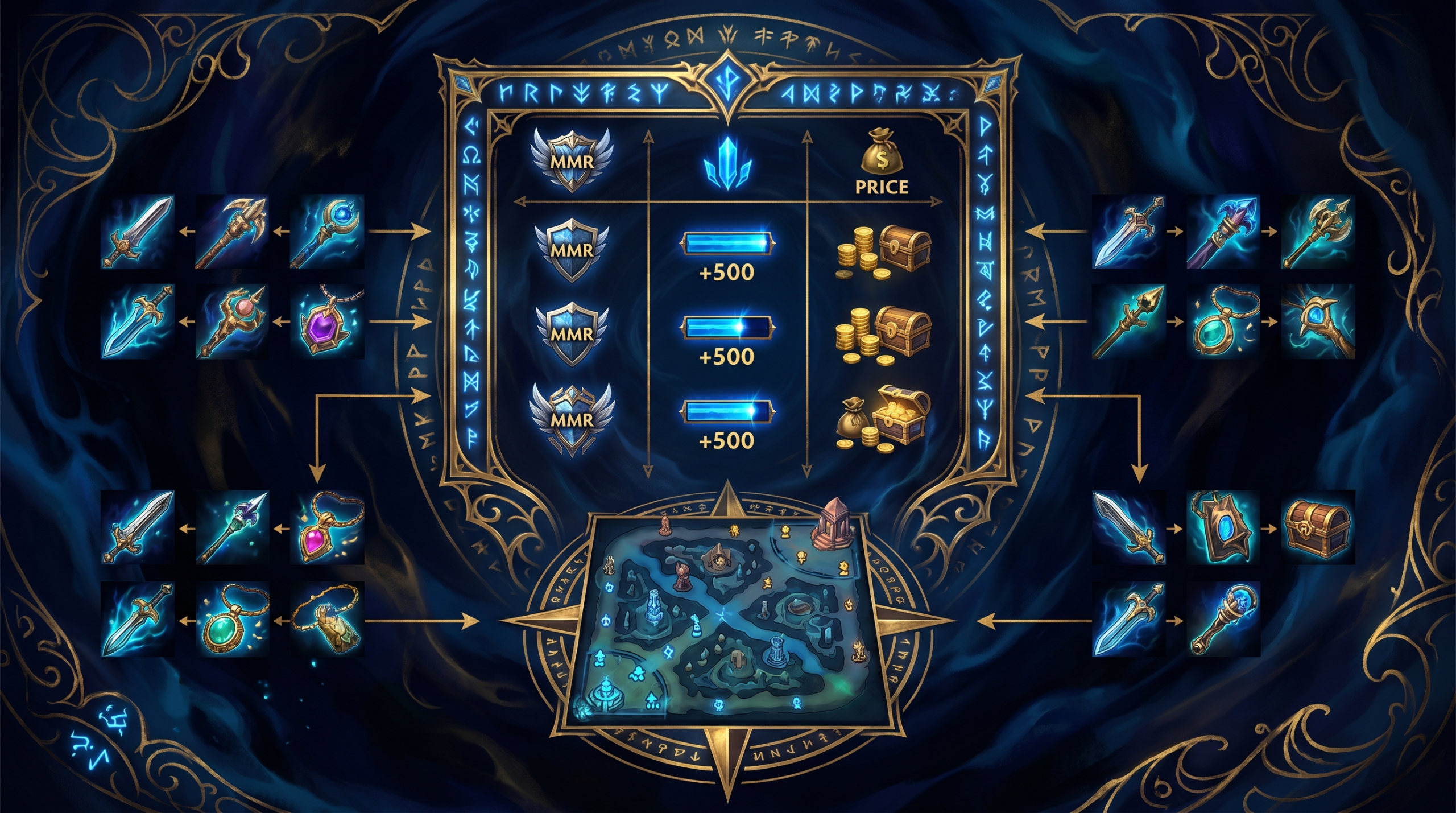
The single most important benchmark when shopping for a boost is cost per 500 MMR at your current rank. Lower brackets cost less because the competition is softer — an Immortal booster can reliably post a 70%+ win rate from Herald through Crusader in nearly any hero pool. Ancient and Divine games require more deliberate play, hero selection discipline, and longer average game times, all of which translate directly into booster labor and risk.
Use this table as your anchor when evaluating any quote. Numbers below reflect mid-market rates for a professional service with the four quality markers listed above. Budget providers may quote 30-40% less; expect slower completion, less communication, and a higher risk of order abandonment.
| Current Rank | Fair Price per 500 MMR | Premium Cap (Justified) | Red Flag Below |
|---|---|---|---|
| Herald (0-616) | $55-80 | $110 | $35 |
| Guardian (617-1386) | $65-90 | $120 | $40 |
| Crusader (1387-2156) | $75-100 | $130 | $45 |
| Archon (2157-2926) | $95-130 | $170 | $60 |
| Legend (2927-3696) | $115-155 | $200 | $75 |
| Ancient (3697-4466) | $145-200 | $260 | $95 |
| Divine (4467-5420) | $200-280 | $360 | $130 |
| Immortal (5420+) | $280-420 | $550 | $180 |
Note that Divine and Immortal pricing is essentially a spot market — at the very top, boosters are rare, games are high-variance, and a single losing streak can cost a booster 10+ hours of reclamation work. The wide price band reflects real variance in booster quality and game length at that level.
Why Prices Vary by Bracket

Most buyers assume price is purely about how many games the booster needs to play. That is only one of three cost drivers. The other two are skill required and detection risk — and both increase non-linearly as MMR rises.
Game Difficulty and Booster Skill Requirement
A Herald game is won mostly through mechanical execution and basic macro decisions. An Immortal booster can draft Juggernaut, use Omnislash and farm efficiently, and win 8 out of 10 games before lunch. An Ancient game requires draft awareness, real-time adaptation to opponent tendencies, and consistent execution across 45-minute game durations. The skill premium is real and it compounds as you climb.
At the Divine bracket, boosters need to track every major item timing across both teams, make micro decisions about when to force fights versus when to farm, and maintain consistent discipline over a 500 MMR block that might represent 30-40 games. Fewer boosters can operate reliably at this level, and those who can command a wage premium accordingly.
Game Duration and Labor Cost
Herald games average 28-32 minutes. Divine games average 40-50 minutes. A booster doing 10 games a day at Herald processes roughly 5 hours of game time. The same booster at Divine processes 7-8 hours for the same number of games — and likely achieves a lower win rate, requiring more games per 500 MMR block. The pricing difference is largely a compensation for that additional labor.
Detection Risk and VPN Infrastructure
Valve’s Overwatch and automated behavior detection systems look for behavioral signatures that indicate account sharing. Playing at an abnormally high win rate, switching hero pools dramatically, or accessing the account from a new location all generate signals. Legitimate services mitigate this through residential VPN endpoints, role and hero restrictions aligned with the client’s existing history, and staggered play schedules. This infrastructure costs money and is reflected in the price. Providers who do not mention VPN usage are either using datacenter IPs (high ban risk) or not using VPNs at all.
Five Variables That Legitimately Shift the Quote
When a service quotes you above or below the table above, ask which of these five variables is driving the difference. A legitimate service should be able to tell you exactly why their number differs from market rate.
1. Solo vs. Duo Boost
Solo boost (the provider plays your account) is cheaper because the booster can use any hero, set their own schedule, and is not constrained by your in-game performance. Duo boost (you play alongside the booster in your own account) costs 40-70% more because the booster is now dependent on your performance, limited in hero selection to supports or utility roles, and spending time in queue with you rather than running back-to-back solo games. Duo boost has the significant advantage of being undetectable since you are playing on your own account — it also lets you learn from the booster in real time.
2. Current Winrate and Behavior Score
If your account has a behavior score below 7,000 or a visible winrate below 40%, boosters quote higher because matchmaking quality is demonstrably lower on those accounts. Low behavior score queues have more disconnects, more deliberate feeders, and longer queue times — all of which inflate the work required per 500 MMR. Some services refuse accounts below 6,000 behavior score entirely. If yours is in that range, consider a behavior score restoration package before a full boost.
3. Role Restriction
If you ask the booster to play exclusively your preferred role (carry or mid, for example), you are restricting their hero pool and potentially their optimal strategy. Role-restricted boosts typically cost 10-20% more because the booster cannot freely adapt drafts to the meta or counter-pick optimally. Unrestricted boosts let the booster play whatever wins most efficiently — usually core roles in the current patch but sometimes off-lane or support when the draft demands it.
4. Timeline and Priority Queue
Standard orders complete in whatever time the natural schedule allows. Express or priority orders guarantee a faster completion window, which requires the service to dedicate their best available booster to your order immediately and potentially pay overtime compensation. Express orders typically add 25-40% to the base price. Rush orders (48-hour completion guarantee) can be 60-80% higher. Unless you have a time-sensitive reason — a friend vouching for a rank, a promotional event, a season reset deadline — standard timing is almost always better value.
5. Starting Point in a MMR Block
500 MMR at 2157 (the bottom of Archon) is not the same as 500 MMR at 2657 (mid-Archon). The closer you are to a rank promotion boundary, the more psychologically loaded and mechanically demanding those games become — both for you watching and for the booster playing. Some services price by MMR segment (0-250 of a 500 block vs. 250-500) to account for this. Most price by rank tier, which is fine but means you may get slightly better value if your starting point is in the lower half of a tier.
Pricing Red Flags That Signal a Scam
The boosting market has a significant gray zone between legitimate services and outright scams. Price alone is not the indicator — some legitimate budget services exist, and some premium-priced scams operate. The red flags below are behavioral and structural, not just numerical.
Prices More Than 40% Below Market Rate
A service quoting $35 for 500 MMR at Legend is not being generous — they are cutting corners somewhere. The most common corner cut is booster quality: using Legend or Ancient boosters (who have lower win rates and take twice as long), using automation scripts for repetitive bracket farming, or accepting payment and then stalling until the client gives up. The labor cost for a legitimate Immortal booster playing 25-35 Legend games is simply not compatible with a $35 price point.
No Written Refund Policy
Any service that cannot point you to a written, specific refund policy on their website is operationally unprepared for disputes. Legitimate services handle dozens of orders monthly and have standardized refund procedures for delays, account issues, and service failures. If the refund policy is “DM us and we will sort it out,” that is a support structure that does not scale and will fail you when you need it most.
Upfront Full Payment Without Escrow
Some services ask for 100% upfront with no milestone payment option. This is high-risk for the buyer. Legitimate services either use a milestone structure (pay half upfront, half on completion) or use a platform with buyer protection. Asking you to pay the full amount via crypto or gift card with no recourse is a scam pattern.
No Live Progress Tracking
Credible services provide either a live order dashboard, regular screenshots or match history links, or scheduled check-in messages. If a provider goes silent after taking payment and only resurfaces when you message them, that is a service management failure. Boosters do not need to message you after every game, but you should have a way to independently verify that games are being played.

How to Save Money Without Sacrificing Quality
There are legitimate ways to reduce your boosting cost without dropping to budget-tier providers. These strategies work because they reduce risk and labor for the booster, savings that a transparent service will pass through to the buyer.
Book During Off-Season or Post-Patch Lulls
Demand for boosting spikes around season rank resets, Tournament International qualifiers, and major patch releases when players want to be at their target rank for the new meta. Off-peak periods (mid-season, post-TI lull, pre-major patch) have lower demand and many services offer 10-20% discounts. If you are not in a rush, timing your order to off-peak windows saves real money.
Bundle Multiple Brackets
Buying 1,000 MMR at once is almost always cheaper per 500 than buying two separate 500 MMR orders. The booster does not need to re-familiarize with your account, there is no re-queuing period between orders, and the service avoids duplicate administrative overhead. Ask explicitly for a bundle quote if you are planning more than 500 MMR of climbing.
Allow Unrestricted Hero Pool
Removing role and hero restrictions is the single cheapest modification you can make to a quote. It gives the booster full flexibility to draft optimally for every game and reduces the number of games needed per 500 MMR block. If you do not have a strong preference for which heroes appear in your match history, unrestricted is almost always better value.
Provide a High Behavior Score Account
Accounts with behavior scores above 9,000 queue into noticeably higher-quality matches where fewer games are decided by disconnects or saboteurs. This reduces the games-per-500-MMR ratio and directly lowers the labor component of your order. Maintaining your behavior score between orders is a genuine cost-savings strategy over time. If your score is currently below 8,000, a Team Smurf behavior reset package often pays for itself in reduced boost costs on the next order.
When Paying Premium Is Actually Worth It
The case for paying above mid-market rate comes down to three scenarios where the risk of using a cheaper provider creates a cost that exceeds the premium itself.
You Are Approaching a Significant Rank Threshold
Crossing from Legend into Ancient, or from Ancient into Divine, requires navigating a rank gate that many budget boosters struggle with. At these thresholds, the opposition quality spike is significant and a booster who was performing adequately 100 MMR below the gate may suddenly struggle to maintain the win rate you need. Paying premium for a proven high-bracket booster at these transitions is insurance against an order that stalls or reverses.
Account Security Is a Priority
Premium services invest more in VPN infrastructure, behavioral mimicry (matching your hero pool and general play patterns), and play schedule management. If account security is a significant concern — if you have cosmetics, rare items, or a long-standing account you cannot afford to have flagged — the premium for a security-focused service is justified.
You Need It Done Fast
Express and rush order premiums are the most transparent form of price increase in this market. If you have a concrete deadline — a friend group is running a stack at a specific rank, a tournament bracket requires a minimum MMR — then the express premium is a known cost for a known benefit. Pay it without guilt if the timeline matters. Do not pay it if you are just impatient.
What Separates Budget from Professional Services
Beyond price, the operational differences between budget and professional boosting services are observable before you spend a cent. Here is what to evaluate during your research phase.
Booster Verification Process
Professional services verify booster credentials — Immortal rank accounts, match history review, and sometimes a trial period before allowing new boosters to take customer orders. Budget services often use whoever applies, regardless of actual rank or recent performance. Ask directly: “How do you verify your boosters?” A vague answer (“we only use experienced players”) is not a verification process.
Communication Infrastructure
Professional services have dedicated support staff, ticket systems, and escalation paths. They respond to order inquiries within hours, not days. Budget services are often one or two people managing multiple Discord servers simultaneously. When something goes wrong — and in a market with inherent risk, things do go wrong — professional communication infrastructure determines whether you get made whole or ghost.
Track Record and Review Depth
Reviews matter but reviewers can be gamed. Look for reviews that describe specific scenarios — delays, hero pool issues, behavior score interactions, or refund processing — rather than generic five-star praise. A service with 200 reviews that all read like marketing copy is more suspicious than a service with 80 reviews that include a mix of positives and resolved complaints.

Contractual Clarity
Read the service terms before purchasing. Specifically look for: what happens if the booster loses MMR (do you get credit?), what happens if your account gets flagged (do you get a refund?), and what the cancellation terms are if you change your mind mid-order. A professional service has clear answers to all three. A budget service either has no terms page or terms that heavily favor the provider in every dispute scenario.
Post-Order Support
The relationship does not end when the order completes. A professional service will help you understand what the booster did, explain any hero or item anomalies in your recent match history, and provide guidance on how to maintain the MMR gain. This post-order context is genuinely useful — it helps you understand why you were losing games before and what the booster did differently. Budget services hand over the account and disappear.
Team Smurf’s Immortal-rank operators provide a written summary with every completed order, including the hero pool used, the key item timings that drove win rates in your bracket, and a brief note on what bracket-specific habits were most impactful. If you want to turn a boost into a learning moment as well as an MMR gain, that service infrastructure matters. You can see our full boost packages here or explore our coaching service if you want to combine skill development with your rank goal.
Ready to Skip the Grind?
Team Smurf’s Immortal boosters handle your MMR with verified credentials, residential VPN, and a written refund policy.
Get Your Boost Now Talk to Our Team