Why Do I Gain 20 MMR but Lose 30? The Uneven Gains Mystery

You win a hard-fought game and pick up 20 MMR. You lose the very next match and drop 30. You check your profile again, do the arithmetic, and still can’t make it add up. Your rank is slowly bleeding even though your win-loss record looks roughly even.
The frustration is real, and the question is legitimate. Asymmetric MMR gains and losses happen for specific, measurable reasons inside Dota 2’s matchmaking engine — and almost all of them are fixable once you understand what’s actually going on. This guide walks through every mechanism that causes your wins to reward less than your losses punish, with concrete steps to address each one.
What’s In This Guide
The Short Answer
Dota 2 does not guarantee identical gains and losses per game. The amount you win or lose from a single ranked match depends on several variables: your current uncertainty rating, how long ago you last played, whether you are inside a calibration window, your performance relative to your current MMR, and some patch-specific matchmaking settings Valve adjusts periodically.
The most common scenario where players notice asymmetry is right after returning from a break or at the start of a new ranked season. In both cases, the system has increased your uncertainty — it is less confident about your true skill level — and it compensates by applying larger adjustments per game in both directions. The trouble is that players coming back from breaks often lose more early games (rust, unfamiliarity with the current meta) than they win, so they notice the bigger losses far more than the bigger wins.
The second most common scenario is subtler: confirmation bias. Humans track losses more attentively than wins. If you gain 25 MMR twelve times in a row but lose 28 MMR once, you will remember that loss as evidence the system is unfair. We’ll come back to this.
How Dota 2 MMR Actually Works
Most players imagine MMR as a simple counter that ticks up or down by a fixed amount. That’s never been quite accurate for Dota 2, and understanding the real system is the foundation for fixing asymmetric gains.
Dota 2’s ranked system is based on a modified Glicko-style rating model, though Valve has never published the exact parameters. The key components are:
- Rating (MMR): Your estimated skill value — the number you see on your profile.
- Uncertainty (RD — Rating Deviation): An invisible second number representing how confident the system is about your true skill. New players have high uncertainty. Veterans with 2,000+ ranked games at the same level have low uncertainty.
- Volatility: How much your performance fluctuates. A player who goes 15-2 in one game then 1-15 in the next has higher volatility than someone who consistently performs at the same level.
The amount you gain or lose per game is roughly: K-factor * (Outcome – Expected Outcome), where K-factor scales with your current uncertainty. High uncertainty means a bigger K-factor, which means bigger swings per game. Low uncertainty means smaller swings.
Here’s how this looks in practice across different account states:
| Account State | Typical Gain/Loss | Why |
|---|---|---|
| Fresh calibration (first 10 games) | +/- 75 to 150 per game | Maximum uncertainty; system needs fast convergence |
| Returning after 3+ months | +/- 35 to 55 per game | Uncertainty spike during inactivity reset |
| Seasonal recalibration window | +/- 30 to 50 per game | Partial uncertainty reset at season start |
| Stable account (500+ games, same bracket) | +/- 20 to 30 per game | Low uncertainty; system is confident in your rating |
| Role queue mismatch penalty | -25 to -30 extra | Additional penalty on top of game result |
| Abandonment in a ranked game | -50 to -75 total | Game loss penalty + separate abandon penalty |
What this table reveals immediately: the asymmetry most players experience is not a design flaw or a conspiracy. It’s a natural consequence of where their account sits on the uncertainty curve.

The Uncertainty Factor Explained
Uncertainty is the hidden variable that controls almost everything about how your MMR moves. Understanding it changes how you approach ranked play entirely.
What Is Uncertainty?
Think of uncertainty as the system’s confidence interval around your MMR. If your displayed MMR is 3,500 and you have low uncertainty, the system is saying “this player is probably between 3,400 and 3,600.” If you have high uncertainty, it might be saying “this player could be anywhere from 2,800 to 4,200 — we need more data.”
When uncertainty is high, the system applies larger adjustments per game because it wants to move you toward your true rating quickly. Once you’ve played enough games for it to be confident, adjustments shrink to the stable range of 25-30 per game.
What Raises Uncertainty?
- Inactivity: Not playing ranked for an extended period causes your uncertainty to creep upward. The system reasons that your skill may have changed during the gap. Different sources suggest the threshold begins around 3-4 weeks of no ranked games, though Valve hasn’t confirmed exact numbers.
- Highly inconsistent performance: Alternating between very strong and very weak games signals volatile skill, which increases the system’s uncertainty about your steady-state level.
- New ranked seasons: Valve deliberately partially resets uncertainty at the start of each ranked season to allow rank correction.
- Account age: Newly eligible ranked accounts carry maximum uncertainty until they’ve played through calibration.
Why This Creates Perceived Asymmetry
Here’s the mechanism that trips players up most often. Suppose you return from a two-month break with elevated uncertainty. The system now gives you +40 for wins and -40 for losses. If your first several games go poorly because you’re rusty, you accumulate losses at the elevated rate. Then, as you warm up and start winning more, your uncertainty has already decreased somewhat — so you’re now winning games at +32 or +28 rather than the full +40 you were losing at earlier.
The result: your losses were at +/-40 but your wins are now at +/-28. This looks like deliberate asymmetry but it’s actually the uncertainty curve working correctly. You were losing at high-uncertainty rates and winning at lower-uncertainty rates, simply because time had passed and you’d played more games.
The fix, in this scenario, is straightforward: play consistently without extended breaks, and the uncertainty will settle into the stable range where gains and losses equalize.
Calibration and Season Resets
Calibration periods are when the uncertainty factor is at its most extreme — and when players most often notice the largest MMR swings.
Initial Calibration
Every account goes through an initial ranked calibration before receiving a permanent MMR. During this 10-game window, gains and losses can be 5-6 times larger than normal because the system is doing rapid convergence from a complete unknown to an estimated rating. A new player might gain 120 MMR from one win and lose 90 from a loss — the numbers are large and they feel completely arbitrary, but they’re actually working correctly.
After calibration completes, the uncertainty drops sharply and gains/losses normalize. Players often think there’s a bug after calibration ends because the numbers feel “suddenly” different.
Seasonal Recalibration
Valve implements seasonal ranked resets at intervals throughout the year. These resets do not zero out your MMR — they partially increase your uncertainty, effectively widening the confidence interval around your existing rating. The effect is that gains and losses during the first 15-20 games of a new season tend to be larger than normal.
This is intentional design. Valve wants ranks to be able to correct between seasons. If you’ve improved significantly, large early-season wins allow your MMR to rise quickly. If you’ve deteriorated, large early losses correct downward faster. The problem is that players often interpret this as proof of rigged matchmaking when the reality is the opposite — the system is trying to be maximally responsive.
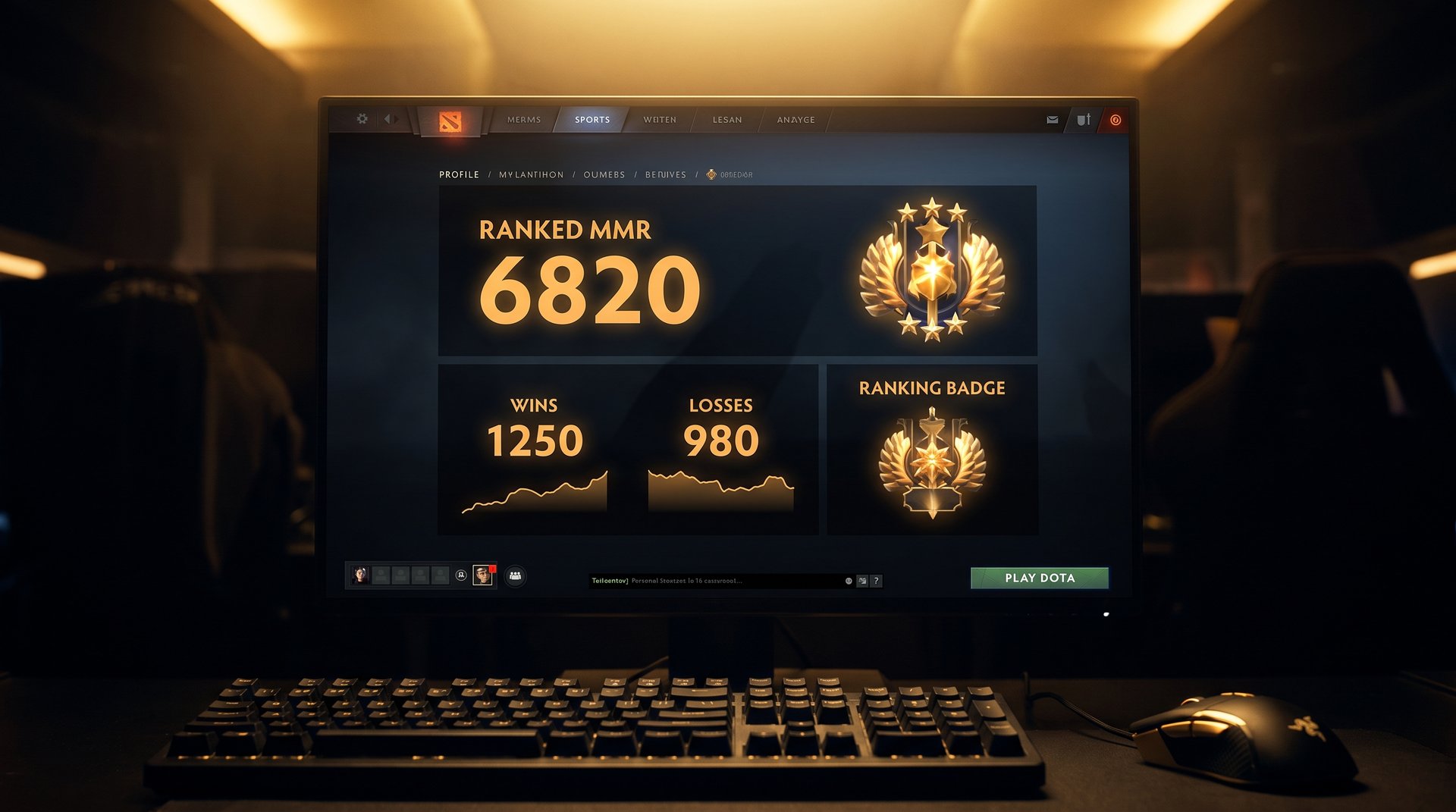
7 Real Causes of Asymmetric MMR Gains
Let’s be specific. Here are the seven most documented causes of asymmetric MMR gains in Dota 2, ranked from most to least common:
1. Elevated Uncertainty After a Break
This covers the majority of cases. You played consistently for months at, say, 3,200 MMR. You took six weeks off. You come back and immediately drop three games — at elevated uncertainty, that costs you 120+ MMR. When you stabilize and start winning again, uncertainty has already partially normalized, so you’re winning 25-30 per game. The math hurts because losses came early at the inflated rate.
2. Playing Against or With Mismatched MMR in Party Queue
Party queue with players outside your MMR range creates unusual expected-outcome scenarios. When you’re partied with someone rated 1,500 MMR above you and you win, the system considers this a more expected outcome for your team (your partner skews the expected win probability upward). You gain less because you “should” have won. When you lose, the upset adjustment swings in the other direction, and you lose more because you “should” have won but didn’t.
Party queue with high-MMR friends can actually be MMR-negative for lower-ranked players in the long run, even if your winrate looks decent. If you’re grinding MMR, play solo queue or with same-bracket friends — it’s the cleanest way to let the system assess your individual skill accurately.
3. Performing Below Your Current Bracket Expectations
Valve’s system doesn’t just use the raw win/loss outcome. There’s evidence it adjusts slightly based on performance metrics within the game — kills, deaths, net worth relative to role, ability to help close games. A player performing dramatically below their bracket norms even in wins may gain slightly less. A player performing dramatically above their bracket norms in losses may lose slightly less. This is a soft modifier, not a major driver, but it can account for a few MMR points difference per game over a long session.
4. Abandonment and Disconnect Penalties
Abandoning a ranked game carries a penalty on top of the regular game loss. Depending on how long into the game the abandon happened, this can add another 25-50 MMR to the total deduction. Even a brief disconnect followed by reconnect can be flagged as a partial abandon in some circumstances. If your connection is unstable, check your network before queuing ranked — a single bad game can set you back the equivalent of two or three normal losses.
5. Role Queue Violations
Playing a role different from the one you selected in role queue (for example, queuing as hard support but going pos 1 carry) triggers an additional MMR penalty separate from the game result. This penalty is visible in your post-game summary if you look at the detailed breakdown. Players sometimes trigger this without realizing it — queuing as offlane then pulling into a position 1 role because the draft demanded it counts in the system’s eyes.
6. New Season Opening Games
Covered in detail above, but worth flagging as its own scenario because many players experience this without connecting it to the season transition. If you notice gains and losses suddenly feel larger than they were two weeks ago, check whether a ranked season reset just occurred. The effect typically normalizes within 10-15 games.
7. The Confirmation Bias Effect
This isn’t a technical cause, but it explains perhaps half of all posts asking “why do I gain less than I lose.” Human memory systematically overweights negative outcomes. Research in behavioral economics shows that the psychological impact of a loss is roughly 2x the impact of an equivalent gain. In practice, this means you notice and remember your -30 MMR losses more vividly than your +28 MMR wins, even when the numbers are nearly identical. We’ll go deeper on this in the psychology section below.
Does Behavior Score Change How Much MMR You Gain or Lose?
This question comes up constantly, and the honest answer is: behavior score affects your queue quality, not your per-game MMR delta directly.
Low behavior score places you in matches with other low-behavior-score accounts. These games tend to have more abandons, intentional feeders, and players who don’t cooperate. The end result is that low-behavior-score players often have lower winrates — not because the system penalizes them with smaller gains, but because the match quality is genuinely worse and winning becomes harder.
The fix is indirect but real: improving your behavior score (by commending others, avoiding reports, not feeding) moves you back into higher-quality queues where your actual skill determines outcomes more reliably. It won’t change the gain/loss per game formula, but it will make your winrate reflect your real ability more accurately.
One important exception: Valve has previously tested behavior-score-based matching that could have secondary effects on uncertainty calculations. This has never been officially confirmed, and the evidence from post-game data suggests behavior score is primarily a queue-sorting mechanism rather than a gains multiplier.
The Psychology Trap: Why You Always Remember Losing More
Loss aversion is one of the most well-documented cognitive biases in psychology, and it makes MMR grind feel rigged even when the math is perfectly fair. Here’s how it works in practice.
Imagine you play 20 games. You win 11 and lose 9, gaining an average of 27 MMR per win and losing an average of 29 MMR per loss. Your net result: (11 x 27) – (9 x 29) = 297 – 261 = +36 MMR. You should feel good. But what you actually remember from those 20 games are the 3 or 4 losses where you played well and got a terrible team. Each of those sticks in your mind. The wins — especially the wins where the game felt easy or where your team carried you — fade into a blur.
When you sit down at the end of the session and try to reconstruct what happened, you’re working from a heavily biased sample. The losses feel more recent, more vivid, and more numerous than they actually were.
The most useful counter to this is keeping a spreadsheet. Write down your MMR before each session, your total games, your win-loss, and your MMR after. Do this for 30 days. The actual numbers almost always tell a very different story than what memory suggests.
If the numbers genuinely show consistent -5 to -10 MMR per session even with decent winrates, then you have a real technical problem (elevated uncertainty or role queue penalties) worth investigating. If the numbers show +15 to +20 MMR per session, the “I gain less than I lose” feeling is a perception issue — the math is working in your favor.
How to Fix Asymmetric MMR Gains
Based on everything above, here is the practical action list for players experiencing genuine asymmetric gains:
Step 1: Diagnose Whether the Problem Is Real
Track your exact MMR at the start and end of every session for two weeks. If you’re gaining overall, the asymmetry you feel is likely psychological. If you’re genuinely losing ground despite a positive win-loss, the issue is real and one of the technical causes above is responsible.
Step 2: Stabilize Your Uncertainty
If you took a long break, expect the first 15-20 games back to have elevated uncertainty. Play them carefully. Pick your highest-confidence heroes in your safest roles. Avoid experimenting with new picks during the high-uncertainty window — this is not the time to try a new hero mid or go position 4 for the first time.
Once you’ve played through the high-uncertainty period, your gains and losses will equalize. The worst thing you can do during this window is keep taking breaks — you reset the uncertainty clock repeatedly and never get to the stable zone.
Step 3: Check Role Queue Behavior
Go to your match history and look at the role you selected versus the role you actually played in your last 20 games. If there are consistent mismatches, you’re taking role queue penalties that add up. Either commit to the role you queue for or queue for a different role that reflects what you actually end up playing.
Step 4: Fix Party Queue Habits
If you regularly party with players 1,000+ MMR above you, consider how this affects your expected-outcome calculations. You’re in matches where you’re expected to win at a higher rate, so wins pay less and losses pay more. For pure MMR grinding, solo queue or playing with same-bracket players gives you the most honest and efficient gains. If you want to explore professional MMR services as an alternative, dedicated solo boosting in your bracket avoids this party-queue penalty entirely.
Step 5: Consider When a Boost Makes More Sense Than Grinding
There’s a practical case for boosting that goes beyond impatience. If your account has persistent elevated uncertainty (common in accounts that cycle between long play periods and long breaks), grinding through the uncertainty window repeatedly is genuinely inefficient. A professional booster working your account through a focused block of games can carry you through the high-uncertainty window at a high win rate, settling your rating quickly and letting your uncertainty normalize. After that, the gains you see in your own play will equalize.
If you’ve struggled with asymmetric gains for more than two weeks and genuine mechanical improvement hasn’t fixed the win rate underlying the problem, it may be time to look at your options. Our complete MMR boosting guide walks through every approach and how to evaluate which one fits your situation.
The Solo Grind Reality Check
It’s worth being honest about what the solo grind actually looks like for most players. If you’re at a stable, established MMR with low uncertainty and a 50% winrate, you will not climb meaningfully. Dota 2’s matchmaker is designed to converge everyone toward a 50% winrate by adjusting opponent difficulty. The only way to climb consistently is to have a winrate above 55% over a large sample of games, which requires either genuine skill improvement, a deep hero pool advantage, or an MMR bracket mismatch (you’re better than your current displayed rating).
Players who feel “stuck” are often correctly assigned. Their uncertainty is low, their winrate is close to 50%, and the gains and losses have equalized — they just don’t like where they’ve equalized. Understanding this distinction matters because the solutions are completely different. A genuine mechanical skill problem requires practice and study. An uncertainty problem requires consistent play through a focused window. An unfair assignment problem (you’re playing well above your bracket) resolves itself naturally within 30-50 games.
Tired of Grinding and Going Nowhere?
If asymmetric gains have you stuck in the same bracket for weeks, TeamSmurf’s Dota 2-only boosters can carry you through the uncertainty window efficiently. We play ranked-only accounts in your exact region and role, with full VPN and offline mode protection.