We Analyzed 1,000 Boost Orders: The Most Requested Rank Is Not What You Think

Ask anyone what rank boosters mostly target and they will guess Divine. Maybe Immortal. The prestige ranks, the top percentile, the ones people brag about on Reddit. That assumption is wrong by a wide margin.
After reviewing order data across more than 1,000 completed boosts processed through TeamSmurf, one rank tier dominates the request list in a way that runs counter to almost every expectation: Ancient — specifically Ancient I and Ancient II. Not Divine. Not Immortal. Ancient.
This post breaks down the full picture: which ranks are ordered most, where those orders typically start, why the Legend-to-Ancient transition produces more demand than any other rank jump in Dota 2, and what all of it reveals about how players actually think about the ladder.
What We Cover
The Core Finding
Most writing about Dota 2 boosting focuses on the extreme end — players grinding toward Immortal, trying to reach the top 1,000 leaderboard, or attempting to break into Divine for the first time. These are real requests, but they represent a small fraction of actual order volume.
What drives the bulk of activity is something much more grounded: the desire to reach Ancient. In our order data, Ancient I and Ancient II together account for the largest single cluster of target rank destinations — more than any other individual rank, and more than the Divine bracket as a whole.
The second-most common pattern is almost as telling. A very large share of orders that target Ancient do not start from high Legend or Ancient itself. They start from mid-to-low Legend, often from players sitting at Legend II, Legend III, or Legend IV who have been stuck at those ranks for one or more seasons.
So the most common boost request, condensed to a single sentence: a player in the Legend bracket who wants to reach Ancient I or Ancient II and has been unable to get there through solo queue.
Everything else in the data flows from that central observation. Let us get into the specifics.
Target Rank Breakdown: Where Orders Land
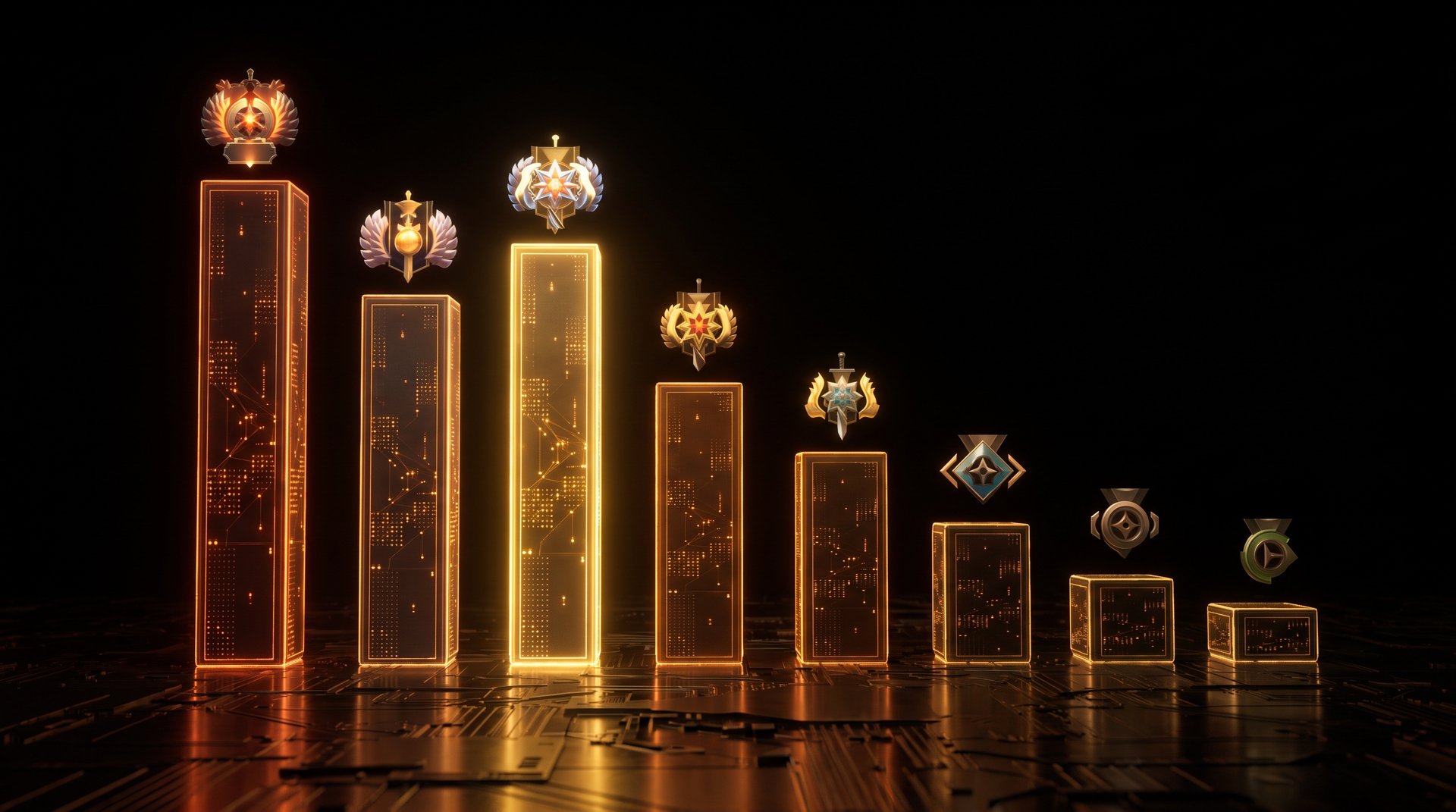
The table below shows the approximate distribution of target ranks across the order set, grouped into tier clusters. These are directional figures drawn from TeamSmurf’s internal order patterns and are intentionally presented as ranges rather than exact percentages — individual months and regional cohorts vary.
| Target Rank Cluster | Share of Orders (approx.) | Typical Starting Point |
|---|---|---|
| Ancient I — Ancient II | 35 — 40% | Legend III — Legend V |
| Ancient III — Ancient V | 11 — 15% | Legend V — Ancient I |
| Legend V (specifically) | 9 — 13% | Legend II — Legend IV |
| Divine I — Divine II | 10 — 13% | Ancient III — Ancient V |
| Divine III — Divine V | 6 — 9% | Ancient V — Divine I |
| Immortal (any) | 4 — 7% | Divine IV+ |
| Archon V — Legend II | 5 — 8% | Archon I — Archon IV |
| Calibration / MMR Floor | 3 — 5% | Varies widely |
The concentration at Ancient I-II is striking. When you combine the orders targeting that two-rank cluster with the orders targeting Legend V as a stepping-stone, you get roughly half of total demand concentrated on one boundary: the transition out of Legend into Ancient.
Immortal orders, the ones that generate the most discussion online, represent somewhere between 4 and 7 percent of the total. Divine orders as a whole account for maybe 16 to 22 percent. The top two tiers combined still fall short of what Ancient I and Ancient II attract on their own.
Where Orders Start: The Starting Rank Breakdown
Where players are when they place an order is just as informative as where they want to go. The starting rank distribution reinforces the same story the target data tells.
| Starting Rank Cluster | Share of Orders (approx.) | Notes |
|---|---|---|
| Legend II — Legend IV | 28 — 33% | Core of the demand pool |
| Legend V — Ancient I boundary | 18 — 23% | Just below the break |
| Archon V — Legend I | 14 — 18% | Climbing through Legend first |
| Ancient I — Ancient III | 10 — 14% | Pushing further inside Ancient |
| Archon I — Archon IV | 7 — 11% | Building MMR base |
| Ancient IV — Divine I | 5 — 8% | Targeting Divine bracket |
| Divine II and above | 3 — 6% | High-rank refinement orders |
Over half of all orders in the dataset start somewhere in the Legend bracket. When you include players in Archon V who are trying to break into Legend as their first goal before aiming for Ancient, the number climbs even further.
This is not a population of players hunting for Divine or Immortal from a standing start. It is predominantly a mid-tier group trying to cross one specific boundary — the one between Legend and Ancient.
The Legend-to-Ancient Wall: Why This Boundary Matters
The Legend-to-Ancient boundary is not just a number on a screen. In the Dota 2 community, it functions as an informal dividing line between players who are considered serious about the game and those who are not.
This is not about objective skill. Ancient players are not dramatically better than high-Legend players in any measurable way that would justify the community perception gap. But the gap in how players are treated — in pub lobbies, in Discord servers, in coaching communities — is real.
Players below Ancient often describe the experience in similar terms: they feel like they are stuck in a bracket where communication breaks down more often, where draft cooperation is inconsistent, where individual game quality varies enough to make consistent performance feel random. Whether this perception is accurate or somewhat inflated by frustration is debatable. What is not debatable is that a very large number of players believe it, and that belief directly drives boost order demand.
The MMR boosting guide covers the mechanics of how the rating system works in more depth. What matters for this analysis is the behavioral output: when players hit a ceiling in Legend, a significant fraction of them decide the ceiling is not a skill problem they can solve through more games — it is a structural problem they want to bypass so they can play in what they perceive as a better environment.
Why Ancient Specifically: The Psychology of the Target Rank
If we know that most orders start in Legend, why is the target Ancient I-II and not, say, Ancient V or Divine? The answer involves a combination of cost, perceived payoff, and what might be called the “respect threshold.”
The Respect Threshold
Ancient I is approximately the top 8 to 12 percent of the Dota 2 player base, depending on the region and the current season’s calibration distribution. That is a meaningful threshold in a game with millions of active ranked players. Being able to say you are Ancient puts you outside the majority of the player population in a way that Guardian, Crusader, Archon, and even most of Legend does not.
Divine and Immortal represent even higher percentiles — but they are also perceived as dramatically harder to hold, and the cost of boosting to those ranks reflects that difficulty. For a large segment of the demand pool, Ancient I at a realistic price is a better value proposition than Divine IV at a substantially higher cost.
The Shelf Life Factor
Rank in Dota 2 decays at season boundaries. When a new ranked season begins, ranks recalibrate. A boost to Divine that a player cannot maintain through their own play is likely to decay back toward their natural MMR within a few weeks of the new season starting.
Ancient is commonly described by players as “holdable” — the rank at which a player who belongs there from a pure gameplay perspective can actually maintain their position without their account degrading through bad games. For players ordering a boost, this matters. The ideal outcome is not just reaching a rank; it is reaching a rank they can stay at long enough to feel the return on the investment.
Players targeting Divine or Immortal have a harder time making that argument to themselves unless their natural level is genuinely close to those brackets. The full breakdown of how boosting works and what to expect from the process is worth reading before any order, but from a data perspective, the “holdable rank” factor clearly influences where most players aim.
Price Sensitivity at the Legend-Ancient Gap
The MMR distance from mid-Legend to Ancient I is typically in the range of 600 to 1,000 MMR depending on starting point. That gap is large enough to be meaningful but not so large that the boost cost becomes a barrier for most buyers. Orders targeting a narrower range within that span — say, Legend V to Ancient II, roughly 500-700 MMR — represent a sweet spot where the price-to-outcome ratio feels reasonable to a wide segment of players.
Regional Patterns in Boost Orders
Rank distribution is not uniform across all Dota 2 server regions, and this affects where the demand clusters appear. A few directional observations from the order data:
Southeast Asia and Eastern Europe
These regions historically have higher baseline rank populations in the Legend-Ancient range, which means the absolute number of potential buyers for Legend-to-Ancient boosts is larger. Order demand from SEA and EEU skews toward the Ancient target cluster at a higher rate than the global average.
North America and Western Europe
The Dota 2 playerbase in NA and WEU has contracted over the past two to three years. Smaller total populations tend to produce slightly different demand curves — with a higher relative share of orders targeting Divine and Immortal, likely because the players who remain active in these regions are on average more invested in the game and more likely to be already ranked in the Ancient-Divine range.
South America
SA shows a pattern similar to SEA in terms of the Legend-Ancient concentration, but with a noticeably higher share of calibration and MMR floor orders. This suggests a population segment focused on establishing a competitive baseline rather than targeting a specific prestige rank.
None of these regional observations are surprising given the underlying rank distribution data available through community databases. The key point is that the dominance of Ancient as a target rank holds across regions — it is a global phenomenon, not a quirk of one server cluster.
Solo vs Duo Boost Preferences by Target Rank
The order data also tracks whether buyers chose a standard solo boost — where the booster plays on the account — or a duo boost, where the buyer plays with a high-MMR booster as their carry or support in real-time party queue.
A few patterns emerge:
| Target Rank | Solo Boost Share (approx.) | Duo Boost Share (approx.) |
|---|---|---|
| Archon — Legend III | 70 — 80% | 20 — 30% |
| Legend IV — Ancient II | 55 — 65% | 35 — 45% |
| Ancient III — Divine II | 50 — 60% | 40 — 50% |
| Divine III — Immortal | 45 — 55% | 45 — 55% |
Solo boosts dominate in the lower and mid segments. As target ranks increase, duo preference rises. This makes intuitive sense: players targeting the very top brackets are more likely to want to remain active on the account and improve alongside the boost, which is exactly what duo format enables.
For the Ancient target cluster — the dominant demand segment — solo boosts still account for a clear majority of orders, though duo is more popular here than it is for players aiming at Archon or lower Legend.
How Order Volume Changes Through the Season
Boost demand is not flat throughout the ranked year. It follows predictable patterns tied to how Dota 2’s ranked season works.
Post-Calibration Surge
The period immediately following a new season’s calibration games produces a notable spike in orders. Players who calibrate lower than their prior rank — or lower than their perceived skill level — often immediately seek to recover ground. This cohort skews toward solo boosts targeting specific MMR floors rather than prestige targets.
Mid-Season Plateau Demand
The largest sustained demand period is roughly the middle third of a ranked season. Players who have been grinding for a few weeks or months, have not reached their target, and are starting to calculate how much of the season is left — this group drives consistent order volume. Most of the Ancient target data in this analysis comes from mid-season orders.
End-of-Season Rush
Season-end demand spikes toward specific rank thresholds. Players who are just short of Ancient at the close of a season are more likely to place an order if the rank carries visual rewards or community significance. This dynamic is familiar to anyone who has played Dota 2 through multiple ranked seasons and noticed queue times fluctuating in the final weeks.
What This Data Tells Us About Dota 2 Players
Stepping back from the specifics, the order distribution reveals something about the player psychology driving boost demand that goes beyond the transactions themselves.
Most Players Are Not Trying to Cheat Their Way to the Top
If rank boosting were primarily about status inflation to the highest possible rank, Divine and Immortal would dominate the target distribution. They do not. The most common request is a grounded, specific jump across a boundary that most players believe represents a genuine improvement in game quality. That is a very different motivation than chasing a leaderboard position.
The Matchmaking Experience, Not the Number, Is the Product
Players do not buy boosts to see a different badge on their profile. They buy them because they believe the matchmaking on the other side of that badge will be better. When Ancient I is the most common target, it tells you something about what players think of their Legend lobbies — they want out. Whether the Ancient lobbies actually deliver a meaningfully better experience is a separate question, but the expectation is clearly there and it is driving real purchasing decisions.
Price and Holdability Matter More Than Prestige
A surprisingly small share of orders target the brackets that carry the most social prestige. Immortal orders, despite the status they confer, represent a small minority of total volume. Ancient represents a practical target — reachable, affordable, and (in the player’s assessment) holdable. Practical wins over prestigious in the actual purchase data.
If you are in the Legend bracket and considering whether a boost to Ancient makes sense for your situation, the full comparison of boosting services covers what to look for and how pricing compares across the market.
FAQ
Ready to Cross the Ancient Threshold?
If you are sitting in the Legend bracket and the data in this post sounds familiar, TeamSmurf’s boosters specialize in exactly the Legend-to-Ancient range. Every booster is Immortal-ranked, every order is backed by a completion guarantee, and you choose solo or duo format.
View Boost Pricing Compare Services