TI 2026 Shanghai Confirmed: Everything We Know About The International 15

The Aegis is heading back to China. Valve has officially confirmed that The International 2026 — the 15th edition of Dota 2’s most prestigious tournament — will take place at the Oriental Sports Center in Shanghai this August. After years of bouncing between European venues, TI is returning to the city where OG made history in 2019, and the entire competitive scene is buzzing.
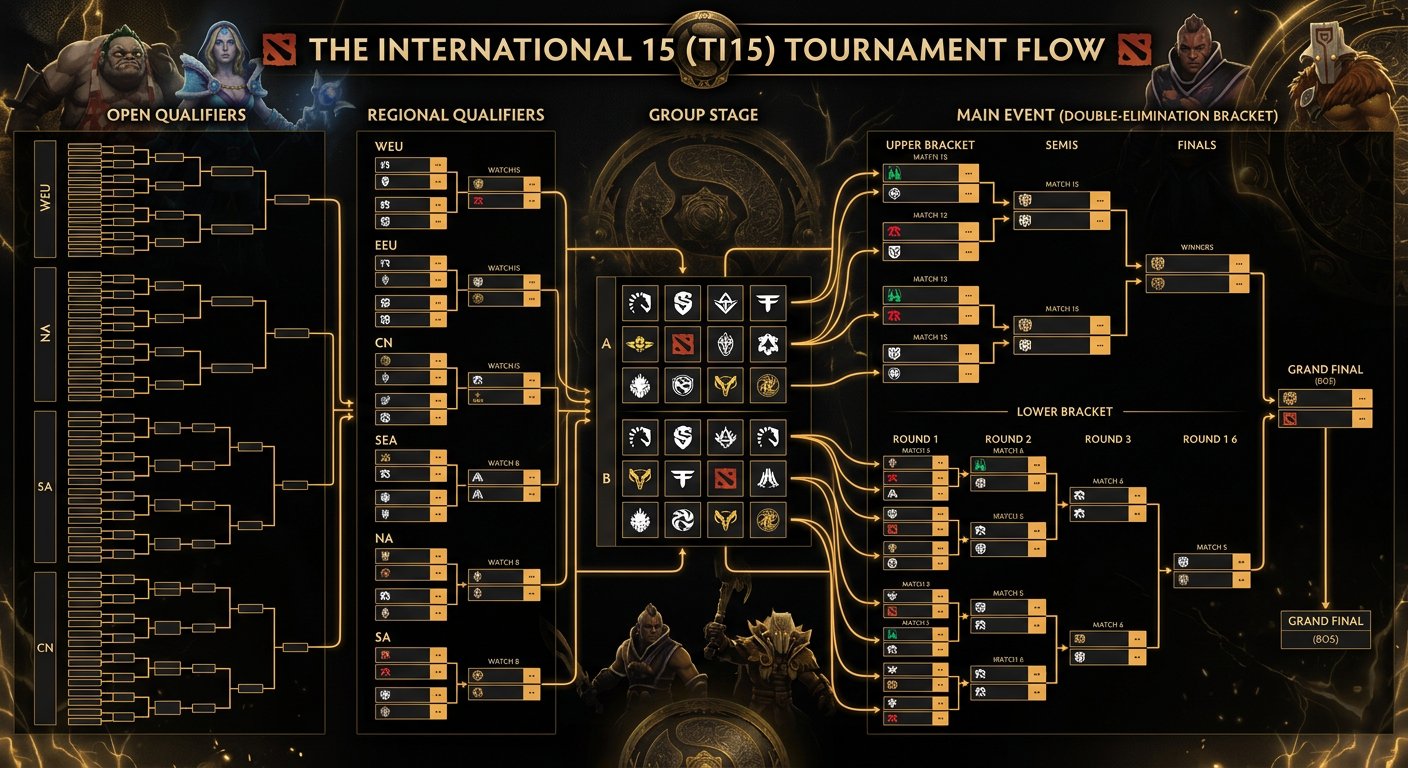
But the headline does not stop there. Open Qualifiers kick off June 9, a Swiss-format Group Stage leads into the Main Event on August 20-23, and — in one of the wildest crossover stories in esports history — former League of Legends World Champion Doinb is reportedly assembling a squad to compete in the Dota 2 open qualifiers. Whether you are a grizzled Immortal player or someone just getting into competitive Dota, TI15 is shaping up to be one of the most talked-about Internationals in years. Here is everything we know so far.
TI15 Confirmed: Shanghai Gets the Aegis Again
Valve dropped the official announcement via the Dota 2 blog, confirming Shanghai as the host city for The International 2026. The venue is the Oriental Sports Center, a massive multi-sport complex in the Pudong district that can hold thousands of fans. This marks the second time Shanghai has hosted TI — the first being TI9 back in 2019, which remains one of the highest-grossing esports events of all time with a prize pool exceeding $34.3 million.
The decision to bring TI back to China makes a lot of sense from multiple angles. The Chinese Dota 2 scene showed serious signs of life at TI 2025, with Xtreme Gaming finishing as runners-up after an incredible playoff run and Team Tidebound also making a strong showing in the Group Stage. Hosting TI15 in Shanghai gives the Chinese fanbase — one of the most passionate in all of Dota — a chance to show up in full force and support their home teams.
For those who remember TI9, the atmosphere inside the Mercedes-Benz Arena was electric even when OG was dismantling the home crowd’s favorites. Now imagine that same energy but with Chinese teams that actually have a realistic shot at winning. Wings Gaming were the last Chinese squad to lift the Aegis back at TI6 in 2016, joining Invictus Gaming (TI2, 2012) and Newbee (TI4, 2014) as China’s three TI champions. The hunger for a fourth is real, and TI15 could be where it happens.
The Full TI 2026 Schedule: From Open Qualifiers to Grand Finals
Valve has laid out a complete timeline for TI15, and if you are a competitive player with dreams of lifting the Aegis, you need to mark these dates right now:
Open Qualifiers: June 9-12, 2026 (Online)
Regional Qualifiers: June 15-28, 2026 (Online)
Group Stage (Road to The International): August 13-16, 2026 (Shanghai)
Main Event (The International): August 20-23, 2026 (Shanghai, Oriental Sports Center)
The Open Qualifiers are the entry point for any team that wants a shot at TI. These are fully online, meaning you do not need to be in Shanghai to compete. If your stack has been grinding ranked and you think you have what it takes, June 9 is your moment. Open Qualifiers feed into the Regional Qualifiers, which run for two weeks from June 15 to 28. This is where things get serious — the level of play jumps dramatically, and only the best teams from each region advance to the main tournament.
The Group Stage runs as a Swiss-format system from August 13-16. All 16 qualified teams will compete, and only the top eight survive to reach the Main Event. The Swiss format has become Valve’s preferred approach in recent years — it ensures that every single match matters and eliminates the “dead games” problem that plagued the old round-robin format. If you lose too many series early, you are out. No safety net.
The Main Event itself spans August 20-23 at the Oriental Sports Center. This is where the remaining eight teams battle it out in a double-elimination bracket for the Aegis of Champions and what will likely be a multi-million dollar prize pool.
16 Teams, Direct Invites, and Regional Slots
TI15 will feature 16 teams total, following the same structure Valve has used in recent years. The lineup will be filled through a combination of direct invites for top-performing teams and Regional Qualifier winners.
Valve has not yet revealed exactly how many direct invite slots there will be or how the regional qualifier spots will be distributed. For reference, here is how TI 2025 broke down the regional qualifier slots:
North America: 1 slot
South America: 1 slot
Western Europe: 2 slots
Eastern Europe: 1 slot
China: 1 slot
Southeast Asia: 2 slots
These numbers could shift for TI15. Given that the tournament is being held in China and the Chinese scene had a strong showing at TI 2025, there is speculation that China might receive an additional qualifier slot. Nothing is confirmed on that front yet, but it would not be surprising given the home-crowd factor and the competitive strength of the region right now.
The direct invite criteria will likely be based on performance in Valve-sanctioned events throughout the 2025-2026 season. Teams like Team Falcons — the reigning TI champions — are near-locks for direct invites, but the full list will depend on results from events like Blast Slam and other major tournaments leading up to TI.
The Swiss Format: What It Means for Competition
If you have watched any recent TI, you already know how the Swiss format works. But for those who are newer to the scene, here is the breakdown.
In a Swiss-format Group Stage, all 16 teams start at 0-0. Each round, teams with the same record are matched against each other. Win and you move up; lose and you slide closer to elimination. Teams that reach a certain number of wins (typically 3) advance to the Main Event, while teams that hit the loss threshold (typically 3) are eliminated.
The beauty of this system is that it is self-correcting. After the first round, strong teams start facing other strong teams, and weaker teams face each other. By the time the Group Stage is over, you have a pretty clear picture of which eight teams deserve to be on the main stage. There are no free rides and no hiding behind favorable group draws.
For players and teams preparing for TI15, the Swiss format means that every game from the very first series counts. You cannot afford to start slow and “warm up” during groups like some teams used to do in the old round-robin format. Come prepared or go home — that is the reality of Swiss groups.
Doinb Enters the Dota 2 Arena: The Crossover Nobody Expected
Now for the storyline that has the entire MOBA community talking. Kim “Doinb” Tae-sang — the legendary mid laner who won the 2019 League of Legends World Championship with FunPlus Phoenix — is reportedly planning to compete in the TI 2026 Open Qualifiers.

According to South Korean journalist kenzi (@kenzi131 on X), Doinb’s agent has confirmed the player’s intention to enter the Dota 2 qualifiers. Reports suggest that Doinb is assembling a stack composed of former League of Legends professionals who are making the jump to Dota 2. The motivation reportedly comes from a combination of factors — Doinb being unable to stream the LPL 2026 season and the opportunity presented by TI being held in Shanghai, where he is based.
The Dota 2 community is understandably split on this. On one hand, Doinb is known for his incredibly creative and unorthodox playstyle. He was never the mechanical god that some other League mid laners were — instead, he won through macro play, unconventional picks, and an almost supernatural ability to read the game. Those skills translate better to Dota 2 than raw League mechanics would.
On the other hand, the gap between League and Dota is enormous. Turn rates alone will throw off any League player for months. The depth of Dota 2’s item system, the complexity of the draft phase with bans and counterpicks, the importance of vision and map control — these are all areas where even talented MOBA players need significant time to develop competence, let alone compete at a professional level.
The realistic take? Doinb and his squad will almost certainly not make it past the Open Qualifiers. The teams competing in those brackets include tier-2 and tier-3 professional stacks with thousands of hours of Dota-specific experience. But that is not really the point. The fact that a League of Legends World Champion is taking Dota 2 seriously enough to enter TI qualifiers is a massive story for the game. It brings attention, it brings crossover fans, and it adds a compelling narrative to the early stages of TI15.
If nothing else, the Open Qualifier matches featuring Doinb’s team will be some of the most-watched qualifier games in years. The rivalry between League and Dota communities has been going on for over a decade, and seeing a champion from one game try to compete in the other is the kind of content that writes itself.
The Oriental Sports Center: What to Expect from the Venue
The Oriental Sports Center is a significant upgrade in terms of facilities compared to some recent TI venues. Located in the Pudong New Area of Shanghai, the complex was originally built for the 2011 FINA World Aquatics Championships and has since hosted numerous international sporting events.
The main arena has a capacity that can accommodate a massive crowd, and Shanghai’s infrastructure makes it one of the most accessible cities in the world for international travelers. Direct flights from virtually every major city, an extensive metro system, and a well-established esports culture in the city all contribute to making this an ideal TI location.
For fans planning to attend in person, start thinking about travel logistics now. Shanghai in August is hot and humid, so pack accordingly. Visa requirements for China can take time to process depending on your country of origin, so do not wait until the last minute. Hotels near the Pudong area tend to fill up quickly during major events, and prices will spike once the full TI schedule and ticket information are released.
Valve has not yet announced ticket prices or on-sale dates, but based on previous TI events, expect tickets to sell out fast. TI9 in Shanghai sold out almost immediately, and there is every reason to believe TI15 will follow the same pattern.
Prize Pool: What We Know (and What We Do Not)
As of March 2026, Valve has not revealed the prize pool for TI15. Historically, The International has featured crowd-funded prize pools through the sale of Battle Passes and in-game cosmetics. This system produced some of the largest prize pools in esports history, peaking at over $40 million for TI10 in 2021.
However, Valve has been adjusting how prize pool contributions work in recent years. The exact structure for TI15’s crowd-funding remains to be seen. What we do know is that The International consistently offers life-changing money for the teams that perform well. Even placing in the top 8 typically yields six-figure payouts per player, and winning the whole thing has historically been worth eight figures for the team.
We expect Valve to announce Battle Pass details and prize pool contribution mechanics in the coming months, likely around April or May to build hype heading into the qualifier season.
Teams to Watch Heading Into TI15
While the full team list will not be finalized until after Regional Qualifiers conclude in late June, here are the squads that are generating the most buzz heading into the TI15 season:
Team Falcons — The reigning TI champions. They won TI 2025 in convincing fashion, defeating Xtreme Gaming in the Grand Finals. Until someone knocks them off, they are the team to beat.
Xtreme Gaming — The Chinese powerhouse that topped the TI 2025 Group Stage undefeated before falling to Falcons in the finals. Playing on home soil in Shanghai gives them a massive advantage in terms of crowd support and comfort.
Team Liquid — A perennial contender that always seems to be in the mix at TI. Their consistency across multiple seasons makes them a threat regardless of meta shifts.
Chinese Dark Horses — With TI in Shanghai, expect the Chinese qualifier scene to be absolutely stacked. Teams that might not normally get attention could level up significantly with the motivation of playing TI on home turf.
The meta heading into TI15 will also play a huge role. Valve typically releases a significant balance patch before the qualifier season, which can completely reshape the competitive landscape. Teams that adapt quickly to the new patch tend to have a major advantage in qualifiers and the early stages of TI.
How to Prepare for TI 2026 Open Qualifiers
If you are a competitive player thinking about entering the Open Qualifiers on June 9, here are some practical tips from someone who has been through the grind:
1. Lock in your roster NOW. You have roughly three months before Open Qualifiers start. That is enough time to build real chemistry with your teammates, but only if you start immediately. Do not wait until May to start looking for a position 5 player.
2. Scrim against the best teams you can find. Ranked matchmaking is useful for individual skill development, but it does not prepare you for the coordinated play you will face in qualifiers. Find other stacks to practice against, ideally teams that have qualifier experience.
3. Study the current meta and anticipate changes. Valve will likely release a patch before qualifiers. Pay attention to hero trends in professional matches and be ready to adapt your drafts accordingly.
4. Work on your mental game. Open Qualifiers are a marathon, not a sprint. You will play multiple best-of series in a single day, and the pressure builds with each round. Teams that tilt after a loss rarely make it through.
5. Get your MMR up. While MMR is not everything, higher-ranked players generally have better mechanics, faster decision-making, and broader hero pools. If you are sitting below 6K, consider investing in a Dota 2 MMR boost or calibration service to get your account where it needs to be before the qualifier grind begins.
TI 2026 and the Future of Dota 2 Esports
The International has always been more than just a tournament. It is the annual proof that Dota 2 remains one of the most compelling competitive games ever made. Every year, skeptics wonder if Dota is dying, and every year, TI reminds the world that this game has a dedicated, passionate community that is not going anywhere.
TI15 in Shanghai represents something special. The return to China signals Valve’s confidence in the global health of the Dota 2 scene. The Swiss format shows that they are willing to iterate on tournament structure to keep competition fair and exciting. And stories like Doinb crossing over from League add a layer of mainstream appeal that TI has not always had.
For the full updated bracket and team list, Liquipedia remains the best resource as information gets released throughout the season.
Whether you are watching from home, cheering from the stands in Shanghai, or competing in the Open Qualifiers yourself, TI15 is shaping up to be an event worth caring about. The Aegis is on the line, the stakes have never been higher, and the road to The International starts in June.
Key Takeaways
Venue: Oriental Sports Center, Shanghai, China
Open Qualifiers: June 9-12, 2026 (Online)
Regional Qualifiers: June 15-28, 2026 (Online)
Group Stage: August 13-16, 2026 (Swiss format, Shanghai)
Main Event: August 20-23, 2026 (Shanghai)
Teams: 16 total (Direct invites + Regional Qualifier winners)
Prize Pool: TBD (expected crowd-funded via Battle Pass)
Wild Card: Doinb (LoL World Champion) entering Open Qualifiers
Frequently Asked Questions
The Main Event runs August 20-23, 2026 at the Oriental Sports Center in Shanghai. The Group Stage takes place August 13-16. Open Qualifiers start June 9-12 and Regional Qualifiers run June 15-28.
TI15 will be held at the Oriental Sports Center in the Pudong district of Shanghai, China. This marks the second time Shanghai has hosted The International, following TI9 in 2019.
16 teams will compete at TI15. The roster will be filled through a combination of direct invites and Regional Qualifier winners. The exact number of invite slots and regional distribution has not been confirmed yet.
The prize pool has not been announced yet. It is expected to be crowd-funded through Battle Pass sales, similar to previous years. Past TI prize pools have ranged from $15 million to over $40 million.
Yes, the Open Qualifiers are open to any team that registers. They take place online from June 9-12, 2026. You do not need a direct invite or prior professional experience to enter — just a full five-player roster and the skill to compete.
According to South Korean journalist kenzi and confirmed by Doinb’s agent, the former League of Legends World Champion intends to compete in the Dota 2 Open Qualifiers for TI 2026. He is reportedly forming a team with other ex-LoL professionals. While the chances of qualifying are slim, the crossover has generated massive buzz in both communities.
TI15 uses a Swiss-format Group Stage where 16 teams compete, and only the top 8 advance to the Main Event. The Main Event features a double-elimination bracket culminating in the Grand Finals on August 23.
Ready to Climb? TeamSmurf Has Your Back
TI season means the ranked grind is more intense than ever. Whether you want to boost your MMR before Open Qualifiers, get coached by high-MMR players who know the meta inside out, or calibrate a fresh account at the rank you deserve — TeamSmurf has you covered. Get TI-ready today.