TI 2026 Fantasy Points Calculator

This is the complete TI 2026 fantasy points calculator reference. Every scoring category, every multiplier, worked examples with real hero roles, and the strategy layer that separates top-ranked fantasy teams from the pack. Bookmark this page before picking your cards.
If you came here wondering why your Morphling scored 38 points in one game and only 12 in the next, the answer is in this guide. The TI fantasy scoring system rewards specific in-game performance categories at fixed point rates — and understanding those rates precisely is the difference between randomly picking famous names and systematically building a roster that scores every game.
What’s on this page
The Complete TI 2026 Fantasy Scoring System
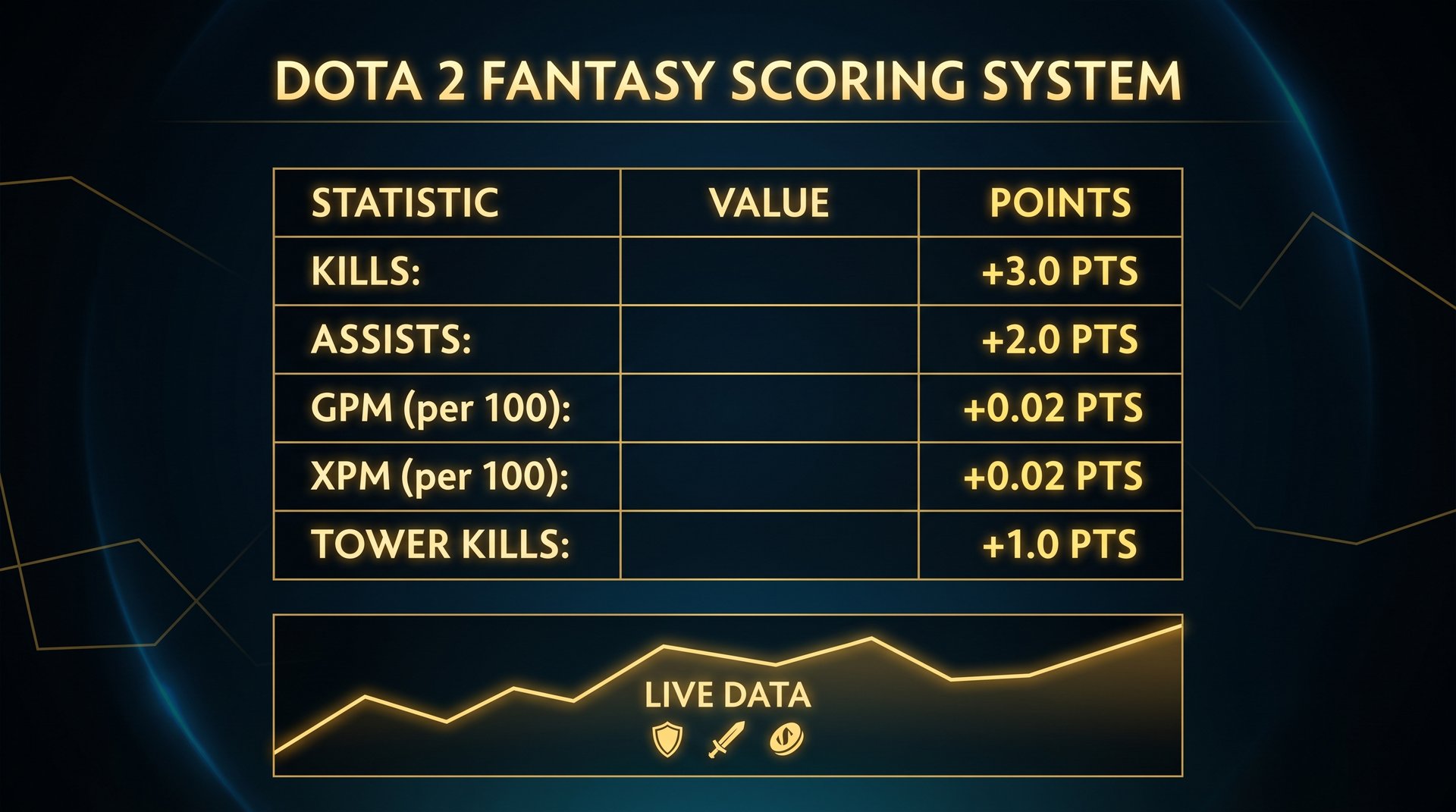
Valve’s fantasy scoring system for The International has used the same core framework since TI5, with minor weight adjustments each year. The system tracks every in-game performance metric available through the Dota 2 replay parser and converts them into fantasy points at fixed rates. Below is the full scoring table for TI 2026, based on the standard Valve fantasy challenge scoring used at recent Internationals.
| Scoring Category | Points per Unit | Notes |
|---|---|---|
| Kills | 0.3 pts each | Every hero kill credited to the player |
| Deaths | -0.3 pts each | Penalizes feeding; supports hurt most here |
| Assists | 0.15 pts each | Credited when near kill within assist range |
| Last Hits (per game) | 0.003 pts each | 200 last hits = 0.6 pts |
| Denies (per game) | 0.006 pts each | Double the value of last hits |
| Gold Per Minute (GPM) | 0.002 pts per GPM | 700 GPM = 1.4 pts |
| XP Per Minute (XPM) | 0.002 pts per XPM | 800 XPM = 1.6 pts |
| Stun Duration (seconds applied) | 0.05 pts per second | 20 seconds applied = 1.0 pt |
| Camps Stacked | 0.5 pts each | Rewards jungle support play |
| Roshans Killed | 1.0 pt per kill | Any player in kill range gets credit |
| Teamfight Participation | 3.0 pts per fight | Based on being in fight zone during teamfight |
| Observer Wards Placed | 0.5 pts each | Rewards vision control |
| Sentry Wards Placed | 0.3 pts each | Lower weight than observer wards |
| Tower Damage (per 100 damage) | 0.1 pts | 1,000 tower damage = 1.0 pt |
| Healing Done (per 100 HP) | 0.05 pts | Primarily rewards hard supports |
Points Calculator: How to Manually Score Any Game
You don’t need a spreadsheet to estimate a player’s fantasy total. The formula is straightforward once you know the weights. Here is how to calculate a game score by hand:
Base Score = (Kills x 0.3) + (Assists x 0.15) – (Deaths x 0.3) + (GPM x 0.002) + (XPM x 0.002) + (Last Hits x 0.003) + (Denies x 0.006)
Then add the bonus categories: stun seconds, camps stacked, ward placements, tower damage, Roshan credits, and teamfight participation. A complete game score for a carry player typically looks like this:
| Stat | Value in Game | Calculation | Points |
|---|---|---|---|
| Kills | 12 | 12 x 0.3 | 3.60 |
| Assists | 8 | 8 x 0.15 | 1.20 |
| Deaths | 3 | 3 x -0.3 | -0.90 |
| GPM | 750 | 750 x 0.002 | 1.50 |
| XPM | 820 | 820 x 0.002 | 1.64 |
| Last Hits | 320 | 320 x 0.003 | 0.96 |
| Denies | 15 | 15 x 0.006 | 0.09 |
| Teamfight Participation (4 fights) | 4 | 4 x 3.0 | 12.00 |
| Tower Damage (2,400 total) | 2400 | 24 x 0.1 | 2.40 |
| Roshan Kill Credit | 1 | 1 x 1.0 | 1.00 |
| Total | — | — | 23.49 |
That 23-point carry game is a solid but not exceptional result. An elite carry performance at TI — think a player finishing with 15+ kills, 850+ GPM, and 3,000+ tower damage across a long game — can break 35-40 points in a single match. Understanding the ceiling for each role helps you decide which slots are worth paying premium budget for in the fantasy UI.
Fantasy Points by Role: What to Expect
One of the most common mistakes in TI fantasy is treating all five hero slots the same way. They don’t score the same. Carry players and mid players have fundamentally different ceiling profiles compared to position 4 and 5 supports. Here is what realistic scoring looks like by role across a typical TI game:
| Role | Low Game | Average Game | Elite Game | Primary Scoring Driver |
|---|---|---|---|---|
| Position 1 (Carry) | 12-15 | 20-26 | 32-42 | GPM, Last Hits, Kills, Tower Damage |
| Position 2 (Mid) | 10-14 | 18-24 | 30-40 | Kills, XPM, GPM, Stuns |
| Position 3 (Offlane) | 8-12 | 15-21 | 26-35 | Kills, Stuns, Teamfight, Tower |
| Position 4 (Soft Support) | 6-10 | 12-18 | 22-30 | Assists, Stuns, Wards, Camps |
| Position 5 (Hard Support) | 5-9 | 10-16 | 18-26 | Assists, Wards, Healing, Camps |
The gap between roles is real and intentional. Valve weights the scoring to reflect that carries and mids spend more game time accumulating farmable stats. A position 5 Chen player in a 50-minute game might post a genuinely excellent performance but still score 18 points — while a position 1 Terrorblade in the same game hits 38 because they have 400 last hits and 900 GPM.
Why Deaths Hurt Supports More Than Carries
The -0.3 death penalty applies equally across all roles, but it hits supports much harder in relative terms. A carry who dies twice in a 12-kill game is still net positive on the kill-death math (+3.0 for kills, -0.6 for deaths). A support who goes 1-4-14 — a genuinely active game with lots of assists — takes -1.2 from deaths against +0.3 kills +2.1 assists = net positive but significantly deflated. Avoiding supports with historically high death counts at TI is a legitimate strategy, especially in the group stage when teams are still finding their footing.
Example Card Breakdowns: Reading the Numbers
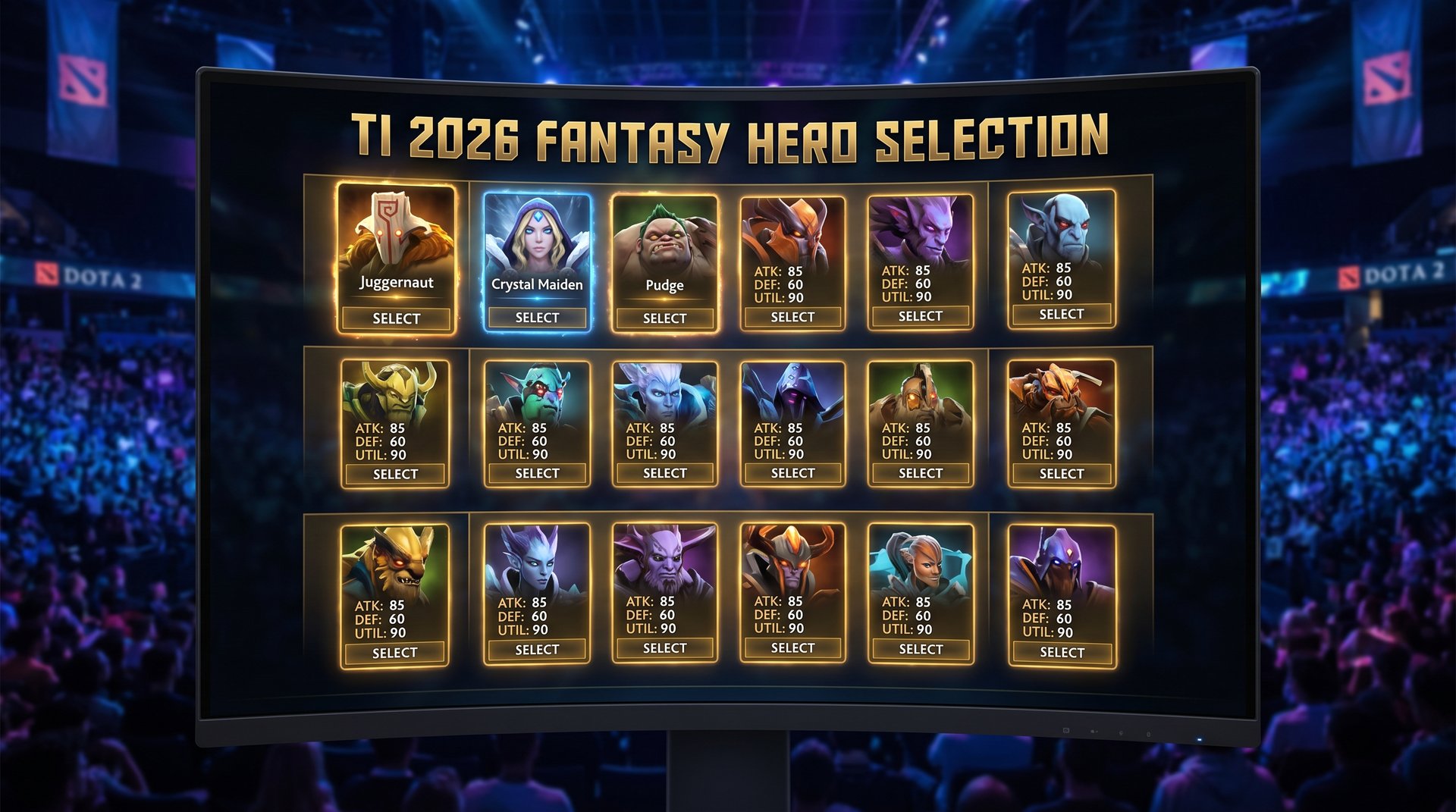
The TI fantasy interface assigns each player a fantasy card before the event. Cards show the player’s projected stats based on their recent LAN performance. Here is how to read a card and translate it into expected fantasy output.
Example: Reading a Core Card
Example: Reading a Support Card
Identifying Undervalued Cards
The fantasy market does not always price cards efficiently. Look for these undervalue signals:
- High-stun heroes at low cost: A player whose primary heroes are Tidehunter, Enigma, or Magnus will consistently post 15+ stun seconds per game. Those seconds add up quietly.
- Stack-farming position 4s: Players who regularly stack jungle camps add 1.5-3.0 fantasy points per game that don’t show in kill-focused card previews.
- Tower-focused offlaners: Offlaners on split-push heroes (Natures Prophet, Beastmaster, Lycan) can post 2,000-4,000 tower damage per game even in losses, which converts to 2.0-4.0 bonus points.
- Carries on farming heroes: A player known for Medusa, Spectre, or Terrorblade will consistently post 350+ last hits and 800+ GPM in long games, regardless of kill count.
If you are approaching TI boosting or want to understand MMR climbing to better read competitive meta, the best Dota 2 boosting services guide breaks down how professional-tier players operate at high MMR — the same skill expression that drives top TI fantasy card scores.
High-Value Categories: Where the Points Actually Come From
Not all scoring categories are created equal. Some categories look impressive on the tooltip but rarely move the needle. Others are quietly worth planning for. Here is the breakdown:
Teamfight Participation: The Hidden Multiplier
At 3.0 points per teamfight, participation is one of the highest-value per-unit categories in the entire scoring system. A game with 6 major teamfights — common in TI playoff games that go 40-50 minutes — means 18.0 points available just from fight credit. The catch: “teamfight participation” is measured by proximity to the kill zone during a classified teamfight event. Players who are dead, farming the opposite side of the map, or split-pushing with no teleport may miss fight credit even in games their team wins.
For fantasy purposes, this means:
- Prefer players who team-fight with their roster rather than split farmers
- Position 4 and 5 players who hover near cores in fights get full credit
- A position 1 who farms while their team fights will underperform their GPM suggests
GPM and XPM: Consistent Base Income
GPM and XPM are the most reliable scoring sources because they are not binary events — they accumulate every second of the game. A player posting 700 GPM across a 40-minute game generates 1.4 fantasy points from GPM alone. Across a 5-game series at TI, that is 7.0 points from one stat category. XPM adds another 1.4-1.8 per game.
For the MMR boosting guide comparison, this mirrors how consistent farming efficiency in pub games is what separates Herald from Archon players — the delta is income efficiency, not mechanical skill alone.
Kills vs Assists: The Role-Dependent Balance
| Scenario | Kill-Heavy Player | Assist-Heavy Player | Points Earned |
|---|---|---|---|
| 10 kills, 3 assists | 3.0 + 0.45 = 3.45 | — | 3.45 |
| 3 kills, 18 assists | — | 0.9 + 2.7 = 3.60 | 3.60 |
| 6 kills, 12 assists | 1.8 + 1.8 = 3.60 | — | 3.60 |
The math shows that assist-heavy supports can match kill-heavy cores on the kill-assist combined score alone — but only if they’re getting 18+ assists, which requires both a very long game and their team winning most fights with them present. A 3-3-18 support game is strong; a 2-5-8 game in a 25-minute stomp is not. High-assist totals depend on game length and win/loss trajectory.
Stun Duration: The Underrated Category
Stun duration at 0.05 points per second rewards heroes with long-duration crowd control. Consider these hero stun benchmarks per game:
- Tidehunter: Ravage (2.5s) + Anchor Smash + Gush in every teamfight — realistic 25-40 stun seconds per game = 1.25-2.0 pts
- Lion: Hex + Impale in every kill — realistic 20-35 stun seconds = 1.0-1.75 pts
- Enigma: Black Hole (4s) hit landing on 3+ heroes each cast — realistic 30-60 stun seconds = 1.5-3.0 pts
- Sand King: Impale stun chains + Epicenter — realistic 40-70 stun seconds = 2.0-3.5 pts
Players on stun-heavy hero pools can earn 2-4 fantasy points per game from this category alone. It is rarely priced into card value by casual fantasy participants.
Title and Star Modifiers Explained
Every TI fantasy card comes with a title slot and a star level. These are multipliers applied to the base score from the categories above, not separate scoring systems. Understanding how they work changes how you should budget your fantasy coins.
Star Levels
| Star Level | Score Multiplier | Notes |
|---|---|---|
| 1 Star | 1.0x (base) | No multiplier applied |
| 2 Stars | 1.15x | 15% bonus on total score |
| 3 Stars | 1.30x | 30% bonus — significant for core slots |
Star levels are set by Valve based on the player’s expected performance tier. Top-seeded players start at 3 stars; mid-tier players are typically 2 stars; up-and-comers and wildcard qualifiers often start at 1 star. You can upgrade stars with fantasy coins. The math on whether to upgrade is straightforward: if a player’s projected per-game total is 20 points, upgrading from 2 to 3 stars adds 3.0 points per game (20 x 0.15). Over a 5-game run, that is 15 additional points — weigh that against the coin cost of the upgrade.
Title Modifiers
Titles add flat bonus points when a player achieves the titled stat in a game. Common titles include:
- “The Carry” — bonus points when the player has the highest net worth on their team
- “Vision Control” — bonus when the player places 6+ observer wards in a game
- “Rampage” — bonus if the player achieves a Rampage kill streak
- “MVP” — bonus based on highest single-player point total in the match
- “Stun Master” — bonus when stun duration applied exceeds a threshold (typically 30s)
The best title strategy is matching the title to what the player naturally does. Giving “The Carry” title to a position 5 player wastes the potential bonus. Giving “Stun Master” to a Lion player who hits 30+ stun seconds every game nearly guarantees the bonus fires.
Building a Balanced Fantasy Roster
The TI fantasy interface gives you a budget to spend across your five player slots plus bench. A common roster-building mistake is spending heavily on all five starters, leaving nothing for a bench that can cover when a player underperforms or gets eliminated early.
The 3-2 Budget Split
Spend heavily on your top 3 slots — ideally your position 1, position 2, and one high-upside offlaner or position 4. Use the remaining budget on 2 consistent but budget-friendly support picks. The upside asymmetry is real: a position 1 that overperforms contributes 40+ points in a game, while an overspent position 5 who goes 0-4-10 still caps around 18 points even in a great game.
Targeting Team Run Depth
Fantasy points multiply with games played. A team that reaches the grand final plays 12-15 games across the event; a team eliminated in the group stage plays 6-8 games. Picking players from deep-running teams is worth a moderate coin premium, because even a 15-point-per-game player accumulates 225 points over 15 games versus 120 points over 8 games. If you want to understand the coaching and mentality mindset of top-tier players for context on who performs under pressure, the TeamSmurf Dota 2 coaching program works directly with Immortal-rank coaches who competed at LAN events.
The Consistency vs Ceiling Trade-off
| Player Type | Average Game | Variance | Best For |
|---|---|---|---|
| Consistent GPM farmer | 20-22 pts | Low (15-28 range) | Safe floor, less upside |
| Kill-heavy star carry | 22-26 pts | High (10-42 range) | High ceiling, can bomb out |
| Stun/teamfight offlaner | 16-18 pts | Medium (12-26 range) | Budget slot with upside |
| Ward-farming position 5 | 12-14 pts | Low (9-18 range) | Low-cost consistent filler |
For a safe roster, mix 2 consistent players with 3 ceiling picks. For a high-risk high-reward build that could win the overall leaderboard, load up on variance — but accept that you will also crash if those ceiling picks have bad series.
Common Fantasy Mistakes and How to Avoid Them
After watching how fantasy drafts play out across multiple TIs, these are the most consistent mistakes that separate top-ranked teams from mid-pack:
Mistake 1: Picking Based on Name Recognition Alone
The biggest names in Dota 2 are not always the highest fantasy scorers. A legendary position 5 player with 15 years of TI experience might average 13 points per game, while a relatively unknown offlaner from a wildcard team averages 22 points because he plays an extremely active, teamfight-heavy style. Check the scoring metrics, not just the resume.
Mistake 2: Ignoring the Death Tax on Supports
Supports who die frequently negate their own assist totals. A position 4 player going 2-6-20 looks impressive with 20 assists, but the net kill-assist-death score is (0.6 + 3.0 – 1.8) = 1.8 from KDA alone. A position 4 going 1-2-14 in a shorter game posts (0.3 + 2.1 – 0.6) = 1.8 from the same categories — with fewer deaths meaning better positioning for ward and camp bonuses on top. Fewer deaths almost always means better supporting.
Mistake 3: Overlooking the Teamfight Participation Score
Players who farm during fights earn 0 teamfight points even if they have excellent GPM. A 700-GPM carry who misses 4 teamfights loses 12 potential points — more than their GPM generates for the game. Watch team VODs to understand which carries team-fight versus which ones farm and rely on their team to win fights for them.
Mistake 4: Wasting Titles on Unlikely Triggers
The “Rampage” title triggers rarely in TI. Top teams play conservatively; a 5v5 teamfight where one player gets 5 kills before any respawns is genuinely rare in a competitive context. Giving a player the Rampage title is essentially burning a title slot. Stick to titles that fire on stats the player posts every game: “The Carry” for your position 1, “Stun Master” for your Lion or Tidehunter player, “Vision Control” for a ward-heavy position 5.
For context on how top MMR players approach decision-making under pressure — the same mentality that drives clean teamfight execution and low deaths — the TeamSmurf boosting safety guide covers how professional-tier play differs from high-MMR pub play at a structural level.
TI 2026 Context: What to Know Before Drafting
TI 2026 draws the top 20 teams in the world through a combination of Dota Pro Circuit points, regional qualifiers, and the wildcard tournament. The group stage runs before the main event bracket, and fantasy scoring is active from game one. This matters because group-stage games often have higher death counts and more experimental drafts than playoff games — which tends to inflate support deaths and reduce GPM consistency.
Some players who look dominant in pub stats perform conservatively at TI because their team runs a slow, vision-heavy meta. Others who look average on paper explode at TI because they are playing into a fast-paced team that generates fights constantly. When making your fantasy picks, weight recent LAN performance more heavily than pub stats or Dotabuff season rankings.
The TeamSmurf boosting guide covers how professional-tier players approach competitive games differently from pub games, which is relevant context for reading LAN performance versus pub-stat projections.
Want to Climb MMR Before the Next TI Cycle?
Fantasy points follow real performance. The players who score highest at TI are operating at Immortal-tier fundamentals — GPM efficiency, teamfight positioning, vision control. If you want to close the gap between your current rank and the players on those fantasy cards, TeamSmurf’s boosting and coaching programs work with Immortal-rank players who understand exactly how the top-level game is played.