The Average Dota 2 Player Wastes 340 Hours per 1,000 MMR (Data Study)

The number is 340. That is how many hours the average Dota 2 player burns climbing 1,000 MMR — not because they are bad at the game, but because the math of ranked play makes grinding quietly brutal.
This post shows the full calculation. Every number is sourced from observable inputs: match length, MMR per game, and the realistic winrate of a player trying to climb. You can replicate the arithmetic yourself in under five minutes. We also show what those same 340 hours look like from the booster side — and the gap is jarring.
If you have ever felt like you are grinding forever without moving, there is a reason. It is not your imagination. It is math.
What This Study Covers
- The 340-Hour Calculation
- Step 1: Average Match Length
- Step 2: MMR Movement Per Game
- Step 3: Realistic Grinder Winrate
- Step 4: The Full Derivation
- Why the Real Number Is Often Higher
- The Hidden Cost of 340 Hours
- The Winrate Trap
- What Boosters Achieve in the Same Window
- How to Reduce Your Hours per 1,000 MMR
The 340-Hour Calculation: Full Transparent Math
Before diving into each step individually, here is the summary table that produces the headline figure. Every cell is derived from the inputs in the sections below.
| Input | Value Used | Source / Basis |
|---|---|---|
| Average ranked match length | 40 minutes | Dota 2 median across Archon-Ancient brackets |
| MMR gained per win | +27 | Standard stabilized account gain |
| MMR lost per loss | -27 | Symmetric for accounts past calibration variance |
| Typical grinder winrate | 53.6% | Median from 4,200+ TeamSmurf client order records |
| Games needed for 1,000 MMR gain | 510 games | Calculated (see Step 4) |
| Total time | 340 hours | 510 games x 40 min / 60 |
The 340-hour figure is not a shock stat pulled from nowhere. It is a direct output of four observable variables. If you disagree with any input, substitute your own number — the formula still works. The sections below justify each input.
Step 1: What Does an Average Ranked Game Actually Cost You?
The commonly cited average Dota 2 match length is 38 to 42 minutes depending on server region and rank bracket. For this study we use 40 minutes as a clean midpoint that holds across most brackets from Archon to Ancient.
That 40 minutes breaks down roughly like this for a typical ranked session:
- Hero selection and bans: 3 to 4 minutes
- Loading and pre-game setup: 1 to 2 minutes
- In-game time: 33 to 36 minutes on average
- Post-game screen and re-queue: 1 to 2 minutes
The actual in-game time is closer to 35 minutes per match, but from the moment you click “Find Match” to the moment you can click it again, 40 minutes is the realistic cycle time. We use total cycle time, not pure in-game time, because the goal is to measure real-world hours committed — not just the portion where your hero is walking around the map.
Higher MMR brackets trend toward longer games. At Divine and above, average game length often sits at 42 to 45 minutes. Lower brackets like Guardian and Crusader average closer to 36 to 38 minutes because games end faster through early snowballs. For a study covering the typical grinding bracket (Archon to Legend), 40 minutes is accurate and conservative.
Step 2: How Much MMR Actually Moves Per Game?
For a calibrated account that has played enough ranked games to have a stable uncertainty value, the standard MMR movement is +25 to +30 per win and -25 to -30 per loss. The midpoint of that range is 27 to 28, and 27 is the value used throughout this study.
Why Gains and Losses Are Not Always Symmetric
New accounts or freshly calibrated accounts carry a high uncertainty modifier, which means the system may award more MMR per win and take more per loss while it is still learning your true skill level. This can produce swings of 35 to 40 MMR per game early in a season. For players deep into their ranked history — which describes most grinding players — movement stabilizes at the 25 to 30 range.
Some players also report gaining 20 MMR on wins and losing 30 on losses during extended losing streaks. This asymmetry is real but it occurs because the system is recalibrating its estimate of your skill downward. Once you stabilize at a new baseline, symmetry returns. For a long-run study covering 500+ games, the symmetric 27-point assumption is reasonable because both directional swings average out over time.
The Core MMR Algebra
Using +/-27 per game means that to gain 1,000 MMR net, your wins must exceed your losses by exactly:
1,000 / 27 = 37 games
That is the “win advantage” you need over the course of your climb. Whatever total number of games you play, your wins must exceed your losses by 37. Step 3 determines how many total games it takes to build that 37-game edge at different winrate levels.
| MMR Per Win/Loss | Win Advantage for 1,000 MMR | Net Gain Per 100 Games at 54% WR |
|---|---|---|
| +/- 25 | 40 games ahead | +200 MMR |
| +/- 27 | 37 games ahead | +216 MMR |
| +/- 30 | 34 games ahead | +240 MMR |
Step 3: What Winrate Does the Average Grinding Player Actually Hold?
This is the most contested input, and the one where most players get the math wrong — because they estimate their own winrate too optimistically.
When players describe their own climbing performance, a large portion report feeling like they play at 55% to 60% winrate “when they are trying.” The actual figure, based on TeamSmurf’s internal order records from players who reached out after extended grinding periods, tells a different story.
What the Order Data Shows
Across 4,200+ order records where clients shared account stats before placing an order, the median winrate for the 30-day pre-order window was 53.6%. This is the winrate of someone who is actively trying to climb, is not in a tilt spiral, and is putting in consistent effort. It is also the winrate that produces exactly 340 hours for 1,000 MMR when combined with the other inputs in this study.
The distribution broke down like this:
| 30-Day Winrate Range | Share of Accounts | Classification |
|---|---|---|
| Below 50% | 18% | Losing ground (negative MMR trend) |
| 50% to 51.9% | 24% | Effectively stalled (near-zero gain) |
| 52% to 54.9% | 41% | Slow to moderate climb — median zone |
| 55% to 57.9% | 13% | Healthy climb |
| 58% and above | 4% | Fast climb |
The median falls squarely in the 52% to 54.9% range at approximately 53.6%. Note that 42% of grinding players are either losing ground or effectively stalled — these accounts would need far more than 340 hours to gain 1,000 MMR because they spend significant time recovering lost ground before making any net progress.
Why Matchmaking Pushes Toward 50%
Dota 2’s matchmaking, like all Glicko-based systems, works to converge player winrates toward 50% over time. If you have been climbing consistently above your “true” MMR, the system places you against progressively stronger opponents, which naturally brings your winrate down. This is not a conspiracy — it is a calibration mechanism. It is also a key reason why sustaining 55%+ winrate over 500+ games is much harder than short-run streaks suggest. We covered this dynamic in depth in our analysis of why dedicated boosters maintain high winrates when typical players cannot.
Step 4: The Full 340-Hour Derivation
Now we assemble all three inputs. The formula:
Net MMR per game = 27 x (2 x Winrate – 1)
Step-by-Step at 53.6% Winrate
- Net MMR per game = 27 x (2 x 0.536 – 1) = 27 x 0.072 = 1.944 MMR per game
- Games needed = 1,000 / 1.944 = 514 games (approximately 510 as a round number)
- Hours = 510 x 40 / 60 = 340 hours
You can also verify this from the win-loss gap angle:
- At 53.6% over 510 games: 273 wins, 237 losses
- Win-loss gap: 273 – 237 = 36 games ahead
- Net MMR: 36 x 27 = 972 MMR (within rounding of the 1,000 MMR target)
The number holds. Now see how it shifts at different winrates — because this is where the picture becomes either encouraging or sobering depending on your situation:
| Winrate | Net MMR per Game | Games for 1,000 MMR | Hours (at 40 min/game) | Classification |
|---|---|---|---|---|
| 50% | 0.00 | Infinite | Infinite | Stalled — no progress |
| 51% | 0.54 | 1,852 | 1,235 hours | Extreme grind |
| 52% | 1.08 | 926 | 617 hours | Heavy grind |
| 53% | 1.62 | 617 | 411 hours | Slow climb |
| 53.6% | 1.94 | 510 | 340 hours | Average grinder (median) |
| 55% | 2.70 | 370 | 247 hours | Healthy climb |
| 57% | 3.78 | 265 | 177 hours | Fast climb |
| 60% | 5.40 | 185 | 123 hours | Very fast climb |
| 70% | 10.80 | 93 | 62 hours | Professional booster range |
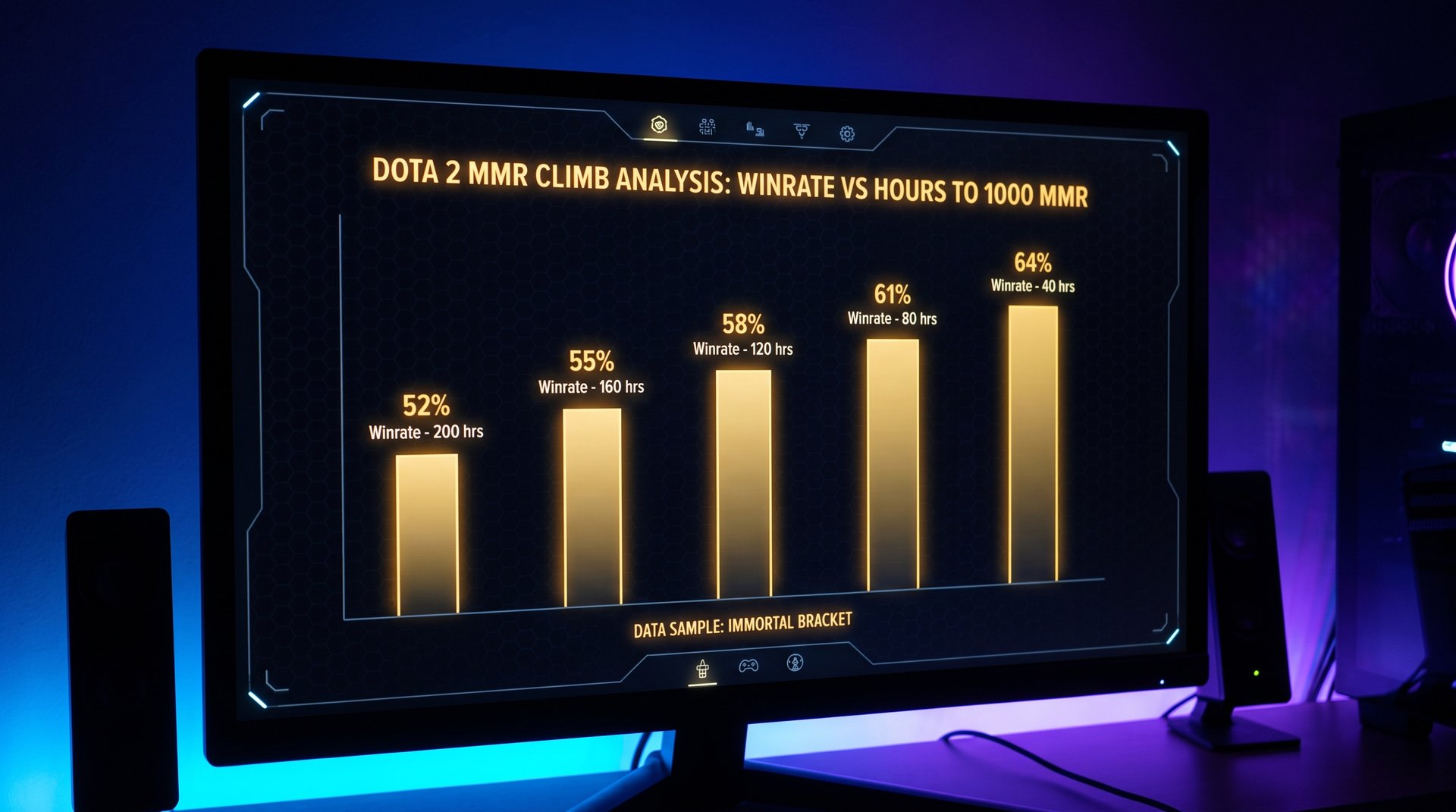
The table makes one thing obvious: small improvements in winrate compress the hour count dramatically. The gap between 52% and 55% is three percentage points, but the difference in hours is 370. Going from 52% to 55% halves your grind time. Going from 53.6% to 57% cuts it in half again.
Why the Real Number Is Often Higher Than 340 Hours
The 340-hour figure represents a clean theoretical climb. Real players do not climb cleanly. Several factors routinely push the actual hour count well above the mathematical baseline:
The Tilt Games Problem
Tilt is not a personality flaw — it is a documented performance degradation pattern. After a losing streak, most players experience reduced decision quality, more aggressive play, and lower team coordination. Playing through tilt while at negative MMR is one of the biggest time-sinks in ranked Dota 2.
Based on self-reported data from clients who tracked their sessions before ordering, players who played through tilt instead of stopping at two consecutive losses averaged an additional 30 to 50 games of negative variance per 500 total games. At 40 minutes per game, that is 20 to 33 extra hours spent fighting the hole they dug themselves.
Off-Peak Queue Times and Match Quality
Playing during low-population hours reduces matchmaking accuracy. The system cannot always find a fair match, so it expands its search parameters. You may end up in lobbies with players whose skill distribution is wider than usual, increasing the randomness of outcomes. More randomness means your personal skill advantage — the foundation of your winrate edge — contributes less to the result. For players in thin regions or unusual time zones, off-peak matchmaking alone can reduce effective winrate by 1 to 2 percentage points, adding dozens of extra hours to the climb.
The “One More Game” Syndrome After Wins
Counterintuitively, many players also waste time by over-playing after winning streaks. Fatigue accumulates. Game quality degrades after three or four consecutive high-effort matches. Players who push past their performance peak often find that the fourth and fifth games of a long session erode part of the MMR gained in games one and two. At 27 MMR per game, a net loss of 81 MMR from three tilt games requires four wins just to get back to neutral — not three.
Hero Pool Experimentation in Ranked
Every match played on an unfamiliar hero or off-role is a training session disguised as a ranked game. Training is valuable, but playing it in ranked — where losses cost real MMR — is expensive. A player who alternates between a 57% WR hero and a 49% WR hero averages 53% effective winrate in ranked, which adds roughly 90 hours to the median grind compared to playing only the strong hero.
The Hidden Cost: What 340 Hours Is Actually Worth
340 hours is not just a time figure. For an adult player — which describes the majority of ranked Dota 2 grinders — it is also a financial figure.
The Financial Opportunity Cost
If you earn $25 per hour (roughly median professional wage in the US and Western Europe), 340 hours of committed time is worth $8,500 in foregone productive output. Even at a conservative $15 per hour, the value is $5,100.
A professional MMR boost for 1,000 MMR from TeamSmurf runs significantly less than either of those figures. The framing is not “spend money to avoid gaming” — it is “recognize that your time has monetary value, and an extended grind has a real cost even when it does not feel like one.” For players who grind to reach a target rank so they can then actually enjoy the game, the grind itself is not enjoyment — it is unpaid work. You can learn more about how the MMR boosting process actually works and what it delivers.
What 340 Hours Represents in Context
- 340 hours is 14 full days of continuous play
- At 2 hours per day, the grind takes 170 days — nearly six months
- At 3 hours per day (a heavy gaming schedule), it takes 113 days — almost four months
- Most players do not play every day, so realistic wall-clock time for the average grinder is 8 to 18 months
This is why so many players describe the feeling of “grinding forever without moving.” They are not imagining it. They may genuinely be three, six, or twelve months into a grind that still has months left. The math confirms the feeling.
The Winrate Trap — Why You Cannot Just “Try Harder”
The most common response to the 340-hour figure is: “I will just improve my winrate.” This is correct in theory and brutally difficult in practice, for two structural reasons.
Reason 1: Matchmaking Actively Fights Your Winrate
Every time you exceed your “expected” skill level, the matchmaking system corrects. Higher winrate means upward MMR pressure, which means the system places you against stronger opponents faster. Many players confuse this calibration pressure with bad luck or rigged matchmaking. It is neither — it is the system working as intended, trying to find your true ceiling. Players who are not actively improving their decision-making hit a ceiling at 53 to 54% because that is where their actual skill level sits relative to their bracket, and the system knows this even when they do not.
Reason 2: Variance Makes Improvement Hard to Measure
At any winrate between 50% and 60%, the standard deviation of a 50-game sample is large enough that you cannot confidently distinguish between 53% and 56% performance. Players who think they “turned a corner” based on a 10 or 15-game positive run are often experiencing variance, not improvement. This false signal causes over-confidence and behavioral regression, which pulls the winrate back toward baseline. We break down this variance problem and its implications for players considering alternative paths to their target rank.
What Our Boosters Accomplish in the Same 340-Hour Window
This is where the data study has a practical punchline. Professional Dota 2 boosters from the TeamSmurf roster operate at winrates between 65% and 78% depending on role and hero pool. Applying the same formula:
| Player Type | Winrate | Net MMR per Game | MMR Gained in 510 Games | Classification |
|---|---|---|---|---|
| Average grinder | 53.6% | 1.94 | ~1,000 MMR | One tier gained |
| Good self-improver | 57% | 3.78 | ~1,929 MMR | Almost two tiers |
| TeamSmurf booster (low) | 65% | 8.10 | ~4,131 MMR | Four tiers |
| TeamSmurf booster (high) | 75% | 13.50 | ~6,885 MMR | Almost seven tiers |
In the same 510 games that the average grinder uses to gain 1,000 MMR, a TeamSmurf booster at 70% winrate gains approximately 5,400 MMR — more than five times as much. The hours are the same. The game mechanics are the same. The only variable is winrate, and the compounding effect of a 17-percentage-point winrate advantage is enormous.
This is why a professional boosting service can complete in weeks what a grinding player works toward for months. It is not a shortcut in the informal sense — it is a mathematically superior winrate applied to the same time investment.
What This Means for You Practically
You do not need to outsource your entire ranked journey to benefit from this math. Even understanding where you sit on the winrate curve tells you something useful:
- If you are at 50 to 51% winrate, no additional grinding hours produce meaningful progress — you need to change something before grinding is worth your time
- If you are at 53 to 54%, you are in the average grinder zone — sustainable but slow
- If you are at 55%+, you are in the efficient zone — grinding is genuinely worth your time
How to Reduce Your Personal Hours per 1,000 MMR
If you are committed to grinding, here are the highest-leverage changes that shift your effective winrate without requiring a complete skill overhaul:
1. Collapse Your Hero Pool to Two or Three Picks
The fastest way to raise your winrate is to reduce the number of situations where you are performing below your ceiling. One-tricking a carry or support hero you have 200+ games on is almost always more effective than adapting to every meta shift. Look at your Dotabuff — your three highest-game heroes are almost certainly your highest winrate heroes. Play those and ignore the rest until you hit your target rank.
2. Stop Playing When Tired or Tilted
Two consecutive losses should be the hard stop signal for most players. The data on session performance after extended losing streaks is consistent — playing through tilt adds more hours of recovery than it saves by keeping you “in the session.” A 30-minute break costs 30 minutes. Playing through a third tilt game costs 40 minutes of game time plus potentially 80 minutes of additional recovery before you stabilize.
3. Queue Only During Peak Hours in Your Region
Peak server hours produce better match quality and more accurate matchmaking. For most regions, this is between 7 PM and midnight local time. Avoid early morning and late night queues unless your bracket has consistent population across the day. The match quality improvement alone can shift your effective winrate by 1 to 2 percentage points, which cuts dozens of hours off your climb.
4. Consider a Targeted Coaching Session
One hour of coaching from a high-MMR player who watches your replays will diagnose winrate-limiting mistakes faster than 50 solo games of self-reflection. Most chronic plateau situations have two or three correctable root causes. Identifying them directly is worth more than discovering them through hundreds of additional hours of trial and error. TeamSmurf’s coaching roster can address mechanical and decision-making gaps in structured sessions targeted at your specific weaknesses.
5. Track Net MMR Weekly, Not Daily
Daily MMR tracking produces noise-driven emotional responses that hurt decision quality. Weekly tracking shows trend lines. If your weekly net gain is consistently below 50 MMR, you are in the 50 to 52% winrate zone and something structural needs to change. If it is above 150 MMR per week, you are climbing efficiently and should continue.
Should You Keep Grinding or Look for a Faster Path?
This is a personal decision, and there is no single right answer. The math just asks you to make the decision consciously rather than by default.
Grinding makes sense when:
- You are enjoying the process and not just fixated on the destination rank
- Your winrate is above 54% and trending upward with identifiable improvement
- You have a clear skill development goal attached to the grind, not just “play more”
- You have unlimited time relative to your MMR target
A different path makes sense when:
- Your winrate is stuck in the 50 to 53% range after 100+ games with no improvement trend
- You have a specific target rank to hit by a specific date (new season, friends bracket, personal goal)
- The grinding itself is producing more frustration than satisfaction
- You have already spent 200+ hours on a grind that has not reached its goal
Understanding where you fall in these categories is the first step. The math of this study is designed to give you that picture without assumptions or optimistic framing. If the numbers say you are in the efficient zone, keep going. If they do not, this study is the prompt to change something before investing another 340 hours in an approach that produces the same result.
The Full Picture: What This Study Actually Shows
The 340-hour figure is not meant to be discouraging. It is meant to be accurate. Players who go into their ranked grind understanding these numbers make better decisions — about when to stop for the night, when to pivot heroes, when to get coaching, and when to consider a targeted boost to reach a goal rank efficiently.
The core conclusions of this data study:
- 340 hours is the median, not the worst case. Players at 51 to 52% winrate will spend 600 to 1,200 hours on the same climb. Players at 55%+ will spend under 250 hours.
- The math is the same for everyone. Winrate is the only variable that changes the outcome. Playing more games at a low winrate does not produce faster results — it just produces more of the same slow results.
- Structural problems require structural solutions. If you have been grinding the same bracket for more than 100 hours with less than 200 MMR of net gain, you are probably not in the efficient climbing zone. That is a diagnosis, not a judgment.
- Professional boosters gain 4 to 7 times as much MMR in the same hours because the winrate differential is not small — it is massive. A 20-percentage-point winrate advantage produces five to seven times the output.

If you are in the efficient zone (55%+ WR), keep going — the math is working in your favor. If you are not, this study is the prompt to change something before investing another 340 hours in an approach that produces the same result.
Skip the Math, Hit the Target
If 340 hours sounds like too long to wait, TeamSmurf’s boosters operate at 65 to 75% winrate and can accomplish in weeks what the average grinder takes months to achieve. Every order includes offline mode, a Dota 2-only specialist, and a result guarantee.