Dota 2 New Season 2026: MMR Reset, Calibration Changes, and Complete Preparation Guide

It’s that time again. A new Dota 2 ranked season is upon us, and with it comes the simultaneous thrill and anxiety that every ranked player knows: the MMR reset. Your carefully cultivated rank — whether you ground it out game by game over months or achieved it through a lucky hot streak — is about to be recalibrated. For some players, this is an opportunity to climb higher than ever before. For others, it’s a potential disaster that could wipe out hundreds of hours of progress.
The 2026 season brings its own set of changes and challenges. Valve has continued refining the calibration system, adjusting how placement matches work, tweaking the MMR formula, and implementing new anti-smurf and matchmaking improvements. Whether you’re a seasoned veteran who’s been through every season reset since ranked was introduced or a newer player facing your first recalibration, this guide will prepare you for everything the new season throws at you.
We’ll cover the mechanics of how the reset works, what’s changed for 2026, a complete preparation timeline to ensure you enter calibration at peak performance, optimal hero and role strategies for placement matches, and how to maximize your starting MMR for the new season.
Table of Contents
- How Dota 2 Season Resets Work
- History of Season Resets and What’s Changed
- What’s New for the 2026 Season
- Calibration Match Mechanics Explained
- Complete Preparation Timeline
- Best Heroes for Calibration Games
- Role Strategy for Maximum MMR Placement
- Common Calibration Mistakes to Avoid
- What to Do After Calibration
- Professional Calibration Services
- Frequently Asked Questions
How Dota 2 Season Resets Work
When a new ranked season begins, every player’s visible rank medal is removed and they must complete a set of calibration matches (typically 10 games) to receive their new seasonal rank. However — and this is the crucial part that many players misunderstand — the reset is not a full wipe.
Soft Reset vs. Hard Reset
Dota 2 uses a soft reset, meaning your previous season’s MMR heavily influences your starting point for calibration. You don’t start from zero. Instead, the system:
- Takes your ending MMR from the previous season as a baseline
- Applies an uncertainty multiplier that increases the MMR impact of each calibration game
- Moves your MMR more aggressively during the 10 calibration games than it would during normal ranked play
- Settles you at a new MMR that reflects your calibration performance combined with your historical data
In practical terms, this means:
- A player who ended Season N at 4,000 MMR and goes 5-5 in calibration will likely place near 4,000 MMR again
- A player who goes 8-2 in calibration might jump to 4,300-4,500 MMR
- A player who goes 2-8 might drop to 3,500-3,700 MMR
The exact numbers vary by season and by Valve’s calibration formula adjustments, but the principle is consistent: calibration games are worth roughly 2-3x the MMR of normal ranked games. Each calibration win might be worth 50-75 MMR instead of the standard ~30, and each loss costs similarly more.
Why Not a Hard Reset?
Valve experimented with more aggressive resets in earlier seasons and quickly learned why hard resets are problematic:
- Matchmaking chaos: If everyone starts from scratch, Immortal players face Heralds for the first few weeks while the system sorts itself out. This creates terrible game quality for everyone.
- Extended instability: A hard reset takes weeks to stabilize, during which ranked matchmaking is essentially random. Players avoid ranked during this period, killing queue populations.
- Smurf amplification: Hard resets allow smurfs to calibrate far above their visible rank by stomping calibration games against disoriented opponents.
The soft reset balances the desire for a “fresh start” feeling with the practical need for stable, fair matchmaking.
What the Reset Affects
| Element | Reset? | Details |
|---|---|---|
| Visible Rank Medal | Yes | Your Herald-Immortal badge is removed until calibration is complete |
| Hidden MMR | Partially | Uncertainty is increased but your previous MMR is the baseline |
| Behavior Score | No | Carries over completely — not affected by season changes |
| Leaderboard Position | Yes | Immortal leaderboard is wiped and repopulated as players recalibrate |
| Role Queue Tokens | Varies | Depending on the season, tokens may reset or carry over |
| Hero Challenges/Quests | Varies | Depends on active Battle Pass or event system |
History of Season Resets and What’s Changed
Understanding the evolution of Dota 2’s seasonal system provides context for the current implementation and helps predict future changes.
The Timeline
- Pre-2017: No Seasons. MMR was a single continuous number that never reset. Players who calibrated in 2013 carried the same MMR baseline into 2017. The system stagnated, with players feeling trapped at their rank and unable to ever “start fresh.”
- 2017-2018: Medal System Introduction. Valve replaced the pure MMR number with rank medals (Herald through Divine, later adding Immortal). Seasons were introduced with periodic medal resets, though the underlying MMR remained relatively stable.
- 2019: Role Queue. The introduction of role queue changed how MMR was tracked — separate MMR values for each role (core and support, later all 5 roles) meant that calibration became more nuanced. Players could calibrate differently in different roles.
- 2020-2021: Calibration Refinements. Valve adjusted the calibration formula multiple times, experimenting with how much weight to give calibration games versus historical data. The number of calibration games was standardized at 10.
- 2022-2023: Anti-Smurf Integration. Calibration began incorporating smurf detection — accounts that performed dramatically above their expected level during calibration were flagged and potentially placed in smurf pools rather than being allowed to calibrate at inflated MMR values.
- 2024-2025: Convergence System. Valve introduced adjustments that accelerated MMR convergence for players whose performance consistently didn’t match their rank, effectively making the post-calibration period more responsive. Players significantly outperforming their rank gained extra MMR per win, while players underperforming lost extra per loss.
- 2026: Current System. The latest iteration builds on all previous changes with further refinements that we’ll discuss in the next section.
What’s New for the 2026 Season
While Valve typically doesn’t announce all calibration changes publicly, community analysis and developer communications have revealed several adjustments for the 2026 season:
Refined Performance Metrics
Calibration games have always considered more than just win/loss — individual performance metrics like KDA, damage, healing, last hits, and objective participation influence calibration MMR. For 2026, these performance metrics have been rebalanced to more accurately reflect contribution across different roles. This means:
- Support players are better evaluated on vision control, saves, and enable metrics rather than raw KDA
- Offlane players get more credit for space creation and team fight initiation
- Carry players are evaluated on farming efficiency and damage output relative to the game’s pace
- Mid players’ calibration weighs early-game impact and map movement more heavily
Behavior Score Influence on Calibration Quality
While Behavior Score doesn’t directly affect your MMR gain or loss, the 2026 season has reportedly tightened the BS-based matchmaking during calibration. This means high-BS players are more consistently matched with other high-BS players during calibration, resulting in better game quality and more accurate calibration outcomes. Conversely, low-BS players face more chaotic calibration games that can lead to less accurate (and often lower) placements.
Reduced Calibration Variance
Previous seasons sometimes saw players gain or lose 500+ MMR from calibration alone. The 2026 system has reportedly narrowed this range, with the maximum calibration swing estimated at 300-400 MMR. This makes calibration less of a “lottery” and more of a reflection of consistent performance.
Improved Party Calibration
For the 2026 season, Valve has refined how party games are counted during calibration. Playing calibration games in a party now better isolates individual performance from party synergy effects, reducing the historical advantage of calibrating in a strong stack.
Calibration Match Mechanics Explained
Understanding exactly how calibration matches determine your new rank is essential for optimizing your approach.
The 10-Game Structure
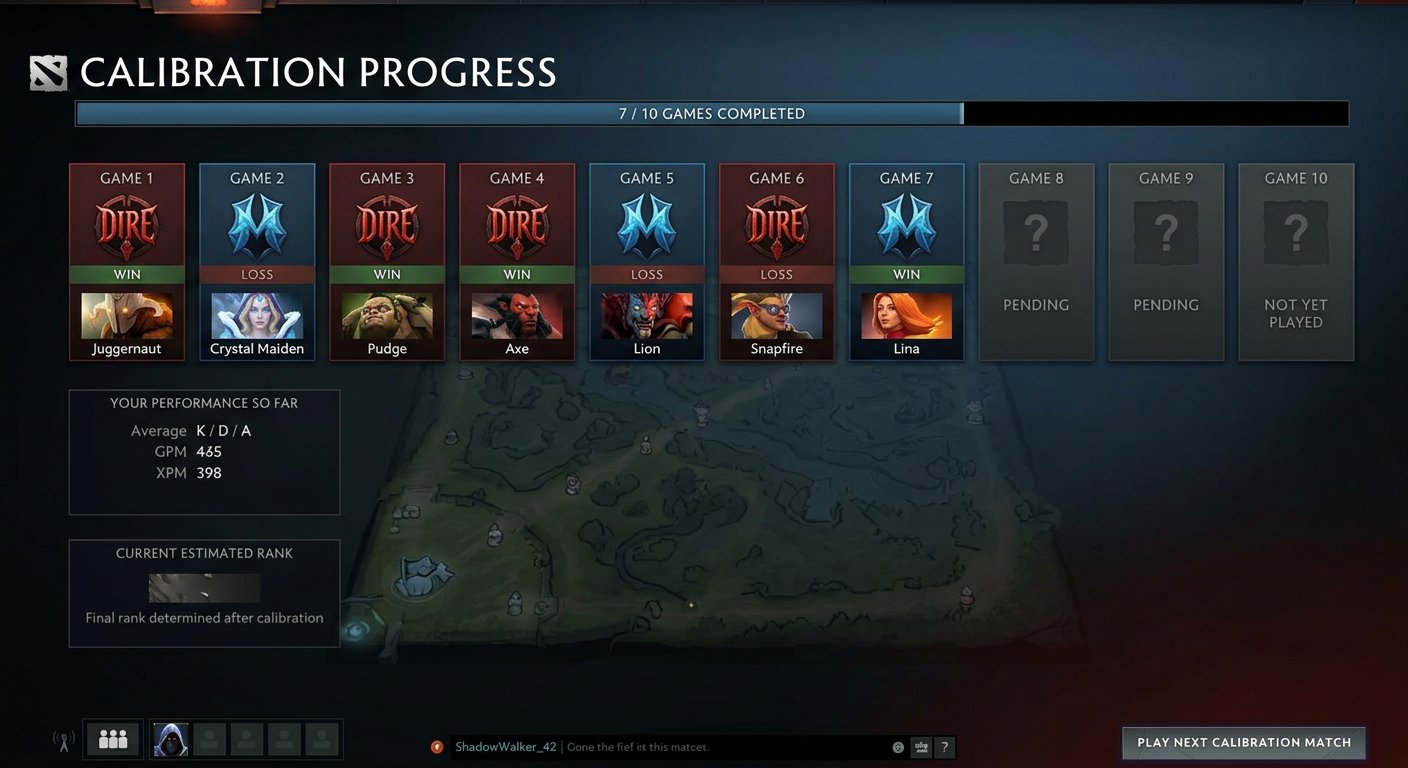
You must play 10 ranked games to complete calibration. These games function like normal ranked matches in every visible way — same matchmaking, same game modes, same rules. The difference is invisible: each game adjusts your MMR by an amplified amount and incorporates performance metrics alongside win/loss.
Win/Loss Weight
The single most important factor in calibration is whether you win or lose. While individual performance matters (see below), winning a calibration game is worth significantly more than having excellent stats in a loss. A rough breakdown of MMR impact per calibration game:
| Result | Performance | Estimated MMR Change |
|---|---|---|
| Win | Excellent performance | +60 to +75 |
| Win | Average performance | +40 to +55 |
| Win | Poor performance (carried) | +25 to +40 |
| Loss | Excellent performance | -20 to -35 |
| Loss | Average performance | -40 to -55 |
| Loss | Poor performance | -55 to -75 |
Notice the asymmetry in the loss column — excellent performance in a loss significantly reduces the MMR penalty compared to poor performance in a loss. This means that even when you lose, playing well protects your calibration.
Performance Metrics That Matter
The specific performance metrics tracked during calibration include (based on community research and Valve developer comments over the years):
- KDA (Kills, Deaths, Assists): Higher KDA in the context of your role and the game’s pacing
- Last Hits/Denies per minute: Farming efficiency for core roles
- Hero Damage: Total damage output relative to game length and hero type
- Tower Damage: Objective-focused play is rewarded
- Healing Done: For support/healing heroes
- Observer/Sentry Wards Placed: Vision contribution for support roles
- Stuns/Disables Applied: For initiators and disablers
- Gold/XP per Minute: Economic efficiency
- Damage Taken (for offlaners/tanks): Space creation metrics
These metrics are normalized against the average for your role and MMR bracket, so a support’s lower KDA isn’t penalized relative to a carry’s higher KDA. The system compares you to other players playing the same role at the same skill level.
Game Order Doesn’t Matter (Much)
A common myth is that early calibration games matter more than later ones, or that going on a winning streak at the end is better than winning early. Community testing suggests that all 10 games are weighted approximately equally, with slight adjustments based on the uncertainty the system has about your actual MMR. In practice, the sequence of your wins and losses has minimal impact on the final result — what matters is the total wins, total losses, and aggregate performance across all 10 games.
Complete Preparation Timeline
Preparing for calibration isn’t something you do the day the season starts. Optimal preparation begins 2-4 weeks before the reset and continues through the calibration period.
4 Weeks Before: Assessment Phase
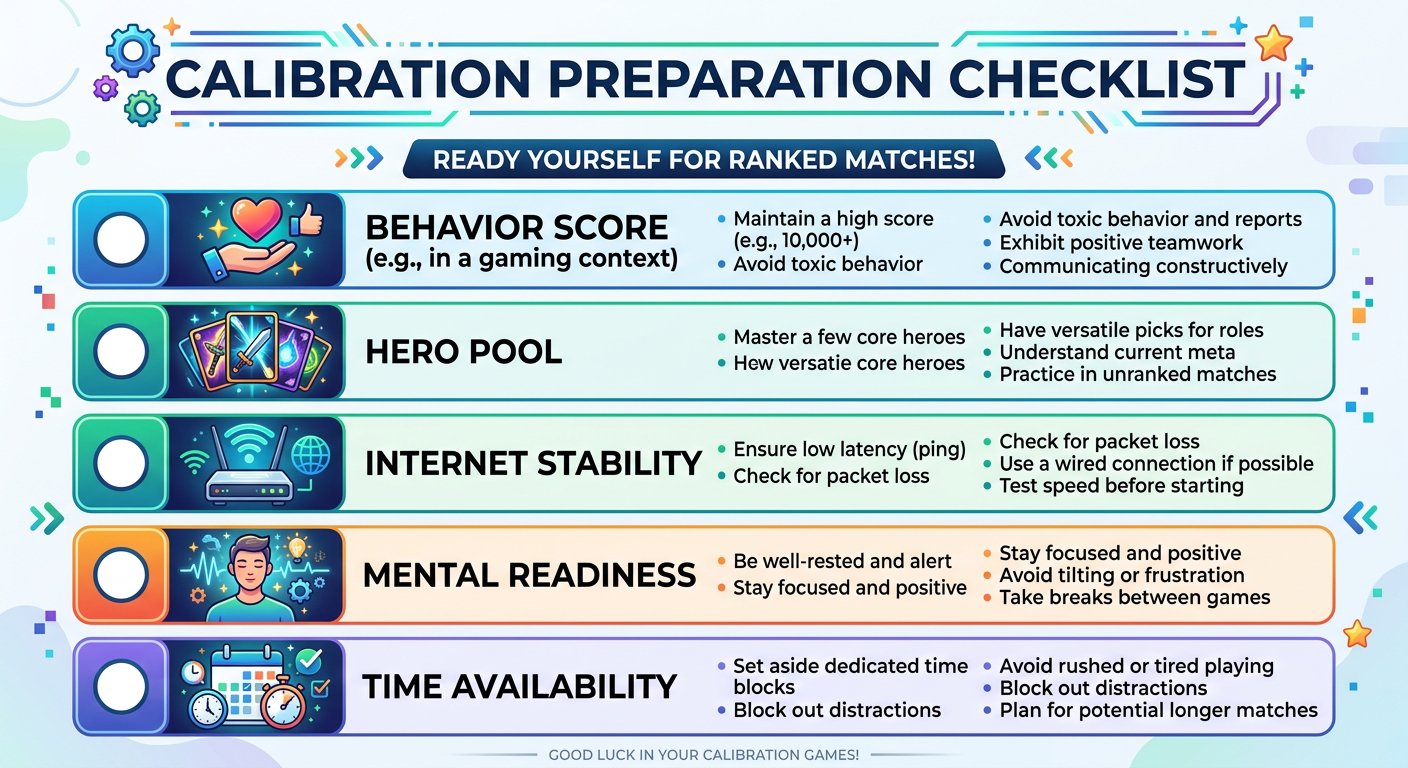
- Evaluate your current MMR and Behavior Score. If your Behavior Score is below 10,000, start recovery now. Higher BS means better calibration games. See our Behavior Score guide for recovery strategies.
- Identify your strongest role and hero pool. Calibration is not the time to experiment. You want to play your best heroes in your best role for all 10 games.
- Check the current meta. Research which heroes are strongest in the current patch. Your calibration hero pool should include at least 5-7 meta-relevant heroes in your primary role.
- Review your recent performance. Use Dotabuff or OpenDota to analyze your last 50 games. What’s your win rate? Which heroes are you performing best on? Where are you losing MMR?
2 Weeks Before: Optimization Phase
- Practice your calibration heroes in unranked. Get comfortable with your top picks in low-stakes games. Focus on consistency — you want reliable 6/10 or 7/10 performances, not flashy 10/10 or 2/10 swings.
- Address any LP or behavioral issues. If you’re in Low Priority, clear it now. If you have pending matchmaking restrictions, resolve them. Starting calibration with any restrictions is catastrophic.
- Build your party (if applicable). If you plan to calibrate in a party, coordinate schedules now. Make sure everyone is available for all 10 games within a short window.
- Study the patch notes. Make sure you understand any recent balance changes that affect your heroes. A nerfed hero that was strong last month might be a trap pick in calibration.
1 Week Before: Peak Performance Phase
- Play ranked games to warm up and maintain form. Don’t take a long break before calibration — your mechanical skills need to be sharp.
- Focus on health and lifestyle basics. Sleep, hydration, nutrition, and exercise all affect cognitive performance. The week before calibration, prioritize these basics.
- Set up your environment. Clean desk, comfortable chair, good lighting, stable internet. Eliminate potential disruptions — let household members know you’ll need uninterrupted gaming time for your calibration sessions.
- Mental preparation. Remind yourself that calibration is 10 games, not 1. Individual game results don’t matter — aggregate performance matters. A loss in game 1 doesn’t doom your calibration.
Calibration Day(s): Execution Phase
- Play when fresh. Don’t calibrate after a long day of work or after playing for hours. Your peak cognitive performance window is typically within the first 2-3 hours of play.
- Play in batches of 2-3 games. Don’t grind all 10 games in one session. Fatigue degrades performance significantly after game 3-4. Play 2-3 games, take a substantial break (1+ hours), then play more.
- Stop if tilted. If you lose 2 games in a row and feel frustrated, stop for the day. There’s no rush — calibration games don’t expire. Coming back tomorrow in a better mental state is always the right call.
- Stick to the plan. Play your prepared heroes in your prepared role. Don’t deviate because of one bad game. The plan was made when you were thinking clearly; trust it.
Best Heroes for Calibration Games
Your calibration hero pool should prioritize three qualities: consistency, meta strength, and personal comfort. Here are recommended approaches by role:
Position 1 (Safe Lane Carry)
For calibration, you want carries that come online at a reasonable timing and can influence the game from the mid-game onward. Ultra-late-game carries like Spectre or Medusa are risky because they require your team to hold for 30+ minutes — which you can’t control.
Recommended calibration carries:
- Juggernaut: Consistent, self-sufficient, strong at all stages. Healing Ward gives sustain independence, Omnislash provides reliable solo-kill potential.
- Wraith King: Simple execution, hard to kill, strong farming speed with skeletons. Minimal mechanical demand lets you focus on decision-making.
- Faceless Void: Chronosphere wins team fights. The hero’s game impact is defined by 2-3 key ultimates, making him both high-impact and relatively consistent.
- Lifestealer: Built-in sustain, BKB-like ability (Rage), strong mid-game fighter. Excellent in the calibration meta where mid-game team fights are decisive.
Position 2 (Mid Lane)
Mid is the highest-impact role in calibration because winning mid creates cascading advantages across the map. Choose heroes that dominate lane and translate into early-game aggression.
Recommended calibration mids:
- Lina: Versatile, strong laner, excellent scaling. Can play aggressively or farm efficiently depending on the game state.
- Spirit Void / Void Spirit: Exceptional mobility, strong team fight impact, good at both ganking and farming.
- Templar Assassin: Dominates most mid matchups, fast farmer, early Roshan potential. High-ceiling hero that rewards skilled play.
- Queen of Pain: Safe laner, excellent ganking potential, strong in mid-game skirmishes where calibration games are often decided.
Position 3 (Offlane)
Offlaners for calibration should be team fight-oriented and durable. Your job is to create space and initiate, and the calibration metrics reward successful initiation and damage tanking.
Recommended calibration offlaners:
- Tidehunter: Ravage is one of the most game-changing ultimates. Tanky, hard to kill in lane, and provides guaranteed team fight impact even if the rest of the game goes poorly.
- Axe: Dominant laner, Call is a reliable initiation tool, Culling Blade secures kills. Strong calibration metrics due to high kill participation and damage tanked.
- Mars: Arena of Blood is a fight-winning ultimate, God’s Rebuke is excellent for farming and fighting. Strong, flexible offlaner.
- Centaur Warrunner: Extremely tanky, Stampede is a game-changing team ability. Strong laner who naturally accumulates good performance metrics.
Position 4 (Soft Support)
Position 4 heroes for calibration should be playmakers who can create kills and control the tempo of the game.
Recommended calibration pos 4:
- Hoodwink: Long-range initiation, excellent damage output for a support, bushwhack is a reliable disable. Good performance metrics from high assist numbers.
- Spirit Breaker: Global presence, simple execution, high kill participation. Charge of Darkness ensures you’re involved in every fight across the map.
- Mirana: Sacred Arrow stun into Star Storm burst creates pick-offs that win games. Moonlight Shadow provides team-wide save potential.
- Tusk: Aggressive roamer with Snowball save potential. High kill participation and strong laning presence.
Position 5 (Hard Support)
Position 5 calibration is unique because the metrics system now better recognizes support contributions. Focus on vision, saves, and enabling your cores.
Recommended calibration pos 5:
- Dazzle: Shallow Grave is the ultimate save ability, healing contributes to performance metrics, and Shadow Wave provides lane dominance. Your saves will be reflected in calibration metrics.
- Crystal Maiden: Aura provides global mana, Frostbite is reliable lockdown, Freezing Field can win team fights. High ward placement and healing (from Tranquils + aura) contribute to metrics.
- Warlock: Fatal Bonds amplifies team damage, Upheaval controls fights, Chaotic Offering is a massive team fight ultimate. Excellent calibration metrics from healing, assists, and team fight contribution.
- Witch Doctor: Maledict + Cask is devastating in lane, Death Ward melts teams in fights. High damage output for a support hero boosts performance metrics.
Role Strategy for Maximum MMR Placement
Should You Calibrate on Your Main Role?
Absolutely yes. Calibration is not the time to try a new role. Play the role you have the most games, the highest win rate, and the most comfort on. The performance metrics compare you to other players at your role and bracket — performing in the 70th percentile on your best role is better than performing in the 40th percentile on an unfamiliar role.
Solo Queue vs. Party Queue for Calibration
This is debatable, and the optimal choice depends on your specific situation:
| Factor | Solo Queue | Party Queue |
|---|---|---|
| Consistency | Higher variance — random teammates | Lower variance — known teammates |
| Communication | Limited, unreliable | Full voice comms, coordinated play |
| Individual MMR accuracy | More accurate reflection of solo skill | Influenced by party synergy |
| Win rate potential | ~50% at accurate MMR | Higher if party is strong, lower if weak |
| Performance metrics | Purely individual | Can be inflated by coordinated play |
| 2026 adjustment | None | Party performance isolation reduces party advantage |
The general recommendation: if you have a reliable, similarly-skilled party, queue together — the consistency and communication advantages outweigh the 2026 party calibration adjustments. If your party includes players significantly above or below your skill level, solo queue to avoid being pulled into games that don’t match your ability.
Timing Your Calibration
When you calibrate within the new season window matters:
- First day: Not recommended. The matchmaking system is adjusting, many players are calibrating simultaneously, and game quality tends to be lowest. Additionally, players who rush calibration are often tilted from the season change anxiety, creating more volatile games.
- Days 2-7 (first week): Good window. The initial chaos has settled, but the calibration pool is still large enough for good matchmaking. Most serious players calibrate during this window.
- Weeks 2-3: Also good. The matchmaking has fully stabilized, and the remaining calibrating players tend to be more casual and less stressed, creating better game quality.
- Week 4+: Fine, but no significant advantage. The season is fully underway and calibration games are essentially normal ranked games with amplified MMR changes.
Common Calibration Mistakes to Avoid
1. Grinding All 10 Games in One Sitting
This is the most common and most costly mistake. Fatigue sets in after 3-4 games. Your reaction time drops, decision-making degrades, and tilt accumulates. Playing all 10 calibration games in one session almost guarantees that games 7-10 are played at a lower level than games 1-3. Spread your calibration over 2-4 days.
2. Trying New Heroes or Roles
Calibration with your newly-learned hero is a disaster waiting to happen. You might have a 40% win rate on that hero you picked up last week. Stick to heroes with 100+ games and 52%+ win rates.
3. Ignoring Behavior Score
Players who enter calibration with low Behavior Score face lower-quality games, more toxic teammates, and higher chance of griefers — all of which degrade calibration outcomes. Fix your BS before the season starts. See our complete Behavior Score guide.
4. Playing Immediately After a Loss
After a calibration loss, your instinct is to queue again immediately to “make up for it.” This is almost always wrong. The loss creates negative emotional momentum that affects the next game. Take at least a 15-20 minute break after every loss — walk around, get water, do something non-Dota.
5. Overthinking the Stakes
Yes, calibration games are worth more MMR than normal games. But they’re still just Dota games. Playing with excessive anxiety — being too passive, afraid to make plays, over-thinking every decision — makes you play worse, not better. Treat them like important ranked games, not life-or-death situations.
6. Calibrating While Tilted from Last Season
If the end of last season was a frustrating loss streak, take a few days off before calibrating. Starting calibration already frustrated and demoralized is a recipe for a poor result. Reset your mental state, and then reset your rank.
7. Neglecting Pre-Game Preparation
Before each calibration game:
- Check the patch notes for any recent changes
- Warm up with a Turbo or unranked game
- Make sure your setup is stable (internet, hardware)
- Queue when you have enough time for a long game (60+ minutes of uninterrupted play)
What to Do After Calibration
Scenario 1: You Calibrated Higher Than Expected
Congratulations! Now the work begins — maintaining and building on your new rank. If you calibrated significantly higher (200+ MMR above last season), you may face an adjustment period where games feel harder. Key strategies:
- Continue playing your calibration heroes — they got you here
- Focus on fundamentals rather than flashy plays
- Review replays of any losses to identify the skill gap areas
- Consider professional coaching to consolidate and build on your new rank
Scenario 2: You Calibrated About the Same
This is the most common outcome and the most psychologically frustrating — you went through 10 high-stakes games to end up roughly where you started. Remember that this is actually a good sign: the system confirmed your skill level is accurate. If you want to climb, the answer is genuine improvement, not hoping for better calibration luck next season.
Scenario 3: You Calibrated Lower Than Expected
This stings, but it’s recoverable. A poor calibration doesn’t mean you’re stuck for the entire season — the convergence system means that if you’re playing above your calibrated level, you’ll gain MMR faster than normal until you reach your true skill bracket. Strategies:
- Don’t panic-queue to recover immediately — you’ll likely tilt and drop further
- Take a day off from ranked, then come back and play normally
- Focus on consistent play over grinding volume
- If the gap is significant (300+ MMR below expected), consider MMR boosting to recover the lost ground quickly and avoid a frustrating grind through games below your level
Professional Calibration Services
For many players, calibration is the single highest-leverage moment of the ranked season. Ten games determine your starting point for months of play, and a poor calibration can mean grinding 50+ additional games just to get back to where you were. This is why professional calibration services exist.
What Professional Calibration Offers
- Peak performance guarantee: Professional players handle your 10 calibration games at maximum skill level, ensuring the highest possible win rate
- Optimal hero selection: Pros pick the strongest meta heroes for each game, adapting to the draft and matchup rather than being limited to a small personal hero pool
- Clean play: Professional calibration maintains or improves your Behavior Score alongside your MMR
- Time savings: Instead of spending 2-3 stressful days on calibration, the games are handled efficiently
- Higher placement: A professional going 8-2 or better in your calibration games can place you 200-400 MMR higher than a 5-5 result would
Who Benefits Most from Calibration Services
- Time-limited players: Adults with jobs and families who can only play a few hours per week. A poor calibration costs them months of grinding to recover.
- Anxious calibrators: Players who perform below their actual skill level under the pressure of high-stakes games. Their ranked performance is good, but calibration anxiety sabotages their placement.
- Returning players: Coming back to Dota after a break means rusty mechanics during calibration. Having a pro handle the calibration while you warm up through unranked ensures your placement reflects your potential, not your rust.
- Behavior Score recovery: Players who enter the new season with lower BS can have their calibration handled professionally while simultaneously beginning BS recovery.
Combining Calibration with Other Services
The most effective approach for many players is combining calibration services with a small MMR boost after calibration to establish a higher baseline, followed by coaching sessions to develop the skills needed to maintain and build on the new rank. This three-step approach maximizes both immediate placement and long-term growth.
Frequently Asked Questions
Ready to Improve Your Dota 2 Experience?
Team Smurf offers professional Dota 2 services — Immortal-rank boosters, maximum safety, competitive pricing, and 24/7 support.