New Ranked Season September 2026: Calibration Prep Guide

A new ranked calibration window is approaching for September 2026. If you have been sitting on a stale MMR badge all year or you plan to use your annual recalibration slot this month, now is the time to prepare properly. A single calibration run can swing your visible rank by 300 to 400 MMR — which is the difference between an entire medal tier. This guide gives you everything you need to walk into those 10 games with maximum confidence: confirmed mechanics, hero selection strategy, a two-week prep checklist, and honest context on what September 2026 is likely to bring (and what remains unconfirmed).
We have separated confirmed facts from reasonable expectations based on historical Dota 2 season patterns. Anything labeled “expected” or “based on past seasons” is our informed projection, not a Valve announcement.
Table of Contents
What We Know About September 2026
As of early July 2026, Valve has not issued a public announcement about a mandatory ranked season reset for September. That is consistent with their approach since late 2023, when compulsory annual resets were removed in favour of a player-initiated recalibration system. Here is the breakdown of what is confirmed versus what players can reasonably expect:
| Item | Status | Notes |
|---|---|---|
| Current live patch | Confirmed: 7.41d | Live as of July 2026 |
| Mandatory September MMR reset | Not confirmed | Valve has not announced one; do not assume |
| New major patch near TI 2026 | Expected based on past seasons | Valve typically ships a large patch in Q3 to align with The International |
| Annual player recalibration slot | Confirmed available | One recalibration per 365 days in Settings — Account — MMR Recalibration |
| Calibration games required | Confirmed: 10 games | Standard since the current recalibration system launched |
| Max MMR swing during calibration | Estimated 300-400 MMR | Based on 2026 player reports; Valve does not publish exact ranges |
Historically, Valve has used major patches as soft inflection points for the ranked ecosystem. When patch 7.33 launched in April 2023 alongside the adoption of the Glicko-2 rating algorithm, it marked a structural shift in how MMR was calculated. A similarly impactful patch around TI season could shift hero win rates enough to reward players who have already optimised their pool — another reason to prepare now rather than wait.
How Calibration Works in 2026
Understanding the mechanics is step one. Dota 2 uses a soft reset for calibration: your hidden MMR (called the “confidence value” or sigma in Glicko-2 terminology) does not go to zero. Your previous MMR heavily influences where you land after 10 games. The system widens your uncertainty range during calibration, which means each game carries more weight than a normal ranked game — roughly equivalent to two or three standard matches.
The Glicko-2 System Explained Simply
Dota 2 adopted the Glicko-2 rating algorithm with patch 7.33. Under Glicko-2, every player has three values: a rating (your visible MMR), a rating deviation (confidence in your rating), and a volatility (how consistent your performance is). During calibration, rating deviation is artificially widened, which allows the 10 games to move you more significantly than usual. Once calibration ends, the deviation narrows again and normal ranked progression resumes.
The 2026 calibration system has two notable refinements compared to earlier years:
- Party calibration isolation: If you play calibration games in a party, the system now better separates your individual contribution from party synergy. This reduces the historical advantage of calibrating in a premade stack of higher-MMR friends.
- Narrower swing ceiling: The maximum upward or downward swing during calibration is estimated at 300 to 400 MMR. This makes calibration less of a lottery and more of a reflection of consistent performance across 10 games.
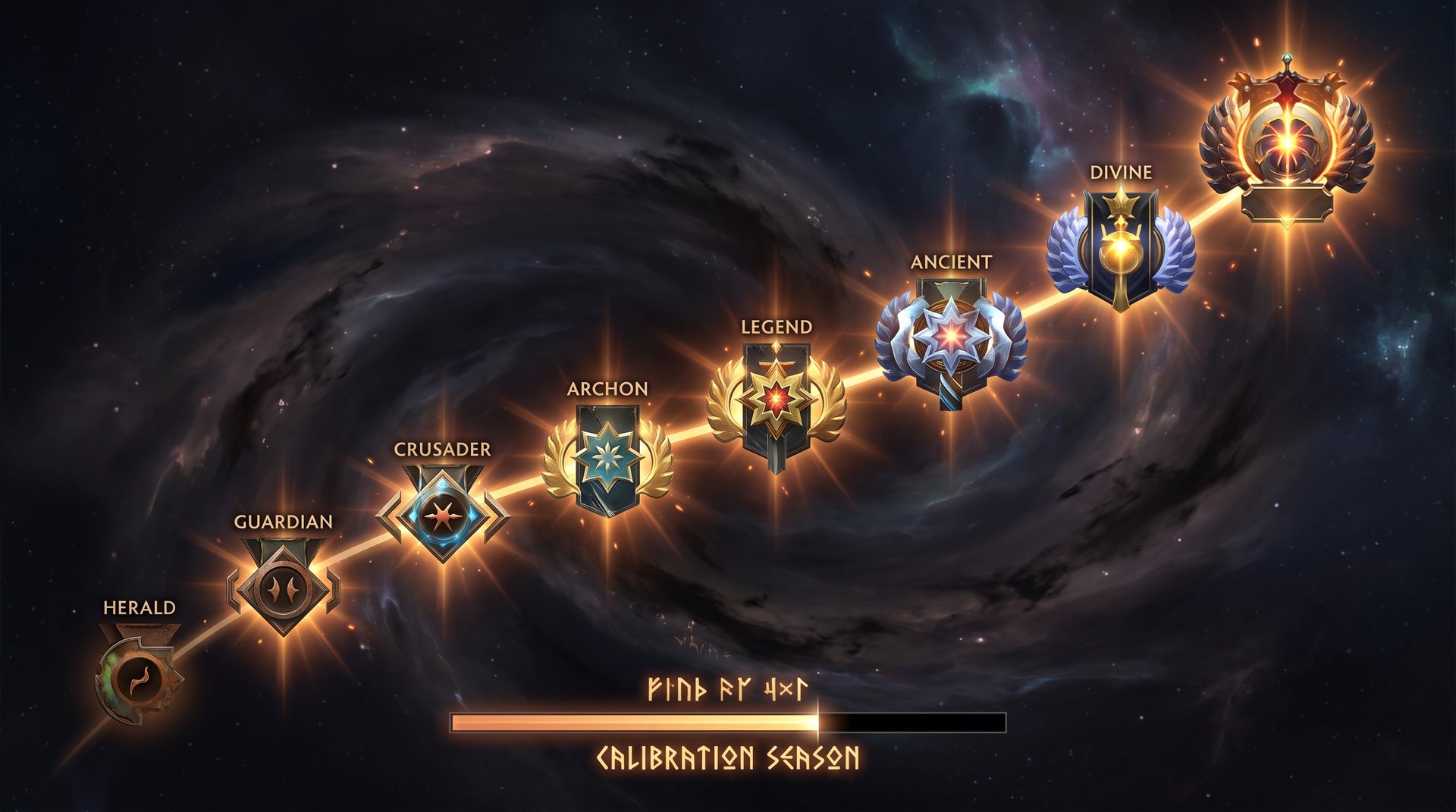
| Dota 2 Rank | Approximate MMR Range | Player Percentile |
|---|---|---|
| Herald | 0 — 770 | Bottom 10% |
| Guardian | 770 — 1540 | 10-25% |
| Crusader | 1540 — 2310 | 25-45% |
| Archon | 2310 — 3080 | 45-65% |
| Legend | 3080 — 3850 | 65-80% |
| Ancient | 3850 — 4620 | 80-90% |
| Divine | 4620 — 5420 | 90-98% |
| Immortal | 5420+ | Top 2% |
Because a 300 to 400 MMR swing can span an entire medal tier — and sometimes two — your 10 calibration games represent a genuinely high-stakes window. Treating them as normal ranked games is the single biggest preparation mistake players make.
Should You Calibrate in September?
Not every player should rush to hit their recalibration in September. Here is a framework for deciding.
Good Reasons to Calibrate in September 2026
- You have been on a consistent win streak in the weeks before — momentum carries into calibration
- Your current medal feels significantly below your actual skill level after months of ranked play
- You want to land at a higher bracket before the new TI 2026 patch reshuffles the meta
- You have studied the current patch deeply and have 3 to 5 high-win-rate heroes ready
- Your behaviour score, conduct summary, and ping are all in good shape
Reasons to Wait
- You are in a losing streak or tilted state — calibrating on tilt is how players end up two tiers below their true rank
- A major new patch is about to drop and you have not yet adapted to it
- You are consistently underperforming on every hero you try
- Your account has any conduct or communication violations pending resolution
Building Your Calibration Hero Pool
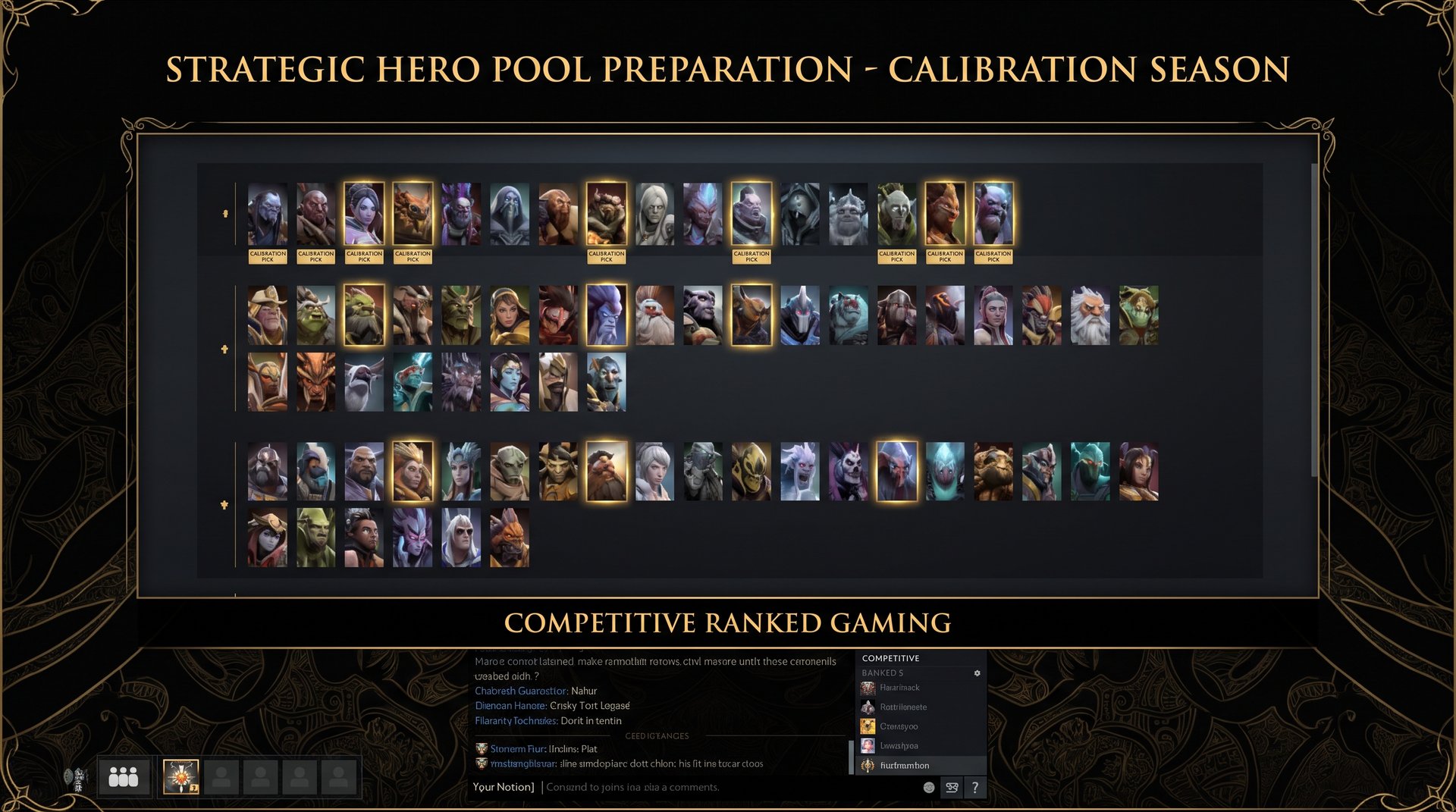
The single most impactful preparation decision you can make before calibration is locking down a small, deep hero pool. Here is why: calibration games carry more weight than normal ranked games. Playing a hero you are only 50% proficient on is a significant handicap when each loss costs you more than usual.
How Many Heroes Should You Pool?
The ideal calibration pool is 3 to 5 heroes. More than 5 means you are spreading your pre-season practice too thin. Fewer than 3 means a ban or counter-pick can derail your entire run. The pool should contain:
- Your best hero — the one you have the highest career win rate on, regardless of meta status
- One or two meta-aligned heroes — currently strong in the patch, adding win rate tailwind
- One flex pick — a hero that can fit multiple positions in case your primary role is taken
How to Evaluate Your Hero Pool Right Now
Before September, spend at least two weeks in unranked or turbo games exclusively on your calibration heroes. Check your stats on Dotabuff or Stratz. Look for heroes where your win rate is above 55% over the last 30 games. That is your anchor. Everything else in the pool should be at 50% or higher, ideally trending upward.
If your anchor hero is no longer strong in the current 7.41d patch, you have two options: adapt your build and itemisation for the current meta, or replace the anchor with a hero you have been winning on recently. Do not calibrate on a hero you have not played in weeks just because it was your best hero a year ago.
For players who want professional assistance locking in the right starting MMR, our MMR boosting guide covers how services work and what to look for in a legitimate provider. For a direct comparison of options, the best Dota 2 boosting services page ranks current providers on reliability, safety, and value.
Best Heroes for Calibration by Role (Patch 7.41d)
The following heroes are strong for calibration in the current patch based on their win rates, ease of carrying individual performance impact, and resilience against counter-picks. Note that hero strength shifts with every patch — these ratings reflect patch 7.41d. If a new major patch drops before your calibration window, verify the current tier list before locking in your pool.
| Role | Recommended Heroes | Why They Work for Calibration |
|---|---|---|
| Safe Lane Carry | Juggernaut, Lifestealer, Wraith King | Self-sufficient, magic immunity windows, forgiving item timings |
| Mid Lane | Lina, Puck, Dragon Knight | Strong kill threat, teamfight presence, low dependency on teammates |
| Offlane | Mars, Tidehunter, Underlord | Hard initiators that control teamfights even when behind |
| Soft Support (4) | Lion, Earthshaker, Ogre Magi | High kill contribution, crowd control, countable individual impact |
| Hard Support (5) | Dazzle, Witch Doctor, Shadow Shaman | Strong saving or pushing tools that visibly affect game outcomes |
A note on Juggernaut: his Blade Fury provides magic immunity during a key early-game window, his Healing Ward keeps the team alive in extended fights, and his ultimate provides a reliable kill tool at most skill levels. He is one of the safest carry picks for calibration at every bracket from Crusader through Ancient.
For mid players, Dragon Knight deserves special mention in September 2026. His straightforward kit, powerful Roshan control, and reliable teamfight presence mean your performance is almost entirely in your hands — he rarely loses games because of team composition mismatches.
Two-Week Calibration Prep Checklist
The two weeks before your calibration window are the highest-leverage period of your Dota 2 year. Here is a structured plan:
Week 1: Foundation
- Finalise your calibration hero pool (3 to 5 heroes, all with positive win rate trends)
- Play 2 to 3 unranked games per day exclusively on your pool heroes — no experimenting
- Review replays of your losses to identify mechanical habits: last-hitting under pressure, spell timing, positioning in teamfights
- Check your behaviour score in the Dota 2 client (Settings — Social). Aim for 9,000 minimum before calibrating
- Identify the 3 most likely counter-picks to your heroes and practice the matchups in unranked
- Ensure your internet connection is stable — disconnects during calibration games are extremely costly
Week 2: Sharpening
- Shift from unranked to one normal ranked game per day on your pool heroes to sharpen the mental edge
- Study patch 7.41d item changes — check which items have been buffed and update your build orders
- Practice your laning phase specifically: the first 10 minutes of a game often determines whether you have enough resources to perform later
- Set a sleep schedule and reduce late-night sessions during calibration week — cognitive performance drops significantly with fatigue
- Write out a short communication template: positive pings, draft requests, and when to call GG versus push for a comeback
Day of Calibration: Game-Day Rules
- Play one to two warm-up games before starting calibration — never go in cold
- Set a hard stop rule: if you lose two calibration games in a row on the same day, stop for that day
- Do not play calibration games when you are hungry, tired, or emotionally agitated
- Keep each session to three calibration games maximum to maintain focus
- Mute toxic players early — spending mental energy on arguments costs more than a bad game
Common Calibration Mistakes to Avoid
These are the errors that cost players an entire medal tier every season:
- Trying new heroes during calibration: You want to be on autopilot for mechanics. Save experimentation for after calibration ends.
- Ignoring your behaviour score: Low behaviour score queues you with disruptive players. Even if you play well, a 5v5 with disconnects and flaming is not a win environment.
- Calibrating immediately after a bad ranked streak: Negative momentum from ranked carries psychological weight. Take a break, reset mentally, then calibrate.
- Playing all 10 games in a single day: Decision fatigue is real. Spreading calibration over 4 to 5 days produces better results than a marathon session.
- Forcing your pocket pick when it is banned: Have your backup heroes ready and equally practiced. Tilting because your main was banned costs you the next game too.
- Underestimating the ping check: Wired connection, closed background apps, and checking ping before queueing are not optional. A 120ms game against a 40ms opponent is not a fair game.
When to Consider a Calibration Boosting Service
Calibration boosting is the practice of having a high-MMR player — typically Immortal bracket — play your calibration games for you, or with you in a duo, to maximise your starting MMR. It is a well-established service in the Dota 2 ecosystem. Before using one, here is what you should know:
Who Uses Calibration Boosting?
Players who use calibration services typically fall into one of three categories: returning players who were much higher-ranked before a long break and want to re-enter at a skill-appropriate bracket; players who have consistently been performing above their current rank in normal games but keep missing calibration windows; and time-limited players who want the guaranteed result that professional play provides over the unpredictability of solos.
Safety Considerations
Account security is the primary concern. Read our detailed breakdown of whether Dota 2 boosting is safe before making a decision. The short version: services that use VPNs matching your region, avoid obvious automation tools, and do not share your account credentials with multiple people simultaneously carry far lower risk than bulk discount platforms. TeamSmurf operates exclusively with Immortal-ranked human boosters and uses VPN security to minimise detection risk.
What a Calibration Service Delivers
A professional calibration boost means your 10 games are played by someone who maintains above a 70% win rate at your MMR level. The statistical impact is dramatic — a 7-win out of 10 run will push your calibration result significantly higher than a 5-win run. For players whose current rank genuinely does not reflect their skill, this is the fastest way to correct that gap without grinding 200 normal ranked games.
If you want to explore your options, our ranked comparison of the best Dota 2 boosting services covers TeamSmurf and other providers with honest scoring on speed, price, communication, and security.
Calibrate at Your True MMR This September
TeamSmurf’s Immortal-ranked boosters specialise in Dota 2 calibration. We handle your 10 games with a high win rate guarantee, full VPN security, and live game updates. Stop leaving your rank to chance.
View Calibration Services Get Coaching Instead