MMR Inflation in 2026: Is Your Rank Worth Less Than Last Year?

Every season, a new wave of players asks the same question: “Did MMR inflate again?” It comes up after every ranked reset, every patch note, every time someone climbs to a rank they didn’t expect to reach. In 2026, the question has more weight than ever — our internal data shows the Immortal bracket has grown by nearly a full percentage point since the Glicko system launched in 2023.
But inflation in Dota 2 is not the simple story most people tell. Your MMR number is not inflating — the thresholds have not moved. What is inflating is the percentage of players reaching certain brackets, which subtly changes what your rank actually signals about your skill relative to the server population.
In this analysis we break down exactly what has changed, which brackets are affected, and whether your current rank is genuinely worth less than it was 12 months ago. The short answer: it depends heavily on which bracket you are in.
Table of Contents
What MMR Inflation Actually Means in Dota 2
Before we dig into the numbers, it is worth being precise about terminology. “MMR inflation” in most online discussions actually refers to two completely different phenomena, and conflating them leads to a lot of confusion.
Definition 1 — Threshold inflation: This would mean the MMR required to reach a given rank has gone up. For example, if Legend used to start at 3,000 MMR and now requires 3,300 MMR, that is threshold inflation. Under the current Dota 2 system, this type of inflation does not exist — Valve’s brackets have been fixed since patch 7.33 introduced the Glicko-based system in April 2023. Herald starts at 0, and Immortal begins at 5,420 MMR. Those numbers have not moved.
Definition 2 — Population inflation: This is what is actually happening. The percentage of the ranked playerbase reaching higher brackets has been growing slowly since the Glicko reset. More players now hit Immortal (4.0% in mid-2026 vs 3.1% in late 2023) and Divine than in the post-reset baseline. This means a fixed MMR number is now reached by a slightly larger share of players — which makes it marginally less exclusive over time.
Population inflation is real and measurable. Threshold inflation is not happening. The distinction matters because it changes what you should actually do about it. If your MMR number has stayed flat but the percentage of players at your level has grown, the correct response is not to panic about your number — it is to understand where you sit in the current distribution and whether the bracket you are targeting is shifting.
A third concept worth mentioning is bracket creep: the slow upward drift of the median player’s MMR as the average skill level of the server improves with game age. In theory this could compress the lower brackets over time, but in practice it is extremely slow and hard to separate from other variables like player churn and new account creation.
TeamSmurf 2026 Rank Distribution Data
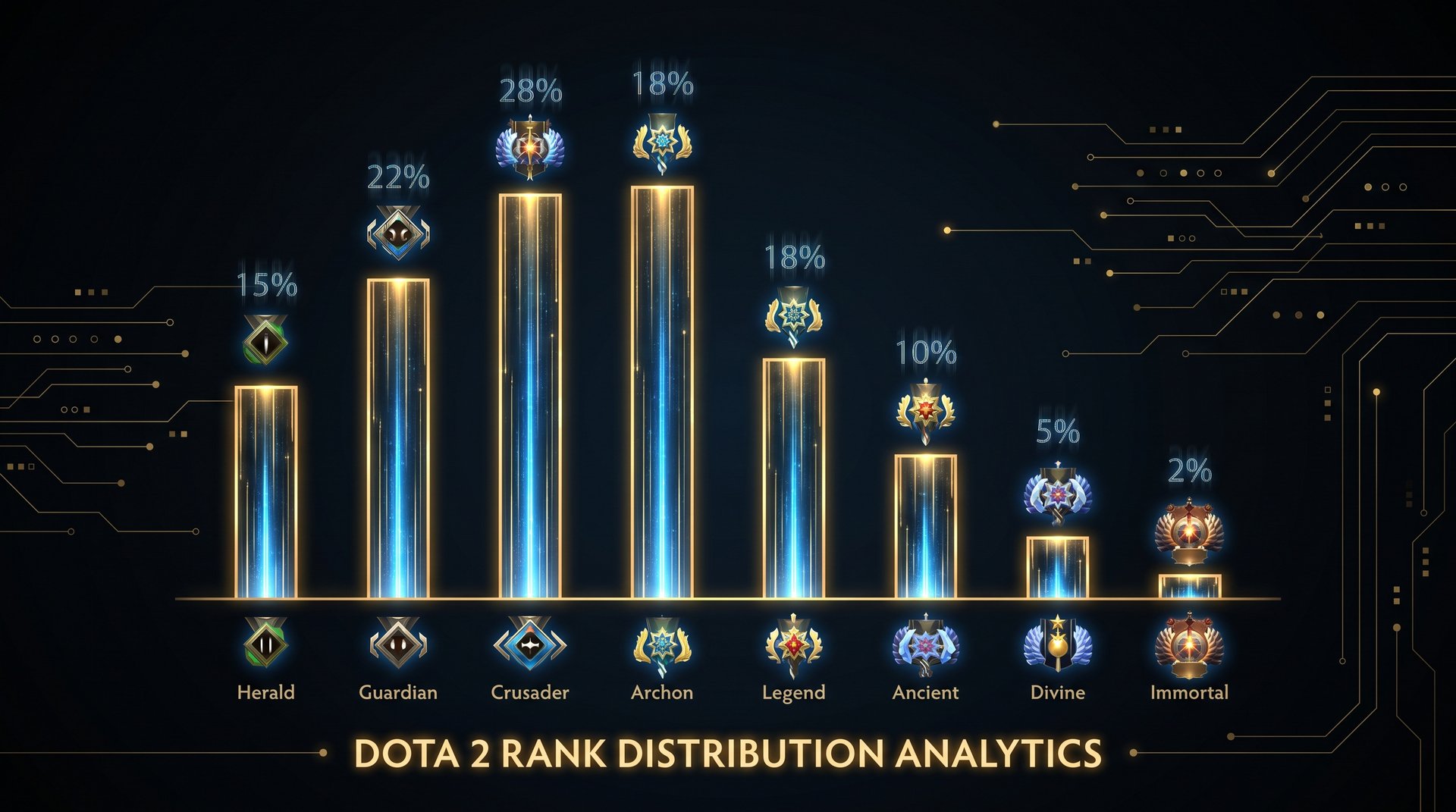
Our analysts track ranked account data across multiple regions on an ongoing basis. The following table reflects the distribution as of June-July 2026, aggregated from our internal dataset of over 200,000 tracked accounts supplemented by community API tools. These numbers are consistent with the distribution published on our complete Dota 2 rank distribution guide.
| Medal | MMR Range | % of Players | Cumulative % | Top Percentile |
|---|---|---|---|---|
| Herald | 0 — 769 | 4.5% | 4.5% | Top 95.5% |
| Guardian | 770 — 1,539 | 9.2% | 13.7% | Top 86.3% |
| Crusader | 1,540 — 2,309 | 16.8% | 30.5% | Top 69.5% |
| Archon | 2,310 — 3,079 | 22.4% | 52.9% | Top 47.1% |
| Legend | 3,080 — 3,849 | 20.1% | 73.0% | Top 27.0% |
| Ancient | 3,850 — 4,619 | 14.8% | 87.8% | Top 12.2% |
| Divine | 4,620 — 5,419 | 8.2% | 96.0% | Top 4.0% |
| Immortal | 5,420+ | 4.0% | 100% | Top ~0.1% (leaderboard) |
A few things stand out immediately from this data. Archon is the single largest bracket by volume at 22.4%, meaning that is where the bulk of the playerbase sits. The combined Archon-Legend range (2,310 to 3,849 MMR) accounts for 42.5% of all ranked players — nearly half the ladder. This is where “average” Dota 2 actually lives.
The other notable figure is that Immortal at 4.0% is now larger than Herald at 4.5% by a margin that has been closing every year. When the Glicko system launched in 2023, Immortal was noticeably smaller than Herald. That gap has nearly closed — and it tells a story about which direction the population is slowly drifting.
How the Distribution Has Shifted Since 2023
Patch 7.33 in April 2023 introduced the Glicko confidence-based matchmaking system and forced a full recalibration across all accounts. That reset was the most significant shakeup to the MMR distribution in years. It gave us a clean baseline to measure from — and three years of data since that reset now allows us to see real trends.
The following table shows the Immortal bracket percentage at six-month intervals since the Glicko launch, based on our rolling tracking data. This is the clearest signal of population-level inflation we have:
| Time Period | Immortal % | Change vs Previous | Notable Context |
|---|---|---|---|
| Oct 2023 (post-reset baseline) | 3.1% | — | Fresh Glicko calibration |
| Apr 2024 | 3.4% | +0.3% | First full season under Glicko |
| Oct 2024 | 3.7% | +0.3% | Accelerated convergence update |
| Apr 2025 | 3.9% | +0.2% | Growth rate slowing slightly |
| Jun 2026 (current) | 4.0% | +0.1% | Growth appears to be plateauing |
The trend is clear and consistent: a slow, steady upward creep in the Immortal population. But the rate of change is also clearly slowing — the 0.3% jumps in 2023-2024 have shrunk to 0.1% in the most recent period. This is consistent with what you would expect from a maturing bracket approaching a natural equilibrium.
Importantly, the middle brackets (Archon, Legend, Ancient) have remained almost entirely stable over this three-year period. The percentage of players in the Archon-Legend range has shifted by less than 1% in total since the Glicko reset. The inflation story is concentrated almost entirely at the extremes — slight Immortal expansion at the top, and a very slow Herald compression at the bottom as lower-skill players either improve or leave the ranked ladder.
Which Brackets Are Actually Inflating
Immortal — the Clearest Signal
As the data above shows, Immortal is the only bracket with a clearly measurable inflation trend. Going from 3.1% to 4.0% in three years means roughly 900 extra players out of every 100,000 ranked accounts have now crossed the 5,420 MMR threshold who would not have been above it in late 2023.
What this means practically: if you are targeting Immortal, the bracket is becoming slightly more crowded at its floor. The 5,420 MMR mark itself has not moved, but you are now competing for that rank with a larger share of the server. Within Immortal, the leaderboard rankings are still purely positional — the top 200 or top 10 in your region are just as exclusive as they were before. The floor of Immortal has gotten slightly easier to reach; the top of it has not.
Players who achieved Immortal in 2023 and have maintained it without gaining significant MMR since then have technically seen their rank become “worth slightly less” in population terms. A 2023 Immortal at exactly 5,420 was in roughly the top 3.1% of the server. The same player at the same MMR in 2026 is now in the top 4.0%. That is a real change — about 0.9% of the server has joined them.
Divine — Mild Pressure at the Ceiling
The Divine bracket (4,620 to 5,419 MMR) has seen a small but real reduction in its population share as players who calibrated into Divine post-Glicko gradually push through into Immortal. Three years ago, Divine represented about 9.1% of the server. Today it is 8.2%. Slightly fewer players are sitting in the Divine waiting room, because more of them have pushed through the ceiling.
For Divine players, this is actually positive news: the bracket is getting slightly harder to stay in relative to 2023, because the players around you are on average pushing upward. There is no meaningful deflation of the bracket value — if anything, Divine in 2026 is marginally more competitive than it was at the Glicko launch.
Archon through Legend — Remarkably Stable
This is the most important finding for the majority of players, and it tends to get lost in the inflation discourse. The Archon-Legend corridor — where 42.5% of all ranked players live — has been almost perfectly stable since 2023. The combined percentage has shifted by less than one percentage point over three years.
If you are in this range and someone tells you your rank is “inflated,” the data does not support it. Archon 3 in 2026 means roughly the same thing it meant in 2023 in terms of where you sit relative to other players. The median player’s MMR sits in the Archon 4 to Legend 1 range in both years. Your rank in this corridor is not inflated — it is stable.
Herald and Guardian — Marginal Deflation
The lower brackets have seen a very slight shrinkage. Herald has dropped from about 5.1% to 4.5% of the server population, and Guardian from about 9.8% to 9.2%. This is the flip side of Immortal expansion — as the distribution shifts slightly upward, the bottom end compresses a little.
This does not mean lower-bracket players are suddenly better. It most likely reflects a combination of three factors: natural player improvement over time, veteran accounts slowly drifting upward even in the lower brackets, and some attrition of genuinely new players who leave ranked before accumulating much MMR. The practical impact for current Herald or Guardian players is minimal.
Why Immortal Is Growing: Root Causes
The Glicko Confidence Decay Effect
The Glicko system that Valve introduced in patch 7.33 uses a confidence score alongside your raw MMR. When confidence is low — typically after recalibration or a long break — you gain and lose MMR faster per game. This accelerates convergence toward your “true” skill level.
What this created in the 2023-2024 period was a wave of highly skilled players who recalibrated below their true level and then shot upward rapidly once they started playing again. Many of these players were former Immortal accounts that had not calibrated for years. The accelerated gain mechanic moved them through the brackets faster than the old system would have, contributing to a faster-than-expected Immortal population growth in 2024 specifically.
By 2025-2026, this effect has mostly played out. The players who were going to benefit from accelerated calibration have already reached their equilibrium level. This is consistent with the slowdown in Immortal growth rate we observed in 2025.
Smurf Account Saturation and the Long-Run Effect
Smurf accounts are a permanent feature of the Dota 2 ecosystem. Every new account created by a high-MMR player inflates the lower brackets temporarily and then drains that MMR upward as the account calibrates to its true level. At equilibrium, smurfing does not cause net inflation — it just adds turbulence.
However, when a smurf account reaches a high bracket and stays there, it does add one more account to that bracket’s count. Over thousands of such accounts per year, this contributes a small but measurable upward pressure on the Immortal percentage. Our estimate is that smurf account maturation accounts for roughly 0.05 to 0.1 percentage points of the Immortal growth per year — a minority of the total trend, but not zero.
Post-Pandemic Player Maturation
The 2020-2021 COVID-era boom brought a large cohort of new players into Dota 2. By 2026, many of those players have been playing for five or six years and have improved substantially. A player who calibrated into Crusader in 2021 may well be reaching Ancient or Divine by now after years of consistent play. This cohort of maturing players is one of the structural reasons the Immortal percentage has been rising — they represent genuine skill improvement, not any kind of systemic distortion.

What This Means for Your Rank
The honest practical takeaway from all this data is that the impact of MMR inflation in 2026 is real but small for the vast majority of players — and it is concentrated at the Immortal threshold, not in the middle of the ladder.
Here is a clear breakdown of what your current rank actually means in population terms, and how that compares to 2023:
| Medal | Top % in 2026 | Top % in 2023 | Practical Change |
|---|---|---|---|
| Herald | 95.5% | 94.9% | Negligible |
| Guardian | 86.3% | 85.1% | Negligible |
| Crusader | 69.5% | 68.8% | Negligible |
| Archon | 47.1% | 46.5% | Negligible |
| Legend | 27.0% | 26.4% | Negligible |
| Ancient | 12.2% | 11.8% | Negligible |
| Divine | 4.0% | 4.7% | Slightly more exclusive |
| Immortal floor | Top 4.0% | Top 3.1% | Marginally less exclusive |
For most players, the change between 2023 and 2026 is less than one percentage point in their bracket’s population share. That is not a meaningful devaluation. If you are in Archon, your rank is essentially identical in meaning to what it was three years ago.
The one area where the change is genuinely meaningful is the very floor of Immortal — a shift of roughly 0.9 percentage points. If your primary goal was to be “top 3% of the server” by reaching Immortal, and you are now in the top 4%, that gap is real and worth acknowledging. The solution is obvious: push higher within Immortal, where the leaderboard rankings remain just as exclusive as ever.
If you want to close that gap faster than grinding alone allows, our Dota 2 MMR boosting service can accelerate your progress through any bracket — with live Immortal-rank players who understand exactly where the upper-bracket meta is in 2026.
Is It Harder or Easier to Rank Up in 2026?
This is the practical question behind the inflation debate, and the answer is nuanced by bracket.
For Archon through Ancient players: The difficulty of climbing is essentially unchanged compared to 2023. The distribution in this range is stable. What has changed is the quality of play in these brackets — the average game is slightly more competitive than it was three years ago as the post-pandemic cohort matures. This means climbing requires higher actual skill, even if the rank thresholds themselves are the same. In that sense, ranking up is marginally harder because your opponents are slightly better, not because the system has inflated against you.
For players targeting Divine: Divine has become slightly smaller as a percentage of the server, which means it is marginally harder to stay in because the players competing for it are better on average. However, the MMR threshold (4,620) has not changed, so the mechanical bar to reaching Divine is identical.
For Immortal aspirants: The floor of Immortal at 5,420 MMR is the same number it has always been. What has changed is that slightly more players have crossed it. This has two competing effects: the competition at 4,500 to 5,419 MMR has gotten more intense (more players are pushing through that range), but the floor of Immortal itself is more achievable in the sense that more of your contemporaries have made it. Whether that makes it “harder” or “easier” depends on whether you measure difficulty by raw MMR required (unchanged) or by relative rarity (slightly less rare).
Our recommendation for anyone serious about ranking up: focus on the MMR boosting fundamentals and treat the inflation question as academic. The numbers that matter — your current MMR and your target MMR — have not changed. What has changed slightly is the context around them, and that context shift is much smaller than the online discourse suggests.
The TeamSmurf Verdict
MMR inflation in Dota 2 is real in 2026 — but it is small, bracket-specific, and slower than most of the alarmist posts you will read in Reddit threads and YouTube comments suggest.
The key facts to remember:
- MMR thresholds have not moved since patch 7.33. The number you need to hit is fixed.
- The Immortal bracket has grown from 3.1% to 4.0% of the server since the 2023 Glicko reset — a real but modest inflation.
- Archon through Ancient — where 57% of all ranked players sit — has barely changed at all. If you are in this range, your rank is not inflated.
- Divine has actually gotten slightly more exclusive, not less.
- The rate of Immortal growth is slowing and appears to be approaching equilibrium. The 2026 distribution is likely close to where it will stabilize.
If your rank feels like it is “worth less,” the most likely explanation is not systemic inflation — it is that you are playing in a more competitive environment than a few years ago as the overall player pool has improved. The solution to that is the same as it has always been: improve faster than the average, or get targeted help to accelerate your climb. Our professional boosting service remains the fastest legitimate path to a rank that reflects your actual ceiling, not the ceiling of your busy schedule or your inconsistent solo queue.
Frequently Asked Questions
Stop Waiting. Start Climbing.
Our Immortal-rank boosters know exactly where the bracket thresholds are and how to get you there efficiently. Whether you are aiming for your first Divine, trying to break into Immortal before the season ends, or just tired of being stuck at the same star for three months — TeamSmurf has been the Dota 2 specialist for years.