Dota 2 MMR Explained: The Complete Technical Guide to How Ranking Works

Every Dota 2 player cares about one number: MMR. It determines who you play with, who you play against, and — let’s be honest — how you feel about your skill. But despite MMR being the single most important metric in competitive Dota, most players have zero idea how it actually works under the hood.
This guide changes that. We’re going deep — not surface-level “win games to gain MMR” advice, but the actual mathematical systems, calibration mechanics, uncertainty algorithms, and hidden variables that Valve uses to assign your number. Whether you’re a Herald trying to understand why you’re stuck or an Immortal pushing for leaderboard, understanding the MMR system gives you a genuine edge.
If you’re looking to jump-start your rank rather than grind it out, TeamSmurf’s MMR boosting service can help you skip the frustrating parts — but understanding the system will help you keep whatever rank you achieve.
Table of Contents
- What Is MMR in Dota 2?
- Elo vs. Glicko-2: The Rating Systems Behind Competitive Games
- How Valve’s Proprietary MMR System Works
- Calibration MMR: Your Starting Point
- Uncertainty Values and Confidence Intervals
- How Wins and Losses Translate to MMR Gain
- Factors That Affect MMR Gain and Loss
- The History of Solo vs. Party MMR
- Role Queue MMR: How It Changed Everything
- Leaderboard MMR and Immortal Rankings
- Medals vs. MMR: What Your Badge Actually Means
- Common MMR Myths — Debunked
- How to Actually Improve Your MMR
- FAQ
What Is MMR in Dota 2?
MMR (Matchmaking Rating) is a numerical value that represents your skill level in Dota 2’s ranked matchmaking. Every player who completes ranked calibration is assigned an MMR — a single integer, typically ranging from around 0 to 13,000+ at the absolute highest levels of play.
Your MMR serves two primary purposes:
- Matchmaking — The game uses your MMR to find opponents and teammates of similar skill, creating balanced 5v5 matches.
- Rank Display — Your MMR determines your visible rank medal (Herald, Guardian, Crusader, Archon, Legend, Ancient, Divine, Immortal).
Unlike many competitive games that obscure the underlying rating, Dota 2 actually shows you your exact MMR number in your profile. This transparency is somewhat unusual — games like League of Legends and Overwatch hide the number behind LP systems or SR, making it harder to track precise changes. Dota gives you the raw data.
MMR Ranges by Medal (2026)
| Medal | Stars | Approximate MMR Range |
|---|---|---|
| Herald | 1-5 | 0 — 770 |
| Guardian | 1-5 | 770 — 1,540 |
| Crusader | 1-5 | 1,540 — 2,310 |
| Archon | 1-5 | 2,310 — 3,080 |
| Legend | 1-5 | 3,080 — 3,850 |
| Ancient | 1-5 | 3,850 — 4,620 |
| Divine | 1-5 | 4,620 — 5,420 |
| Immortal | — | 5,420+ |
Note: These ranges shift slightly each season. Valve adjusts the boundaries based on the overall player distribution.
Now, knowing the numbers is one thing. Understanding how the system assigns and adjusts those numbers — that’s where it gets interesting.
Elo vs. Glicko-2: The Rating Systems Behind Competitive Games
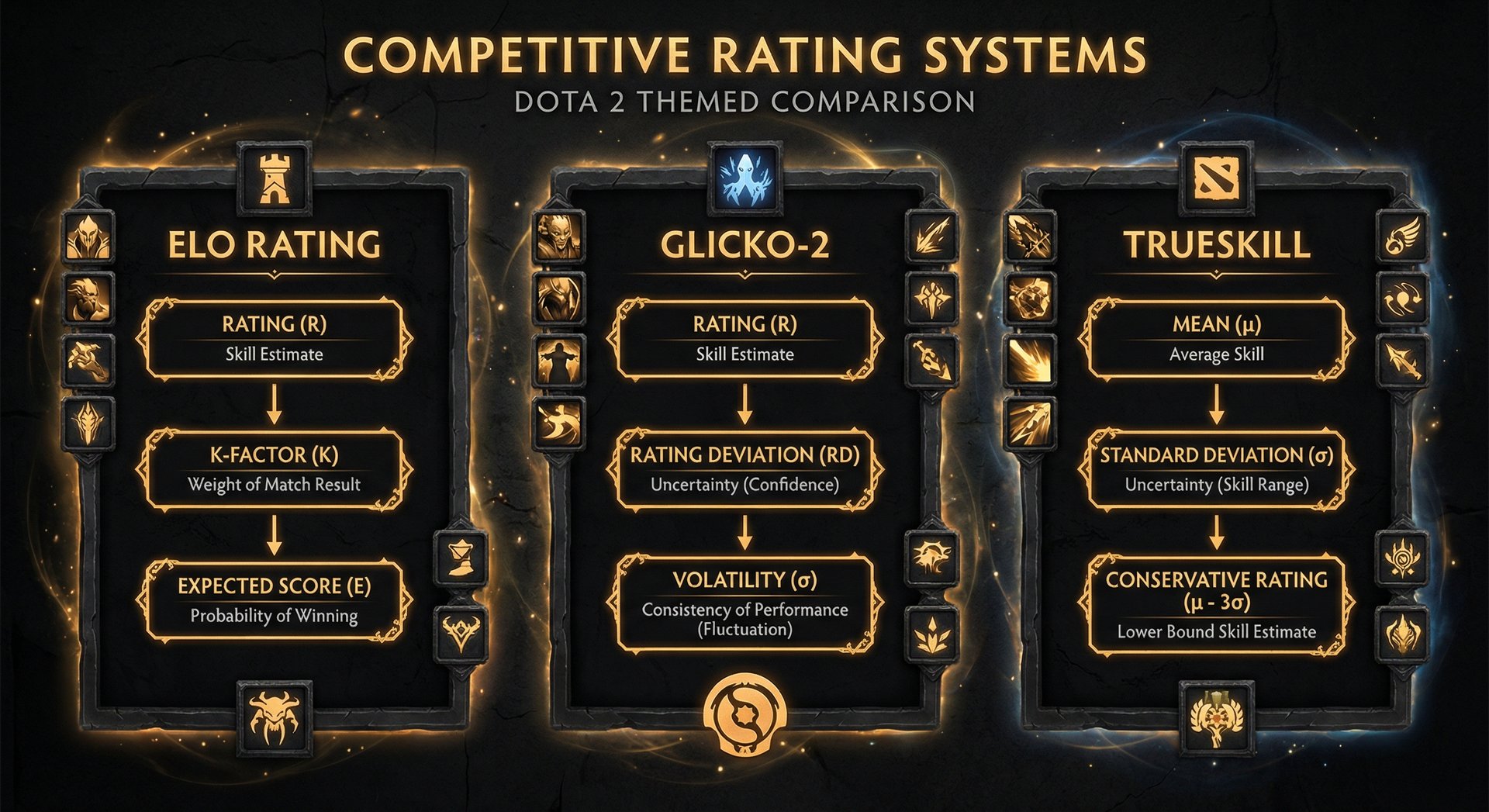
To understand Dota 2’s MMR, you first need to understand the two foundational rating systems used across competitive gaming and sports: Elo and Glicko-2.
The Elo Rating System
Originally designed by Arpad Elo for chess in the 1960s, the Elo system is elegant in its simplicity. Here’s how it works:
- Each player starts with a rating (typically 1200 or 1500).
- Before a match, the system calculates the expected outcome based on the rating difference between players.
- After the match, ratings are adjusted based on whether the actual outcome exceeded or fell short of the expected outcome.
- A constant called K-factor determines how much ratings change per game.
The key formula:
New Rating = Old Rating + K × (Actual Score — Expected Score)
Where Expected Score = 1 / (1 + 10^((Opponent Rating — Your Rating) / 400))
The beauty of Elo is its zero-sum nature: in a 1v1 match, the rating points gained by the winner exactly equal the points lost by the loser. This keeps the total “MMR pool” constant across the population.
Elo’s Limitations:
- Doesn’t account for rating confidence — a player who hasn’t played in months has the same “weight” as someone who plays daily.
- Can be slow to adjust for players whose true skill has changed significantly.
- The fixed K-factor means new players and veterans gain/lose the same amount per game.
- Designed for 1v1 games, not team-based competition.
The Glicko-2 Rating System
Developed by Mark Glickman at Harvard, Glicko-2 addresses most of Elo’s shortcomings by adding two additional variables:
- Rating — similar to Elo (your skill number).
- Rating Deviation (RD) — how confident the system is in your rating. High RD means uncertain; low RD means the system is confident.
- Rating Volatility (σ) — how much the system expects your rating to fluctuate based on your recent results.
The genius of Glicko-2 is the RD (Rating Deviation) component:
- When you haven’t played in a while, your RD increases — the system becomes less confident about your rating.
- When you play frequently, your RD decreases — the system becomes more confident.
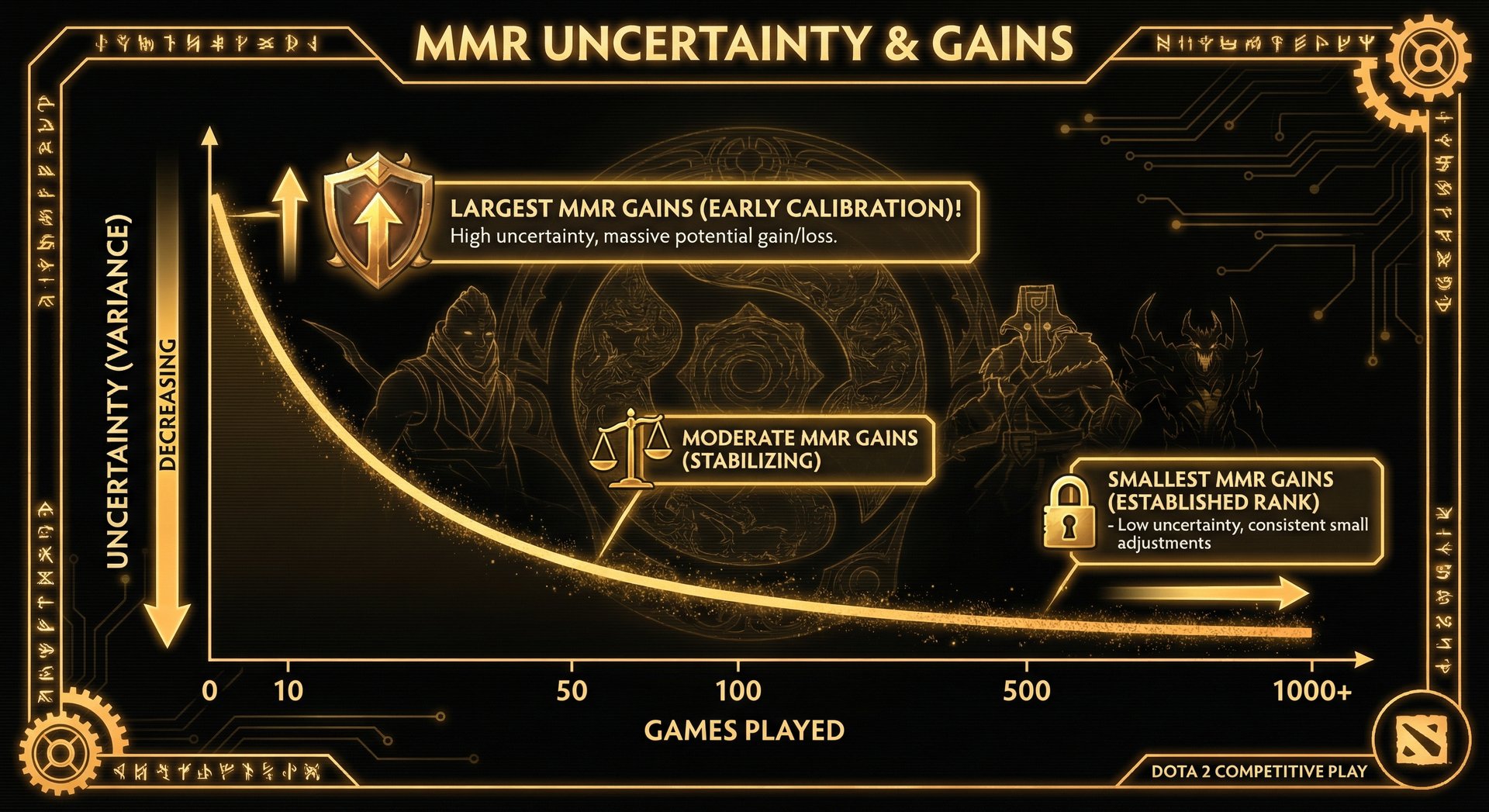
- When your RD is high, you gain and lose more MMR per game (the system is trying to find your true level faster).
- When your RD is low, changes are smaller and more stable.
This is critically important for understanding Dota 2’s system — because Valve’s implementation borrows heavily from Glicko-2 concepts, even if they don’t use the system verbatim.
How Team Games Adapt These Systems
Both Elo and Glicko were designed for 1v1. Adapting them for 5v5 team games introduces a fundamental challenge: how do you isolate individual contribution in a team outcome?
Most implementations solve this by treating each team as a single “player” with an averaged rating. The match outcome (win/loss) then updates each individual player’s rating based on the team’s aggregate performance against the opponent team’s aggregate.
Microsoft’s TrueSkill system (used in Halo and other Xbox games) and its successor TrueSkill 2 are designed specifically for team games and use Bayesian inference to handle multi-player scenarios. Valve hasn’t confirmed using TrueSkill, but the concepts are relevant.
How Valve’s Proprietary MMR System Works
Here’s the uncomfortable truth: Valve has never fully disclosed how Dota 2’s MMR system works. What we know comes from a combination of:
- Occasional Valve blog posts and developer comments
- Data mining and community research
- Statistical analysis by players tracking thousands of matches
- Inferences from observed behavior
Based on all available evidence, here’s what the community has pieced together:
It’s Modified Glicko-2 (Most Likely)
The system behaves most consistently with a modified Glicko-2 implementation. Key evidence:
- Variable MMR gains — Players don’t always gain/lose exactly 25 MMR. The amount varies, which is consistent with Glicko-2’s confidence system.
- Returning player acceleration — Players who take long breaks often experience larger MMR swings initially, consistent with increased Rating Deviation.
- Calibration behavior — New accounts experience much larger MMR changes during calibration, suggesting a high initial RD that decreases over games.
- Win/loss streaks — Extended winning or losing streaks appear to temporarily increase MMR volatility, consistent with Glicko-2’s σ parameter.
The “Hidden MMR” Layer
Valve uses two distinct layers of matchmaking rating:
- Displayed MMR — The number you see on your profile. Changes after each ranked game.
- Hidden/Behavioral MMR — An invisible score that influences matchmaking but isn’t shown. This appears to factor in behavior score, game impact metrics, and possibly performance data.
The hidden layer explains why two players with identical displayed MMR can have vastly different match quality. A 3,000 MMR player with a 10,000 behavior score gets matched with different people than a 3,000 MMR player with a 6,000 behavior score.
Team Balance Algorithm
When creating a match, Valve’s system attempts to make both teams’ average MMR as close as possible. The system also considers:
- MMR spread within teams — It tries to avoid putting a 5k and a 3k player on the same team against five 4k players.
- Party composition — Parties are ideally matched against other parties of similar size.
- Queue time vs. match quality — The longer you wait, the wider the acceptable MMR range becomes.
- Region and server — Geographic constraints further limit the pool.
The predicted win rate for each team is approximately 50% in a well-balanced match. When the system can’t find a perfect balance, it compensates by adjusting MMR gains — the team with slightly lower average MMR gains a bit more for winning and loses a bit less for losing.
Calibration MMR: Your Starting Point
Calibration is the process that determines your initial MMR when you first play ranked — or at the start of certain seasons when Valve performs soft resets. It’s arguably the most impactful set of games you’ll ever play, yet most players go into calibration completely blind.
How Calibration Works for New Accounts
Before you even play your first ranked game, the system already has data on you:
- Unranked MMR — Every unranked game you’ve played has a hidden MMR attached. This forms the starting point for your ranked calibration.
- Account level requirement — You need to reach a certain account level and play a minimum number of games before ranked is unlocked.
- Phone number verification — Required to reduce smurf accounts.
During calibration (typically 10 games), the system assigns you a starting MMR estimate based on your unranked performance, then rapidly adjusts with each game. The adjustments during calibration are much larger than normal — possibly 75-150+ MMR per game instead of the usual ~25-30.
This large adjustment reflects the high Rating Deviation the system assigns to new ranked players. It’s saying: “I’m not sure where this player belongs, so I need to make big adjustments to find out quickly.”
What Calibration Actually Measures
This is where it gets controversial. Does performance matter during calibration, or just wins?
Based on extensive community testing and data analysis, the evidence suggests:
- Wins/losses are the primary factor — Going 8-2 will almost always calibrate higher than going 3-7, regardless of individual performance.
- Performance provides a secondary adjustment — Two players who both go 7-3 but with different KDA, hero damage, and other metrics may calibrate at slightly different MMRs.
- Hero choice may matter — Playing core roles (especially mid) during calibration appears to give the system more data about your individual skill, since your performance is less dependent on teammates.
Our recommendation: Focus on winning above all else during calibration. Play your best heroes, pick meta-relevant heroes, and play roles you’re most comfortable on. For a comprehensive strategy guide, check our Dota 2 calibration service — or read our dedicated Dota 2 Calibration Guide for step-by-step optimization.
Seasonal Recalibration
When Valve performs a ranked season reset, the recalibration process is different from initial calibration:
- Your MMR doesn’t reset to zero — it uses your previous season’s final MMR as the starting point.
- The system increases your Rating Deviation slightly, allowing for bigger swings during the recalibration period.
- Typically 10 games of recalibration, but the adjustments are smaller than new account calibration.
- The intent is to allow players who improved (or declined) during the off-season to adjust their rank without grinding hundreds of games.
Uncertainty Values and Confidence Intervals
This is the part of the system most players don’t know exists — and it’s arguably the most important hidden mechanic affecting your day-to-day MMR experience.
What Is Uncertainty?
In Glicko-2 terms, your uncertainty (Rating Deviation) represents how confident the system is about your current MMR. Think of it as an error margin:
- Low uncertainty (tight confidence interval): The system is very confident you belong at your current MMR. Result: smaller MMR changes per game (closer to 20-25).
- High uncertainty (wide confidence interval): The system isn’t sure about your true skill level. Result: larger MMR changes per game (30-50+).
What Increases Uncertainty?
| Factor | Effect on Uncertainty | Practical Impact |
|---|---|---|
| Long break from playing | Increases significantly | First games back have bigger MMR swings |
| New ranked season | Increases moderately | Recalibration games are more impactful |
| Extended win/loss streaks | Increases temporarily | System thinks you may be misranked |
| Inconsistent performance | Increases gradually | Win-loss-win-loss patterns signal uncertainty |
| Playing many games consistently | Decreases over time | MMR changes stabilize around 25 |
Why This Matters for Climbing
Understanding uncertainty gives you a strategic advantage:
- After a break, your first ~20 games back carry extra weight. If you’ve improved during the break (watching replays, studying guides), this is an opportunity to jump significantly.
- Win streaks compound — a 10-game win streak doesn’t just add 250 MMR. The uncertainty increase from the streak means later wins in the streak add more than 25 per game.
- The “recalibration window” after each season reset is your best opportunity to make large rank jumps without grinding hundreds of games.
This is exactly why calibration boosting can be so effective — those 10 games have outsized impact compared to any other 10 games you’ll play that season.
How Wins and Losses Translate to MMR Gain
The “standard” MMR change per game is approximately +/- 25-30 MMR. But this number varies, and understanding why it varies is crucial.
The Base Calculation
For a perfectly balanced match (both teams have equal average MMR):
- Win: +25 to +30 MMR
- Loss: -25 to -30 MMR
For an imbalanced match (your team has higher average MMR):
- Win: +20 to +22 MMR (you were expected to win)
- Loss: -28 to -30 MMR (you weren’t expected to lose)
For an imbalanced match (your team has lower average MMR):
- Win: +28 to +35 MMR (you weren’t expected to win)
- Loss: -20 to -22 MMR (the loss was expected)
The Math Behind It
The expected win probability for your team is calculated based on the MMR difference between the two teams. In a simplified Elo model:
Expected Win Rate = 1 / (1 + 10^((Enemy Avg MMR — Your Team Avg MMR) / 400))
If your team’s average MMR is 3000 and the enemy’s is 3100:
- Expected Win Rate = 1 / (1 + 10^(100/400)) = ~0.36 (36%)
- If you win: you gain more because you beat the odds
- If you lose: you lose less because the loss was somewhat expected
The actual K-factor and scaling Valve uses is proprietary, but the principle holds.
Does Individual Performance Affect MMR Gains?
This is the most debated question in the Dota 2 community. Here’s what we know:
For regular post-calibration games: The overwhelming consensus, backed by years of data tracking, is that individual performance does NOT directly affect MMR gain/loss in standard ranked games. You gain or lose the same amount whether you went 20-0-15 or 0-15-2. Only the win/loss outcome matters.
For calibration games: Performance may play a secondary role (see the calibration section above).
Why this design choice? If performance affected MMR, it would incentivize stat-padding over winning. Support players who sacrifice their KDA for vision and space would be punished. Carries who farm safely instead of fighting would be rewarded even in losses. The win-only system ensures that winning is the only thing that matters — which is the correct incentive for a team game.
Factors That Affect MMR Gain and Loss
While individual performance doesn’t change your MMR per game, several other factors do influence how much you gain or lose:
1. Team Average MMR Difference
As discussed above, being on the “underdog” team means more MMR for a win, less lost for a defeat. This is the single biggest variable in MMR change per game.
2. Your Uncertainty/RD Value
Higher uncertainty = bigger swings. New accounts, returning players, and players on extreme streaks will see more volatile MMR changes.
3. Ranked Role Queue vs. Classic Ranked
In role queue, each role has its own MMR. Your MMR adjustment applies only to the role you played. If you queue as support and win, your support MMR goes up but your core MMR stays the same.
4. Party Size and Composition
When you queue as a party, the system accounts for the communication advantage. Party MMR adjustments may differ slightly from solo queue — historically, party games had their own separate MMR entirely.
5. Behavior Score
Your behavior score doesn’t directly change MMR gains, but it indirectly affects your climb by determining the quality of your teammates. Players with 10,000 behavior score consistently report better team coordination, fewer griefers, and more enjoyable games — all of which contribute to a higher win rate. If your behavior score is tanked and you’re stuck in low priority, fixing that should be your first priority before trying to climb.
6. Server Region
MMR is global, but match quality varies by region due to different player pool sizes. In less populated regions (South Africa, Japan), matches may be more imbalanced, leading to more variable MMR gains.
The History of Solo vs. Party MMR
Understanding the evolution of Dota 2’s MMR system helps explain why it works the way it does today.
The Original Split (2013-2019)
When ranked matchmaking launched in late 2013, Valve implemented two completely separate MMR values:
- Solo MMR — Affected only by games where you queued alone.
- Party MMR — Affected only by games where you queued with one or more friends.
Your rank medal was determined by the higher of the two. This system had significant problems:
- Players could “boost” their medal by playing party games with higher-skilled friends.
- Party MMR was widely considered less meaningful because coordination with friends skewed results.
- Solo MMR became the “real” measure of skill in the community’s eyes.
- Players often didn’t care about party games, leading to griefing and lower-quality matches.
The Merge (2019-2020)
In late 2019, Valve merged solo and party MMR into a single unified MMR. This was controversial — many players felt it “cheapened” the system by allowing party abuse. Valve mitigated this with restrictions:
- Large MMR gaps between party members were restricted.
- The “Immortal” rank required solo queue play for leaderboard placement.
- Behavior score requirements were tightened.
Role Queue Introduction (2019)
Simultaneously, Valve introduced Ranked Roles, which split your single MMR into role-specific MMR values. This was a massive change — more on this in the next section.
Role Queue MMR: How It Changed Everything
The role queue system, introduced in late 2019, fundamentally changed how MMR works in Dota 2. Instead of one MMR, you now have separate MMRs for each role:
- Safe Lane (Carry) — Position 1
- Mid Lane — Position 2
- Off Lane — Position 3
- Soft Support — Position 4
- Hard Support — Position 5
How Role MMR Works
Your displayed rank medal is based on your highest role MMR. However, your other role MMRs are visible on your profile and affect matchmaking when you queue for those roles.
Key mechanics:
- Winning as pos 5 only increases your pos 5 MMR.
- Role MMRs are not fully independent — there’s a “pull” effect where significant changes to one role MMR slightly adjust others. This prevents a 6k mid player from being placed in Herald-level games when they queue for support.
- The initial calibration for a new role uses your existing role MMRs as a baseline. If you’re 4k as a carry and first queue as support, you won’t start at zero.
- The maximum gap between your highest and lowest role MMR appears to be capped at around 1,000-1,500 MMR.
The Role Queue Token System
To incentivize playing support roles (which are less popular), Valve implemented a token system:
- Playing support earns role queue tokens.
- Queueing for core roles costs tokens.
- “All roles” queue earns tokens and has faster queue times.
This system indirectly affects your MMR experience by ensuring you can’t exclusively play one role without contributing to the ecosystem. Versatile players who can perform across roles have a climbing advantage due to shorter queue times and token availability.
Strategic Implications
Role queue MMR creates interesting strategic considerations:
- Specialize to climb — Your highest role MMR determines your medal. Focus on your best role to push your peak rating.
- Use secondary roles as practice — Since off-role games don’t tank your main MMR, you can experiment more freely.
- Support is easier to climb on (sometimes) — Queue times are faster and the “pull” effect means gains transfer partially to other roles.
Leaderboard MMR and Immortal Rankings
Once you cross the Immortal threshold (~5,420 MMR), the ranking system changes significantly. Instead of medal stars, you’re ranked on a regional leaderboard.
How Leaderboard Rankings Work
- Threshold: You must be Immortal rank to appear on the leaderboard.
- Games required: You need a minimum number of ranked games in the current season (typically solo queue games specifically).
- Solo queue emphasis: Only solo queue games count toward leaderboard placement. This prevents party abuse at the highest levels.
- Regional separation: Leaderboards are separated by region (Americas, Europe, China, Southeast Asia). Your position reflects your rank among players in your region.
- Activity requirement: You must play ranked games regularly to maintain your leaderboard position. Extended inactivity will remove you from the leaderboard (but not reduce your MMR).
Top Immortal MMR Ranges
| Leaderboard Position | Approximate MMR (2026) |
|---|---|
| Top 1-10 | 12,000 — 13,500+ |
| Top 11-100 | 10,000 — 12,000 |
| Top 100-500 | 8,500 — 10,000 |
| Top 500-1000 | 7,500 — 8,500 |
| Immortal (no rank shown) | 5,420 — 7,500 |
The MMR gap between an “Immortal with no number” and a Top 10 player is enormous — often 5,000-8,000 MMR. This is the equivalent of the gap between Herald and Ancient. The Immortal bracket contains the most extreme skill disparities of any rank tier.
Medals vs. MMR: What Your Badge Actually Means
A common source of confusion: your medal and your MMR can be out of sync. Here’s how:
- Medals only go up during a season — If you hit Legend 3 and then lose 500 MMR, your medal stays at Legend 3 even though your actual MMR might be Crusader level.
- MMR is real-time — Your actual matchmaking is based on your current MMR, not your displayed medal.
- Season resets — Medals reset each season. You need to recalibrate to get your new medal, which is based on your current MMR.
This means you can face opponents whose medal looks much higher than yours — because their medal reflects their peak, while their current MMR (which is what matchmaking uses) has dropped to your level.
Common MMR Myths — Debunked
Myth 1: “KDA Affects MMR Gains”
FALSE. In regular ranked games post-calibration, only win/loss determines MMR change. A 0-20 win gives the same MMR as a 30-0 win.
Myth 2: “The System Intentionally Forces 50% Win Rate”
PARTIALLY TRUE, BUT MISUNDERSTOOD. The system doesn’t “force” a 50% win rate by deliberately giving you bad teammates. What happens is: as you win games and your MMR rises, you face better opponents, which naturally brings your win rate toward 50%. This is called regression to the mean — it’s a mathematical inevitability, not a conspiracy. If you’re truly better than your MMR, you’ll maintain above 50% until you reach your real level.
Myth 3: “Support Players Gain Less MMR”
FALSE. All five players on the winning team gain the same amount, and all five on the losing team lose the same amount (adjusted only for team MMR difference, not role).
Myth 4: “New Accounts Calibrate Higher Than They Should”
SOMETIMES TRUE. The high uncertainty during calibration can lead to volatile placements. A lucky 8-2 calibration can place someone higher than their true skill. However, the system corrects this relatively quickly — within 50-100 games, most players converge to their real level.
Myth 5: “Playing More Games Per Day Reduces MMR Gains”
FALSE. There is no evidence of diminishing MMR returns based on games played per day. However, player performance often declines after many consecutive games due to fatigue, which leads to losses — creating the illusion that the system reduces gains.
Myth 6: “You Can’t Climb as a Support”
ABSOLUTELY FALSE. Support players climb at exactly the same rate as core players if they maintain the same win rate. In fact, support roles often have shorter queue times, meaning you can play more games per hour, potentially climbing faster. Check the best heroes for climbing MMR guide for support-specific recommendations.
How to Actually Improve Your MMR
Now that you understand how the system works, here are evidence-based strategies for climbing:
1. Focus on Win Rate, Not Individual Stats
Since only wins matter for MMR, every decision should be evaluated by: “Does this increase our chance of winning?” Sometimes that means dying to save your carry. Sometimes it means farming instead of fighting. Always think about the win condition, not your scoreboard.
2. Specialize in 2-3 Heroes Per Role
Hero mastery is the single biggest predictor of win rate in ranked. Players with 100+ games on a hero consistently outperform those with 10 games, even at the same MMR. Pick your best heroes and spam them. See our complete hero tier list for climbing.
3. Play During Off-Peak for Faster Climbs
During off-peak hours, matchmaking creates more imbalanced games. If you’re confident you’re better than your MMR, these imbalanced games can actually benefit you — you’ll occasionally get favorable matchups where you gain extra MMR for wins against theoretically better opponents.
4. Maintain 10,000 Behavior Score
This is non-negotiable. High behavior score = better teammates = higher win rate. If your behavior score is below 8,000, you’re handicapping yourself. If you’re in low priority, get out immediately — every game spent there is a game not spent climbing.
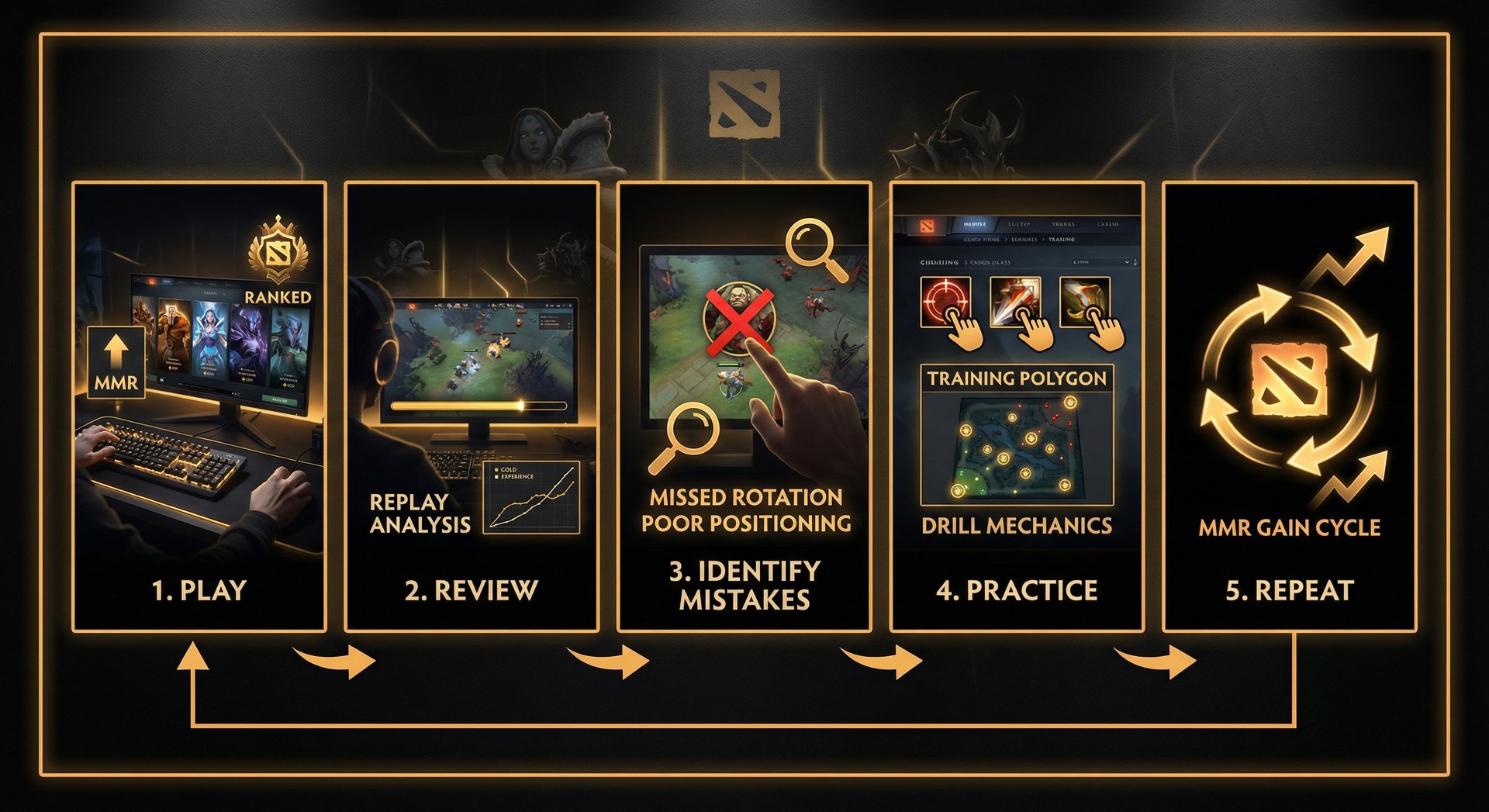
5. Review Your Replays
The single most efficient way to improve. Watch your losses and identify one specific mistake per game. Focus on fixing that mistake in your next games. A professional Dota 2 coach can accelerate this process dramatically by identifying patterns you can’t see yourself.
6. Understand the Meta
The meta matters more than most players think. A hero with a 55% win rate in the current patch will naturally give you a climbing advantage over a hero with 45%. Check our mid lane tier list and hero guides for current meta picks.
7. Consider Professional Boosting for a Fresh Start
If you’re deeply stuck in a bracket you don’t belong in — whether due to bad calibration, a rough patch, or simply having improved beyond your current rank — professional MMR boosting can give you a clean slate at the rank you actually play at. Many players use boosting as a starting point and maintain their new rank through their own gameplay, which proves the system accurately reflects improved skill when given the right starting MMR.
Frequently Asked Questions (FAQ)
Ready to Climb? Start Your Boost Today
Team Smurf is the #1 rated Dota 2 boosting service in 2026. Immortal-rank boosters, maximum safety, competitive pricing, 24/7 support.
Final Thoughts
Understanding Dota 2’s MMR system won’t magically make you better at the game — but it will help you make smarter decisions about how you approach ranked. Knowing that only wins matter eliminates the temptation to stat-pad. Understanding uncertainty values helps you time your climbs strategically. Recognizing the role queue system helps you choose the right role to specialize in.
The bottom line: MMR is a very accurate long-term measure of skill. Over hundreds of games, you will converge to the rating you deserve. If you want to increase that rating, you need to genuinely improve. Professional coaching is the fastest way to identify and fix your weaknesses. And if you want to skip past a bracket you’ve already outgrown, TeamSmurf can help you get to where you belong — fast.
For more on how to put this knowledge into practice, check out our guides on maximizing your calibration, the current rank distribution, and the best heroes for climbing MMR in 2026.
Written by Team Smurf’s Immortal-rank analysts — Rankings last verified February 2026