Dota 2 MMR Boosting: The Ultimate Guide to Everything You Need to Know

If you’ve ever searched for “dota 2 mmr boost” or wondered whether a dota 2 mmr boosting service is right for you, you’re far from alone. Every single day, thousands of Dota 2 players across every region — from Herald to Ancient — consider boosting as a way to reach the rank they believe they deserve. And yet, despite being one of the most talked-about topics in the Dota 2 community, MMR boosting remains deeply misunderstood.
This guide isn’t a sales pitch. It’s an exhaustive, no-nonsense breakdown of everything you need to know about Dota 2 MMR boosting — from the mechanics of the matchmaking system itself, to the exact steps that happen during a boost, to the security protocols that separate legitimate services from outright scams. Whether you’re a casual player frustrated by a losing streak, a content creator who needs a specific rank for their brand, or a time-strapped adult who simply doesn’t have 6 hours a day to grind ranked, this guide will answer every question you have.
By the end of this 5,000+ word guide, you’ll understand:
Table of Contents
- What Is MMR in Dota 2?
- How Dota 2’s Matchmaking System Actually Works
- What Is MMR Boosting?
- Why Do People Get Boosted? (It’s Not Just Being “Stuck”)
- Types of Dota 2 MMR Boosting: Solo, Duo, and Lobby
- Boost Type Comparison Table
- How MMR Boosting Works: Step-by-Step
- How Professional Boosters Are Selected
- Timeline Expectations Per Rank Bracket
- Account Security Measures
- What Happens During a Boost
- Post-Boost Tips to Maintain Your New Rank
- Red Flags in Boosting Services
- How to Choose the Right Boosting Service
- Frequently Asked Questions
- What MMR actually is and how Valve’s matchmaking system works behind the scenes
- The different types of boosting (solo, duo, lobby) and which is right for you
- Realistic timeline expectations for every rank bracket
- How professional boosters are selected and vetted
- Exactly what happens during a boost — step by step
- Account security measures that protect you
- Post-boost strategies to maintain your new rank
- Red flags that indicate a fraudulent boosting service
- The real reasons people buy dota 2 mmr boost services
Let’s get into it.
What Is MMR in Dota 2?
MMR (Matchmaking Rating) is the numerical value that represents your skill level in Dota 2’s ranked matchmaking system. Every player who completes their calibration matches receives an MMR value, and this number goes up when you win ranked games and down when you lose them. It’s the backbone of everything competitive in Dota 2.
Here’s what most players don’t realize: MMR is not just a number — it’s a complex, multi-variable system that Valve has refined over a decade of development. While the community often reduces it to “win = +30, loss = -30,” the reality is significantly more nuanced.
How MMR Numbers Map to Medals
Dota 2 uses a medal system that corresponds to MMR ranges. These ranges shift slightly between seasons, but as of 2026, the approximate breakdown is:
| Medal | Approximate MMR Range | Percentile (Approx.) |
|---|---|---|
| Herald | 0 — 770 | Bottom 5% |
| Guardian | 770 — 1,540 | 5% — 15% |
| Crusader | 1,540 — 2,310 | 15% — 32% |
| Archon | 2,310 — 3,080 | 32% — 50% |
| Legend | 3,080 — 3,850 | 50% — 70% |
| Ancient | 3,850 — 4,620 | 70% — 85% |
| Divine | 4,620 — 5,620 | 85% — 95% |
| Immortal | 5,620+ | Top 5% |
One crucial detail: your medal can only go up during a season, never down. Your actual MMR can drop below the threshold for your displayed medal, but the badge stays. This is why some players feel “hardstuck” — their displayed rank doesn’t reflect their current performance, creating a mismatch between expectations and reality.
Core vs. Support MMR
Valve previously split MMR into separate Core and Support ratings, but this has been unified in recent updates. However, the system still tracks your performance differently based on role queue selections. If you primarily play support but want a boost on core roles, this distinction matters for how your games are approached.
The Hidden Factors
Beyond the visible MMR number, Valve’s system tracks several hidden variables:
- Behavioral Score: Ranges from 0 to 12,000. Higher scores get matched with other well-behaved players, creating better game quality. A low behavior score can effectively trap you in a bracket regardless of skill.
- MMR Uncertainty: A hidden value that determines how much your MMR changes per game. New accounts or accounts returning after a break have high uncertainty, meaning bigger swings per match.
- Smurf Detection: Valve’s system monitors for play patterns that suggest a much higher-skilled player, which can result in accelerated MMR gains (or flags).
- Role Performance: Even within a single MMR number, the system evaluates your performance on different roles to create more balanced matches.
Understanding these hidden mechanics is essential for anyone considering a dota 2 mmr boost, because they directly affect how a boost is executed and how sustainable the results are. For a deeper dive into MMR mechanics, check out our comprehensive MMR explained guide.
How Dota 2’s Matchmaking System Actually Works
To understand boosting, you need to understand what you’re working within. Dota 2’s matchmaking algorithm — often called the Glicko-based system (named after the rating system it’s derived from) — doesn’t just match you with 9 random players near your MMR. It’s far more sophisticated.
The Matching Process
When you queue for a ranked match, the system considers:
- MMR proximity: It tries to find 10 players as close in MMR as possible
- Role distribution: In role queue, it needs the right combination of position preferences
- Party composition: Parties are matched against similar-sized parties when possible
- Behavior score: Players are grouped by behavioral ranges
- Region and ping: Physical proximity to servers matters
- Queue time: The longer you wait, the wider the search parameters become
This means that not all MMR games are created equal. A game at 3,000 MMR with 10 solo players and 10,000+ behavior scores is a fundamentally different experience from a game at 3,000 MMR with mixed parties and 6,000 behavior scores. This is one reason many players feel their rank doesn’t reflect their ability — the quality of games at the same MMR can vary dramatically.
Why Some Players Genuinely Get “Stuck”
The matchmaking system has a well-documented issue: convergence to a “true” MMR takes hundreds of games. A player who is genuinely 500 MMR above their current rating would need approximately 50-100 games of consistent play to reach their actual skill level naturally — assuming a 55-60% win rate. For players who can only play 2-3 games per day, that’s a month or more of grinding just to reach where they already belong.
This isn’t speculation. Research into Dota 2’s matchmaking system on Liquipedia and community analysis of millions of games confirms that the system is designed for long-term accuracy, not short-term precision. It’s great at placing you correctly over 500 games — but painfully slow over 50.
What Is MMR Boosting?
MMR boosting is the process of having a higher-skilled player increase your Dota 2 ranked rating. This can happen in several ways — a booster can play on your account (solo boost), play alongside you in a party (duo boost), or use lobby-based methods — but the core concept is the same: leveraging superior skill to win games and increase your MMR.
A dota 2 mmr boosting service like Team Smurf provides this professionally, with vetted boosters, security protocols, and customer support. It’s the difference between asking a random Discord stranger to play on your account and hiring an insured contractor to renovate your house.
Is It Legal?
MMR boosting exists in a gray area. It’s not illegal in any jurisdiction — no laws anywhere in the world prohibit it. However, it does technically violate Valve’s Terms of Service (specifically the clause about account sharing). That said, Valve’s enforcement has historically been minimal for boosting customers. Their detection systems primarily target boosters operating at scale, not individual accounts that receive a boost.
For more on the safety and legality aspects, read our detailed guide: Is Dota 2 Boosting Safe?
Why Do People Get Boosted? (It’s Not Just Being “Stuck”)
The gaming community often reduces boosting to “bad players buying a rank they don’t deserve.” This is a massive oversimplification. Here are the real reasons people use a dota 2 mmr boosting service:
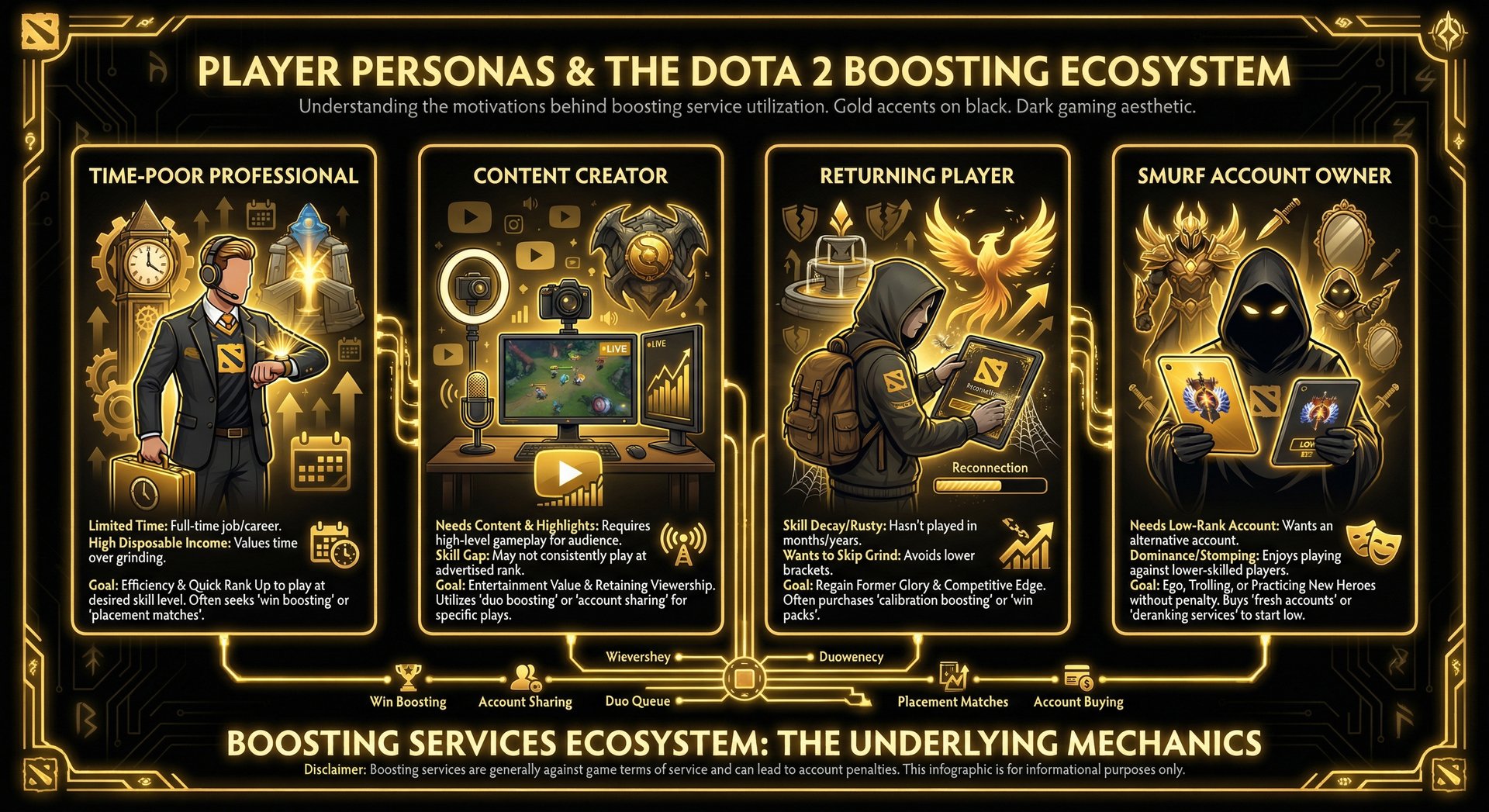
1. Time-Poor Adults
This is the single largest demographic of boosting customers, and it’s rarely talked about. Consider this: a working professional with a family might have 5-7 hours per week to play Dota 2. At 2-3 games per session, even with a healthy 55% win rate, climbing 1,000 MMR would take approximately 4-6 months of consistent play.
These aren’t bad players. Many were Ancient or Divine during their college years and maintained high game sense. They simply can’t commit the time required to grind through hundreds of games. A boost puts them back at the rank where they actually belong, so the limited time they do have is spent in quality, competitive games — not stomping Crusader lobbies.
2. Career Gamers and Content Creators
Streamers, YouTubers, and aspiring pro players often need a specific rank as a baseline for their content or career. A content creator who focuses on “high-level Dota gameplay” needs to actually be in high-level games. An aspiring pro who’s been gatekept at Divine 3 for months might need a push to Immortal to get noticed by teams or appear on leaderboards.
For these players, the boost is a business investment, not a shortcut.
3. Smurf Account Elevation
Many experienced players create secondary accounts for various legitimate reasons — playing in different regions, practicing new roles, or playing with lower-ranked friends without tanking their main. Grinding a smurf account through 100+ hours of low-tier games benefits nobody. Boosting the account to its appropriate rank actually improves game quality for everyone involved.
4. Returning Players
Dota 2 has been around since 2013. Players who were highly ranked years ago but took extended breaks often return to find their MMR has decayed or the meta has shifted so dramatically that their calibration placed them far below their actual skill level. A boost accelerates the re-acclimatization process.
5. Players Affected by External Factors
Not every MMR loss is about skill. Players dealing with:
- Internet instability that caused abandon penalties
- Hardware issues that led to underperformance
- Tilt spirals following personal life events
- Unfair behavior score drops from false reports
These players may have lost significant MMR through no fault of their gameplay skill. A boost restores them to where they were before the external factors impacted their rating.
6. Escaping the “Trench”
Yes, this is a real thing. While every player at every rank believes they’re in the “trench,” certain MMR brackets — particularly 2,000-3,500 — are statistically more volatile. The variance in player skill, behavior, and game quality at these brackets is measurably higher than at either extreme. Some players genuinely need a push through this zone to reach games where their specific skill set (game sense, teamwork, communication) is actually valued.
Types of Dota 2 MMR Boosting: Solo, Duo, and Lobby
Not all boosts are created equal. The three primary methods each have distinct advantages, risks, and ideal use cases. Understanding these differences is critical before you buy dota 2 mmr boost services.
Solo Boosting
How it works: You provide your account credentials to the boosting service. A professional booster — typically an Immortal-rank player with a 75-90%+ win rate at your bracket — logs into your account and plays ranked matches until your MMR reaches the target.
Key characteristics:
- Fastest method: A single highly skilled player can maintain 80%+ win rates in brackets significantly below their actual skill level
- Most cost-effective: Because only one person is involved and the win rate is highest, solo boosting requires fewer games and therefore costs less per MMR point
- Requires account sharing: You’ll need to share your Steam credentials, which means trust in the service is essential
- You don’t play: This is hands-off. The booster handles everything while you go about your life
- Fastest completion: Most solo boosts complete 30-50% faster than duo boosts for the same MMR range
Best for: Players who want the fastest, most affordable result and are comfortable with account sharing through a trusted service.
Duo Boosting
How it works: You play your own games, but you’re partied with a professional booster. The booster plays on their own account (or a service account at your bracket) and carries the games while you participate normally.
Key characteristics:
- You keep control: Your account credentials stay private — you play on your own account the entire time
- Learning opportunity: Playing alongside an Immortal-rank player gives you real-time exposure to high-level decision-making, positioning, and game sense
- Slightly slower: Win rates in duo queue are typically 65-80%, compared to 80-90%+ for solo boosting, because the booster must compensate for potential party MMR adjustments
- More expensive: Two people’s time is involved, and more games are needed to reach the target
- Schedule coordination: You and the booster need to be online at the same time
Best for: Players who want to improve while climbing, value account security above all else, or enjoy the social aspect of playing with a skilled partner. For a complete comparison, see our guide on Duo vs. Solo Boosting.
Lobby Boosting
How it works: This method exploits the matchmaking system by having multiple accounts queue simultaneously to increase the chances of landing in the same game. The “enemy” accounts then intentionally lose. This method has become increasingly rare and risky.
Key characteristics:
- Highest detection risk: Valve has implemented sophisticated anti-abuse measures that detect coordinated lobby manipulation
- Inconsistent results: Matching into the same game isn’t guaranteed, leading to wasted time and unpredictable timelines
- Ethical concerns: This method directly ruins games for uninvolved players, unlike solo or duo boosting where the booster is simply a better player in a normal game
- Declining availability: Reputable services have largely abandoned this method due to detection risks
Best for: Nobody, honestly. Team Smurf does not offer lobby boosting because the risks to your account far outweigh any potential benefits. We strongly advise against any service that does.
Boost Type Comparison Table
Here’s a comprehensive side-by-side comparison of the three boosting methods to help you decide which is right for your situation:
| Factor | Solo Boost | Duo Boost | Lobby Boost |
|---|---|---|---|
| Account Sharing Required | Yes | No | Yes |
| Typical Win Rate | 80-90%+ | 65-80% | Variable (90%+ when matched) |
| Speed (1,000 MMR) | 3-7 days | 5-14 days | Unpredictable |
| Cost (Relative) | $$ | $$$ | $$$$ |
| Detection Risk | Low | Very Low | High |
| Learning Potential | Low (you don’t play) | High (you play alongside booster) | None |
| Your Involvement | None — fully hands-off | Full — you play every game | Minimal |
| Schedule Flexibility | High — booster plays anytime | Low — must coordinate | Low |
| Account Security | Depends on service | Excellent (no sharing) | Poor |
| Post-Boost Sustainability | Moderate | High (you’ve learned) | Low |
| Available at Team Smurf? | Yes Yes | Yes Yes | No No |
Need help deciding? Our Dota 2 Boosting Cost Guide breaks down exact pricing and value comparisons for every bracket.
How MMR Boosting Works: Step-by-Step
Transparency matters. Here’s exactly what happens when you order a Dota 2 MMR boost from Team Smurf, broken down into every stage of the process:
Step 1: Order Placement
You visit the MMR Boost page and specify your current MMR and desired target MMR. You’ll select your preferred boost type (solo or duo), any additional options (specific heroes, offline mode, priority processing), and complete payment through secure checkout.
The system calculates pricing based on several factors:
- The MMR gap between your current and target rating
- The difficulty of the bracket (higher brackets cost more per point because win rates decrease)
- Your selected boost type (duo costs more than solo)
- Any add-on services (streaming, specific hero requests, etc.)
Step 2: Booster Assignment
Within minutes of your order, the system matches you with an available booster who meets the criteria for your specific order. This isn’t random — the matching considers:
- Booster’s peak MMR: Your booster will always be at least 2,000-3,000 MMR above your target to ensure comfortable, consistent winning
- Role specialization: If you’ve requested specific roles or heroes, the system assigns a booster who excels in those areas
- Region compatibility: For duo boosts, you’ll be paired with someone in a compatible time zone and server region
- Availability: Active boosters who can start immediately are prioritized
- Track record: Boosters with higher win rates and better customer ratings get priority for orders
Step 3: Account Setup (Solo Boost)
For solo boosts, you provide your Steam login credentials through an encrypted form. The booster logs into your account using VPN settings that match your typical login region (to avoid triggering Steam’s security alerts). Several protective measures are implemented:
- Steam Guard codes are coordinated with you in real-time
- The booster sets your profile to appear offline to your friends list
- Your account password is changed (by you) before and after the boost
- No personal information on your account is accessed or modified
Step 4: The Boosting Phase
The booster plays ranked games on your account (solo) or parties with you (duo). During this phase:
- Games are played in focused sessions: Typically 3-6 games per session to maintain peak performance
- Progress updates are provided: You receive regular updates showing your current MMR, games won/lost, and estimated completion time
- Breaks between sessions: Professional boosters don’t marathon 20 games straight — fatigue leads to losses. Sessions are spaced to maintain optimal performance
- Communication is ongoing: You can message your booster through the service’s chat system at any time
Step 5: Completion and Handoff
Once your MMR reaches the target, the booster notifies the service, and you receive a completion notification. For solo boosts:
- You’re prompted to change your password immediately
- You receive a summary of the boost: total games played, win rate, heroes used, and any notable streaks
- A short “cooling off” period is recommended before you play ranked (12-24 hours) to let any session-related flags clear
Step 6: Post-Boost Support
Reputable services don’t disappear after the boost. Team Smurf provides:
- Post-boost tips specific to your new bracket
- Access to coaching services to help you maintain and improve from your new rank
- A satisfaction guarantee — if any issues arise during the boost, they’re resolved at no additional cost
How Professional Boosters Are Selected
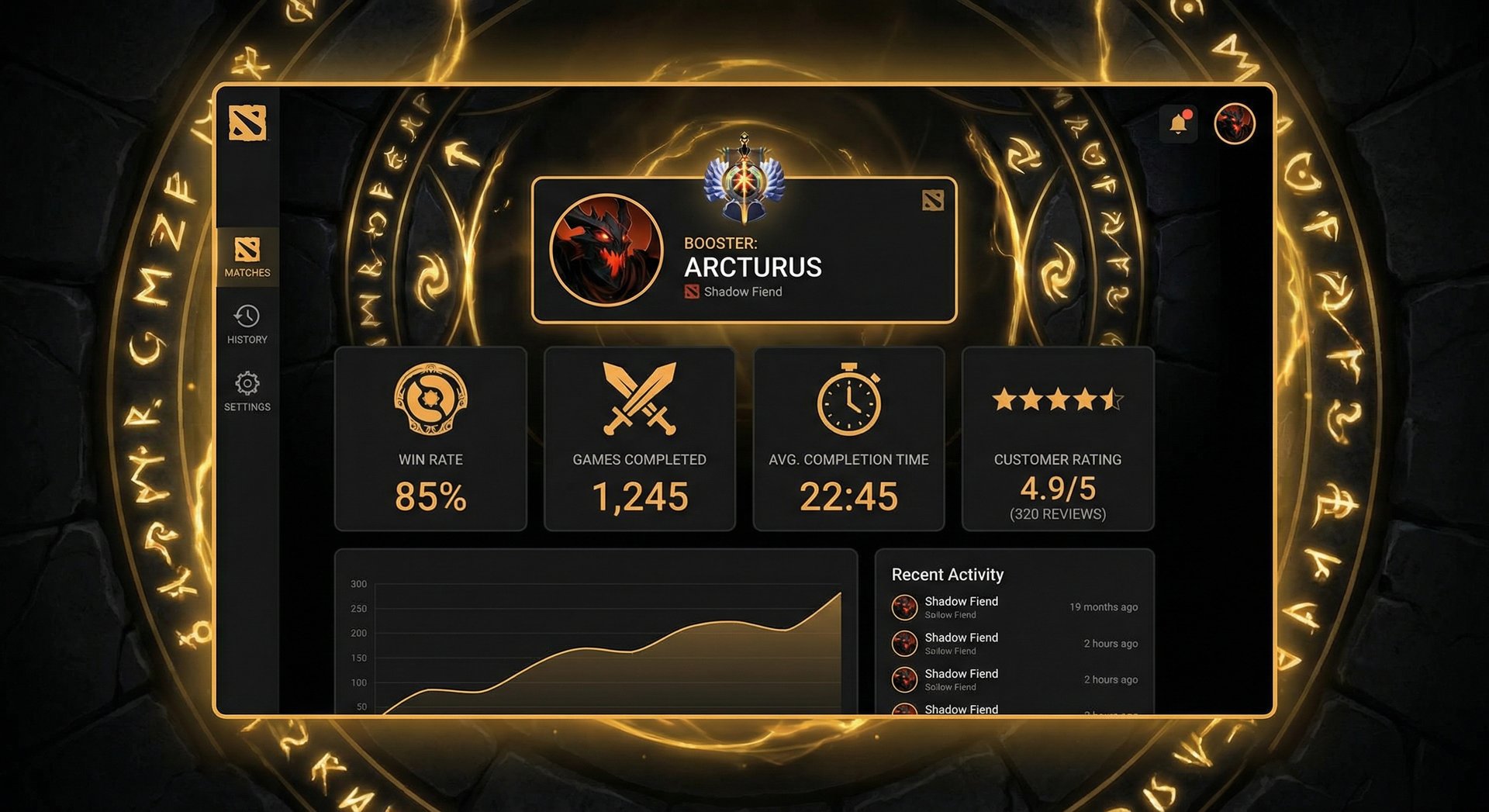
The quality of any dota 2 mmr boosting service lives and dies with its boosters. At Team Smurf, the selection process is rigorous:
Minimum Requirements
- Immortal rank (5,500+ MMR minimum): Most of our boosters are 6,000-8,000+ MMR with leaderboard experience
- Proven track record: A minimum of 500 verified ranked wins with at least 60% lifetime win rate
- Account age: Booster accounts must be at least 2 years old with extensive match history
- Behavioral score: 10,000+ required — we don’t employ toxic players
- Communication skills: Boosters must be responsive and professional in customer interactions
The Vetting Process
- Application review: Dotabuff/OpenDota profile analysis, win rate verification, hero pool assessment
- Trial period: New boosters start with lower-bracket orders and must maintain 80%+ win rates
- Ongoing monitoring: Win rates, customer feedback, and game logs are reviewed regularly
- Performance benchmarks: Boosters who fall below performance thresholds are retrained or removed
- Security compliance: All boosters agree to strict security protocols regarding customer accounts
The result? When you buy dota 2 mmr boost from Team Smurf, you’re getting a vetted professional — not a random Discord mercenary.
Timeline Expectations Per Rank Bracket
One of the most common questions we get is: “How long will my boost take?” The answer depends on several factors, but here’s a realistic timeline table based on thousands of completed orders:
Typical Boost Timeline Table (Solo Boost)
| Starting Bracket | Target Bracket | MMR Gap | Estimated Games | Estimated Time | Typical Win Rate |
|---|---|---|---|---|---|
| Herald (0-770) | Guardian (770-1,540) | ~770 | 20-30 | 2-4 days | 90%+ |
| Guardian | Crusader | ~770 | 22-32 | 2-4 days | 88-92% |
| Crusader | Archon | ~770 | 25-35 | 3-5 days | 85-90% |
| Archon | Legend | ~770 | 28-38 | 3-6 days | 82-88% |
| Legend | Ancient | ~770 | 30-45 | 4-7 days | 78-85% |
| Ancient | Divine | ~770 | 35-50 | 5-9 days | 72-80% |
| Divine | Immortal | ~1,000 | 45-70 | 7-14 days | 65-75% |
| Herald | Ancient | ~3,850 | 120-180 | 14-28 days | 82-88% avg |
| Crusader | Immortal | ~4,080 | 140-220 | 18-35 days | 75-85% avg |
Important notes about these timelines:
- Duo boosts typically take 40-60% longer than the timelines shown above due to lower win rates and scheduling requirements
- Timelines assume the booster plays 4-8 games per day — not round-the-clock grinding
- Individual results vary based on matchmaking conditions, server load, and game quality
- Higher brackets take longer not just because games are harder, but because queue times increase
- Weekend play may be slightly faster due to larger player pools and shorter queues
Account Security Measures
Account security is the #1 concern for anyone considering a dota 2 mmr boost — and it should be. Your Steam account likely contains hundreds or thousands of dollars in games, items, and history. Here’s how legitimate services protect it:
Before the Boost
- Encrypted credential transmission: Your login details should never be sent via plain text (Discord DMs, email). Reputable services use encrypted forms or secure portals
- VPN matching: The booster connects from a VPN server in your geographic region to avoid triggering Steam’s location-based security
- Steam Guard coordination: Two-factor authentication codes are handled securely through real-time communication, never stored
- Offline mode: Boosters set your status to offline so friends don’t notice unusual activity
During the Boost
- No item trading: Reputable boosters never touch your inventory. Period. Any service that requires you to “unlock” your inventory is a red flag
- No friend list changes: Your social connections remain untouched
- No settings modifications: Game settings, profile information, and account details stay as-is
- Session logging: Every login, game, and action is logged for accountability
After the Boost
- Mandatory password change: You should always change your password immediately after a solo boost is completed
- Enable Steam Guard Mobile: If not already active, enable mobile authentication for maximum protection
- Review login history: Check Steam’s “Recent Login Activity” to verify the booster’s sessions
- Credential purging: Reputable services delete your credentials from their systems after completion
At Team Smurf, we’ve completed thousands of boosts with zero account theft incidents. Our boosters undergo background checks and are contractually bound to security protocols. Read more about account safety in our dedicated guide: Is Dota 2 Boosting Safe?
What Happens During a Boost
Let’s peek behind the curtain. Here’s what a typical day of a solo boost looks like from the booster’s perspective:
A Day in the Life of a Team Smurf Booster
Session 1 (Morning): 3-4 games
The booster logs into your account using the VPN-matched connection. They check your current MMR, review recent match history to understand your typical hero pool and role preferences, and begin queueing. The first game of a session is often treated as a “warm-up” — the booster plays a comfort hero to get into rhythm.
Typical heroes at lower brackets: Mid-dominant heroes like Huskar, Templar Assassin, or Storm Spirit that can single-handedly control the game. At higher brackets, the hero pool shifts to more team-oriented picks like Invoker, Puck, or Ember Spirit.
Break (1-2 hours): Mental rest is critical. Even Immortal players experience performance degradation after 4+ consecutive games. This break keeps win rates optimal.
Session 2 (Afternoon): 3-4 games
The second session continues the climb. If the first session had any losses (it happens — Dota is inherently chaotic), the booster adjusts their approach. Maybe they switch roles, ban different heroes, or adjust their playstyle to the specific challenges of the bracket.
Progress Update: After Session 2, you receive a message with your current MMR, games won/lost, and any relevant notes (“Your bracket has a lot of Pudge spammers, so I’ve been banning it every game”).
Session 3 (Evening — optional): 2-3 games
If progress is on schedule, a third session may be added. If the day’s win rate has been lower than expected, the booster may call it early and resume fresh the next day. Forcing games through tilt or fatigue is the #1 cause of unnecessary losses in boosting, and professional boosters know when to stop.
What About Duo Boosts?
Duo sessions are coordinated around your schedule. You and the booster agree on play times (typically 2-4 hour blocks), party up, and queue together. During the game, the booster typically takes a high-impact role (mid or carry) while communicating key decisions — rotations, power spikes, objective timing — through voice chat.
Many customers report that duo boosting sessions feel like intensive coaching. You’re not just passively gaining MMR — you’re absorbing decision-making patterns from someone who plays at the highest level. If you’re interested in pure coaching without the boosting component, check out our Dota 2 Coaching service.
Post-Boost Tips to Maintain Your New Rank
Getting boosted is only half the equation. Maintaining your new rank requires deliberate effort. Here are evidence-based strategies from our Immortal-rank analysts:
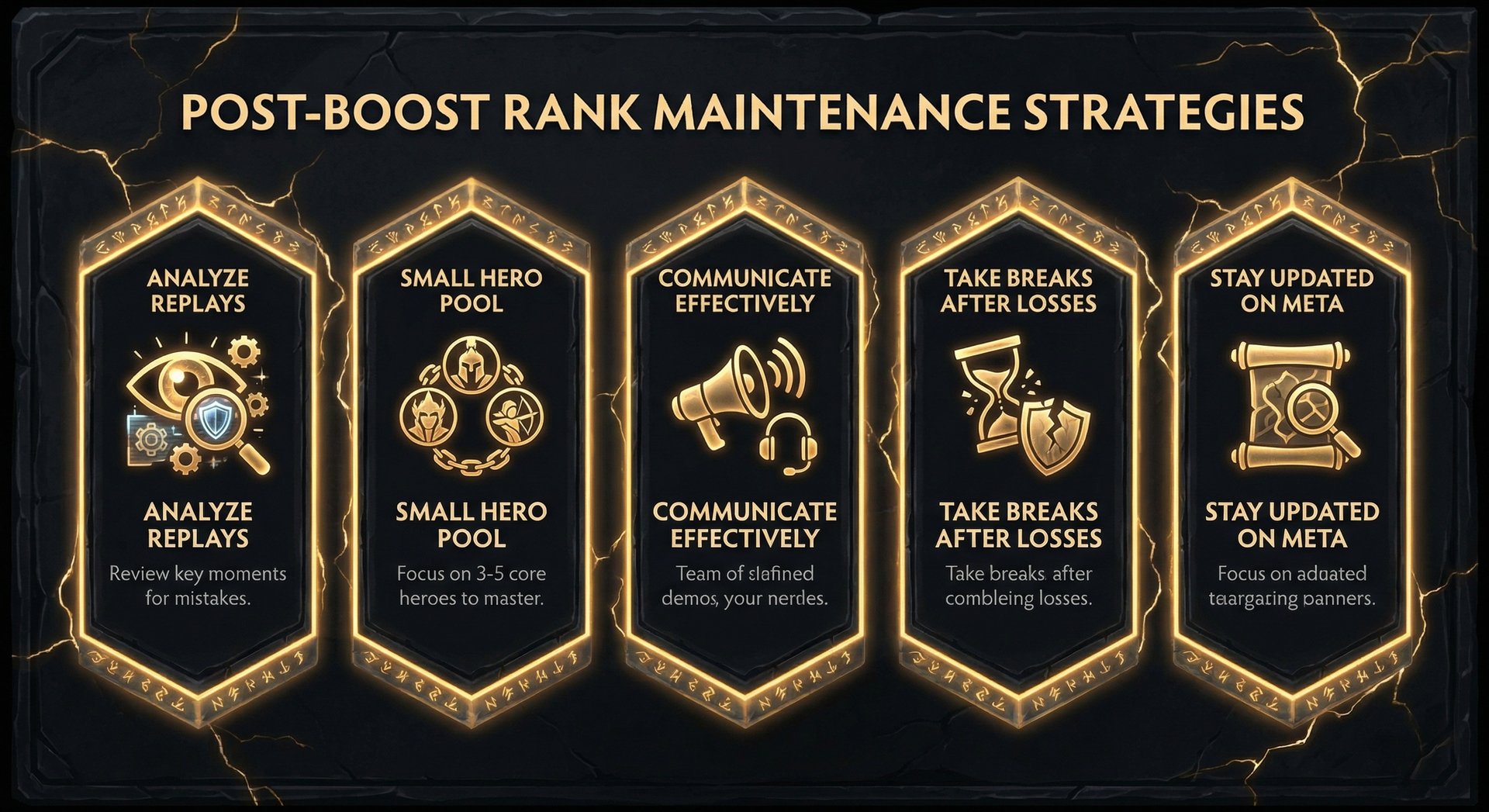
1. Narrow Your Hero Pool
At your new, higher rank, you’ll face stronger opponents. This is not the time to experiment with new heroes. Pick 3-5 heroes you’re genuinely comfortable with and focus exclusively on those in ranked. Versatility is a luxury you earn once you’ve stabilized at your new MMR.
2. Study Your Boost Replays
If you had a solo boost, you now have a goldmine of educational content: replays of an Immortal-rank player winning games at your bracket on your account, with your heroes, in your games. Watch these replays and note:
- Itemization choices and timing
- Map movements and rotation patterns
- When they farm vs. when they fight
- Ward placement and vision control
- How they handle losing lanes
3. Play During Off-Peak Hours
Counter-intuitive, but effective: games during off-peak hours tend to have less variance in player quality. The late-night crowd is often more consistent (dedicated players) versus peak hours when you get a wider mix of casual, tilted, and distracted players.
4. Maintain a Positive Behavior Score
Your behavior score directly affects game quality. At higher brackets, the difference between 9,000 and 10,000+ behavior score games is dramatic. Never flame, never abandon, always commend good teammates. This isn’t just moral advice — it’s a strategic advantage.
5. Limit Your Daily Ranked Games
A common post-boost mistake is immediately grinding 8+ ranked games in a day. This leads to fatigue, tilt, and unnecessary losses. Limit yourself to 3-5 ranked games per session. If you lose 2 in a row, stop for the day. Your MMR will thank you.
6. Focus on One Role
Role queue exists for a reason. Specialize in one position and queue exclusively for it. You might wait longer, but the quality of your games — and your consistency within them — will be significantly higher.
7. Use the Mute Button Liberally
At higher brackets, communication becomes more important, but toxic communication is still communication you should ignore. If a teammate is flaming, mute them instantly. Don’t engage. The mental clarity of a muted game is worth more than any callouts a toxic player might provide.
8. Consider Coaching
If you find yourself struggling to maintain your new rank after 20-30 games, a few coaching sessions can make a massive difference. A coach can identify specific habits that are costing you games at your new bracket — things you might not notice on your own.
Red Flags in Boosting Services
The Dota 2 boosting market includes legitimate businesses and outright scams. Here’s how to tell the difference:
Major Red Flags
- Prices that seem too good to be true: If a service is charging $5 for 1,000 MMR, something is wrong. Quality boosters command fair rates. Suspiciously cheap services often use account theft or lobby manipulation
- No website or professional presence: Discord-only “services” with no website, no reviews, and no accountability should be avoided entirely
- Requesting inventory access: No legitimate boost requires you to unlock your Steam inventory or trade items
- No communication after payment: If the service goes silent after receiving payment, you’ve likely been scammed
- Guaranteeing 100% win rate: Nobody wins 100% of Dota games. Any service claiming this is lying
- Pressuring you to pay via cryptocurrency or gift cards: These payment methods are non-reversible, which is exactly why scammers prefer them
- No refund policy: Legitimate businesses stand behind their product. No refund = no accountability
- Asking for your Steam Guard permanently: Temporary code sharing during login is normal; requesting permanent access to your authenticator is not
Yes Green Flags
- Professional website with secure checkout: SSL encryption, established payment processors
- Verified reviews: Trustpilot, independent review sites, or verifiable testimonials
- Clear refund and guarantee policies: Written, accessible, and fair
- Responsive customer support: Live chat, ticket systems, or responsive messaging
- Transparent pricing: No hidden fees, clear breakdown of costs
- Progress tracking: Real-time or regular updates on your boost’s status
- Post-boost support: The relationship doesn’t end at completion
How to Choose the Right Boosting Service
With dozens of services advertising dota 2 mmr boost options, here’s a practical framework for making your choice:
Step 1: Check Their History
How long has the service been operating? Services that have been around for 3+ years have proven their reliability through market cycles. Team Smurf has been serving the Dota 2 community for years with a consistent track record.
Step 2: Read Reviews — But Smartly
Look for reviews on independent platforms (Trustpilot, Reddit, independent review sites), not just testimonials on the service’s own website. Pay attention to reviews that mention specific details — these are more likely genuine than generic “great service 5 stars” reviews.
Step 3: Test Customer Support
Before placing an order, reach out to customer support with a question. How quickly do they respond? Are they knowledgeable? Do they pressure you to buy immediately, or do they provide helpful, honest information? This interaction is a strong predictor of your overall experience.
Step 4: Compare Pricing Fairly
Don’t just compare total prices — compare value. A slightly more expensive service with better boosters, faster completion, and genuine security measures is a better investment than a cheap service that takes twice as long and puts your account at risk. See our complete cost guide for fair market pricing.
Step 5: Verify Security Practices
Ask specifically about their security protocols. Do they use VPNs? How are credentials handled? What’s the password-change procedure? A service that can answer these questions confidently and in detail is one that takes security seriously.
Final Thoughts: Is a Dota 2 MMR Boost Right for You?
Let’s be honest: boosting isn’t for everyone. If you’re a player who genuinely enjoys the grind, who has the time to play 30+ ranked games per week, and who values the journey over the destination — you don’t need a boost. The climb is part of the experience, and there’s nothing wrong with taking the slow road.
But if you’re one of the millions of Dota 2 players who:
- Don’t have 500 games’ worth of time to reach your natural rank
- Have been genuinely impacted by external factors that dropped your MMR
- Need a specific rank for professional or content-creation purposes
- Want to play at a competitive level without the months-long grind
- Are returning to the game and need to skip the low-bracket re-calibration slog
Then a professional dota 2 mmr boosting service like Team Smurf can save you hundreds of hours of frustration and get you into the games you actually want to be playing.
The key is choosing the right service — one with vetted boosters, robust security, transparent pricing, and genuine customer support. If you’ve read this far, you now have every piece of information you need to make that choice confidently.
Ready to start your climb? Browse our MMR Boost packages or visit our homepage to explore all of our Dota 2 services.
Frequently Asked Questions
Ready to Start Your MMR Climb?
Team Smurf offers the most comprehensive Dota 2 boosting service — Immortal-rank boosters, maximum safety, transparent pricing.
Written by Team Smurf’s Immortal-rank analysts — Last verified February 2026