

Medal Demotion Rules: Can You Actually Lose Your Medal?

Short answer: yes, you absolutely can lose your medal in Dota 2. Valve does not give you a permanent badge just for reaching a bracket — your visible rank tracks your current MMR, and if that MMR drops below the floor for your medal tier, your badge demotes. No grace period, no hidden shield, no exceptions.
The confusion around demotion is understandable. The system has changed several times since ranked matchmaking launched in 2017, and plenty of outdated guides still describe protections that no longer exist. This guide covers how demotion actually works in 2026, the exact MMR thresholds where each medal can fall, what happened to medal protection, and the practical steps that actually prevent you from dropping.
What This Guide Covers
Can You Actually Lose Your Medal?
Yes — and the mechanism is simpler than most players expect. Your medal badge in Dota 2 is not a trophy you earn and keep forever. It is a live reflection of your current MMR bracket. The moment your MMR drops below the lower boundary of your current tier, the badge changes to reflect the tier you are now in.
This is a deliberate design choice by Valve. Ranked matchmaking is supposed to put you in games where everyone is at roughly your current skill level. If your badge stayed at Ancient forever after a brief visit to that bracket, you would be inflating your lobby quality with players who are no longer Ancient-level. The badge moves with your MMR so that the system always attempts to match you with peers at your actual current level.
The important nuance is where the boundaries sit and what demotion actually looks like in practice. Losing one game does not demote you unless you happen to be sitting exactly at the boundary with one loss to spare. For most players, demotion happens after a sustained losing streak that pushes MMR below the tier floor — not from a single bad night.
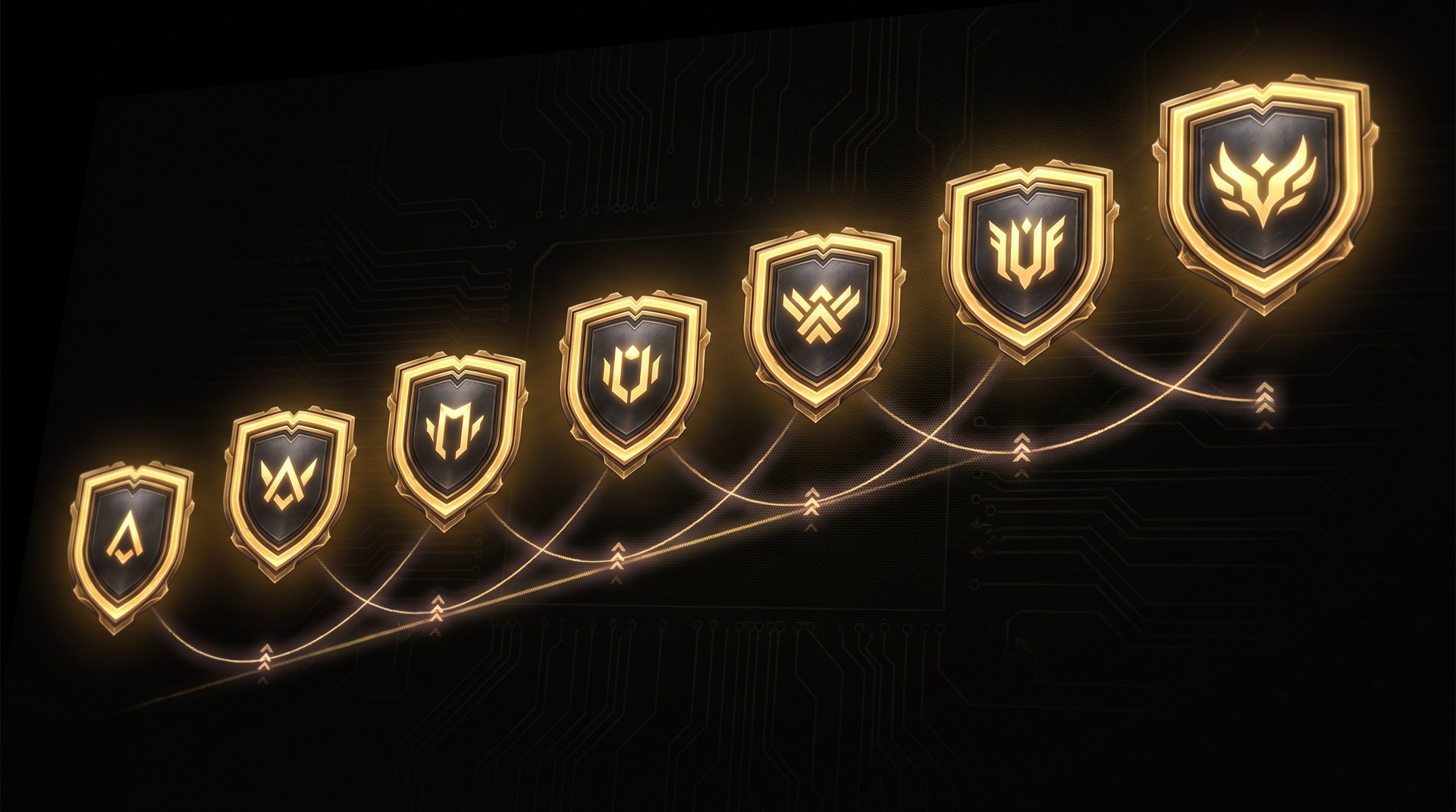
Dota 2 has eight medal tiers: Herald, Guardian, Crusader, Archon, Legend, Ancient, Divine, and Immortal. The first seven each have five stars, with each star representing approximately 154 MMR. The eighth — Immortal — uses a leaderboard position instead of stars and has its own demotion rules covered later in this guide.
How the Medal System Actually Works in 2026
Dota 2 uses eight medal tiers, each subdivided into five stars. Achieving a new star or a new medal badge requires your MMR to reach the threshold for that tier. The boundaries below are based on the ranges tracked by the community via Dotabuff and Stratz across multiple seasons and are consistent with Valve’s recalibration windows going back to the seasonal reset system introduced in 2018.
Understanding the MMR ranges is the foundation for understanding demotion. You cannot protect something you have not measured.
The Eight Tiers and Their MMR Ranges
| Medal | MMR Range | MMR Per Star | Stars |
|---|---|---|---|
| Herald | 0 — 769 | ~154 | 5 |
| Guardian | 770 — 1,539 | ~154 | 5 |
| Crusader | 1,540 — 2,309 | ~154 | 5 |
| Archon | 2,310 — 3,079 | ~154 | 5 |
| Legend | 3,080 — 3,849 | ~154 | 5 |
| Ancient | 3,850 — 4,619 | ~154 | 5 |
| Divine | 4,620 — 5,420 | ~160 | 5 |
| Immortal | 5,421+ | — (leaderboard position) | — |
Each tier spans roughly 770 MMR, divided evenly across five stars at approximately 154 MMR per star. Divine is slightly wider at the top because it transitions into the Immortal leaderboard, which has no fixed ceiling.
Immortal is the outlier. Once you cross the Immortal threshold (approximately 5,421 MMR, though this floor shifts slightly each season based on leaderboard population), you no longer show stars. Instead, your badge displays your current leaderboard position within your region — which rises and falls game by game.
The implication for demotion is direct: every star boundary is a potential demotion point. If your MMR is at 2,310 (the very floor of Archon 1), a single loss worth 30 MMR puts you back at Guardian 5 (2,280). Your badge updates to reflect that immediately.
For a complete breakdown of every MMR value per star across all eight tiers, the Dota 2 MMR Table 2026 guide covers each bracket in detail. Bookmark it alongside this guide — the two together give you a full picture of where you stand and where the danger zones are.
What Triggers a Demotion
Demotion is triggered by one thing: your ranked MMR dropping below the floor of your current medal tier. There are no secondary triggers — behavior score does not affect medal loss, abandons do not directly demote you (though they cost MMR through the low-priority penalty structure), and your hero pool or role selection does not change the mathematical threshold.
The floor is the lower boundary of the first star in each tier. Cross below it and your badge updates to the top star of the tier below. Here are the critical floor values and what happens when you cross them:
The MMR Floor for Each Medal
| Medal | Floor (Demotion Threshold) | Where You Land After Demotion |
|---|---|---|
| Guardian 1 | 770 MMR | Herald 5 (615 — 769) |
| Crusader 1 | 1,540 MMR | Guardian 5 (1,385 — 1,539) |
| Archon 1 | 2,310 MMR | Crusader 5 (2,155 — 2,309) |
| Legend 1 | 3,080 MMR | Archon 5 (2,925 — 3,079) |
| Ancient 1 | 3,850 MMR | Legend 5 (3,695 — 3,849) |
| Divine 1 | 4,620 MMR | Ancient 5 (4,465 — 4,619) |
| Immortal | ~5,421 MMR | Divine 5 (5,261 — 5,420) |
Landing at the top star of the tier below means you are immediately close to re-promoting. If you demote from Archon 1 to Crusader 5, you only need to recover roughly 154 MMR to climb back. The practical pain of demotion is therefore less about the single drop event and more about what a continued losing streak does across multiple stars or multiple full tiers.
One underappreciated demotion scenario: mid-star demotions. You do not need to drop to an inter-medal boundary to see your star count drop. Losing 154 MMR from the middle of any star drops you a full star within the same medal. For players tracking their rank carefully, watching the star count drop is often the first warning sign that the floor is approaching.
How Many Losses Before You Demote?
This is the question most players actually want answered. The calculation depends on two variables: how much MMR you gain or lose per game, and how much buffer you have above the current tier floor.
The Math Behind Each Game’s MMR Change
Dota 2 uses a Glicko-based uncertainty system alongside its core Elo-style rating. The practical result for most players in established ranked accounts is gains and losses in the range of 20 to 30 MMR per game — consistently cited by the community as approximately 25 to 30 MMR for a typical solo ranked match. Accounts with higher uncertainty (new accounts, accounts returning after a long break, or accounts recalibrating at the start of a new season) can see larger swings of 35 to 50+ MMR per game until the system stabilizes.
Using 30 MMR per loss as a working estimate, here is how many games it takes to demote from various positions:
| Starting Position | Games to Demote (pure losing streak) | Buffer Above Floor |
|---|---|---|
| Archon 5 top of tier (~3,079 MMR) | ~26 losses | ~769 MMR |
| Archon 3 mid-tier (~2,618 MMR) | ~10 losses | ~308 MMR |
| Archon 1 bottom of star (~2,310-2,464 MMR) | 1 to 5 losses | 0 to ~154 MMR |
| Any medal, 40% sustained winrate | Slow drain, ~net -6 per game | Varies |
The pure losing streak column represents worst-case: zero wins during the streak. More realistic is a player tilting at 35-40% win rate over a 10 to 20 game stretch, generating a net loss of about 6 to 9 MMR per game on average. At that rate, dropping 300 MMR — roughly two full stars — takes 33 to 50 games at a deteriorating win rate. This is why slow MMR drift is more dangerous than a single bad session: it is harder to notice until you have already demoted by a full medal.
Party Queue Changes the Numbers
Party ranked games historically award and deduct MMR at rates that depend on the MMR spread within the party. Playing with friends who are significantly higher or lower MMR than you can result in asymmetric gains and losses that differ from the solo queue baseline. The safest approach for rank protection is solo queue or duo queue with a player at a very similar MMR — ideally within 500 MMR of your own bracket.
If you are seriously trying to protect a bracket — or to reclaim a lost medal quickly — reading through how the MMR system handles party composition is worth your time before you queue. Our MMR boosting guide covers this in full, including the role party MMR spreads play in determining your real effective gain rate.
The Winrate You Actually Need to Stay Stable
A 50% win rate, at equal MMR gain and loss, keeps you at the same MMR over time. But it does not feel that way in practice because of variance. A 50% win rate over 100 games can swing you 300+ MMR in either direction just from clustering of wins and losses.
To climb and protect yourself from demotion simultaneously, you need a sustained win rate above 52-53% to meaningfully build buffer away from tier floors. The difference between 50% and 53% over 100 games is approximately 90 MMR — enough to push you from the danger zone of a low star into the safer mid-star range where a single bad run will not cost you a full medal.
Immortal Demotion — The Special Case
Immortal demotion is real, and it happens more often than most players expect. Because Immortal has no stars — just a leaderboard position within your region — there is only one question: is your MMR above the Immortal threshold or below it?
When Immortal Players Fall Back to Divine
The Immortal floor is approximately 5,421 MMR, but this number is not entirely fixed. Each season, Valve adjusts the threshold based on the number of active players hitting that bracket. In regions with larger player populations such as SEA and EU, the Immortal floor can sit slightly higher because more players are competing for leaderboard positions. In smaller regions it may be lower. Community trackers on Stratz and Dotabuff document the current floor each season as data becomes available.
An Immortal player who drops below the regional floor demotes to Divine 5 — the tier immediately below. This is not a hypothetical: it is a documented outcome that affects players every season, particularly those who calibrate into Immortal early in a season with a lucky winning streak and then face the harder lobby quality at that tier consistently for the rest of the season.
The leaderboard position itself rises and falls with every game. A player who is Immortal rank 500 in their region and then goes on a 10-game losing streak may end up at rank 800 or 1,000 — still Immortal, but displayed with a higher number. The badge itself only changes (to Divine) if the underlying MMR drops below the Immortal threshold.
For Immortal players, the practical implication is that maintaining MMR above the floor requires active management. Unlike lower bracket players who have a 770 MMR spread within their tier to absorb variance, Immortal players have a floor but no ceiling below their best, meaning every bad streak directly risks the badge itself.

Does Medal Protection Still Exist in 2026?
This is the question that causes the most confusion, largely because the answer has changed several times since the ranked system launched. Players who learned Dota 2 in 2018 or 2019 often have memories of some protection existing. They are not wrong — it did. But it does not anymore.
The History of Rank Protection in Dota 2
When Valve first introduced the seasonal medal system in 2018, there was a period where the badge you earned at calibration was treated as a floor for the early part of the season. You could not drop below your calibrated medal for a certain number of games. This protection existed to ease the transition to the seasonal recalibration system and prevent immediate anxiety about losing the badge you just earned from calibration.
Over subsequent seasons, this protection was progressively reduced. Valve determined that the protection was creating visible inflation at each tier boundary, where players would play more aggressively knowing they could not demote and often ended up in longer loss streaks. The protection was also exploited: players would use the protection window to play on behalf of others knowing demotion was impossible.
The current system — in place from 2023 onward and unchanged through the 2026 recalibration windows based on community documentation — has no mid-season medal protection. Your badge updates with your MMR bracket at all times, with no cushion and no delay.
What Does NOT Protect Your Medal in 2026?
- Winning a game: one win does not create a “protection charge” against a future loss
- Reaching a new star or medal: there is no grace period after gaining a new tier
- Account age or hours played: veteran accounts have no special protection mechanics
- Behavior score: a high behavior score improves lobby quality but does not protect your MMR from falling
- Role queue selection: playing your best role increases win rate, which indirectly protects MMR, but there is no explicit role-based protection mechanic in the system
- Dota Plus subscription: the premium subscription provides additional in-game stats and hero tracking but zero mechanical benefit to MMR protection
What Season Start Actually Changes
At the start of each recalibration window, your badge does get reset to an uncalibrated state — but this is not protection. It is a reset followed by a new calibration. Your MMR shifts from the previous season value to a new calibrated value after playing approximately 10 placement games. During calibration the MMR changes per game are often larger because the system treats your rating uncertainty as higher. Once calibration ends, the standard demotion rules apply with no buffer.
The one real floor that exists — and it matters only at the very bottom — is zero MMR. A Herald player at 0 MMR cannot drop further. But this is only relevant to the lowest bracket and offers no comfort to anyone trying to protect a medal above Herald.
Recalibration and Your Medal
Dota 2 runs recalibration windows at the start of each major ranked season. These windows have historically occurred every few months, typically aligned with major game patches and ranked season rollover events. The October 2026 recalibration is expected to follow the same pattern based on previous seasonal schedules.
What Happens to Your Medal During Calibration
When a recalibration window opens, your existing badge is greyed out and shown as uncalibrated until you complete the placement games. Your underlying MMR does not disappear — the system uses it as the baseline for your calibration results. Players who ended the previous season at 3,500 MMR will calibrate back somewhere in the Legend bracket after placing, not at Herald.
How much your MMR shifts during calibration depends on your performance in the placement games and the system’s uncertainty calculation for your account. Strong calibration performance, meaning a high win rate alongside good personal stats in games the system tracks, can boost your MMR by 100-300 points above your previous season end value. Poor calibration performance can drop it by a similar margin. The effect is not catastrophic in either direction precisely because the system anchors calibration results to your previous season MMR — it is a modifier on top of where you were, not a fresh start from zero.
Strategic Preparation for Recalibration
The strategic implication is this: if you are sitting at a medal floor at the end of a season, push your MMR up by at least 200-300 points before the season ends. That buffer means even a poor calibration run will not immediately drop your new season badge below your current medal level.
Finishing a season at Archon 3 (2,618 MMR) rather than Archon 1 (2,310 MMR) gives you roughly two full stars of safety margin going into calibration. Those two stars represent roughly 300 MMR of downside protection. Combined with the calibration anchor, you would need both a bad calibration run and continued post-calibration losses to drop below the Archon floor.
This is also why the two weeks before a recalibration window closes are the highest-demand period for rank services. Players who want to enter the new season at a higher bracket — or who want a meaningful buffer above the floor of their current medal — often use the pre-recalibration window to build that buffer. You can read more about the timing and strategy in our comparison of Dota 2 boosting services that handle this exact scenario.
Five Practical Ways to Protect Your Medal
Knowing how demotion works is step one. Step two is building habits that reduce your demotion risk in practice. These five approaches come from what our boosters and coaches at TeamSmurf observe across thousands of hours of ranked games every month across all brackets.
1. Track Your Buffer, Not Just Your Medal
Most players focus on how far they are from the next star or the next full medal. Flip this perspective. When you are in a losing streak, the number that matters is how far above the demotion floor you are sitting. Open your Dotabuff or Stratz profile, note your current MMR, and subtract the floor for your current medal tier. That is your demotion buffer. When this number drops below 100 MMR, treat it as a warning signal and consider stopping ranked for the night.
2. Tighten Your Hero Pool When You Lose Three Games in a Row
Losing streaks often coincide with either playing unfamiliar heroes or counter-picking into losing positions against better enemy coordination. The moment you hit three consecutive losses, stop experimenting. Return to the two or three heroes you know best in your primary role. Comfort picks have measurably higher individual win rates than situational counter-picks in almost all brackets below Divine, because mechanical familiarity consistently outperforms theoretical matchup advantages at sub-Immortal play.
3. Stop at Three Consecutive Losses
This is the single most effective habit for MMR protection available to any player. Three consecutive losses correlates strongly with tilt — a state of measurably worse decision-making that further reduces win rate in subsequent games. Taking a 30-minute break after three losses, or stopping ranked for the day entirely, prevents the situation where a manageable 3-game losing streak compounds into a 7-game streak that erases a full star or more. The MMR you protect by not queuing while tilted is reliably worth more than the MMR you might gain in three more games.
4. Use Role Queue Consistently
Role queue forces players to commit to a lane role before the game starts, which reduces the frequency of team composition disasters in lower and mid brackets. Playing in your strongest role — rather than filling gaps that emerge in lobby drafts — directly increases your individual win rate. A carry player who fills support “because no one else will” is voluntarily reducing their own win rate every game. Role queue removes most of that pressure and keeps you on the role where your game knowledge is deepest.
5. Address the Mechanical Gap, Not the Symptom
If you have demoted more than once at the same tier boundary despite changing your queuing habits, the issue is almost certainly mechanical — a knowledge or execution gap specific to the lobby quality at that MMR level. A targeted coaching session from a coach who regularly plays at the tier above identifies those gaps in a single session. One coaching session that correctly diagnoses your three biggest in-game errors is worth more than 50 additional ranked games where you reinforce the same mistakes without external feedback.
If your schedule does not allow the grinding required to climb out of a bracket you have fallen into, a professional Dota 2 MMR boost from a specialist service like TeamSmurf can recover lost ground without disrupting your account standing. Our boosters operate with VPN matching to your region, use offline mode throughout every session, and play exclusively on Dota 2 accounts — the full safety profile that amateur services cannot provide.
Slipping Toward Demotion? We Fix That.
TeamSmurf boosters play at Immortal level every day. If you are sitting at a medal floor and do not have time to grind back, we handle the recovery while you focus on the rest of your life.
Get Your MMR Back Book a Coach Instead


