Stuck in Dota 2 Low Priority The Complete Guide to Getting Out Fast

Few things in Dota 2 are more frustrating than being thrown into Low Priority (LP). The queue times are longer. The game mode is restrictive. Your teammates are tilted, AFK, or actively griefing. And worst of all — you need to win your way out, not just play your way out. Every loss resets your progress and traps you deeper in one of the most miserable experiences in competitive gaming.
Whether you landed in LP because of a power outage, an internet disconnect, a bad streak of reports, or — let’s be honest — because you tilted and abandoned a game you were losing, this guide covers absolutely everything you need to know about Dota 2 low priority removal. We’ll explain the exact mechanics Valve uses, the fastest heroes and strategies to win LP games, DIY tips for escaping on your own, and when it makes sense to use a professional Dota 2 LP removal service.
Let’s get you out.
Table of Contents
- What Is Low Priority in Dota 2?
- What Triggers Low Priority? Every Cause Explained
- Exact LP Mechanics: Games, Modes, and Win Requirements
- The Behavior Score–Low Priority Connection
- Best Heroes for Winning LP Games Fast
- Winning Strategies for LP Games
- DIY Tips: Getting Out on Your Own
- When to Use a Professional LP Removal Service
- How LP Removal Services Work
- How to Avoid Low Priority in the Future
- The LP–Behavior Score Death Spiral
- Low Priority Myths Debunked
- FAQ
1. What Is Low Priority in Dota 2?
Low Priority is Valve’s punishment queue for players who negatively impact the Dota 2 experience. When you’re placed in LP, several things change about your matchmaking:
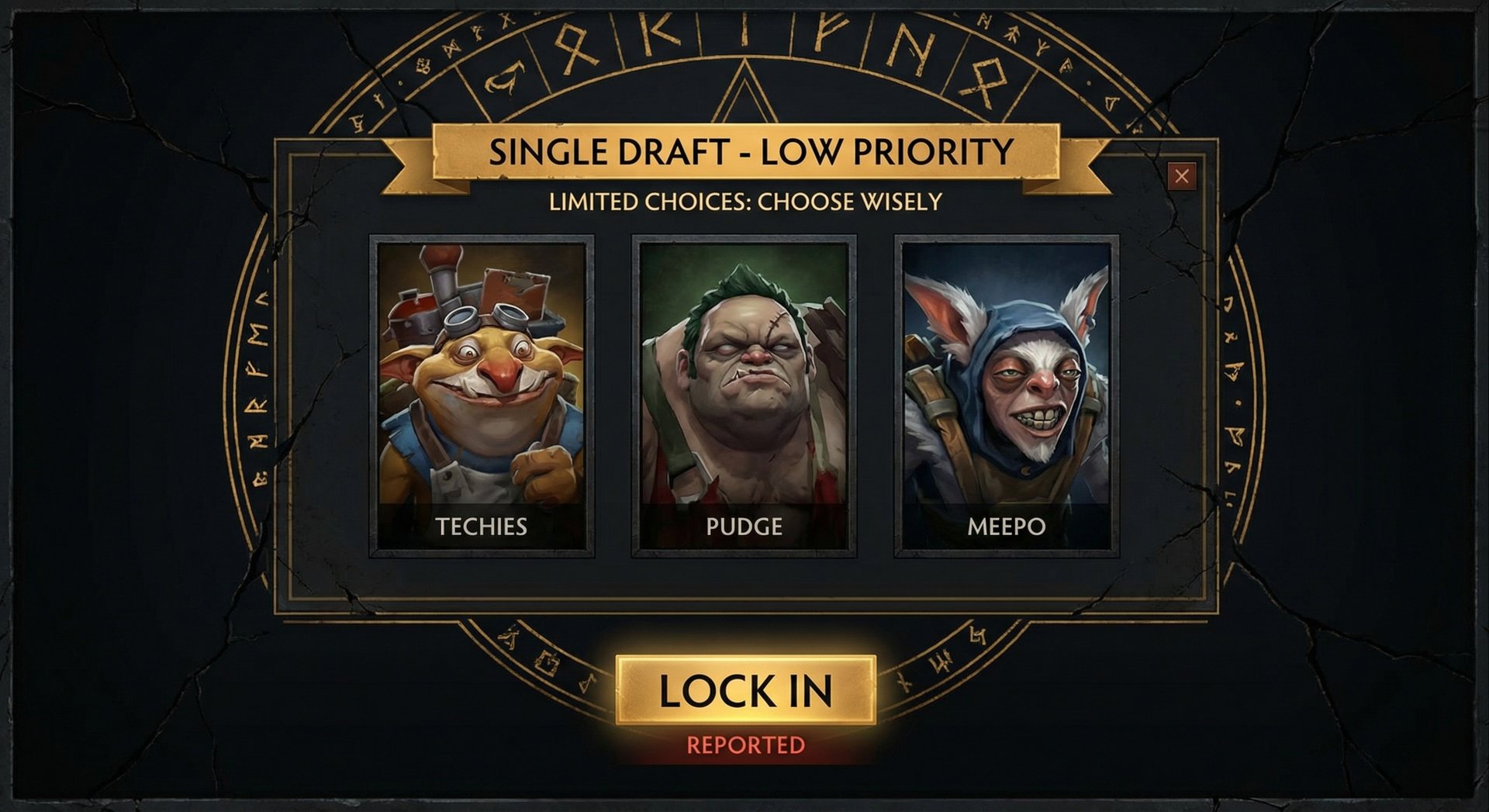
- You can only play Single Draft — you get a random selection of three heroes (one from each attribute) and must pick from those three. No banning phase, no comfort picks.
- You must WIN a set number of games to escape. Losses don’t count toward your progress. This is the critical difference — you can’t just AFK through games.
- Queue times are significantly longer — sometimes 10-30+ minutes depending on your region and behavior score.
- Match quality is abysmal — you’re matched with other LP players, many of whom are toxic, tilted, or intentionally feeding.
- No MMR is gained or lost — LP games are unranked and don’t affect your medal or rating.
- No Battle Pass progress — challenges, quests, and seasonal content don’t track in LP games.
In short, LP is designed to be unpleasant enough that you’ll modify your behavior to avoid returning. For most players, it works. But for some, LP becomes a recurring nightmare — especially when combined with a dropping behavior score.
A Brief History of LP in Dota 2
Low Priority has existed since the earliest days of Dota 2. Over the years, Valve has made it progressively harsher:
- Original system (2012-2014): LP required you to play a set number of games — wins or losses both counted. You could speedrun it by picking a hero, walking down mid, and ending games in 15 minutes.
- Win requirement added (2015): Valve changed LP to require wins, not just games played. This was a massive change that dramatically increased the time required to escape.
- Single Draft restriction (2016): Previously you could play All Random or other modes. Valve locked LP to Single Draft only, preventing players from picking their best heroes.
- Behavior score integration (2017-present): LP became more tightly integrated with the behavior score system, creating a feedback loop where LP further damages your score.
Each change has made LP harder to escape, which is why understanding the exact mechanics is so important.
2. What Triggers Low Priority? Every Cause Explained
There are several ways to land in Low Priority. Understanding exactly what triggers it helps you avoid it — and helps you understand why you’re there now.
Cause #1: Abandoning Games
This is the most common and most straightforward trigger. You abandon a game when:
- You disconnect and don’t reconnect within 5 minutes. The game marks you as abandoned regardless of the reason — internet outage, power failure, PC crash, or intentional leave.
- You accumulate 5+ minutes of total disconnect time during a single match (even if you reconnect between disconnects).
- You fail to pick a hero during the drafting phase and the game fails to start because of you.
- You sit in the fountain AFK and gain zero XP for 5 consecutive minutes (the game treats this as a soft abandon).
How many abandons trigger LP?
| Scenario | LP Penalty |
|---|---|
| First abandon in recent history | Warning — no LP (unless behavior score is already low) |
| Second abandon within ~20 games | 1-3 LP games |
| Third+ abandon in short period | 3-5 LP games |
| Abandon with behavior score below 5,000 | Often instant LP even on first abandon |
| Abandon during LP game | Additional LP games added to your penalty |
Key insight: Your behavior score acts as a buffer. A player with 10,000 behavior score might get one “free” abandon without LP. A player with 3,000 behavior score will likely get LP from a single abandon. This is why maintaining your behavior score is so critical.
Cause #2: Excessive Reports
When other players report you, those reports accumulate. If you receive too many reports within a rolling window of recent games (approximately the last 25 matches), you’ll be placed in LP.
The exact thresholds aren’t publicly documented by Valve, but extensive community testing suggests:
- Communication reports alone rarely trigger LP — they primarily affect your behavior score and can result in communication bans (mutes).
- Gameplay reports (intentional feeding, ability abuse, not playing assigned role) are weighted much more heavily.
- Party reports count as one report — if a 4-stack reports you, it counts as a single report, not four. Valve implemented this to prevent party abuse.
- Reports from players you’ve recently reported are given less weight (anti-retaliation measure).
- Approximate threshold: Receiving gameplay reports in 4-6+ of your last 25 games will typically trigger LP, though this varies based on your current behavior score.
Cause #3: Behavior Score Thresholds
If your behavior score drops below approximately 3,000, you enter a danger zone where the system becomes extremely punitive. Players with very low behavior scores (below 1,000) can be placed in LP with minimal additional triggers.
This creates the infamous LP–behavior score death spiral that we’ll discuss in detail later in this guide.
Cause #4: VAC and Game Bans
While not technically LP, Valve Anti-Cheat detections can result in temporary matchmaking bans that function similarly. Using third-party cheats, exploits, or scripting software will result in penalties far worse than LP — permanent bans.
Cause #5: Failing to Ready Up Repeatedly
This one is less known. If you repeatedly let the matchmaking accept timer expire (failing to click “Accept” when a match is found), you’ll receive escalating matchmaking cooldowns. While this doesn’t directly place you in LP, the cooldown timers increase exponentially: 5 minutes → 15 minutes → 30 minutes → 60 minutes → 24 hours.
3. Exact LP Mechanics: Games, Modes, and Win Requirements
Understanding the precise mechanics of Low Priority is essential for escaping efficiently. Here’s everything we know from years of experience and community research.
Number of Games Required
When you’re placed in LP, you’ll see a notification telling you how many wins are required:
| Penalty Level | Wins Required | Typical Cause |
|---|---|---|
| Light | 1 win | First offense, high behavior score |
| Moderate | 3 wins | Repeat offenses, moderate behavior score |
| Severe | 5 wins | Serial offenders, low behavior score |
The number of required wins has been observed to vary from 1 to 5, with 3 being the most common. The penalty scales based on:
- How many times you’ve been in LP recently
- Your current behavior score
- The severity of the offense (abandon vs. reports)
- How quickly you returned to LP after your last stint
Single Draft Mode
All LP games are played in Single Draft. Here’s how it works:
- Each player is offered 3 heroes — one Strength, one Agility, one Intelligence/Universal.
- The hero selection is random but seeded — you won’t necessarily get the same heroes if you requeue.
- There is no banning phase.
- You can swap heroes with teammates if they drafted a hero you want (and vice versa).
- The hero pool is the full hero roster — you might get offered Meepo, Chen, and Io, or you might luck into Wraith King, Juggernaut, and Zeus.
This randomness is what makes LP so frustrating. You can’t rely on your best heroes. You might get three heroes you’ve never played. And since your teammates are in the same boat, team compositions are often terrible — no supports, all carries, or five melee heroes.
How Wins Count
- Only wins reduce your LP counter. Losses have zero effect on your progress.
- If you abandon an LP game, your counter INCREASES. This is critical — rage-quitting an LP game makes your situation worse.
- If the game is “safe to leave” (someone else abandoned first), it still doesn’t count as a win even if your team finishes the game.
- All 10 players must be in LP for the game to count as an LP match. If the system can’t find 10 LP players, queue times extend dramatically.
Average Time to Escape LP
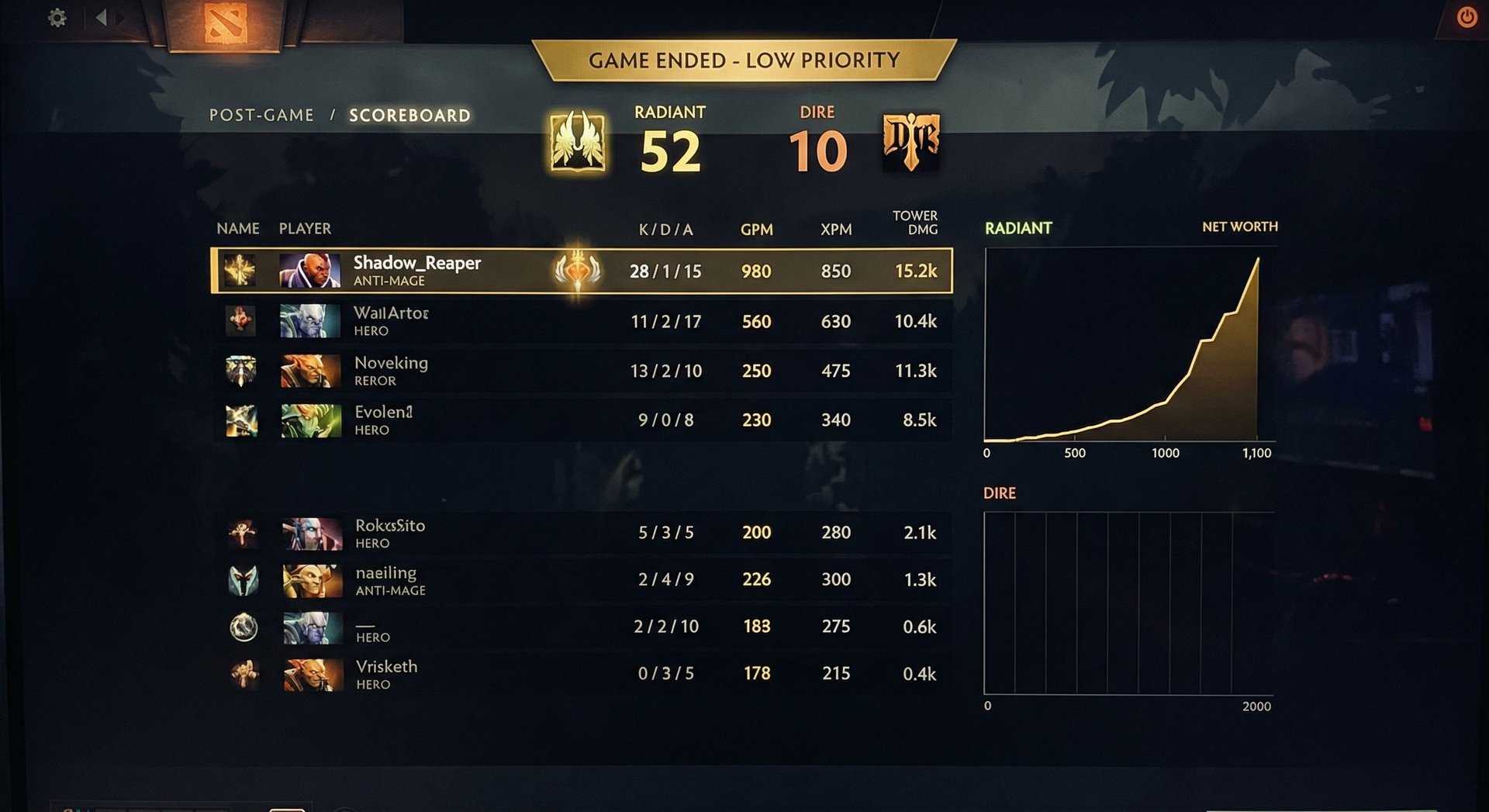
Based on data from thousands of LP removal cases at Team Smurf, here are realistic time estimates:
| LP Games Required | Average Player (solo) | Skilled Player (solo) | Professional Service |
|---|---|---|---|
| 1 win | 1-3 hours | 30-60 minutes | 20-40 minutes |
| 3 wins | 4-10 hours | 2-4 hours | 1-2 hours |
| 5 wins | 8-20+ hours | 4-8 hours | 2-4 hours |
The variance is enormous because LP games are inherently unpredictable. You might win three in a row, or you might lose seven straight because teammates abandon, grief, or simply have no idea how to play their randomly assigned heroes.
4. The Behavior Score–Low Priority Connection
Your behavior score and Low Priority are deeply intertwined. Understanding this connection is crucial for both escaping LP and preventing future trips.
How Behavior Score Affects LP Penalties
- 10,000 behavior score: You get maximum tolerance. A single abandon might not even trigger LP. Reports are weighted lightly against you.
- 7,000-9,999: Normal operation. Standard thresholds apply for abandons and reports.
- 5,000-6,999: Reduced tolerance. Fewer abandons/reports needed to trigger LP.
- 3,000-4,999: High risk zone. Almost any infraction triggers LP.
- Below 3,000: Danger zone. You’re one bad game away from LP at all times. Some players report being placed in LP seemingly at random at this level.
How LP Affects Your Behavior Score
Here’s where it gets ugly: being in LP further damages your behavior score. LP games tend to include more reports, more toxic behavior, and more abandons — all of which lower your score. This creates a vicious cycle:
- Low behavior score → easier to get LP
- LP games → more reports and toxic matches → behavior score drops further
- Escape LP with even lower behavior score → get LP again faster
- Repeat
This is the LP–behavior score death spiral that traps thousands of players. Breaking out of it requires not just escaping LP, but actively rebuilding your behavior score afterward. We’ll cover how to do that in our dedicated behavior score guide.
5. Best Heroes for Winning LP Games Fast
Since LP is Single Draft, you can’t choose your heroes. But when you DO get offered one of these heroes, pick them immediately. These are the heroes with the highest win rates and game-carrying potential in LP environments.
Tier 1: Auto-Pick These Heroes
| Hero | Why They Dominate LP | LP Win Rate* |
|---|---|---|
| Wraith King | Simple to play, tanky, two lives with Reincarnation, can carry with minimal farm, strong at all stages | ~58% |
| Zeus | Massive damage from safe distance, global ultimate for kill steals and assists, doesn’t need much farm to be effective | ~57% |
| Necrophos | Self-sustaining, tanky for an INT hero, Reaper’s Scythe deletes enemies, punishes overconfident LP players | ~56% |
| Bristleback | Nearly unkillable when played correctly, snowballs hard, punishes disorganized teams | ~56% |
| Abaddon | Aphotic Shield purges debuffs, Borrowed Time makes you nearly impossible to kill, can play any role | ~55% |
Tier 2: Strong LP Picks
| Hero | Why They Work in LP | LP Win Rate* |
|---|---|---|
| Juggernaut | Built-in magic immunity, healing ward for sustain, Omnislash devastates uncoordinated teams | ~55% |
| Viper | Lane dominator, slows make enemies easy targets, melts towers | ~54% |
| Ogre Magi | Extremely tanky support, easy to play, Bloodlust buffs your carry, Ignite harasses enemies | ~54% |
| Ursa | Enormous burst damage, solo Roshan potential, punishes isolated targets | ~54% |
| Spirit Breaker | Global ganking presence, bashes through BKB, creates chaos that favors your team | ~53% |
*Win rates are approximate, based on Team Smurf’s internal data from LP removal cases across all MMR brackets.
Heroes to AVOID in LP
Some heroes are terrible in LP environments. Even if you’re good at them normally, avoid these if possible:
- Meepo — Requires extreme micro and team coordination. LP teams won’t play around you.
- Chen — Needs team coordination and map awareness that LP players simply don’t have.
- Io — Tether-based hero that requires a partner who knows how Io works. Good luck finding that in LP.
- Techies — Games go too long, teammates will flame you, and LP players will walk into mines then report you.
- Oracle — Complex abilities that confused teammates will misinterpret. You’ll save someone with False Promise and they’ll report you for “griefing.”
The Golden Rule of LP Hero Selection
Pick the hero that can do the most with the least team coordination. Self-sufficient heroes that can farm, fight, push towers, and sustain themselves without relying on teammates are the key to escaping LP. You cannot count on your team for anything — not wards, not ganks, not coordinated teamfights.
6. Winning Strategies for LP Games
LP games are fundamentally different from normal Dota matches. The strategies that work in ranked won’t necessarily work here. Here’s how to approach LP games for maximum win rate.
Strategy #1: Mute Everyone Immediately
This might sound extreme, but it’s the single most important thing you can do. Mute all nine other players at the start of every LP game.
Why? LP chat is pure toxicity. Players will flame, blame, threaten to feed, and try to tilt you from minute zero. Engaging with them only hurts your mental state and increases your chances of getting reported (further damaging your behavior score). You need to play your best Dota, and you can’t do that while reading toxic garbage in chat.
Strategy #2: Pick Cores, Not Supports
In a normal game, playing support is noble and often game-winning. In LP, playing support is a trap. Here’s why:
- Your carry might be a player who got LP for feeding — they might feed again.
- Your mid might abandon if they die twice.
- Your offlaner might AFK jungle from minute 1.
- You need to be the player who can single-handedly win the game.
Pick a core hero (preferably position 1 or 2) from your three options. If all three are support heroes, pick the one that can transition into a core role (e.g., Silencer who steals INT, Lina who scales with items).
Strategy #3: End Games Early
LP games get worse the longer they go. More time = more chances for teammates to tilt, abandon, or throw. Your goal should be to close out games before 30 minutes.
- Pick heroes with strong mid-game power spikes.
- Push towers aggressively after winning fights.
- Don’t farm for a 6-slotted carry build. Get your core 2-3 items and start pushing.
- Take Roshan when possible — the Aegis is disproportionately powerful in LP because teams can’t coordinate to deal with it.
Strategy #4: Exploit LP Player Psychology
LP players are predictable in their behavior patterns. Use this to your advantage:
- Many LP players give up after falling behind early. Win your lane hard, and the enemy team might start fighting each other or abandoning.
- LP players tilt off kills, not objectives. If you kill the enemy mid twice, there’s a good chance they go AFK or start feeding. Focus early aggression on the most emotionally volatile enemy player.
- LP teams don’t push together. Split pushing is extremely effective because enemies will chase one hero around the map while you take towers elsewhere.
- LP players don’t buy detection. Invisible heroes (Riki, Bounty Hunter, Clinkz) are disproportionately effective in LP.
Strategy #5: Be Positive (Strategically)
If you choose not to mute everyone, at least be the most positive player on your team. Use the chat wheel to say “Well Played!” after good plays. Don’t flame anyone — even if they’re terrible. A single positive player can sometimes prevent the whole team from imploding.
But never argue. If someone flames you, mute them instantly. Don’t type back. Every second you spend typing is a second you’re not playing Dota.
7. DIY Tips: Getting Out on Your Own
If you want to grind out LP yourself, here are practical tips to maximize your efficiency.
Play During Peak Hours
LP queue times vary dramatically based on when you play. During peak hours (typically 5 PM — 11 PM in your region), queues are fastest because more LP players are online. Playing at 3 AM means 20-30 minute queues between games.
Party with a Friend
You can queue for LP games with a party. If you have a friend willing to queue with you (they’ll be placed in the LP queue too), this dramatically improves your chances:
- Coordinated dual-core strategy becomes possible.
- You have at least one teammate who won’t abandon or grief.
- You can communicate via voice chat for ganks and fights.
- Your friend can pick support and actually support YOU specifically.
Pro tip: If your friend has a high behavior score, the average behavior score of your LP matches may be slightly higher, resulting in marginally better teammates.
Warm Up Before Queuing
Don’t jump into LP cold. Play a bot match or two to warm up your mechanics. LP games require you to perform at your best despite tilting conditions. Coming in warmed up gives you an edge.
Take Breaks Between Losses
If you lose two LP games in a row, stop playing for at least 30 minutes. Tilt compounds in LP. Each loss makes you play worse, makes you more susceptible to flaming, and increases the chance of another loss. Break the cycle with a break.
Focus on One Role
Even though Single Draft limits your heroes, you should always try to play the same role — ideally a core role. If your three hero options are Crystal Maiden, Tidehunter, and Shadow Fiend, always take Shadow Fiend (the core) unless you genuinely can’t play mid.
Use the Hero Swap Feature
Many LP players don’t know about or forget the hero swap feature. If you see a teammate who got offered your best hero while you got offered theirs, use the swap function. It costs nothing and can dramatically improve your chances.
8. When to Use a Professional LP Removal Service
DIY LP removal works for many players, but there are situations where using a professional LP removal service is the smarter choice.
You Should Consider a Service When:
- You have 5 LP wins required — This can take an average player 10-20+ hours solo. A professional can complete it in 2-4 hours.
- You’ve been stuck in LP for days — If you keep losing and your behavior score keeps dropping, you’re in the death spiral. A fresh set of skilled hands breaks the cycle.
- Your behavior score is below 3,000 — At this level, LP match quality is so bad that even skilled players struggle. Professionals know how to navigate these nightmare matches.
- You have limited time — If you can only play a few hours a day and don’t want to spend all of them grinding LP, a service frees up your time.
- You’re tilted beyond recovery — If LP has you so frustrated that you can’t play well, taking a step back and letting a professional handle it is better for your mental health.
- You keep getting LP repeatedly — If you’re stuck in the LP cycle, you might need to combine LP removal with a coaching session to address the underlying issues.
Cost vs. Time Analysis
Think about it this way: if you value your time at even $10/hour, and LP removal takes you 15 hours solo versus a service that costs $15-30, the service is objectively cheaper when you factor in the opportunity cost of your time.
Additionally, there’s the hidden cost of behavior score damage. Every LP game you lose exposes you to more reports and further score degradation. A professional who wins quickly minimizes this damage.
9. How LP Removal Services Work
If you’ve never used an LP removal service before, here’s exactly what to expect when you use Team Smurf’s LP removal service.
The Process
- Order and provide account details. You share your Steam login credentials through a secure, encrypted system.
- A professional player logs in. An Immortal-rank booster accesses your account and queues for LP games.
- They win your required games. Using high win-rate heroes and advanced strategies, they grind through your LP wins as quickly as possible.
- You get your account back. Once all LP wins are completed, you’re notified and can log back in — LP-free.
- Optional: Behavior score recovery. Many services (including Team Smurf) offer behavior score boosting to prevent you from falling right back into LP.
What Professional Boosters Do Differently
You might wonder why professional boosters win LP games faster than you do. Here’s their edge:
- Hero pool mastery: Immortal-rank players can play any hero at a high level. Single Draft’s randomness doesn’t affect them because they’re proficient on 120+ heroes.
- Tilt immunity: Professionals treat LP as a job. They don’t tilt from toxic teammates or bad games. This consistent mental state leads to consistent performance.
- LP-specific strategies: Experienced boosters have played thousands of LP games and know exactly which strategies work in that environment.
- Skill differential: An Immortal player in a Crusader LP game has such a massive skill advantage that they can solo-carry even 4v5 situations.
Is It Safe?
Account sharing does carry some inherent risk, as it technically violates Steam’s Terms of Service. However, in practice:
- Valve has never mass-banned accounts for LP removal services.
- Reputable services use VPNs matching your region to avoid detection.
- The risk is minimal compared to MMR boosting because LP games don’t affect ranked matchmaking.
- Team Smurf uses industry-standard security practices to protect your account.
10. How to Avoid Low Priority in the Future
Getting out of LP is only half the battle. If you don’t change the behaviors that put you there, you’ll be back. Here’s how to stay out permanently.
Fix Your Internet Connection
If you got LP from disconnections, address the root cause:
- Use a wired ethernet connection instead of WiFi. WiFi drops are the #1 cause of accidental abandons.
- Close background downloads and streaming services while playing. Windows updates have ruined more Dota games than any intentional feeder.
- Check your ISP’s stability. If your internet drops frequently, call your provider or switch to a more reliable service.
- Have a mobile hotspot ready as a backup. If your main internet drops, tethering your phone can keep you connected long enough to avoid an abandon.
Manage Your Tilt
If you got LP from abandoning games out of frustration:
- Set a loss limit. Decide before you start playing: “If I lose 3 games in a row, I stop for the day.” Stick to it.
- Take breaks between games. Even 5 minutes of walking around resets your mental state.
- Never abandon. Even if the game feels lost at minute 10, comeback mechanics in Dota 2 are strong. And even if you lose, you protect your behavior score and avoid LP.
- Mute toxic players immediately. Don’t engage. Don’t argue. Mute and play.
Maintain Your Behavior Score
Your behavior score is your insurance policy against LP. A high behavior score means:
- More tolerance for occasional disconnects.
- Reports against you carry less weight.
- Better teammates who are less likely to report you unfairly.
Read our complete behavior score guide for detailed strategies on maintaining a high score.
Use the “Commend After Every Game” Strategy
Make it a habit to commend at least one player after every game — win or lose. This has two benefits:
- Players who receive commends are more likely to commend you back.
- Commends directly increase your behavior score, building your LP immunity buffer.
11. The LP–Behavior Score Death Spiral Explained
This is the most dangerous trap in Dota 2’s punishment system, and it affects thousands of players. Here’s how it works in detail.
Stage 1: Initial LP Entry
You get LP for a legitimate reason — maybe you abandoned a game or received too many reports. Your behavior score is around 5,000-7,000. Not great, not terrible.
Stage 2: LP Game Damage
You play LP games. The environment is toxic. Even if you’re trying your best, you might get reported by frustrated teammates. Each LP game can lower your behavior score by 100-300 points due to the high-report environment.
Stage 3: Escape with Lower Score
You win your required games and escape LP. But your behavior score has dropped from 6,000 to 4,500 during the process. Now you’re in a worse position than before you entered LP.
Stage 4: Quick Return
With a behavior score of 4,500, your LP threshold is lower. You need fewer reports or one fewer abandon to trigger LP again. Your matchmaking quality is worse, meaning more toxic teammates who are more likely to report you. Within 20-30 games, you’re back in LP.
Stage 5: Deeper and Deeper
Each cycle through LP drops your behavior score further. 4,500 → 3,200 → 2,100 → 1,000. At sub-1,000 behavior score, you’re essentially living in LP. You escape, play 5 games, and you’re right back.
Breaking the Spiral
To break this cycle, you need to do more than just escape LP. You need to:
- Escape LP (the immediate problem)
- Play Turbo games to quickly rebuild behavior score (Turbo games count toward behavior score updates but are shorter)
- Focus exclusively on behavior for 50-100 games (don’t worry about MMR, just focus on not getting reported)
- Get your score above 6,000 before returning to ranked
If you can’t break the spiral on your own, combining LP removal with coaching addresses both the immediate problem and the root cause. A coach can identify the specific behaviors getting you reported and help you change them.
For a deeper dive into rebuilding your behavior score, check out our comprehensive Behavior Score Guide.
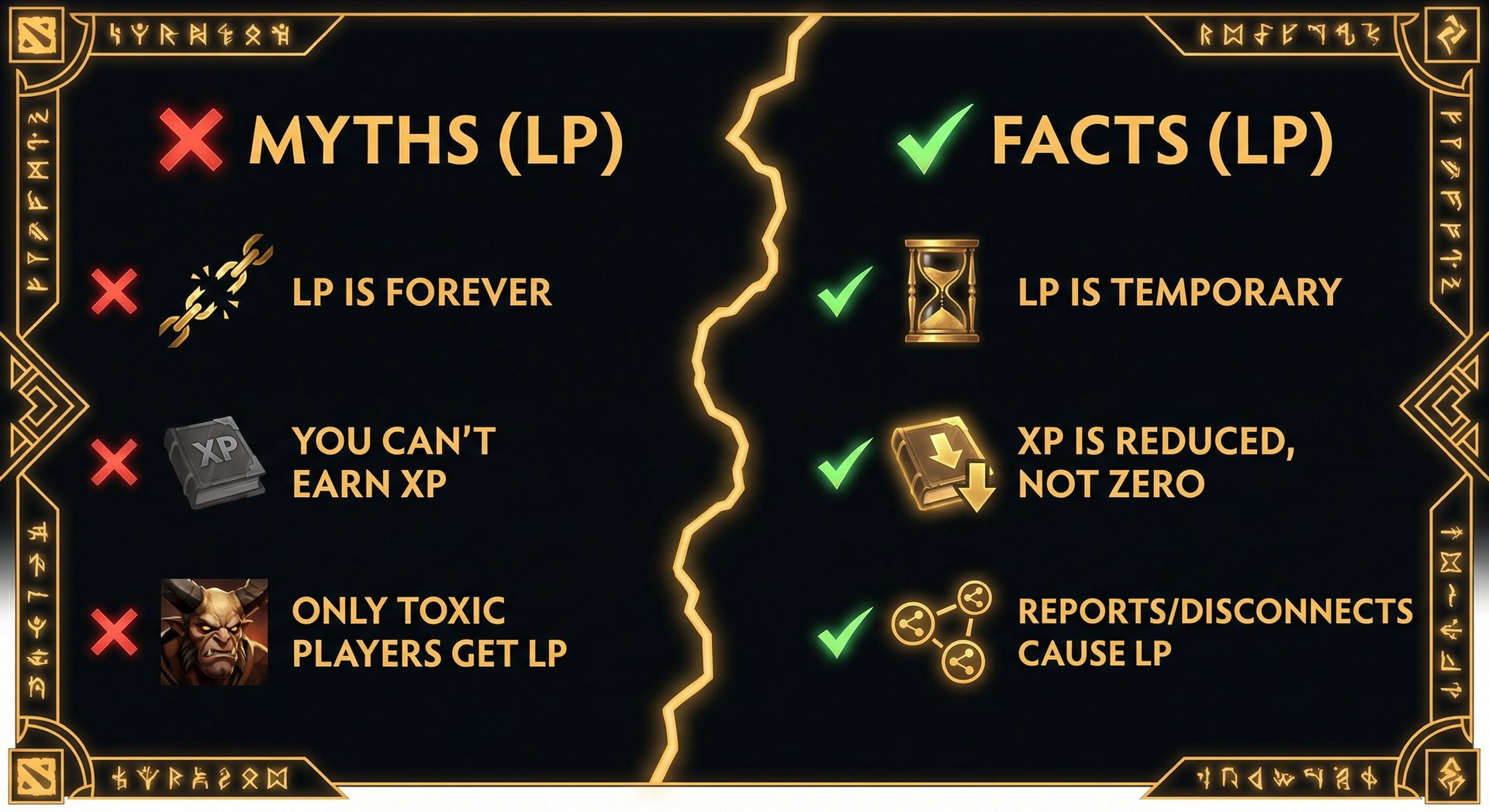
12. Low Priority Myths Debunked
There’s a lot of misinformation about LP circulating on Reddit and Dota forums. Let’s set the record straight.
Myth: “You can get LP from one bad game”
Mostly false. Unless your behavior score is extremely low (sub-2,000), a single bad game — even one where you get four reports — won’t trigger LP. The system uses a rolling window of recent games, not individual matches. However, a single abandon CAN trigger LP if your behavior score is already low.
Myth: “Reports from party stacks count as multiple reports”
False. Valve confirmed years ago that reports from players in the same party count as a single report. A 4-stack reporting you has the same effect as one solo player reporting you.
Myth: “Playing support in LP is the best strategy”
False. As we discussed above, support heroes in LP are generally a losing strategy because you’re relying on random core players to carry you. Self-sufficient core heroes are the way to go.
Myth: “Turbo games count for LP wins”
False. LP games are exclusively Single Draft. You cannot play Turbo, All Pick, or any other mode to clear your LP penalty. Turbo is useful for rebuilding behavior score AFTER escaping LP, but not for escaping LP itself.
Myth: “Commend swapping at the end of LP games helps you escape faster”
False. Commends affect your behavior score but have zero effect on the number of LP wins required. You still need to win the specified number of games regardless of commends.
Myth: “You can get LP just from losing a lot”
False. Losing games never directly triggers LP. What happens is that frustrated players report more when losing, and those reports can accumulate. But the losses themselves are not a factor.
Myth: “LP is rigged against you”
False (mostly). LP matchmaking uses the same algorithms as normal matchmaking. However, the player pool is smaller and more toxic, which naturally leads to worse game quality. It’s not rigged — it’s just that the available players are all there for behavioral reasons.
Final Thoughts: You Don’t Have to Stay Stuck
Low Priority is Valve’s attempt to correct negative behavior, and for many players, it works as intended — a wake-up call to change. But for others, LP becomes a trap. The combination of toxic teammates, random hero selection, win requirements, and behavior score degradation can create a cycle that feels impossible to escape.
If you’re grinding through LP on your own, use the strategies and hero recommendations in this guide. Mute toxic players, pick self-sufficient cores, end games early, and take breaks between losses. With patience and good play, you can escape.
If you’re stuck in the death spiral, or if you simply value your time and want to get back to playing real Dota, Team Smurf’s LP removal service can get you out quickly and cleanly. Our Immortal-rank boosters have completed thousands of LP removals and know exactly how to navigate the LP environment.
Once you’re out, focus on your behavior score. That’s the real key to never ending up in LP again. And if you want to start climbing MMR once you’re free, check out our complete MMR boosting guide or explore our MMR boost services.
Good luck out there. LP is temporary — your improvement is permanent.
Frequently Asked Questions
Get Out of Low Priority Fast
Team Smurf’s Immortal-rank boosters can clear your LP games quickly and get you back to real Dota.
Written by Team Smurf’s Immortal-rank analysts — Last verified February 2026