

Is 7K MMR Good? The Divine-to-Immortal Zone Explained

Is 7K MMR good in Dota 2? The short answer is yes — it is exceptionally good. Seven thousand MMR puts you inside the top 0.1% of all ranked players globally. You are not just an Immortal player at that point; you are a high Immortal player whose name appears on or near the regional leaderboard, depending on which server you play on.
But “good” only tells you half the story. What matters more is understanding exactly where 7K places you by region, what you had to develop to close the gap between Divine 5 and 7,000 Immortal, what games at that level actually feel like, and where the next wall sits above you. This guide covers all of that in concrete terms.
In This Article
Is 7K MMR Actually Good? (Direct Answer)
Yes — 7,000 MMR is genuinely, objectively excellent. You are in the top 0.1% of all active ranked Dota 2 players worldwide. That is not a marketing phrase; it is a structural fact about how Dota 2’s rank distribution works. Immortal rank itself starts at roughly 5,400-5,600 MMR depending on the current season calibration, and only a fraction of Immortal players ever push into the 6,000+ range, let alone 7,000.
To put this in perspective: if you lined up every person who played ranked Dota 2 in the last six months, you would have to walk past 999 of them before you found someone at your MMR or above. At 7K you are not in the same conversation as the average Immortal player. You are competing with and against players who have often played 5,000-10,000+ career games and have spent years refining mechanics that most players never develop.
7K vs the Full MMR Ladder
Here is where 7K fits into the full Dota 2 rank distribution as of mid-2026, based on community data aggregated from Dotabuff and OpenDota tracking:
| MMR Range | Approximate Rank | Estimated Player % | What It Means |
|---|---|---|---|
| 0 — 770 | Herald 1-5 | ~22% | Learning the game |
| 770 — 1540 | Guardian 1-5 | ~20% | Basics established |
| 1540 — 2310 | Crusader 1-5 | ~19% | Understanding roles |
| 2310 — 3080 | Archon 1-5 | ~18% | Most common bracket |
| 3080 — 3850 | Legend 1-5 | ~11% | Above average |
| 3850 — 4620 | Ancient 1-5 | ~6% | Strong pub player |
| 4620 — 5500 | Divine 1-5 | ~3% | Elite bracket |
| 5500 — 6000 | Low Immortal | ~0.5% | Top of the ladder |
| 6000 — 7000 | Mid-High Immortal | ~0.15% | Near leaderboard |
| 7000+ | High Immortal / Leaderboard | ~0.05% | Leaderboard territory |
Source: community aggregate data from Dotabuff & OpenDota tracking, mid-2026 season. Percentages are approximate and shift between calibration resets.
The table makes clear how dramatically the player population thins above 6K. Going from 5K to 6K already filters out most of the Immortal population. Going from 6K to 7K filters out most of what remains. By the time you hit 7K, you are in a peer group measured in hundreds or low thousands per region, not tens of thousands.
Where 7K MMR Places You by Region
Regional leaderboard positions at 7K vary significantly because server populations differ. The EU and SEA servers carry the largest active player bases; North America has always had a relatively small dedicated Dota 2 player pool. This means 7K in NA is far closer to the absolute top of the regional ladder than 7K in EU or SEA.
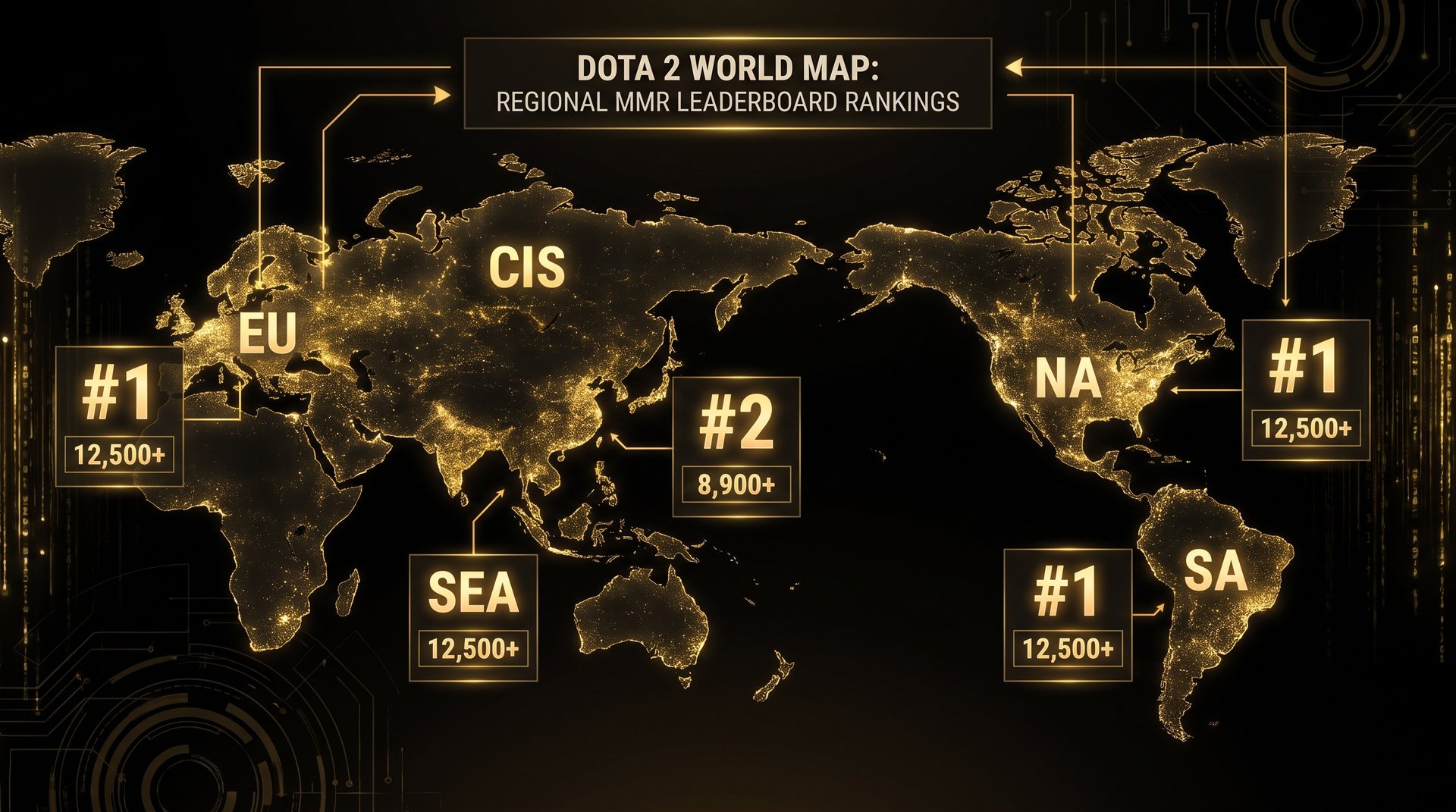
| Region | Approx. Leaderboard Position at 7K | Server Context | What 7K Means Locally |
|---|---|---|---|
| EU (Europe) | ~600-800 | Largest Western server | High Immortal, consistent leaderboard fringe |
| SEA (Southeast Asia) | ~300-500 | Largest overall, very competitive | Deep in leaderboard territory |
| NA (North America) | ~50-150 | Smallest major server | Near the top 100 of the entire region |
| CIS (Eastern Europe/Russia) | ~400-700 | Dense mid-tier, thinner at top | Strong leaderboard presence |
| SA (South America) | ~200-450 | Growing playerbase | Comfortably inside top 500 |
These figures reflect community data and observable leaderboard tracking patterns from mid-2026. They will shift somewhat between calibration periods, but the relative picture is consistent: NA 7K is dramatically more exclusive than EU 7K simply because there are fewer total players on the server.
What Regional Position Actually Means
Being in the top 600-800 of your region sounds like a big number until you consider that each region has hundreds of thousands of active ranked players. EU alone has well over 500,000 players who completed calibration in 2026. Being in the top 600-800 out of that pool means you are in the top 0.12-0.16% of your entire regional population.
In NA, where the player base is smaller, 7K can put you close enough to the top 100 that you are genuinely competing for a named leaderboard spot. Some NA players at 7K will appear on the public leaderboard page that Valve publishes, which starts at rank 1 and lists the top players by name. That is a level of recognition that most Dota 2 players will never experience.
The Gap Between Divine 5 and 7K Immortal
The distance from Divine 5 (approximately 5,400 MMR) to 7,000 MMR looks like 1,600 MMR on paper. In practice, it represents one of the steepest skill jumps in the entire game. Players who grind from Archon to Divine often describe that journey as slow but manageable with enough games. The jump from high Divine into deep Immortal — and then from low Immortal to 7K — is a different kind of challenge entirely.
What You Develop Between 5K and 7K
Here is what specifically separates a 7K player from a strong 5K player. Each of these is a genuine, learnable skill gap — not just “better mechanics” in the abstract:
- Hero pool depth: 5K players typically have 4-6 heroes they can pilot at a high level. 7K players have 10-15+ heroes per role they can play competently. When a counter-pick comes out in draft, 7K players flex around it cleanly. 5K players often get stuck on their comfort picks or forced into unfamiliar territory.
- Ward precision: At 5K, warding is mostly correct in terms of general spots. At 7K, players use timing-specific ward placements that deny vision for key objectives — Roshan spawns, lane deward setups before smoke ganks, and block wards on the correct side based on the enemy offlaner’s camp pattern.
- Draft reading: 7K players understand why the enemy picked what they picked in pick 3 and can anticipate their last pick. This changes how they spend resources early: do you pressure before 20 minutes because their lineup has a hard 40-minute power spike, or do you play defensively because they drafted for early kills?
- Resource denial: Pulling patterns, lane dominance windows, and denying enemy carries their farm rotations become precise at 7K. Not just “I should stack this camp” but “I should stack this camp at exactly 53 seconds because the enemy carry will go there at 3:10 and I want to take that gold away before the enemy support can arrive.”
- Communication efficiency: Callouts at 7K are faster and more accurate. Players say “smoke from dire secret shop, Blink offlane missing” rather than “careful they might be coming.” The speed of information processing — seeing a ward, tracking the missing hero, estimating the rotation time — is measurably faster.
If you need help accelerating this journey, professional coaching from players who live in this bracket is one of the most direct ways to compress the learning curve. The Dota 2 coaching service at TeamSmurf connects you with coaches at your target MMR range who can pinpoint exactly which of the above skills is your current ceiling.
The Immortal Threshold Is Not the Hard Part
Many players treat cracking Immortal as the goal. What they discover once they get there is that low Immortal (5,500-6,000 MMR) still has players who recently made the jump and are learning the pace of the bracket. The real wall is around 6,000-6,500, where the lobby quality becomes visibly more consistent. At 7K, every player in your game has been through that filter and come out the other side.
This is why 7K feels qualitatively different from any point below it: you cannot reliably stomp anyone in your lobby. Every mistake you make will be punished. Every opportunity you create will be contested. The games are decided by small advantages accumulated over 30-40 minutes, not by one player playing far above the average.
What Games at 7K MMR Actually Look Like

If you have only experienced Dota 2 up to the Ancient or Divine bracket, games at 7K will feel noticeably different in several concrete ways. Here is what to expect:
The Draft Is a Real Contest
At 7K, the draft phase is not a formality. Both teams make targeted picks and bans. High-winrate heroes in the current patch get banned early. Lanes are drafted with specific matchups in mind — position 3 picks that counter the enemy carry’s farming pattern, or a position 5 that can zone out the enemy pos 3 in lane. Double-support-initiator drafts, counter-initiation drafts, and split-push lineups are all deployed deliberately and countered deliberately.
Laning Phase Is Near-Perfect
CS rates at 7K are very high. Supports are in the lane for the first 8-10 minutes maintaining lane dominance or harass pressure rather than leaving the carry to fend for themselves. Denies are consistent. Pulls are timed. Nobody is passively standing in lane absorbing harassment without a plan. The laning phase outcome is determined by minor advantages — who gets a slightly better trading pattern, whose level-2 spike is stronger, whether the offlaner can secure a fast level-6 — rather than one player simply out-last-hitting the other.
Smoke and Vision Control Are Active Tools
At 7K, teams use smoke rotations and ward-deward patterns as active weapons, not as an afterthought. Roshan attempts are preceded by vision clears and smoke setups. High-ground vision before a push is standard. You will rarely see a 7K team attempt a smoke gank without checking the ward coverage first. The minimap awareness to understand when you have a vision gap and when the enemy probably does is a consistent skill at this MMR.
Objectives Drive Decision-Making
Games at 7K are fundamentally about objectives — towers, Roshan, barracks — not kills. A kill is valuable because it enables an objective window, not as a goal in itself. Teams will often choose not to fight when they cannot convert the fight into a map objective. This is one of the hardest mindset shifts for players climbing into this bracket from lower MMR, where kills are often chased for their own sake.
The 7K vs 8K+ Wall — Where Professional Players Live
If 7K is genuinely elite, what is above it? This is where the conversation about professional play begins. Most active professional Dota 2 players — players who compete at DPC events, Majors, and The International — maintain MMRs in the 8,000-11,000 range on their primary accounts. Some all-time greats and active top players have pushed into the 12,000-13,000 range.
| MMR Range | Player Category | Typical Rank on EU Leaderboard |
|---|---|---|
| 7,000 — 7,500 | High Immortal — leaderboard fringe | ~300-800 |
| 7,500 — 8,000 | Top leaderboard | ~100-300 |
| 8,000 — 9,000 | Semi-pro / professional-adjacent | ~20-100 |
| 9,000 — 10,000 | Pro player range | ~5-20 |
| 10,000+ | World top players | Top 5 per region |
The gap between 7K and professional MMR is real but narrower than most people imagine in terms of raw mechanics. A 7K player watching a professional player’s replay will recognize almost everything being done — the ward spot, the item timing, the teleport decision. The differences at the pro level are speed, consistency, and the ability to execute at that level for an entire series without tilting. A pro player at 9K makes the same decisions as a 7K player, but faster, more cleanly, and with fewer mental errors across a longer session.
Why Most 7K Players Do Not Reach Pro Level
It is worth being honest about this. The vast majority of 7K players will never compete professionally, not because 7K is bad (it is excellent) but because the professional Dota 2 ecosystem requires more than individual MMR. Teams compete through tournament circuits that require sponsorship, visa access, consistent team practice, and connections to the competitive scene. A 7K solo queue player in NA or EU could have the mechanics of a roster player but lack the connections, the team environment, or the time commitment to break into a professional roster.
That said, 7K is the bracket where scouts and coaches notice players. Several current TI-qualified roster players started as high-MMR pub players who were picked up because they were visible on regional leaderboards. If that path interests you, 7K is where it starts — not where it ends.
How to Reach the 7K Bracket
Getting to 7K from your current MMR — whether you are at 5K, 6K, or just below the threshold — requires either thousands of hours of deliberate self-improvement or a combination of coaching and MMR boosting from verified high-level players.
TeamSmurf works exclusively with Dota 2 boosters who are active in the Immortal bracket and above. When you order a boost, your account is played by a player who spends their games at 7K-9K MMR — not a generalist service that handles multiple games. The Dota 2-only focus means your account stays in the hands of someone who understands the meta, the current patch, and exactly what needs to happen to climb efficiently.
If you want to verify that this is a legitimate and safe process, we recommend reading our guide on whether Dota 2 boosting is safe before ordering. We also have a full breakdown of the best Dota 2 boosting services if you want to compare options before committing.
Ready to Reach the 7K Bracket?
TeamSmurf connects you with active Immortal and high-leaderboard Dota 2 players who boost or coach exclusively — no generalist services, no account risks, just Dota 2 specialists who live in the bracket you are targeting.


