Dota 2 Duo Boost vs Solo Boost: The Definitive Comparison Guide

You’ve decided to get a dota 2 boost. Smart move. But now you’re facing the biggest decision in the process: do you go with a dota 2 duo boost or a dota 2 solo boost?
This isn’t a trivial choice. The difference between duo and solo boosting affects everything — your account security, how much you pay, how fast you climb, whether you actually learn anything, and how sustainable your new rank will be. Pick the wrong one, and you might end up disappointed even if the boost itself goes perfectly.
We’ve helped thousands of players make this exact decision. This guide distills everything we’ve learned into the most comprehensive duo vs solo boosting dota 2 comparison ever written. By the time you finish reading, you’ll know exactly which option is right for your specific situation — no guesswork, no ambiguity.
Table of Contents
- How Solo Boosting Works: Complete Mechanics Breakdown
- How Duo Boosting Works: Complete Mechanics Breakdown
- Security Comparison Matrix
- Speed Comparison: Which Is Faster?
- Cost Breakdown: Which Is More Affordable?
- Learning Potential: Which Makes You Better?
- Rank Sustainability: Which Lasts Longer?
- The Master Comparison Table
- Decision Tree: Which Should You Choose?
- Scenario-Based Recommendations
- Common Myths Debunked
- The Hybrid Approach: Best of Both Worlds
- Frequently Asked Questions
Here’s what we’ll cover:
- The exact mechanics of how each boost type works
- A complete security comparison matrix
- Speed and efficiency analysis with real data
- Detailed cost breakdowns
- Learning potential and skill development
- A decision tree to determine your ideal choice
- Common myths debunked with evidence
- Scenario-based recommendations for every type of player
How Solo Boosting Works: Complete Mechanics Breakdown
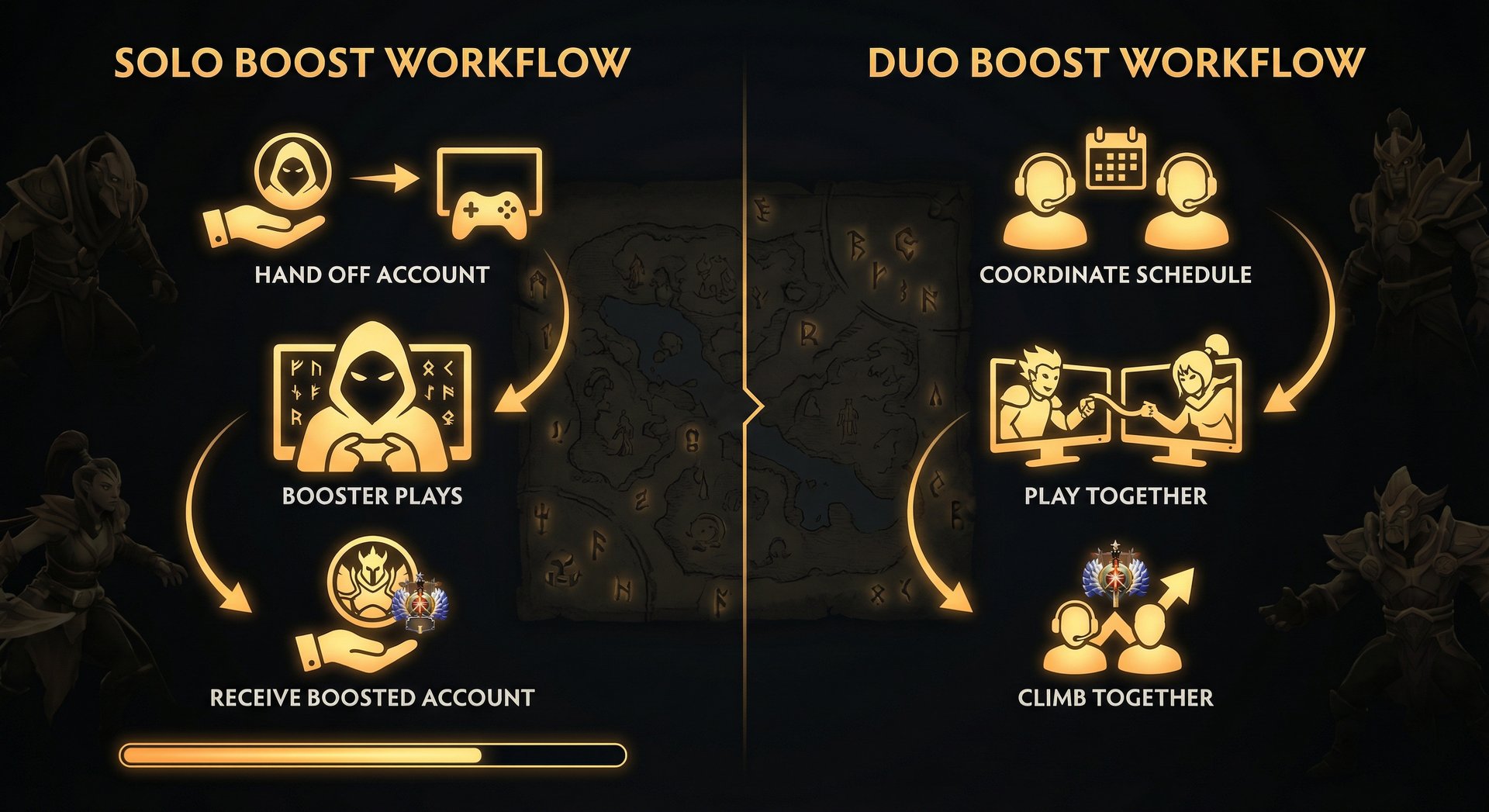
In a dota 2 solo boost, a professional booster — typically an Immortal-rank player with 6,000-8,000+ MMR — logs into your account and plays ranked matches on your behalf. You hand over control; they deliver results. It’s the most straightforward form of boosting, and the one most people think of first.
The Technical Process
Here’s exactly what happens when you order a solo boost from a service like Team Smurf:
- Credential exchange: You provide your Steam username and password through an encrypted portal (never via plain text or Discord DMs)
- VPN configuration: The booster connects through a VPN server that matches your typical login region. If you’re a US West player, the booster logs in from a US West IP address. This prevents Steam from flagging the login as suspicious
- Steam Guard authentication: You receive a Steam Guard code and relay it to the booster in real-time. This is a one-time process per session
- Profile setup: The booster sets your status to “Offline” or “Invisible” so your friends list doesn’t see unusual activity
- Ranked play: The booster queues for ranked matches, typically playing 3-6 games per session with breaks to maintain peak performance
- Progress reporting: After each session, you receive an update with your current MMR, win/loss record, and estimated time to completion
- Completion: Once your target MMR is reached, you’re notified to change your password and the boost is finalized
Why Solo Boosters Win So Much
The win rates in solo boosting are staggering — 80-90%+ at most brackets — and understanding why helps you appreciate what you’re paying for.
A 7,000 MMR booster playing at 3,000 MMR isn’t just “a bit better” than the other players in the game. They’re operating at a fundamentally different level of the game. The skill gap between 3,000 and 7,000 MMR is comparable to the gap between a recreational tennis player and a professional ATP player. The booster:
- Reads the map differently: They predict enemy movements 30-60 seconds before they happen based on patterns invisible to lower-ranked players
- Optimizes farm patterns: They extract 20-40% more gold per minute from the map through efficient jungle rotations, creep stacking, and lane equilibrium management
- Wins lanes consistently: Superior trading, creep aggro manipulation, and power spike awareness means they dominate the laning phase in virtually every game
- Makes decisive calls: They know exactly when to push, when to farm, when to take Roshan, and when to fight — the macro decisions that determine games at every bracket
- Itemizes perfectly: They adapt their builds to the specific game state rather than following static guides, giving them advantages in every fight
The result is that in a 3,000 MMR game, a 7,000 MMR booster effectively turns a 5v5 into a 5v4.5 — they’re worth more than any single opponent, and often more than two.
Solo Boost Limitations
Despite its efficiency, solo boosting has genuine downsides:
- Zero learning: You don’t play, so you don’t improve. Your mechanical skill and game sense remain exactly where they were
- Account access required: This is the deal-breaker for many players. No matter how secure the service, you’re trusting someone with your Steam account
- Potential match history mismatch: If the booster plays heroes you never touch, your match history might look suspicious to observant friends or Valve’s systems
- Post-boost adjustment: Jumping from, say, 2,500 to 4,000 MMR overnight means you’ll face significantly stronger opponents immediately with no transition period
How Duo Boosting Works: Complete Mechanics Breakdown
A dota 2 duo boost is a fundamentally different experience. Instead of someone playing for you, someone plays with you. You remain on your own account, queue as a party with the booster, and play every game yourself — with a massive skill advantage on your team.
The Technical Process
- Schedule coordination: You and the booster agree on play sessions — typically 2-4 hour blocks at mutually convenient times
- Party formation: You add the booster’s account as a friend (or accept their request) and party up. The booster uses a service account calibrated near your bracket, or their own account if the MMR difference allows partying
- Role assignment: In most duo boosts, the booster takes a high-impact role (mid or carry) while you play your preferred position. This maximizes the booster’s ability to influence the game while keeping you in your comfort zone
- Communication: You’ll typically be in voice chat (Discord or Steam) during games. The booster calls shots, suggests plays, and provides real-time guidance on positioning and decision-making
- Ranked matches: You play standard ranked games as a two-stack. The booster ensures a high win rate through their individual performance while also enhancing your play through communication
- Session review: After each session, the booster may highlight key moments from your games — what went well, what could improve, and what to practice
The Party MMR Dynamic
Dota 2’s matchmaking handles parties differently than solo players, and this directly impacts duo boost efficiency:
- Party MMR weighting: When you queue as a party, the system may apply a slight MMR inflation to your team’s average rating, meaning you face slightly stronger opponents than your combined MMR would suggest
- Enemy team composition: The system tries to match parties against other parties, though this isn’t guaranteed. When facing another two-stack, the advantage is reduced
- Role queue interaction: Both players need to select roles, which can limit flexibility if the booster’s best role conflicts with yours
These factors are why duo boost win rates (65-80%) are lower than solo boost win rates (80-90%+). The booster is still the best player in the game by a wide margin, but the party dynamics introduce variables that reduce the margin of dominance.
Duo Boost Advantages
- Complete account security: Your credentials never leave your hands. This is the single biggest advantage and the reason many players choose duo despite the higher cost
- Genuine skill improvement: Playing alongside and communicating with an Immortal player for 30-50+ games has a measurable impact on your own gameplay
- Natural-looking match history: Since you’re playing on your own account in a party, your match history looks completely normal — just two friends playing together
- Social experience: Many customers report that duo boosting is simply fun. It’s an enjoyable gaming experience, not just a transactional service
- Smoother transition: Because you’re playing through the entire boost, you gradually adjust to higher-level opponents. There’s no jarring skill gap when the boost ends
Duo Boost Limitations
- Higher cost: You’re paying for two people’s time (the booster + the coordination overhead), and more games are needed due to lower win rates
- Schedule dependency: Both you and the booster need to be available simultaneously. This can be challenging across time zones or for players with irregular schedules
- Slower completion: The combined effect of lower win rates and schedule constraints means duo boosts take significantly longer
- Your performance matters: Unlike a solo boost where the booster handles everything, your play affects the outcome. If you’re having a bad day, the win rate drops further
- Requires your time: You need to actually play 30-70+ games. For time-poor players (one of the biggest boosting demographics), this can be a major drawback
Security Comparison Matrix
Account security is typically the decisive factor for most players choosing between duo vs solo boosting dota 2. Let’s analyze every security dimension:
| Security Factor | Solo Boost | Duo Boost | Winner |
|---|---|---|---|
| Account credential exposure | Full credentials shared with booster | No credentials shared | Duo |
| Risk of account theft | Low (with reputable service), non-zero | Zero | Duo |
| Steam login anomaly detection | Mitigated by VPN matching, but detectable | Not applicable — you log in yourself | Duo |
| Match history appearance | Can look unusual if booster plays different heroes/roles | Completely natural — party games with a friend | Duo |
| Smurf detection triggers | Possible — sudden performance spike from same account | Minimal — your performance improves gradually | Duo |
| Behavior score impact | Usually positive (boosters are well-behaved) | Depends on both players’ behavior | Tie |
| Item/inventory safety | Depends on booster integrity and service policies | Complete — booster has no account access | Duo |
| Friend list privacy | Booster can see your friend list | Only sees you added as friend | Duo |
| Post-boost account safety | Requires password change; lingering risk if credentials stored | No action needed | Duo |
Verdict: Duo boosting wins every single security category except behavior score (which is a tie). If account security is your primary concern, duo boosting is the unambiguous choice.
That said, the solo boost security risks are dramatically reduced when using a reputable service. Team Smurf has completed thousands of solo boosts with zero account theft incidents. The risk isn’t zero, but with proper protocols, it’s negligible. Read more: Is Dota 2 Boosting Safe?
Speed Comparison: Which Is Faster?
For players who want their MMR as quickly as possible, speed is a critical factor. Let’s compare with real data:
Win Rate Comparison by Bracket
| Bracket | Solo Boost Win Rate | Duo Boost Win Rate | Speed Difference |
|---|---|---|---|
| Herald → Guardian | 92-95% | 78-85% | Solo ~40% faster |
| Guardian → Crusader | 90-93% | 75-82% | Solo ~40% faster |
| Crusader → Archon | 87-91% | 72-80% | Solo ~35% faster |
| Archon → Legend | 83-88% | 68-76% | Solo ~35% faster |
| Legend → Ancient | 78-85% | 65-73% | Solo ~30% faster |
| Ancient → Divine | 72-80% | 62-70% | Solo ~25% faster |
| Divine → Immortal | 65-75% | 58-67% | Solo ~20% faster |
Calendar Time Comparison (1,000 MMR boost)
| Factor | Solo Boost | Duo Boost |
|---|---|---|
| Games needed (avg) | 30-40 | 45-65 |
| Games per day (avg) | 6-8 (booster plays when available) | 3-5 (limited by your schedule) |
| Calendar days | 4-7 days | 9-18 days |
| Total hours of gameplay | ~20-30 hours | ~35-50 hours |
| Your time investment | ~30 minutes (order + coordination) | 35-50 hours (you play every game) |
Verdict: Solo boosting is 25-40% faster in terms of games needed and 2-3x faster in calendar time. The schedule dependency of duo boosting is the biggest bottleneck — even if both methods had identical win rates, duo would still be slower because you can’t play 8 games a day like a professional booster can.
For players in a rush — whether it’s a seasonal reset, a tournament qualifier, or just impatience — the speed advantage of solo boosting is significant.
Cost Breakdown: Which Is More Affordable?
Budget matters. Here’s an honest comparison of what you can expect to pay:
Why Duo Costs More
Duo boosting is more expensive for three compounding reasons:
- More games required: Lower win rates mean more games to reach the same target — roughly 50-60% more games
- Two people’s time: The booster plays for the same duration, but their sessions must align with yours, reducing their efficiency
- Coordination overhead: Scheduling, communication, voice chat setup — all add operational cost
Approximate Cost Comparison
| MMR Range | Solo Boost (Approx.) | Duo Boost (Approx.) | Duo Premium |
|---|---|---|---|
| 1,000 → 2,000 | $40-70 | $65-110 | +55-60% |
| 2,000 → 3,000 | $55-90 | $90-145 | +55-65% |
| 3,000 → 4,000 | $75-120 | $120-195 | +60-65% |
| 4,000 → 5,000 | $100-170 | $165-280 | +60-70% |
| 5,000 → 5,600 | $120-200 | $200-340 | +65-70% |
Note: These are approximate market rates. Visit Team Smurf’s MMR Boost page for exact current pricing.
Value Per Dollar Analysis
Here’s where it gets interesting. While duo boosting costs more in absolute terms, the value per dollar calculation changes when you factor in what you actually receive:
- Solo boost: You pay for MMR. That’s it. Your skill doesn’t change. The only value is the number on your profile
- Duo boost: You pay for MMR plus 35-50 hours of playing alongside an Immortal player. That’s essentially free coaching bundled into your boost
If you value skill improvement, the duo premium is actually a bargain. A single hour of professional Dota 2 coaching typically costs $15-30. If duo boosting includes 40 hours of effectively coaching-lite, that’s $600-1,200 worth of coaching baked into a service that costs $100-300 more than solo.
For a complete pricing analysis across all brackets and services, check our Dota 2 Boosting Cost Guide.
Learning Potential: Which Makes You Better?
This is where the two approaches diverge most dramatically, and it’s the factor that most players underweight in their decision-making.
Solo Boost Learning: Passive at Best
With a solo boost, your only learning opportunity is watching replays after the fact. The booster played games on your account, and you can review them in Dota 2’s replay system. This is valuable if you’re disciplined about it, but let’s be realistic — most players don’t watch a single replay.
Even if you do watch replays, passive observation is the weakest form of learning. You’re watching someone with fundamentally different mechanics, reaction times, and game knowledge execute strategies you may not fully understand. It’s like watching a Formula 1 driver’s onboard camera and trying to learn how to drive fast — informative, but not transformative.
Duo Boost Learning: Active and Immersive
Duo boosting is fundamentally different because you’re learning through active participation:
- Real-time shotcalling: The booster tells you when to rotate, when to farm, when to fight, and when to back off. You’re building correct habits through hundreds of in-game decisions
- Live lane guidance: During the laning phase, the booster can comment on your trades, last-hitting, and positioning. These small adjustments compound over dozens of games
- Contextual itemization: Instead of following a guide, you hear the booster’s thought process: “They have a lot of magic damage, so I’m going BKB second instead of my usual timing.” This builds decision-making frameworks
- Tempo understanding: High-level Dota is about timing — power spikes, objective windows, map pressure cycles. Playing alongside someone who instinctively understands these rhythms gradually transfers that understanding to you
- Mistake correction: When you make a mistake, the booster can point it out immediately. “You were too far forward there — watch the minimap, their mid is missing.” This real-time feedback is incredibly powerful
Measurable Impact
Based on our internal data from thousands of completed boosts:
- Solo boost customers who don’t receive additional coaching lose an average of 200-400 MMR within the first 30 days after their boost, stabilizing at roughly 70-80% of the MMR gained
- Duo boost customers lose an average of 50-150 MMR in the same period, stabilizing at 85-95% of the MMR gained
The difference is attributable almost entirely to the skill improvement that occurs during duo boosting. Players who go through a duo boost are genuinely better at the game by the time it’s complete, which means they can sustain a higher percentage of their new rank.
Rank Sustainability: Which Lasts Longer?
Getting to a new rank is one thing. Staying there is another. Here’s the uncomfortable truth about post-boost rank sustainability:
The Solo Boost Cliff
After a solo boost, you’re suddenly playing at a bracket where every opponent is significantly better than what you’re used to. The skill gap can be jarring:
- Laning becomes harder: Opponents trade more efficiently, deny more creeps, and punish positioning mistakes you’ve been getting away with for hundreds of games
- Rotations are faster: Higher-bracket players gank more effectively, meaning your usual aggressive farming patterns become risky
- Teamfights are tighter: Opponents use abilities more precisely, focus targets better, and disengage more intelligently
- Psychological pressure: Knowing you were boosted can create anxiety that worsens performance — a self-fulfilling prophecy of rank decay
This doesn’t mean solo boosts are pointless. Many players stabilize at their new rank by adapting over time. But the first 20-30 games can be a rough experience, and some players lose a significant portion of their gained MMR before finding equilibrium.
The Duo Boost Transition
Duo boost customers experience a much smoother transition because:
- They’ve already been playing at the higher bracket for dozens of games during the boost
- They’ve developed correct habits through the booster’s guidance
- They understand the tempo and expectations of their new bracket
- They’ve had time to adjust incrementally rather than facing a sudden jump
The post-boost experience for duo customers is less “oh god, these players are way better than me” and more “okay, this is what I’ve been doing for the past two weeks, just without the booster in my party.” The adjustment is real but manageable.
Long-Term Retention Rates
| Timeframe | Solo Boost Retention | Duo Boost Retention |
|---|---|---|
| After 1 week | 85-95% of gained MMR | 92-98% of gained MMR |
| After 1 month | 70-85% of gained MMR | 85-95% of gained MMR |
| After 3 months | 60-80% of gained MMR | 80-93% of gained MMR |
| After 6 months | 55-75% of gained MMR | 75-90% of gained MMR |
Data based on Team Smurf’s internal analytics from customers who continued playing ranked regularly.
The Master Comparison Table
Here’s everything side-by-side in one comprehensive table:
| Category | Solo Boost | Duo Boost | Winner |
|---|---|---|---|
| Account Security | Good (with reputable service) | Perfect | Duo |
| Speed (games needed) | Fewer games (higher win rate) | More games (lower win rate) | Solo |
| Speed (calendar time) | Much faster (no scheduling) | Much slower (coordination needed) | Solo |
| Cost | Lower | 40-70% higher | Solo |
| Learning Potential | Minimal (replays only) | Significant (active learning) | Duo |
| Rank Sustainability | Moderate (60-80% retention) | High (80-93% retention) | Duo |
| Your Time Required | Near zero | 35-50+ hours | Solo |
| Match History Appearance | Can look suspicious | Completely natural | Duo |
| Detection Risk | Very low (with VPN) | Essentially zero | Duo |
| Fun Factor | N/A (you don’t play) | High (playing with a pro) | Duo |
| Convenience | Maximum (fully hands-off) | Requires scheduling | Solo |
| Post-Boost Adjustment | Jarring (sudden skill gap) | Smooth (gradual transition) | Duo |
| Value for Money | Good (MMR only) | Excellent (MMR + learning) | Duo |
Final Score: Duo wins 8 categories, Solo wins 4, 1 tie.
But raw category count doesn’t tell the whole story. Which categories matter most to you is what determines the right choice. That’s where the decision tree comes in.
Decision Tree: Which Should You Choose?
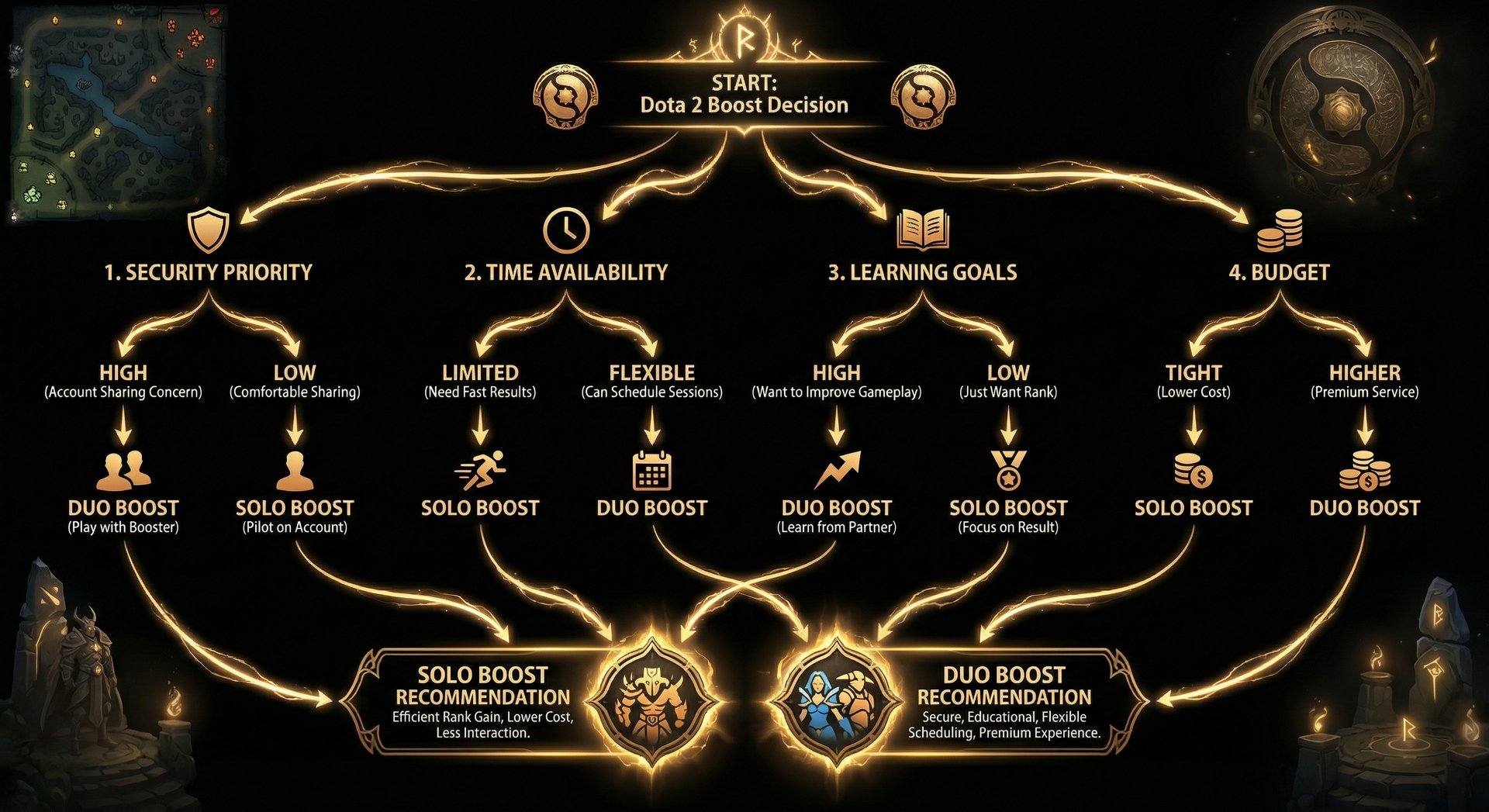
Follow this decision flowchart to find your ideal boost type. Answer each question honestly:
Question 1: How important is account security to you?
If “absolutely paramount — I won’t share credentials under any circumstances”: → Duo Boost. Full stop. No further questions needed. Duo is the only option that keeps your credentials completely private.
If “important, but I trust a reputable service to handle it”: → Continue to Question 2.
Question 2: Do you have time to play the games yourself?
If “no — I barely have time to play Dota at all, which is why I’m getting boosted”: → Solo Boost. Duo boosting requires 35-50+ hours of your time. If time poverty is your reason for boosting, adding 50 more hours of required play defeats the purpose.
If “yes — I have regular gaming sessions and can commit 2-4 hours several times per week”: → Continue to Question 3.
Question 3: Do you care about improving your actual skill?
If “not really — I just want the rank for [status/content/tournament access/etc.]”: → Solo Boost. If the MMR number is all that matters, solo is faster and cheaper.
If “yes — I want to be a better player, not just a higher-rated one”: → Duo Boost. The learning component of duo boosting is genuinely transformative.
Question 4: What’s your budget flexibility?
If “tight — I want the most MMR per dollar”: → Solo Boost. It’s 40-70% cheaper for the same result.
If “flexible — I’m willing to pay more for a better experience”: → Duo Boost. The premium pays for itself in skill improvement and rank sustainability.
Question 5: How urgent is the boost?
If “very — I need this done within a week”: → Solo Boost. Duo boosts take 2-3x longer in calendar time.
If “not rushed — I can wait 2-3 weeks”: → Either option works. Other factors should determine your choice.
Summary Decision Matrix
| Your Profile | Recommended |
|---|---|
| Time-poor adult, just wants rank | Solo Boost |
| Aspiring player who wants to improve | Duo Boost |
| Content creator needing rank ASAP | Solo Boost |
| Security-conscious player | Duo Boost |
| Budget-constrained player | Solo Boost |
| Player who enjoys the social aspect of gaming | Duo Boost |
| Returning player re-learning the game | Duo Boost |
| Smurf account that just needs to be at the right rank | Solo Boost |
| Player who’s been tilted and lost MMR | Solo Boost (reset) then Duo (to maintain) |
Scenario-Based Recommendations
Theory is useful, but real scenarios are better. Here are detailed recommendations for common player situations:
Scenario 1: The Busy Professional
Profile: Sarah, 34, software engineer. Was Legend 3 during grad school, now Crusader 5 after a 2-year break. Plays 4-5 hours per week maximum. Doesn’t care about “the journey” — just wants to play competitive games in her limited free time.
Recommendation: Solo Boost
Sarah’s primary constraint is time. A duo boost would require 40+ hours of gameplay — that’s 8-10 weeks of her entire gaming time budget. Solo boost gets her back to Legend in a week without touching her precious gaming hours. When she does play, every game is at a level that’s engaging rather than frustrating.
Scenario 2: The Aspiring Competitive Player
Profile: Marcus, 22, college student. Archon 3, dreams of reaching Immortal and competing in amateur tournaments. Has 20+ hours per week available for Dota. Wants to improve, not just inflate his number.
Recommendation: Duo Boost
Marcus has time and ambition. A duo boost to Divine or low Immortal gives him both the rank boost and 50+ hours of playing alongside a professional. The skills he absorbs during the duo boost will compound over thousands of future games. This is an investment in his long-term Dota career.
Scenario 3: The Content Creator
Profile: Alex, 28, Dota 2 streamer with 5K followers. Currently Ancient 2, but needs to hit Immortal for credibility and to produce “high-rank gameplay” content. Needs it by next month for a planned content series.
Recommendation: Solo Boost with Coaching Follow-up
Alex needs the rank fast for a business reason. Solo boost to Immortal, then invest in coaching sessions to maintain the rank while streaming. The coaching helps bridge the skill gap that solo boosting creates, and the coach can provide off-stream practice guidance.
Scenario 4: The Security-First Player
Profile: Viktor, 19, has a $2,000+ Steam inventory and refuses to share account credentials under any circumstances. Currently Legend 1, wants to reach Ancient 5.
Recommendation: Duo Boost
No question. Viktor’s inventory represents significant real-world value, and his security priority is absolute. Duo boosting eliminates all credential-related risks while still delivering the MMR he wants. The premium cost is a small price compared to the potential loss of thousands in inventory.
Scenario 5: The Tilt Victim
Profile: Chen, 25, dropped from Ancient 4 to Legend 2 in a two-week tilt spiral after a breakup. Knows he belongs in Ancient — has 3,000+ hours and years of consistent play at that level. Just needs a reset.
Recommendation: Solo Boost
Chen doesn’t need to learn anything — he needs his rating corrected. He already belongs at Ancient based on years of data. Solo boost back to Ancient 4, then resume normal play once he’s emotionally recovered. If anything, his post-boost performance should naturally keep him there or even push him higher as the tilt subsides.
Scenario 6: The Returning Veteran
Profile: Nina, 30, played Dota 2 competitively in 2018-2019 at Divine 2. Took 4 years off. Came back to find herself calibrated at Crusader 3. The game has changed significantly — new heroes, new items, new meta.
Recommendation: Duo Boost
Nina has the fundamental skills (last-hitting, positioning, game sense) but needs to relearn the meta. Duo boosting with an Immortal player who can explain current strategies while climbing is the ideal combination — she gets both MMR recovery and a crash course in modern Dota. By the time the boost ends, she’ll be up to speed on the current meta and capable of maintaining her rank.
Common Myths Debunked
The Dota 2 community is full of misconceptions about both dota 2 duo boost and dota 2 solo boost services. Let’s address the biggest ones:
Myth 1: “Duo boosting doesn’t really work because the MMR system accounts for parties”
Reality: While the matchmaking system does apply slight adjustments for party queue, the impact is minor — typically equivalent to adding 100-200 MMR to your team’s effective rating. A 7,000 MMR booster’s advantage at 3,000 MMR games is so overwhelming that this adjustment is negligible. Duo boosting works, and the win rates prove it (65-80% depending on bracket).
Myth 2: “Solo boosting always gets your account banned”
Reality: Account bans for boosting customers are exceptionally rare. Valve’s anti-cheat and anti-abuse systems target behavioral patterns (playing on dozens of accounts), not individual accounts that receive a boost. With proper VPN usage and hero selection, the boost is virtually indistinguishable from a natural improvement streak. That said, the risk isn’t literally zero — just very, very low.
Myth 3: “Duo boosting is just paying someone to play with you — you could do the same with any high-rank friend”
Reality: There’s a massive difference between playing with a friend who happens to be high-rank and playing with a professional booster. Professional boosters:
- Actively adapt their playstyle to maximize the party’s win rate
- Provide structured communication and shotcalling
- Adjust their hero picks to synergize with your hero pool
- Maintain consistency across 50+ games without burning out or getting bored
- Have specific experience carrying games at your exact bracket
Your Immortal friend who’s doing you a favor won’t provide any of these things.
Myth 4: “You’ll always drop back to your original MMR after a boost”
Reality: Data shows that most boosted players stabilize well above their pre-boost MMR. For duo boosts, 80-93% of gained MMR is retained long-term. Even for solo boosts, 55-75% is retained. Complete regression to original MMR is the exception, not the rule — and it only happens to players who either stop playing ranked entirely or were boosted far beyond any reasonable estimate of their skill ceiling.
Myth 5: “Solo boosters use cheats and hacks”
Reality: Professional boosters don’t need cheats — they’re 3,000-4,000 MMR above the games they’re playing. Using cheats would be like a Formula 1 driver using nitrous in a go-kart race. It’s unnecessary, and the risk of a VAC ban (which would compromise the customer’s account) makes it completely counterproductive. Reputable services explicitly prohibit any form of cheating.
Myth 6: “Duo boosting takes forever and isn’t worth the time”
Reality: It takes longer than solo — that’s true. But calling it “not worth the time” ignores the dual value proposition. You’re spending time playing Dota 2 (which you presumably enjoy) while simultaneously improving your skills and climbing MMR. For many players, duo boosting is the most enjoyable way to spend their gaming time. It’s not wasted time — it’s enhanced gaming.
Myth 7: “All boosting services are scams”
Reality: The boosting industry, like any industry, has both legitimate businesses and fraudulent operators. Services like Team Smurf that have operated for years, have verifiable reviews, professional websites, and clear policies are as legitimate as any other online service. The key is doing your research before purchasing. For specific red flags to watch out for, read our MMR Boosting Ultimate Guide.
The Hybrid Approach: Best of Both Worlds
Here’s something most guides don’t discuss: you don’t have to choose just one. A hybrid approach combines the speed of solo boosting with the learning benefits of duo:
How It Works
- Phase 1 — Solo Boost (bulk MMR gain): Get the majority of your MMR through a solo boost. For example, if you’re Crusader targeting Ancient, solo boost from Crusader to Legend. This is the fast, efficient portion.
- Phase 2 — Duo Boost (final push + learning): Switch to duo for the last portion — Legend to Ancient. By this point, you’re playing in games that are closer to your target bracket, and the duo experience teaches you how to play at that level.
Benefits of the Hybrid Approach
- Cost savings: The cheaper solo boost handles the larger MMR gap, while duo is used only for the higher-value final push
- Skill development: You learn to play at your target bracket, not the bracket you started from
- Faster overall: The solo phase eliminates the grind through brackets far below your goal
- Better sustainability: The duo phase at the end means you’re actively practicing at your target rank before the boost ends
Not all services offer hybrid approaches, but Team Smurf’s flexible order system allows you to structure your boost however works best for you.
The Bottom Line
Choosing between a dota 2 duo boost and a dota 2 solo boost isn’t about which is objectively “better” — it’s about which is better for you. Both methods work. Both deliver results. The right choice depends on your priorities, circumstances, and goals.
Choose Solo Boosting if:
- You value speed and convenience above all
- You’re time-poor and can’t commit to playing the games yourself
- Budget is a primary concern
- You just need the rank — skill improvement isn’t a priority
- You trust a reputable service with your credentials
Choose Duo Boosting if:
- Account security is non-negotiable
- You want to genuinely improve as a player
- You have the time to play 35-50+ games
- You value the social experience of playing with a pro
- Long-term rank sustainability matters more than speed
Consider the Hybrid Approach if:
- You need a large MMR boost (2,000+)
- You want efficiency for the bulk of the climb but learning at the top
- You have moderate time availability
Whatever you choose, the most important factor is using a reputable service. A good solo boost from a trusted provider beats a bad duo boost from a sketchy one every time.
Ready to decide? Explore our boost options — we offer both solo and duo with transparent pricing, vetted boosters, and genuine customer support. Or check out our coaching if you want to climb entirely on your own.
Frequently Asked Questions
Choose Your Boost Type Today
Whether you prefer solo speed or duo safety, Team Smurf delivers with Immortal-rank boosters and full account protection.
Written by Team Smurf’s Immortal-rank analysts — Last verified February 2026