Dota 2 vs League of Legends in 2026: The Ultimate MOBA Comparison

It’s 2026 and the great MOBA debate rages on. Dota 2 and League of Legends remain the two titans of the genre, each boasting millions of active players, thriving esports scenes, and fiercely loyal communities. But which game is actually better? Which one should you play? And how do they stack up in terms of gameplay depth, competitive integrity, and player experience?
This isn’t a fanboy argument. We’re going to break down every meaningful difference between Dota 2 and League of Legends — from core mechanics to business models, from ranked systems to esports prize pools — using real data, game knowledge, and years of experience playing both games at high levels. Our team at TeamSmurf includes players who’ve competed in both games, giving us a uniquely balanced perspective.
Let’s settle this once and for all.
Table of Contents
Quick Overview: Dota 2 vs LoL at a Glance
| Feature | Dota 2 | League of Legends |
|---|---|---|
| Developer | Valve | Riot Games |
| Release Year | 2013 | 2009 |
| Player Count (2026 est.) | ~12–15 million monthly | ~120–150 million monthly |
| Heroes/Champions | 125+ heroes | 170+ champions |
| All Heroes Free? | Yes, all free from day one | No, must unlock or buy most |
| Average Game Length | 35–50 minutes | 25–35 minutes |
| Map | Larger, more complex | Smaller, more streamlined |
| Turn Rate | Yes (heroes have turn speed) | No (instant turning) |
| Deny Mechanic | Yes | No |
| Courier System | Yes (personal couriers) | No (recall to base) |
| Loss of Gold on Death | Yes (reliable/unreliable gold) | No |
| Buyback | Yes | No |
| Esports Model | Open circuit + The International | Franchised leagues |
| Biggest Prize Pool | $40M+ (TI) | ~$2.5M (Worlds) |
| Engine | Source 2 | Custom (updated 2024) |
The headline stat is clear: League of Legends has roughly 10x the player base. But player count doesn’t equal game quality — and when you dig into the mechanics, Dota 2 offers a depth that League simply can’t match. Let’s explore why.
Core Gameplay Mechanics
This is where the two games diverge most dramatically. While both are MOBAs with three lanes, towers, creeps/minions, and a base to destroy, the way you interact with these elements is fundamentally different.
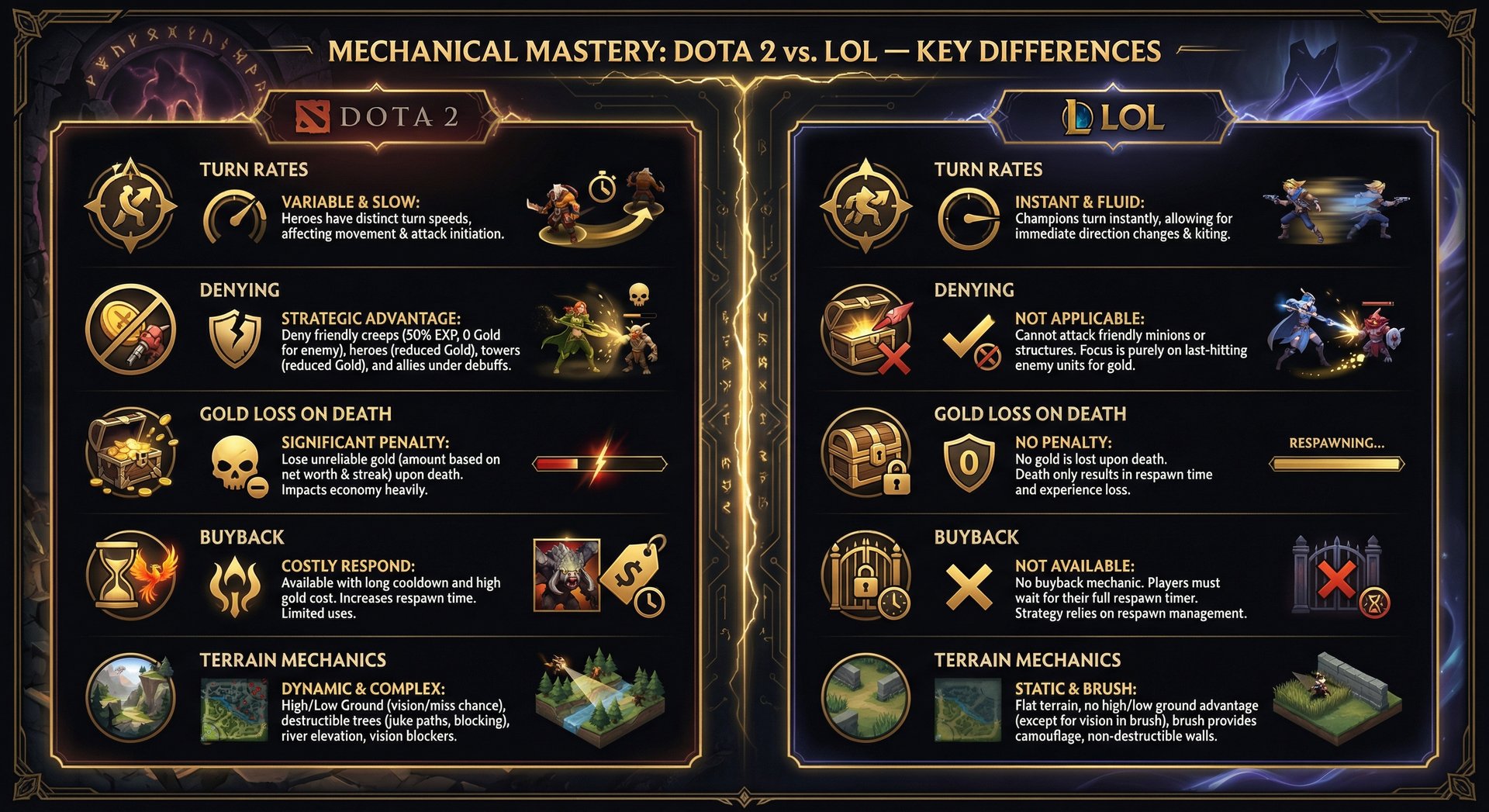
Turn Rates
Dota 2 heroes have turn rates — the speed at which they rotate to face a new direction before attacking or moving. This mechanic doesn’t exist in League of Legends, where champions instantly face any direction.
Turn rates have massive implications:
- Kiting is harder in Dota 2. You can’t just orb-walk infinitely as a ranged hero because turning around to attack takes time. This makes melee heroes more viable.
- Melee carries are legitimate. In LoL, melee ADCs are almost nonexistent because ranged champions kite them endlessly. In Dota 2, heroes like Anti-Mage, Phantom Assassin, and Juggernaut are top-tier carries because turn rates (combined with Blink Dagger and BKB) let them close gaps and stick to targets.
- Positioning matters more. Because you can’t instantly turn and run, being in a bad position is more punishing. You have to commit to your movements.
Denying
In Dota 2, you can attack and kill your own creeps (and even allied heroes under certain debuffs) to deny them from the enemy. This reduces the XP the enemy receives by 50% and denies them the gold entirely.
League of Legends has no deny mechanic. Minions give gold and XP when they die regardless of who killed them (though only the last-hitter gets the gold).
Denying adds an entirely second layer to the laning phase. In Dota 2, you’re not just trying to last-hit — you’re also trying to deny, creating a complex push-pull of lane equilibrium. This is one reason laning in Dota 2 is considered more skill-intensive. For a deep dive into this, check our laning phase guide from Immortal players.
Gold Loss on Death and Buyback
When you die in Dota 2, you lose unreliable gold (gold from creep kills). This means dying doesn’t just cost you time — it literally costs you money. In late-game scenarios, a death can cost 1,000+ gold, potentially delaying a key item by several minutes.
Dota 2 also has buyback — you can spend gold to instantly respawn. This creates incredible late-game decision-making: Do you buy back and fight? Do you save buyback gold for the next fight? Buyback management is an entire skill unto itself at high MMR.
League has neither mechanic. Death costs time but not gold, and there’s no buyback (aside from Guardian Angel, which functions differently).
Day/Night Cycle
Dota 2 features a day/night cycle that affects vision range (heroes see less at night), certain hero abilities (Night Stalker becomes vastly more powerful at night), and overall game tempo. The cycle adds strategic depth — teams often time pushes and ganks around nightfall.
League has no day/night cycle.
Terrain and High Ground
Dota 2’s map features elevation changes. Attacking uphill gives a 25% miss chance. Trees provide juke paths that can be destroyed. Certain abilities interact with terrain (Clockwerk’s cogs, Earthshaker’s Fissure). The Roshan pit, high ground base defense, and ward placement all involve terrain strategy.
League’s map is essentially flat with bushes providing vision concealment. While bushes add some strategy, the terrain interactions in Dota 2 are far more complex.
Teleport Scrolls
Every Dota 2 hero can buy Town Portal Scrolls (TP scrolls) to teleport to any friendly structure. This creates a dynamic where global rotations are possible at all times, making map awareness critical. An enemy diving your tower? Two teammates can TP in for a counter-kill.
League has Teleport as a summoner spell (one of two you can pick), and it has a long cooldown. This means TP rotations are less frequent and more situational. Recall (free base teleport) is the primary way to return to base.
Courier vs Recall
Dota 2 uses couriers — controllable units that ferry items from your base to your hero in the field. Managing courier timing (when to send items, how to avoid enemy courier sniping) is an additional skill layer.
League uses Recall — a channeled ability that teleports you to base for free. This is simpler but means you lose lane presence every time you need items.
Summary: Mechanical Depth
Dota 2 is objectively more mechanically complex. Turn rates, denying, gold loss, buyback, day/night, elevation, TP scrolls, and couriers all add layers that League doesn’t have. This isn’t necessarily a criticism of League — simplicity has its advantages, which we’ll discuss in the learning curve section. But if you’re looking for the deeper game, Dota 2 wins hands down.
Heroes vs Champions
Roster Size and Design Philosophy
As of 2026, Dota 2 has approximately 125+ heroes while League of Legends has 170+ champions. But roster size tells a small part of the story — it’s design philosophy that matters.
Dota 2’s approach: Every hero is designed to be unique, with abilities that fundamentally change how the game is played. Invoker has 14 abilities. Meepo controls multiple clones. Io tethers to allies and globally relocates them. Chen controls jungle creeps. Morphling can literally become another hero. The design ethos is: if it creates interesting gameplay, ship it, even if it’s “broken.”
League’s approach: Champions are designed with clearer roles and more standardized kits. Most champions have a passive, Q, W, E, and R with relatively predictable interactions. There’s less “jank” and fewer game-breaking abilities, which makes balancing easier but reduces uniqueness. Many champions feel similar within their archetype (ADCs especially).
Ability Design and Complexity
| Aspect | Dota 2 | League of Legends |
|---|---|---|
| Average abilities per hero | 4–5 (some have 10+) | 4 + passive |
| Hard crowd control duration | Long (2–4 second stuns common) | Short (0.5–1.5 seconds typical) |
| AoE ability impact | Massive (teamfight-deciding) | Moderate (usually dodgeable) |
| Global abilities | Many (Zeus, Nature’s Prophet, Spectre) | Few (Karthus, Shen, TF) |
| Summons/Micro-intensive | Multiple heroes (Chen, Meepo, Visage) | Minimal (Shaco clone, Yorick) |
| Ability interactions | Complex (Rubick steals spells, Morphling copies heroes) | Limited |
The stun duration difference is particularly significant. A 4-second stun in Dota 2 (like Mirana’s Sacred Arrow at max range) can lead to a kill from full HP. League’s shorter CC means fights are more about sustained damage and repeated skill use rather than single-moment plays.
Hero Availability
This is where Dota 2 wins unambiguously. All heroes are free from the moment you install the game. You never have to grind or pay to access a hero. Every player in every match has access to the full roster.
League requires you to unlock champions through in-game currency (Blue Essence) or real money (RP). A new player has access to a free rotation of ~15 champions per week. Unlocking the full roster takes years of grinding or hundreds of dollars.
This has competitive implications: in Dota 2, you can always counter-pick because you have every hero available. In League, you might not own the counter-pick champion, forcing suboptimal choices.
Meta and Balance
Dota 2’s balance philosophy, guided by IceFrog, tends toward making everything powerful rather than nerfing everything to be similar. The result is a game where almost every hero is viable in some context. TI-level tournaments regularly see 100+ heroes picked across the event.
League’s balance, managed by a larger team, tends toward more frequent patches that shift the meta deliberately. Certain champions are intentionally buffed to promote “diversity,” which can feel artificial. Pro play meta is often narrower, with 40–60 champions seeing regular play.
Item Systems
Dota 2 Items: Game-Changing Actives
Items in Dota 2 aren’t just stat sticks — they’re often the most impactful abilities in your arsenal. Some examples:
- Blink Dagger: Instant 1200-range teleport. Completely changes how initiators function.
- Black King Bar (BKB): Magic immunity. Without it, most carries can’t fight.
- Force Staff: Push any unit 600 range in the direction they’re facing. Save allies, escape ganks, push enemies into your team.
- Refresher Orb: Resets ALL cooldowns instantly. Double Ravage, double Black Hole, double Chrono.
- Scythe of Vyse: 3.5-second hex that turns the enemy into a harmless pig. Instant cast, no counter-play except BKB or Linken’s.
- Aghanim’s Scepter/Shard: Upgrades or adds abilities to every hero in the game, each unique.
The item system in Dota 2 is a second layer of hero building. Two players on the same hero can have completely different item builds depending on the matchup, game state, and team composition.
League of Legends Items: Mythics and Stat Efficiency
League’s item system was overhauled with the Mythic item update and has continued evolving. Items in League are primarily about stats (AD, AP, attack speed, armor) with some active abilities. Recent seasons have added more active items, but the depth still doesn’t match Dota 2’s.
League items are more about optimizing your damage output or survivability within your role. There are fewer “utility” items that fundamentally change what your champion can do.
Item Build Diversity
| Aspect | Dota 2 | League of Legends |
|---|---|---|
| Active items | Extremely common (most items have actives) | Less common |
| Build diversity per hero | High (3–5 viable builds per hero) | Moderate (usually 1–2 optimal builds) |
| Counter-building | Essential (BKB vs magic, MKB vs evasion) | Less impactful |
| Consumable items | Many (Dust, Smoke, Wards, TP scrolls) | Few (wards are free and limited) |
| Neutral items | Yes (random drops from jungle) | No |
Map Design and Objectives
Dota 2’s Map
Dota 2’s map is larger and more asymmetric than League’s. Key features:
- Two sides are different. Radiant and Dire have distinct jungle layouts, Roshan access, and high ground configurations. This asymmetry creates draft implications — some heroes are stronger on one side.
- Trees everywhere. Dense tree coverage enables juking, fog-of-war plays, and ward placement mind games. Trees can be destroyed by abilities, adding another tactical layer.
- Roshan (Boss objective): Drops Aegis of the Immortal (free resurrection), Cheese (instant heal), Refresher Shard, and Aghanim’s Blessing on subsequent kills. Roshan is a pivotal objective that dictates game tempo.
- Outposts: Capturable objectives that provide XP and map control.
- Secret Shop: Certain item components can only be purchased at the secret shop, located in dangerous map positions. This forces carries to venture into risky territory.
League of Legends’ Map
League’s Summoner’s Rift is more symmetric and streamlined:
- Dragon pit: Elemental dragons spawn throughout the game, each providing permanent team-wide buffs. Dragon Soul (4 dragons) provides a powerful buff, and Elder Dragon is a game-ending threat.
- Baron Nashor: The primary late-game objective, providing empowered minions for sieging.
- Rift Herald: Early-game objective that can be used to push towers.
- Bushes: Provide vision concealment but can’t be destroyed.
- Alcoves: Small nooks in the map for juking and warding.
Objective Comparison
League’s objective system is arguably better designed for creating consistent game tempo. Dragon spawns force teams to contest, creating regular teamfight windows. Baron provides clear win conditions. The game has a more predictable flow.
Dota 2’s objectives are more open-ended. Teams can ignore Roshan for 30 minutes or rush him at 15. There’s no elemental dragon system forcing fights at specific times. This open-endedness gives more strategic freedom but can also lead to slower, more passive games.
Ranked Systems and Competitive Integrity
Dota 2 Ranked
Dota 2 uses MMR (Matchmaking Rating) — a numerical value that goes up when you win and down when you lose. Medals (Herald through Immortal) correspond to MMR ranges and are displayed on your profile.
Key features:
- Separate MMR for core and support roles
- Ranked roles matchmaking (queue for specific positions)
- Behavior score system (low score = worse match quality)
- Phone number required for ranked
- Calibration matches for new accounts (10 games)
- No promo series — MMR changes are immediate
- Leaderboards for top players (Immortal rank)
Dota 2’s ranked system is transparent but sometimes frustrating. MMR gains/losses are typically 20–30 per game, meaning climbing requires sustained win rates. Our MMR Boost service helps players push through plateaus when they feel stuck despite improving. For fresh accounts, our Calibration service ensures you start your ranked journey at an appropriate level.
League of Legends Ranked
League uses a tier system (Iron through Challenger) with divisions within each tier (IV to I). You gain League Points (LP) for wins and lose them for losses, with promotion series required to move between tiers.
Key features:
- Promotion series between tiers (best of 3 or best of 5)
- Demotion protection (shields prevent dropping tiers easily)
- Placement matches each season (usually 10)
- Role selection during queue
- Duo queue allowed in most ranks
- Flex queue (up to 5-man premade)
Ranked Comparison
| Feature | Dota 2 | League of Legends |
|---|---|---|
| Rank visibility | MMR number + medal | Tier + division + LP |
| Promotion series | No | Yes |
| Smurf detection | Moderate | Moderate (improved recently) |
| Queue times (average) | 3–8 minutes | 2–5 minutes |
| Match quality | Generally good at high MMR | Inconsistent due to autofill |
| Behavior system | Behavior score (visible) | Honor system (less impactful) |
Both systems have flaws. Dota 2’s can feel grindy — gaining 25 MMR per win means 40 consecutive net wins to climb 1,000 MMR. League’s promotion series add unnecessary variance — you can be at your peak skill and still fail promos due to a bad teammate or two.
Learning Curve and New Player Experience
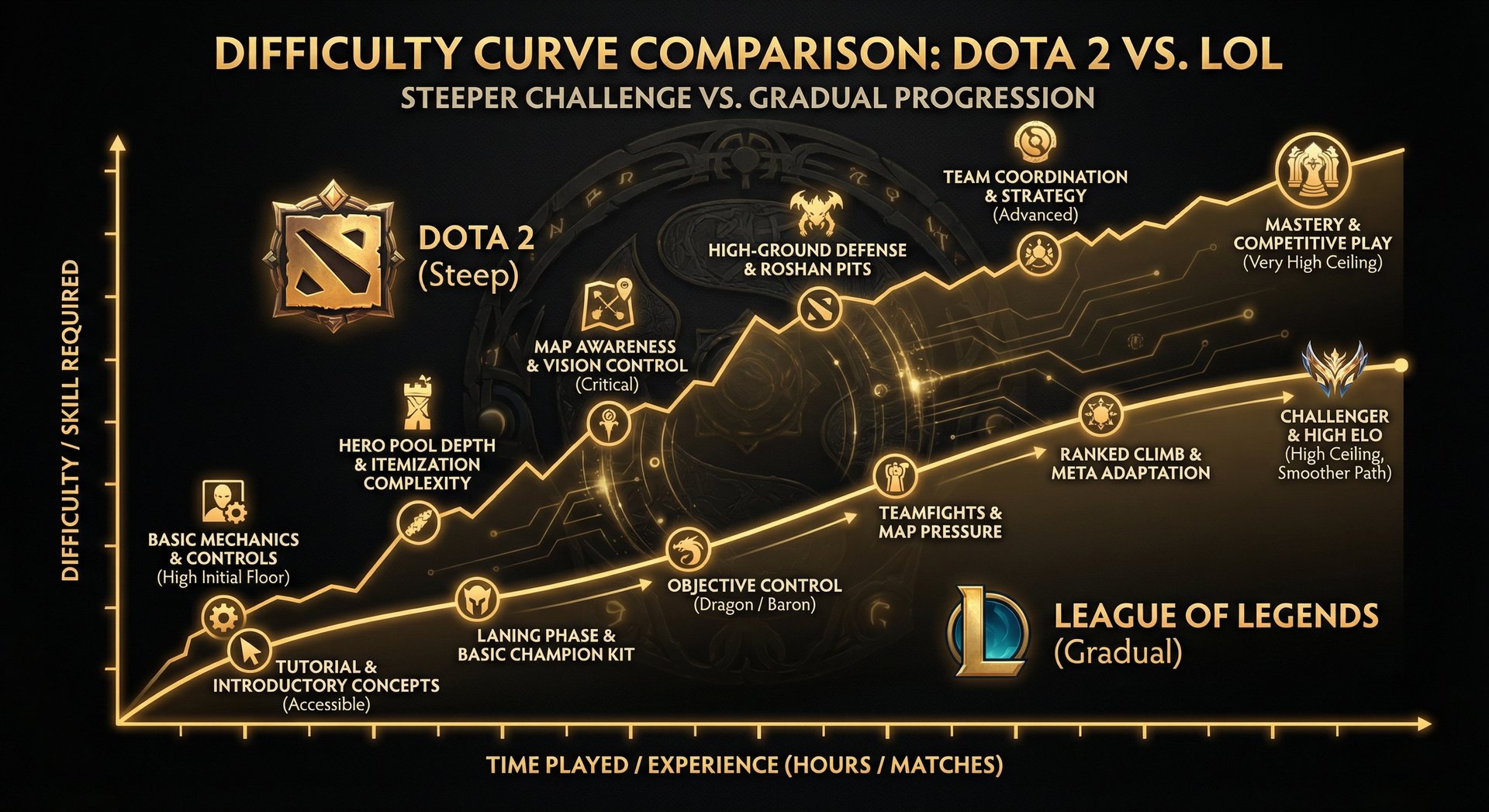
This is where the two games differ most dramatically in terms of accessibility.
Dota 2: The Everest of Gaming
Dota 2 has arguably the steepest learning curve of any competitive game, period. Here’s why:
- 125+ heroes with unique abilities — you need to learn what every hero does, not just the ones you play
- Hundreds of items with active abilities you need to understand
- Denying, pulling, stacking, creep aggro, lane equilibrium — mechanics that don’t exist in simpler games
- No tutorial that covers real gameplay. The in-game tutorial teaches you to move and attack. It doesn’t teach you that you need to buy TP scrolls, or that denying exists, or what pulling is.
- Toxic community toward new players. New players are often flamed for mistakes they didn’t even know were mistakes.
- 100-hour minimum before ranked. Valve requires roughly 100 hours of unranked play before you can queue ranked, which is both a barrier and a necessary learning period.
The new player experience in Dota 2 is, frankly, terrible. Valve has made some improvements (bot matches, guided tutorials), but the game still assumes knowledge it doesn’t teach. Most new Dota 2 players learn from friends, YouTube guides, or coaching services like ours.
League of Legends: Accessible but Deceptive
League is significantly easier to pick up:
- Simpler mechanics — no denying, no turn rates, no gold loss on death
- Better tutorial — Riot has invested heavily in new player onboarding
- Lower barrier to ranked — you can start ranked sooner
- Recommended items and runes — the game suggests what to buy
- Champion spotlight videos — Riot produces content explaining each champion
However, League is deceptively deep. The macro game (wave management, jungle tracking, objective timing) is complex, and the skill ceiling at high ranks is very high. The difference is that you can have fun in League without understanding these concepts, while Dota 2 punishes ignorance harshly.
Time to Competency
| Milestone | Dota 2 | League of Legends |
|---|---|---|
| Understanding basic gameplay | 50–100 hours | 10–30 hours |
| Ready for ranked | 200–500 hours | 100–200 hours |
| Understanding all heroes/champions | 500–1,000 hours | 300–500 hours |
| Reaching average rank | 1,000+ hours | 500+ hours |
| Reaching high rank | 3,000–5,000+ hours | 2,000–3,000+ hours |
If you’re just starting your Dota 2 ranked journey, our guide on unlocking ranked and calibration can help you prepare efficiently.
Esports Scene
Dota 2 Esports
Dota 2’s esports crown jewel is The International (TI), which consistently features the largest prize pools in esports history. TI’s prize pool is funded by the community through Battle Pass sales, with Valve contributing a base amount.
Key stats:
- TI prize pools have exceeded $40 million
- Open qualifier system allows any team to theoretically qualify
- Regional leagues (DPC) provide year-round competition
- Majors serve as the secondary tier of premier tournaments
- The scene has a more “grassroots” feel compared to League’s franchised model
Pros of Dota 2 esports:
- Massive prize pools attract top talent
- Open qualifiers mean any team can compete
- Hero diversity in pro play is excellent
- Games are strategically deep and varied
Cons of Dota 2 esports:
- Valve’s hands-off approach means inconsistent production
- Player salaries outside of top teams are low
- The scene is top-heavy — huge money at TI, less elsewhere
- Third-party tournament organizers do much of the heavy lifting
League of Legends Esports
Riot Games runs a franchised league system with regional leagues (LCS, LEC, LCK, LPL) feeding into international events (MSI, Worlds).
Key stats:
- Worlds viewership consistently exceeds 100 million unique viewers
- Franchised teams pay buy-in fees (reportedly $10–30 million)
- Player salaries are higher on average than Dota 2
- Year-round leagues provide consistent content and narratives
- Worlds prize pool is smaller (~$2.5 million) but supplemented by team salaries
Pros of LoL esports:
- Consistent, high-quality production from Riot
- Year-round narratives through league play
- Higher average player salaries
- Massive global viewership
Cons of LoL esports:
- Franchising limits new team entry
- Meta can feel stale with fewer viable champions
- Prize pools are comparatively small
- Regional leagues can have lopsided competition
Esports Comparison
| Aspect | Dota 2 | League of Legends |
|---|---|---|
| Biggest tournament | The International | World Championship |
| Prize money (top event) | $40M+ | ~$2.5M |
| Peak viewership | ~5–8 million | ~100+ million |
| Player salaries (avg) | Lower (except top teams) | Higher across the board |
| Accessibility to new teams | Open qualifiers | Franchised (buy-in) |
| Hero/champ diversity in pro play | Very high (90%+ pick rate) | Moderate (50–60% pick rate) |
| Game quality for viewers | Complex, slower, strategic | Fast-paced, action-oriented |
Both esports scenes have their strengths. League dominates in viewership and infrastructure; Dota 2 dominates in prize money and competitive openness. If you’re a viewer, League is easier to follow. If you’re a competitor, Dota 2 offers higher peak rewards.
Community and Toxicity
Let’s be honest: both communities are toxic. But they’re toxic in different ways.
Dota 2 Community
Dota 2’s community is smaller but more intense. Toxicity in Dota 2 tends to manifest as:
- Verbal abuse in voice chat — Dota 2’s open voice chat means you hear toxicity directly
- Intentional feeding and griefing — players who tilt may deliberately run down mid
- Ability abuse — using abilities to grief teammates (Tiny tossing allies into enemies, Io relocating allies to fountains)
- Smurfing — experienced players creating new accounts to stomp lower-ranked games
Valve’s behavior score system helps somewhat — players with high behavior scores generally have better match quality. But enforcement of reports is inconsistent, and low priority queue (the punishment pool) is the main deterrent, which some players just grind through quickly.
League of Legends Community
League’s larger community means more total toxicity but arguably lower intensity per interaction. Toxicity in League tends toward:
- Text chat flame — League historically didn’t have voice chat (now available for premades)
- Passive-aggressive play — soft inting, taking farm, refusing to group
- Surrender vote spam — giving up at 15 minutes is a cultural norm for many players
- Champion select toxicity — role stealing, banning teammates’ declared champions
Riot’s punishment system includes chat restrictions, temporary bans, and permanent bans. They’ve also implemented the Honor system to reward positive behavior.
The Verdict
Neither community is great. Dota 2 is more vocally toxic (voice chat), while League has a larger volume of text-based toxicity and passive griefing. Both games could improve significantly in this area.
Business Models
Dota 2: Truly Free-to-Play
Dota 2 is one of the fairest free-to-play games in existence:
- All heroes free — no gameplay advantage from spending money
- Monetization is cosmetics only — skins, announcer packs, terrain skins, couriers
- Battle Pass — seasonal content pass with cosmetic rewards
- Dota Plus — subscription service with hero progression, analytics, and slight convenience features
You can play Dota 2 for 10,000 hours and never spend a cent with zero competitive disadvantage.
League of Legends: Free-to-Play with Grind
League’s business model is more aggressive:
- Champions cost money or grind — unlocking all champions takes years or hundreds of dollars
- Skin prices range from reasonable to absurd — ultimate skins cost $30+
- Loot boxes (Hextech Crafting) — randomized cosmetic rewards
- Event passes — similar to battle passes with mission-based progression
- Rune pages — while runes are free now, additional rune pages cost RP
League isn’t pay-to-win in a strict sense, but having fewer champions means fewer options in draft, which is a competitive disadvantage. A new player with 20 champions can’t counter-pick the way a veteran with 170 can.
Which Game Should You Play?
After thousands of words of comparison, here’s our honest recommendation:
Play Dota 2 if you want:
- Maximum strategic and mechanical depth
- A truly free-to-play experience
- Longer, more complex games with dramatic comebacks
- An esports scene with massive prize pools
- A game that rewards thousands of hours of learning
- More diverse hero design and build variety
Play League of Legends if you want:
- A more accessible starting experience
- Faster-paced games with quicker feedback loops
- A larger player base and faster queue times
- A more structured esports ecosystem
- Easier to pick up and play casually
- More consistent game updates and developer communication
Our Bias (Transparency)
We’re a Dota 2 service — TeamSmurf provides boosting, coaching, and calibration for Dota 2 players. So naturally, we believe Dota 2 is the deeper, more rewarding game. But we’ve tried to be fair in this comparison, and we genuinely believe both games have strengths worth acknowledging.
If you’re already a Dota 2 player looking to improve, check out our Coaching service or browse our other guides for in-depth strategy content.
Switching Between Games: What to Know
Going from LoL to Dota 2
If you’re a League player trying Dota 2, here’s what will trip you up:
- Turn rates will feel sluggish. You’ll feel like your hero is moving through molasses. This is intentional — embrace it.
- You will die to things you’ve never seen. Dota 2 has more one-shot combos, global abilities, and “unfair” interactions than League. That’s part of the game.
- You need to buy TP scrolls. There’s no free recall. Forgetting TP scrolls means you’re walking across the map.
- Denying is a new skill. You’ll need to actively deny creeps while last-hitting.
- Items have active abilities. You’ll need to use 4–6 active items in fights, not just press your champion abilities.
- Games are longer. Average games are 35–50 minutes. Get comfortable with that pace.
Going from Dota 2 to LoL
If you’re a Dota 2 player trying League:
- Everything feels faster. No turn rates, shorter CC, faster movement — the pace is noticeably quicker.
- You can’t deny creeps. Focus purely on last-hitting and harassing.
- Mana management is different. Most champions have lower mana costs and regenerate faster. Spam abilities more freely.
- Recall is free. Use it liberally to buy items and heal.
- Dragon is important. It’s not like Roshan — you need to contest dragons regularly.
- Warding is simpler. Everyone gets free wards with limited charges. No ward economics.
Frequently Asked Questions
Ready to Climb? Start Your Boost Today
Team Smurf is the #1 rated Dota 2 boosting service. Immortal-rank boosters, maximum safety, competitive pricing, 24/7 support.
Conclusion
Dota 2 and League of Legends are both excellent games that have defined the MOBA genre for over a decade. In 2026, the choice between them comes down to what you value: depth and complexity (Dota 2) or accessibility and pace (League of Legends).
We believe Dota 2 is the more rewarding game for players willing to invest the time to learn it. The strategic depth, hero diversity, item complexity, and comeback potential create an experience no other game can match. Every game of Dota 2 is different in a way that League, with its more standardized gameplay loops, can’t quite replicate.
But we also respect League for what it does well — making the MOBA genre accessible to hundreds of millions of players and building one of the most successful esports ecosystems in history.
Whichever game you choose, play it for fun, and remember: rank is just a number. But if that number bothers you, we can help with that too.