


Dota 2 Vision and Fog of War Explained: Ranges, High Ground, Trees and Night Vision

You just got killed by an enemy you never saw coming. Your lane partner died to a gank from a direction that was completely dark on your minimap. You attacked a hero on the high ground cliff and half your arrows sailed straight into the air. If any of this sounds familiar, you are losing games because of vision — and this guide explains exactly why.
Fog of war is not just a decorative darkness on your screen. It is the single most mechanically important system in Dota 2, and understanding it changes how you position, how you ward, and how you interpret every fight. This guide covers unit vision ranges (day and night), how high ground creates a 25% miss penalty, why trees block line of sight, how Night Stalker reshapes the vision economy every night phase, and exactly how far each type of ward actually sees.
What’s in This Guide
- What Is Fog of War?
- Ground Vision vs. Flying Vision
- Vision Ranges by Unit Type
- Tower Vision
- High Ground and the 25% Miss Chance
- Trees and Line of Sight
- How the Day/Night Cycle Changes Vision
- Night Stalker and Night Vision Heroes
- Ward Vision Ranges
- True Sight and Reveal Mechanics
- Practical Vision Tips
- Frequently Asked Questions
What Is Fog of War in Dota 2?
Fog of war is the black area on your screen that your team cannot currently see. Any unit, building, tree, or piece of terrain inside the fog is hidden from your team. You cannot see enemy heroes there, you cannot target them with abilities, and your hero will not automatically attack into it.
Every unit in Dota 2 has a vision radius — a circle of terrain around it that it reveals for its team. When an enemy walks into that revealed circle, your team can see them. When they walk back out into the fog, they disappear. This is the most basic version of fog of war, and it applies whether you are talking about a hero, a tower, a ward, a lane creep, or a summoned unit.
There are two key rules that apply from the moment the game starts:
- You only see what your team’s units can see. Allies share their vision with you in real time. If your support places an observer ward in the river, your entire team sees everything inside that ward’s vision circle.
- The fog updates dynamically. The moment a unit dies, moves away, or gets its vision blocked, the fog closes back in. There is no “memory” — the fog reflects current vision, not where an enemy was two seconds ago.
There is one exception: when an enemy unit you previously had vision of moves into the fog, Dota 2 briefly shows the unit in its last known position at reduced opacity. This ghost image is not the real unit — it is only where they were when you last had eyes on them. Experienced players use this to track rotations and gank patterns.
Shared Vision and Allied Units
Your team’s vision pool is the sum of all your team’s units’ vision. That includes your five heroes, your towers, your creeps, courier, any summoned units, any runes your courier touches, and any wards you have placed. When you pick heroes with summons like Invoker’s Forge Spirits, Nature’s Prophet’s Treants, or Broodmother’s spiderlings, each of those units contributes to your team’s total vision and can be used to scout areas of the map your heroes cannot safely reach.
The Dota 2 coaching staff at TeamSmurf often point to vision as the first skill gap between Herald players and Archon players. Understanding where your team has eyes — and where it does not — is the foundation of map awareness, and map awareness is how you stop dying to ganks you never saw coming.
Ground Vision vs. Flying Vision
Not all vision in Dota 2 works the same way. There are two types: ground vision and flying vision. The difference changes what terrain and obstacles can block your line of sight.
Ground Vision
Ground vision is what the majority of heroes and ground-based units use. It is blocked by:
- Trees — any tree on the map stops ground vision from passing through it
- High ground cliffs — units on low ground cannot see onto the high ground plateau unless another source of vision is placed up there
- Fog-of-war tiles — areas with no allied unit nearby are simply dark
The radius for ground vision is measured in “units” — an internal Dota 2 measurement where approximately 64 units equals one small grid square on the minimap. When the game says a hero has 1800 vision range, that is 1800 of these units in all directions.
Flying Vision
Flying vision passes over trees and terrain. It is granted by observer wards, certain flying units like Viper when casting his ultimate at high range, and some abilities. Flying vision reveals the ground beneath trees, meaning it can expose heroes hiding in tree lines. This is one reason why a correctly placed observer ward near a common gank route provides so much more information than a hero standing in the same spot — the ward’s flying vision sees through the trees on either side of the path.
Vision Ranges by Unit Type
Most units in Dota 2 follow standard vision values, but there are important exceptions. The table below covers the most common unit types you will encounter. All values are in Dota 2 units (the game’s internal measurement).
| Unit Type | Day Vision | Night Vision | Vision Type | Notes |
|---|---|---|---|---|
| Most heroes (melee) | 1800 | 800 | Ground | Standard for majority of heroes |
| Most heroes (ranged) | 1800 | 800 | Ground | Same radius despite attack range |
| Night Stalker (during night) | 1800 | 1800 | Ground | Void ability also reduces all enemies to 675 |
| Towers (T1, T2, T3) | 1900 | 1900 | Ground | Constant day/night, no reduction |
| Observer Ward | 1600 | 1600 | Flying | Sees through trees, constant |
| Sentry Ward | 850 | 850 | True Sight | Reveals invisible units only |
| Lane creeps | 900 | 900 | Ground | Consistent day and night |
| Roshan | 700 | 700 | Ground | Constant, low range for a large unit |
| Courier | 350 | 350 | Flying | Flying vision but very short range |
| Ancient creeps (jungle) | 600 | 600 | Ground | Slightly higher than lane creeps |
The most important number to internalize from this table is 1800 / 800 — that is the day/night split for virtually every hero you will ever play. During the day phase, you see 1800 units in every direction. When night falls, that collapses to 800. To put it concretely: at night, an enemy hero standing 900 units away from you is completely invisible unless you have a ward, ability, or a source of True Sight providing vision there.
Heroes With Non-Standard Vision Ranges
A handful of heroes have vision ranges that differ from the standard 1800/800 baseline. These tend to be either very vision-dependent heroes or heroes whose kit interacts with the day/night cycle:
- Night Stalker — Has 800 night vision base like everyone else, but his Darkness ability reduces all non-Night-Stalker units to 675 night vision during his night, and he himself gains 1800 night vision during this period.
- Meepo — Each Meepo clone contributes 1800/800 ground vision independently, making coordinated Meepo play a genuine vision advantage on its own.
- Lycan’s wolves — His summoned wolves have 1800/1800 vision (day and night), making them useful scouts beyond the 800 night limit heroes face.
- Phoenix’s Supernova egg — Has reduced vision while in egg form, which matters for positioning during team fights.
Tower Vision — What Towers Can and Cannot See
Towers maintain 1900 day/night vision constantly — they are not affected by the day/night cycle. This makes them reliable anchors for your team’s map control near your base. However, tower vision follows the same ground-vision rules, meaning:
- Towers cannot see through trees — an enemy hero standing behind a nearby tree cluster is invisible to the tower
- Towers cannot see high ground they are positioned below — a T1 Radiant tower in the river does not have vision of the Dire high-ground side lanes by default
- Towers do see creeps that are attacking them, even without any hero nearby
The practical consequence is that towers are much weaker vision anchors than they appear. An enemy hero can approach your tier 1 tower through the treeline on either side of the lane and the tower will not see them until they step into the clear area in front of it. This is how skilled offlaners and supports set up kills on Tier 1 towers even when your carry is “safely farming under tower.”
Tower denial vision: when a tower is in the final seconds of dying, it loses its vision contribution. Smart teams push towers with a unit baiting slightly ahead to deny the tower’s vision at the same moment it falls, ensuring the defending team cannot immediately see what happens next.
High Ground and the 25% Miss Chance
High ground is one of the most misunderstood mechanics in Dota 2, and it is a primary reason why winning teams can turtle base defenses effectively. Here is exactly how it works.
The Miss Penalty
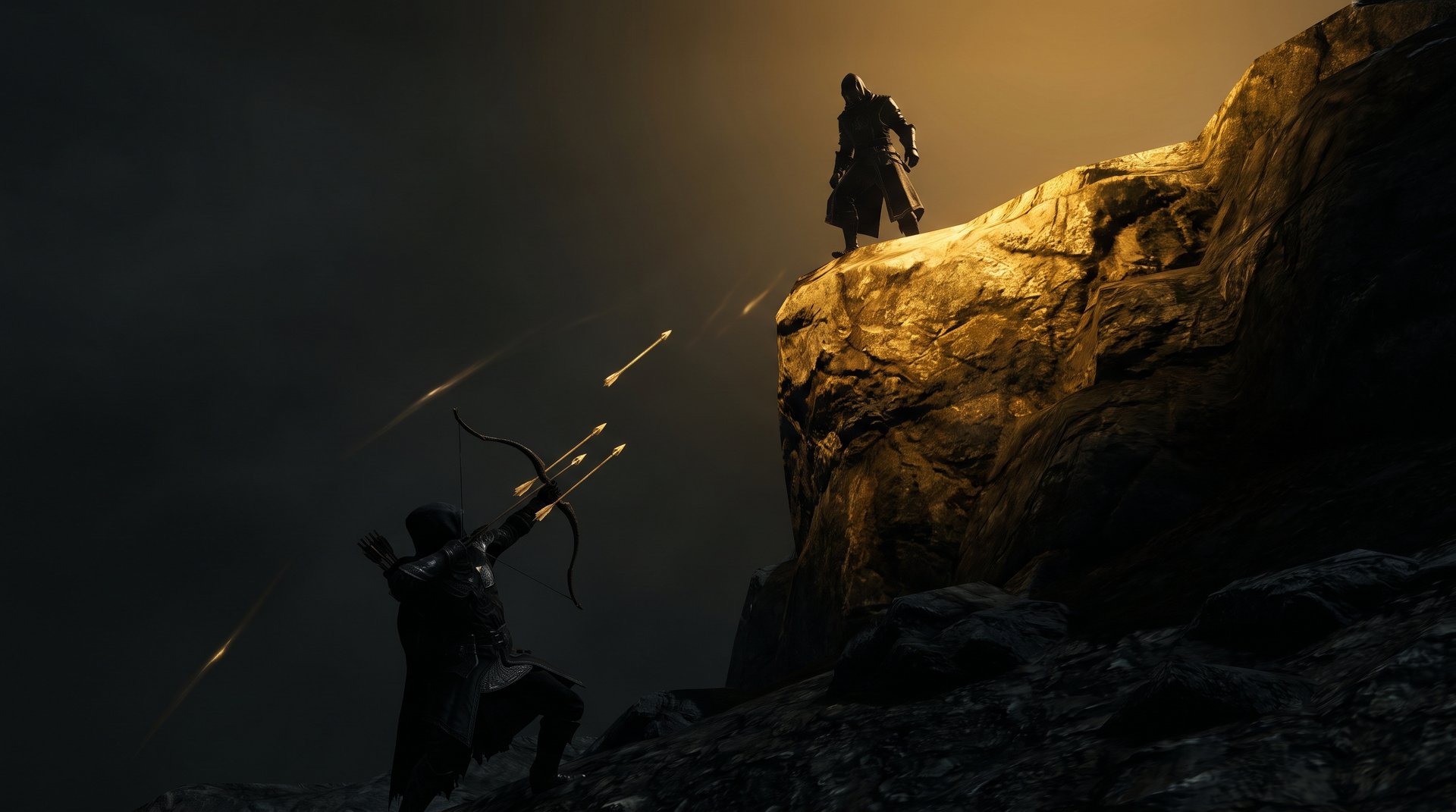
When a ranged unit on low ground attacks a unit on high ground that it does not have true vision of, each attack has a 25% chance to miss. This is not a miss from the target’s evasion — it is a blind miss caused by the fog of war on the high ground.
The “25% miss” is calculated per attack. Each individual arrow or projectile fired from low ground toward a high-ground unit rolls a 25% miss chance independently. Over the course of a siege, a carry shooting 30 attacks in 60 seconds will miss roughly 7-8 of them to the high-ground penalty alone — before accounting for any evasion or miss from abilities like Smoke Screen or Blind.
How to Deny the Miss Penalty to Your Enemies
The miss penalty disappears the moment the attacking unit has direct vision of the target. This means:
- An observer ward placed on the high ground (where the defending enemy is positioned) removes the miss chance for your team
- A Sentry ward does not count — it provides True Sight, not normal vision
- Any unit your team has on the high ground provides vision that removes the penalty for all attacks on targets within that vision radius
- Abilities like Clairvoyance that grant temporary vision remove the penalty during their duration
This is why warding properly during a push is a tactical skill, not just a support task. A well-placed ward on the enemy’s tier 3 high ground removes the miss penalty that costs your team 25% of their damage output during that siege.
High Ground Vision — The Defensive Side
The flip side of the high-ground penalty is the vision advantage the defending team gets. A hero standing on high ground can see down onto the low ground below, as long as there is no terrain blocking the line of sight. This creates a strong information asymmetry: the defender on the high ground often sees the attacking force before any attack is made.
Teams that are ahead but have been catching up to use this advantage — they will recall their heroes to base before the enemy reaches their tier 3 and use the high-ground vision to get information on where the enemy is grouping, which direction they are approaching from, and whether a Smoke gank is in play.
Trees and Line of Sight
Trees are the most interactive vision obstacle in Dota 2. They block ground vision but not flying vision, and they can be destroyed, cut through, or used as juke spots. Understanding how trees interact with vision explains a huge number of the “how did they not see me?” moments in pubs.
Trees Block Ground Vision in One Unit of Width
Each tree in Dota 2 is a single unit that blocks ground vision. When standing in a tree line, a hero’s ground vision extends radially from their position, but any tree in the path of that vision cone creates a shadow behind it. An enemy hiding immediately behind a single tree can be fully invisible to a hero who is only a few hundred units away.
This is why the tree lines on the edges of the river are some of the most contested vision spots in the game. Observers placed in those trees provide flying vision that sees through to both sides, which is why supports fight over them during the early game before any major fights happen.
Cutting Trees for Vision and Mobility
Several heroes can destroy or cut through trees with their abilities:
- Timbersaw — His entire kit is built around tree interaction; Timber Chain flies through trees and removes them
- Nature’s Prophet — Sprout creates trees, and Teleportation can be blocked by trees (or not, depending on the exact geometry)
- Dragon Knight — Breathe Fire has a cleave that destroys trees
- Invoker — Tornado passes through trees
- Treant Protector — Eyes in the Forest gives vision inside trees at specific spots
- Quelling Blade / Iron Talon — Any hero can destroy a tree with a right-click while holding these items
When trees are cut or destroyed, the vision through that location opens up permanently (until the next day/night tree respawn cycle). This is used offensively to open sight lines that enemy supports have not warded and defensively to cut off juke paths an enemy may use to escape.
Trees and the Day/Night Difference
During the day phase with 1800 vision range, your hero can see the tops of trees around them, which lets you spot enemies who are standing in the tree line but not directly behind a tree. At night with 800 vision range, any enemy hero in the tree line that is more than 800 units away is effectively invisible even if no single tree is between you. This is why night ganks via tree lines are so effective — the tree line compresses the gap where enemies can approach unseen to nearly the entire length of any side lane.
How the Day/Night Cycle Changes Vision
The Dota 2 map operates on a day/night cycle. Day lasts 4 minutes, night lasts 4 minutes, and the cycle alternates throughout the game. The game starts at daytime.
During night, all standard heroes lose 1000 units of vision — from 1800 to 800. This has several cascading effects:
- Ganks become safer — approaching from the side lane trees at night is significantly harder to detect
- Farming becomes riskier — jungle farming at night requires more active warding because your hero cannot see approaching threats until they are almost on top of you
- Tower defense gets harder — the defender on the high ground is also limited to 800 vision at night, meaning they cannot see the low ground as far as during the day
- Ward placement priorities shift — a ward that covers a comfortable amount of the river at day may not cover the full width of the gank approach path at night
The transition from day to night is shown with a brief visual darkening of the screen. Keeping track of the cycle on your HUD clock is a habit that separates autopilot farming from active decision-making. If you are farming deep jungle at night with no nearby wards, you are playing a blind game — which directly costs your MMR over time.
Night-Phase Combat Dynamics
Team fights at night are fundamentally different from day fights because of the reduced vision. Units caught in the open at night can be surrounded by enemies they did not see until it was too late. Initiation heroes with long-range abilities can engage from outside the enemy’s 800 vision range — an Enigma Black Hole cast from 820 units away starts with no warning visible to the target.
Good players time their rotations around the day/night boundary. If a gank is about to happen at a side lane, initiating during night means the target has less time to react even without Smoke of Deceit. If your team is pushing tier 2 towers, waiting until the day phase begins gives your carry full 1800 vision which significantly reduces the high-ground blind spots around the tower.
Night Stalker and Night Vision Heroes
Night Stalker is the hero most mechanically tied to the day/night vision system. His passive ability Darkness activates during the night phase and dramatically reshapes the vision economy for all teams.
What Night Stalker’s Darkness Does to Vision
During Darkness (Night Stalker’s night), all non-Night Stalker units — both allied and enemy — have their night vision reduced to 675 units. Night Stalker himself retains 1800 vision range at night. This creates a situation where Night Stalker has more than 2.5 times the vision range of every other hero on the map.
At higher levels, Night Stalker’s Aghanim’s Scepter upgrade extends the Darkness duration significantly and enables a persistent night state. A team with Night Stalker and Aghanim’s can effectively lock the map into permanent reduced-vision conditions, making all five enemy heroes nearly blind relative to a night-vision-equipped team.
Items That Interact With Night Vision
Several items grant night vision to heroes that would normally drop to 800:
- Helm of the Overlord / Dominated units — Lycan wolves (when summoned) and certain dominated creeps maintain full night vision, providing scouting beyond the hero’s 800 range
- Scout ability heroes — Heroes with revealing abilities like Zeus’s Thundergods Wrath or Beastmaster’s Hawk can grant map-wide or area vision regardless of the day/night cycle
- Flying units — Any flying unit (Phoenix after transforming, Viper’s in some interactions) uses flying vision which generally does not suffer the night reduction in the same practical way ground vision does, because it sees over terrain blockers
The broader lesson from Night Stalker’s kit is that Dota 2 treats night vision as a resource that can be manipulated at the hero and item level. Teams that want to specialize in night-fighting compositions build around this — combining Night Stalker with heroes that have strong initiation range so they can engage from beyond the reduced 675 vision that the enemy team experiences during his night.
Ward Vision Ranges — Observer and Sentry
Wards are the most important tools for controlling vision on the Dota 2 map. Each type provides a fundamentally different kind of vision, and understanding the exact ranges helps you place them precisely rather than by habit.
Observer Wards
Observer wards provide 1600-unit flying vision. The key facts:
- 1600-unit radius — slightly less than hero day vision (1800) but constant: no reduction at night
- Flying vision — sees through trees in every direction within the 1600 radius
- 6-minute duration — each ward lasts 6 real-time minutes before expiring
- Invisible to enemies without True Sight — only a Sentry ward, Gem of True Sight, or True Sight abilities reveal observer wards
The 1600-unit radius means a single observer ward at the river rune spots covers a substantial portion of the river gank paths, but not all of them. Teams that know ward placement can position their approach to just barely skirt the 1600-unit radius of a standard rune ward. This is why experienced supports try to place wards slightly off the standard rune spot — by 200-300 units — to cover the most common approaches where enemies expect standard placements.
For a full breakdown of which ward spots to use at every stage of the game, see our Dota 2 warding guide.
Sentry Wards
Sentry wards provide True Sight within an 850-unit radius. They do NOT provide normal vision — placing a sentry in the fog does not let you see into that area. They only reveal invisible units and invisible wards within their radius.
- 850-unit True Sight radius — detects invisible heroes, wards, and Roshan
- No normal vision — you cannot see terrain, trees, or non-invisible units through a sentry
- 3-minute duration — half the duration of observer wards
- Invisible itself — needs another sentry, gem, or True Sight ability to be detected
The 850-unit sentry True Sight radius is smaller than most players intuitively think. A sentry placed at a standard rune spot ward location will detect observer wards within 850 units — which means a ward placed 851 units away in the treeline will not be detected by the sentry. Counter-warding is a precision skill: the exact placement of your observer ward relative to the spot you expect the enemy sentry determines whether your ward survives.
Understanding the relationship between observer and sentry ward ranges is the foundation of advanced map awareness. The goal is never just “place a ward” — it is “place a ward where the sentry that will be sent to kill it cannot reach.”
Ward Vision and the Day/Night Cycle
Observer wards are unaffected by the day/night cycle. Their 1600-unit flying vision is constant. This makes them especially valuable during the night phase because a single ward provides more effective vision than two of your heroes standing in the area would — your heroes drop to 800 at night, but the ward stays at 1600.
True Sight — Revealing Invisible Enemies
True Sight is a special vision type that reveals invisible units, invisible wards, and any unit using invis-granting abilities within its range. Standard normal vision does not reveal invisible units — you need True Sight specifically.
The sources of True Sight, their ranges, and the heroes that interact with it are covered in detail in our companion post: True Sight in Dota 2. For the purposes of this fog-of-war guide, the key points are:
- Sentry wards provide True Sight in an 850-unit radius (see the table above)
- Gem of True Sight provides True Sight in a 1100-unit aura around the carrier
- Several hero abilities provide True Sight in an area — Beastmaster’s Roar, Zeus’s Thundergods Wrath, Vengeful Spirit’s Wave of Terror, and others
- Dust of Appearance gives a 1050-unit True Sight pulse when used on a hero
- Towers provide True Sight in their attack range as long as they are not disabled
The interaction between True Sight and fog of war is not about the fog itself — it is about a separate invisibility layer that sits on top of the fog. You can have full normal vision in an area and still not see an invisible hero inside it without a True Sight source.
Practical Vision Tips for Intermediate Players
Knowing the numbers is one thing. Applying them in-game is another. These are the highest-leverage vision habits that improve the most with deliberate practice:
1. Track the Day/Night Cycle Actively
Check the in-game clock. Day transitions happen at 0:00, 4:00, 8:00, 12:00, 16:00 and so on. Before you start a rotation or farm a jungle camp at night, ask yourself: do I have ward coverage at 800-unit depth, not 1800-unit depth? The answer changes which rotations are safe and which are not.
2. Know the High Ground Before Every Fight
Before your team takes a fight near the high ground, identify whether any ally has vision on the high ground plateau. If not, your ranged heroes are dealing 25% less effective damage. One ward placed on the high ground before the fight starts eliminates that entire penalty. A single well-placed ward before a tier 3 push is worth hundreds of gold in effective damage.
3. Use Creep Vision During Ganks
Lane creeps provide 900 ground vision even at night. When a creep wave is pushing your side lane, the enemy gank has to approach either through the wave’s vision or from a direction the wave does not cover. Learning to read the creep wave as a vision tool — not just as a gold source — is an early indicator of advanced thinking about the map.
4. Couriers Are Flying Vision Sources
The courier has 350-unit flying vision, which is short range but provides flying vision. A courier flying through a common gank approach in the early game can briefly reveal enemies in tree lines. This is a micro habit at high-level play where supports send the courier through contested spots to scout before a rotation.
5. Tree Line Vision at 1800 vs. 800
At daytime (1800 range), standing in the tree line next to a camp allows you to spot units in the camp without entering it, because your vision radius extends past the first layer of trees into the open area of the camp. At night (800 range), this same position may not show you into the camp — you have to step closer. This is why daytime jungling is mechanically easier than night jungling for heroes with no innate flying vision.
If you want to move from understanding these concepts to applying them at a higher MMR, Dota 2 coaching sessions at TeamSmurf focus specifically on how to use vision data to make better real-time decisions — and are one of the most direct paths to breaking through a rank ceiling driven by positional mistakes. For more on the full map picture, our team’s guides section covers every mechanics topic from vision to buyback to attribute scaling.
Frequently Asked Questions
Master Vision With a Dota 2 Coach
Understanding fog of war mechanics is step one. Applying them in real games — knowing when to ward, how to track the day/night cycle, and how to use vision to win fights before they start — is a skill that develops fastest with direct feedback. TeamSmurf’s coaches are high-MMR players who will review your positioning, ward placements, and vision habits to identify exactly what is costing you games.
Book a Coaching Session Is Boosting Safe?


