Dota 2 Boosting for Returning Players: Recalibrate After a Long Break

You stopped playing Dota 2 for six months, maybe a year, maybe longer. Now you log back in, fire up your calibration games, and watch in disbelief as your MMR lands hundreds of points below where you left off. You know the mechanics. You still know how to last-hit, rotate, and draft. But the number on your profile says otherwise.
This is one of the most frustrating experiences in Dota 2, and it happens to thousands of returning players every season. Valve’s matchmaking system treats inactivity as a signal of uncertainty, and it resolves that uncertainty conservatively — meaning it places you lower until you prove yourself again across a full set of calibration games played against opponents who have been active the whole time.
This guide explains exactly why that happens, how bad the MMR drop typically gets depending on how long you were away, and what your realistic options are — including how Dota 2 boosting for returning players can cut weeks of frustrating re-grind down to a few days of proper placement.
What’s in This Guide
Why Returning Players Get Placed Much Lower Than They Deserve
Dota 2’s ranked matchmaking uses a variant of the Glicko-2 rating system, which tracks not just your MMR but also a hidden “rating deviation” (RD) value. Think of RD as a measure of how confident the system is in your current rating. When you play regularly, your RD stays low — the system has fresh data and knows where you belong. When you stop playing, your RD gradually increases over time.
A high RD at the start of recalibration means two things. First, the system treats your old MMR as an unreliable anchor and gives it less weight. Second, because it is uncertain, it tends to place you conservatively — it would rather place you too low and let you climb than place you too high and disrupt active players’ games. That conservative placement is why you land lower than you left off.
There is also a second factor that gets less attention: skill drift in the game itself. The Dota 2 meta shifts constantly. Patches change hero viability, itemization, and macro strategy. Players who have been active for six months or a year have absorbed those changes incrementally. You missed them all at once. In your first few calibration games, micro-errors from outdated habits — using old item builds, undervaluing heroes that became dominant, misplaying new mechanics — compound the algorithmic penalty and push placement even lower.
The result is a starting MMR that is lower than your true skill level in two separate ways: the system’s statistical uncertainty about you, and your own genuine need to re-sync with the current meta. Both are real, and both are temporary. But temporary can still mean weeks of grinding games you are capable of winning at a much higher level.
Understanding whether boosting is safe and whether it makes sense for your situation is the first honest question to ask yourself. The answer is not the same for every returning player.
How Dota 2 Recalibration Actually Works in 2026
The 10 Calibration Games
When Valve detects that your account has been inactive for an extended period — generally defined as not completing any ranked games for 30 or more days — your account enters a recalibration window. You are required to complete 10 ranked matches before your new MMR is set. These 10 games count at a higher-than-normal rate, meaning wins and losses during calibration shift your MMR more than standard matches do.
This accelerated weighting exists to move you quickly to your true level. In theory, a player who belongs at 4,500 MMR will win enough calibration games to land near that number. In practice, however, the games themselves are harder than they should be. Your opponents are drawn from the matchmaker’s best guess at your bracket, which during recalibration tends to be set below your actual peak. You face players who are active and calibrated, while you are still shaking off rust.
What Valve Uses to Calculate Your New MMR
The new MMR after calibration is determined by a weighted combination of several signals:
- Your win/loss record across the 10 games — the most heavily weighted factor
- Your pre-break MMR — used as a loose anchor, less influential the longer you were inactive
- Your in-game performance data — GPM, XPM, KDA, hero damage, and net worth relative to match averages are factored in at a lesser weight than the W/L record
- Your previous calibration history — accounts with a long track record of high MMR tend to calibrate higher than brand new accounts playing identical games
The practical takeaway is that your win rate across the 10 games is by far the most important number. Performance stats provide a secondary correction but they cannot overcome a 3-7 win/loss record on their own. Getting strong results in those 10 games matters enormously.
How Long the Uncertainty Window Lasts?
Even after your calibration MMR is set, you remain in an elevated-uncertainty state for another 20-30 games. During this window, your MMR moves more per game than it does for a long-time active player. A fresh returning player might gain or lose 30 to 45 MMR per game instead of the standard 20 to 30. This is actually good news — it means a strong run of post-calibration games can correct a bad placement faster than normal. The flip side is that a bad streak immediately after calibration compounds the problem.
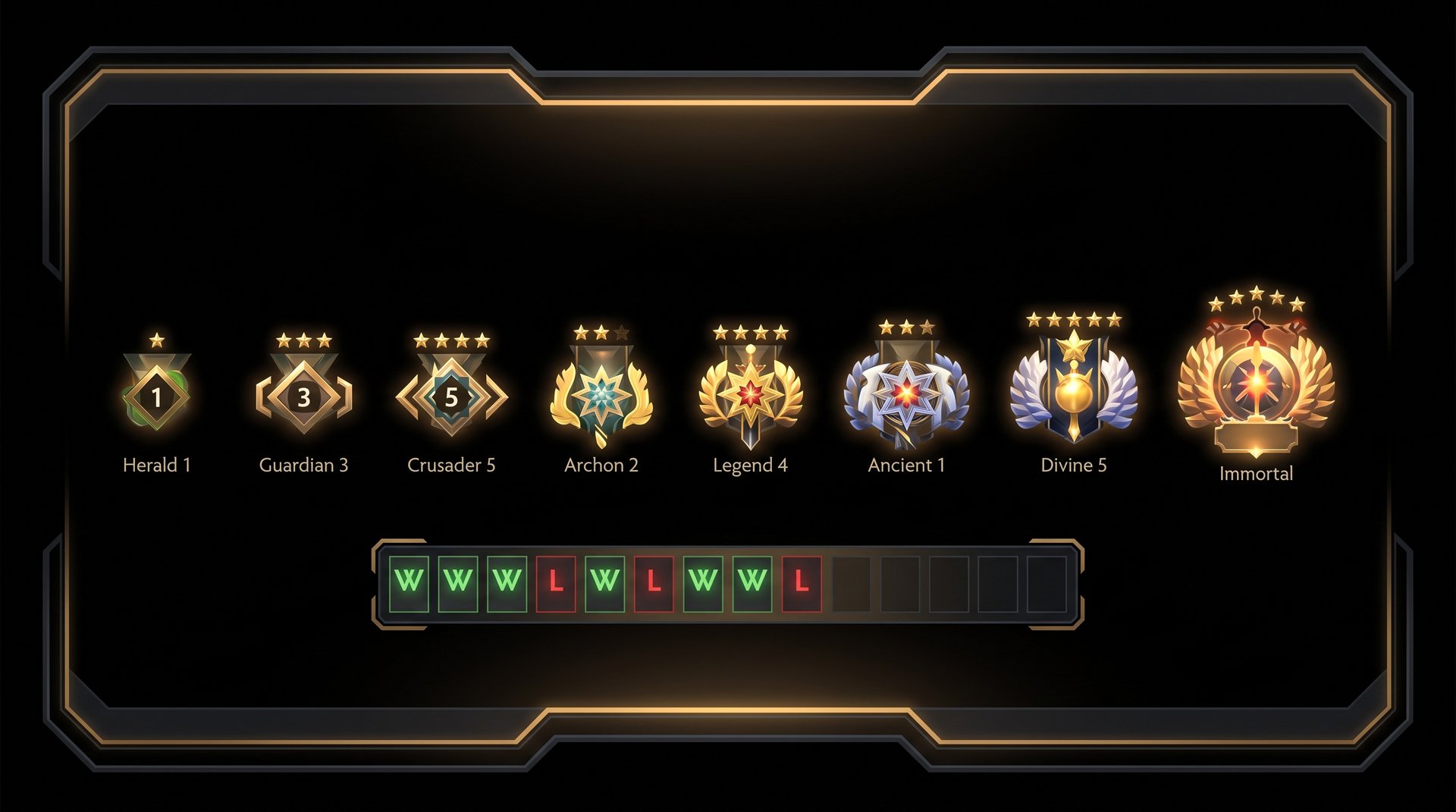
How Far Can MMR Drop After a Long Break?
The size of the drop varies depending on how long you were away, your pre-break MMR bracket, and how the meta shifted during your absence. Based on patterns across returning player accounts, here are realistic ranges:
| Break Length | Typical MMR Drop | Difficulty to Recover | Boost Recommended? |
|---|---|---|---|
| 1-2 months | 100-200 MMR | Low — 10-20 games | Optional |
| 3-5 months | 200-400 MMR | Moderate — 3-6 weeks grinding | Often yes |
| 6-11 months | 400-700 MMR | High — 6-10 weeks grinding | Strongly recommended |
| 12-24 months | 600-1,000 MMR | Very high — 2-3 months grinding | Strongly recommended |
| 2+ years | 800-1,500+ MMR | Extreme — meta knowledge gap adds extra penalty | Essential for time efficiency |
These numbers are not fixed — outliers exist in both directions. A returning player who was 7,000 MMR before their break may still land at 6,400 after 12 months because their mechanical ceiling is obvious even in imperfect calibration games. Conversely, a player who tilted through their calibration games by playing unfamiliar heroes may land 800 MMR below their true level even after a short break.
The bracket you left at also matters. Higher-MMR brackets are more sensitive to meta shifts, so a Divine or Immortal player returning after eight months typically sees a larger relative drop than an Archon player returning after the same period. The high-bracket meta moves faster, demands more precise macro knowledge, and punishes outdated habits more harshly.
Should You Grind Through Calibration or Get a Boost?
This is the honest question most guides skip. The answer depends on what you value and how much time you have.
The Case for Grinding It Out
If your break was short (under three months) and your MMR drop was under 200, grinding makes complete sense. You will re-sync with the current meta through normal gameplay, the time investment is small, and you will genuinely learn the patch changes as you recover. There is also real satisfaction in climbing back under your own power — it confirms your skill level in a way that sticks psychologically.
Grinding also makes sense if you enjoy the calibration process itself and are not in a hurry. Some players use the lower-bracket games as an opportunity to experiment with heroes they would not normally risk in high-stakes matches. If that describes you, the grind is actually a feature, not a bug.
The Case for Getting Boosted
If your break was six months or longer and your estimated drop is 400 to 1,000+ MMR, the math changes substantially. Re-grinding 600 MMR at a 55% win rate takes roughly 120 games. At 45 minutes per game, that is 90 hours of play — not to relearn Dota, but purely to undo a statistical placement error. For players with limited gaming time, that is weeks of dedicated play just to get back to where they were.
A professional boost from a verified service like TeamSmurf can recover that same ground in two to five days. More importantly, because boosters play your account at or near your true skill level rather than through the uncertain bracket you land in, the games are actually played properly — reducing the risk of cementing bad habits from playing in a bracket that is too easy.
Grind Yourself
- No cost
- Gradual meta relearning
- Personal satisfaction
- Control over the process
Grind Yourself
- 50-100+ hours to recover large drops
- Risk of tilting and losing extra MMR
- Habits from low-bracket opponents
- No guarantee of reaching old peak
Professional Boost
- Recover 400-1,000 MMR in days not months
- Games played at correct skill level
- No tilt-spiral risk during recovery
- Restart from a fair calibration point
Professional Boost
- Costs money
- Need to maintain MMR yourself afterward
- Small risk if using an unverified service
For most players returning after a significant break who have limited time and a clear previous skill level, a targeted boost to recalibrate is the rational choice. Check out the full breakdown in our MMR boosting guide for a detailed cost-time analysis.
How Dota 2 Boosting for Returning Players Works in Practice
If you have decided a boost makes sense, here is what the actual process looks like when you use a reputable dedicated service.
Solo Boost: The Standard Approach
In a solo boost, a professional booster logs into your account and plays ranked games on your behalf. For a returning player, this typically means the booster is targeting your recalibration window specifically — ideally completing all 10 calibration games while maximizing wins. After calibration, many returning players also order a small additional boost (often 200-400 MMR) to build a comfortable buffer above the calibration result before they take the account back.
The booster plays heroes they are strongest on, which are typically high-carry-impact picks suited to solo lobbies. They communicate through the service’s platform if you want updates, but generally operate independently. A good service matches you with a booster who is experienced in your region and time zone to minimize queue times.
Duo Boost: Learning While Recovering
Duo boosting is a particularly good fit for returning players because it lets you play alongside the booster rather than handing over account access. You queue together — the booster plays a complementary role (often a position 1 or 5 based on your preference) while you play your main. Their superior game sense lifts the lobby quality of your games and raises your win rate substantially.
The advantage for returning players is direct: you get the MMR recovery while simultaneously relearning the current meta from someone playing at a much higher level. You see first-hand how the patch changes affect itemization, how rotations have evolved, which heroes are dominant, and where you personally need adjustment. It is part coaching, part boosting.
What to Expect from a Quality Service
A legitimate dedicated service like TeamSmurf — which focuses exclusively on Dota 2 — differs from general marketplaces in several important ways. Boosters are vetted at 7,000+ MMR. Offline mode and VPN-matching are standard features to keep your account inconspicuous. Real-time tracking lets you watch progress. Completion timelines are guaranteed. And if results fall short of the ordered target, the service completes additional games at no extra cost.
For returning players specifically, reputable services also allow you to specify the heroes you want played and the bracket you are calibrating from, so the booster can adjust their hero pool to maximize win rate against opponents at that MMR range rather than overplaying dominant high-bracket picks that do not translate as well to lower brackets.
Picking the Right Boosting Service After a Long Break
Not every service that advertises Dota 2 boosting is worth your time or your account. The market includes legitimate specialized services, general gaming marketplaces with variable quality, and outright scams. For returning players whose accounts may hold years of cosmetic inventory and game history, the stakes of picking the wrong service are high.
What Sets Dota 2-Only Services Apart
General gaming marketplaces like Fiverr or G2G list individual freelancers of wildly inconsistent quality. You might get an Immortal-ranked booster or you might get someone who plays at your current bracket. Specialist services that focus only on Dota 2 — rather than offering boosts across 15 different games — maintain a vetted booster roster, provide consistent service standards, and have customer support staffed by people who actually understand the game.
For returning players, the added benefit of a specialist service is that their boosters know the current patch deeply. They will not play a meta from six months ago, which is exactly the kind of out-of-date approach that makes recalibration games harder than they need to be. A booster who is actively playing 7,000+ MMR games in the current patch is the single most important factor in a successful recalibration boost.
What to Look for Specifically
- Offline mode support — your friends list should not see someone else on your account
- VPN and region matching — the booster should appear to be playing from your usual region
- Calibration-specific pricing — some services offer a flat fee for the 10 calibration games, which is more cost-effective for returning players than per-MMR pricing
- Hero preferences — ability to request specific heroes or roles
- Live tracking dashboard — you should be able to monitor progress without logging in to Steam yourself
- Completion guarantee — if the booster falls short of the target, they finish it at no extra charge
Re-entry Strategy: Before, During, and After the Boost
Before You Place a Single Game
Regardless of whether you are boosting or grinding, there are steps worth taking before your first calibration game. Log into the client and spend an hour in demo mode or unranked testing the heroes you plan to play. Watch a few recent high-level matches — even a couple of hours of VOD review will reveal the biggest meta shifts. Check which items are currently core on your heroes, particularly if the patch introduced new items or changed recipe costs.
Also update your settings. Keybindings occasionally reset after patches. Quick-cast, unit queuing, and camera settings should be confirmed before you enter a game that matters. These are small things, but combining first-game-back nerves with wrong settings is a frustrating and avoidable way to drop a calibration game.
During the Boost
If you are using a solo boost, the most useful thing you can do during the boost period is watch replays of your booster’s games on your account. This is not cheating or using information improperly — you are watching games played on your account, which is publicly available replay data. You will see exactly which heroes the booster picks in your bracket, how they approach the laning phase, when they rotate, how they communicate objectives, and where their decision-making diverges from what you would have done. It is concentrated coaching without any of the coaching cost.
If you are duo boosting, treat each game as a learning session. Pay close attention to the booster’s positioning, item timings, and objective calls. Ask questions between games if the service allows in-session communication. Some players get more out of a five-game duo session with an Immortal booster than they would from 20 hours of solo grinding.
After the Boost
Once you take your account back, do not immediately queue into ranked. Play 3-5 unranked games to confirm your settings are comfortable and your mechanics feel warm. Only then start ranked. Your first 20-30 ranked games after taking the account back are still in the elevated-uncertainty window we discussed earlier, meaning they count for more than normal. A strong start cements your recalibration. A bad start can partially undo it.
Set a session limit: no more than 3-4 ranked games per day for the first week back. Returning players are especially prone to tilt because the gap between their expectations and their early performance feels unjust — you know you are better than a bad game suggests, but you cannot always execute that knowledge cleanly when the mental model of the current meta is still rebuilding. Short sessions protect your MMR and your enjoyment.
Hero Pool Decisions for Returning Players
One of the biggest mistakes returning players make is coming back on their old hero pool without checking whether those heroes are still viable in the current patch. Dota 2 patches shift power levels dramatically — a hero that was a top-three carry six months ago might now be a niche pick, and one you ignored might be a must-pick. Playing a nerfed hero at a skill level that already penalizes you for inactivity is compounding a bad situation.
The Two-List Approach
Before your calibration games, build two short lists. First, your comfort pool: the three to four heroes you played most before your break, whose mechanics you know deeply. These are your insurance picks — even if slightly suboptimal in the current meta, your superior mechanical familiarity may outweigh a small power gap. Second, a meta-adapted list: two or three heroes who are currently strong in your bracket and role. These might take a game or two to feel comfortable on, but the power level will compensate.
Use your comfort pool as your default for calibration games when you are under pressure or in an unfamiliar matchup. Slot in meta picks when you know the draft is favorable and your mental state is sharp. This hybrid approach maximizes your win rate across 10 games without requiring you to re-learn the game entirely before you start.
Role Consistency Matters More Than Hero Choice
Pick your role before you pick your heroes. If you primarily played carry, play carry in calibration. If you played position 4 support, do not switch to core in an attempt to “have more impact.” Your muscle memory, decision trees, and game-sense are all calibrated to a specific role. Switching roles during your recalibration period adds another layer of unfamiliarity on top of an already uncertain situation. Stay in your role and focus on hero selection within that role, rather than trying to reposition entirely.
Simplified Builds for the Re-entry Phase
Returning players sometimes use outdated item builds from memory — builds that were optimal six months ago but have since been replaced by better options. Rather than guessing, open the in-game shop assistant (hit the lightbulb icon or check the suggested items) and cross-reference with a recent patch notes summary for your main heroes. You do not need to follow the suggested items perfectly, but identifying any major changes to core timings will prevent obvious misplays.
Prioritize simple, high-impact builds during calibration. This is not the time to explore six-item situational builds or experiment with unusual Aghanim’s upgrades. Build towards the standard high win rate core items, execute cleanly, and save the creative theory-crafting for after you have re-established your rating.
How to Hold Your New MMR Once You Get There
Whether you grinded back or used a boost, arriving at a target MMR is only half the work. Many returning players who boost their way back to their old peak quickly realize that they are still operating with a slightly outdated mental model of the game, and they begin to slip. Here is how to prevent that.
Commit to a Short Meta Study Period
After recalibration, invest two or three hours specifically studying the current patch — not just passively playing games, but actively reading patch notes from the last two major updates and watching a few recent ranked matches from players in your bracket on Dotabuff or YouTube. This is the period to close the knowledge gap that the boost covered over. You are not starting from scratch — you have the mechanical foundation — you just need to update your strategic database.
Track Your Win Rate by Hero
Use Dotabuff or OpenDota to identify which heroes are giving you positive results and which are pulling down your win rate. After your first 30 games back, you should have enough data to make meaningful decisions. If a hero you loved before your break is consistently losing you games now, the meta probably moved against it. Retire it from your ranked pool temporarily and focus on the heroes showing positive results until your overall confidence is restored.
Set a Target Range, Not a Peak
Returning players who fix on a specific number — “I need to get back to exactly 4,200 MMR” — often create psychological pressure that causes inconsistent play. Instead, target a 100-200 MMR band around your goal. If you hit the lower end of the range, that is fine. Consolidate there, maintain positive win rate, and let it creep upward naturally. If you set an exact target and fall 50 MMR short, the frustration can trigger the tilt cycle that returned players are especially susceptible to.
The goal of recalibration — whether boosted or self-grinded — is to get you to a MMR that accurately reflects your current skill, not one you have to fight to maintain. If the number you land at feels easy to hold, you probably landed close to true strength. If you feel like you are constantly barely hanging on, you may have over-boosted or your skill has genuinely shifted from your pre-break level. Both are honest signals worth acknowledging.
Frequently Asked Questions
Most returning players who were away for six months lose between 400 and 700 MMR during recalibration, though the range varies. Players who left at higher MMR (Divine and above) tend to lose more because the high-bracket meta shifts faster and punishes outdated knowledge more harshly. Players who were at Guardian to Archon typically lose 300-500 MMR. The actual number depends heavily on your win rate across the 10 calibration games, not just the break length.
No. Once you have been inactive long enough for Valve to flag your account for recalibration, the 10-game requirement is mandatory before ranked play can continue. There is no way to bypass this requirement. Your best option is to approach the calibration games as strategically as possible — pick strong heroes, play your best role, and avoid tilting into suboptimal decisions under pressure.
Yes, significantly. Boosting specifically during the 10-game calibration window produces better results per dollar than boosting after calibration. The calibration games carry extra weight, so wins during this period move your placement higher than an equivalent number of wins post-calibration. If budget is a constraint, prioritize covering the calibration window first and add post-calibration MMR as a secondary order if needed.
Not if you use a reputable service with offline mode support and VPN matching. Offline mode makes your account appear offline to your Steam friends list while the booster plays, so no one sees you online or notices unusual hero choices on your match history. VPN matching ensures the games are played from an IP that matches your usual region, which prevents Steam from sending suspicious login notifications. TeamSmurf includes both features as standard.
Covering the 10 calibration games typically takes 1-2 days depending on queue times in your region and the booster’s schedule. If you add a post-calibration MMR order (for example, an additional 400 MMR after placement), the total time is usually 3-6 days. Express options are available at most services for an added fee, which assigns a dedicated booster with priority queue to complete the order faster — sometimes within 24 hours for the calibration window alone.
A poor calibration win rate — say, 3-7 or 4-6 — will place you significantly below your true level, possibly by 600-900 MMR if you came back from a high bracket. At this point you have two options: play through the elevated-uncertainty post-calibration window aggressively (30 games where each game counts more than normal) and try to self-correct, or order a targeted boost to bring you back to your accurate level before your MMR locks in at a stable rate. Most players who find themselves in this situation choose the boost because re-grinding 700 MMR at a standard rate takes weeks.
Often yes. Duo boosting is the format that most directly addresses both problems returning players face — the MMR deficit and the meta knowledge gap. Playing alongside an Immortal booster for 10-20 games gives you direct exposure to how the current meta is played at a high level, which accelerates your reintegration significantly. Solo boosting is faster and costs less, but duo boosting has a learning component that makes it uniquely valuable for players who want to maintain their recalibrated MMR long-term, not just arrive at a number and immediately start slipping.
Pricing varies by service and the scope of the order. Covering just the 10 calibration games as a flat package typically costs $25-60 depending on your starting bracket — lower brackets cost less because matches are shorter and easier to win. If you add a post-calibration MMR order to reach a specific target, pricing moves to per-100-MMR tiers. A full returning player package covering calibration plus 400 MMR typically runs $60-120 at a reputable service. Compare pricing across services, but weigh price against booster quality — a cheap service with poorly vetted boosters can underperform and leave you needing more work.
Ready to Recalibrate Without the Grind?
TeamSmurf specializes in Dota 2 boosting for returning players. Our Immortal-ranked boosters know the current patch, include offline mode and VPN matching as standard, and offer a completion guarantee. Get back to your real MMR — fast.
View MMR Boost Pricing Book a Coaching Session