Is Dota 2 Coaching Worth It Everything You Need to Know Before Hiring a Coach

You’ve watched every BSJ video. You’ve read the guides. You’ve spammed your best heroes for hundreds of games. And yet your MMR refuses to move. Sound familiar?
At some point, every serious Dota 2 player asks the same question: is hiring a Dota 2 coach actually worth the money? It’s a fair question — coaching isn’t free, results aren’t guaranteed, and the internet is full of conflicting advice about whether it works.
We’ve helped thousands of players through our Dota 2 coaching service, and we’ve seen firsthand what coaching can and can’t do. This guide breaks down everything — minute-by-minute session breakdowns, pricing analysis, ROI calculations, red flags to avoid, and honest expectations about what coaching will do for your MMR.
Table of Contents
- What Is Dota 2 Coaching, Exactly?
- What a Coaching Session Actually Looks Like (Minute-by-Minute)
- Types of Dota 2 Coaching
- What Coaches Focus On at Each Rank Bracket
- How to Evaluate a Good Coach
- Pricing Breakdown: What Coaching Actually Costs
- ROI Analysis: Is It Worth Your Money?
- Red Flags in Coaches
- How Many Sessions Do You Need?
- Coaching vs. Free Resources
- When Coaching Is Better Than Boosting (and Vice Versa)
- Success Stories and Realistic Expectations
- Frequently Asked Questions
Whether you’re a Herald trying to escape the trench or an Ancient player pushing for Immortal, this is the most comprehensive guide to Dota 2 coaching you’ll find anywhere.
What Is Dota 2 Coaching, Exactly?
Let’s get the basics straight. Dota 2 coaching is a one-on-one (or sometimes small group) educational session where a higher-ranked player — typically Immortal or top-500 — analyzes your gameplay and provides personalized feedback to help you improve.
It’s not someone playing on your account. That’s MMR boosting, which is a completely different service with different goals. Coaching is about making you a better player, not changing your number.
Think of it like hiring a personal trainer at the gym. The trainer doesn’t lift the weights for you. They watch your form, correct mistakes you can’t see yourself, design a program for your specific weaknesses, and hold you accountable. A Dota 2 coach does the same thing — for your gameplay.
Why Self-Improvement Has Limits
Here’s the uncomfortable truth: you can’t see your own blind spots. That’s literally what makes them blind spots. You might think you’re losing because your teammates are bad, when the real reason is that you’re consistently missing power spikes at the 15-minute mark. You might think your laning phase is fine because you’re not dying, when actually you’re leaving 30% of available last hits on the table.
A coach provides an external perspective that’s impossible to replicate on your own. They’ve seen hundreds or thousands of players make the same mistakes, and they can identify yours in minutes.
This is why many players who have been stuck at the same MMR for months or years suddenly break through after just a few coaching sessions. The information was always there — they just needed someone to point at it.
What a Coaching Session Actually Looks Like (Minute-by-Minute)
One of the biggest barriers to hiring a coach is not knowing what to expect. Let’s walk through a typical 60-minute coaching session, minute by minute, so you know exactly what you’re paying for.
Pre-Session (5 Minutes Before)
Before the session starts, a good coach will:
- Ask for your Dota 2 profile link (Dotabuff, OpenDota, or Stratz)
- Review your recent match history
- Note your most-played heroes, win rates, and role preference
- Prepare specific things to look for based on your rank bracket
At Team Smurf, our coaches review at least your last 10 matches before the session even begins. This means the session starts with actionable insights, not awkward introductions.
Minutes 0–5: Introduction and Goal Setting
The session begins with a quick chat. The coach will ask:
- What rank are you and what’s your goal?
- What role do you primarily play?
- What do you think your biggest weaknesses are?
- Is there anything specific you want to work on?
This is important because it sets the agenda. If you come in knowing you want to work on laning as a carry, the coach can focus the entire session on that. If you have no idea what’s wrong, the coach will diagnose from scratch.
Minutes 5–25: Replay Analysis
This is the meat of most coaching sessions. The coach will pull up one of your recent replays — usually a loss, because losses reveal weaknesses more clearly — and go through it with you.
What the coach is looking for:
- Laning phase (0–10 min): Creep aggro usage, trading patterns, regen management, last hit efficiency, wave positioning, when you should’ve secured bounty runes
- Early-mid game (10–20 min): First item timing vs. expected timing, rotation decisions, TP usage, map awareness, power spike recognition
- Mid-late game (20+ min): Teamfight positioning, target priority, itemization choices, Roshan timing, high ground decisions, buyback management
- Throughout: Camera habits, minimap attention, communication with team
The coach will pause frequently to explain what went wrong and — critically — what you should have done instead. This is what separates coaching from just watching your replay yourself. You can see the mistake; the coach provides the solution.
Minutes 25–40: Live Game Coaching (If Applicable)
In many sessions, you’ll play a live ranked game while the coach spectates and talks to you over voice chat. This is where things get intense.
The coach will give you real-time direction:
- “Pull the creep wave now — the equilibrium is too close to their tower”
- “Check the minimap — their mid is missing, play back”
- “Your BKB timing is now, look for a fight before they get their next item”
- “Don’t TP here — you need it to respond to the other side of the map in 30 seconds”
This live coaching is incredibly valuable because it builds real-time decision-making habits. After a few sessions, you’ll start hearing the coach’s voice in your head during games — “Check minimap. Where’s their carry? Is Roshan alive?”
Minutes 40–55: Targeted Drills or Second Game
Depending on what the coach identified as your primary weakness, the second half might include:
- Last-hit drills: Practicing last hitting in a private lobby under various conditions
- A second live game to immediately apply what you learned
- Hero-specific mechanics: Practicing combos, micro, or specific interactions
- Draft analysis: Going through recent drafts and discussing better picks
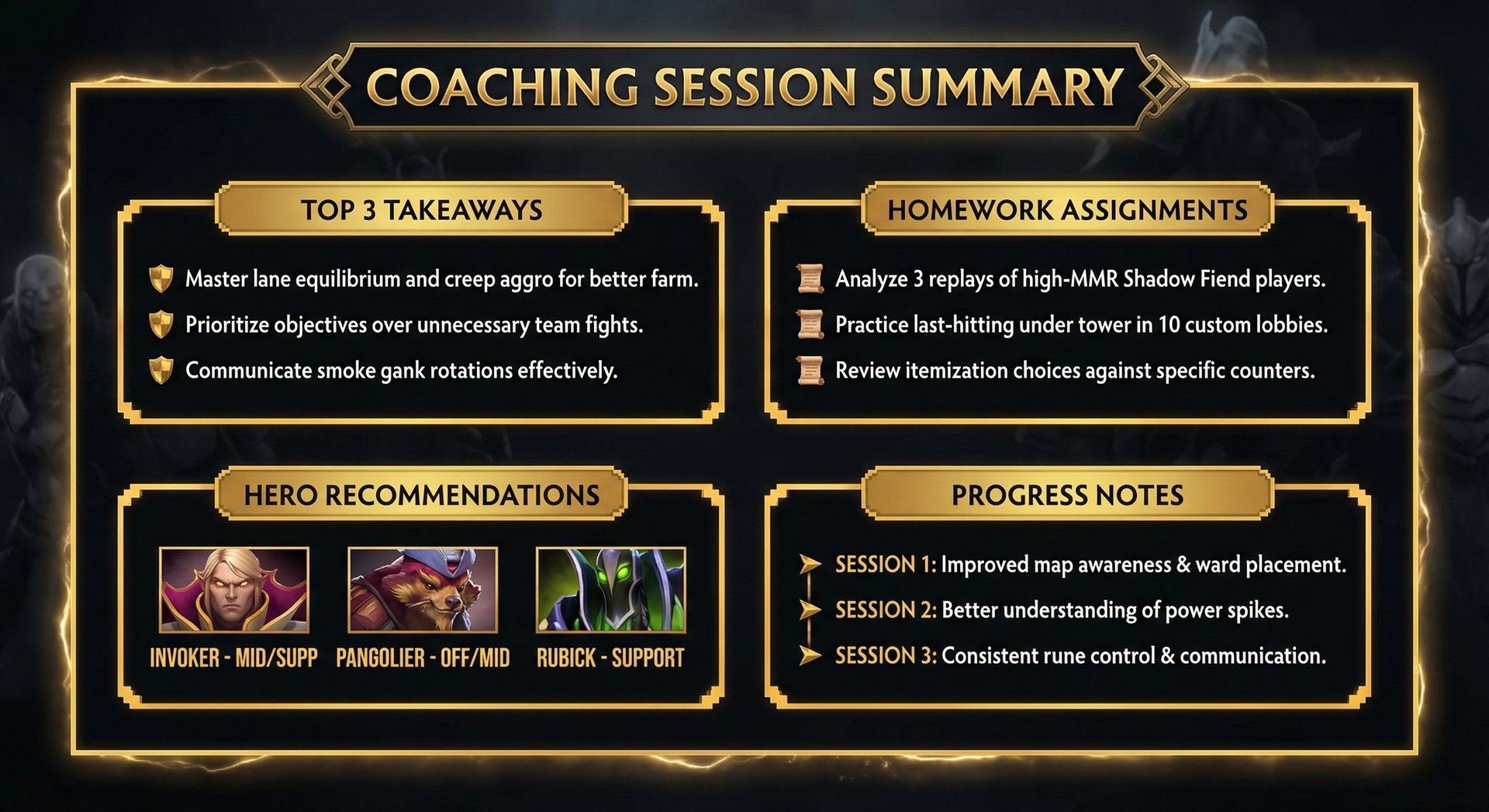
Minutes 55–60: Summary and Homework
A good coach will end with:
- Top 3 takeaways from the session (the most impactful things to change)
- Homework — specific things to practice before the next session
- Hero recommendations — heroes that suit your playstyle and fix your weaknesses
- A written summary (the best coaches provide this via Discord or email)
The homework part is crucial. Coaching without practice between sessions is like going to the gym once a month — you won’t see results.
Types of Dota 2 Coaching
Not all coaching is the same. Understanding the different formats helps you choose the right one for your goals and budget.
1. Replay Analysis
What it is: The coach watches your replays (without you playing live) and provides feedback — either in a live session or as a recorded video review.
Best for: Players who want to understand their macro-level mistakes, those on a tight schedule, or players in regions with high ping to the coach’s server.
Pros:
- Cheapest option (some coaches charge less for replay-only)
- Can be done asynchronously
- Coach can pause and rewind freely to explain concepts thoroughly
- Good for strategic/macro improvements
Cons:
- Doesn’t build real-time habits
- Less interactive — harder to ask questions in the moment
- May miss mechanical issues that only show up live
Typical cost: $10–25 per replay reviewed
2. Live Coaching (Spectator Mode)
What it is: The coach watches you play a live game via spectator mode or screen share, providing real-time voice guidance.
Best for: Players who need to improve decision-making, map awareness, and in-game habits. This is the most popular format and the one we recommend for most players.
Pros:
- Builds real-time habits and muscle memory
- Coach can correct mistakes as they happen
- Highly interactive
- Immediate application of concepts
Cons:
- Spectator delay (can be 2–5 minutes in Dota 2 client) — many coaches use screen share instead
- Can feel overwhelming for newer players
- Requires scheduling around both parties’ availability
Typical cost: $20–40 per hour
3. Duo Queue Coaching
What it is: The coach plays alongside you in a ranked or unranked game, typically in a complementary role (e.g., they play support while you carry, or vice versa). They coach you via voice chat during the game.
Best for: Players who want to see high-level play in action while getting coached, support players who need to learn how to enable their carry, and players who get anxious playing “under a microscope.”
Pros:
- Most natural-feeling format
- Coach demonstrates concepts in real time
- Higher win rate during sessions (coach is actively helping you win)
- Great for learning lane dynamics between roles
Cons:
- Most expensive option
- Coach is split between playing and teaching
- Some might confuse this with boosting (it’s not — you’re on your own account, playing your own hero)
- MMR difference may limit ranked queue options
Typical cost: $30–50 per hour
4. Bootcamp / Multi-Session Packages
What it is: A structured series of sessions (typically 5–10) with specific goals, milestones, and progressive training. Think of it as a “coaching program” rather than a one-off session.
Best for: Serious players committed to long-term improvement, players stuck at a specific bracket for months, and anyone who wants a structured path with accountability.
Pros:
- Structured progression with clear milestones
- Coach learns your patterns deeply over time
- Usually discounted per-session rate
- Built-in accountability
- Best long-term results
Cons:
- Higher total cost commitment
- Requires consistent schedule over weeks
- Need to find a coach you click with before committing
Typical cost: $150–350 for a 5–10 session package
Coaching Format Comparison Table
| Format | Cost/Hour | Best For | Interaction Level | MMR Impact |
|---|---|---|---|---|
| Replay Analysis | $10–25 | Macro improvement, budget-conscious | Low–Medium | Moderate |
| Live Coaching | $20–40 | Real-time habits, decision-making | High | High |
| Duo Queue | $30–50 | Role synergy, seeing high-level play | Very High | High |
| Bootcamp | $25–35 (bulk) | Serious long-term improvement | High | Very High |
What Coaches Focus On at Each Rank Bracket
One of the biggest advantages of coaching over generic YouTube guides is that a good coach tailors everything to your rank. The advice that helps a Herald climb is completely different from what an Ancient player needs to hear.
Here’s what coaches typically focus on at each bracket, based on our experience coaching players across all ranks at Team Smurf.
Herald (0–769 MMR)
Primary focus areas:
- Basic mechanics: Last hitting, spell casting, using items from inventory
- Understanding roles: What carries, supports, and offlaners actually do
- Item basics: Why you buy certain items and in what order
- Not dying: Literally — many Herald players die 15+ times per game
- Camera control: Looking at the minimap at least once every 15 seconds
Typical session outcome: Herald players often gain the most from coaching because the low-hanging fruit is enormous. A single session can identify 5–10 habits that, if fixed, will result in immediate MMR gains.
Expected MMR gain per session: 100–300 MMR (if homework is done)
Guardian (770–1539 MMR)
Primary focus areas:
- Laning fundamentals: Trading effectively, creep aggro tricks, pulling and stacking
- Item timing awareness: Understanding when you’re ahead or behind based on item timings
- Basic map awareness: Checking minimap, understanding when to play safe
- Hero pool refinement: Narrowing from 30 heroes to 3–5 reliable picks
- Objective focus: Hitting towers when you get a kill instead of farming jungle
Expected MMR gain per session: 75–200 MMR
Crusader (1540–2309 MMR)
Primary focus areas:
- Power spike awareness: Knowing when your hero is strong and forcing fights at the right time
- Farming patterns: Efficient jungle routes, stacking for yourself, balancing farming vs. fighting
- Vision game: Ward placement, dewarding, understanding vision control
- TP scroll discipline: Having TP ready, using it to counter-gank or defend towers
- Draft understanding: Basic counter-picking and synergy
Expected MMR gain per session: 50–150 MMR
Archon (2310–3079 MMR)
Primary focus areas:
- Game tempo: Understanding when to push advantages and when to farm
- Teamfight positioning: Where to stand, who to target, when to use BKB
- Advanced laning: Manipulating lane equilibrium, denying effectively, zoning
- Resource management: Mana usage, cooldown tracking, buyback gold
- Reading the map: Predicting enemy movements based on visible information
Expected MMR gain per session: 50–100 MMR
Legend (3080–3849 MMR)
Primary focus areas:
- Advanced itemization: Situational items, timing BKB vs. damage items, neutral item optimization
- Split-push and pressure: Creating map pressure without your team
- Smoke usage: When and where to smoke, reading smoke movements
- Roshan timing: When to take Rosh, how to force fights around Rosh pit
- Lane matchup mastery: Knowing every common matchup and how to play it
Expected MMR gain per session: 25–75 MMR
Ancient (3850–4619 MMR)
Primary focus areas:
- Efficiency optimization: Maximizing GPM/XPM through better farming patterns
- Mental game: Tilt management, playing from behind, not giving up
- Advanced team coordination: Shot-calling, smoke timing, push timing
- Meta awareness: Understanding current patch strengths, adapting to nerfs
- Micro-advantages: Small optimizations that add up over many games
Expected MMR gain per session: 15–50 MMR
Divine and Immortal (4620+ MMR)
Primary focus areas:
- Pro-level concepts: Lane manipulation, advanced ward spots, timing windows
- Psychological edge: Reading opponents, exploiting patterns, playing mind games
- Draft strategy: Complex drafting theory, flex picks, last-pick advantage
- Replay study: Analyzing pro matches and applying concepts
- Consistency: Performing at peak level across all games, not just some
Expected MMR gain per session: 10–25 MMR
Notice the pattern: lower-ranked players gain more MMR per session because the improvements are more fundamental. A Divine player’s mistakes are subtle — an Ancient player’s mistakes are glaring. This is actually great news if you’re lower-ranked: coaching has a higher ROI for you.
For more tips specific to your bracket, check out our guide on proven ways to increase your MMR.
How to Evaluate a Good Coach
Not all coaches are created equal. The difference between a great coach and a mediocre one can mean the difference between gaining 500 MMR in a month and wasting your money. Here’s how to evaluate a Dota 2 coach before committing.
Must-Have Qualifications
| Criteria | Minimum Standard | Ideal Standard |
|---|---|---|
| Current MMR | At least 2000 MMR above yours | Immortal (6000+) |
| Teaching experience | 10+ coaching sessions | 100+ sessions with positive reviews |
| Communication | Clear English, patient | Articulate, structured, uses examples |
| Role expertise | Plays your role at high level | Specializes in your role |
| Availability | Responds within 24 hours | Flexible scheduling, consistent |
| Tools | Discord, screen share | Drawing tools, VOD reviews, written summaries |
Questions to Ask Before Hiring
- “What’s your current MMR and what’s your peak?” — Verify on Dotabuff/OpenDota. A coach at 4k coaching 3k players is questionable.
- “How many students have you coached?” — Experience matters. A 7k player with zero teaching experience might be worse than a 6k player who’s coached 200 students.
- “Can I see testimonials or results?” — Legit coaches have before/after MMR screenshots, reviews, or references.
- “What’s your coaching structure?” — Good coaches have a process. “I just watch you play and tell you what’s wrong” is lazy coaching.
- “Do you provide written summaries after sessions?” — This is a sign of professionalism and helps you retain information.
- “What roles/heroes do you specialize in?” — A pos 1 main coaching a pos 5 player may miss support-specific nuances.
- “What’s your refund policy?” — Legitimate coaches and services (like Team Smurf’s coaching) offer satisfaction guarantees.
The Personality Factor
This is underrated. You need to actually get along with your coach. If their communication style stresses you out, you’ll be too tense to learn. If they’re passive and you need someone direct, you won’t get the push you need.
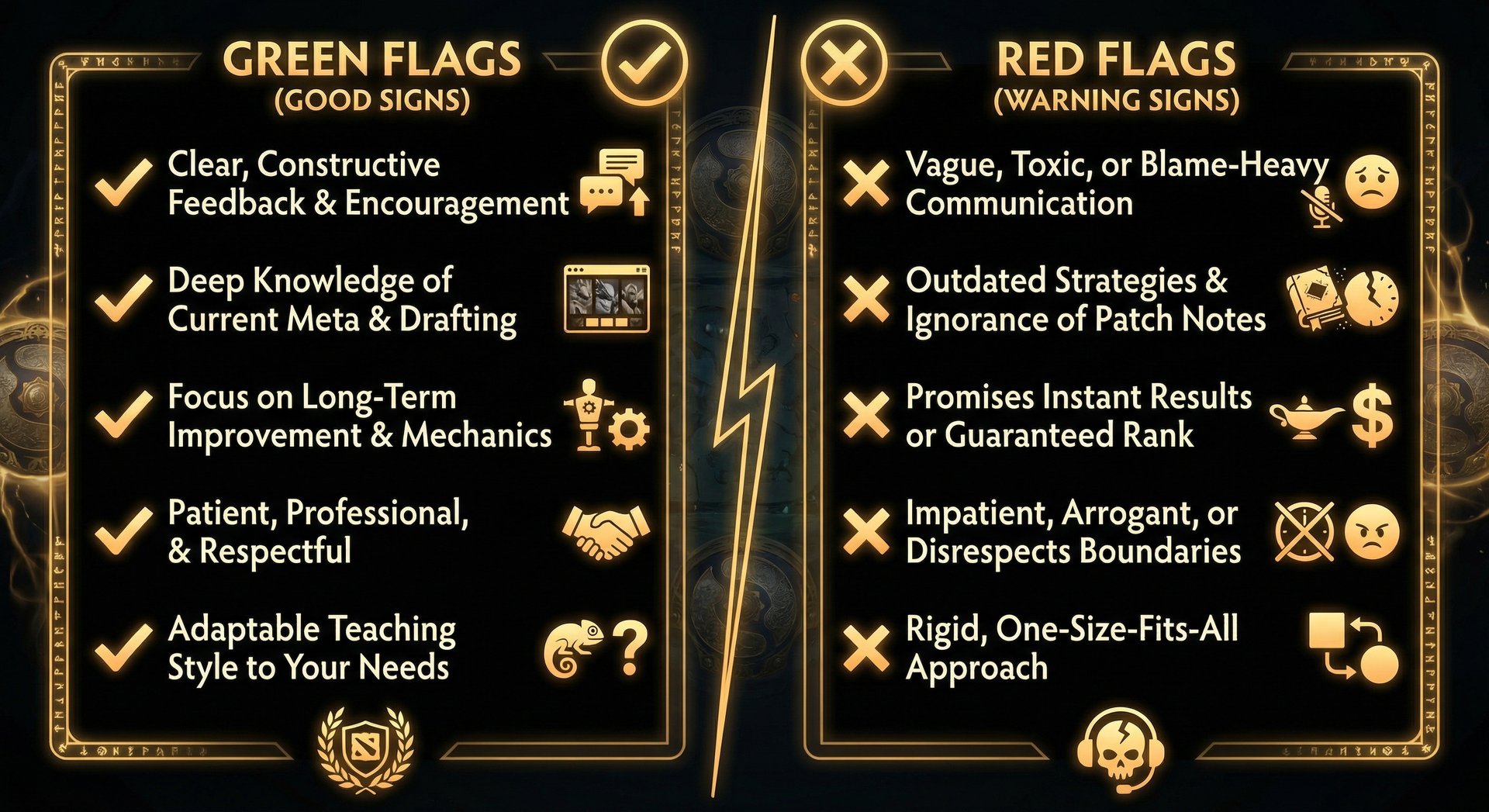
Good signs:
- They ask about your goals before jumping into criticism
- They explain the “why” behind every correction
- They encourage you when you do something right
- They’re patient when you make the same mistake twice
- They adjust their teaching style to your learning speed
Bad signs:
- They focus only on mistakes, never on what you’re doing well
- They get frustrated when you don’t understand immediately
- They talk in jargon without explaining terms
- They spend more time showing off their own skills than teaching
- They blame your teammates instead of helping you play around bad teammates
Pricing Breakdown: What Dota 2 Coaching Actually Costs
Let’s talk money. Dota 2 coaching prices vary wildly depending on the coach’s rank, experience, reputation, and the platform you find them on. Here’s a comprehensive breakdown.
Price Ranges by Coach Tier
| Coach Tier | Typical MMR | Price/Hour | What You Get |
|---|---|---|---|
| Budget | 5000–5500 | $10–15 | Basic voice coaching, limited structure |
| Mid-Range | 5500–6500 | $15–25 | Structured sessions, replay + live coaching |
| Premium | 6500–7500 | $25–40 | Full program, written summaries, homework |
| Elite/Pro | 7500+ / Ex-pro | $40–80+ | Pro-level analysis, draft theory, mental coaching |
Where to Find Coaches and Their Pricing
Freelance platforms (Fiverr, Metafy): $10–30/hr. Wide quality range. Some gems, some duds. Always check reviews.
Dedicated coaching services (Team Smurf): $15–35/hr. Pre-vetted coaches, quality guarantees, consistent experience. This is what we recommend because the vetting is done for you.
Reddit/Discord freelancers: $5–25/hr. Cheapest option but zero quality control. You’re rolling the dice.
Pro player coaching: $50–100+/hr. You’re paying for the name. Worth it if you’re 6k+ and need that specific expertise. Overkill for most players.
Hidden Costs to Watch For
- Session minimums: Some coaches require you to buy 3–5 sessions upfront
- Platform fees: Fiverr takes 5.5% from buyers; other platforms may charge
- Currency conversion: If your coach is in another country, watch exchange rate fees
- Time zone mismatch: You might end up coaching at 2 AM, which affects your ability to play and learn
ROI Analysis: Is Coaching Worth Your Money?
This is the section everyone really wants to read. Let’s do the math.
Average MMR Gained Per Session
Based on data from our coaching service and aggregated reports from the coaching community:
| Starting Bracket | Avg MMR Gained Per Session | Cost Per Session ($25 avg) | Cost Per 100 MMR |
|---|---|---|---|
| Herald–Guardian | 150–250 MMR | $25 | $10–17 |
| Crusader–Archon | 75–150 MMR | $25 | $17–33 |
| Legend | 50–100 MMR | $25 | $25–50 |
| Ancient | 25–75 MMR | $25 | $33–100 |
| Divine+ | 10–40 MMR | $25 | $63–250 |
Important caveat: These are averages assuming you actually practice what the coach teaches between sessions. If you do a coaching session and then go back to autopiloting your games, you’ll gain nothing.
Coaching vs. Boosting: Cost Comparison
Let’s compare the cost of coaching 500 MMR versus boosting 500 MMR:
| Method | Cost for 500 MMR (Archon) | Permanent? | Skill Improvement? |
|---|---|---|---|
| Coaching (5 sessions) | $100–150 | Yes (you earned it) | Significant |
| MMR Boosting | $50–100 | Risk of decay if you can’t maintain | None (someone else played) |
Coaching costs more upfront but the results are permanent because you actually become a better player. Boosting is faster and cheaper, but you might lose the MMR if you can’t play at the new level.
For a deeper dive on this comparison, read our guide: Boosting vs. Coaching: Which Is Right for You?
The Time Value Argument
Here’s another way to think about ROI. If you’re stuck at 3000 MMR, you might grind 500 games over 6 months to gain 500 MMR. At 45 minutes per game, that’s 375 hours of gameplay.
With coaching, you might reach that same 500 MMR gain in 100 focused games over 2 months — a fraction of the time. If your time is worth anything, coaching pays for itself by saving you hundreds of hours of inefficient grinding.
Red Flags in Coaches: What to Avoid
The coaching space has its share of scammers and low-quality providers. Here are the red flags to watch for:
Major Red Flags (Run Away)
- No verifiable profile: If a coach won’t share their Dotabuff or verify their rank, they’re probably not the rank they claim.
- Guarantees specific MMR gains: “I guarantee you’ll gain 1000 MMR!” — No legitimate coach says this because it depends entirely on you.
- Asks for your account credentials: A coach never needs your login. If they ask, they’re probably planning to boost (or worse, steal your account).
- No reviews or testimonials: Even new coaches should have a few initial reviews. Zero reviews is suspicious.
- Pressures you to buy many sessions upfront: A confident coach lets you try one session first.
Minor Red Flags (Proceed with Caution)
- No structure to sessions: They just “wing it” without a plan.
- Focuses on their own gameplay: Spends time talking about their achievements instead of helping you.
- Only speaks in absolutes: “Always do X, never do Y” — Dota is situational. Good coaches explain the context.
- Doesn’t adjust to your level: Uses Divine-level jargon with a Guardian player.
- No follow-up: Session ends and you never hear from them again. Good coaches check in.
How Many Coaching Sessions Do You Need?
This is one of the most common questions we get. The answer depends on your starting rank, your goal, and how diligently you practice between sessions.
Sessions Needed by Goal
| Starting Rank | Goal | Sessions Needed | Estimated Timeline |
|---|---|---|---|
| Herald | Guardian | 2–3 | 2–4 weeks |
| Guardian | Crusader | 3–4 | 3–5 weeks |
| Crusader | Archon | 4–6 | 4–8 weeks |
| Archon | Legend | 5–8 | 6–10 weeks |
| Legend | Ancient | 6–10 | 8–14 weeks |
| Ancient | Divine | 8–15 | 10–20 weeks |
| Divine | Immortal | 10–20+ | 3–6+ months |
The Optimal Session Frequency
Once per week is the sweet spot for most players. Here’s why:
- You get enough time to practice what you learned (15–20 games between sessions)
- The coach can track your progress meaningfully
- It’s affordable (~$100/month at $25/session)
- You don’t forget the previous session’s lessons before the next one
Twice per week is good for players on a time crunch or during a “tryhard” period.
Once every two weeks is the minimum frequency that still produces results. Less than that and you’ll forget between sessions.
When to Stop Coaching
You don’t need coaching forever. Good signs that you’ve graduated:
- You can identify your own mistakes in replays
- You’ve reached your target MMR and maintained it for 2+ weeks
- The coach is running out of things to correct
- You’re winning consistently without applying new concepts
- You have a clear, self-directed improvement plan
Coaching vs. Free Resources: Can YouTube Replace a Coach?
This is a legitimate question. With thousands of hours of free Dota 2 educational content on YouTube, Reddit, and guides, why pay for coaching?
What Free Resources Do Well
- General knowledge: Understanding game mechanics, item builds, hero abilities
- Meta awareness: Tier lists, patch analysis, pro player builds
- Inspiration: Watching high-level play to understand what good Dota looks like
- Hero-specific guides: “How to play Invoker” or “Pos 4 Tusk guide”
- Entertainment value: Learning while being entertained (Purge, BSJ, etc.)
What Free Resources Can’t Do
- Personalized diagnosis: A YouTube video can’t tell you that you specifically lose because you don’t check minimap before farming dangerous areas
- Real-time correction: You can’t ask a video to clarify or adjust its advice
- Accountability: No one checks if you’re actually improving
- Priority identification: With 100 things to improve, a coach tells you which 3 to focus on right now
- Emotional support: A coach can recognize when you’re tilting and address the mental game
The Optimal Approach: Both
Smart players use both free resources and coaching. Here’s how:
- Watch educational YouTube content to build general knowledge (free)
- Use a coach to identify your specific weaknesses and create a plan (paid)
- Watch hero-specific guides for the heroes your coach recommends (free)
- Return to coaching when you plateau again (paid)
- Participate in community discussions on Reddit and Discord for ongoing learning (free)
Free resources give you the knowledge. Coaching gives you the application. You need both.
For specific improvement strategies you can apply right now, check our guide: How to Increase Your MMR: Proven Tips
When Coaching Is Better Than Boosting (and Vice Versa)
We offer both coaching and MMR boosting, so we have a uniquely honest perspective on when each is the right choice.
Choose Coaching When:
- You want to genuinely improve as a player — coaching makes you better; boosting changes your number
- You have time to practice — coaching requires 10–20 games per week of deliberate practice
- You’re within 1–2 brackets of your goal — coaching can close small gaps efficiently
- You plan to keep playing Dota long-term — the skills compound over time
- Your main issue is knowledge, not time — you play enough games but don’t know what to improve
- You want the satisfaction of earning your rank — there’s genuine pride in climbing yourself
Choose Boosting When:
- You need results fast — season ending, playing with friends, time constraints
- The gap is very large — climbing from Herald to Ancient through coaching alone would take 6+ months
- You’ve been permanently stuck — some accounts have MMR that’s tanked so badly that climbing feels impossible. A calibration service might be the fresh start you need.
- You don’t have time to grind — adults with full-time jobs who play 5 games/week can’t realistically grind 2000 MMR
- You’re in low priority — LP removal is a prerequisite before any coaching can help
- You want to play with higher-ranked friends — sometimes you just need the number
The Hybrid Approach (Our Recommendation)
The smartest players use both:
- Boost to close the largest gaps quickly
- Coach to develop the skills needed to maintain and grow from the new rank
- Practice deliberately between coaching sessions
This hybrid approach gives you the fast results of boosting combined with the lasting improvement of coaching. Read more in our dedicated comparison: Boosting vs. Coaching: Which Is Right for You?
Success Stories and Realistic Expectations
Let’s be honest about what coaching can and can’t achieve.
Realistic Success Stories
Story 1: The Stuck Support Player
A Crusader 4 support player came to us after being stuck for 8 months. After 5 coaching sessions focused on pull timings, vision game, and lane partner communication, they climbed to Archon 5 in 6 weeks. Key insight: they were buying wards but placing them in the same spots every game. The coach taught them how to vary ward spots based on game state.
Story 2: The Mechanical Carry
An Ancient 1 carry player had excellent last-hitting but couldn’t break into Divine. After 8 sessions, we identified that their teamfight positioning was consistently poor — they were always the first to die in fights despite being the highest-net-worth hero. By focusing purely on positioning for 3 weeks, they hit Divine 2.
Story 3: The Tilted Mid Laner
A Legend 3 mid player who would rage-queue after losses and drop 200 MMR in a single evening. Three coaching sessions focused almost entirely on the mental game — setting loss limits, taking breaks, and reframing losses as learning opportunities. They gained 400 MMR in a month, mostly by stopping the bleeding from tilt-queuing.
What Coaching Will NOT Do
Let’s be completely honest:
- It won’t make you Immortal overnight. Climbing takes time, even with coaching.
- It won’t fix everything in one session. One session identifies problems; fixing them takes practice.
- It won’t help if you don’t practice. Coaching is useless without 10–20 games of deliberate practice between sessions.
- It won’t make you enjoy Dota if you hate it. If you’re not having fun, no amount of coaching will fix that.
- It won’t eliminate bad teammates. You’ll still get griefers and feeders. Coaching teaches you to win despite them.
Setting the Right Expectations
If you go into coaching expecting to gain 300 MMR per week, you’ll be disappointed. If you go in expecting to understand your mistakes, have a clear improvement plan, and gain 50–150 MMR per week with consistent practice — you’ll be very satisfied.
The best coaching clients are those who treat it like education, not a magic pill. Come prepared, practice the homework, and be honest about your weaknesses. The results will follow.
Want to pair coaching with the right hero pool? Check out our guide: Best Heroes to Climb MMR in Every Bracket
Final Verdict: Is Dota 2 Coaching Worth It?
Yes — if you’re willing to put in the work.
Coaching is the single most efficient way to improve at Dota 2. No amount of YouTube videos, Reddit guides, or solo grinding can replicate the value of having an experienced, high-MMR player analyze your specific gameplay and give you a personalized improvement plan.
The math supports it. The results support it. The thousands of players who’ve climbed through coaching support it.
But coaching isn’t magic. It requires:
- An open mind and willingness to accept criticism
- Consistent practice between sessions (10–20 games minimum)
- Patience — lasting improvement takes weeks, not days
- The right coach for your rank, role, and personality
If you’re ready to invest in yourself as a player, Team Smurf’s coaching service matches you with verified Immortal-rank coaches who specialize in your role and bracket. Every session is structured, every coach is vetted, and every student gets a satisfaction guarantee.
Stop guessing what’s wrong with your gameplay. Let someone who’s been where you want to go show you the way.
Ready to start? Book your first coaching session and see the difference personalized instruction makes.
Frequently Asked Questions
Ready to Invest in Your Improvement?
Team Smurf pairs you with verified Immortal-rank coaches who specialize in your role and bracket. Structured sessions, real results.
Written by Team Smurf’s Immortal-rank analysts — Last verified February 2026