Dota 2 Boosting vs Coaching: A Complete Analysis of Which Is Right for You

You’re stuck. Maybe you’ve been 3,000 MMR for two years despite watching every BSJ video and studying every pro replay. Maybe you need to hit Divine before your stack’s tournament next month. Maybe you’re just tired of the grind and want to enjoy Dota at a higher level. Whatever your situation, you’ve probably considered two options: getting boosted or getting coached.
Both services exist for a reason. Both have helped hundreds of thousands of Dota 2 players. But they solve fundamentally different problems, and choosing the wrong one wastes your money and time.
This guide provides an exhaustive, honest comparison of Dota 2 boosting vs coaching across every dimension that matters — cost, time, skill development, MMR sustainability, account safety, fun factor, and more. We’ll cover who each service is best for, the hybrid approach that combines both, real scenario comparisons, ROI analysis, and common misconceptions that lead players to regret their choice.
Table of Contents
- What Is MMR Boosting?
- What Is Dota 2 Coaching?
- The Complete Comparison Matrix
- Cost Comparison
- Time Investment
- Skill Development
- MMR Sustainability
- Account Safety
- Fun Factor & Experience
- Who Boosting Is Best For
- Who Coaching Is Best For
- The Hybrid Approach
- Real Scenario Comparisons
- ROI Analysis
- Common Misconceptions
- What to Do After Each Service
- FAQ
No sales pitch. Just analysis. Let’s break it down.
1. What Is MMR Boosting?
MMR boosting is a service where a professional player (typically Immortal rank, 7,000+ MMR) plays on your account to increase your Matchmaking Rating. The booster logs into your account, plays ranked games, wins consistently due to their superior skill, and raises your MMR to your desired target.
How It Works
- You select your current MMR and target MMR (e.g., from 3,000 to 4,500).
- You provide account access to the boosting service through a secure system.
- A professional booster plays ranked games on your account, typically winning 80-95% of games depending on the MMR bracket.
- Your MMR climbs to the target over hours or days.
- You receive your account back at the new, higher MMR.
At Team Smurf, our boosters maintain an average win rate of 85%+ across all brackets, with higher rates at lower MMR differences. A typical 1,000 MMR boost (e.g., 3,000 → 4,000) requires approximately 35-45 games and takes 3-7 days depending on booster availability and play schedule.
Types of Boosting
- Solo Boosting: The booster plays on your account alone. Most common and most efficient.
- Party Boosting (Lobby Boosting): The booster plays in a party with you. You’re in the game but the booster carries. This is sometimes called “duo queue boosting.”
- Calibration Boosting: The booster plays your 10 calibration matches at the start of a new season, maximizing your starting MMR.
2. What Is Dota 2 Coaching?
Dota 2 coaching is a service where a high-skill player analyzes your gameplay, identifies weaknesses, and teaches you how to improve. Unlike boosting, the coach never plays on your account. Instead, they teach YOU to play better so that you climb on your own.
How It Works
- You book coaching sessions (typically 1-2 hours each).
- The coach reviews your replays to identify patterns, mistakes, and areas for improvement.
- Live coaching sessions where the coach watches you play in real-time (via screen share or spectating) and provides guidance.
- You receive specific homework — things to practice, habits to change, concepts to study.
- Follow-up sessions to check progress and address new issues.
Team Smurf’s coaching service pairs you with Immortal-rank coaches who specialize in your role and bracket. Sessions can focus on laning, decision-making, hero pool optimization, itemization, map awareness, or any other aspect of your game.
Types of Coaching
- Replay Analysis: Coach watches your past games and provides written or recorded feedback. Most affordable option.
- Live Coaching: Coach spectates while you play and provides real-time guidance via voice chat. Most effective for immediate improvement.
- Structured Programs: Multi-session packages that build on each other over weeks, creating a complete improvement plan.
- Role-Specific Coaching: Focused sessions on a specific role (pos 1-5) with a coach who specializes in that role.
3. The Complete Comparison Matrix
Here’s the head-to-head comparison across every meaningful dimension:
| Dimension | MMR Boosting | Coaching | Winner |
|---|---|---|---|
| Immediate MMR gain | Yes Guaranteed specific MMR | No No guaranteed MMR gain | Boosting |
| Long-term MMR gain | May drop back without skill improvement | Yes Permanent skill improvement = permanent MMR | Coaching |
| Skill development | No Zero — someone else plays | Yes Direct, personalized skill building | Coaching |
| Time to results | Yes Days | Weeks to months | Boosting |
| Your time investment | Yes Zero — booster does everything | Significant — you must play and practice | Boosting |
| Cost per 1,000 MMR | $50-200 depending on bracket | $100-500+ (sessions + your time) | Boosting (usually) |
| Account safety | Small risk (account sharing) | Yes Zero risk (no account access) | Coaching |
| MMR sustainability | You may lose MMR if skill doesn’t match | Yes MMR matches your improved skill | Coaching |
| Fun factor during service | No You can’t play while boosted | Yes You play and learn simultaneously | Coaching |
| Fun factor after service | Higher rank games may be too hard | Yes You’re skilled enough for your rank | Coaching |
| Effort required | Yes None | Significant — must practice and change habits | Boosting |
| Guarantee of reaching target | Yes Yes — booster plays until target reached | No No — improvement depends on your effort | Boosting |
| Learning from the process | Can study replay data afterward | Yes Every session is a learning experience | Coaching |
| Social perception | No Stigmatized in the community | Yes Respected as self-improvement | Coaching |
Score: Boosting wins 5, Coaching wins 8, Tie 1.
On paper, coaching wins more dimensions. But as we’ll explore, the “right” choice depends entirely on your specific situation, goals, and constraints.
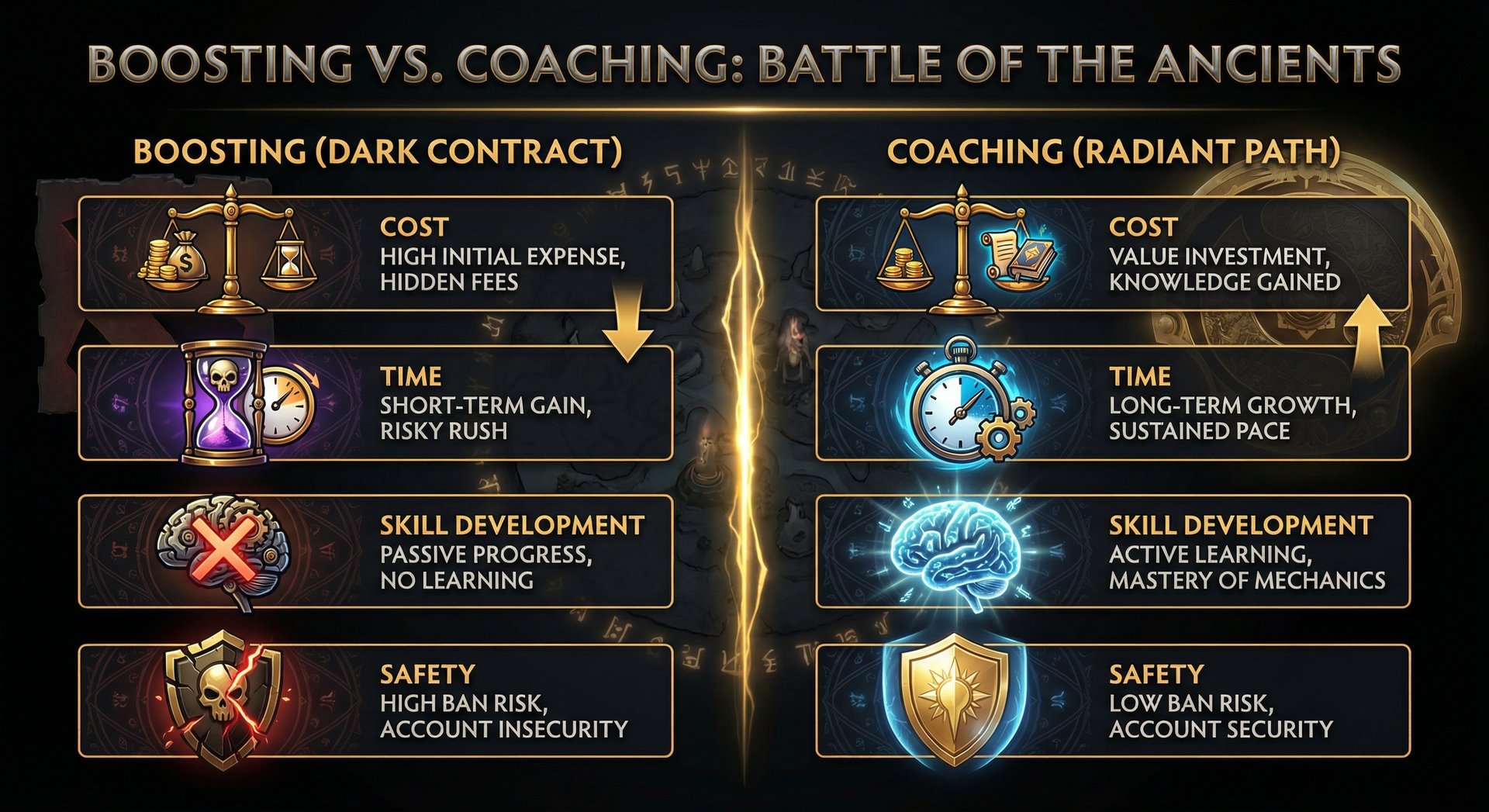
4. Cost Comparison
Let’s get specific about what each service costs and what you’re paying for.
Boosting Costs
MMR boosting is typically priced per 100 MMR gained, with rates varying by bracket (higher brackets cost more because games are harder to win).
| MMR Range | Cost per 100 MMR (approx.) | Cost for 1,000 MMR boost |
|---|---|---|
| Herald to Guardian (0-1,500) | $3-6 | $30-60 |
| Guardian to Crusader (1,500-2,500) | $5-8 | $50-80 |
| Crusader to Archon (2,500-3,500) | $6-10 | $60-100 |
| Archon to Legend (3,500-4,500) | $8-15 | $80-150 |
| Legend to Ancient (4,500-5,500) | $12-20 | $120-200 |
| Ancient to Divine (5,500-6,500) | $18-30 | $180-300 |
| Divine to Immortal (6,500+) | $25-50+ | $250-500+ |
Prices are approximate and vary by service. Check Team Smurf’s current pricing for exact rates.
For a complete breakdown of boosting costs, see our Dota 2 Boosting Cost Guide.
Coaching Costs
Coaching is typically priced per hour of coach time:
| Coach Tier | Cost per Hour | Sessions for Meaningful Improvement | Total Cost (approx.) |
|---|---|---|---|
| High-rank amateur (6K+) | $15-25 | 5-10 sessions | $75-250 |
| Semi-pro / content creator | $30-60 | 5-10 sessions | $150-600 |
| Professional / ex-pro | $50-150+ | 5-10 sessions | $250-1,500+ |
| Team Smurf coaching | Competitive rates | 3-8 sessions | Varies by package |
The Hidden Cost of Coaching: Your Time
Coaching’s sticker price doesn’t tell the full story. Beyond the session cost, you need to invest:
- Practice time: 50-200+ games applying what you’ve learned (at ~40 min/game, that’s 33-133 hours).
- Review time: Watching replays, studying notes, researching concepts the coach mentioned.
- Mental energy: Changing habits is mentally taxing. You’ll play worse before you play better as you break old patterns.
If you value your free time at $15/hour, the true cost of coaching (sessions + practice time) can be $500-2,000+ for a 1,000 MMR improvement.
The Hidden Cost of Boosting: MMR Decay
Boosting’s sticker price also doesn’t tell the full story. If you get boosted 1,000 MMR but lose 500 of it because the games are too hard, you effectively paid double per MMR point. Many boosted players need repeat boosts, compounding the cost over time.
5. Time Investment
Boosting: Fast Results, Zero Effort
A typical 1,000 MMR boost takes 3-7 days from order to completion. During this time, you don’t play at all — the booster handles everything. Your total time investment is approximately 15 minutes (placing the order and providing account details).
Coaching: Slow Results, Significant Effort
A realistic timeline for 1,000 MMR improvement through coaching:
| Phase | Duration | Your Time Investment |
|---|---|---|
| Initial assessment (1-2 sessions) | Week 1 | 2-4 hours |
| Core skill building (3-5 sessions) | Weeks 2-4 | 6-10 hours coaching + 20-40 hours practice |
| Habit integration | Weeks 4-8 | 40-80 hours of focused play |
| MMR climbing (with new skills) | Weeks 8-16 | 60-120 hours of ranked play |
| Total | 2-4 months | 130-250+ hours |
The honest comparison: Boosting gives you 1,000 MMR in a week with zero effort. Coaching gives you 1,000 MMR in 2-4 months with 130-250 hours of effort. The MMR from coaching is more sustainable, but the time difference is enormous.
6. Skill Development
Boosting: Zero Skill Gain
Let’s be blunt: boosting teaches you nothing. Someone else plays your games. You don’t practice, you don’t learn, you don’t develop. When you get your account back at 4,500 MMR, you’re still a 3,500 MMR player in 4,500 MMR games.
There is ONE slight exception: some players study their boosted account’s match history afterward, analyzing what the booster did differently. What heroes did they pick? What items did they buy? What was their farming pattern? This post-boost analysis can provide insights — but it requires initiative that most players don’t take.
Coaching: Significant, Permanent Skill Gain
Good coaching addresses the specific weaknesses holding you back. Common areas where coaching creates breakthroughs:
- Laning fundamentals: Most players below Ancient have significant laning weaknesses. A coach can improve your laning by 500+ MMR worth of skill in just 2-3 sessions.
- Decision-making: When to fight, when to farm, when to push — the macro decisions that separate brackets.
- Itemization: Building the right items for the game state, not following static guides.
- Map awareness: Reading the minimap, predicting enemy movements, positioning safely.
- Hero pool optimization: Playing fewer heroes better, understanding power spikes and matchups.
- Mental game: Managing tilt, playing consistently, maintaining focus.
The skill gains from coaching are permanent. Once you understand a concept, you don’t unlearn it. Once you break a bad habit, it stays broken. This is the fundamental advantage of coaching over boosting.
Want to know if coaching is right for you? Read our detailed guide: Is Dota 2 Coaching Worth It?
7. MMR Sustainability
This is the most important dimension for many players, and it’s where the differences are starkest.
Boosting: The Sustainability Problem
After a boost, here’s what typically happens based on our data from thousands of cases:
| Player Type | MMR Retained After 100 Games | Notes |
|---|---|---|
| Player boosted 500 MMR | ~70-80% retained | Small boost, close to actual skill |
| Player boosted 1,000 MMR | ~40-60% retained | Noticeable skill gap, gradual decline |
| Player boosted 2,000+ MMR | ~20-40% retained | Large skill gap, rapid decline |
| Player who studies replays post-boost | ~60-80% retained | Active learning helps retention |
| Player who combines boost + coaching | ~80-95% retained | Best of both worlds |
Key insight: The larger the boost relative to your actual skill, the more MMR you’ll lose afterward. A 500 MMR boost might stick because you were close to that level anyway. A 2,000 MMR boost will almost certainly result in a painful losing streak.
Coaching: Sustainable by Design
When you gain MMR through coaching, you keep it because your skill genuinely improved. Your MMR reflects your actual ability. You don’t face the dreaded post-boost losing streak because you’re not outmatched — you belong at your new rank.
In fact, many coached players continue climbing beyond their initial improvement as they internalize concepts and compound small gains over time.
8. Account Safety
Boosting: Some Risk
Boosting requires sharing your account credentials. This creates several risk categories:
- Steam ToS violation: Account sharing violates Steam’s Terms of Service. In theory, Valve could ban your account. In practice, bans for boosting are extremely rare but not zero.
- Credential security: You’re trusting a third party with your Steam login. Reputable services like Team Smurf use encrypted systems and have track records, but the risk is inherent.
- Detection: Valve’s systems can theoretically detect sudden skill changes, unusual login locations, or hardware fingerprint changes. Most reputable services use VPNs and other measures to minimize this.
- Smurf pool placement: Accounts with unusual win streaks may be flagged by Valve’s smurf detection, potentially affecting matchmaking quality.
Coaching: Zero Risk
Coaching requires no account sharing whatsoever. The coach watches you play (via screen share, Dota TV, or replay files). Your credentials stay with you. There’s literally zero risk to your account.
This is a clear, unambiguous win for coaching on the safety dimension.
9. Fun Factor & Experience
During the Service
Boosting: You can’t play your account while it’s being boosted (or shouldn’t — logging in disrupts the booster). For days, your account is unavailable. Some players use this time for a Dota break; others find it frustrating.
Coaching: You’re actively playing Dota during sessions, which most players find enjoyable even when they’re being corrected. The “aha moments” when you understand why you’ve been losing can be genuinely exciting.
After the Service
Boosting: This is where things get complicated. If you were boosted significantly beyond your skill level, your post-boost games will be miserable. You’ll face better opponents, get outplayed, and lose frequently. Your teammates will be confused by your poor performance at your medal level. Some boosted players report that the experience is worse than where they started.
However, if you were boosted a small amount (or were already close to the target skill level), the post-boost experience can be fine or even exciting — you’re playing with better players in higher-quality games.
Coaching: Post-coaching Dota is almost universally more enjoyable. You understand the game better, you make better decisions, and you win more. The games at your new MMR feel earned and appropriate.
10. Who Boosting Is Best For
Despite coaching winning more dimensions in the comparison, boosting is the superior choice in several specific situations:
Scenario 1: The Time-Pressured Player
Profile: Working professional, 30+ years old, limited gaming time (5-10 hours/week), wants to play at a higher level but doesn’t have months to invest in improvement.
Why boosting: They literally don’t have 150+ hours to invest in coached improvement. A boost gives them immediate access to better games at a higher rank. Even if they slowly lose some MMR, the experience of playing at a higher level for weeks or months is worth the cost.
Scenario 2: The Deadline Player
Profile: Needs to reach a specific rank by a specific date — maybe for a tournament, a bet, or a personal milestone.
Why boosting: Coaching can’t guarantee a specific MMR by a specific date. Boosting can. If you need Divine by Saturday, boosting is the only realistic option.
Scenario 3: The Returning Player
Profile: Was 5,000 MMR two years ago, quit, came back, calibrated at 3,500 due to meta changes and rust.
Why boosting: Their actual skill level is higher than their current MMR — they just need time to readjust. A boost back to 4,000-4,500 puts them closer to their real level while they shake off the rust. They’ll sustain this MMR because the skill is there — just dormant.
Scenario 4: The Behavior Score Victim
Profile: Dropped from 4,500 to 3,200 MMR during a behavior score spiral where terrible match quality caused a losing streak.
Why boosting: Combined with behavior score recovery, a boost restores them to their actual skill level after an artificial depression caused by system issues, not skill issues.
Scenario 5: The Trophy Hunter
Profile: Wants a specific medal or rank displayed on their profile. Doesn’t necessarily plan to play actively at that rank.
Why boosting: If the goal is purely cosmetic (profile medal), boosting achieves it directly. No improvement needed because they don’t plan to play at that level.
11. Who Coaching Is Best For
Scenario 1: The Plateau Player
Profile: Has been the same MMR for 500+ games. Watches educational content. Tries to improve. Can’t identify what they’re doing wrong.
Why coaching: They’ve hit a skill ceiling that self-study can’t break. A coach’s external perspective identifies blind spots they literally can’t see in their own play. This is coaching’s strongest use case.
Scenario 2: The Competitive Improver
Profile: Genuinely wants to become a better Dota player. Cares about skill, not just rank. Willing to put in the work.
Why coaching: Coaching provides the personalized guidance that YouTube videos and guides can’t. A coach adapts to YOUR specific weaknesses, YOUR hero pool, YOUR playstyle. The improvement is real, lasting, and deeply satisfying.
Scenario 3: The Role Switcher
Profile: Wants to switch from support to carry (or vice versa) but doesn’t know the role well enough to play it at their current MMR.
Why coaching: A role-specific coach can fast-track the transition, teaching the fundamentals of the new role without the painful MMR loss that usually accompanies role switching.
Scenario 4: The Young Player
Profile: Student with lots of free time, limited budget, long-term gaming horizon.
Why coaching: They have the time to invest in improvement but not the money for repeated boosts. A few coaching sessions create skills that last forever and continue paying dividends across thousands of future games.
Scenario 5: The Aspiring Competitive Player
Profile: Wants to play in amateur tournaments, join a team, or pursue Dota semi-competitively.
Why coaching: Boosted MMR is meaningless in competitive play where your actual skill is exposed. Coaching builds the real skills needed to compete.
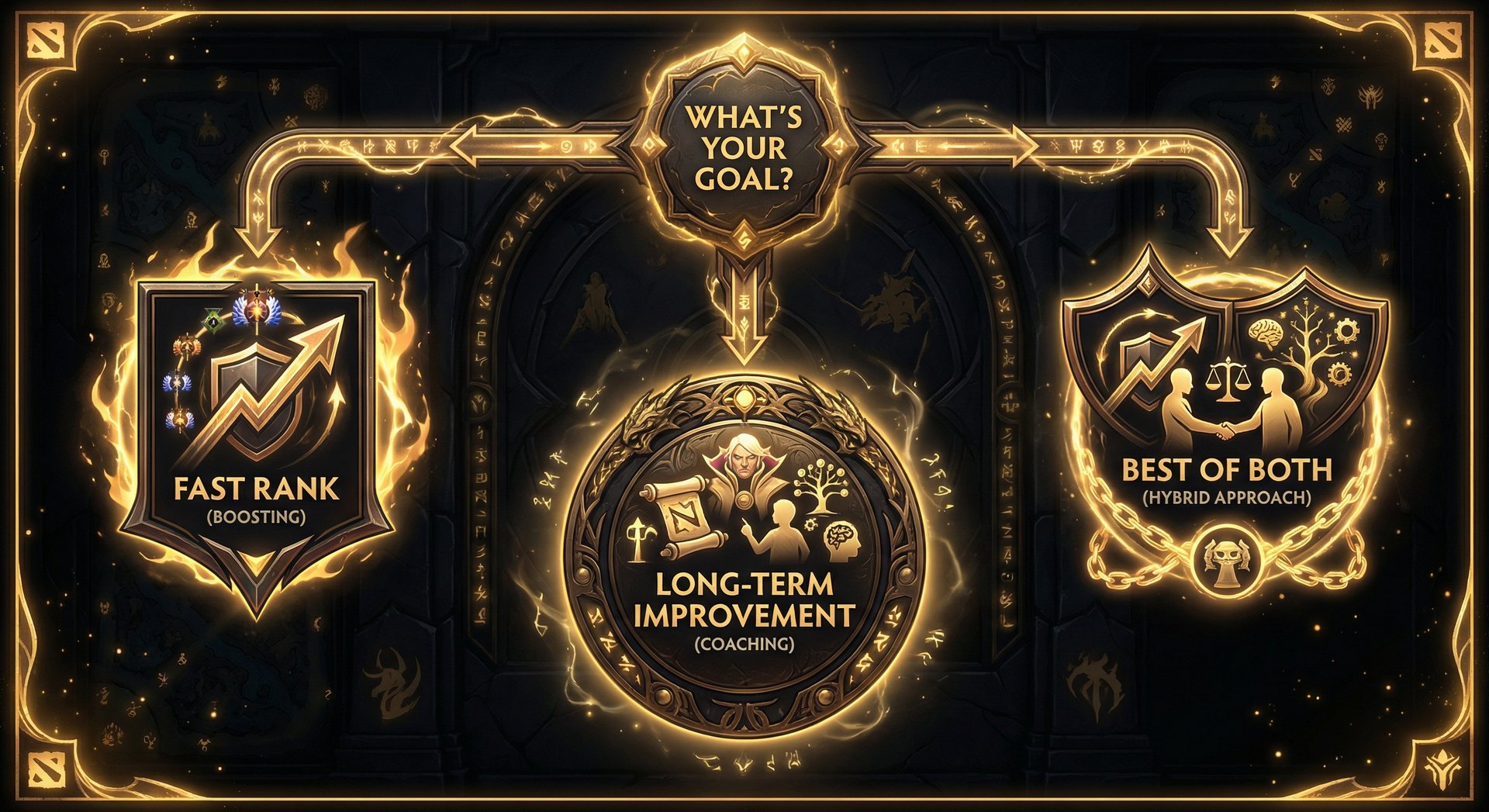
12. The Hybrid Approach
The most effective strategy for many players is combining both services. Here’s how the hybrid approach works and why it’s so powerful.
The Boost + Coach Model
- Get a moderate boost (500-1,000 MMR) to exit a bracket where you feel stuck.
- Book coaching sessions to develop the skills needed to maintain and grow from the new MMR.
- Apply coaching lessons at the new, higher bracket where game quality is better and lessons are easier to apply.
Why This Works
The hybrid approach solves the core problems of each service individually:
- Boosting’s problem (unsustainable MMR) is solved by coaching — you develop the skills to maintain your new rank.
- Coaching’s problem (slow results) is solved by boosting — you skip the months of grinding and immediately play at a level where coaching insights are more applicable.
- Better learning environment: Coaching is more effective at higher MMR because games are more structured and predictable. It’s easier to learn proper Dota concepts when your teammates are actually trying.
The Coach + Boost Model (Reverse Order)
Alternatively:
- Start with coaching to build fundamental skills and identify your realistic skill ceiling.
- Climb naturally with improved skills.
- Use a small boost to bridge the final gap if you plateau before reaching your goal.
This model is more conservative and results in better MMR retention, but it’s slower.
Cost of the Hybrid Approach
A typical hybrid package might look like:
- 500 MMR boost: ~$40-75
- 3-5 coaching sessions: ~$75-200
- Total: $115-275
This is more expensive than boosting alone but less expensive than extensive coaching, and it provides better results than either service individually.
13. Real Scenario Comparisons
Let’s apply everything we’ve discussed to real scenarios that players commonly face.
Scenario A: “I’ve been 3,000 MMR for two years. I play 15 hours a week.”
| Option | Expected Outcome | Recommendation |
|---|---|---|
| Boost to 4,000 | Reach 4,000 in 5 days, drop to ~3,500 within a month | Temporary fix |
| Coaching (5 sessions) | Reach 3,500-4,000 in 2-3 months with sustained skill gains | Yes Better long-term |
| Hybrid (500 boost + 3 sessions) | Boosted to 3,500, coached to maintain and push toward 4,000+ | YesYes Optimal |
Best choice: Hybrid or coaching. Two years at the same MMR indicates a skill plateau. Boosting alone won’t fix the underlying issues. Coaching (or hybrid) addresses the root cause.
Scenario B: “I want to reach Divine by next month for a tournament.”
| Option | Can Meet Deadline? | Recommendation |
|---|---|---|
| Boost to Divine | Yes Yes (1-2 weeks) | Yes Only realistic option for deadline |
| Coaching | No No — months needed | No Can’t meet deadline |
| Hybrid | Maybe, if close already | Risky with deadline |
Best choice: Boosting. Hard deadlines require guaranteed results. But consider coaching AFTER the tournament to develop skills for sustainable play at that level.
Scenario C: “I’m Ancient 3 and I want to reach Immortal. I’m willing to invest 6 months.”
| Option | Expected Outcome | Recommendation |
|---|---|---|
| Boost to Immortal | Reach Immortal in 1-2 weeks, likely drop to Divine within months | Expensive, unsustainable |
| Coaching (8-12 sessions over 6 months) | Reach Divine 3-5, possibly Immortal, with sustainable skills | Yes Best approach |
| Hybrid | Boost to Divine 5, coach to push to Immortal | Yes Efficient if budget allows |
Best choice: Coaching or hybrid. The Ancient-to-Immortal jump requires genuine skill development. At these brackets, the skill gap between ranks is significant and boosted players are quickly exposed.
Scenario D: “I’m 2K and just want to have more fun. Don’t care about being a pro.”
| Option | Expected Outcome | Recommendation |
|---|---|---|
| Boost to 3K | Better game quality, might slowly drop but stay 2.5K+ | Yes Good value for fun |
| Coaching | Improve over months, more fun through understanding | Yes Also good |
| Just fix behavior score | Same MMR but better match quality immediately | YesYes Check this first! |
Best choice: Fix behavior score first. If you just want more fun, your behavior score might be the real issue, not your MMR. A 2K player with 10,000 behavior score has better games than a 4K player with 4,000 behavior score.
14. ROI Analysis
Let’s calculate the return on investment for each service across different time horizons.
Boosting ROI
Investment: $100 for a 1,000 MMR boost
Immediate return: 1,000 MMR gained
After 1 month: ~600 MMR retained (40% lost)
After 3 months: ~400 MMR retained (60% lost)
After 6 months: ~300 MMR retained (70% lost, with some natural improvement)
Effective cost per sustained MMR point: $0.33/MMR (at 300 retained)
Coaching ROI
Investment: $250 for 5 coaching sessions + 150 hours of practice time
Immediate return: ~200 MMR gained (during learning phase, performance often dips)
After 1 month: ~400 MMR gained
After 3 months: ~700 MMR gained
After 6 months: ~1,000+ MMR gained (continues climbing)
Effective cost per sustained MMR point: $0.25/MMR (at 1,000+ gained, ignoring time cost)
However, if we factor in time at $15/hour: $250 + (150 hours × $15) = $2,500 total cost. That’s $2.50/MMR — significantly more expensive in real terms.
Hybrid ROI
Investment: $175 (500 MMR boost + 3 coaching sessions) + 80 hours practice
Immediate return: 500 MMR from boost
After 3 months: ~800 MMR retained and growing
After 6 months: ~1,000+ MMR total gain
Effective cost per sustained MMR point: Best ratio when accounting for time efficiency.
The Bottom Line on ROI
If you value only money: boosting is cheapest.
If you value money + time: boosting is cheapest by far.
If you value long-term MMR per dollar: coaching or hybrid wins.
If you value the learning experience itself: coaching is priceless.
15. Common Misconceptions
Misconception: “Boosting will ruin my account”
Reality: Boosting doesn’t permanently damage your account. If you lose MMR after a boost, you simply return toward your natural skill level. Your account isn’t “ruined” — it’s exactly where it would be without the boost, minus the temporary experience of higher-rank games. The only real risk is account security, which reputable services mitigate.
Misconception: “Coaching is a scam — I can learn everything from YouTube”
Reality: YouTube provides generic advice for general audiences. Coaching provides personalized diagnosis of YOUR specific problems. You might watch 100 videos about laning and still not realize that YOUR specific issue is pulling timing, or creep aggro management, or trading patterns. A coach identifies your unique weaknesses in one session.
Misconception: “If I get boosted, I’ll learn from playing with better players”
Reality: This is the most dangerous misconception in boosting. Playing AGAINST better players doesn’t teach you — it overwhelms you. You don’t learn from getting stomped. You learn from understanding WHY you got stomped, which requires analytical ability you likely don’t have yet (if you did, you’d already be at that rank). Playing at a rank you don’t deserve is frustrating, not educational.
Misconception: “Coaching is only for bad players”
Reality: Professional athletes at every level have coaches. The world’s best tennis players have coaches. Olympians have coaches. Top 100 Dota players have coaches (their team’s analysts). Coaching at any level provides an external perspective that self-analysis can’t replicate.
Misconception: “One coaching session will change everything”
Reality: One session will give you insights and identify problems. Fixing those problems takes practice and time. Most meaningful coaching results require 3-5+ sessions over weeks, combined with dedicated practice between sessions. Expect a dip in performance initially as you break old habits before seeing improvement.
Misconception: “Boosting is cheating”
Reality: This is a philosophical debate, not a factual one. Boosting does place players at ranks they haven’t earned through personal skill. However, it’s a personal choice that primarily affects the boosted player’s own experience. The impact on teammates is temporary (the player either improves to match or drops back down). For a thorough discussion, see our MMR Boosting Guide.
16. What to Do After Each Service
After Boosting: The Critical First 50 Games
Your actions after a boost determine whether you keep the MMR or lose it all. Follow this protocol:
- Don’t play ranked immediately. Play 5-10 unranked games at your new MMR bracket to acclimate to the speed, aggression, and skill level.
- Study the booster’s replays. Watch every game the booster played on your account. Note hero picks, item builds, farming patterns, and decision-making.
- Stick to your best heroes. Now is not the time to experiment. Play your highest win-rate heroes to maximize your chance of maintaining MMR.
- Consider coaching. Even 1-2 coaching sessions after a boost can help you identify what you need to improve to sustain the new rank.
- Accept some MMR loss. You’ll likely lose 200-500 MMR. This is normal. The goal is to stabilize at a higher point than where you started.
- Maintain your behavior score. Better behavior score = better teammates = more wins = easier MMR maintenance.
After Coaching: Maximizing Your Investment
- Review session notes immediately. Write down the key takeaways while they’re fresh.
- Focus on ONE improvement at a time. Don’t try to fix everything at once. Pick the single biggest weakness your coach identified and work on it for 20-30 games before moving to the next.
- Record your own games. Watch replays of your games and check whether you’re applying the lessons. Self-review compounds the coaching effect.
- Schedule follow-up sessions. Check in with your coach after 30-50 games to assess progress and identify the next area to work on.
- Be patient with results. Skill improvement doesn’t translate to instant MMR. You might play better and still lose games due to variance. Trust the process — over 100+ games, improved skill always shows in MMR.
- Keep a “lesson journal.” After each game, write one thing you did well and one thing you should improve. This habit accelerates improvement dramatically.
Final Verdict: Which Should YOU Choose?
After analyzing every dimension, here’s our honest recommendation framework:
| If You… | Choose… |
|---|---|
| Need specific MMR by a deadline | Boosting |
| Want to genuinely improve at Dota | Coaching |
| Have limited time but want lasting results | Hybrid (boost + coaching) |
| Are stuck at the same MMR for 6+ months | Coaching (the plateau is skill-based) |
| Lost MMR due to behavior score/LP issues | Boosting + behavior score fix |
| Want to switch roles without MMR loss | Coaching |
| Just want a medal for your profile | Boosting |
| Want to play competitively / in tournaments | Coaching (real skill required) |
| Are returning after a long break | Boosting (back to your actual level) |
| Want the best possible outcome regardless of cost | Hybrid |
There’s no universally “right” answer. Both services are tools, and the right tool depends on the job. What matters is being honest about what you actually want and choosing accordingly.
Whatever you decide, Team Smurf offers both boosting and coaching services with Immortal-rank professionals. We’re here to help you reach your goals — whatever those goals look like.
Good luck out there. Whether you boost, coach, or both — the important thing is that you’re investing in your Dota 2 experience. That already puts you ahead of most players.
Frequently Asked Questions
Boost, Coach, or Both — Your Choice
Team Smurf offers both MMR boosting and professional coaching with Immortal-rank players. Choose what fits your goals.
Written by Team Smurf’s Immortal-rank analysts — Last verified February 2026