

BLAST Slam VIII Preview: Everything Dota 2 Fans Need to Know

BLAST Slam VIII Dota 2 is the biggest iteration of the BLAST Slam series yet — 16 teams, a $750,000 prize pool, four GSL groups of relentless Bo3 action online, and a four-day LAN Finals at BLAST Arena Studios in Malta. If you follow competitive Dota 2 at all, this is the tournament you need to clear your schedule for this October. Here is everything you need to know before the first draft of group stage begins on September 29, 2026.
Whether you are a seasoned tournament watcher or someone who tunes in once a year for The International, BLAST Slam VIII is an event with genuine storylines, a revamped format that rewards consistency over a single best-of-one upset, and a prize pool big enough that every team will be playing for blood. Read on for the full preview — format, teams, prize breakdown, qualification details, and why this tournament matters for your own Dota 2 journey.
Table of Contents
What Is BLAST Slam VIII Dota 2?
BLAST Slam VIII is a Tier 1 Dota 2 tournament organized by BLAST, one of the most established esports tournament operators in the world. It runs from September 29 to October 11, 2026, and combines an online group stage with an offline LAN Finals held at BLAST Arena Studios in Malta.
The BLAST Slam series has been a regular fixture in the European Dota 2 calendar for several years, typically drawing the strongest teams from Europe, the CIS region, China, and Southeast Asia. For SLAM VIII, BLAST made significant structural changes that were announced in July 2026 and confirmed via the official BLAST.tv site and Liquipedia.
The headline changes: participant count jumps from 12 to 16, the entire online group stage is now played as Best-of-3 (eliminating the Bo1 games that created upset results in earlier editions), and competition is organized into four GSL-style groups instead of one large round-robin pool. The result is a tournament that rewards preparation and deep hero pools over a single lucky draft on a bo1 map.
For pub players who want to accelerate their own rank progression, keeping up with BLAST Slam VIII is more than entertainment. The heroes and strategies that dominate this event will shape the ranked meta for weeks afterward. We cover that connection in detail later in this article, but first — the nuts and bolts of what BLAST Slam VIII actually is and how it works.
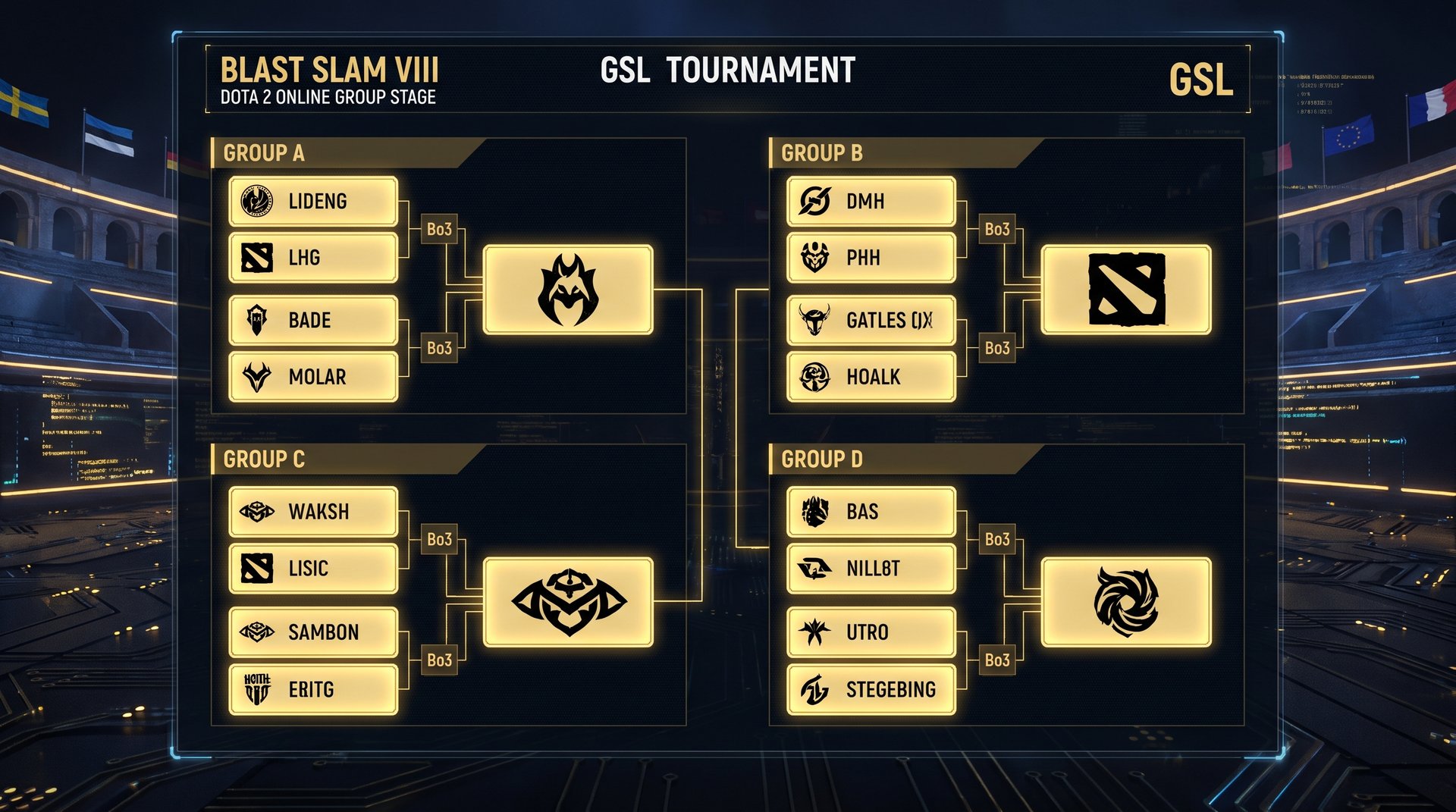
The New Format: 16 Teams, 4 GSL Groups
The new format for BLAST Slam VIII is one of the most significant structural changes the series has seen. Here is the complete breakdown from group stage through to the Malta Finals.
Online Group Stage (September 29 — October 7, 2026)
The 16 teams are divided into four groups of four, each played in a GSL (Group Stage League) format. A GSL group works as follows: two opening matches are played, the two winners then face each other to determine the top seed, and the two losers play each other in an elimination match. If you lose your opening game, you get one more chance — lose again and you are eliminated. Every single match is a Best-of-3, so no team can be knocked out by a single draft disaster, a disconnect on map one, or a momentary lapse on a tired night.
This is a meaningful upgrade over earlier BLAST Slam formats that used Bo1 group matches. Bo1 group stages are inherently volatile — a single game can end a team’s tournament before they have had a chance to show their preparation. Bo3 groups mean that the best teams should, more often than not, advance, and the data from three maps per series is also dramatically more useful for viewers who want to learn from watching.
Malta Finals (October 8 — 11, 2026)
Six teams qualify from the four groups and travel to BLAST Arena Studios in Malta for a four-day offline event. The Malta Finals are single-elimination or bracket-format (seeded by group stage placement). Playing a LAN Final in Malta gives the event genuine prestige — BLAST Arena Studios is a purpose-built esports facility that has hosted several high-production-value events. Expect full broadcast production, an analyst desk, and interviews between series.
| Stage | Format | Dates | Location |
|---|---|---|---|
| Online Group Stage | 4 GSL Groups, all Bo3 | Sep 29 — Oct 7, 2026 | Online |
| Malta Finals | 6-team bracket | Oct 8 — 11, 2026 | BLAST Arena Studios, Malta |
Prize Pool Breakdown: $750,000 on the Line
The total prize pool for BLAST Slam VIII Dota 2 is $750,000 USD, structured as two components: $550,000 in prize money (distributed by placement) and $200,000 in team earnings (participation-based, shared across all 16 competing teams). The team earnings component is a BLAST practice designed to ensure teams can cover participation costs without their entire financial return riding on a single bracket result.
| Placement | Prize Money | Notes |
|---|---|---|
| 1st Place | $200,000 | Malta Finals champion |
| 2nd Place | $100,000 | Malta Finals runner-up |
| 3rd — 4th Place | $50,000 each | Malta Finals semi-finalists |
| 5th — 6th Place | $25,000 each | Malta Finals first-round exits |
| Group stage exits | Varies | Share of remaining prize pool |
| Team Earnings (all 16) | $200,000 shared | Participation guarantee |
For reference, SLAM VII had a $1,000,000 prize pool across 12 teams. BLAST reduced the total to $750,000 for SLAM VIII while expanding to 16 teams. The per-team earning potential is comparable when you factor in team earnings, and the Tier 1 championship points from a SLAM VIII win carry significant value for DPC or circuit ranking purposes heading into the next Valve-sanctioned season.
How Teams Qualify for BLAST Slam VIII
BLAST uses a three-region qualification system covering Europe, China, and Southeast Asia. Each region runs the same two-stage qualifier format, giving a total of six qualifier spots (two per region) with the remaining 10 spots filled via direct invite.
Open Qualifier: The First Gate
The Open Qualifier is available to any registered team in the relevant region. All matches use Best-of-1 format except the semifinals, which are Best-of-3. The top two finishers from each regional Open Qualifier advance to the Closed Qualifier. This is where lower-seeded organizations, newly formed rosters, and up-and-coming squads get their shot at a main event berth — and where regional fans get to see local heroes compete for a place on the biggest stage.
Closed Qualifier: The Final Gate
The Closed Qualifier combines the Open Qualifier survivors with direct-invited teams at this stage. All matches are Best-of-3. The top two finishers per regional Closed Qualifier secure a main event spot. With three regions each producing two qualifiers, that accounts for six of the sixteen BLAST Slam VIII slots, with BLAST awarding the remaining ten through direct invitations based on recent Tier 1 performance.
Direct Invites
BLAST confirmed that direct invites to the main event were sent on August 4, 2026. Historically, direct invites go to the strongest European squads with consistent Tier 1 tournament results, plus standout teams from China and Southeast Asia who have demonstrated international-level performance. The 10 direct invite slots make this predominantly an invite-based event, with the qualifier pathway providing genuine opportunity for the best regional teams outside the traditional top tier.
Teams to Watch at BLAST Slam VIII
While the complete participant list was not confirmed at publication, we can draw on tournament history, SLAM VII participation, and the current European Dota 2 landscape to identify which organizations and storylines to follow when group stage begins.
The European Core: Consistency Is the Story
The BLAST Slam series is primarily a European event in character, even though it features teams from multiple regions. The squads that have defined European Dota 2 in 2025-2026 — including Team Liquid, Team Spirit, Tundra Esports, BetBoom Team, and OG — have historically been BLAST Slam participants and would be expected to receive direct invites to SLAM VIII based on their circuit performances.
Team Spirit has been one of the most dominant European rosters heading into the 2026 autumn circuit. Their ability to draft flexibly across multiple positions and adapt mid-series is a significant advantage in the new Bo3 group format. A team that can out-prepare an opponent across three maps of series play is exactly the type of squad the revamped BLAST Slam format was built for.
Tundra Esports, meanwhile, are a team that tends to get underrated on paper heading into events but consistently shows up with well-structured drafts. In a GSL group format where consistency matters, Tundra’s systematic approach to Dota 2 — building advantages through objective control rather than flashy individual plays — is a real asset.
Regional Challengers: China and SEA
The expanded qualification system for SLAM VIII, covering China and Southeast Asia with formal qualifier paths, signals BLAST’s intent to make this a genuinely international field. Chinese Dota 2 has produced several world-class squads over the past two years, with organizations like Xtreme Gaming and others from the CN region showing the individual mechanical skill to compete with the best European teams in a Bo3 environment.
Southeast Asia qualifier teams often arrive at international events as unknowns and leave as talking points. A team that grinds through an Open Qualifier and a Closed Qualifier to reach BLAST Slam VIII main event has proven they can perform under pressure — that kind of tournament toughness can show up as a genuine upset in the Malta Finals bracket.
Teams That Could Define the Narrative
HEROIC and Team Falcons are organizations worth watching closely. HEROIC have been building a consistent Dota 2 identity in the European scene and have the individual talent to take series off the top European teams when everything clicks. Falcons, similarly, have shown glimpses of what they can do at the highest level when their draft and macro execution align.
In a 16-team field with Bo3 group matches, any team that can win two best-of-three series is in Malta. That lowers the barrier to LAN qualification compared to past SLAM editions and creates more genuine opportunity for teams outside the established top three of European Dota to show they belong.

The Malta Finals: A Four-Day LAN Spectacle
The BLAST Arena Studios in Malta is BLAST’s permanent home for offline production, and the BLAST Slam Finals there have established a reputation for high-quality esports broadcasting. Here is what to expect from the four days in Malta.
Production Quality
BLAST consistently delivers broadcast production that rivals Valve’s own TI coverage in terms of camera work, overlay design, and analyst desk depth. If you have watched a BLAST.tv Dota 2 broadcast before, you know what to expect: sharp graphics, roster cards with stats, replay-heavy analysis segments, and post-game interviews that actually ask interesting questions. For fans who want to learn from watching, good broadcast production is half the value.
The LAN Adjustment Factor
One of the most interesting elements of the Malta Finals is the shift from online group stage play to offline LAN conditions. Teams that dominated in the online phase face different variables on LAN: consistent low-latency connectivity, physical presence of opponents, live crowd pressure, and a tighter schedule with less time between series to recover and re-prepare.
Historically, there are teams in Dota 2 that are “LAN monsters” — organizations that consistently outperform their online results when they play in person. These tend to be teams with experienced players who have competed at multiple international events and know how to manage the mental load of a four-day LAN bracket. Identifying which BLAST Slam VIII participants have that track record is one of the most reliable ways to predict Malta Finals outcomes.
Scheduling and Viewing
The group stage runs from September 29 through approximately October 7. The Malta Finals begin October 8 and run through October 11. For viewers in European time zones, this scheduling is comfortable — BLAST typically runs afternoon and early evening Central European Time slots. For Middle Eastern, South Asian, and East Asian viewers, some group stage matches may fall in late-night or early-morning windows. Watch the official BLAST.tv page for the match schedule, which will be posted closer to the start date.
BLAST Slam VIII and the Post-TI Meta
BLAST Slam VIII runs in early October 2026, placing it in one of the most strategically interesting windows of the Dota 2 calendar. The International 2026 will have concluded in the weeks prior, and Valve typically releases a major patch in September or October that reshuffles the hero pool significantly heading into the next cycle.
What this means for BLAST Slam VIII is a genuine unknown: teams will either be adapting to a brand-new patch in real time during the group stage, or they will be playing the final definitive chapter of the TI meta before Valve hits reset. Either scenario creates compelling storylines. A team that correctly identifies which heroes survive a post-TI patch adjustment will have a decisive edge over teams still running pre-patch comfort picks.
For pub players, the post-TI meta period is one of the best times to watch professional Dota 2 and absorb strategic lessons. Pro teams are in the same position as everyone else — adapting to patch changes, reassessing their hero pools, and finding new win conditions. The heroes that show up at BLAST Slam VIII Malta are the ones that cleared that adaptation challenge. Those are the heroes worth adding to your pub pool immediately afterward.
For more context on how meta cycles work after major events, check out our analysis of Dota 2 heroes that always spike after TI — the pattern is remarkably consistent year over year and gives you a framework for anticipating which picks will be strongest in ranked queues through October and November.
How Watching BLAST Slam VIII Can Actually Improve Your MMR
Watching professional Dota 2 with purpose is genuinely one of the most effective free methods for improving your ranked game. BLAST Slam VIII — with its Bo3 format, large international field, and post-TI meta timing — is an unusually good tournament to use as a study tool. Here is how to get the most out of it for your own MMR climb.
1. Follow the Draft Across All Three Maps
A Bo3 series gives you something that a single game never can: a window into how teams adapt. After losing game one on a particular draft, how does team A respond? Do they ban out what beat them, or do they trust their execution and run the same draft again with adjustments? Watching this decision-making across three maps teaches you draft fundamentals that directly apply to your own ranked games — when to stick with your comfort picks and when to switch it up based on what the enemy is showing.
2. Study Laning Phase Timing, Not Just Teamfights
The gap between high-MMR and low-MMR players is not primarily about individual mechanical skill — it is about timing awareness. Pro players are constantly monitoring the minimap, identifying when their opponent is vulnerable, and rotating the exact moment a window opens rather than waiting for an obvious invitation. Watching BLAST Slam VIII with commentary that calls out these moments teaches you what “good timing” looks like in real-time. You can then start running mental timing checks in your own games: “should I have rotated here? Did I miss a window?”
3. Identify One Hero Per Series to Study
Rather than trying to absorb everything in a match, pick one hero per series and watch only their movements, item timings, and decision-making. This focused approach builds hero knowledge far faster than watching the full broadcast casually. If you see a support hero creating value through constant rotation and vision control in a BLAST Slam VIII match, study exactly how they time those rotations relative to rune spawns, lane states, and roshan timers.
4. Accelerate with Expert Help
Passive viewing has limits. The fastest path from tournament-viewer to ranked improvement is playing alongside someone who already applies those strategies in real games. Our Dota 2 boosting services connect you with high-MMR players who understand the current pro meta at a level that translates directly into ranked queue decisions. Playing ten games alongside a booster who is actively running BLAST Slam VIII meta strategies is worth more than 50 hours of passive watching.
If you are weighing whether that is the right move for your account, read our honest assessment of whether Dota 2 boosting is safe — we walk through the actual risks, what distinguishes a legitimate service from a sketchy one, and how TeamSmurf approaches the process to protect your account throughout.
| BLAST Slam VIII Quick Facts | Details |
|---|---|
| Tournament | BLAST Slam VIII Dota 2 |
| Organizer | BLAST |
| Tier | Tier 1 |
| Total Prize Pool | $750,000 USD |
| Prize Money | $550,000 USD |
| Team Earnings | $200,000 USD |
| Teams | 16 (expanded from 12) |
| Group Stage | 4 GSL Groups, all Bo3, Sep 29 — Oct 7 |
| Finals Location | BLAST Arena Studios, Malta, Oct 8 — 11 |
| Qualifier Regions | Europe, China, Southeast Asia |
| Where to Watch | BLAST.tv, Twitch, YouTube |
Rank Up While the BLAST Slam VIII Meta Is Fresh
The heroes and strategies dominating BLAST Slam VIII will shape pub queues through October and beyond. Get ahead of the post-tournament meta shift with support from high-MMR Dota 2 specialists who track the pro scene closely.
Get MMR Boost Book a Coaching Session


