How to Master Windranger in Dota 2: The Ultimate Guide for Every Rank (2026)

Windranger is one of the most versatile heroes in Dota 2, and that versatility is exactly what makes her so dangerous in the right hands — and so underwhelming in the wrong ones. She can play mid, offlane, or soft support. She can nuke, disable, escape, and single-handedly delete towers and heroes with Focus Fire. But none of that matters if you do not understand her timing windows, her ability interactions, and the precise skill progression that separates a 3K Windranger from a 7K one.
In patch 7.40c, Windranger sits at roughly a 48% winrate across all brackets with around 17,000 matches tracked this month. That number might look average, but it hides something important: her winrate climbs significantly in higher brackets where players can land Shackleshot latches consistently and close games before she falls off. This guide breaks down every single aspect of mastering Windranger — from the angle geometry behind Shackleshot to the exact item timings that let you snowball out of control.
Whether you are a Herald learning the basics or a Divine player looking to add Windranger to your hero pool, this is the only guide you need. No filler, no generic advice. Just actionable knowledge from Immortal-rank analysis.
Table of Contents
Why Windranger Is the Ultimate Flex Pick
Windranger — formerly known as Windrunner before the rename — is a ranged Intelligence hero classified as a Carry, Disabler, Escape, Nuker, and Support. That laundry list of tags is not just flavor text. She genuinely functions in all of those roles depending on how you itemize and where you lane her.
In the current 7.40c meta, Windranger occupies an interesting space. She is not the highest-winrate hero in any single role, but she offers something almost no other hero does: complete draft flexibility. You can pick her early without revealing your lane assignment. Your opponents have to guess whether she is going mid with a Killshot facet build, offlane with Tangled for setup, or even position 4 support with early Shackleshot max.
Her current stats tell the story. Across all brackets, she holds about a 48.06% winrate in support, 48.36% winrate in offlane, and roughly 47.5% in mid. The Killshot facet dominates pick rates at 92.68% in support and 66.78% in mid, while the Tangled facet sees more play in offlane (37.58% pickrate with a slightly higher 49.74% winrate). These numbers suggest that Tangled is underrated and Killshot is overpicked — something we will explore in depth.
Hero Identity and Strengths
Windranger excels at three things that win Dota games:
- Pick-off potential: A two-hero Shackleshot into Powershot and Focus Fire can delete a core before a teamfight even starts.
- Tower pressure: Focus Fire on buildings is one of the fastest tower-killing abilities in the game, especially with damage items.
- Survivability: Windrun provides 100% physical evasion and bonus movement speed, making her extremely difficult to kill for right-click dependent heroes.
Her weaknesses are equally clear: she falls off hard if she does not snowball, she is extremely skill-shot dependent (miss Shackleshot and you are half a hero), and she struggles against magic burst and targeted disables that bypass Windrun.
Abilities Deep Dive
Shackleshot (Q)
This is Windranger’s signature ability and the single most important spell to master. Shackleshot fires a projectile that, on hitting an enemy hero, searches for a tree or another enemy unit within a 575 unit range behind the target at a 26-degree angle. If it finds a valid latch target, the primary target is stunned for up to 2.6 seconds at max level. If it latches to another hero, both are stunned.
The critical thing most players get wrong: the latch searches behind the target relative to the projectile’s travel direction, not relative to Windranger’s position at the time of impact. This means if you fire Shackle and then move, the latch angle is based on where the projectile came from, not where you are standing when it connects.
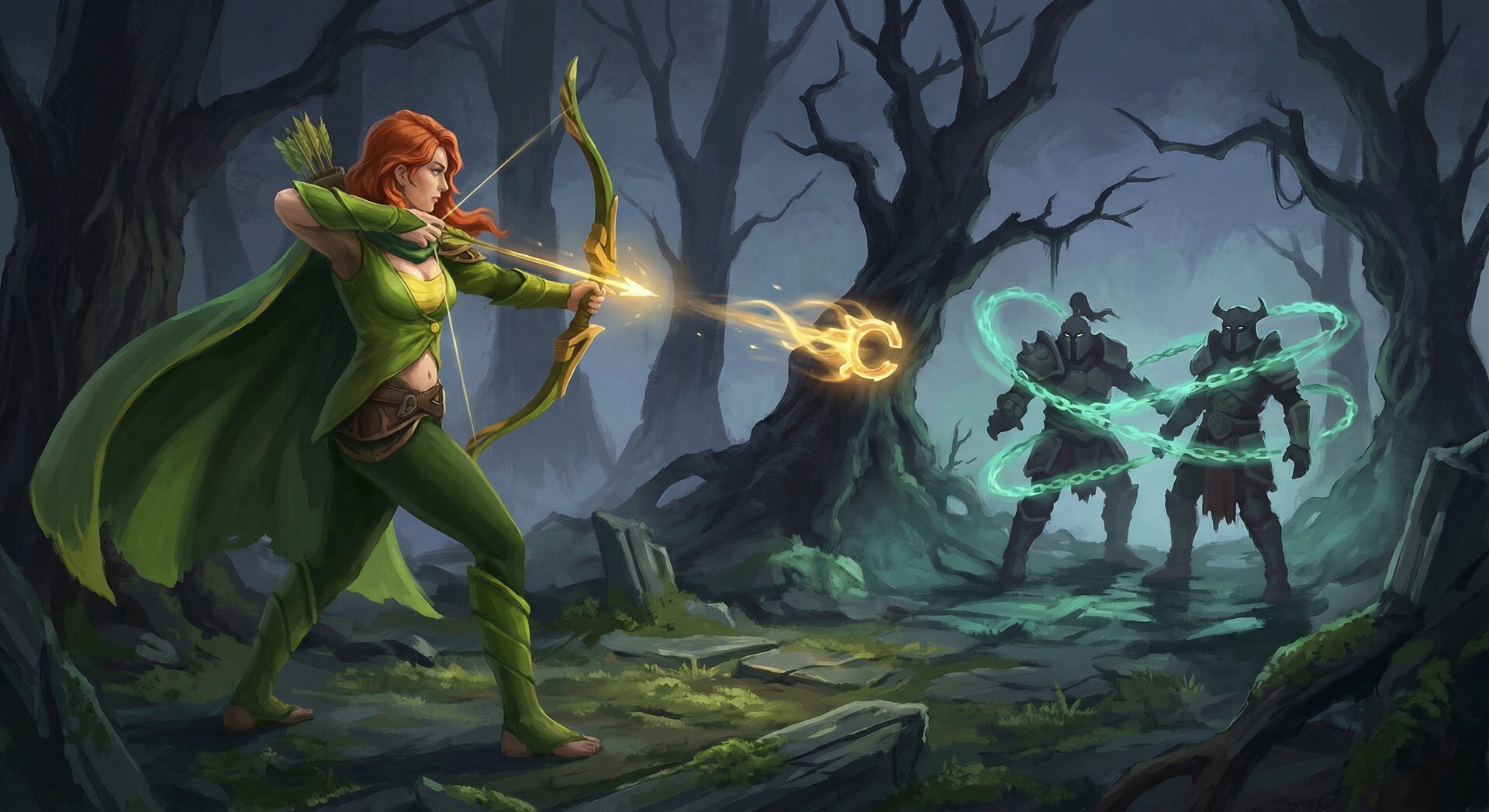
Hidden mechanics and interactions:
- Tree latch range is generous. The search area behind the target is a cone, not a straight line. You do not need perfect alignment — being within roughly 26 degrees of a tree is enough.
- Shackle pierces Linken’s Sphere on the primary target but will NOT latch. The projectile hits, pops the Linken’s, but no stun occurs.
- You can Shackle to player-created trees from Iron Branch, Sprout (Nature’s Prophet), or Ironwood Tree. This creates setups that opponents do not expect.
- Fog of war does not prevent latching. The latch searches for valid targets even in fog, meaning you can Shackle someone to a hero or tree you cannot see.
- Shackle can latch to Roshan. If an enemy is positioned between you and the Rosh pit with Roshan behind them, the Shackle can latch to Rosh.
Skill Build: When to Max Shackleshot First
Maxing Shackleshot first is primarily a support build. At level 1, Shackleshot only stuns for 1.4 seconds on latch (0.7 without). At level 4, that becomes 2.6 seconds latched and 1.3 seconds unlatched. The cooldown also drops from 18 to 12 seconds. If your job is to provide lockdown for your cores, this max makes sense — but only if you can consistently land latches.
Powershot (W)
Powershot is a channeled nuke that charges up over 1 second and fires a long-range projectile dealing up to 360 damage at max level. The damage reduces by 20% for each unit it passes through. It also provides vision along its path and destroys trees in its wake.
This is your primary farming tool, your snipe for low-health heroes retreating, and your wave-clear mechanism. In the 7.40c meta, Powershot max first (W-E-W-Q-W-R-W) is the standard skill build across all roles because the farming acceleration it provides is irreplaceable.
Key mechanics:
- You can cancel the channel early. Releasing before full charge reduces damage proportionally, but sometimes a quick 50% Powershot to secure a last hit or finish someone is better than waiting the full second.
- Powershot gives vision. Use it to scout Roshan pit, check high ground, or reveal juke paths. This is free information that costs you almost nothing.
- Tree destruction clears juke paths. In a chase scenario, firing Powershot through trees removes escape routes. This is especially powerful near side shops and jungle entrances.
- The -15% Powershot Reduction talent at level 15 increases Powershot’s per-unit damage retention, making it significantly stronger for wave clear and team fight poke.
Windrun (E)
Windrun grants Windranger 100% physical evasion and bonus movement speed for up to 6 seconds at max level. It also slows nearby enemies’ movement speed. This is one of the most powerful defensive abilities in the game against physical damage dealers.
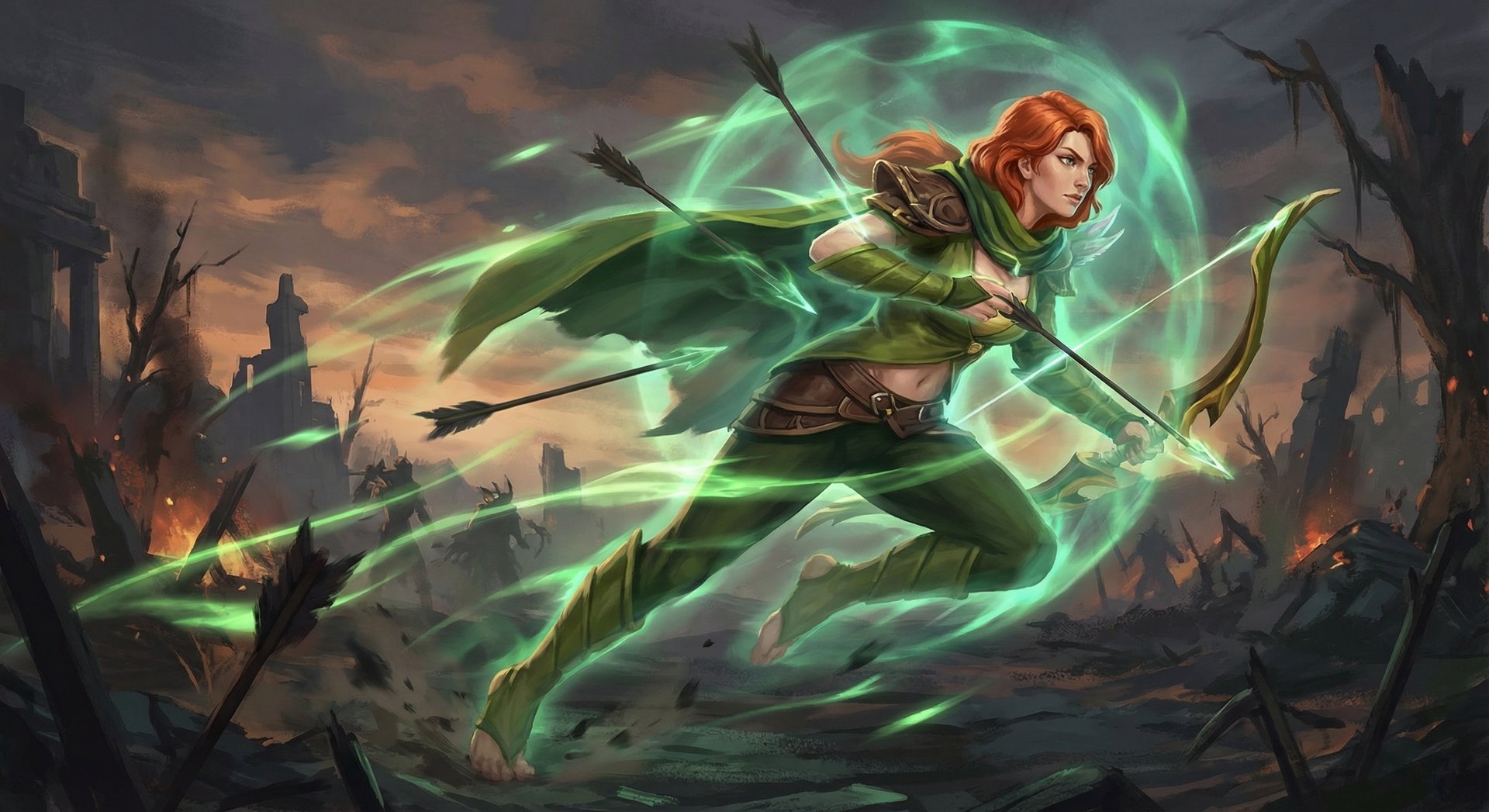
Critical interactions:
- Windrun does NOT evade attacks from Monkey King Bar. MKB’s True Strike pierces the evasion. This is the single most important counter-itemization to remember.
- Windrun can be purged by strong dispels (Fortune’s End, Demonic Purge) and by Nullifier. However, the level 25 talent makes Windrun undispellable.
- The evasion works against towers. You can dive towers with Windrun active and take zero physical damage from tower shots for the duration.
- Windrun does not evade magical or pure damage attacks (Silencer’s Glaives of Wisdom, Outworld Destroyer’s Arcane Orb). These will still hit you.
- The -2s Windrun Cooldown talent at level 15 combined with max level Windrun gives near-permanent uptime, making you almost unkillable by right-clickers.
Focus Fire (R) — Ultimate
Focus Fire is what turns Windranger from a utility hero into an absolute monster. When activated on a target (hero, creep, or building), Windranger gains maximum attack speed (500) against that target but with a damage reduction that scales from -50% at level 1 to -30% at level 3. The -10% Focus Fire Damage Reduction talent at level 20 further reduces this penalty to just -20%.
This ability has several nuances that separate good Windranger players from great ones:
- Focus Fire works on buildings. A Windranger with Aghanim’s Shard, Maelstrom, and Focus Fire can melt a tier 2 tower in seconds. This tower pressure is one of her primary strategic advantages.
- Damage reduction applies to base damage only in some calculations. Items like Javelin, Maelstrom, and Monkey King Bar proc on every hit at full damage because they are separate damage instances. This is why attack-proc items are core on Windranger.
- You can switch targets during Focus Fire to attack other units, then return to the Focus Fire target and retain the bonus attack speed. The buff persists for the full duration regardless of target switching.
- Aghanim’s Scepter removes the Focus Fire damage penalty entirely on heroes (not buildings), turning every Focus Fire into a full-damage maximum attack speed assault.
- The Killshot facet makes Focus Fire kill threshold grant bonus damage, making it even deadlier as a finishing tool. This is why 92% of support Windranger players choose Killshot.
Item Builds by Rank
Windranger’s item build varies significantly by role and bracket. The core philosophy is the same — maximize Focus Fire damage through proc-based items — but the path to get there and the situational choices change based on game understanding.
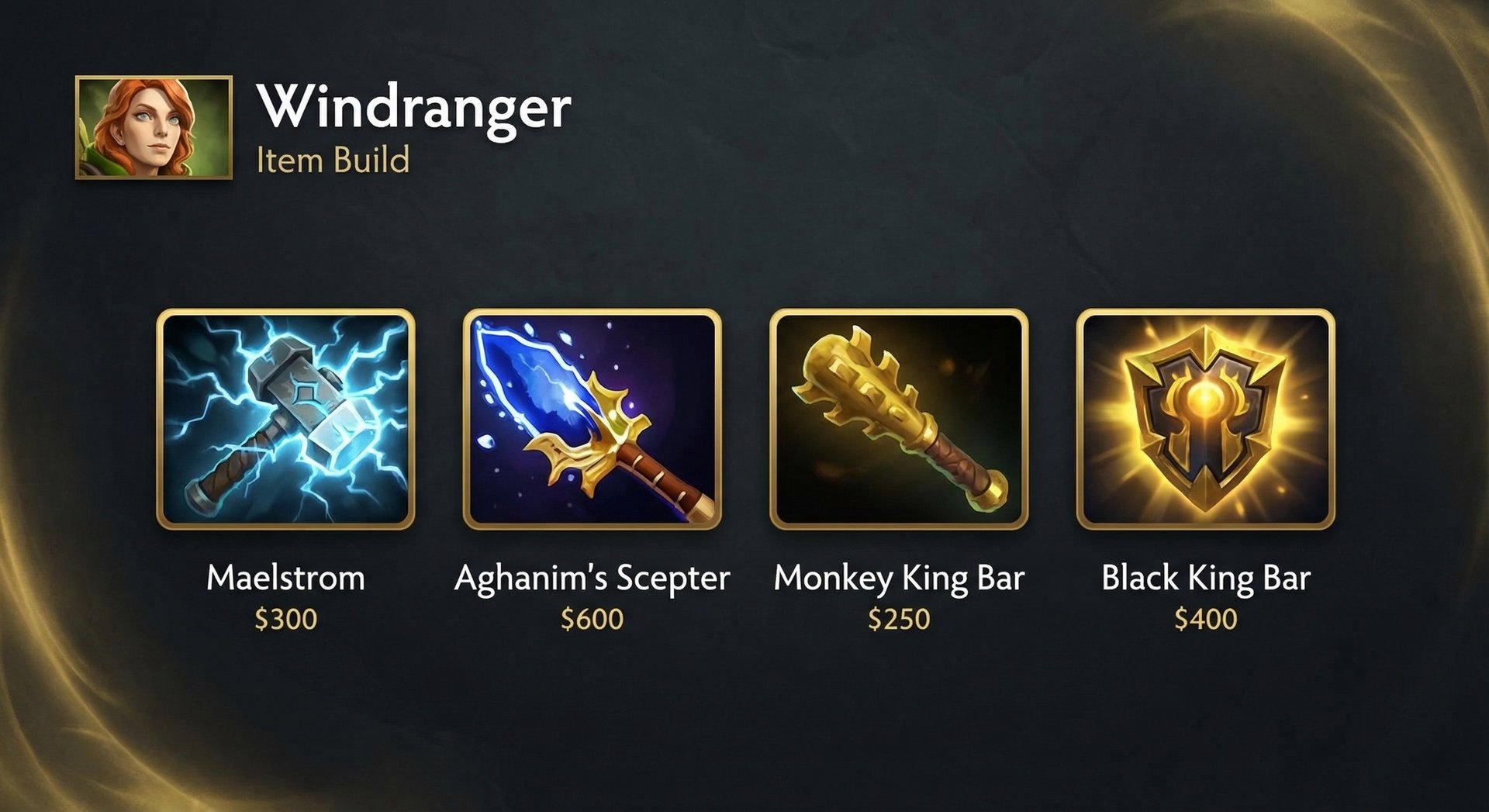
| Rank | Starting | Early Game | Core Items | Late Game |
|---|---|---|---|---|
| Herald-Crusader | Tango, Faerie Fire, 2x Iron Branch, Circlet | Bottle (mid), Magic Wand, Boots of Speed, Javelin | Phase Boots, Maelstrom, BKB | Monkey King Bar, Aghanims Scepter, Daedalus |
| Archon-Legend | Tango, Faerie Fire, Branches, Circlet or Null | Bottle, Magic Wand, Javelin, Boots | Phase Boots, Maelstrom, BKB or Orchid | Gleipnir, Aghanims Scepter, MKB, Nullifier |
| Ancient-Divine | Tango, Faerie Fire, Null Talisman components | Bottle, Null, Javelin, Phase | Maelstrom, BKB, Aghanims Scepter | Gleipnir, MKB, Bloodthorn, Refresher Orb |
| Immortal | Tango, Faerie Fire, Null components | Bottle, 2x Null, Javelin | Phase, Witch Blade or Maelstrom, BKB | Aghanims Scepter, Gleipnir, Bloodthorn, Refresher |
Why Items Differ by Rank
Lower brackets benefit from simpler, more forgiving item progressions. Phase Boots into Maelstrom into BKB gives you everything you need: mobility, farming speed, damage procs, and spell immunity. Daedalus as a late-game option provides raw damage that does not require much positioning finesse.
Higher brackets lean toward Orchid Malevolence or Witch Blade as early pickups because these items provide catch potential and mana sustain that skilled players can exploit. Bloodthorn as a late-game evolution of Orchid adds True Strike, critical hits, and a silence that synergizes perfectly with Focus Fire’s max attack speed. Refresher Orb is a luxury purchase that lets you Focus Fire two different targets in a team fight or chain Focus Fire on the same target for extended kill potential.
Core Item Explanations
Maelstrom / Gleipnir: The lightning proc from Maelstrom triggers on every Focus Fire hit at full damage (not reduced by the damage penalty). With 500 attack speed, you are proccing Chain Lightning constantly. Gleipnir upgrades this with an active root that synergizes with Shackleshot for layered lockdown.
Black King Bar: Non-negotiable in almost every game. Windranger needs to stand still and auto-attack during Focus Fire, making her vulnerable to disables. BKB lets you commit to kills without getting stunned out of your damage window.
Aghanim’s Scepter: Removes the Focus Fire damage penalty on heroes entirely. This transforms your ultimate from “decent single-target DPS” to “I will kill any hero in 3 seconds.” The timing on this item is crucial — too early and you lack survivability, too late and the game might already be decided.
Monkey King Bar: Provides True Strike (so your Focus Fire attacks cannot miss against evasion) plus a damage proc that triggers at full value during Focus Fire. Essential against Phantom Assassin, Butterfly carriers, or any hero stacking evasion.
Laning Phase Masterclass
Windranger’s laning phase varies dramatically depending on her role, but the fundamentals remain the same: use Powershot to secure ranged creeps, harass with right-clicks using your 600 attack range, and threaten kills with Shackleshot whenever trees are nearby.
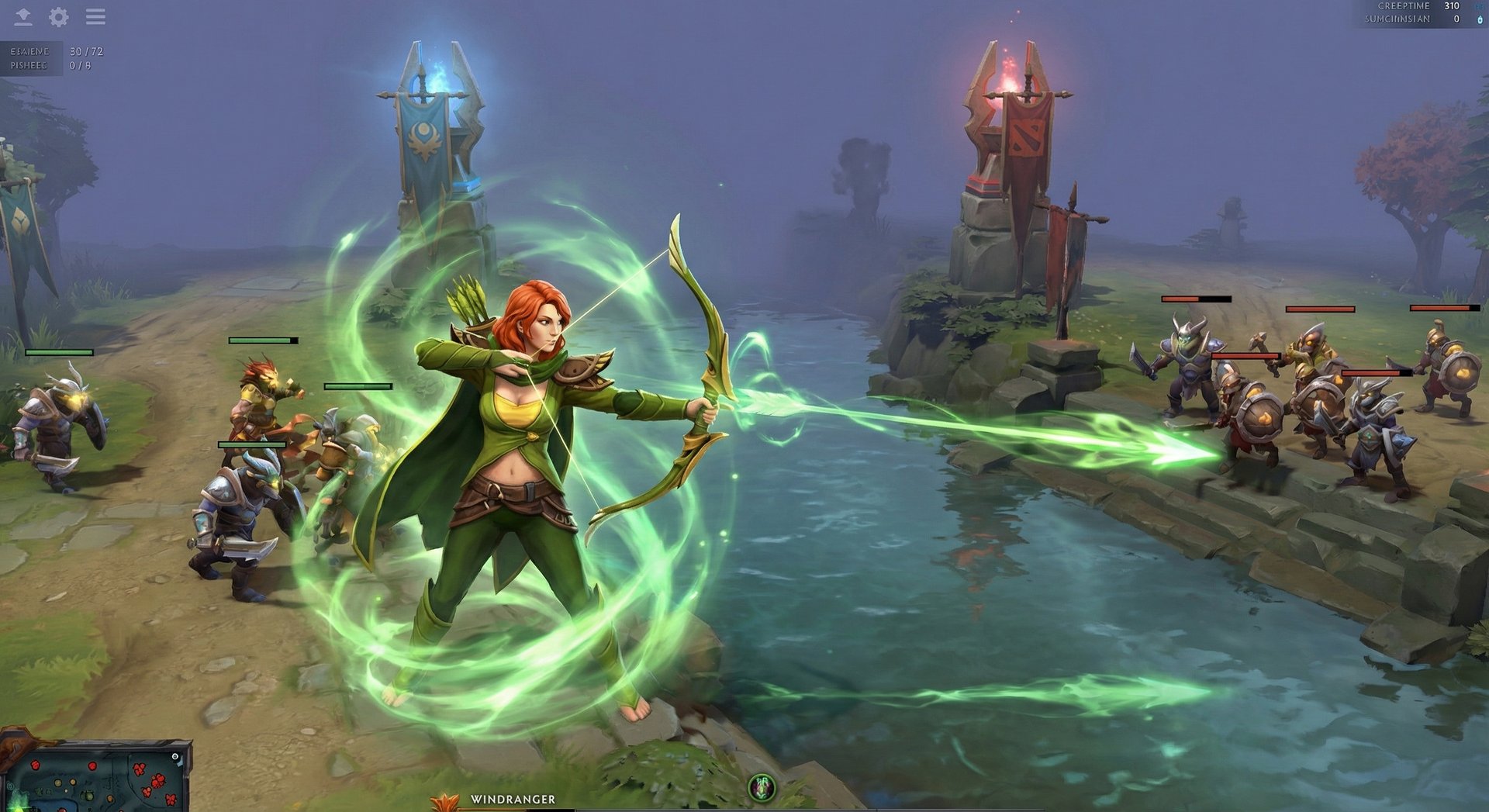
Mid Lane Windranger
Mid is Windranger’s most common core role. Your laning priorities are:
- Secure every ranged creep. Powershot the wave when the ranged creep is low. One charged Powershot clears the ranged creep and damages the entire wave, pushing the lane and giving you time to grab the rune or stack a camp.
- Harass with right-clicks. Your 600 attack range outranges most melee mids and matches most ranged mids. Use your range advantage to get favorable trades, especially under the safety of Windrun.
- Set up Shackleshot kills at level 3. With one point in Q, one in W, and one in E, you have enough to threaten a kill if your opponent stands near a tree. Walk to the side of the lane where trees are behind your opponent, fire Shackleshot, then Powershot and right-click them down.
- Control runes aggressively. Windranger with Windrun is one of the fastest heroes at contesting runes. Use the movement speed to beat your opponent to every rune spawn.
Offlane Windranger
Offlane Windranger focuses more on disruption and tower pressure. Your job is not to farm — it is to make the enemy carry’s life miserable.
- Harass the carry relentlessly. Stand behind the creep wave and right-click the enemy carry whenever they go for last hits. Trade aggressively because Windrun lets you disengage safely.
- Use Shackleshot setups with your support. Communication matters here. Tell your support to position for Shackle latches against the trees at the edge of the lane.
- Powershot the wave to push. Pushing the wave into the tower forces the carry to last-hit under tower (which lower-bracket carries struggle with) and opens up pull camps for your support to contest.
- Take the tower early. Once you hit level 6, Focus Fire on the tier 1 tower whenever the lane is pushed. Windranger can take towers faster than almost any other offlaner at this stage of the game.
Support Windranger
Support Windranger is viable but demanding. You need to land Shackleshots consistently because without items, your damage contribution relies entirely on your spells.
- Max Powershot for damage and wave clear. Even as a support, Powershot max first is standard because it lets you farm small camps between rotations and contribute meaningful nuke damage.
- Play behind trees. Position yourself where you can fire Shackleshots that latch to trees. The offlane and safe lane both have tree lines that create natural Shackle angles.
- Ward aggressively. Windrun lets you place deep wards safely. You can run into enemy territory, drop a ward, and Windrun out before anyone catches you.
Mid and Late Game Transitions
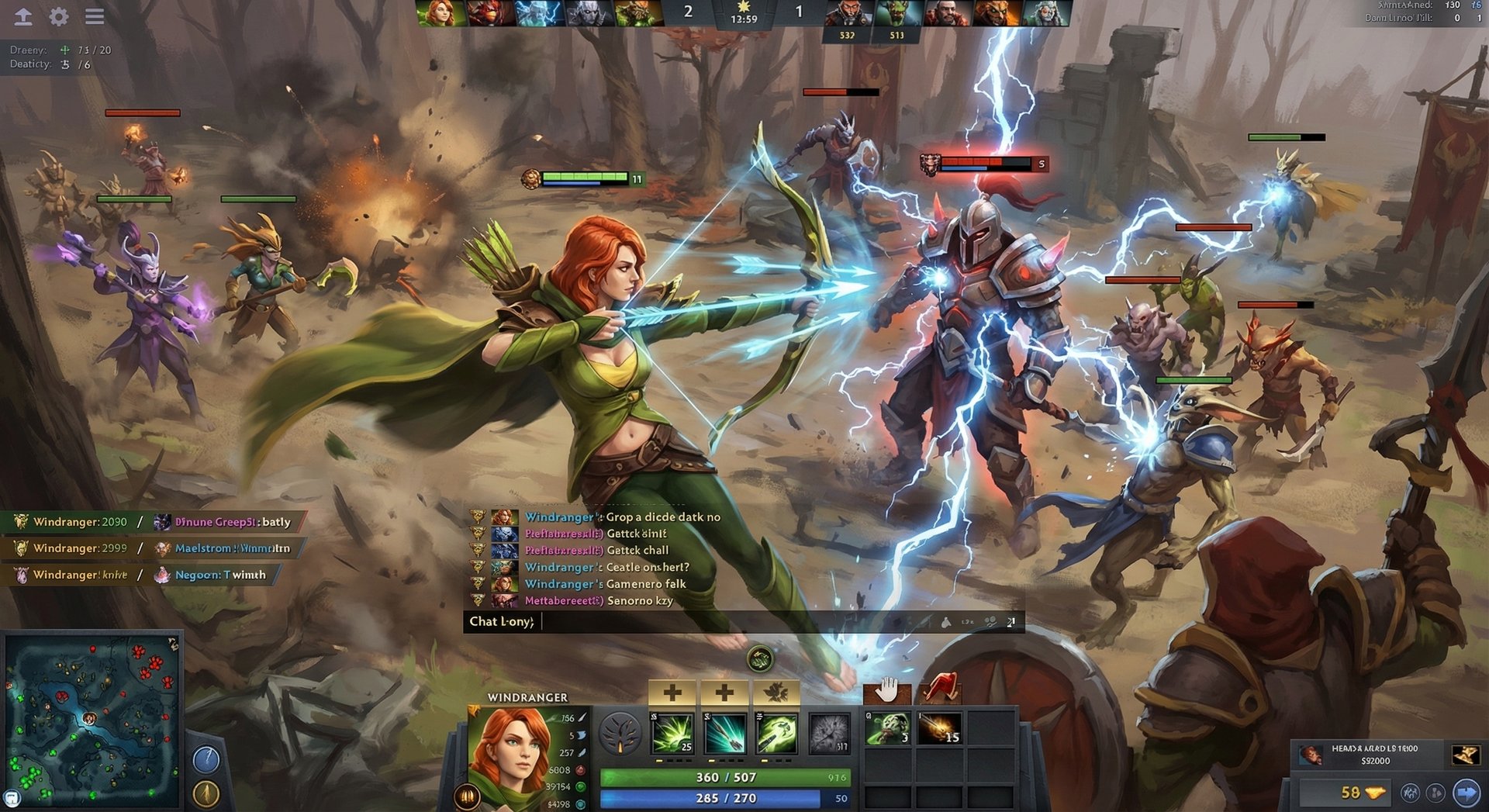
Windranger’s mid game is her strongest phase. Between levels 10-18 with two to three core items completed, she can delete heroes, push towers, and create map pressure that suffocates the enemy team. Understanding when to fight and when to push is what separates average Windranger players from game-winning ones.
Mid Game Timing Windows (15-30 minutes)
Your first major power spike comes when you complete Phase Boots + Maelstrom (usually around 13-16 minutes for mid, 16-20 for offlane). At this point, Focus Fire with Maelstrom procs deals massive single-target damage that most heroes cannot survive through.
What to do with this spike:
- Look for pick-offs on isolated heroes. Smoke with your team, find a target near trees, Shackleshot-Powershot-Focus Fire. The kill should take 3-5 seconds.
- Push towers immediately after kills. One Focus Fire rotation can take 50-70% of a tier 2 tower’s HP with Maelstrom. This is how you convert kills into objectives.
- Take Roshan if your team has the damage. Focus Fire works on Roshan and your attack speed makes the kill fast.
Your Second Spike: BKB Timing
When BKB is completed (usually 18-24 minutes), you become nearly unkillable during your damage window. Pop BKB, Focus Fire, and free-hit for the full spell immunity duration. This is your teamfight “I win” button and it is strongest when it is fresh (10 seconds). Do not waste BKB charges on fights that do not matter.
Late Game (30+ minutes)
This is where Windranger starts to fall off relative to hard carries. Your Focus Fire damage, even with Aghanim’s Scepter, is single-target. Against a six-slotted Phantom Assassin, Terrorblade, or Medusa, you simply cannot match their sustained multi-target damage output.
How to stay relevant late game:
- Split push. Focus Fire melts buildings. Use this to force the enemy team to respond while your team takes objectives elsewhere.
- Focus the right target. In late-game team fights, your job is to delete the enemy’s highest-value target. That might be the support with save spells, the mid with burst damage, or even the carry if you have Aghanim’s + MKB + Bloodthorn.
- Refresher Orb lets you Focus Fire twice. In ultra-late games, Refresher means you can kill two targets in a single fight or chain Focus Fire on the same tanky target.
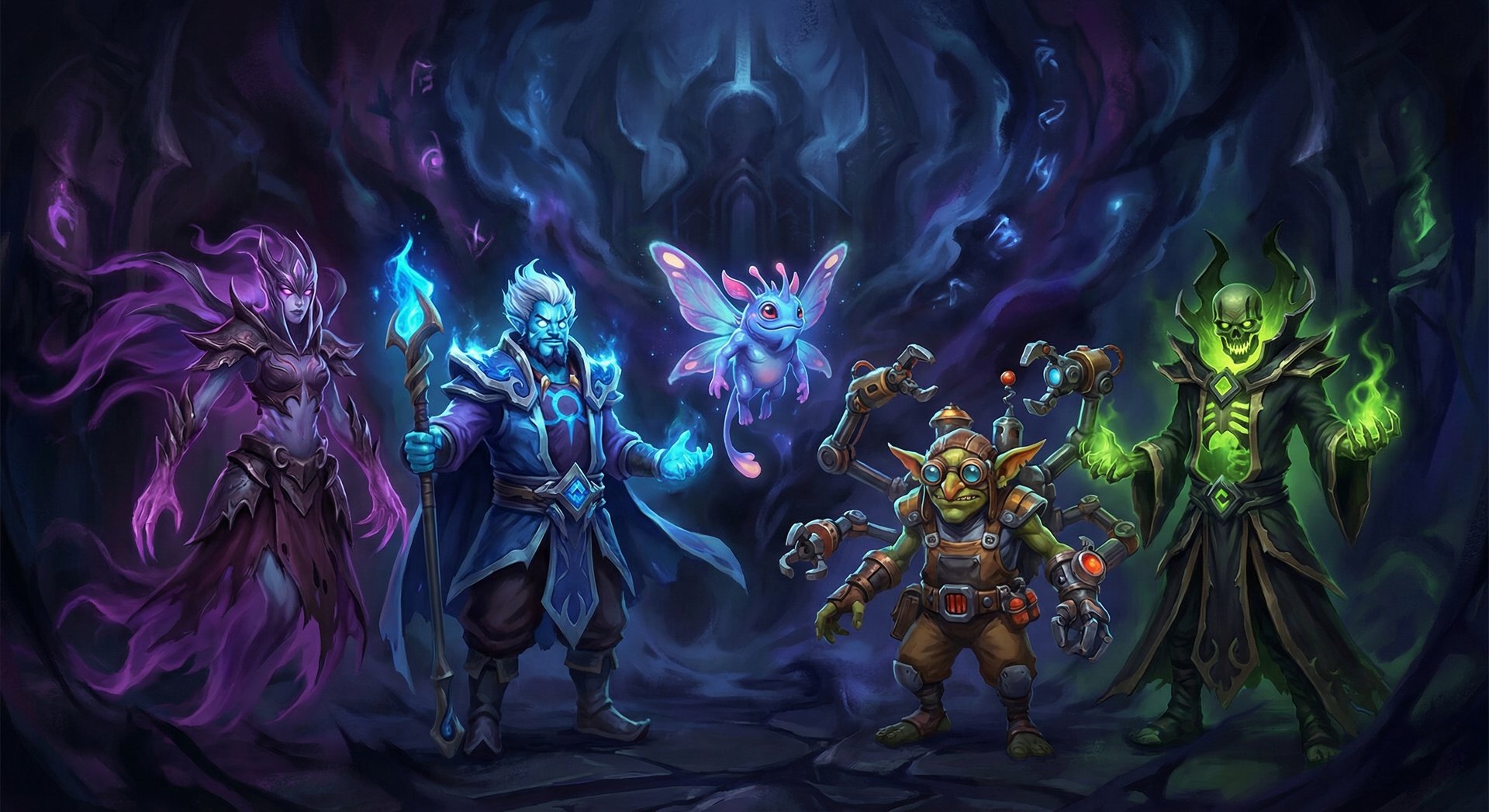
Counters: Heroes That Destroy Windranger
Every hero has bad matchups, and knowing Windranger’s counters is essential for both picking her wisely and playing around her weaknesses.
1. Spectre
Spectre is Windranger’s nightmare. Desolate deals bonus pure damage when Spectre is alone with a target, and Windranger often isolates herself for pick-offs. Dispersion reflects a percentage of all damage taken, meaning Focus Fire’s rapid hits are partially reflected back at you. Haunt forces global presence, and Windranger has no way to deal with a Spectre appearing next to her. Worst of all, Spectre outscales Windranger in every scenario.
2. Storm Spirit
Storm Spirit can zip on top of Windranger, applying Electric Vortex (which goes through BKB in some interactions) and Overload procs. Ball Lightning makes him nearly impossible to Shackleshot reliably, and his magic burst bypasses Windrun entirely. Storm also farms faster and scales harder with Orchid/Bloodthorn timing.
3. Puck
Puck’s Phase Shift dodges Shackleshot, Powershot, and even Focus Fire attacks. Dream Coil punishes Windranger’s repositioning during fights. Waning Rift silences, cutting off Windrun and BKB. Puck’s magic damage ignores Windrun evasion, and the hero’s mobility makes it extremely hard to land a clean Shackle latch.
4. Tinker
Tinker’s Laser blinds Windranger, making Focus Fire miss entirely (100% miss chance for the duration). Defense Matrix provides a shield and status resistance. Heat-Seeking Missile and Laser deal magic damage that bypasses Windrun. Tinker’s ability to Rearm and reposition with Blink makes him a frustrating target to chase down.
5. Pugna
Nether Ward punishes Windranger’s mana-intensive spell rotation (Shackleshot + Powershot + Focus Fire costs a significant chunk of mana). Life Drain through BKB pierces spell immunity, and Decrepify makes a target ethereal — immune to Focus Fire’s physical damage. Pugna invalidates Windranger’s entire kit.
How to Play Around Counters
- Against Spectre: End the game before 35 minutes. Push towers with Focus Fire and force high ground before Spectre comes online. Buy Spirit Vessel to cut healing.
- Against Storm: Buy Orchid before he gets BKB. A Shackle + Orchid + Focus Fire during the silence window is usually a kill. Save Windrun for Ball Lightning engages.
- Against Puck: Hold Shackleshot until after Phase Shift is used. Puck will reflexively Phase Shift your first spell — bait it out, then Shackle.
- Against Tinker: Buy BKB and Aghanim’s Scepter. Jump Tinker when Laser is on cooldown. Gleipnir root prevents Tinker from blinking away.
- Against Pugna: Avoid extended fights near Nether Ward. Focus Fire buildings instead of heroes when Pugna is alive. Destroy Nether Ward immediately (it has low HP).
Heroes Windranger Destroys
Windranger thrives against heroes who rely on physical damage, lack mobility, or have no way to break through Windrun.
1. Phantom Assassin
Windrun makes you immune to PA’s crits for its duration. PA has no way to purge Windrun, and her Blur evasion is countered by MKB (which you build anyway). Shackleshot locks PA down, and Focus Fire melts her relatively low HP pool. PA wants to jump supports and one-shot them — Windranger simply does not die to that gameplan.
2. Sniper
Sniper relies entirely on right-click damage. Windrun makes every attack miss. Shackleshot’s range exceeds Sniper’s comfortable positioning range, and Powershot can snipe Sniper from even further away. Windranger also has natural gap-closing with Windrun’s movement speed, negating Sniper’s range advantage.
3. Drow Ranger
Similar to Sniper, Drow relies on physical right-click damage that Windrun negates. Drow’s Gust silence is annoying, but if you bait it out before engaging, Windrun makes you untouchable. Focus Fire burns through Drow’s low armor and HP quickly.
4. Wraith King
Wraith King’s single-target stun is easy to dodge with Windrun’s movement speed. His right-click damage is evaded by Windrun. Most importantly, Focus Fire can burn through both of Wraith King’s lives relatively quickly, and Windranger can kite him indefinitely with Windrun and Phase Boots.
5. Lifestealer
Lifestealer’s Feast and right-click sustain are negated by Windrun evasion — he cannot lifesteal from attacks that miss. Rage gives BKB-like immunity, but it does not prevent Focus Fire from dealing physical damage (you can still attack him). Windranger’s mobility means Lifestealer can never reliably chase her down.
How Pros Play Windranger in Patch 7.40c
Windranger has seen occasional pro picks in the current patch cycle, primarily as a flex pick that confuses opponents during the draft phase. She is not a first-phase pick but rather a strategic third or fourth pick that exploits specific draft weaknesses.
Notable pro trends in 7.40c:
- Mid Windranger with Killshot facet remains the most common pro pick. Players like Topson (when he plays pubs) and w33 have historically been known for their Windranger play, and the hero continues to appear in high-MMR ranked games at 8K+ MMR.
- Offlane Windranger with Tangled facet has seen increased play in scrims and tier 2 tournaments. The Tangled facet provides additional utility through Shackleshot interactions, making her a more reliable initiator in the offlane role.
- The standard pro item progression is Bottle, 2x Null Talisman, Phase Boots, Javelin (for early procs), then Maelstrom into BKB. Aghanim’s Scepter is the third major item in games where Windranger is the primary damage dealer.
- Timing focus: Pro players aim to have Maelstrom completed by 12-14 minutes and BKB by 18-20 minutes. If these timings are hit, the mid-game Focus Fire damage window is devastating.
The key difference between pro Windranger play and pub play is target priority. Pros do not waste Focus Fire on tanks or BKB carriers. They wait for the perfect Shackleshot on a high-value target, pop BKB, and delete that hero before the enemy team can react. This requires patience and positioning that most pub players lack.
Another pro-level technique is using Focus Fire on towers between fights. Whenever a teamfight ends with even one kill advantage, pro Windranger players immediately Focus Fire the nearest tower. This converts small advantages into map control — something pub Windranger players consistently fail to do.
Rank-Specific Climbing Guide
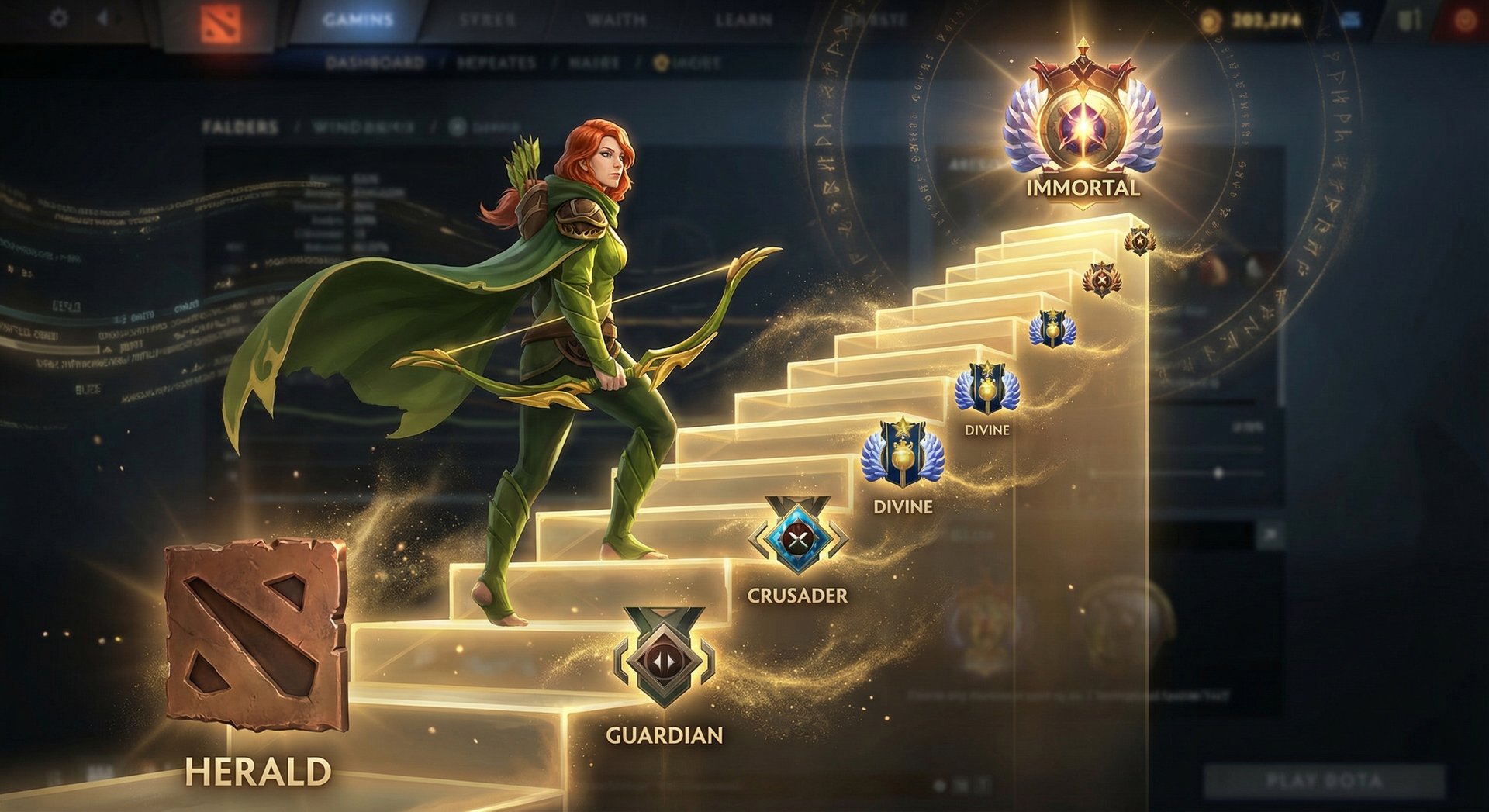
Herald to Guardian (Below 1500 MMR)
At this bracket, fundamentals matter more than hero mastery. If you want to climb with Windranger, focus on these basics:
- Last-hit practice. Windranger has a smooth attack animation with decent base damage. Aim for 50+ last hits by 10 minutes in the mid lane. Use Powershot to secure ranged creeps you would otherwise miss.
- Do not skip BKB. Herald players love damage items and hate BKB. Build it anyway. You will win more fights.
- Focus Fire buildings. After every kill, Focus Fire the nearest tower. Do not go back to jungle. Push. This single habit will win you more games than any mechanical improvement.
- Keep it simple: Phase Boots, Maelstrom, BKB, then more damage. No fancy Orchid or Bloodthorn builds until you are comfortable with the hero.
Crusader to Archon (1500-3000 MMR)
Players in this bracket understand the basics but struggle with timing and positioning. Here is what to improve:
- Learn Shackleshot angles. Go into a practice lobby and spend 30 minutes firing Shackles at bots near trees. The angle becomes intuition with practice. Aim for 60%+ latch rate in games.
- Time your rotations. After pushing mid wave with Powershot, check if side lanes have kill potential. A TP rotation with Shackleshot can turn a side lane completely.
- Buy Orchid against slippery targets. Against Storm Spirit, Ember Spirit, Puck, or Void Spirit, Orchid Malevolence before BKB gives you kill potential on heroes that would otherwise escape.
- Stack and farm camps between waves. Powershot clears stacked camps quickly. Stack the medium camp at :53 when mid wave is pushing, then clear it with Powershot + auto-attacks.
Legend to Ancient (3000-5000 MMR)
This is where Windranger play starts to become genuinely impactful. The macro improvements that matter most:
- Draft awareness. Do not pick Windranger into heavy magic burst lineups (Zeus, Lina, Storm). She thrives against physical lineups and single-target heroes.
- Facet selection matters. Use Tangled in offlane for the utility it provides. Use Killshot mid when you are the primary damage dealer. Think about your facet during the pick phase, not at the last second.
- Smoke ganks with vision. Use Powershot to scout before your team smokes. Clear trees in common ward spots. Provide information while farming.
- BKB discipline. Do not pop BKB for small skirmishes. Save it for fights that determine tower pushes or Roshan. Your BKB duration matters more in this bracket because players know how to play around short-duration BKBs.
Divine to Immortal (5000+ MMR)
At this level, Windranger is a precision instrument. What separates Divine from Immortal:
- Shackle-first target identification. Before a fight starts, identify the two targets you want Shackled together and position accordingly. The two-hero Shackle that wins the fight is decided 10 seconds before you throw it.
- Refresher Orb timing. In games where you are the primary damage dealer and the enemy has two tanky cores, Refresher lets you Focus Fire both in a single fight. This purchase timing (usually 30-35 minutes as a 4th or 5th item) can be game-deciding.
- Talent optimization. The level 20 choice between -10% Focus Fire Damage Reduction and +0.75s Shackleshot Duration depends on your role. Core Windranger takes the damage reduction. Utility/support Windranger takes the Shackle duration.
- Tree awareness. Know every tree cluster on the map. Know which trees are close enough to latch. Know which trees you need to cut to deny the enemy Shackle angles against your team.
Tips and Tricks
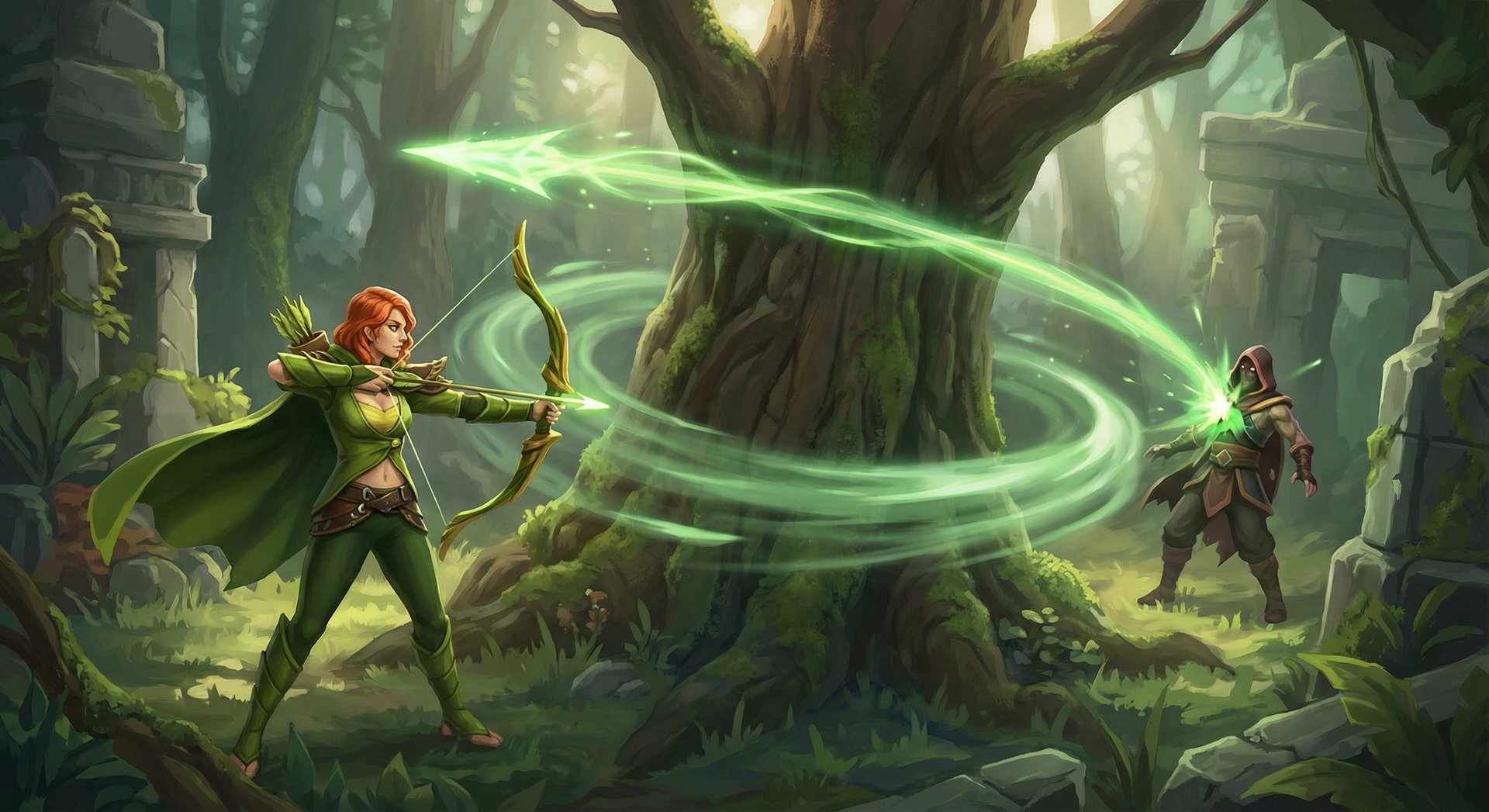
Advanced Mechanics
- Shackle animation cancel: You can issue a move command immediately after Shackleshot’s cast point to cancel the backswing animation, letting you reposition faster during chases.
- Focus Fire item weaving: During Focus Fire, use items between attacks. The attack speed is so high that you can use Orchid, Sheepstick, or any active item without losing meaningful DPS. The attacks resume automatically after the item use.
- Powershot snipe positions: Learn the common high-ground Powershot angles for sniping Roshan attempts, ancients stacking, and low-HP heroes TPing to their fountain. The vision provided by Powershot makes these snipes possible even through fog.
- Iron Branch Shackle combo: Carry an Iron Branch. When chasing, plant the tree behind the enemy hero and immediately Shackleshot. The freshly planted tree provides a latch target where none existed. This costs 50 gold and can win a fight.
- Windrun tower dive timing: Windrun lasts 6 seconds at max level. A tower hits every 0.95 seconds. That means you can tank roughly 6 tower shots with complete evasion. Plan your dives around this timing — 6 seconds of invulnerability is enough to kill most heroes under tower with Focus Fire.
Common Mistakes to Avoid
- Using Shackleshot without a latch angle. A 1.3-second ministun is not worth the 12-second cooldown. Wait for a proper angle against trees or another hero. Patience wins.
- Holding Focus Fire for “the right target.” Focus Fire has a relatively low cooldown. Use it on towers between fights. Use it on creep waves to push. Do not save it exclusively for hero kills.
- Not buying detection. As a support or offlane Windranger, you can carry Dust and use Windrun to chase invisible heroes. Your mobility makes you an excellent Dust carrier.
- Skipping Maelstrom. Some players rush Aghanim’s Scepter first item. Do not do this. Without Maelstrom procs, your farming speed is terrible and your teamfight damage is inconsistent. Maelstrom first, always.
- Not pressing Windrun early enough. Windrun is reactive, not proactive, but you need to activate it BEFORE the enemy’s burst hits. Waiting until you are at 30% HP defeats the purpose. Pop it as soon as you see the enemy commit to attacking you.
Frequently Asked Questions
Mid is generally her strongest role because she gets solo XP and gold to hit item timings faster. However, offlane Windranger with the Tangled facet has a higher winrate (49.74% vs 47.46%) in the current patch. If your team needs a utility offlaner with tower pressure, offlane is viable. If you need a tempo mid who can snowball kills, go mid with Killshot.
Killshot is the default choice for mid and support (92% pickrate in support, 67% in mid). Tangled is better for offlane and when your team lacks lockdown. The stats show Tangled has a slightly higher winrate in offlane (49.74% vs 47.50%), suggesting it is underrated for that role. Choose based on what your team needs: damage (Killshot) or control (Tangled).
Maelstrom is almost always the first major item regardless of role. The lightning procs synergize perfectly with Focus Fire’s max attack speed, providing both farming acceleration and fight damage. The only exception is support Windranger, where you might go Force Staff or Glimmer Cape first if your team desperately needs saves.
Pick heroes with magic burst (Storm Spirit, Puck, Tinker) since Windrun only blocks physical damage. Buy Monkey King Bar to pierce Windrun evasion. Use targeted disables that do not rely on skillshots. Ghost Scepter and Ethereal Blade block Focus Fire damage entirely since it is physical. Blade Mail can punish her rapid Focus Fire attacks.
Focus Fire has an inherent damage reduction (-50% at level 1, -30% at level 3). Without Aghanim’s Scepter, you are dealing reduced damage on every hit. Build proc items (Maelstrom, Javelin, MKB) because their procs deal full damage and are not affected by the reduction. Aghanim’s Scepter removes the penalty on heroes entirely and should be a priority in most games.
Windranger can carry mid-game fights and snowball a lead, but she struggles as a primary carry past 40 minutes. Her damage is single-target, and against farmed hard carries with BKB and sustain items, she gets outscaled. Her best late-game contribution is split-pushing with Focus Fire on towers and picking off supports before fights start.
The standard build across all brackets is W-E-W-Q-W-R-W-E-E-E. Max Powershot first for farming and harass, get one early point in Windrun for survivability, and one point in Shackleshot by level 4 for kill potential. Max Windrun second for the increased evasion duration. Shackleshot is maxed last because one point provides the latch — the stun duration increase is less impactful than Windrun uptime in the mid game.
Master Windranger with Immortal Coaching
Shackleshot angles, Focus Fire target priority, power spike timings — our Immortal-rank coaches will break down your Windranger replays and show you exactly where you are leaving wins on the table.