How to Climb from Ancient to Divine as Pos 4 Soft Support in Dota 2 (2026 Guide)

Pos 4 soft support is the most chaotic, creative, and individually impactful support role in Dota 2. It’s also the role where Ancient players plateau most dramatically — because the jump from Ancient to Divine Pos 4 requires mastering an entirely different way of thinking about the game.
At Ancient level, Pos 4 players are reactive. They lane with their offlaner, stack some camps, participate in fights when they happen, and buy wards when someone pings. At Divine level, Pos 4 players are proactive architects of game tempo. They control the pace of the game through aggressive rotations, smoke ganks, vision warfare, and constant map pressure that suffocates the enemy team’s ability to execute their game plan.
This guide is for Ancient Pos 4 players who want to stop being “support players” and start being game-winners. We’re going deep on rotation timing, smoke usage, vision control, draft intelligence, and the specific habits that Divine Pos 4 players have that Ancient ones don’t.
The Ancient vs. Divine Pos 4 Gap
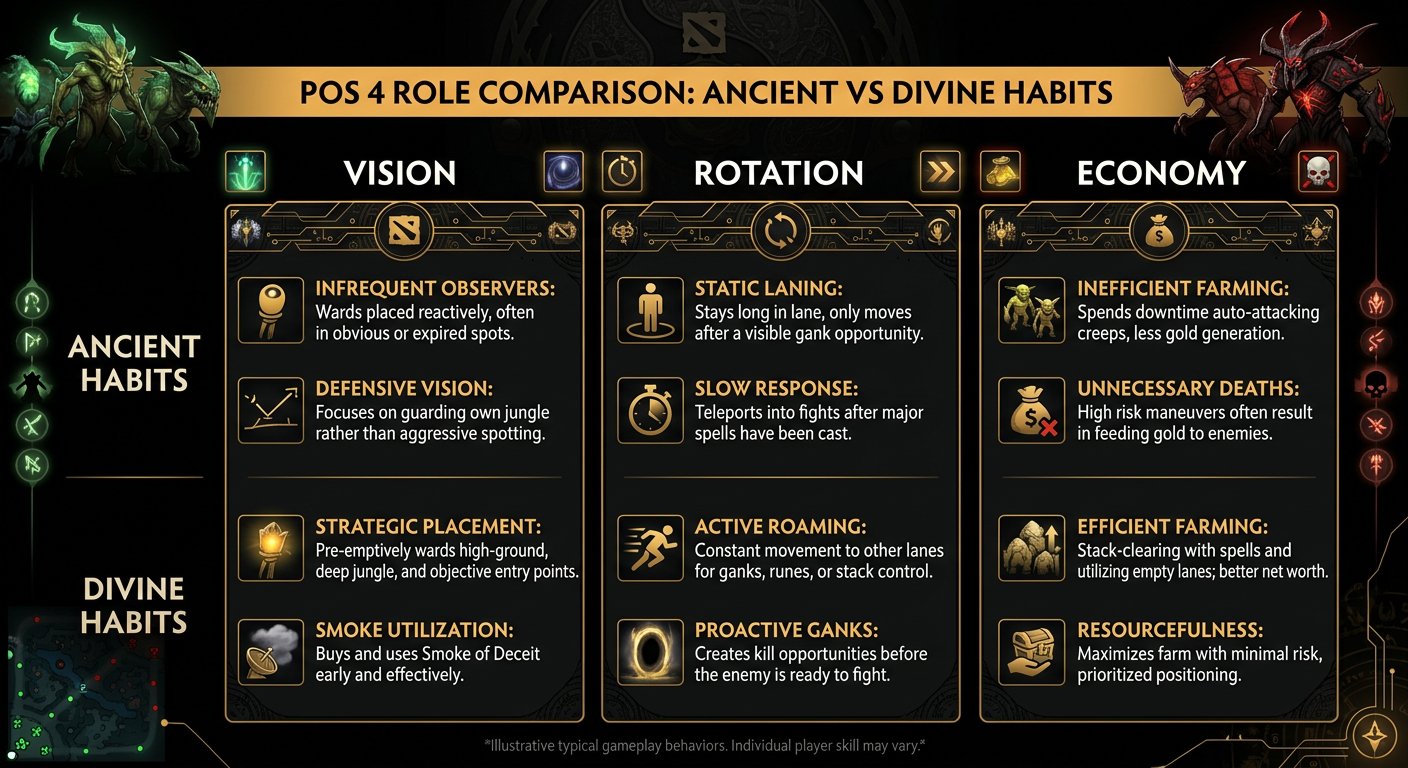
Let’s establish what exactly changes between these two brackets for the soft support role.
Rotation Intelligence
Ancient Pos 4 players rotate when they “feel like it” or when a lane looks gankable. They’ll leave the offlane at minute 4, walk to mid, throw a stun, miss the kill, and then wander back to offlane having accomplished nothing — wasting 60 seconds of game time.
Divine Pos 4 players rotate based on specific criteria: the target is pushed up without escape, the mid has kill contribution ready, there’s no enemy ward on the rotation path, and the kill leads to something (tower damage, rune control, or forced TP). The rotation has a purpose, a plan, and a fallback if it fails.
Vision Warfare
Vision control is where the biggest gap exists between Ancient and Divine supports. Ancient Pos 4 players place wards in common spots — rune wards, defensive jungle wards, Roshan ward. These are fine, but they’re predictable. The enemy support dewarding at Ancient level has memorized these spots and removes them within 2-3 minutes.
Divine Pos 4 players think about vision as a resource allocation problem. Every ward has an opportunity cost — placing it in one spot means not placing it somewhere else. The best ward spots change throughout the game based on which areas of the map are contested. A cliff ward that provides rune vision at minute 5 is useless at minute 25 when the contested area has shifted to the enemy jungle.
Resource Management
Ancient Pos 4 players are chronically underleveled and underfarmed because they spend too much time standing around doing nothing — waiting for fights, standing in lane not getting XP, or walking between locations without farming along the way. Divine Pos 4 players squeeze gold and XP from every moment: stacking camps while rotating, taking a last hit or two when the carry isn’t in lane, and farming dangerous areas during dead time.
Top 5 Heroes to Climb from Ancient to Divine as Pos 4
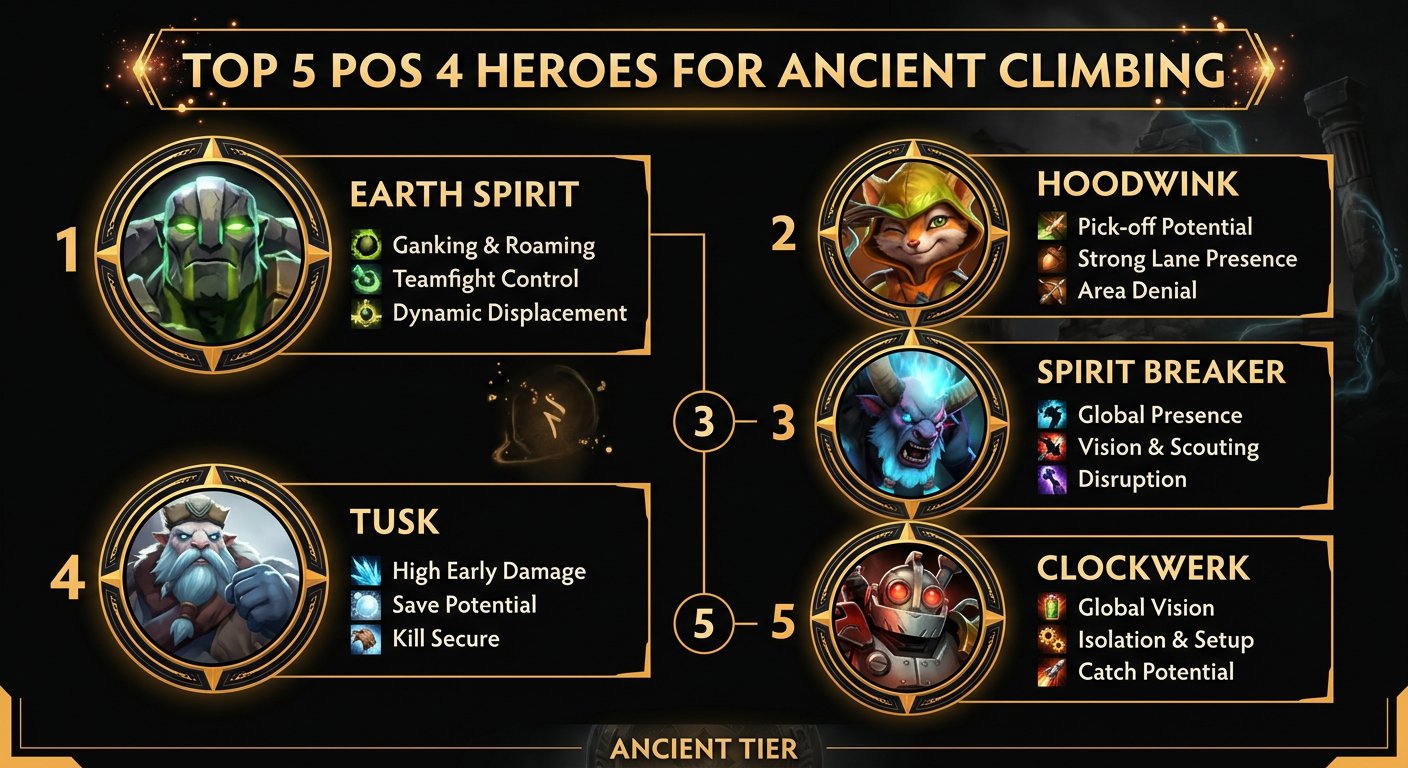
1. Earth Spirit
Earth Spirit is the king of Pos 4 climbing for one reason: his kit scales with decision-making, not items. A level 6 Earth Spirit with brown boots and a Stick is more impactful than most Pos 4 heroes with full items. This means your game impact is determined entirely by your skill, not your farm — perfect for climbing.
Why Earth Spirit dominates at Ancient:
- Rolling Boulder provides high-speed rotations that cover the map faster than any other Pos 4
- Boulder Smash + Magnetize combos kill heroes at Ancient level who don’t respect ES’s damage
- Geomagnetic Grip provides a silence AND a stun (with remnant), shutting down escape-heavy heroes that Ancient players love (Weaver, Anti-Mage, Puck)
- The hero’s level 6 is one of the strongest power spikes in the game for any support
- Aghanim’s Scepter (Magnetize spreading to new targets) provides enormous late-game teamfight impact
The ES rotation pattern: Lane with your offlaner until level 3-4 Roll to mid for a gank If kill succeeds, stay mid for rune control Roll to the opposite lane Return to offlane. This circuit takes roughly 3 minutes and should net you 1-2 kills if the enemy mid or carry is pushed up.
Remnant management: You start with 7 remnants and replenish slowly. Every remnant matters. The biggest mistake Ancient ES players make is wasting remnants on unnecessary stuns or positioning. A good rule: keep 2 remnants in reserve at all times — one for escape (Rolling Boulder needs a remnant for max range) and one for a clutch save or kill.
2. Rubick
Rubick is the Pos 4 for players who thrive on outplaying opponents. Spell Steal is the highest-skill-ceiling ability in Dota 2, and at Ancient level, enemies are careless about which spell they cast last — giving you free access to devastating stolen abilities.
Why Rubick climbs at Ancient:
- Telekinesis is a BKB-piercing disable with repositioning — one of the best setup stuns in the game
- Fade Bolt reduces enemy attack damage by up to 40%, neutering physical damage heroes
- Spell Steal at Ancient level is almost always high-value because enemies don’t consciously manage which spell they cast last
- The hero’s teamfight impact is enormous — a stolen Ravage, Black Hole, or Chronosphere can single-handedly win a fight
- Rubick provides excellent harassment in lane and decent wave push with Fade Bolt
Spell Steal prioritization: Know which spells are worth stealing in every matchup. Tier 1 steals (game-changing): Ravage, Black Hole, Chronosphere, Reverse Polarity, Fiend’s Gate. Tier 2 steals (fight-winning): Shackleshot, Ice Path, Light Strike Array, Sacred Arrow. Tier 3 steals (utility): Ink Swell, Wave of Terror, Fissure. Position yourself to steal tier 1 and 2 spells — they’re worth dying for.
Positioning in fights: Rubick should NEVER be in the front of a teamfight. Stay 1500-2000 units behind your frontline, use Telekinesis on divers, and wait for the high-value spell to steal. Patience is everything — the stolen Ravage that comes 5 seconds into the fight is worth more than the Telekinesis you threw on the first enemy you saw.
3. Clockwerk
Clockwerk is the Pos 4 for players who want to aggressively control the early game. Hookshot + Power Cogs is one of the most reliable kill setups in the game, and at Ancient level, enemies consistently die to it because they don’t respect Clockwerk’s catch range.
The Clockwerk pattern: Harass in lane with Battery Assault and Rocket Flare Hit level 6 Start Hookshotting across the map for kills Transition into a vision provider with Aghanim’s Scepter (Flare provides vision). This pattern creates relentless pressure that Ancient teams can’t handle.
Hookshot target selection: At Ancient level, don’t Hookshot the tankiest enemy — Hookshot the most out-of-position enemy. A Hookshot on a support who’s farming a camp alone is a guaranteed kill. A Hookshot on the enemy carry in the middle of their team is a guaranteed death (yours). Pick your targets wisely.
Cogs mastery: Power Cogs does three things: traps enemies inside, keeps enemies outside, and drains mana. At Ancient level, use Cogs primarily to isolate a single enemy from their team — trap them inside with you while your team kills them 4v4 outside the Cogs. This isolation technique wins fights at a rate Ancient players can’t match.
4. Spirit Breaker
Spirit Breaker is the simplest and most effective Pos 4 for climbing because his entire kit is designed to do one thing: run at people and kill them. Charge of Darkness provides a global-range initiation that Ancient players consistently fail to play around.
Why Spirit Breaker climbs:
- Charge of Darkness provides global map presence — the enemy never knows when they’re safe
- Greater Bash procs guarantee stun during Charge and Nether Strike, providing reliable lockdown
- The hero requires minimal items to be effective — Urn, Treads, BKB is all you need
- Spirit Breaker’s mere existence on the map forces enemy carries to play scared, reducing their farming efficiency
- Nether Strike goes through BKB, providing late-game relevance
Charge timing: Don’t Charge randomly. Wait for an enemy to be alone on the minimap — farming a lane, jungling, or rotating between towers. Charge from fog of war so they don’t see it coming. The ideal Charge timing is when the target is 3000-5000 units away (close enough to arrive quickly, far enough that they can’t easily react).
Map pressure concept: Even when you’re NOT charging, the enemy team has to play as if you might. This “threat of Charge” is almost as valuable as actual Charges. By simply being alive and off the map, you force the enemy carry to farm closer to their tower and the enemy mid to check for Charge every 5 seconds. This passive pressure is one of Spirit Breaker’s most underappreciated strengths.
5. Mirana (Pos 4)
Mirana Pos 4 combines roaming ganks with scaling damage and one of the best save abilities in the game (Moonlight Shadow). At Ancient level, Mirana arrows hit far more often than they should because players move in predictable patterns.
Arrow accuracy at Ancient level: The key to landing arrows at Ancient isn’t mechanical aim — it’s timing and prediction. Arrow when: (1) the enemy is walking in a straight line to last hit, (2) the enemy is running away from your teammate in a predictable path, (3) the enemy is in fog and you can predict their movement. Don’t throw random max-range arrows — they waste time and reveal your position.
Moonlight Shadow usage: Moonlight Shadow isn’t just an escape — it’s a teamwide smoke on a cooldown. Use it offensively: group your team, activate Moonlight Shadow, walk into the enemy jungle, and find a pick-off. At Ancient level, enemies rarely carry detection, so the offensive use of Moonlight Shadow is devastatingly effective.
Scaling advantage: Unlike most Pos 4 heroes, Mirana scales into the late game. Starstorm + Sacred Arrow damage is relevant at all stages, and with Aghanim’s Scepter, Mirana becomes a secondary damage dealer. This late-game scaling means games that go long aren’t auto-losses — you remain impactful throughout.
10 Critical Mistakes Ancient Pos 4 Players Make
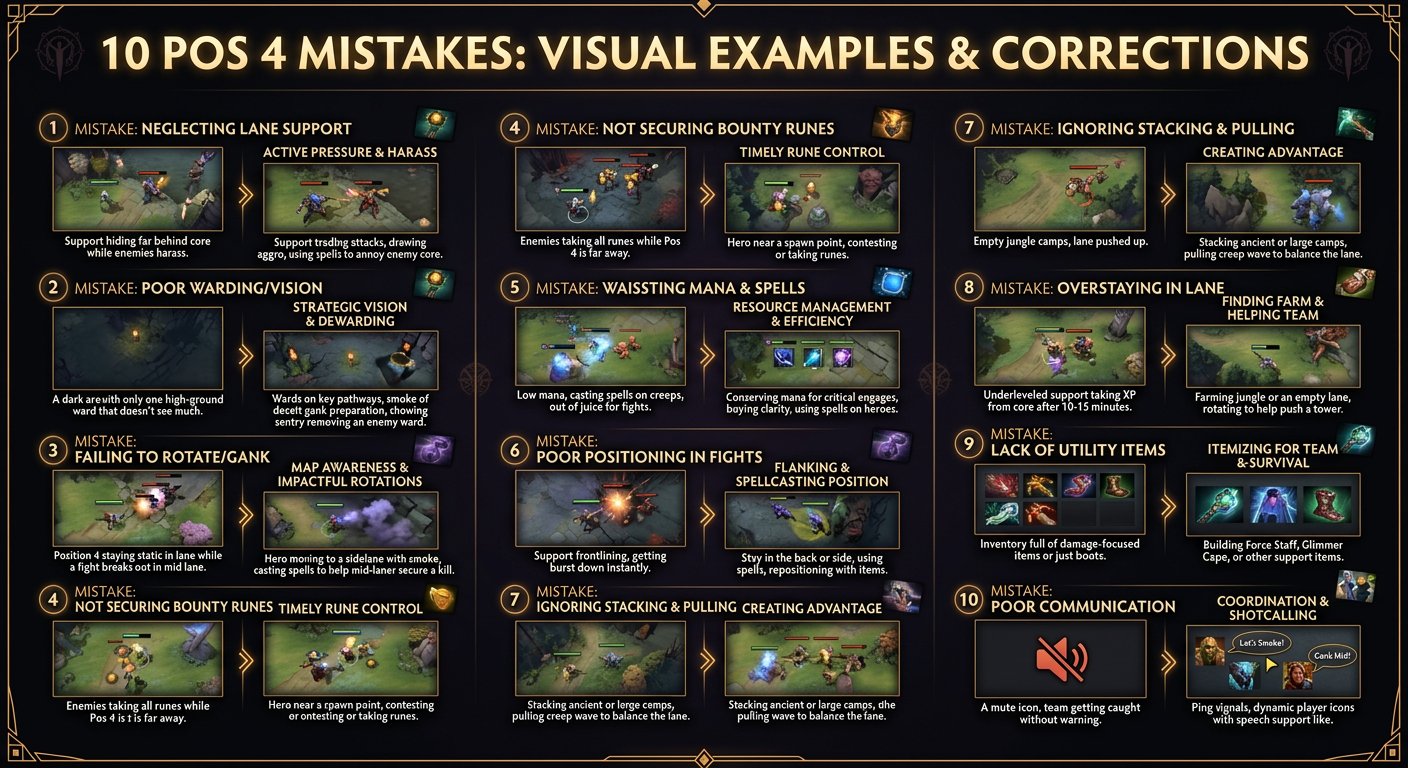
Mistake #1: Staying in the Offlane Too Long
Ancient Pos 4 players often stay in the offlane until minute 8-10, soaking XP and “helping” the offlaner. But after minute 4-5, most offlaners don’t need you — they’re strong enough to survive solo. Your presence in lane is actually hurting your team because you’re sharing XP and not creating pressure elsewhere.
The fix: Leave the offlane between minutes 3-5 (depending on the matchup). Your offlaner gets solo XP (which accelerates their level 6 timing), and you start creating impact elsewhere — ganking mid, securing runes, stacking camps for your carry, or placing aggressive wards. The minute you leave lane is the minute you start winning the game.
Mistake #2: Failed Rotations That Waste Time
Ancient Pos 4 players rotate to mid, walk around for 30 seconds, the enemy mid sees them and backs off, and they return to lane having accomplished nothing. This 60+ second waste of time happens multiple times per game and is one of the biggest efficiency drains.
The fix: Before rotating, ensure three conditions are met: (1) the target is in a killable position (pushed up, low HP, no escape cooldown), (2) your mid has the mana and HP to participate in the kill, and (3) you have a plan if the kill fails (stack a camp, place a ward, take a rune). Never rotate with only one plan — always have a backup objective. If the gank fails, at least stack the mid camp or place a ward so the rotation wasn’t wasted.
Mistake #3: Poor Smoke Usage
Smokes are the most powerful and underutilized item in Ancient bracket. Ancient supports buy smokes but use them poorly — smoking at bad times, walking predictable paths, and breaking smoke on the first enemy they see instead of the most valuable target.
The fix: Buy a smoke every time it’s off cooldown (5-minute restock). Use it with a specific target in mind — “We’re smoking to kill their carry in their jungle” or “We’re smoking to take Roshan without contest.” Always smoke with at least 2-3 teammates. The ideal smoke timing is right after an enemy hero shows on the map in a predictable farming pattern — you know where they’ll be in 30 seconds, so smoke and position accordingly.
Mistake #4: Warding in Default Spots
Ancient Pos 4 players place wards in the same spots every game — rune wards, common cliff wards, river wards. These are the first spots the enemy checks when dewarding. Your wards have a lifespan of 2-3 minutes instead of the full 6.
The fix: Place wards in unusual spots that provide the SAME information as default wards but from unexpected angles. Instead of the rune cliff ward, place it in the trees 500 units to the side — same vision coverage, but the enemy walks right past it when dewarding the cliff. Instead of the jungle entrance ward, place it deeper in the jungle to see farming patterns rather than just movements. The best ward spots are ones the enemy never checks.
Mistake #5: Not Dewarding Enough
Ancient Pos 4 players buy sentries occasionally but don’t actively hunt for enemy wards. They’ll buy a sentry for the rune spot and call it done. Divine Pos 4 players deward aggressively — they buy sentries every time they have gold, and they proactively check enemy ward spots based on the enemy’s likely warding patterns.
The fix: Always carry 1-2 sentries. When you walk past a common ward spot, drop a sentry. When you notice the enemy has unusual information (they dodge a smoke, they rotate to defend a gank perfectly), that’s a ward — find it. Dewarding denies the enemy team gold (they lose the observer) and 100 gold to the dewarder. More importantly, it removes vision that could save their lives or cost yours.
Mistake #6: Not Stacking Camps
Stacking is the highest-value activity a Pos 4 can do between rotations, and Ancient players almost never do it consistently. A double-stacked camp at minute 10 provides 300-400 gold to your carry or mid — that’s an entire item component.
The fix: Incorporate stacking into your movement patterns. When you walk past a camp at :50-:55, stack it. When you’re waiting for a rotation timing, stack. Multi-stacking (stacking two camps simultaneously by timing your position between them) is a Divine-level skill that can provide 800+ gold in stacked camps by minute 15. Practice it in custom lobbies.
Mistake #7: Dying for Bad Wards
Ancient Pos 4 players sometimes walk into dangerous territory to place a deep ward and die. The ward provides 6 minutes of vision. Your death costs your team 30 seconds of your absence plus gold from the kill. In most cases, the ward wasn’t worth your death.
The fix: Only place deep wards when it’s safe — after a won teamfight, during a smoke, or when you can see the enemy’s position on the minimap. If you have to walk into fog to place a ward, ask yourself: “If I die here, is this ward still worth it” Usually the answer is no. A ward placed safely in a less optimal spot is better than a ward placed in the perfect spot at the cost of your life.
Mistake #8: Spending Gold on Wrong Items
Ancient Pos 4 players often buy items that feel good but don’t impact the game. Aether Lens on a hero that doesn’t need range. Aghanim’s Scepter when Glimmer Cape would save more lives. Force Staff when the team needs Spirit Vessel.
The fix: Before buying any item, ask: “What is the #1 thing killing my team in fights” If it’s burst magic damage, buy Glimmer Cape. If it’s healing/regeneration from the enemy, buy Spirit Vessel. If it’s a hero that jumps your backline, buy Force Staff. Your items should solve your team’s biggest problem, not improve your personal KDA.
Mistake #9: Not Tracking Enemy Cooldowns
Ancient Pos 4 players don’t track enemy ability cooldowns. They don’t know when the enemy’s Ravage was used, when their BKB expires, or when their Blink is on cooldown from damage. Divine supports track these cooldowns and make plays around them.
The fix: After a fight, mentally note which big cooldowns the enemy used. “Tidehunter used Ravage — 150 second cooldown. We have 2 minutes to fight without Ravage.” “Their carry used BKB — it’s now 8 seconds instead of 10. Next fight, BKB is shorter.” This information is crucial for deciding when to take fights and when to back off.
Mistake #10: Playing Passively After a Bad Start
If the offlane goes badly, Ancient Pos 4 players often become passive — following their offlaner around, placing defensive wards, and waiting for something to happen. This passivity guarantees a loss because you’re not creating any advantages.
The fix: A bad offlane doesn’t mean a bad game. If your offlane is lost, rotate immediately. Gank mid. Secure runes. Stack your carry’s jungle. Place aggressive wards. Do ANYTHING that creates an advantage somewhere else on the map. The Pos 4 is the most flexible role in the game — use that flexibility to find impact regardless of how the offlane went.
Phase-by-Phase Guide: Playing Pos 4 from Ancient to Divine
Pre-Game: Draft Considerations
Your Pos 4 pick should complement both your offlaner and your overall team composition. Consider these factors:
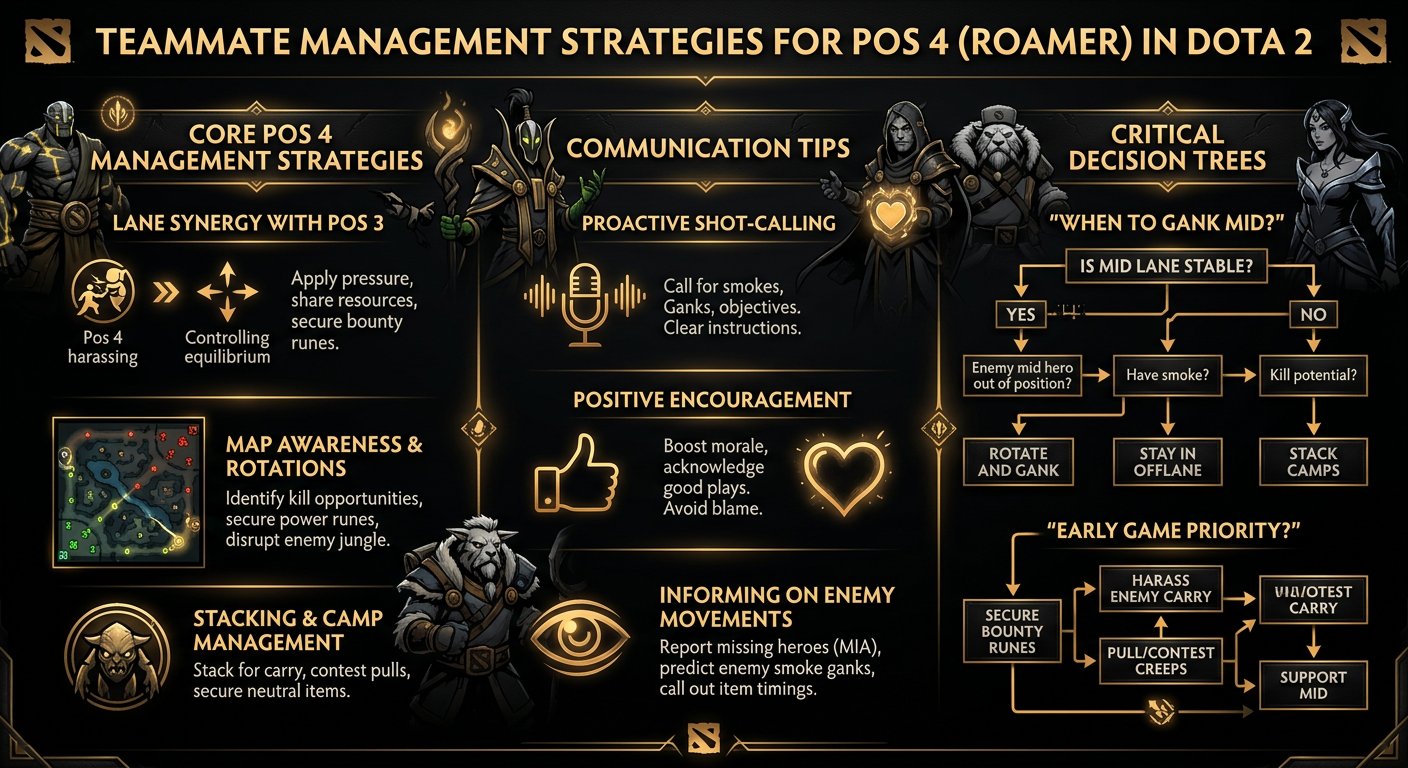
Lane synergy: Your Pos 4 should create kill threat in combination with your Pos 3. If your offlaner is Axe (has Call for initiation), pick a Pos 4 with follow-up damage — Skywrath Mage, Shadow Shaman, Lina. If your offlaner is Centaur (has Stomp setup), pick a hero with additional lockdown — Rubick, Mirana, Hoodwink.
Rotation capability: Pick heroes that can rotate effectively. Heroes with movement abilities (Earth Spirit, Clockwerk, Spirit Breaker) or long-range initiation (Mirana, Hoodwink) rotate better than static heroes (Jakiro, Crystal Maiden). If your team needs a roaming Pos 4, pick accordingly.
Scaling: Some Pos 4 heroes scale better than others. If your team has a greedy lineup that wants to go late, pick a scaling Pos 4 (Rubick, Mirana, Windranger). If your team wants to end early, pick an aggressive Pos 4 that peaks at 15-25 minutes (Earth Spirit, Clockwerk, Spirit Breaker).
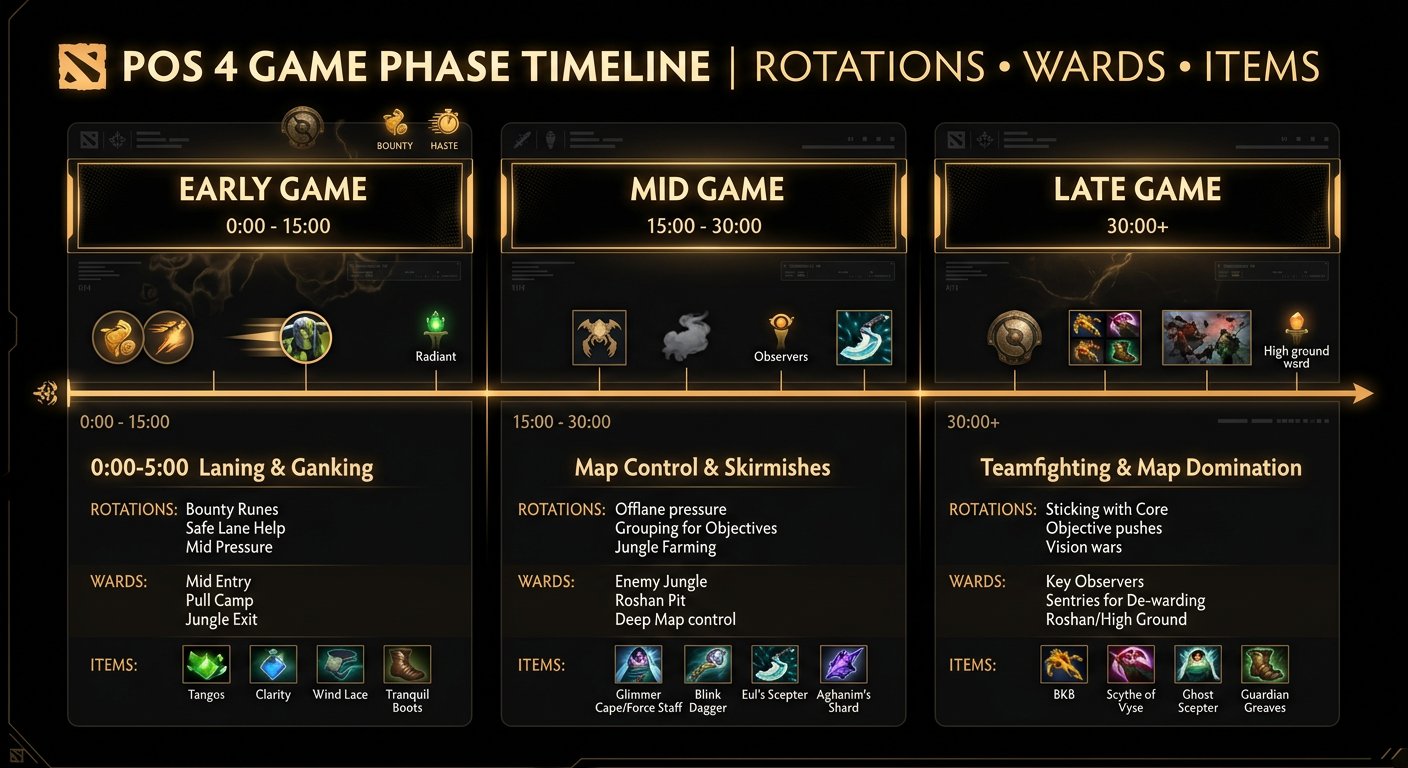
Laning Phase (0:00 – 8:00)
Minutes 0-3: Offlane support. Your primary job is ensuring your offlaner gets levels and CS. This means: harassing the enemy carry (forcing them to use regen), contesting enemy pulls (standing in the pull camp or blocking it with a sentry), and providing kill threat in combination with your offlaner.
Pull contesting: This is the single most impactful thing you can do in the first 3 minutes. The enemy Pos 5 will try to pull the hard camp at :15/:45 to deny your offlaner XP. Your job is to prevent this — either by blocking the camp with your body, placing a sentry to block the spawn, or pulling through the medium camp to create a double wave that pushes into the enemy tower.
Minutes 3-5: Rotation decision. By minute 3-4, assess whether your offlaner needs you. If the lane is winning or stable, leave. If the lane is losing badly and your offlaner will die without you, stay until they’re safe. The decision to leave should be proactive, not reactive — don’t wait until minute 8 to realize you should have rotated at minute 4.
Minutes 5-8: Roaming phase. This is where the Pos 4 role truly begins. Your offlaner has solo XP, and you’re roaming the map. Key activities during this window:
- Gank the enemy mid (only if the kill is highly probable)
- Secure the 6-minute power runes for your mid
- Stack camps (ancient stacks are particularly valuable)
- Place aggressive wards in the enemy jungle entrance
- Rotate to your safelane to help your carry if the enemy is pressuring them
Early Mid-Game (8:00 – 20:00)
This is the Pos 4’s highest-impact phase. You should be the most active player on the map.
Vision control: By minute 10, you should have 2-3 observers placed on the map, with at least one in an aggressive position. Your ward placement should reflect your team’s game plan — if you’re pushing, ward the areas around the tower you want to take. If you’re defending, ward your own jungle entrances.
Smoke ganks: Buy a smoke at 8 minutes and use it to gank with your offlaner or mid. The ideal smoke gank at this timing targets the enemy carry, who’s typically farming their jungle in a predictable pattern. A successful smoke gank on the enemy carry at minute 10 provides 2-3 minutes of unopposed farming for your team — that’s a 1,000-2,000 gold swing.
Stacking economy: Continue stacking camps whenever you’re near them at :50-:55. By minute 15, you should have created at least 2-3 stacked camps for your cores. This “invisible economy” is one of the biggest differences between Ancient and Divine Pos 4 players.
Item progression: Your first item should solve your team’s biggest problem. Common first items: Urn Spirit Vessel (vs healing/sustain heroes), Glimmer Cape (vs magic burst), Force Staff (vs gap-closers), Solar Crest (to amplify your carry’s damage).
Late Mid-Game (20:00 – 30:00)
Teamfight positioning: In teamfights, the Pos 4 has two possible roles: (1) Initiator (if you’re Clockwerk, Spirit Breaker, Earth Spirit) — you start the fight by catching a key target. (2) Counter-initiator (if you’re Rubick, Mirana, Hoodwink) — you wait for the enemy to commit and then punish them.
Know which role you’re playing in each fight and position accordingly. Initiators should be at the front or flanking. Counter-initiators should be behind their frontline, waiting for opportunities.
Objective-focused play: At this stage, every action should lead toward an objective. Smoke to kill Take tower. Win fight Take Roshan. Push high ground Take barracks. If you’re fighting without an objective in mind, you’re wasting time.
Late Game (30:00+)
In the late game, the Pos 4’s role shifts to save and utility. Your damage falls off, but your abilities and items remain impactful. Focus on keeping your carry alive (Glimmer, Force Staff, Lotus Orb), providing vision around objectives, and using your abilities for control rather than damage.
Buyback management: Pos 4 buyback is often undervalued. If you have a critical save ability (Rubick’s Telekinesis to save your carry, Earth Spirit’s Grip to pull an ally to safety), your buyback can be game-saving. After minute 30, try to maintain buyback gold when possible.
Dealing with Difficult Teammates as Pos 4
When Your Offlaner Doesn’t Want You to Leave
Some Ancient offlaners expect their Pos 4 to stay in lane until minute 10+, and they tilt if you leave early. They don’t understand that your rotation creates more value than your lane presence.
The solution: Communicate before you leave. “I’m going to gank mid, you’re fine solo” or a simple “Going mid” in chat. If they die while you’re gone and blame you, don’t engage — focus on making the rotation count. If you get a kill mid, the value was worth it regardless of their reaction.
When Nobody Follows Your Smokes
You ping “Gather for smoke,” buy a smoke, and nobody comes. This is one of the most frustrating experiences at Ancient level. Your team knows smoke ganks are valuable but they’re too busy farming to participate.
The solution: Don’t try to smoke as 5. Smoke with 2-3 people who are already nearby. Ping your offlaner and go — they’re usually the most willing to participate in aggressive plays. A 2-man smoke gank on a solo enemy is more reliable than a 5-man smoke that never happens.
When Your Carry Blames You for Everything
The carry died in a 1v3 dive “GG no wards.” The carry got ganked while farming without vision “Support diff.” At Ancient level, carries frequently blame supports for their own mistakes.
The solution: Mute and move on. Your job is to provide vision and make plays, not to babysit a carry who makes bad decisions. If your wards were placed and they died anyway, that’s their mistake, not yours. Don’t let tilted teammates derail your game plan.
When the Enemy Support Is Better Than You
Sometimes the enemy Pos 4 or Pos 5 is simply outplaying you — better wards, better rotations, better fight contribution. This feels terrible as a support because your impact is harder to measure than a core’s.
The solution: Focus on what you CAN control. If their vision is better, buy more sentries and deward aggressively. If their rotations are better, play more defensively and counter-gank instead of ganking. If their teamfight contribution is better, position more carefully and prioritize staying alive to use your abilities twice in a fight.
Realistic Timeline: Ancient to Divine as Pos 4
Pos 4 is often considered the hardest support role to climb with because your impact is subtle and inconsistent. However, when played correctly, the Pos 4 can have the highest individual win rate influence of any support role.
- At 53% win rate: 200-300 games (3-5 months at 2-3 games per day)
- At 55% win rate: 120-180 games (2-3 months)
- At 58%+ win rate: 70-100 games (1-2 months)
The key to climbing as Pos 4 is consistency. Unlike core roles where one big play can win the game, the Pos 4 wins through accumulation — every successful gank, every good ward, every stacked camp adds up over the course of the game. Maintain this consistency over hundreds of games and the climb is inevitable.
The plateau: Pos 4 players typically plateau around Ancient 3-4, where the matchmaking becomes more demanding and your “free ganks” dry up because enemies play more carefully. If you’re stuck here, focus on improving your smoke game and vision warfare — these skills have the highest return on investment at this MMR.
If you want expert guidance for climbing, consider Dota 2 coaching with a Divine or Immortal support player who can review your replays and identify specific improvement areas. Or, if you want to fast-track your rank, our MMR boost service can help you reach Divine efficiently.
Frequently Asked Questions
Both, in phases. Minutes 0-5: support your offlaner. Minutes 5-15: roam and gank aggressively. Minutes 15+: transition to teamfight support with utility items and vision control. The balance shifts throughout the game, and adapting to each phase is the key skill.
Aim for 15-25 observers placed per game (shared with your Pos 5). This means roughly 8-12 wards for you personally. If you’re placing fewer than 8, you’re not warding enough. If you’re placing more than 15, you’re either spending too much time warding or your Pos 5 isn’t helping.
Utility items first, always. Glimmer Cape, Force Staff, or Spirit Vessel should come before Aghanim’s Scepter in almost every game. Your Aghanim’s is a luxury item for when your team is ahead and you can afford the farm. Buying Aghs while your team has no Glimmer or Force is griefing.
No. Simplicity is an advantage when climbing because it lets you focus on macro decisions (when and where to charge) rather than mechanical execution. Spirit Breaker’s impact comes from game sense, not button pressing, and that game sense translates directly to higher MMR.
Vision and smoke ganks. These activities don’t require items or levels — they require knowledge and positioning. Even a level 5 Pos 4 with boots and a Magic Stick can place a game-winning ward or organize a smoke gank that kills the enemy carry. Your impact as Pos 4 is never zero, no matter how far behind you are.
Final Thoughts: The Pos 4 Path to Divine
Climbing from Ancient to Divine as a Pos 4 is about transforming from a reactive support into a proactive game controller. You set the tempo with rotations, control the information war with vision, and create the space your cores need to win.
Focus on three pillars: (1) Leave the offlane early and roam with purpose. (2) Win the vision war — place unusual wards, deward aggressively, and use smoke effectively. (3) Build items that solve your team’s problems, not your own.
The Pos 4 who masters these skills doesn’t just climb to Divine — they become the player that everyone wants on their team. Every game you play, you’re either creating an advantage or preventing a disadvantage. Make every second count.
Ready to reach Divine TeamSmurf’s coaching service pairs you with experienced support players who understand the nuances of climbing through Ancient bracket. For a direct route to Divine, our MMR boosting service delivers safe, fast results. Your Divine rank is waiting.
Ready to Climb Start Your Journey Today
Team Smurf offers professional coaching with Divine and Immortal players, plus safe, reliable MMR boosting to help you reach your target rank.
Written by Team Smurf’s Immortal-rank analysts — Rankings last verified February 2026