


How to Play Dota 2 (2026): The First-Game Guide for New Players

Dota 2 is a free-to-play 5v5 strategy game where two teams battle to destroy each other’s Ancient — a massive structure in the back of each base. To start playing, download Dota 2 for free on Steam, complete the built-in tutorial, and jump into your first match against bots.
This guide walks you through everything you need for your first real game: how the map works, what last-hitting means, which heroes to pick as a beginner, and the objectives that actually win games. No prior MOBA experience needed.
In This Guide
What is Dota 2?
Dota 2 is a free-to-play multiplayer online battle arena (MOBA) developed by Valve Corporation. Two teams of five heroes compete to destroy the enemy’s Ancient — a massive structure in the center of their base. The first team to destroy it wins the match.
What separates Dota 2 from most games:
- Every match starts fresh. No persistent character progression. Your advantage comes from skill, knowledge, and teamwork — not accumulated stats from previous games.
- Over 120 heroes. Each with four unique abilities and a distinct playstyle. You do not need to learn all of them — 3 to 5 heroes played well beats knowing all 120 poorly.
- Extreme strategic depth. Dota 2 is widely considered the most complex competitive game ever made. Professionals with 10,000+ hours are still discovering new interactions and strategies.
- Completely free. All heroes, all ranked modes, all patches. Cosmetics (skins, voice packs) cost money but have zero gameplay impact. There is no pay-to-win element.
A typical match lasts 30 to 50 minutes, though some end in 20 minutes and others stretch past an hour. Games follow three broad phases:
| Phase | Timing | What Happens |
|---|---|---|
| Laning Phase | 0 to 15 min | Heroes farm gold in lanes by killing AI creeps. Supports protect cores and ward the map for vision. |
| Mid Game | 15 to 30 min | Heroes have core items and start fighting over towers, Roshan, and map control objectives. |
| Late Game | 30+ min | Heroes near full power. One decisive teamfight can end the game. |
Installing Dota 2 and Your First Launch
Getting into Dota 2 is straightforward:
- Download Steam from store.steampowered.com and create a free account.
- Search “Dota 2” in the Steam store and click Install. The client is free with no hidden costs.
- Complete the tutorial. When you first launch, Dota 2 walks you through basic controls, last-hitting mechanics, and hero abilities. Complete all tutorial sections — they cover the fundamentals you need before your first real match.
- Play vs Bots first. Select Practice vs Bots from the Play menu. Set bot difficulty to Passive for your first 3 to 5 games. Learn the map layout, practice last-hitting, and get used to your hero’s kit before playing against human opponents.
- Enable Quickcast. Go to Settings > Hotkeys > Advanced Hotkeys and enable Quickcast for all abilities. This casts spells on key press instead of requiring a second click. Takes one game to adjust to and makes you more effective in every game after.
Understanding the Dota 2 Map
The map is divided diagonally. The Radiant side (green aesthetic, bottom-left) faces the Dire side (dark aesthetic, top-right). Three lanes connect the two bases, and the jungle fills the space between them.
| Lane | Radiant Assignment | Dire Assignment |
|---|---|---|
| Top Lane | Offlane (dangerous side) | Safe Lane |
| Mid Lane | Solo — one hero per side, highest XP gain | Solo — one hero per side, highest XP gain |
| Bottom Lane | Safe Lane | Offlane (dangerous side) |
Each lane has three tiers of towers (T1, T2, T3) that must be destroyed in order. You cannot bypass Tier 1 to attack Tier 2. Behind the Tier 3 towers are two base towers and the barracks — structures that, when destroyed, permanently upgrade your team’s creeps in that lane.
Key Map Locations Every Beginner Must Know
- The Jungle: Areas between lanes filled with neutral creep camps. Any hero can kill these for gold and XP. Junglers and roaming heroes use jungle paths for farming and ambush routes.
- Roshan’s Pit: A cave near the river where Roshan, the map’s most powerful neutral boss, lives. Killing Roshan drops the Aegis of the Immortal, which lets the carrier revive on the spot after death. The most contested objective in the game.
- Outposts: Two capturable structures that give your team periodic XP. Contest them early — they are often undefended in the first 5 minutes.
- River Rune Spots: Runes spawn every 2 minutes and provide temporary buffs (Double Damage, Haste, Invisibility, and others). Controlling river runes is a key mid-lane responsibility and provides strong advantages when secured.
Basic Game Mechanics: The Four Skills You Need First
These four mechanics form the technical foundation of Dota 2. Learn them before anything else — they appear in every game, at every role, at every skill level.
Last-Hitting
Last-hitting means dealing the killing blow to an enemy creep. Only the hero who lands the final hit earns the gold bounty. This is the primary way carry heroes (Positions 1, 2, 3) earn gold in the early game, and it is the single most important mechanical skill in Dota 2.
How to improve your last-hitting:
- Practice in Last Hit Training Mode (Dota client > Play > Training > Last Hit Challenge). This isolated mode builds the timing instinct without the pressure of a live match.
- Watch each creep’s health bar. Time your attack to connect when the creep has roughly one attack’s worth of HP remaining.
- Do not mindlessly auto-attack enemy creeps. Each attack that does not earn a last hit pushes the wave toward the enemy tower, reducing your safety in lane.
- Missing just 2 to 3 last hits per creep wave costs 100 to 150 gold per minute — a significant item timing difference by minute 10 or 12.
Denying
Denying is a mechanic unique to Dota 2, absent from other MOBAs. You can attack your own creep when it falls below 50% HP to prevent the enemy hero from getting the last hit. A denied creep gives zero gold and reduced XP to the enemy. This mechanic makes Dota 2’s laning phase more active and creates genuine skill gaps between players who deny and those who ignore it.
As a support, deny your lane creeps constantly to slow the enemy carry’s development. As a mid player, out-denying your opponent creates an XP gap even with equal last-hit counts — the XP gap is more important at mid because the level lead directly translates to ability levels and kill potential.
Pulling and Stacking Neutral Camps
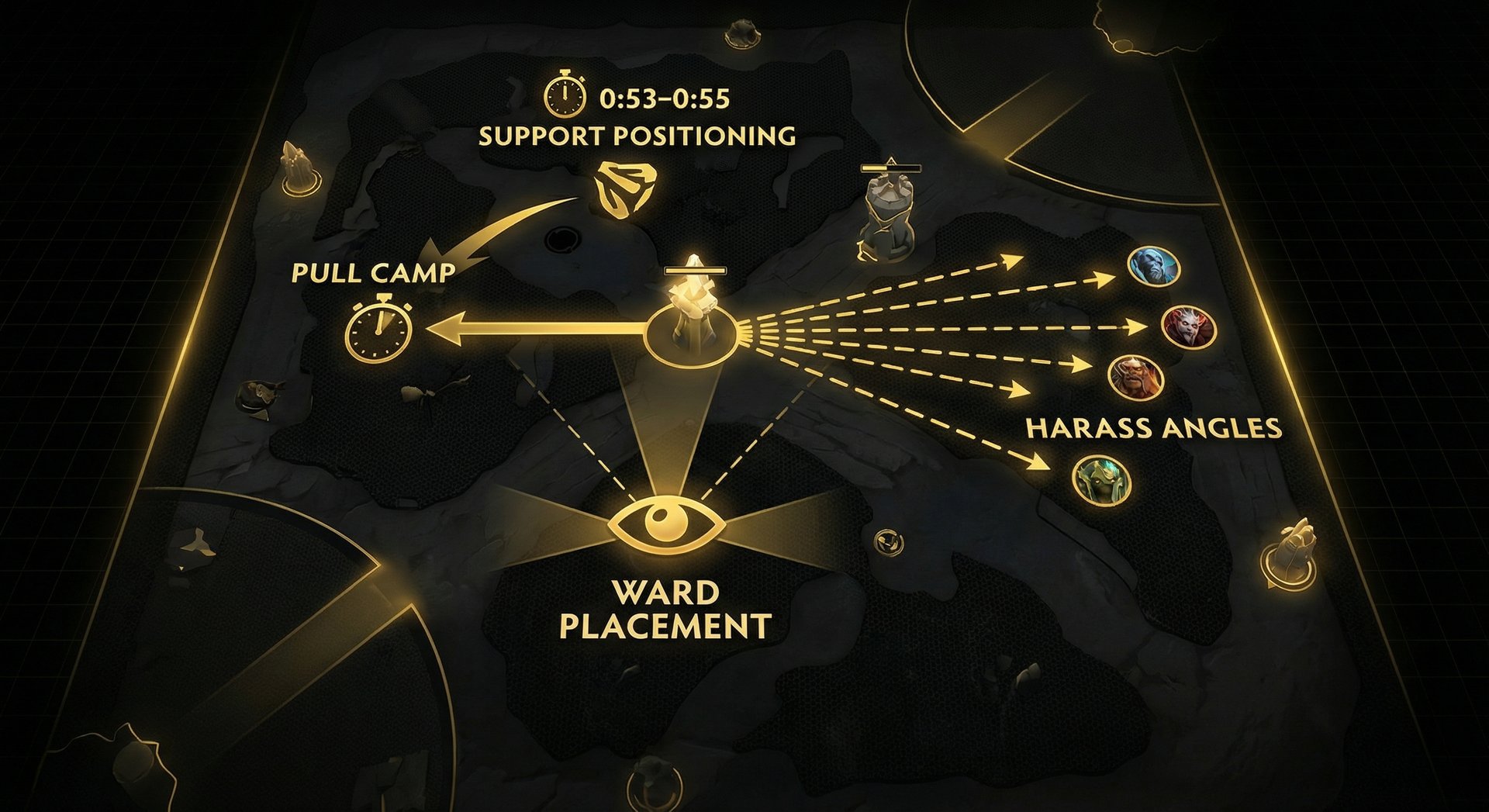
Stacking is a support technique that every Position 4 and 5 player should master. At exactly :53 to :55 of each minute, attack a nearby neutral camp to make it aggro toward you, then walk away. The camp’s spawn timer resets and a new full camp spawns alongside the original stack. Your carry can later farm a 2x or 3x stacked camp for significantly more gold than a normal single camp. A 3x stacked ancient camp is worth 700+ gold — effectively a free early item for your carry.
Pulling means leading a neutral camp into your lane’s creep wave, diverting your creeps into the jungle and pulling the lane equilibrium back toward your tower. Supports pull at 1:30 to 1:45 after the game starts (and every 2 minutes afterward) to keep their carry farming safely closer to their own tower. Learning pull timing is the first skill that separates average supports from effective ones.
Warding and Vision
Everything outside your team’s unit range is covered by Fog of War — you cannot see enemy heroes or what they are doing in those areas. Observer Wards are free consumables that provide vision of an area for 6 minutes. Place them at key positions — river rune spots, near Roshan’s pit, jungle entrances, high-ground edges — to give your team information that prevents ganks and enables coordinated objective plays.
Sentry Wards cost 50 gold and reveal invisible units and enemy Observer Wards within their range. De-warding enemy vision is as important as placing your own wards. Good ward coverage is the difference between teams that get repeatedly ambushed and teams that see every rotation coming with enough time to respond.
Your First Hero Picks
Dota 2 has over 120 heroes. Do not try to learn all of them — focus on 3 to 5 that fit your preferred role and master those first. For a detailed breakdown of which heroes are best for beginners at every role with build guides, read our dedicated guide: Best Beginner Heroes in Dota 2 (2026): Your First 100 Games. The guide covers specific item builds, skill builds, and matchup tips for each recommended hero.
Here is a quick-reference starting point by role:
| Role (Position) | Best Starter Hero | Why They Work for Beginners |
|---|---|---|
| Hard Support (Pos 5) | Ogre Magi | Two point-and-click spells, nearly unkillable, lets you focus on map awareness and positioning |
| Hard Carry (Pos 1) | Wraith King | One active stun, passive crit and lifesteal, ultimate provides a second life on death |
| Offlaner (Pos 3) | Tidehunter | Extremely tanky, Ravage is one of the game’s best teamfight ultimates, very simple execution |
| Mid (Pos 2) | Viper | Wins most mid lane matchups naturally, simple slow-and-damage kit, tanky for a ranged hero |
| Soft Support (Pos 4) | Crystal Maiden | Reliable root ability, passive mana aura helps your whole team, straightforward spells |
Avoid heroes with complex execution in your first 50 games: Invoker (requires memorizing 10+ spell combos), Meepo (micromanaging 5 clones), Chen (hero control), and Earth Spirit (ultra-precise positioning combos required). These heroes reward thousands of hours of specific practice and will be more frustrating than educational at the start.
When unsure what items to buy, open the shop and select the Guides tab for community-voted item builds for your specific hero. These are not perfect for every game situation but will keep you building sensibly while the item system is still new to you.
How to Win: Objectives, Roshan, and the Ancient
Killing enemy heroes feels satisfying — but kills do not win games. Objectives do. The team that converts advantages into tower gold, Roshan, barracks, and ultimately the Ancient wins. Farming kills while the enemy takes buildings is one of the most common losing patterns in low-MMR matches.
The Objective Priority Order
- Tier 1 Towers — Take them first. Each T1 tower destroyed opens up more map territory for your team and generates team-wide gold. Force the enemy to defend under their own tower.
- Outposts — Capturable structures near each base that give your team periodic XP. Capture them during laning when the opportunity presents itself.
- Tormentors — Spawn at 15 minutes. Killing one drops Aghanim’s Shard upgrades for two heroes on your team. A significant power boost worth coordinating around as a team.
- Roshan — The Aegis drop gives one hero an extra life. Teams that take Roshan and use the Aegis on the right hero in the right fight win a disproportionate number of close games. Keep a ward on the pit to track when Roshan respawns.
- Barracks — After T3 towers fall, destroy enemy barracks. Each set destroyed gives your lane creeps permanent strength upgrades. Destroying all six barracks creates mega creeps in all three lanes — effectively an auto-win condition if you can defend your own base.
- The Ancient — The win condition. With mega creeps or a decisive net-worth lead, siege the enemy base and destroy the Ancient to end the game.
The Decision After Winning a Teamfight
When your team wins a fight, you have a window equal to the dead heroes’ respawn timers to act. The most important question to ask is: “What can we take before they respawn?”
- Can you reach a tower and destroy it? Push it immediately.
- Are you near Roshan with enough health? Go for Roshan.
- Is an Outpost nearby and undefended? Capture it.
- Is your team too wounded to contest anything? Fall back, heal, and farm your next key item quickly.
The TP Scroll (Town Portal Scroll, 100 gold, dedicated item slot) lets you teleport to any allied tower after a short channel. Buy one before every item in every game. Use it to respond to enemy pushes across the map, get back to base quickly after fights, or escape dangerous positions by teleporting to a safe tower. Not having a TP Scroll when a tower is being pushed is one of the most common ways new players lose towers that a 100-gold item would have saved.
Common Beginner Mistakes (and How to Fix Them)
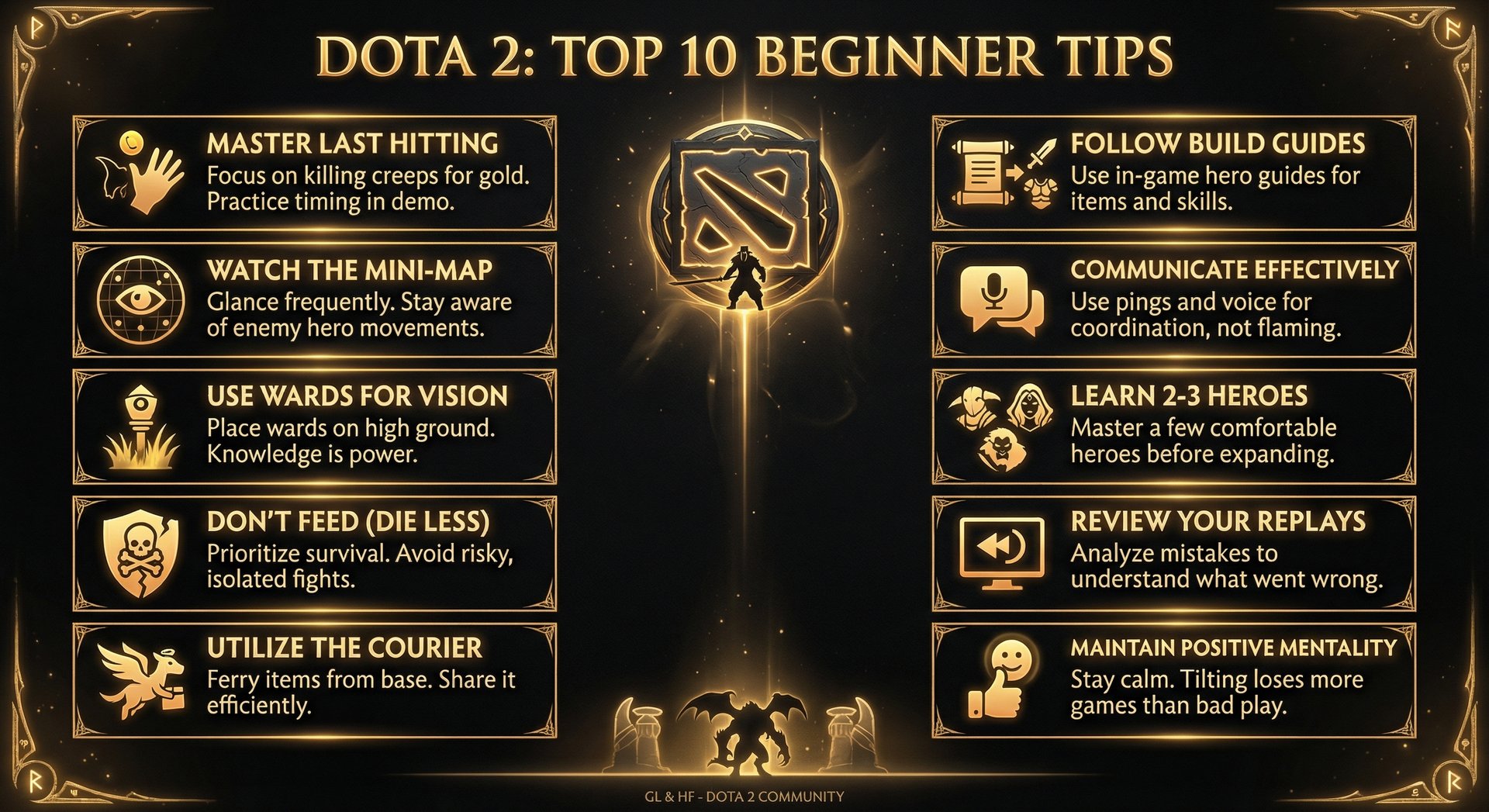
These eight mistakes cost new players more games than anything else. Fix them first — mechanics and hero knowledge develop naturally with playtime, but these habits are difficult to break once formed.
Mistake 1: No TP Scroll in Inventory
The most common mistake at every bracket below Archon. A TP Scroll costs 100 gold and can save a tower, teleport you into a fight across the map, or get you back to base in seconds. Buy one before your starting items unless your hero desperately needs early regeneration. Check your inventory before every fight — if you do not have a TP Scroll, buy one immediately from the side shop or your base shop.
Mistake 2: Chasing Low-Health Enemies
An enemy hero with 50 HP runs into Fog of War. Do not follow them. Do not chase into the enemy jungle, under their tower, or into areas without vision. The risk of walking into an ambush or dying under a tower far outweighs the value of one kill. In Dota 2, dying is the most expensive action available. You lose gold on death, lose time while dead, and give your team a 4v5 disadvantage for your entire respawn timer.
Mistake 3: Ignoring the Minimap
Glance at the minimap every 5 to 10 seconds. If multiple enemy heroes are missing from their usual positions, they are rotating toward you or your allies. When 2 or more enemies are unaccounted for on the minimap, move closer to your tower and play conservatively until they show up somewhere. Minimap awareness is the highest-impact free skill improvement available to any new player.
Mistake 4: Pushing Into Enemy Territory Without Vision
Walking into the enemy jungle or toward high ground without wards placed first is an invitation to a 5-man ambush. Before pushing into enemy territory, ask your support to ward the rotation paths the enemy would use to defend. If you are the support, place the wards before the push happens, not after your team is already walking in. The Dota 2 glossary explains every map term and game concept you will encounter while learning to communicate and coordinate with your team.
Mistake 5: Forcing Fights Before Key Items
Every hero has a power spike when they complete a key item (Blink Dagger, Black King Bar, Force Staff). Forcing 5v5 teamfights before your carry or your initiator has their core items usually results in a lost fight and lost objectives afterward. Learn to recognize your hero’s power spike timing and communicate it with your team. If the enemy wants to fight before your team is ready, stall — defend, farm, and delay until you have the items you need.
Mistake 6: Winning a Fight and Going Back to Farm
Winning a teamfight and then returning to your lane to farm is the most common way to throw a winning advantage. When you win a fight, immediately look at what objective is available before the dead heroes respawn. Even taking one T1 tower after a won fight generates permanent gold for your team and accelerates your path to winning. This mental habit of asking “what objective next?” is the single biggest improvement most new players can make to their decision-making.
Mistake 7: Playing Support and Never Buying Wards
If you are playing support and have placed zero wards this entire game, that is a critical failure in your role. Observer Wards are free. Place two at game start on key high-ground or jungle entrance spots, replace them when they expire after 6 minutes, and counter enemy wards with Sentry Wards throughout the game. A support who never wards is playing 5v4 against their own team by keeping everyone in the dark.
Mistake 8: Playing Multiple Games Consecutively After Losing
Dota 2 has a steep learning curve and an intense community. Losing two games in a row frequently leads to a third, fourth, and fifth loss — not from a sudden skill drop but from frustration degrading decision-making and patience. Every professional player with meaningful coaching experience gives identical advice: if you lose two consecutive games, stop for the day. Come back rested and the game will feel different.
Resources to Improve at Dota 2
Once you have 20 to 30 games and understand the core mechanics, these resources accelerate improvement beyond what raw playtime alone can achieve.
Educational Video Content
YouTube channels dedicated to Dota 2 education — Gameleap, BSJ (BananaSlamJamma), and Jenkins — produce structured content for players at every skill level. One focused 10-minute educational video per day compounds dramatically over a month. Prioritize content specific to your role first (support fundamentals, carry farming patterns, mid rotation timing) then expand into general game knowledge as your fundamentals solidify.
Replay Analysis
Dota 2 saves every match replay in the Watch tab. After a loss, find your worst death sequence in the replay and ask three questions: why did I die here, what information was I missing that would have prevented it, and what should I have done instead. Identifying your actual individual mistakes — not the team’s — is the highest-quality free improvement method in the game. Start with just one death per replay rather than watching the whole match.
Stat Trackers
Dotabuff and Stratz show detailed statistics from every match: GPM (gold per minute), XPM (experience per minute), last-hit counts, death timings, hero matchup records, and ward placement heat maps. Identifying patterns across your recent games — consistently low GPM, too many deaths in the first 10 minutes, specific hero matchups you always lose — lets you set concrete, measurable improvement goals rather than vague intentions.
Dota 2 Coaching
The fastest documented path to improvement is having a high-MMR player watch your gameplay and give direct, personalized feedback. Our Dota 2 Coaching service pairs you with Immortal-rank coaches who identify your specific weaknesses from replay analysis, correct habits before they solidify, and give you a concrete game-by-game improvement plan. One coaching session typically achieves what 50 to 100 games of self-directed solo play achieves on its own — without the bad habits reinforced along the way.
Understanding MMR and the Ranking System
Once you unlock ranked play after 100 hours of unranked games, you will earn an MMR number that tracks your skill level across seasons. Read our complete Dota 2 MMR guide to understand how the ranking system works, how calibration is determined, and the most effective strategies for climbing. If you want to explore rank acceleration services, see our review of the best Dota 2 boosting services and our analysis of whether Dota 2 boosting is safe.
Community Learning Resources
The r/learndota2 subreddit is one of the most welcoming communities in competitive gaming, specifically designed for new and improving players to ask questions, share replays for feedback, and find practice partners. The official Dota 2 Discord has dedicated beginner channels where experienced players voluntarily answer questions every day. Unlike the in-game environment during a losing match, these communities exist specifically to help new players improve without the frustration of competitive pressure.
Frequently Asked Questions
Cut Years Off the Learning Curve
Our Immortal-rank coaches watch your replays, identify your exact mistakes, and give you a concrete plan. One session replaces 50 to 100 hours of guessing what you are doing wrong.


