Dota 2 Battle Cup Boost: The Complete Guide to Winning Your Weekend Tournament

Every Saturday, Dota 2 transforms. The casual pub game atmosphere gives way to something more intense, more structured, and infinitely more rewarding — the Battle Cup. This weekly tournament system gives every Dota 2 player, from Guardian to Immortal, the chance to experience competitive tournament play without the commitment of joining a team or signing up for third-party leagues.
But there’s a catch: Battle Cup is hard. The format is unforgiving, the competition is fierce, and a single loss eliminates you. For many players, the dream of hoisting that virtual trophy and earning those exclusive rewards remains frustratingly out of reach — week after week, they fall in the quarterfinals or semifinals against more coordinated teams.
This guide covers everything about Dota 2 Battle Cup in 2026: the format, the tier system, how to draft effectively, the strategies that separate winners from losers, and how professional Battle Cup boosting services can finally get you that trophy. Whether you’re a solo player looking to form a winning stack or a team that’s perpetually stuck in the semifinals, read on.
Table of Contents
- What Is Battle Cup
- Tournament Format and Structure
- The Tier System Explained
- How to Register and Form a Team
- Battle Cup Rewards
- The Art of Drafting in Battle Cup
- Optimal Team Compositions
- Winning Strategies for Each Round
- Common Mistakes That Lose Battle Cups
- Battle Cup Boosting: How It Works
- Frequently Asked Questions
What Is Battle Cup
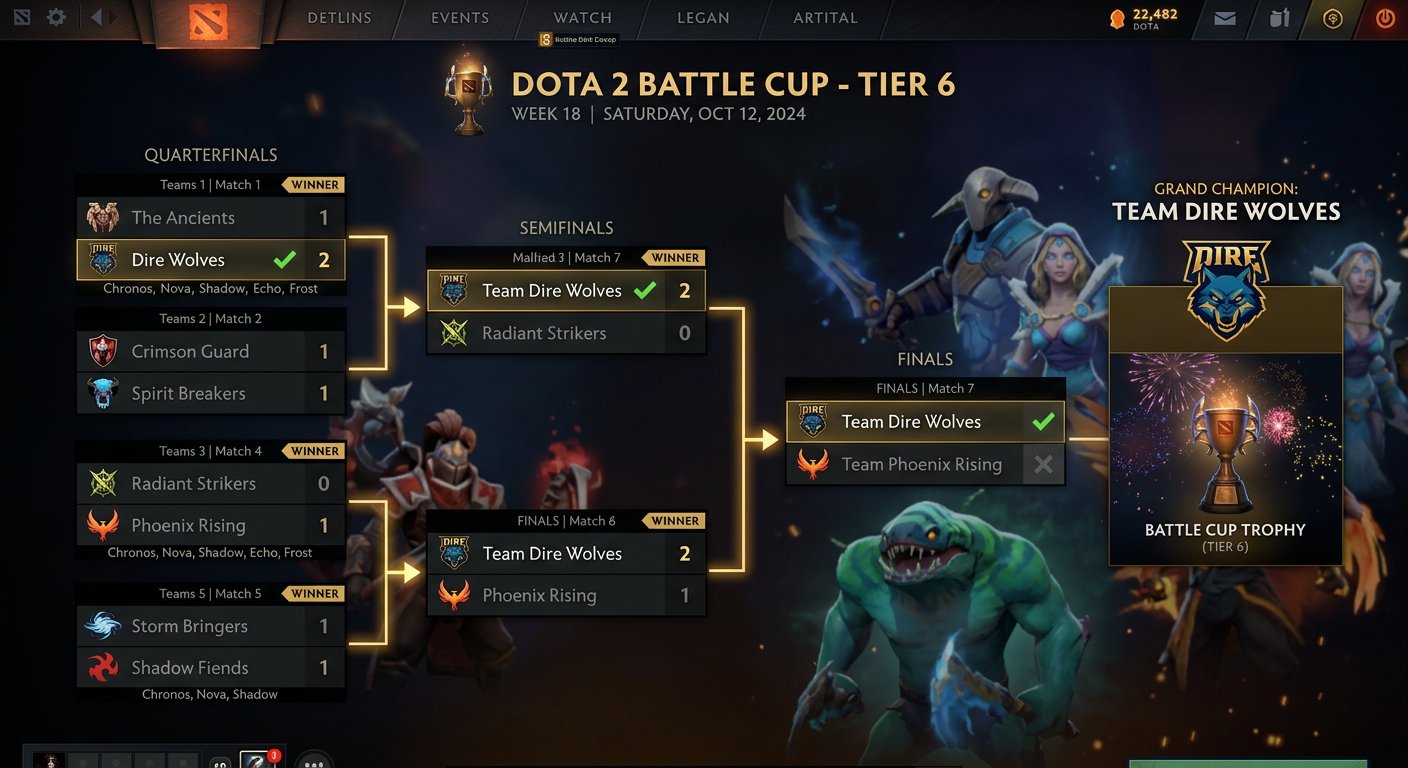
Battle Cup is Dota 2’s official weekly tournament system, running every Saturday across all regions. It’s an 8-team, single-elimination bracket that uses Captain’s Mode (CM), the same drafting format used in professional Dota 2 tournaments. The tournament takes approximately 2-3 hours to complete (three rounds if you go all the way to the finals), and winners receive exclusive cosmetic rewards, profile trophies, and bragging rights.
Originally introduced alongside the Dota 2 Battle Pass system, Battle Cup has evolved into a standalone feature accessible to all Dota Plus subscribers. It fills a unique niche in the Dota 2 ecosystem — it’s more competitive than ranked matchmaking but more accessible than joining amateur leagues or open qualifiers. For many players, Battle Cup Saturday is the highlight of their Dota week.
Why Battle Cup Matters
Battle Cup is special because it’s the closest most players will ever get to professional Dota 2. The Captain’s Mode format forces strategic drafting, the single-elimination bracket creates high-stakes pressure, and the team-based nature requires coordination and communication that pubs simply can’t replicate.
Winning a Battle Cup provides:
- A genuine sense of competitive achievement
- Experience with the drafting phase that improves your overall game understanding
- Team coordination skills that transfer to ranked party games
- Exclusive rewards you can’t earn any other way
- A profile trophy that persists on your account permanently
Tournament Format and Structure
Single-Elimination Bracket
Each Battle Cup bracket contains 8 teams. The tournament is single-elimination, meaning one loss and you’re out. The structure is straightforward:
| Round | Name | Teams Remaining | Stakes |
|---|---|---|---|
| Round 1 | Quarterfinals | 8 → 4 | Elimination match — lose and your Battle Cup is over |
| Round 2 | Semifinals | 4 → 2 | Win here and you’re guaranteed a finals appearance |
| Round 3 | Finals | 2 → 1 | The championship match — winner takes the trophy |
Game Mode: Captain’s Mode
All Battle Cup games use Captain’s Mode, which is fundamentally different from the All Pick format used in ranked matchmaking. In CM:
- One player on each team serves as the Captain, responsible for all picks and bans
- The draft follows a structured pick/ban order: Ban-Ban-Ban-Ban → Pick-Pick-Pick-Pick → Ban-Ban-Ban → Pick-Pick-Pick-Pick → Ban-Ban → Pick-Pick
- Heroes are banned before they can be picked, allowing teams to remove strong meta heroes or counter their opponents’ strategies
- The Captain decides all hero selections, though communication with the team is essential
This format dramatically changes the game. In All Pick, you choose your hero independently; in CM, the draft is a chess match where each pick and ban has strategic implications. Many players who dominate All Pick struggle in CM because they can’t adapt when their signature heroes are banned.
Time Commitment
Plan for approximately 2.5-4 hours for a full Battle Cup run:
- Registration and queue: 15-30 minutes
- Quarterfinals: 45-75 minutes (including draft)
- Break between rounds: 5-10 minutes
- Semifinals: 45-75 minutes
- Break: 5-10 minutes
- Finals: 45-75 minutes
The Tier System Explained
Battle Cup uses a tier system to ensure fair competition. Teams are placed into tiers based on the highest-ranked player in the party, preventing Immortal players from stomping in Herald brackets.
| Tier | Approximate MMR Range | Rank Equivalent | Competition Level |
|---|---|---|---|
| Tier 1 | 0 – 1,540 | Herald | Low — basic mechanics, minimal strategy |
| Tier 2 | 1,540 – 2,310 | Guardian | Low-Medium — improving mechanics, basic team play |
| Tier 3 | 2,310 – 3,080 | Crusader | Medium — decent mechanics, emerging strategy |
| Tier 4 | 3,080 – 3,850 | Archon | Medium-High — solid fundamentals, strategic awareness |
| Tier 5 | 3,850 – 4,620 | Legend | High — strong mechanics and game sense |
| Tier 6 | 4,620 – 5,390 | Ancient | Very High — near-professional fundamentals |
| Tier 7 | 5,390 – 6,160 | Divine | Elite — excellent all-around play |
| Tier 8 | 6,160+ | Immortal | Top-tier — professional-adjacent skill level |
Tier Assignment Rules
- Your team’s tier is determined by the highest-MMR player in the party
- You can play in a higher tier than your individual rank, but not a lower one
- If your party has an Archon player, you’re playing in at least Tier 4, even if everyone else is Herald
- Champion status from previous wins can sometimes bump you up a tier
Tier Strategy Implications
Different tiers have dramatically different metagames:
- Tiers 1-3: Individual skill dominance. One strong player can carry the entire team. Drafting matters less than mechanical execution.
- Tiers 4-5: The transition zone. Drafting begins to matter, team coordination becomes important, but individual skill gaps can still decide games.
- Tiers 6-8: Full competitive Dota. Drafting is crucial, team coordination is mandatory, and small strategic edges decide outcomes. Games at these tiers often mirror professional-level Dota.
How to Register and Form a Team
Requirements
- Dota Plus subscription: Battle Cup access requires an active Dota Plus subscription (or a Battle Cup ticket, though these are less common now)
- Phone number verification: Your account must have a verified phone number linked to it
- No LP/matchmaking bans: You must be in good standing — no Low Priority games pending or active matchmaking bans
- 5-player party: You need a full 5-stack. No solo or partial party registration.
Forming Your Team
Building a winning Battle Cup roster is an art form. Here are the key considerations:
Role Coverage
You need one player comfortable in each of the five roles:
- Position 1 (Safe Lane Carry): Your late-game insurance, responsible for farming efficiency and carry execution
- Position 2 (Mid Lane): The tempo setter, responsible for winning mid and creating space through the mid-game
- Position 3 (Offlane): The initiator and space-creator, responsible for disrupting the enemy carry and providing teamfight presence
- Position 4 (Soft Support/Roamer): The playmaker support, responsible for ganking, warding aggressively, and setting up kills
- Position 5 (Hard Support): The foundation, responsible for vision, save mechanics, and enabling the cores to farm safely
The Captain
Your captain should be the player with the best overall game knowledge — not necessarily the highest MMR, but the person who understands meta picks, counters, draft strategy, and can communicate calmly under pressure. The captain needs to know every player’s hero pool and preferences to draft effectively.
Communication
Voice communication is mandatory for Battle Cup. Discord or in-game voice chat works, but the key is that all five players need to be on the same channel, communicating actively. Teams that don’t voice-comm are at a massive disadvantage in CM.
Battle Cup Rewards
Winning a Battle Cup earns you several rewards:
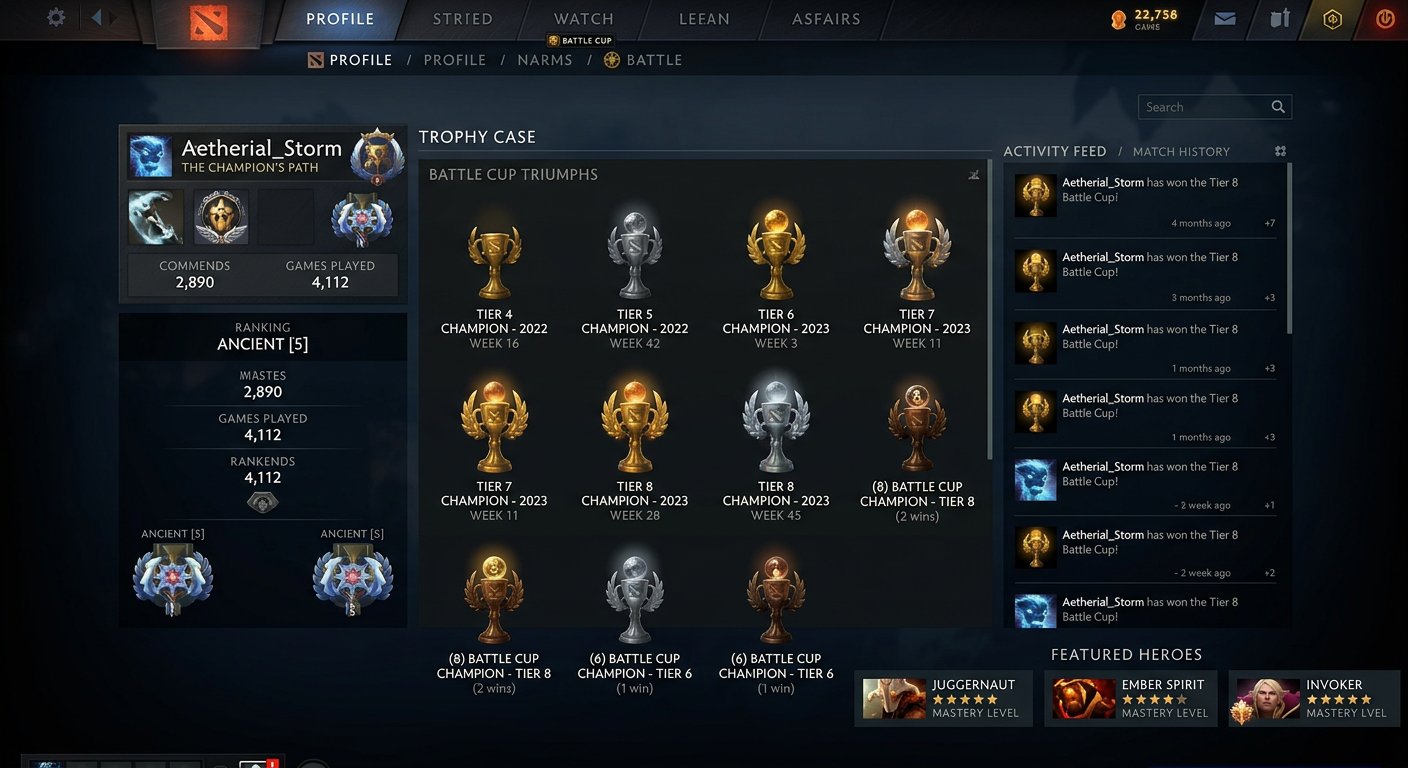
- Champion’s Trophy: A profile trophy that permanently displays on your Dota 2 profile, showing your tier and date of victory
- Champion’s Chat Emoticon: An exclusive chat wheel emoticon for the week following your win
- Champion’s Effect: Your profile portrait displays a special golden border for the week
- Dota Plus Shards: Bonus shards that can be spent in the Dota Plus store for sets and hero relics
- Battle Pass Progress: During Battle Pass seasons, Battle Cup wins grant significant BP levels
The most coveted reward is the trophy — it’s a permanent record of your achievement that other players can see. Having multiple Battle Cup trophies on your profile signals competitive experience and skill.
The Art of Drafting in Battle Cup
If there’s one skill that separates Battle Cup winners from losers, it’s drafting. The Captain’s Mode draft is a strategic mini-game that happens before the actual game begins, and a superior draft can win the game before a single creep spawns.
Phase 1: The Opening Bans (4 Bans)
The first ban phase removes 4 heroes (2 per team). Your goals here are:
- Remove meta-dominant heroes: Ban the heroes that are statistically overpowered in the current patch. In 2026, this changes with each balance update, but there are always 2-3 heroes that are “first ban” worthy.
- Deny comfort picks: If you’ve scouted the enemy team (more on this below), ban their most-played heroes.
- Protect your strategy: If your draft plan relies on a specific hero not being picked by the enemy, consider banning heroes that counter your strategy rather than generically strong heroes.
Phase 2: First Picks (4 Picks)
The first pick phase is where you establish your draft’s direction. Key principles:
- Flex picks first: Choose heroes that can play multiple positions (e.g., Marci can be pos 3, 4, or 5). This conceals your strategy and prevents counter-picking.
- Don’t reveal your carry early: Your position 1 should usually be picked later when you can see what the enemy team is building. Early carry picks get counter-picked.
- Prioritize contested heroes: If a hero is strong and both teams might want it, pick it in the first phase.
Phase 3: Second Bans (3 Bans)
The second ban phase is reactive — you’ve seen some enemy picks and can now ban specific counters or synergies:
- Ban heroes that counter your already-picked heroes
- Ban heroes that complete a strong enemy combo (if they picked two parts of a combo, ban the third)
- Remove the enemy’s likely counter-picks to your planned remaining picks
Phase 4: Second Picks (4 Picks)
This is where your core strategy materializes. You’re locking in your carries and finalizing your team composition. By now you should have a clear game plan — aggressive push Late-game teamfight Split-push — and your remaining picks should reinforce that plan.
Phase 5: Final Bans (2 Bans) and Last Picks (2 Picks)
The final phase is the most critical. The last pick in the draft has the advantage of seeing the entire enemy lineup and can select the perfect counter or the final piece of a synergistic puzzle. Typically, the last pick is reserved for mid or carry — the role where counter-picking provides the most advantage.
Scouting the Enemy
One of Battle Cup’s unique aspects is that you can see your opponents before the game starts. Use this time wisely:
- Check their Dotabuff/OpenDota profiles
- Identify their most-played heroes and roles
- Note their recent win rates and which heroes they’ve been spamming
- Look for patterns — do they always pick the same carry Do they have a comfort mid hero
- Ban accordingly — removing a one-trick’s signature hero is devastating
Optimal Team Compositions
While the meta shifts with patches, certain team archetypes consistently perform well in Battle Cup:
1. The Deathball Push
Win condition: Group early, push towers, end before 30 minutes
Key heroes: Pugna, Chen, Lycan, Death Prophet, Leshrac, Jakiro, Shadow Shaman
Why it works in Battle Cup: Coordinated 5-man pushes are devastating when your team is communicating. Pub teams rarely group early enough to respond, and the strategy requires minimal individual outplay — just coordination and timing.
2. The Pick-Off / Gank Squad
Win condition: Find isolated enemies, win skirmishes, snowball advantage into objectives
Key heroes: Spirit Breaker, Nyx Assassin, Bounty Hunter, Storm Spirit, Clockwerk, Batrider
Why it works in Battle Cup: Teams that don’t move together get punished. Even with voice comm, many Battle Cup teams have players farming alone in dangerous parts of the map. A pick-off composition turns every positional mistake into a kill.
3. The Teamfight Wombo-Combo
Win condition: Group for 5v5 fights, land devastating ability combos, win fights decisively
Key heroes: Enigma (Black Hole), Magnus (Reverse Polarity), Dark Seer (Vacuum + Wall), Invoker (Cataclysm), Tidehunter (Ravage), Disruptor (Static Storm)
Why it works in Battle Cup: Big combo ultimates are reliable win conditions because they don’t require sustained mechanical excellence — just good timing on a few key abilities. One landed Black Hole + follow-up can win a game.
4. The Late-Game Insurance
Win condition: Survive until 35+ minutes, win with superior scaling
Key heroes: Medusa, Spectre, Faceless Void, Terrorblade, plus defensive supports like Oracle, Dazzle, Winter Wyvern
Why it works in Battle Cup: If your team can execute a protect-the-carry strategy and reach late game without falling too far behind, hyper-carries become nearly unbeatable. The risk is getting run over early.
5. The Flexible Draft
Win condition: Counter the enemy’s strategy with adaptable picks
Key heroes: Flex picks like Mirana, Marci, Lina, Vengeful Spirit, Windranger that can be played in multiple positions
Why it works in Battle Cup: By not committing to a single strategy early, you force the enemy captain to guess while you adapt your plan to counter their picks. Requires the most skilled captain and most versatile players.
Winning Strategies for Each Round
Quarterfinals: Establish Dominance
The quarterfinals are where you set the tone. Key strategic priorities:
- Play your strengths. Don’t try experimental strategies in the first round. Pick your best heroes, execute your most practiced strategies, and win decisively.
- Conserve mental energy. A close, stressful game in the quarterfinals drains you for the later rounds. Try to win convincingly so your team goes into the semifinals fresh and confident.
- Scout ahead. While your quarterfinal is happening, have someone note the teams in the other bracket. The team you’ll face in the semifinals is playing simultaneously, and knowing their hero preferences before the draft gives you a significant edge.
Semifinals: Adapt and Counter
The semifinals are where Battle Cups are really won or lost. The competition steps up significantly:
- Use your scouting data. You’ve seen the other team play. Ban their star player’s best hero. Prepare counters to their team composition style.
- Adjust your tempo. If the enemy won their quarterfinal with an early-game push strategy, pick a lineup that can survive the push and counter-attack in the mid-game. If they went late, pick aggressive tempo heroes to end early.
- Play your best game. Semifinals opponents are almost always competent. This is where individual skill starts to matter alongside strategy.
Finals: Peak Performance
The finals are where everything comes together. Both teams have proven they can win under pressure, and the margin for error is razor-thin:
- Mental game matters. Take a 5-minute break before the finals draft if possible. Discuss what went well in the previous games. Make sure everyone is focused and hydrated.
- Respect the opponent. They made it to the finals too. Don’t get cocky with meme picks or disrespect drafts.
- Have a plan B. If your go-to strategy gets banned out, your captain needs a backup plan ready. The worst thing that can happen in a finals draft is panic-picking because your primary plan was denied.
- Play clean. Don’t force plays. Don’t take unnecessary risks. Let the game develop and take advantages when they’re offered. Finals-winning Dota is patient, disciplined Dota.
Common Mistakes That Lose Battle Cups
1. No Draft Preparation
Walking into the Captain’s Mode draft without a plan is a recipe for disaster. Before queuing, your team should discuss: what heroes does everyone want to play What combos have we practiced What heroes are strong in this patch What’s our ideal draft order Teams that plan their draft consistently outperform teams that wing it.
2. One-Dimensional Hero Pools
If your mid player only plays Invoker and your carry only plays Anti-Mage, the enemy captain will ban both and your team is crippled. Every player should have at least 3-4 heroes they’re confident on for Battle Cup, specifically prepared for the CM format where bans are a factor.
3. Ignoring Power Spikes
Battle Cup teams often draft without considering when their lineup is strongest. If your draft peaks at 20 minutes but you’re passively farming until 35, you’ve thrown away your advantage. Conversely, if you have a late-game lineup and fight at 15 minutes, you’re playing into the enemy’s hands.
4. Tilting After a Bad Start
Battle Cup games are best-of-one — every game counts. Getting first-blooded or losing a lane doesn’t mean the game is over. Teams that tilt after early setbacks throw away winnable games. The key is having a shot-caller who keeps the team focused on the macro game plan regardless of early results.
5. Forgetting About Roshan
Roshan timing wins Battle Cups. In the competitive-adjacent environment of Battle Cup, Roshan control is the single most important macro objective. Taking Roshan before a high-ground push, timing your fights around Aegis, and denying the enemy their Roshan attempt are all critical skills that many Battle Cup teams neglect.
6. Not Communicating During the Draft
The captain picks the heroes, but they need input from the team. If your offlaner is assigned a hero they’ve never played, that’s a communication failure during the draft. Every pick should be confirmed with the player who’ll play it.
Battle Cup Boosting: How It Works
For many players, Battle Cup represents a frustrating gap between aspiration and execution. You want the trophy, the rewards, and the competitive experience, but you can’t find four reliable teammates, or your team’s skill level just isn’t quite enough to win the tournament. This is where Battle Cup boosting enters the picture.
What Is Battle Cup Boosting
Battle Cup boosting involves having one or more professional players join your Battle Cup team — either by playing on their own accounts within your tier or by offering strategic support through coaching and draft assistance. The most common formats are:
- Full team carry: A professional player (or players) joins your stack and plays core roles, providing the mechanical skill and game knowledge to carry the team through the tournament
- Draft coaching: A professional assists with the drafting phase, providing captain guidance, scouting enemy teams, and recommending picks/bans based on extensive competitive knowledge
- Account play: A professional player plays Battle Cup on your account, though this carries the same considerations as any account-sharing service
Why Consider Battle Cup Boosting
- Inconsistent team availability: You need 5 players available at the same time on Saturday. Finding and keeping a reliable Battle Cup team is surprisingly difficult, and services can fill empty slots with competent players.
- Learning through play: Playing alongside a professional player is one of the fastest ways to improve. You see their decision-making, rotations, and game sense in real time, in the context of a competitive match that matters.
- Breaking the trophy drought: If you’ve played dozens of Battle Cups without winning, the frustration can be immense. Getting that first win provides both the rewards and the confidence to build on.
- Time efficiency: Battle Cup takes 3+ hours. Losing in the quarterfinals means those hours produced nothing. Having professional support maximizes the return on your time investment.
How TeamSmurf Battle Cup Services Work
At TeamSmurf, Battle Cup boosting is handled by experienced players who specialize in competitive team play. The process typically involves:
- Assessment: Your team’s tier, available players, hero pools, and goals are evaluated
- Matching: Professional players appropriate for your tier are assigned to fill needed roles
- Preparation: Pre-tournament communication establishes draft strategies and role assignments
- Execution: The team plays through the Battle Cup with professional guidance and gameplay
The key advantage of professional Battle Cup services is reliability — you’re not hoping your random Discord pickup group holds together, you’re playing with proven players who perform under pressure.
For players looking to improve their individual skill alongside Battle Cup performance, combining boosting with professional coaching creates a powerful development pathway. The coach can review your Battle Cup games, identify areas for improvement in both individual play and team coordination, and help you build toward winning Battle Cups independently.
Frequently Asked Questions
Advanced Tips for Consistent Battle Cup Success
Build a Permanent Roster
The teams that win Battle Cup consistently aren’t random stacks — they’re the same 5 players who play together every week. If you find players you work well with, add them to a friends list specifically for Battle Cup. Over time, your team develops synergy, practiced strategies, and communication shorthand that random groups can never match.
Practice Captain’s Mode in Scrims
If you’re serious about Battle Cup, schedule practice sessions during the week. Queue for unranked Captain’s Mode as a 5-stack and practice your drafting, team compositions, and execution. The more CM games your team plays together, the more prepared you’ll be on Saturday.
Study the Meta
Dota 2’s meta shifts with every patch and even within patches as players discover new strategies. Your captain should be actively following professional Dota (DPC tournaments, Valve’s patch notes, and community analysis) to stay current on which heroes and strategies are strongest. A draft that leverages current meta advantages has a significant edge over teams playing outdated styles.
Review Your Battle Cup Games
After each Battle Cup — win or lose — watch the replays together as a team. Identify what went right, what went wrong, and what you’d do differently. This debrief process is what separates teams that improve over time from teams that plateau. If you want structured analysis, professional coaching sessions focused on replay review can accelerate your team’s improvement dramatically.
Ready to Improve Your Dota 2 Experience
Team Smurf offers professional Dota 2 services — Immortal-rank boosters, maximum safety, competitive pricing, and 24/7 support.