How to Reach Immortal in Dota 2: The Final Push from Divine

You’re Divine. Top 5% of all Dota 2 players. You’ve mastered the fundamentals, refined your execution, and climbed through every bracket below you. You understand drafting, farming optimization, smoke ganking, Roshan timing, teamfight positioning, and objective-based play. You’re a legitimately skilled Dota 2 player.
And yet, Immortal feels impossibly far away.
The Divine-to-Immortal transition (approximately 4,620 MMR to 5,620+ MMR) is the hardest single rank climb in Dota 2. Not because the skill gap is the largest — the gap between Herald and Guardian is arguably bigger in raw terms. It’s the hardest because the improvements required are the most subtle, the most mental, and the most personal. At this level, every player you face is skilled. Every game is competitive. The margins are microscopic.
This guide won’t teach you how to last hit or when to buy BKB. You already know that. Instead, we’ll tackle the factors that actually separate Divine from Immortal: the mental game, hero mastery versus versatility, queue timing optimization, dealing with account buyers and griefers, leaderboard mechanics, and the psychology of the final push.
This is the guide for players who are already great and want to become elite.
Table of Contents
- The Reality of Immortal Rank
- The Mental Game: Your Biggest Obstacle
- Hero Mastery vs. Versatility: The Eternal Debate
- Queue Timing and Optimization
- Dealing with Account Buyers and Griefers
- Leaderboard Mechanics
- The Micro-Advantages That Win Games
- Breaking Through Plateaus
- The Consistency Framework
- The Professional Mindset
- Role Perfection
- The Final Push: A Strategic Approach
- FAQ
The Reality of Immortal Rank
Let’s start with some hard facts about Immortal rank to calibrate your expectations.
By the Numbers
| Stat | Value |
|---|---|
| Approximate MMR threshold | ~5,620+ (varies by region and season) |
| Percentage of players | Top ~1.5-2.5% |
| MMR gap from Divine 1 | ~1,000 MMR |
| Average games at Divine to reach Immortal | 300-500+ (at 53-55% win rate) |
| Leaderboard threshold (varies by region) | ~5,800-6,200+ for numbered rank |
What Makes Immortal Different
Immortal isn’t just a higher number on your profile. The games themselves feel fundamentally different:
- Faster pace. Decisions happen quicker. Fights are shorter. Rotations are snappier. There’s less “dead time” in Immortal games because everyone is always doing something productive.
- Higher punishment for mistakes. In Divine, you might overextend and get away with it 30% of the time. In Immortal, you get away with it 10% of the time. Every mistake is capitalized on.
- Better coordination. Even without voice comms, Immortal players tend to make coordinated decisions because they understand the game well enough to predict what their teammates will do.
- Meta awareness. Immortal players understand the current patch’s meta — which heroes are strong, which strategies are optimal, and how to exploit current game mechanics. They update their hero pool and playstyle every patch.
- Ego and toxicity. Unfortunately, Immortal games can also be more toxic. Players at this level are invested in their rank and react strongly to perceived bad play. Managing your own tilt and your teammates’ emotions becomes a real skill.
The Uncomfortable Truth
Not everyone can reach Immortal. Not because of some innate talent ceiling, but because of time, dedication, and willingness to self-improve. Reaching Immortal requires hundreds or thousands of focused games, consistent replay analysis, and a commitment to fixing your weaknesses even when it’s uncomfortable. Many Divine players plateau not because they can’t improve, but because they’re not willing to put in the specific type of work required.
If you’re reading this guide, you’re already ahead of most Divine players — because most Divine players have stopped actively trying to improve. They play on autopilot and wonder why they’re stuck. The fact that you’re seeking out information means you have the right mindset. Now let’s turn that mindset into action.
The Mental Game: Your Biggest Obstacle
At Divine level, the mental game is the #1 factor separating you from Immortal. Not mechanics. Not game knowledge. Not hero pool. Your mental state.
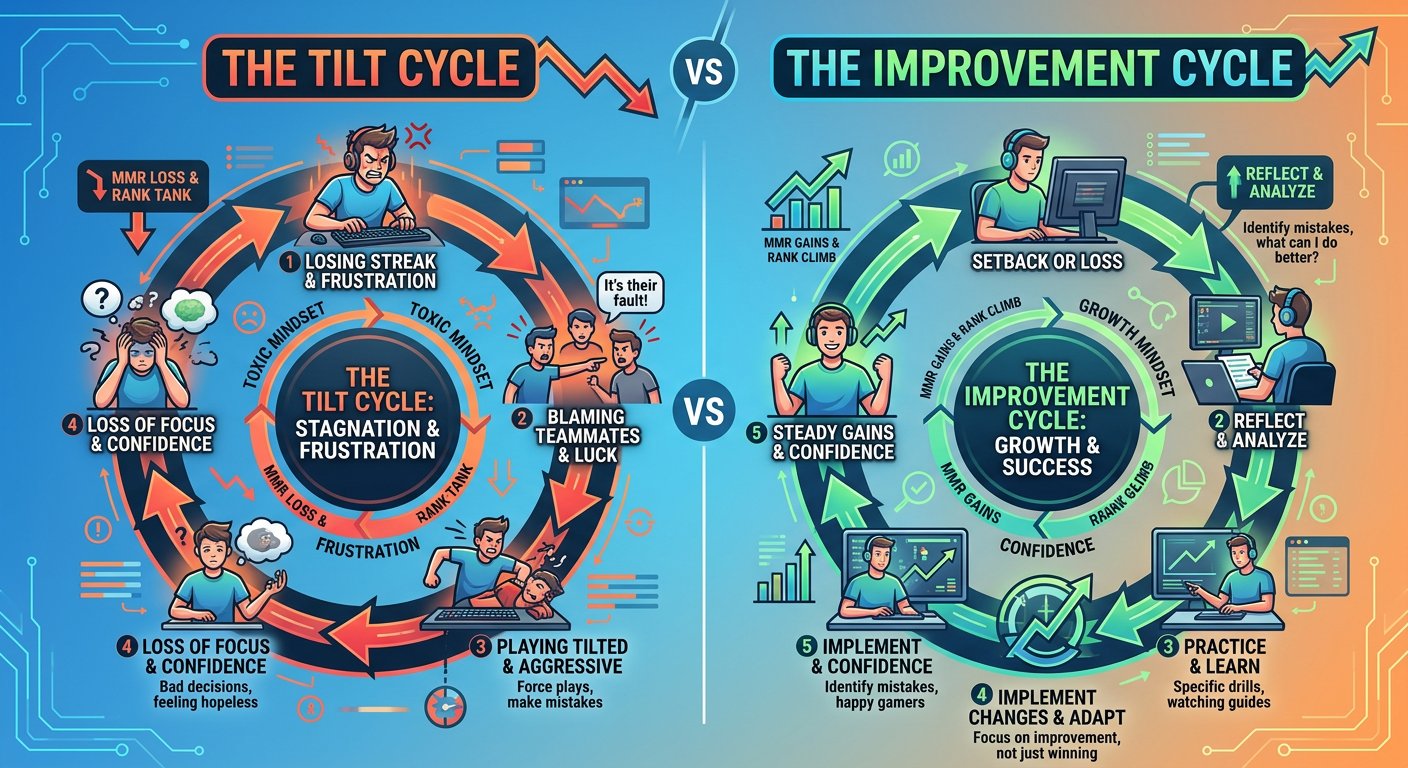
Tilt: The MMR Killer
Tilt costs Divine players more MMR than any other single factor. Here’s the math:
A tilted player’s win rate drops from ~52% to ~40%. Over 20 games, that’s the difference between gaining 120 MMR and losing 300 MMR — a net swing of 420 MMR. One bad tilt session can erase weeks of grinding.
The tilt cycle:
- Lose a close game due to teammate mistakes
- Queue again immediately, slightly frustrated
- Play more aggressively than usual because you’re trying to “force” a win
- Lose again because you’re making impulsive decisions
- Now you’re fully tilted — you make bad picks, flame teammates, and play recklessly
- Lose 3-4 more games
- End the session -150 MMR and demoralized
Breaking the tilt cycle:
- The two-loss rule. After two consecutive losses, stop playing ranked. No exceptions. Go to unranked, watch a replay, or do something else. Come back in at least 1 hour.
- The body check. Before queuing, ask: “Am I hungry Tired Stressed Angry” If any answer is yes, don’t queue. Your physiological state directly impacts your cognitive performance.
- The score ignore. Stop checking your MMR after every game. Check it once a week. This removes the emotional attachment to individual game outcomes.
- The mute button. If someone is toxic, mute them instantly. Don’t engage. Don’t respond. Don’t let their tilt become your tilt. Every second you spend arguing is a second you’re not thinking about the game.
Anxiety and Ranked Ladder Fear
Many Divine players develop ranked anxiety — fear of losing MMR that prevents them from playing or causes them to play passively. Symptoms include:
- Queuing for unranked or turbo instead of ranked
- Playing your “safe” heroes instead of what the game needs
- Avoiding risky plays that could win the game because losing feels worse than not winning
- Checking your MMR constantly and feeling sick when it drops
The cure: Reframe your relationship with MMR. MMR is not a measure of your worth — it’s a measure of your current performance. It goes up and it goes down. The goal isn’t to protect a number; it’s to improve as a player. If you improve, the number follows. If you focus on the number, improvement stalls.
The Stoic Approach to Dota
Adopt a stoic philosophy toward your games:
- Control what you can control. You can control your hero pick, your item build, your positioning, and your decision-making. You cannot control your teammates, your opponents, or random chance. Focus exclusively on the former.
- Accept variance. Over any 10-game sample, variance will dominate. You’ll have unwinnable games and unlosable games. Over 100 games, your skill level determines your rank. Play enough games and the noise cancels out.
- Detach from outcomes. After a game, ask “Did I play well” not “Did I win” A well-played loss teaches more than a poorly-played win.
Pre-Game Rituals
Elite athletes have pre-game rituals to enter the right mental state. You should too:
- Physical preparation: Eat. Hydrate. Stretch your hands and wrists. Make sure your room is comfortable.
- Warm-up: Play one turbo or unranked game to warm up your mechanics and get into “Dota mode.”
- Intention setting: Before queuing ranked, state one specific thing you’ll focus on. “This game I’m focusing on hitting my BKB timing.” “This game I’m focusing on not dying before 20 minutes.”
- Mental reset: If you’ve played other games or had a stressful day, take 5 minutes to clear your head. Deep breaths, short walk, etc.
Hero Mastery vs. Versatility: The Eternal Debate
At Divine, every player has a hero pool debate: should you spam 2-3 heroes and master them completely, or should you be flexible and pick what the game needs
The Case for Hero Mastery (Spamming)
- Autopilot mechanics. When your hero’s mechanics are 100% automatic, your entire brain is free for decision-making. This is a massive advantage in Divine where decisions are the primary differentiator.
- Matchup encyclopedia. After 200+ games on a hero, you know every matchup intimately. You know exact kill thresholds, ability interactions, and timing windows that take opponents by surprise.
- Psychological comfort. Playing your best hero gives you confidence. Confidence improves decision-making. Better decisions win games.
- MMR climbing speed. Statistically, players who spam 2-3 heroes climb faster than players who play 10+ heroes at the same skill level.
The Case for Versatility
- Counter-pick flexibility. If you only play 2 heroes and both get banned or hard-countered, you’re at a massive disadvantage.
- Draft optimization. Being able to play what the team needs (rather than forcing your comfort pick) leads to better team compositions.
- Meta resilience. When patches change and your main hero gets nerfed, you need alternatives. Versatile players adapt faster to meta shifts.
- Deeper game understanding. Playing multiple heroes gives you insight into their weaknesses — which helps when you’re playing against them.
The Optimal Approach
The answer isn’t “one or the other” — it’s a structured hero hierarchy:
| Tier | Number of Heroes | Games Played | Purpose |
|---|---|---|---|
| S-Tier (Main) | 1-2 | 200+ | Your default pick. You know every matchup, every timing, every trick. |
| A-Tier (Strong) | 2-3 | 80-150 | Picked when your main is banned/countered. Very comfortable on these. |
| B-Tier (Competent) | 3-4 | 30-60 | Situational picks for specific drafts. You won’t embarrass yourself. |
| C-Tier (Emergency) | 2-3 | 10-20 | Last resort picks. Basic competence but not ideal. |
Total: 8-12 heroes across your primary and secondary roles. This gives you enough versatility to handle any draft while maintaining the depth needed to dominate with your best heroes.
How to Choose Your Main Heroes
Your main heroes should have these qualities:
- High skill ceiling. You want heroes where mastery creates measurable advantages. Invoker, Earth Spirit, Puck, Morphling, Arc Warden — heroes where a master player significantly outperforms a merely good player.
- Meta independence. Choose heroes that remain viable across multiple patches. Heroes like Invoker, Anti-Mage, and Rubick have been relevant for years. Avoid “flavor of the month” heroes as mains.
- Personal synergy. Pick heroes that match your playstyle. If you’re an aggressive player, main aggressive heroes. If you’re a calculated player, main calculated heroes. Fighting your natural instincts is a losing battle.
- Enjoyment. You’re going to play this hero 200+ times. If you don’t enjoy playing them, you won’t have the motivation to grind through the learning curve.
When to Pick Your Main vs. Flex
- Pick your main when: It’s not banned, it’s not hard-countered, and it fits the draft reasonably well.
- Flex to an A-tier hero when: Your main is banned, hard-countered, or the draft strongly favors a different hero.
- Flex to a B-tier hero when: The draft has a very specific need that none of your top heroes fill (e.g., your team desperately needs an AoE teamfight hero and your main is a single-target assassin).
Queue Timing and Optimization
At Divine level, when you queue matters almost as much as how well you play. Queue timing affects matchmaking quality, game quality, and your win rate.
Peak Hours vs. Off-Peak Hours
| Time Period | Queue Quality | Typical Match Quality | Recommendation |
|---|---|---|---|
| Weekday mornings (6-10 AM) | Longer queues, wider MMR spread | Lower — more variance in skill levels | Avoid unless you have no other option |
| Weekday afternoons (12-5 PM) | Moderate queues | Moderate — getting better | Acceptable for grinding |
| Weekday evenings (5-11 PM) | Short queues, tight MMR matching | Highest — peak player population | Best time to play ranked |
| Weekend afternoons/evenings | Short queues | High but more casual players | Good for climbing (easier opponents) |
| Late night (11 PM – 3 AM) | Longer queues, wider MMR spread | Low — tired players, smurfs, griefers | Avoid |
Server Selection
If you’re in a region with multiple server options (e.g., US East and US West), consider which server gives you the best combination of ping and player pool. Lower ping = better execution, which matters more at Divine than at lower ranks where decisions are more impactful than reaction time.
The “Hot Streak” Window
When you’re playing well and winning, keep playing (within reason). Your mechanics are sharp, your decision-making is clean, and your confidence is high. Don’t stop a winning streak at 3 games just because “it might end.” Play until you feel your performance declining or you’ve hit your daily time limit.
Conversely, when you’re cold, stop immediately. The difference between a hot session (+75 MMR) and a cold session (-100 MMR) is enormous, and identifying which state you’re in is a crucial meta-skill.
Role Queue Considerations
At Divine, role queue selection matters:
- Carry/Mid: Longer queues but more game impact. Good if you’re confident in your ability to carry games.
- Support: Shorter queues, more games per session. Good if you’re a support main, but less direct game impact in terms of raw damage/farming.
- All roles: Shortest queues but you might get a role you’re not comfortable with. Only use this if you’re genuinely competent at all positions.
Dealing with Account Buyers and Griefers
This is a reality of Divine bracket that nobody talks about enough. Account buyers — players who purchased or boosted accounts to a rank above their skill level — are a consistent presence in Divine games. So are griefers, tilted players, and people having bad days.
Identifying Account Buyers
Signs that a teammate might be an account buyer:
- Recent ranked history shows dramatic hero changes (went from spamming Invoker at 55% win rate to playing random heroes at 30%)
- Game sense that doesn’t match their rank (making Herald-level decisions at Divine)
- Inability to play their assigned role at the expected level
- Anonymous profile + sudden rank changes on Dotabuff/OpenDota
How to Adapt When You Have One
You can’t control who’s on your team. You can control how you play around them:
- Don’t flame them. Flaming makes them play worse. Your goal is to win, not to be right.
- Reduce reliance on them. If your carry is clearly underperforming, adjust your playstyle to be less dependent on them. Take more farm as a mid or offlaner. Make more space as a support.
- Play around your strongest teammate. Identify which of your 4 teammates is playing best and coordinate with them.
- Accept 4v5 games. Some games are effectively 4v5. You can still win 4v5 games at any bracket if you play smart — focus on pick-offs, avoid 5v5 teamfights, and capitalize on every mistake the enemy makes.
Dealing with Griefers
Griefers (players who intentionally ruin games) are rarer at Divine than at lower brackets, but they exist:
- Don’t engage. Any reaction fuels their behavior.
- Mute, report, and focus on your own play.
- Treat it as a practice game. Even in a 4v5 or a griefed game, you can practice mechanics, positioning, and decision-making.
- Move on immediately. Don’t let a griefed game affect your next game’s mental state.
The Statistical Reality
Account buyers and griefers affect both teams equally over a large sample. In any given game, there’s an equal chance the account buyer is on the enemy team. Over 100 games, these factors wash out. Your skill is the only persistent variable. Focus on that.
Leaderboard Mechanics
Once you reach Immortal, you enter the leaderboard system. Understanding how it works is important for your goal-setting.
How the Leaderboard Works
- Immortal badge: Awarded when you reach the MMR threshold (approximately 5,620+). You get the Immortal medal but no number.
- Numbered Immortal: Once your MMR reaches the regional leaderboard threshold (varies by region, typically ~5,800-6,200+), you receive a leaderboard number showing your rank among all Immortal players in your region.
- Top 100/Top 10: The highest-ranked players get additional recognition. This is where you start seeing professional players.
Regional Leaderboard Differences
| Region | Approximate Leaderboard Entry MMR | Competitiveness |
|---|---|---|
| Europe | ~6,000-6,200 | Very high — largest Immortal player pool |
| China | ~6,000-6,200 | Very high |
| Southeast Asia | ~5,800-6,000 | High |
| North America | ~5,800-6,000 | Moderate-high |
| South America | ~5,600-5,800 | Moderate |
| Other regions | Varies | Varies |
Leaderboard Maintenance
To maintain your leaderboard position, you need to:
- Play a minimum number of ranked games within a rolling time window
- Keep your MMR above the leaderboard threshold (which gradually increases as more players reach Immortal)
- Have your profile set to public
If you stop playing ranked for too long, your leaderboard position will decay and eventually be removed, though your MMR itself doesn’t decay.
The Micro-Advantages That Win Games at Divine
At Divine, games are won by accumulating dozens of tiny advantages rather than one big play. Here are the micro-advantages that add up:
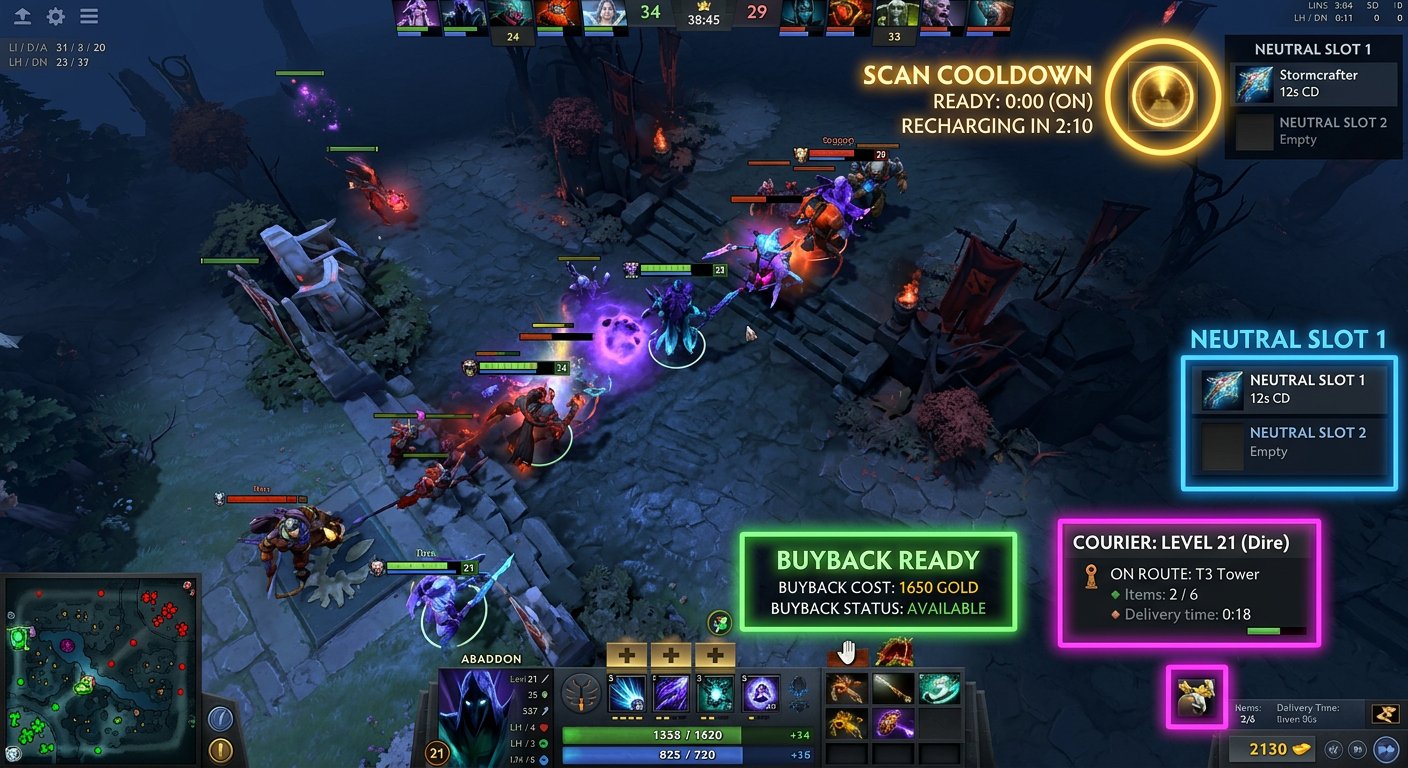
Courier Efficiency
Every second your courier spends idle or making a long trip is a second you’re playing without an item component. Optimize courier usage:
- Queue up your item purchases so the courier picks up everything in one trip
- Use the courier speed boost at the right time (when you need the delivery fast, not randomly)
- Don’t hog the courier — if your support needs wards delivered, let them have priority during the laning phase
Scan Usage
Scan is a team-wide ability on a 4.5-minute cooldown that reveals whether enemies are in a large area. It’s criminally underused even at Divine:
- Scan Roshan pit before checking it with a smoke
- Scan the enemy jungle before invading it
- Scan the area behind you when pushing a tower to check for flanking enemies
Buyback Gold Management
After 30 minutes, every core player should maintain buyback gold at all times. This means:
- Knowing the exact buyback cost at your current level and death timer
- Not spending gold that would drop you below buyback threshold
- Using buyback aggressively when the situation calls for it (e.g., buying back immediately after dying in a fight that your team is winning to rejoin and push)
TP Scroll Management
- Always carry 2 TP scrolls after 15 minutes. If one is on cooldown, you have a backup.
- Don’t waste TPs on short rotations that could be walked.
- TP to unexpected locations for counter-ganks — the enemy expects you to TP to the tower, not to a different lane to flank them.
Neutral Item Optimization
Neutral items are free power. Optimize them by:
- Distributing them to the heroes that benefit most (e.g., attack speed items to carries, utility items to supports)
- Swapping neutral items as the game progresses and higher tiers become available
- Farming specific camps that are likely to drop items your team needs
Breaking Through Plateaus
Every Divine player hits plateaus — extended periods where MMR stagnates despite feeling like they’re playing well. Here’s how to break through them.
Identify the Pattern
Review your last 50 games and look for patterns in your losses:
- Do you lose more on specific heroes → Your hero performance is inconsistent
- Do you lose more in specific roles → You might be better suited to a different role
- Do you lose more at specific game lengths → Your early/mid/late game might be weak
- Do you lose more at specific times of day → Queue timing issue
- Do you lose more after winning streaks → Overconfidence or tilt
The “Video Review” Method
Record yourself playing (webcam + screen) for 5 games. Then review the footage, focusing on:
- Your facial expressions and body language when things go wrong (are you tilting)
- Where your eyes are looking (minimap vs. center screen)
- How quickly you make decisions (hesitation vs. confidence)
- Your posture and physical state (slouching, tension, fatigue)
This sounds extreme, but it’s a technique used by professional esports players and reveals insights that replay analysis alone can’t provide.
The “Teach It” Method
Explain your decision-making to a friend, a recording, or even an empty room. When you try to articulate WHY you made a decision, you discover gaps in your reasoning. “I went to the triangle because…” if you can’t finish that sentence with a logical reason, you’re playing on autopilot.
The “One Skill per Week” Method
Pick one specific micro-skill and obsess over it for an entire week:
- Week 1: Smoke execution (buying, timing, target selection)
- Week 2: Power spike identification (knowing exact timing of each game’s turning point)
- Week 3: Death prevention (goal: fewer than 3 deaths per game as a core)
- Week 4: Post-fight decisions (always take an objective after winning a fight)
After 4 weeks, you’ve improved 4 specific skills. This compounds over months into significant MMR gains.
The Consistency Framework
Consistency is what separates Divine from Immortal. Divine players have great games and bad games. Immortal players have good games and slightly less good games. The variance is dramatically lower.
Tracking Consistency
Create a spreadsheet and track these metrics for every ranked game:
| Metric | Target (Core) | Target (Support) |
|---|---|---|
| Deaths | ≤ 5 | ≤ 7 |
| CS at 10 min (carry) | ≥ 80 | N/A |
| GPM | ≥ 600 | ≥ 300 |
| First item timing | Within 2 min of target | N/A |
| Wards placed (support) | N/A | ≥ 15 |
| Smokes used (team) | ≥ 4 | ≥ 4 |
| Post-fight objective taken | ≥ 60% of won fights | ≥ 60% of won fights |
Review these numbers weekly. If your variance on any metric is high (e.g., deaths range from 1 to 10), that’s where your inconsistency lives and where improvement will yield the most MMR.
The “Minimum Acceptable Performance”
Define your minimum acceptable performance for each game:
- I will not die more than 5 times
- I will complete my first item within 2 minutes of my target timing
- I will look at the minimap every 3 seconds
- I will use smoke at least once before 25 minutes
- I will take an objective after every won teamfight
If you hit all five in every game, you’re playing at Immortal level regardless of the game’s outcome. Track your “minimum acceptable performance” hit rate and aim for 80%+.
The Professional Mindset
Immortal players approach Dota with a professional mindset, even if they’re not professional players.
Deliberate Practice vs. Grinding
There’s a critical difference between playing 10 games and practicing for 10 games:
- Grinding: Queue → play → queue → play. No reflection, no focus, no improvement. You might gain MMR from volume, but you’re not getting better.
- Deliberate practice: Set a goal → play with focus → review → adjust → repeat. Each game has a specific learning objective. You’re actively trying to improve, not just play.
5 games of deliberate practice are worth more than 15 games of grinding. Quality over quantity, always.
Patch Adaptation
Immortal players adapt to patches within days. When a new patch drops:
- Read the full patch notes carefully
- Identify which of your main heroes were buffed/nerfed
- Identify which heroes became stronger in the meta
- Play 5-10 unranked games to experiment with the changes
- Adjust your hero pool and item builds accordingly
- Return to ranked with a clear understanding of the new meta
Players who don’t adapt to patches lose MMR in the first two weeks after a patch and then slowly recover. Players who adapt quickly gain MMR because they’re exploiting imbalances that others haven’t adjusted to yet.
Learning from Professionals
At Divine, you’re skilled enough to learn directly from professional Dota 2:
- Watch pro matches with a focus on your role. Don’t just watch highlights — watch the full game and focus on one player’s decisions throughout.
- Study replays from the in-game watch tab. Download replays of top leaderboard players on your main heroes and analyze their decision-making.
- Follow pro player streams on Twitch. Many pros stream ranked games with commentary that reveals their thought process.
- Consider professional coaching. At this level, a high-MMR coach can identify the specific issues holding you back. Even a single session can be worth 200+ MMR if the feedback is actionable.
Role Perfection at Divine Level
Position 1: The Complete Carry
The Immortal-level carry is defined by three traits: farming consistency, fight timing, and clutch execution. They never miss a farming pattern. They join fights at the exact right moment — not too early (wasting farm time) and not too late (arriving after their team has already lost). And in the crucial late-game teamfights, they execute flawlessly: BKB timing, target selection, and repositioning are all optimal.
Practice: Play 10 carry games and track your GPM variance. The goal is to minimize variance — your worst carry game should have a GPM no more than 100 below your best game.
Position 2: The Playmaker
The Immortal mid player is the game’s tempo setter. They win lane (or at least don’t lose it badly), establish map control with rotations, and identify the exact moments when the game can be broken open. They’re also the most versatile players — comfortable on 6-8 mid heroes with deep matchup knowledge.
Practice: Before every game, predict the game’s pivotal moment (“We fight at 22 minutes when I have BKB and Orchid on their Storm Spirit”). Track how accurate your predictions are.
Position 3: The Commander
The Immortal offlaner is the team’s field commander. They call the shots on when to fight, when to push, and when to retreat. They build the exact right combination of aura and utility items. They never feed by overextending, and they initiate fights at the perfect moment with the perfect positioning.
Practice: Review your initiation success rate. For every fight you initiated, did you catch the right targets Did your team follow up If not, was the problem your initiation or your team’s positioning
Position 4/5: The Invisible Hand
The Immortal support is invisible but omnipresent. Their wards are always in the right spot at the right time. Their smokes create kills. Their saves keep their carry alive through otherwise lethal situations. They communicate constantly and track enemy cooldowns, items, and positions. A great Immortal support is the difference between a team that looks coordinated and a team that looks lost.
Practice: Track ward efficiency (how many wards provided useful vision vs. how many were immediately dewarded or placed in useless locations). Target: 80%+ ward efficiency.
The Final Push: A Strategic Approach
Here’s a concrete plan for the Divine-to-Immortal climb:
Phase 1: Preparation (1-2 weeks)
- Identify your 2 main heroes and 3-4 backup heroes
- Review your last 50 games for patterns in losses
- Set up your tracking spreadsheet
- Establish your pre-game ritual
- Decide your queue schedule (optimal days and times)
Phase 2: Focused Climbing (4-8 weeks)
- Play 3-5 ranked games per day during optimal hours
- Follow the two-loss rule religiously
- Review one replay per day (your worst game from the session)
- Track all metrics in your spreadsheet
- Focus on one micro-skill per week
Phase 3: Assessment (1 week)
- Review your spreadsheet data
- Identify areas where consistency is still lacking
- Adjust hero pool if needed
- Consider coaching for persistent blind spots
Phase 4: The Push (2-4 weeks)
- Enter this phase only when you’re consistently hitting your “minimum acceptable performance” targets
- Increase volume slightly (4-6 games per day during peak hours)
- Maintain strict tilt management
- Play to your strengths — spam your best heroes when possible
- If you hit a losing streak of 3+, revert to Phase 2 and rebuild confidence
Expected Timeline
| Starting Point | Win Rate Needed | Games to Immortal | Estimated Time |
|---|---|---|---|
| Divine 1 (~4,620) | 55% | ~300-400 | 3-5 months |
| Divine 3 (~4,930) | 55% | ~200-250 | 2-3 months |
| Divine 5 (~5,390) | 55% | ~75-100 | 1-2 months |
These are estimates assuming focused, deliberate practice. If you’re grinding without focus, multiply the game counts by 2-3x.
If you want to reach Immortal faster — whether to unlock a leaderboard position, to access higher-quality games, or simply to have the medal — TeamSmurf’s MMR boosting service can get you there. Many players use boosting to reach a rank, then study the booster’s replays to learn how to maintain it. It’s a shortcut, but a legitimate one when combined with actual improvement.
Frequently Asked Questions
Final Thoughts
The climb from Divine to Immortal is the final boss of Dota 2 ranked play. It demands everything you have — mechanical skill, game knowledge, strategic thinking, emotional control, and raw determination. There is no shortcut to sustained Immortal-level play (though boosting can give you a head start).
But here’s the thing: you’re already Divine. You’re already in the top 5% of all players. The skills you need to reach Immortal are refinements, not reinventions. You don’t need to learn a new game — you need to play the game you already know, better and more consistently.
Master the mental game. Build your hero hierarchy. Optimize your queue timing. Manage tilt religiously. Track your performance obsessively. And above all, approach every single game with intention and focus.
Immortal isn’t reserved for prodigies or no-lifers. It’s reserved for disciplined players who refuse to stop improving. Be that player.
The summit is within reach. Take the final step.
For support on your journey — whether it’s MMR boosting, professional coaching, calibration services, or low priority removal — TeamSmurf has been helping players reach their goals since day one. Whatever rank you’re targeting, we’ll help you get there.
Ready to Climb Start Your Boost Today
Team Smurf is the #1 rated Dota 2 boosting service in 2026. Immortal-rank boosters, maximum safety, competitive pricing, 24/7 support.
Written by Team Smurf’s Immortal-rank analysts — Rankings last verified February 2026