Ancient to Divine: What Separates Good Players from Great Ones

If you’ve reached Ancient rank (approximately 3,850–4,620 MMR), congratulations — you’re already in the top 10-15% of all Dota 2 players. You understand the game at a level that most people never reach. You know how to draft, farm efficiently, use smoke, time Roshan, and fight for objectives. You’re a good player.
But “good” isn’t “great.” And the gap between Ancient and Divine is the gap between good and great.
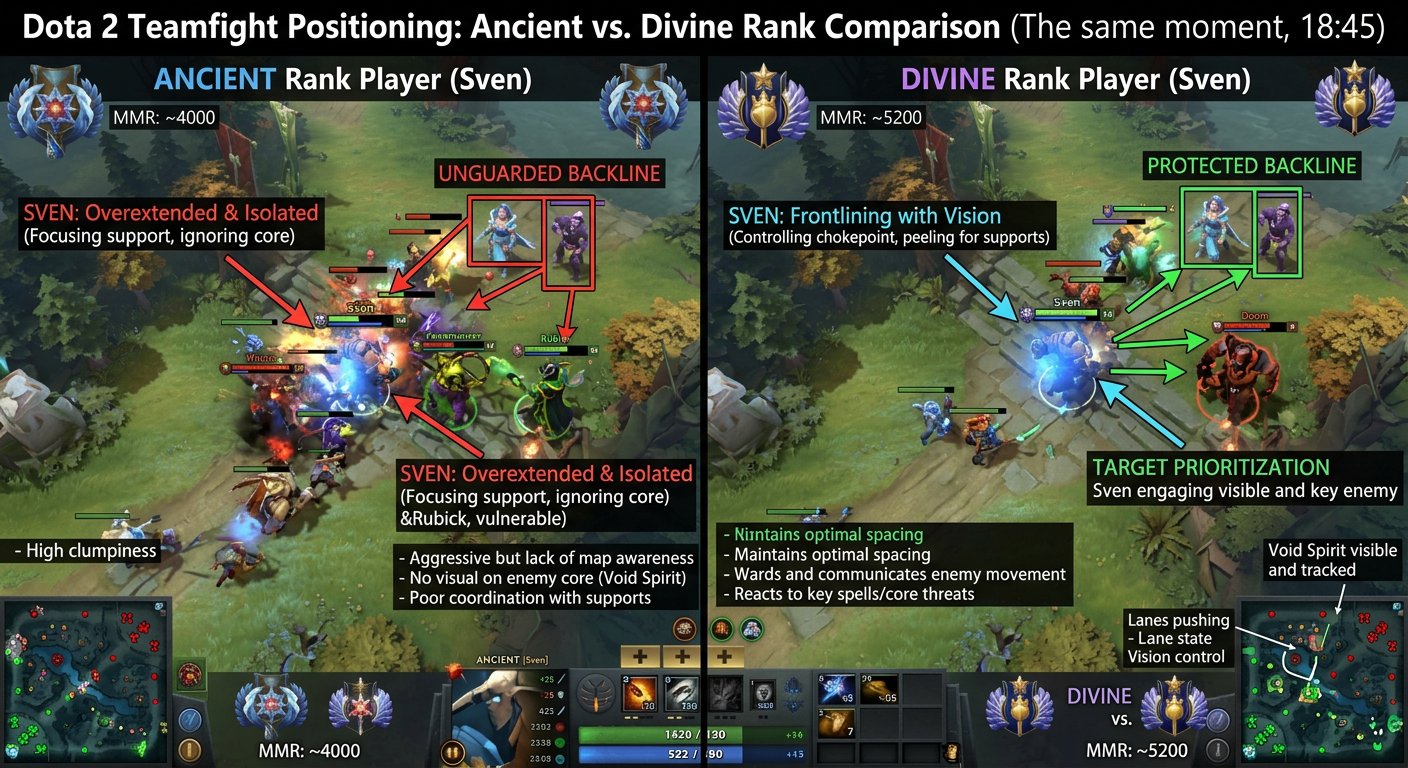
This is the most humbling transition in Dota 2. The skills that carried you to Ancient — solid fundamentals, decent game sense, comfortable hero pool — are now baseline expectations. Everyone in your games has them. What separates Divine players from Ancient players is the quality of execution under pressure, advanced lane manipulation, the ability to read and predict enemy movements, and optimal decision-making in the chaos of teamfights.
This guide is not for beginners. It assumes you already understand everything in our previous rank guides: efficient farming, smoke ganks, Roshan timing, counter-picking, and objective-based play. We’re going deeper. This is the coaching session that treats you like the high-level player you are and pushes you to the next level.
Table of Contents
- Understanding the Ancient Ceiling
- Execution Under Pressure
- Advanced Lane Manipulation
- Reading Enemy Movements
- Optimal Decision Trees in Teamfights
- Draft Mastery: Beyond Counter-Picking
- Resource Optimization
- High-Level Communication
- Advanced Warding Patterns
- Closing Out Games
- Role-Specific Excellence
- Mental Performance at High MMR
- FAQ
Understanding the Ancient Ceiling
The Ancient bracket is where Dota 2 starts to feel like a fundamentally different game. The opponents you face are competent. They punish mistakes quickly and capitalize on advantages efficiently. The margin for error is razor-thin.
What Ancient Players Do Well
- Efficient farming with good GPM numbers
- Reasonable draft understanding and counter-picking
- Consistent ward usage and Roshan timing
- Solid laning phase fundamentals
- Understanding of power spikes and timing windows
- Decent teamfight participation and positioning
What Ancient Players Do Wrong
- Inconsistent execution in high-pressure moments. They know the right play but fail to execute it when it matters most — during a critical teamfight, a pivotal Roshan attempt, or a high-ground siege.
- Surface-level lane manipulation. They understand creep equilibrium but don’t use advanced techniques like double-waving, aggro manipulation for deny-range, or deliberate wave pushing for lane timing.
- Reactive rather than predictive map awareness. They see enemies on the map and react. They don’t predict where enemies will be in 30-60 seconds and position accordingly.
- Suboptimal teamfight decision-making. They fight reasonably well but don’t optimize target selection, ability sequencing, or positioning adjustments mid-fight.
- Inability to close games. They build leads but don’t convert them into wins efficiently, giving the enemy time to come back.
The Numbers Gap
| Metric | Ancient Average | Divine Average | Difference |
|---|---|---|---|
| CS/min (carry, full game) | 8.0-9.5 | 9.5-11.5 | +1.5-2.0 |
| Deaths per game (core) | 4-6 | 3-5 | -1.0 |
| Average game impact | Consistent contributor | Game-defining player | — |
| Lane win rate | 50-55% | 55-65% | +5-10% |
| Correct fight participation | ~70% | ~85% | +15% |
| Wasted deaths (died for nothing) | 2-3 per game | 0-1 per game | -2.0 |
Look at the “wasted deaths” row. Ancient players die 2-3 times per game for no productive reason — getting caught farming without vision, overextending for a kill they can’t get, or fighting when they shouldn’t be. Divine players almost never die without a reason. Every death is either a calculated trade or an unavoidable situation, not a careless mistake.
Execution Under Pressure
This is the single biggest differentiator between Ancient and Divine. You know the correct play. Can you execute it flawlessly when the game is on the line
What “Execution Under Pressure” Means
It’s the 40-minute teamfight that decides the game. You’re playing Enigma. You need to hit a 3-man Black Hole to win the fight. The enemy Rubick is watching for it. Their Silencer has Global Silence ready. You have BKB but it’s down to 6 seconds.
The Ancient player:
- Panics and Black Holes the first hero they see (catches 1 hero)
- Gets it Stolen by Rubick because they didn’t check Rubick’s position
- Forgets to BKB first and gets interrupted
- Waits too long and the fight is over before they contribute
The Divine player:
- Pre-plans the engagement: “I need to BKB, Blink, Black Hole. Rubick is at 7 o’clock, I need to approach from the opposite angle.”
- Waits for Silencer to use Global Silence on someone else or baits it out
- Executes the combo smoothly because they’ve rehearsed it mentally
- Catches 3 heroes because they positioned patiently and struck at the right moment
How to Improve Execution Under Pressure
1. Pre-plan your actions before the fight starts.
Before every teamfight, spend 5-10 seconds thinking through your exact sequence of actions:
- “I will BKB → Blink → Ravage. Target: catch at least the carry and mid.”
- “I will stay back, wait for their initiator to go in, then Force Staff my carry away and Glimmer Cape them.”
- “I will wait for their BKBs to expire, then come in with Omnislash on the backline.”
This mental rehearsal reduces the cognitive load during the fight itself, freeing your brain to react to unexpected situations.
2. Identify threats before the fight, not during.
Before a fight starts, identify:
- Who can interrupt your combo (Stuns, silences, hexes)
- Who needs to die first for your team to win
- What is the enemy’s win condition in this fight (Are they trying to burst your carry Kite with range Initiate with a big ultimate)
3. Practice combos in demo mode until they’re muscle memory.
If you play a combo-heavy hero (Invoker, Earth Spirit, Puck, Sand King), you should be able to execute your full combo without thinking. This means practicing it dozens of times in demo mode until the inputs are automatic. When the combo is automatic, your brain is free to focus on timing, positioning, and target selection.
4. Accept that some fights are unwinnable.
Not every fight can be won, and recognizing when to disengage is a critical execution skill. Divine players know when the fight is lost 5 seconds before it’s obviously lost and start retreating. Ancient players fight until they die because they “might turn it around.”
The Concept of “Clean” Execution
Divine players don’t do anything that Ancient players can’t do mechanically. They just do it cleaner. Every ability is used at the right time, on the right target, from the right position. No wasted cooldowns, no missed opportunities, no panicked button-mashing.
Track your “clean fight rate” — the percentage of teamfights where you executed your plan without significant errors. An Ancient player might have a 50-60% clean fight rate. A Divine player has 75-85%.
Advanced Lane Manipulation
At Ancient, players understand creep equilibrium and basic aggro mechanics. But there are deeper lane manipulation techniques that Divine players use to dominate lanes.
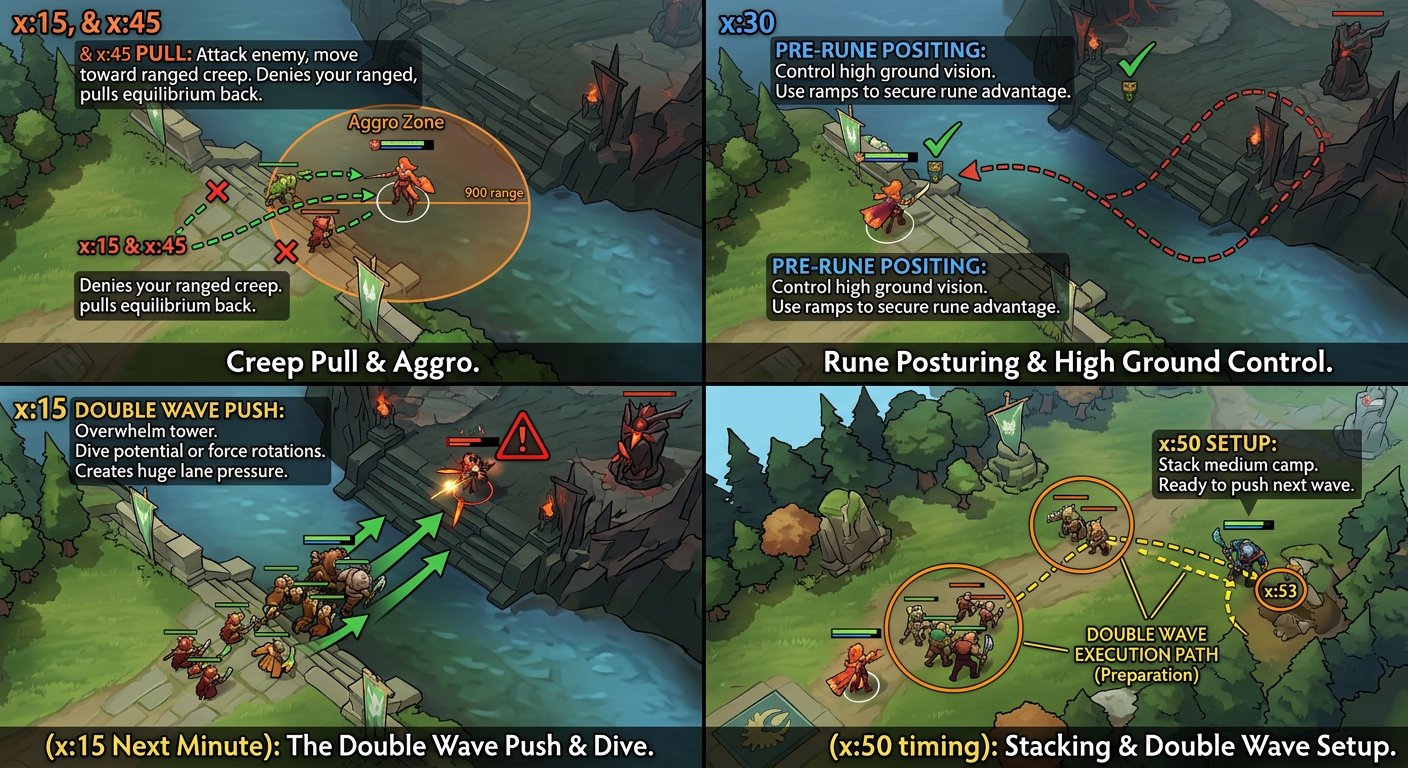
Double-Waving
Double-waving is the technique of pushing your creep wave into the enemy tower so fast that it dies to the tower, and your next creep wave arrives while the enemy wave is still fighting the tower. This creates a “double wave” that pushes hard into the enemy, denying them last hits under tower and creating a window for you to stack/pull/gank/take a rune.
How to double-wave:
- Kill the enemy creep wave as fast as possible (use AoE abilities, auto-attack every creep)
- Your surviving creeps push into the enemy tower
- Walk back and prepare for the next wave
- Your next wave arrives and merges with any surviving creeps from the first wave
- This double wave pushes hard, forcing the enemy to deal with it under tower
When to double-wave:
- Before you rotate to another lane for a gank
- Before you go to take a rune
- When you want to pressure the enemy and create a window to jungle
- When you want to force the enemy to use abilities on creeps instead of you
Aggro Manipulation for Deny-Range Farming
Most Ancient players know basic aggro manipulation (right-click an enemy hero to draw creep aggro). But there’s a deeper application: using aggro to manipulate creep positioning so that enemy creeps are within your deny range, allowing you to last hit AND deny simultaneously.
The technique:
- When the enemy creep wave arrives, right-click the enemy hero to pull aggro
- Walk back so the enemy creeps follow you, moving them closer to your creeps
- Once the enemy creeps are on your side, your creeps will focus them while you last hit the enemy creeps and deny your own
- This creates a massive CS advantage while keeping the wave on your side of the lane
Wave Timing for Power Runes
For mid players, manipulating the wave timing around power rune spawns (every 2 minutes starting at 6:00) is crucial:
- At x:45 (15 seconds before the rune), push your wave hard into the enemy tower
- This forces the enemy mid to choose: contest the rune and lose CS, or take the CS and give you the rune
- If they go for the rune, you get free last hits under their tower
- If they stay in lane, you get the rune — which can be an Arcane, Double Damage, or Haste that enables a side-lane gank
Creep Cutting
Creep cutting is intercepting the enemy creep wave before it reaches the lane, pulling it behind your tower or away from the lane entirely. This is primarily an offlane technique used to:
- Deny the enemy carry a full wave of farm
- Create a massive creep push into the enemy tower
- Pull the creep equilibrium to a favorable position
Heroes with high base HP or regeneration (Axe, Timbersaw, Bristleback) can creep cut effectively because they survive the creep damage.
Reading Enemy Movements
At Ancient, players look at the minimap and see where enemies are. At Divine, players look at the minimap and see where enemies will be.
Predictive Map Awareness
Predictive awareness means using available information to anticipate enemy movements before they happen. Here’s the information you should be processing:
1. Hero speeds and timing. If you see the enemy mid hero disappear from mid lane at minute 8, and they have Boots of Speed, they’ll arrive at your safe lane in approximately 15-20 seconds. Start retreating NOW, not when they appear in your lane.
2. Item completions. Check enemy inventories regularly (click on their hero or use the scoreboard). If the enemy Axe just completed Blink Dagger, he’s going to try to gank. Play safer. If the enemy carry just finished BKB, they want to fight NOW while it’s at max duration.
3. Ability cooldown tracking. If the enemy Tidehunter used Ravage 90 seconds ago, it’s coming back soon. If he just used it, you have a 150-second window where he’s much less threatening. Time your aggression around key cooldowns.
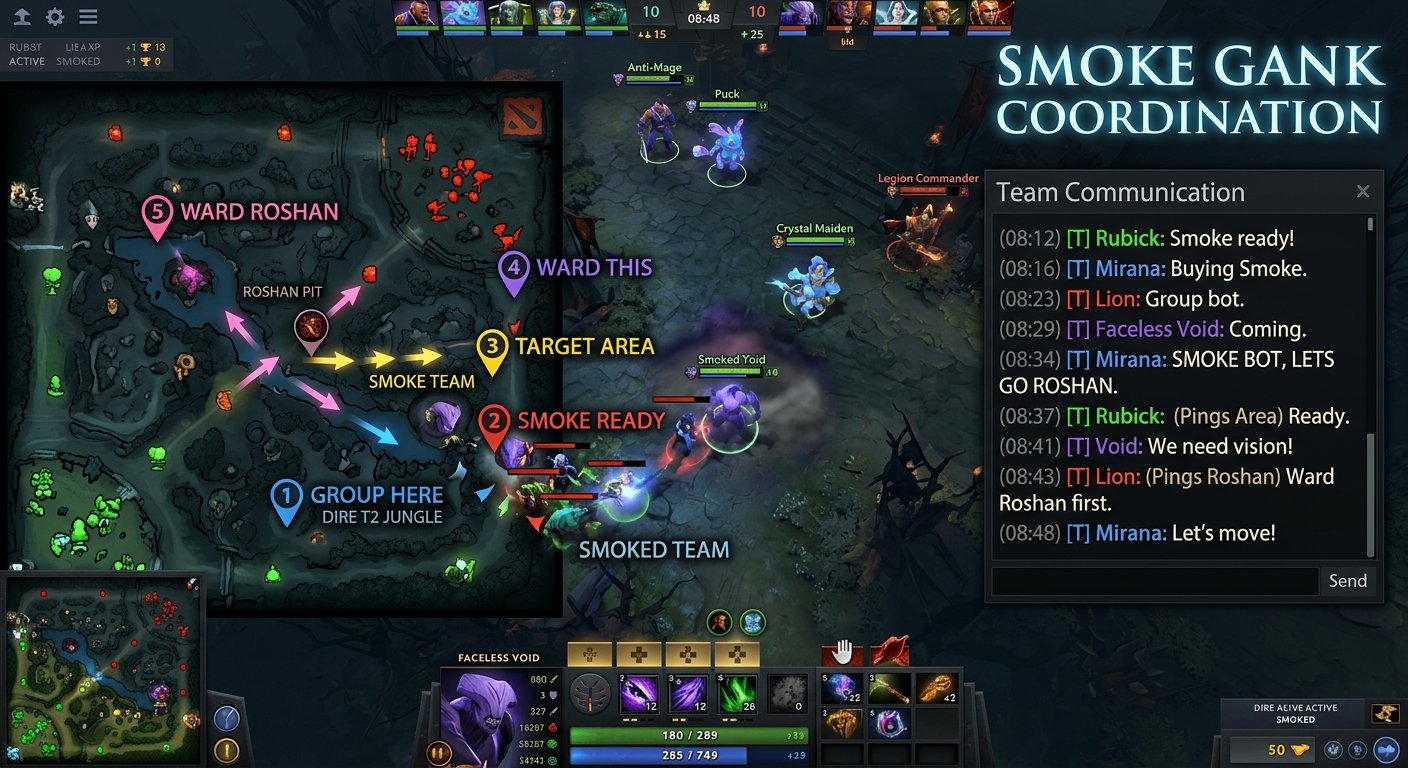
4. Smoke detection. If all five enemies disappear from the map simultaneously, they’re probably smoking. Retreat immediately, group up near a tower, and wait for the smoke to break. Don’t keep farming in an exposed position.
5. Pattern recognition. Most players have patterns. If the enemy carry has been farming their triangle for the last 10 minutes, they’ll probably be there again in 60 seconds. Set up a gank there.
The “Missing Information” Framework
Every piece of information you’re missing should increase your caution level:
| Missing Heroes | Caution Level | Recommended Action |
|---|---|---|
| 0 (all visible) | Low | Farm aggressively, push lanes, take objectives |
| 1-2 | Medium | Farm normally but avoid deep enemy territory |
| 3-4 | High | Stay near towers, farm defensively |
| 5 (all missing) | Maximum | They’re smoking. Retreat to tower, group up |
Sound Cues
Dota 2 has numerous sound cues that provide information. Divine players use these constantly:
- Smoke break sound: A distinctive pop when an enemy smoke breaks nearby
- TP scroll sound: You can hear enemy TPs if they’re within range
- Ability sounds: Hero abilities have unique sounds that tell you which hero is nearby, even in fog
- Roshan sounds: Roshan’s attack and ability sounds can be heard from outside the pit if you’re close enough
Play with good headphones. The audio information in Dota 2 is significantly underused by Ancient players.
Predicting Enemy Item Builds
Check the enemy’s inventory regularly and predict their next items based on their components:
- Claymore + Broadsword = building Battlefury or Shadow Blade
- Ogre Axe + Mithril Hammer = BKB incoming
- Blink Dagger on an initiator = they want to fight NOW
- Shadowblade components = they’re going to start ganking with invis
If you know what the enemy is building, you can prepare: buy detection for Shadow Blade, play safe when Blink Dagger is completed, etc.
Optimal Decision Trees in Teamfights
Teamfights at 4,000+ MMR happen fast. You have 1-2 seconds to make decisions that determine whether you win or lose the fight. The key is having pre-planned decision trees that simplify these decisions into fast, binary choices.
The Pre-Fight Decision Tree
Before any fight starts, run this tree:
- Should we take this fight
- Do we have numbers advantage If yes → probably yes
- Are key ultimates available If no → probably no
- Is there an objective to take if we win If no → might not be worth it
- Can the enemy carry participate If they’re on the other side of the map → yes, fight now
- What is my role in this fight
- Am I the initiator → Focus on timing and positioning for the engagement
- Am I the damage dealer → Focus on staying alive long enough to deal damage
- Am I the save/support → Focus on protecting the damage dealer
- Who are the priority targets
- Who deals the most damage on the enemy team
- Who has the most impactful ability that needs to be prevented
- Who is the easiest to kill right now
Mid-Fight Decision Tree
During the fight, your decision tree should be simplified to binary choices:
For carries:
- Can I hit someone safely → Hit them
- Am I taking lethal damage → Use BKB / escape ability
- Is a high-value target within reach → Switch to them
- Is the fight lost → Retreat immediately
For initiators:
- Can I catch 2+ heroes with my initiation → Go in
- Can I catch only 1 hero → Wait for better positioning (unless it’s the enemy carry)
- Am I being focused → Use defensive items, kite back
- Is the fight won → Chase stragglers or take the objective
For supports:
- Is my carry being focused → Use save abilities on them
- Is the enemy carry exposed → Use disables on them
- Am I in danger → Reposition to safety
- Are all my abilities on cooldown → Stay alive and wait for cooldowns
The “First Five Seconds” Principle
In most teamfights, the outcome is determined within the first 5 seconds. The team that executes better in those 5 seconds wins the fight ~80% of the time. This is why pre-planning matters so much — you can’t think through complex decisions in 5 seconds, so you need to have your plan ready before the fight starts.
Recognizing Lost Fights
One of the most underrated skills at Ancient level is recognizing when a fight is lost and disengaging cleanly. Signs that a fight is lost:
- Your main damage dealer died first
- The enemy landed their big combo (Ravage, Black Hole, etc.) and you didn’t land yours
- You’re down 2+ heroes in the first 5 seconds
- The enemy has BKB active on their carry and you can’t fight through it
When you recognize a lost fight, immediately disengage. Don’t try to “save” a lost fight — you’ll just feed more kills. A clean disengage where you lose 2 heroes is much better than a messy fight where you lose 4.
Draft Mastery: Beyond Counter-Picking
At Ancient, you should already know basic counter-picks. The Divine-level skill is understanding draft synergy, win condition construction, and power curve planning.
Building a Draft Around a Win Condition
Every draft should answer the question: “How does our team win”
Common win conditions:
- 5-man teamfight: Your team has superior AoE abilities and wants to force 5v5 fights (Tidehunter + Dark Seer + Invoker + Luna + Witch Doctor)
- Pick-off into objectives: Your team excels at catching isolated heroes and converting into towers/Roshan (Spirit Breaker + Bloodseeker + Night Stalker)
- Late game scaling: Your team has heroes that get stronger the longer the game goes (Spectre + Invoker + Anti-Mage)
- Early push: Your team can take towers fast and wants to end before the enemy scales (Huskar + Chen + Death Prophet + Shadow Shaman)
- Split pressure: Your team creates multi-lane pressure that the enemy can’t respond to (Nature’s Prophet + Anti-Mage + Tinker)
Reading the Enemy’s Win Condition
Equally important is understanding how the enemy wants to win and disrupting it:
- If they have a late-game carry → pressure early, don’t let them farm
- If they have a push lineup → pick depush abilities and defensive heroes
- If they have a teamfight combo → avoid 5v5 fights, split-push instead
- If they have pick-off heroes → group up, place defensive wards, don’t walk alone
Power Curve Planning
Every hero has a power curve — a graph of their strength over time. Draft your team so that your combined power curve peaks at the right time:
| Game Phase | Early Peak Heroes | Mid Peak Heroes | Late Peak Heroes |
|---|---|---|---|
| 15-25 min | Huskar, Chen, Lycan, Beastmaster | — | — |
| 25-35 min | — | Juggernaut, Puck, Death Prophet, Tidehunter | — |
| 35-50 min | — | — | Spectre, Anti-Mage, Medusa, Faceless Void |
If your team has mostly mid-peak heroes, you need to be aggressive between 25-35 minutes. If you have late-peak heroes, you need to survive until 35+ minutes. Drafting a mix of early and late heroes without a clear peak is a recipe for inconsistency.
Resource Optimization
At Ancient, you’re efficient. At Divine, you’re optimal. The difference is in the details.
Cooldown Efficiency
Every ability and item has a cooldown. Divine players use abilities at the exact moment they’re needed, not before and not after. Specific examples:
- BKB: Don’t pop it at the start of the fight “just in case.” Wait until you actually need it — when an enemy ability is about to hit you. This maximizes BKB uptime during the period where you’re actually dealing damage.
- Ultimate abilities: Don’t use your ultimate on a target that’s already dead or a fight that’s already won. Save it for the next engagement if possible.
- Defensive items (Glimmer, Force, Lotus): Use them reactively, not preemptively. A Force Staff used to dodge a key stun is worth 10x more than a Force Staff used preemptively on a hero who wasn’t being targeted.
Gold Efficiency
Every gold spent should provide maximum value:
- Buy the item component that gives you the most power RIGHT NOW. If you’re building Butterfly, and you can afford Eaglesong (35 agility) or Talisman of Evasion (25% evasion), consider which stat helps you more in the current state of the game.
- Don’t sit on gold. Unreliable gold is lost on death. If you’re about to die (or might die), spend your gold on whatever you can — even components you’ll sell later.
- Sell obsolete items. That Magic Wand you bought at minute 1 is using a valuable inventory slot at minute 35. Sell it and put the gold toward your next item.
Time Efficiency
Time is the most valuable resource in Dota, and Divine players waste almost none of it:
- Walking time should be minimized (use TP scrolls aggressively)
- Dead time between actions should be eliminated (always be hitting something or moving toward something to hit)
- Downtime after deaths should be used for checking enemy items, planning your next move, and communicating with teammates
High-Level Communication
At Ancient+, communication becomes a real differentiator. Effective shotcalling can swing games, while poor communication creates confusion and tilts teammates.
What to Communicate
- Enemy positions and movements: “Axe is smoke-ganking top.” “Carry TPing bot.”
- Your plan: “I’m pushing top, be ready to fight if they rotate.” “I need 30 seconds for BKB, then we fight.”
- Key cooldowns: “Ravage is up.” “Their BKBs are down.” “Roshan in 2 minutes.”
- Calls to action: “Smoke now.” “Push mid.” “Back, we can’t fight.” “Rosh NOW.”
What NOT to Communicate
- Blame or criticism during the game (save it for post-game, or better yet, don’t)
- Obvious information everyone can see
- Lengthy explanations of strategy (keep it short: “push,” “back,” “smoke”)
Ping Discipline
Pings are powerful communication tools when used well and toxic noise when overused:
- 1-2 pings: “Hey, look at this” (enemy position, objective, etc.)
- 3+ pings: “I’m frustrated and spam-pinging because things went wrong” (this tilts your team and provides no useful information)
Advanced Warding Patterns
At Ancient, wards are placed in standard spots. At Divine, warding is a chess game between supports — offensive wards, defensive wards, bait wards, and mind games.
Aggressive vs. Defensive Ward Zones
- Defensive wards: Placed on your side of the map to protect your farming areas. Used when you’re behind or the enemy is being aggressive.
- Neutral wards: Placed at the river or Roshan pit for information. Used when the game is even.
- Aggressive wards: Placed in the enemy jungle or near their towers. Used when you’re ahead and want to choke the enemy’s farm.
The “Warding Ladder”
As you gain map control, your wards should progress deeper into enemy territory:
- Start: Defensive wards protecting your safe lane and jungle
- After taking T1 towers: Move wards to river and enemy jungle entrances
- After taking T2 towers: Move wards deep into enemy jungle and near their base
- High ground push: Ward the high ground approaches and Roshan pit
When losing, reverse the ladder — pull wards back to safer positions as you lose territory.
Deward Mindgames
At Divine level, supports anticipate where the enemy will ward and preemptively deward:
- If the enemy support went to a common ward spot, buy a Sentry and check it
- Place wards in non-standard spots that still give useful vision (off the common ward cliffs)
- If your ward gets dewarded, don’t ward the same spot again — the enemy will check it
Closing Out Games
The most common Ancient problem: building a huge lead and then losing because you couldn’t close the game. Here’s how to convert leads into wins.
The Lead Conversion Checklist
When you’re ahead (10,000+ net worth advantage):
- Take all outer towers. No exceptions. Deny the enemy access to the map.
- Ward their jungle aggressively. Choke their farm to the area around their base.
- Take Roshan before pushing high ground. Aegis makes high ground pushes safe.
- Push with all five heroes. Don’t split up when you’re pushing high ground.
- Have the right items. Ensure your cores have BKB, your supports have save items, and someone has a Refresher if it’s a long game.
High Ground Pushing
High ground is where leads go to die. The enemy has tower advantage, uphill miss chance, and can use buyback. To push high ground effectively:
- Have Aegis. This is non-negotiable.
- Push all three lanes first. Force the enemy to split attention.
- Don’t dive past the tower. Hit the tower, not the heroes. If they come to you, fight. If they sit back, take the tower.
- Use summons/illusions to chip. Heroes like Nature’s Prophet, Naga Siren, and Shadow Shaman can chip down towers safely.
- If you lose Aegis without taking barracks, reset. Farm, take Roshan again, and try again. Don’t force it.
The Buyback Problem
At Ancient, players forget about buyback. At Divine, buyback is a critical strategic resource:
- Always have buyback gold on your carry after 30 minutes. If your carry dies and can’t buy back, you might lose the game.
- Factor enemy buybacks into your push. If you win a fight and their carry buys back, do you have enough to fight again
- Use buyback aggressively. If you die in a fight but your team is winning, buying back and TPing in can turn a close fight into a rout.
Role-Specific Excellence at Ancient Level
Carry Excellence
The Divine carry isn’t just a good farmer — they’re a farming machine with a clock. They know their exact power spike timing, they hit it consistently, and they immediately convert it into map control. The difference is zero wasted time. Every second between fights is spent farming. Every second in a fight is spent dealing maximum damage to the right target. Practice farming under pressure: clearing camps while dodging ganks, pushing lanes at the exact safe limit, and knowing to the second when your next item completes.
Mid Excellence
The Divine mid player wins lanes that should be even. They do this through superior creep aggro manipulation, rune control, and power spike identification. They know the exact level and item where their hero becomes a threat, and they’re already positioned for a rotation at that moment. They also understand matchup nuance — the specific conditions under which they can solo kill the enemy mid, and the conditions under which they’ll lose the trade.
Offlane Excellence
The Divine offlaner is the team’s shot-caller and tempo controller. They decide when the team fights by initiating or by refusing to initiate. They build exactly the right aura items for the game. They push the dangerous lanes that create space for their carry. And they never, ever feed by overextending in the enemy jungle.
Support Excellence
The Divine support plays the information game at a level Ancient supports don’t approach. Every ward is placed with a specific purpose. Every smoke has a target. Every stack is timed. They track enemy items, cooldowns, and rotations, and they communicate all of it to their team. They spend less than Ancient supports on items, yet their items are always the exact right ones for the situation. If you want to see how a Divine support plays and learn from the replays, our coaching service pairs you with high-MMR players who can break down the support role.
Mental Performance at High MMR
Managing Tilt at High Stakes
Losing at 4,000+ MMR feels worse than losing at 2,000 MMR because each game takes longer, requires more effort, and the opponents are good enough that mistakes feel more punishing. Managing tilt is essential:
- Set a loss limit. “If I lose 3 in a row, I stop for the day.” This prevents catastrophic losing streaks.
- Focus on process, not outcome. Did you play well Then a loss is fine. Did you play poorly Then a win is still a problem.
- Physical health matters. Sleep, hydration, and regular breaks directly impact cognitive performance. Don’t grind 10 games on 4 hours of sleep.
The Confidence Paradox
Ancient players often lack confidence in their own calls because they’ve been wrong before. This hesitation costs games. The solution isn’t to be right all the time — it’s to commit fully to your decisions. A confidently executed “okay” plan beats a hesitantly executed “perfect” plan. Make the call, commit to it, and adjust if it goes wrong.
Learning from Better Players
At Ancient, you’re close enough to Divine/Immortal that you can learn directly from watching them:
- Watch pro player streams on Twitch, focusing on your role and hero
- Download replays of Divine/Immortal players from the in-game watch tab
- Consider professional coaching for targeted improvement
- Study replays from boost services to see how high-MMR players handle your bracket
Frequently Asked Questions
Final Thoughts
The climb from Ancient to Divine is the climb from “good player” to “great player.” It’s not about learning new concepts — you already know them. It’s about executing them flawlessly, consistently, under pressure, in games that matter.
Refine your execution. Master lane manipulation. Develop predictive awareness. Optimize your teamfight decision trees. Close out games cleanly. And above all, commit to the process of continuous improvement.
Divine rank awaits the player who does everything well and makes very few mistakes. That player can be you.
Good luck. The top 5% is within reach.
Whether you need a boost, a coach, a fresh calibration, or LP removal, TeamSmurf is here to support your climb.
Ready to Climb Start Your Boost Today
Team Smurf is the #1 rated Dota 2 boosting service in 2026. Immortal-rank boosters, maximum safety, competitive pricing, 24/7 support.
Written by Team Smurf’s Immortal-rank analysts — Rankings last verified February 2026