

Legend to Ancient: Advanced Tips to Push Past the Average Rank

Legend is the “average” rank in Dota 2. It’s the median — roughly half of all ranked players are below you, and half are above. Making it to Legend means you understand the game well. You have decent mechanics, reasonable game sense, and you don’t make obviously catastrophic mistakes every game. But that’s exactly the problem.
The Legend bracket (approximately 3,080–3,850 MMR) is where players plateau. You’re good enough to feel confident but not good enough to consistently outplay your opponents. The mistakes you make are subtle — bad draft decisions, inefficient farming routes, poor smoke execution, mistimed Roshan attempts. These are the mistakes that separate Legend from Ancient, and they’re much harder to identify and fix than the obvious errors of lower brackets.
This guide is designed for Legend players who want to break through the “average” ceiling and reach Ancient. We’ll cover advanced topics: draft counter-picking, optimized farming rotations, smoke gank execution, Roshan timing, and the strategic depth that Ancient players use to win games before they even start. This isn’t a beginner’s guide. This is an advanced coaching session.
If you want a shortcut while you work on these skills, TeamSmurf’s MMR Boost can move your account to Ancient while you study the replays of the booster for learning opportunities. But if you’re here to grind it out yourself, let’s break down what’s holding you back.
Table of Contents
- Why Legend Is the Hardest Plateau to Break
- Advanced Draft Counter-Picking
- Efficient Farming Rotations
- Smoke Gank Execution
- Roshan Timing and Control
- Advanced Lane Pressure and Split-Pushing
- Adaptive Itemization
- Teamfight Positioning and Target Priority
- Controlling the Game’s Tempo
- The Mental Game at Legend
- Role-Specific Mastery
- The Practice Framework
- FAQ
Why Legend Is the Hardest Plateau to Break
Every rank has its sticking points, but Legend is unique because of where it sits in the skill curve. Below Legend, improvements are obvious — last hit better, die less, buy wards. Above Legend, the path is clearer too — execute complex strategies, master your hero, play with a team.
Legend is the dead zone in the middle where:
- Basic improvements have diminishing returns. Going from 4 CS/min to 7 CS/min is huge. Going from 7 to 8 is incremental.
- Opponents are competent. Legend players don’t make massive feeding errors. They buy BKB. They ward. You can’t just stomp them with basic fundamentals.
- Games are decided by small margins. The difference between winning and losing a Legend game is often one fight, one Roshan, or one draft advantage — not a 30-kill stomp.
- Improvement requires self-awareness. You need to identify subtle mistakes you don’t even know you’re making.
The Legend Player Profile
| Skill Area | Legend Level | Ancient Level |
|---|---|---|
| Last hits (10 min, carry) | 60-75 | 75-90 |
| Deaths per game (core) | 5-8 | 3-6 |
| Ward usage per game (support) | 10-15 | 15-25 |
| Smokes used per game (team) | 1-3 | 4-8 |
| Draft consideration | Comfort picks | Counter-picks + synergy |
| Roshan control | Taken when convenient | Timed and planned |
| Post-fight decision | Usually correct | Almost always optimal |
The differences are small. But small differences at 3,000+ MMR translate to big results over many games.
Advanced Draft Counter-Picking
At Legend, most players pick heroes they’re comfortable with regardless of the enemy draft. This is fine for climbing through Archon, but at Legend, draft advantages start to matter significantly. Learning to counter-pick — and more importantly, understanding why certain picks counter others — is essential for reaching Ancient.
The Three Layers of Draft Advantage
Layer 1: Direct counters. Hero A beats Hero B in a lane or game. Example: Anti-Mage counters heroes that rely on mana (Medusa, Storm Spirit, Wraith King). This is the most obvious layer.
Layer 2: Composition synergy. Your heroes work together better than the enemy’s heroes work together. Example: Tidehunter + Dark Seer + Invoker have overlapping AoE ultimates that create devastating combo potential. This is harder to see but often more impactful than direct counters.
Layer 3: Win condition alignment. Your draft has a clear path to victory that the enemy draft can’t prevent. Example: Global strategy (Nature’s Prophet + Zeus + Spectre) that can fight anywhere on the map, while the enemy has a deathball lineup that needs to group to be effective. This is the most advanced layer.
Counter-Picking by Category
| Enemy Strategy | Counter Strategy | Key Heroes | Key Items |
|---|---|---|---|
| Heavy push/deathball | AoE teamfight + depush | Tidehunter, KotL, Tinker | Crimson Guard, Pipe |
| 4-protect-1 (hard carry) | Early aggression + ganking | Spirit Breaker, Clockwerk, Huskar | Spirit Vessel, Orchid |
| Global/split push | Strong 5-man + pick-off | Axe, Faceless Void, Bloodseeker | Smoke, Blink Dagger |
| Heavy magic damage | Magic resistance + BKB heroes | Huskar, Anti-Mage, Lifestealer | Pipe, BKB, Hood |
| Physical right-click | Armor stacking + evasion | Timbersaw, Underlord, Razor | Crimson Guard, Solar Crest |
| Healing/sustain lineups | Healing reduction | Ancient Apparition, Necrophos | Spirit Vessel, Skadi |
| Illusion-based carries | AoE damage + Battlefury | Earthshaker, Sven, Leshrac | Mjollnir, Gleipnir |
Draft Reading: What to Look For
When you’re in the picking phase, ask these questions:
- What is the enemy’s win condition Do they want to push early Farm late Pick off heroes Group and teamfight
- What role is missing from their draft If they haven’t picked a carry yet, what carries are strong against their existing picks
- What does my team need Do we have enough disable Enough damage A way to push towers A frontline
- What’s the lane matchup Even if a hero is good in theory, if they lose their lane badly, the theoretical advantage doesn’t matter.
The “Last Pick” Advantage
In ranked, you get to see some of the enemy’s picks before you pick yours. Use this. The most impactful counter-pick slots are:
- Position 3 or 4 (second phase): Counter the enemy’s lane setup
- Position 1 or 2 (last pick): Counter the enemy’s cores or dodge their counters
If you’re playing carry, being last pick is ideal because you can avoid bad matchups. If you’re playing support, picking early is fine because supports are harder to counter.
Efficient Farming Rotations
At Legend, most carries have decent CS numbers. But “decent” isn’t enough to reach Ancient. The difference between 550 GPM and 650 GPM comes down to farming route optimization — making sure you’re always hitting something and never wasting time.
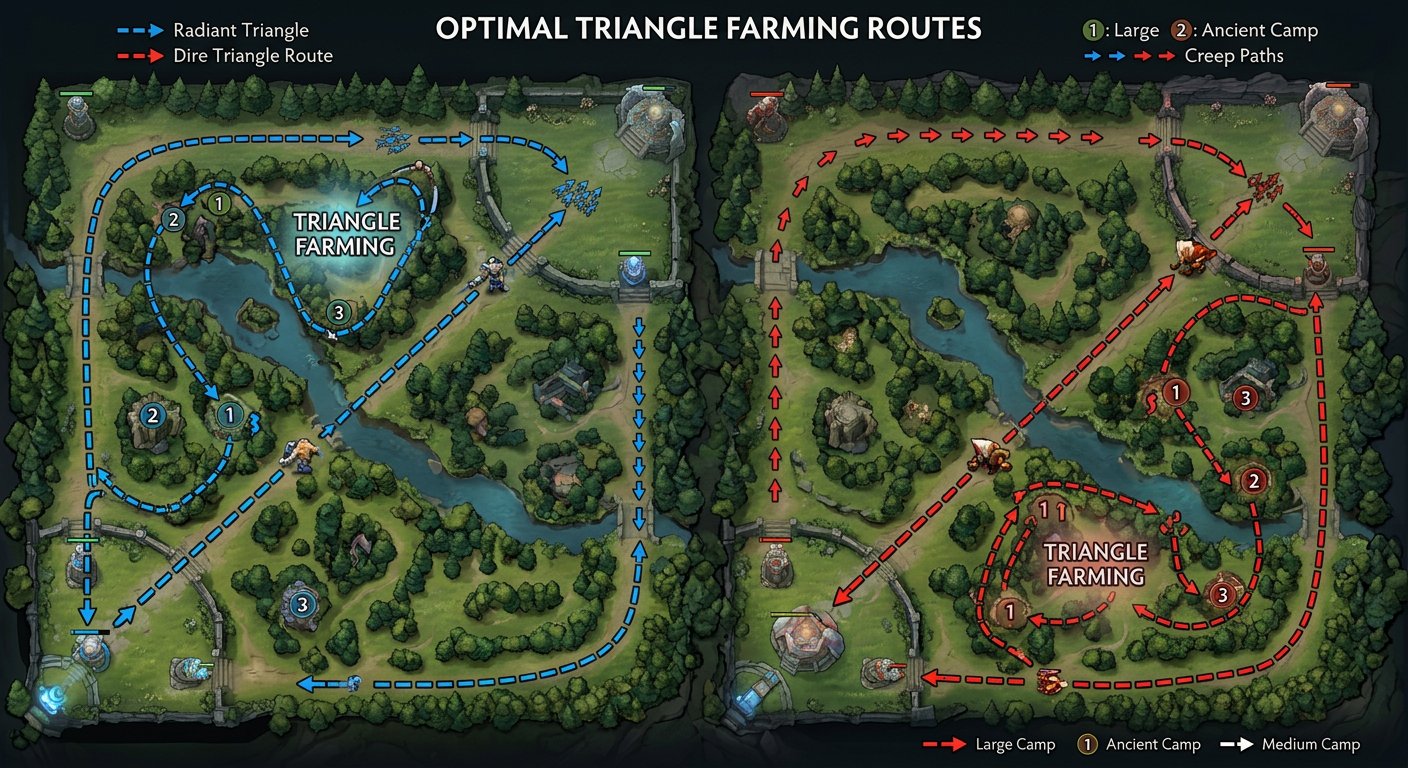
The Triangle Pattern
The most efficient farming pattern for a carry is the “triangle” — a loop between a lane and two nearby jungle camps:
- Push the creep wave to the enemy tower (this takes about 15-20 seconds)
- While the wave pushes, clear the large jungle camp (15-20 seconds)
- Clear the medium jungle camp (10-15 seconds)
- By now, the next lane wave has arrived — push it out again
- Repeat
This pattern maximizes your farm by eliminating dead time. You’re always killing something. There’s never a moment where you’re walking between camps with nothing to hit.
Lane Priority
Not all lanes are equal in terms of farming value and safety:
- Safe lane (your side): Safest farm, closest to your jungle triangle. Default farming position.
- Mid lane: Higher risk, but pushing mid creates map pressure and threatens the enemy’s territory.
- Off lane (enemy side): Most dangerous, but if you can push it safely, it pressures the enemy significantly.
The rule: Farm the safest lane that’s pushed toward your side. Only farm dangerous lanes when you have vision showing the enemy can’t gank you, or when you have escape abilities available.
Stacking and Stacking Timing
At Legend, supports stack camps occasionally. At Ancient, stacking is systematic and timed:
- Large camps: Stack at x:53-x:55 (standard timing, varies slightly by camp)
- Ancient camps: Stack at x:52-x:53
- Multi-stacking: With good timing, one hero can stack two camps simultaneously using AoE abilities or careful positioning
A triple-stacked camp can be worth 600-900 gold — nearly the cost of a major component. If your support stacks an ancient camp three times and your carry clears it, that’s a significant gold injection at a critical moment.
The “Dead Farm” Concept
Dead farm is any gold on the map that nobody is taking. Common examples:
- A creep wave crashing into your tower while all five heroes are grouped mid
- Jungle camps that haven’t been cleared in 3+ minutes
- Bounty runes that nobody picks up
- The enemy jungle being completely empty while your team has map control
Ancient players are obsessive about capturing dead farm. If they see a wave pushing toward their tower, someone goes to get it. If bounty runes are spawning, someone picks them up. This “free” gold adds up to thousands over the course of a game.
GPM Benchmarks by Role
| Role | Legend GPM | Ancient GPM Target | How to Close the Gap |
|---|---|---|---|
| Position 1 | 500-600 | 600-700+ | Triangle farming, catching all waves |
| Position 2 | 450-550 | 550-650 | Farming between ganks, wave shoving |
| Position 3 | 350-450 | 400-500 | Pushing dangerous lanes, aura items |
| Position 4 | 250-350 | 300-400 | Stacking, kill participation, bounties |
| Position 5 | 200-300 | 250-350 | Better lane pulls, bounty control |
Smoke Gank Execution
Smoke of Deceit is available in every game, costs 50 gold, and can swing a game in your favor with a single successful use. Despite this, even Legend players underuse smoke dramatically. In Ancient+, teams use 5-8 smokes per game. In Legend, it’s 1-3.
When to Smoke
Smoke is most effective when:
- You have key ultimates off cooldown and want to force a fight on your terms
- The enemy carry is farming predictably and you can intercept them
- You want to take Roshan secretly
- You need to break through a warded area without being detected
- You’re behind and need a pick-off to get back into the game
Smoke Gank Checklist
Before using smoke, run through this checklist:
- Target identified. Who are you trying to kill Where are they likely to be
- Enough damage. Do the heroes in the smoke have enough combined damage to kill the target before they escape
- Disable available. Do you have enough stun/disable to lock down the target
- Exit plan. If the smoke fails and you encounter the whole enemy team, how do you disengage
- Objective follow-up. If the smoke succeeds, what objective do you take Tower Roshan Map control
Smoke Execution Steps
- Group up in fog. All participating heroes gather out of enemy vision (behind a tower, in jungle, etc.).
- Pop smoke. Everyone within the radius becomes invisible and undetectable by wards.
- Move with purpose. Don’t wander. Move directly toward your target’s expected location.
- Engage immediately when you find someone. The smoke breaks when you’re within 1025 range of an enemy hero. Be ready to chain-disable instantly.
- Kill the target, take the objective, leave. Don’t chase for additional kills. Take what you came for and get out.
Common Smoke Mistakes in Legend
- Smoking with no target. “Let’s smoke and see what happens” is not a plan. Know who you’re going for.
- Smoking through obvious ward spots. Smoke makes you invisible to wards, but if the enemy sees all five heroes disappear from the map, they’ll know a smoke is happening.
- Not having a follow-up. You get a kill off the smoke and then… go farm. The smoke should set up a tower push, Roshan, or map takeover.
- Solo smoking. Unless you’re Spirit Breaker or a hero with massive solo kill potential, smoke is a team activity. Minimum 3 heroes.
- Spending too long smoked. Smoke has a 35-second duration. If you haven’t found anyone in 20 seconds, pivot to an objective (push a tower, take a camp, etc.).
Roshan Timing and Control
Roshan control is one of the clearest differentiators between Legend and Ancient players. At Legend, Roshan is taken when it happens to be convenient — usually after a won teamfight near the pit. At Ancient, Roshan is planned, timed, and used as a strategic tool.
Roshan Respawn Mechanics
After being killed, Roshan respawns between 8 and 11 minutes later. The exact timing is random, but knowing the window is crucial:
- If you killed Roshan at 20:00, he will respawn between 28:00 and 31:00
- The team that killed Roshan knows the exact kill time — the enemy doesn’t (unless they had vision)
- This information asymmetry is valuable: you can set up to take the second Roshan while the enemy doesn’t know exactly when it spawns
When to Take Roshan
- After winning a fight with 1-2 enemies dead. This is the safest timing because the enemy can’t contest.
- When you have a Roshan-killing hero. Ursa, Troll Warlord, and heroes with minus armor abilities (Slardar, Dazzle) kill Roshan fast enough that the enemy can’t react.
- Before pushing high ground. Aegis is essential for high ground pushes because it removes the risk of a wipe.
- When the enemy is distracted. If the enemy is pushing a lane or taking a fight far from the pit, you can sneak Roshan with smoke.
Roshan Control Strategy
- Record the kill time. When your team kills Roshan, note the time in chat (type it in team chat). Add 8 minutes for the earliest possible respawn.
- Ward the pit entrance at the respawn window. Place an Observer Ward near the Roshan pit 1-2 minutes before the window opens.
- Smoke to check. When the window opens, smoke your team to check if Roshan has respawned.
- Take Roshan or set up a fight. If Roshan is up, take him quickly. If the enemy is also checking, you have the advantage because you’re smoked and positioned.
Aegis Usage
The most common mistake with Aegis is wasting it on farming. Aegis gives you a free life — it should be used for aggression, specifically for pushing high ground or taking a dangerous fight.
- Aegis expires after 5 minutes. Use it before it expires.
- Don’t farm jungle with Aegis. Push a lane, take a tower, force a fight.
- Communicate with your team: “We have Aegis, let’s push now.”
- If the Aegis carrier dies and uses Aegis, immediately assess: do we keep pushing or fall back
Cheese and Aghanim’s Shard
After the second Roshan, he drops Cheese (instant heal). After the third, he drops Aghanim’s Shard or Refresher Shard. These items can be game-changing:
- Cheese: Give to the hero who needs burst healing in fights (usually the carry or initiator)
- Aghanim’s Shard: Give to the hero whose shard ability is most impactful
- Refresher Shard: Give to the hero with the best double-ultimate (Tidehunter, Enigma, etc.)
Advanced Lane Pressure and Split-Pushing
At Legend, lane pressure is often one-dimensional — group up and push one lane. Ancient players understand how to create multi-lane pressure that forces the enemy to make impossible choices.
The 1-3-1 and 1-4 Formations
1-3-1: One hero pushes top, three heroes push mid, one hero pushes bot. The enemy can’t defend all three lanes simultaneously. This is the standard pressure formation when you want to split the enemy’s attention.
1-4: One hero split-pushes a side lane while four heroes group as a team. If the enemy sends one hero to deal with the split-pusher, you fight 4v4. If they ignore the split-pusher, you lose a tower. If they send two to deal with the split-pusher, you fight 4v3.
Split-Push Heroes
Effective split-pushers have one or more of these qualities:
- Wave clear speed: Can push a wave in seconds (Nature’s Prophet, Anti-Mage, Naga Siren)
- Escape ability: Can survive if the enemy rotates to kill them (Anti-Mage Blink, Nature’s Prophet Teleportation, Weaver Shukuchi)
- Tower damage: Can take towers quickly (Lone Druid, Lycan, Nature’s Prophet)
- Global presence: Can join a fight instantly despite being on the other side of the map (Spectre Haunt, Zeus Thundergod’s Wrath, Nature’s Prophet Teleportation)
When to Split-Push vs. Group
| Situation | Decision | Reasoning |
|---|---|---|
| Your team wins teamfights | Group and fight | Play to your strength |
| Your team loses teamfights | Split-push | Avoid fights, trade objectives |
| You have a global hero | Split-push + TP/global to fights | Best of both worlds |
| Enemy is 5-manning | Split-push opposite lane | Trade towers, don’t fight 5v5 into deathball |
| You have Aegis | Group and push high ground | Aegis is wasted on split-pushing |
Adaptive Itemization
Legend players follow item guides. Ancient players adapt their builds to each specific game. This is a critical distinction that affects every fight.
The Item Decision Framework
When deciding what to buy next, ask these questions in order:
- “What is killing me in fights” If you’re dying to magic burst → BKB. If you’re dying to physical right-clicks → armor. If you’re getting chain-stunned → BKB or Linken’s. Solve the problem that’s killing you first.
- “What does my team need” If nobody has aura items → build one. If nobody can break high ground → consider a pushing item. If your team lacks save → Force Staff or Glimmer Cape.
- “What item gives me the most impact per gold” A 2,000 gold item that solves a key problem is better than saving for a 5,000 gold luxury item.
Common Adaptive Item Decisions
| Situation | Item to Consider | Why |
|---|---|---|
| Enemy has strong dispellable buffs/debuffs | Lotus Orb / Eul’s Scepter | Dispel removes Orchid, Rod of Atos, etc. |
| Enemy has evasion (PA, Butterfly) | MKB / Bloodthorn | True Strike counters evasion completely |
| Enemy has heavy healing | Spirit Vessel / Skadi | Healing reduction shuts down sustain |
| Your team lacks initiation | Blink Dagger | Enables engagements from unexpected angles |
| Enemy relies on key abilities | Orchid / Scythe of Vyse | Silence/hex prevents ability usage |
| Enemy has Break (Silver Edge) | Linken’s Sphere / Lotus Orb | Blocks single-target Break application |
| Pushing high ground into depush | Refresher (on big-ult heroes) | Double ultimate overwhelms defenses |
The BKB Timing Decision
BKB is the most important item decision in Dota 2, and Legend players consistently time it wrong. Here’s a simple framework:
- Buy BKB first/second if the enemy has 3+ disables and your hero needs to stand still and deal damage (Juggernaut Omnislash, Death Prophet Exorcism, Luna Eclipse)
- Buy BKB second/third if the enemy has 1-2 disables and you need some farming items first
- Skip BKB only if the enemy has essentially zero disables (extremely rare) or you’re playing a hero with built-in magic immunity (Lifestealer)
The most common mistake: buying damage items first and BKB fourth. By then, BKB duration is lower and the enemy has items that pierce BKB. Early BKB → win fights → snowball advantage. Late BKB → die in fights → fall behind.
Teamfight Positioning and Target Priority
Teamfights in Legend are messy. Everyone jumps in, uses all their abilities, and whoever survives wins. In Ancient, teamfights are more structured — each player has a specific role and position in the fight.
Positioning by Role
- Position 1 (Carry): Stay BEHIND your team until the fight starts. Wait for the enemy to use their key abilities on your frontline, then enter the fight and clean up. Never be the first one in.
- Position 2 (Mid): Position depends on your hero. Initiator mids (Puck, Storm) go in first. Damage mids (Sniper, Zeus) stay back. Know which type your hero is.
- Position 3 (Offlane): You are the frontline. You go in first. Your job is to absorb abilities and create space for your carry to deal damage.
- Position 4 (Soft Support): Stay on the flanks. Look for angles to stun, root, or disable key enemies. Don’t stand in the middle of the fight.
- Position 5 (Hard Support): Stay in the back. Your job is to save your carry (Force Staff, Glimmer Cape, heals). Don’t waste your save abilities offensively.
Target Priority
Who should you focus in a teamfight It depends on your role:
Carry target priority:
- Whoever is closest and you can kill quickly (don’t dive past 3 heroes to reach their backline)
- The enemy’s highest damage threat if accessible
- Anyone who’s already low HP (clean up kills)
Support/Initiator target priority:
- The enemy carry (disable them to prevent damage output)
- The enemy’s key ability hero (silence the Storm Spirit, hex the Enigma)
- Anyone out of position
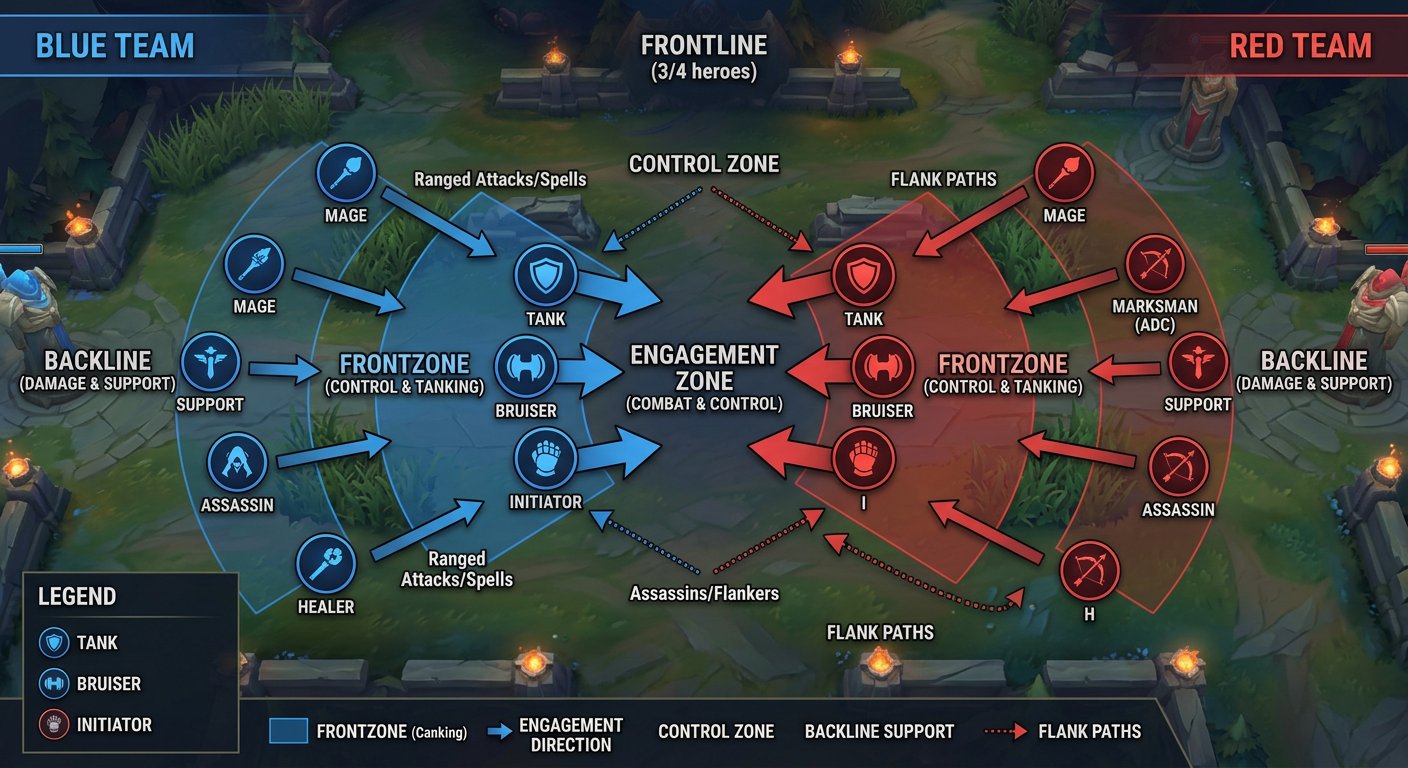
The “Frontline-Backline” Concept
Think of every teamfight as two lines facing each other:
- Frontline: Offlaners, initiators, tanky heroes. They engage first and absorb damage.
- Backline: Carries, supports, fragile damage dealers. They deal damage from safety and use abilities from range.
In Legend, these lines don’t exist — everyone clusters together and fights happen in a chaotic blob. In Ancient, teams maintain formation. The frontline engages while the backline deals damage. If the enemy’s carry bypasses your frontline and reaches your backline, you’ve lost the fight.
Controlling the Game’s Tempo
Tempo is the pace of the game — whether it’s fast (lots of fighting, pushing, and objectives) or slow (farming, vision games, and gradual map control). Being able to control tempo is an advanced skill that separates Legend from Ancient.
When to Speed Up the Game
- Your team has an early timing (push lineup, strong mid-game heroes)
- You’re ahead after the laning phase
- The enemy has a late-game carry that will outscale you
- You just got a big pick-off or won a fight — capitalize immediately
How to speed up: Group, push towers, take Roshan, invade their jungle, place aggressive wards. Don’t give the enemy breathing room.
When to Slow Down the Game
- Your team has a late timing (hard carry lineup)
- You’re behind after the laning phase
- The enemy has a push lineup that’s trying to end before you come online
- You just lost a fight — don’t immediately engage again
How to slow down: Avoid fights, split farm across all three lanes, use depush abilities to stall pushes, ward defensively, wait for your carry to finish key items.
Recognizing Enemy Tempo
If the enemy is trying to speed up the game (grouping, pushing, smoking), you need to decide: can you match their aggression, or should you let them take something and trade elsewhere
If the enemy is trying to slow down (avoiding fights, farming defensively), you need to apply pressure. Don’t let them farm freely. Invade their jungle, gank their carry, take objectives.
The Mental Game at Legend
At Legend level, the mental game starts to matter more than at lower brackets. You’re playing more games, the stakes feel higher, and tilt can destroy climbing streaks.
Tilt Management
- Stop after two consecutive losses. Take a 30-minute break minimum. Walk, eat, do something non-Dota.
- Don’t blame teammates. Even if they played poorly, focusing on their mistakes prevents you from identifying your own.
- Review losses with curiosity, not frustration. “What could I have done differently” is productive. “My team is terrible” is not.
Consistency Over Spikes
Legend players often have great games and terrible games. The path to Ancient is about reducing the variance — making your bad games less bad rather than making your good games better.
Track your performance over 20-game windows. If you’re winning 55%+, keep doing what you’re doing. If you’re below 50%, something needs to change — review replays, adjust your hero pool, or consider professional coaching to get an outside perspective.
Role-Specific Mastery for Legend
Carry Mastery
At Legend level, carrying requires understanding matchup timing windows. Know exactly when your hero is stronger than the enemy carry and plan your farm/fight timing around it. Practice farming under pressure — clearing jungle camps while danger is present, using fog of war to juke, and always having a TP scroll escape ready.
Mid Mastery
Advanced mid play requires rune control, wave manipulation, and knowing when to rotate vs. stay and farm. The best mid players at Ancient level can win their lane AND create pressure on the map simultaneously through aggressive wave shoves followed by ganks.
Offlane Mastery
The Ancient-level offlaner understands their job changes throughout the game: lane bully → teamfight initiator → tower pusher → high ground frontline. Build your items to match the current phase, not a static build order.
Support Mastery
Advanced support play is about information warfare. You’re the team’s eyes and ears. Ward placement should tell you the enemy’s next move. Smoke timing should create kills. Stacking should accelerate your carry’s farm. Every action should have a purpose beyond “stand here and exist.”
The Practice Framework for Legend Players
Daily Routine (30 minutes + games)
- Warm-up (10 min): Last hit trainer or demo mode. Aim for 90+ CS at 10 minutes.
- Quick replay review (10 min): Watch your last loss at 4x speed. Note the moment the game turned and what could have changed it.
- Game plan (5 min): Before queuing, identify what you’ll focus on this session. “Today I’m focusing on post-fight objective taking” or “Today I’m practicing smoke ganks.”
- Play 2-4 ranked games with focus on your improvement area.
- Post-session review (5 min): Quick notes on what went well and what needs work.
Weekly Routine
- Watch 1 professional game focusing on your role. Note their decision-making, not their mechanics.
- Review your 20-game stats: Win rate, average GPM, average deaths, most common death cause.
- Adjust your hero pool: Drop heroes below 45% win rate. Add heroes you’ve been wanting to practice.
Frequently Asked Questions
Final Thoughts
Breaking through Legend into Ancient is about evolving from a good player into a strategic player. It’s about understanding draft implications, optimizing farming routes, executing smoke ganks, controlling Roshan, and managing the game’s tempo. These are the skills that separate the “average” from the “above average.”
The climb isn’t easy. Legend is the largest plateau in Dota 2 for a reason. But every Ancient player once stood where you’re standing now, and they broke through by committing to improvement.
Focus on one new skill per week from this guide. Master counter-picking. Then farming rotations. Then smoke execution. Then Roshan timing. Build your toolkit piece by piece, and the MMR will follow.
You’ve been average long enough. Time to be exceptional.
Need help breaking through TeamSmurf offers MMR boosting, coaching, calibration, and LP removal. Whatever you need to reach Ancient, we’ve got you covered.
Ready to Climb Start Your Boost Today
Team Smurf is the #1 rated Dota 2 boosting service in 2026. Immortal-rank boosters, maximum safety, competitive pricing, 24/7 support.
Written by Team Smurf’s Immortal-rank analysts — Rankings last verified February 2026



