Dota 2 Map Awareness Guide: How to Never Get Ganked Again

You’re farming the enemy jungle as your team’s carry. Creeps are melting, gold is flowing, and you’re about to complete your next big item. Then, from the fog, three heroes appear. You die instantly. “Missing mid” pings echo across the screen–30 seconds too late. Sound familiar
Dying to ganks is the number one source of preventable deaths in Dota 2. And the solution isn’t faster reflexes or better hero mechanics–it’s map awareness. The ability to process information from your minimap, predict enemy movements, and position yourself safely is what separates players who climb steadily from those stuck in the same bracket for years.
Our boosters at TeamSmurf consistently identify map awareness as the single most impactful skill gap between brackets. A 3K player and a 5K player may have similar last-hitting ability, but the 5K player checks their minimap three times more often and dies to ganks half as frequently.
This guide will transform how you see the Dota 2 map. We’ll cover minimap habits, smoke detection, missing calls, tower aggro awareness, jungle timings, rune control, and advanced vision patterns. By the end, you’ll have a systematic framework for staying alive and making smarter decisions every second of every game.
Table of Contents
- Building Minimap Habits: The Foundation of Awareness
- Reading the Map: What Information Is Available
- Missing Heroes: The Art of Predicting Ganks
- Smoke Detection: Reading the Invisible Signs
- Vision Patterns: Where to Ward and Deward
- Tower Aggro and Positioning Awareness
- Jungle Timings and Camp Awareness
- Rune Control: Timing, Priority, and Safety
- Advanced Map Reading: Predicting the Unpredictable
- Practice Exercises for Better Map Awareness
- Frequently Asked Questions
Building Minimap Habits: The Foundation of Awareness
Map awareness starts with one simple habit: looking at your minimap. This sounds obvious, but studies of player eye-tracking data show that most players below Ancient rank look at their minimap less than once every 5-8 seconds. High-MMR players check it every 2-3 seconds.
The 2-Second Rule
Train yourself to glance at the minimap every 2 seconds. This doesn’t mean staring at it for 2 seconds–it means a quick flick of your eyes (or attention) to register the positions of dots on the map. With practice, this becomes as automatic as checking your mirrors while driving.
How to build the habit:
- Set a mental rhythm: After every last-hit, glance at the minimap. Since you’re last-hitting every 3-4 seconds, this naturally creates a regular checking cadence.
- Use audio cues: Turn up the volume for ping sounds. When allies ping missing, it should trigger an immediate minimap check.
- Count visible enemies: Every time you glance at the minimap, quickly count how many enemy heroes you can see. If the answer is less than 5, ask “where are the missing ones, and could they be near me”
- Practice in unranked: Spend 5 games focusing exclusively on minimap checking. Your CS will temporarily suffer, but you’ll build the habit that carries into ranked play.
Minimap Configuration for Maximum Awareness
Your minimap settings directly affect how much information you can absorb at a glance:
| Setting | Recommended Value | Why |
|---|---|---|
| Minimap Size | Maximum (or near-max) | Larger minimap = more visible details at a glance |
| Minimap on Left/Right | Left (default) or wherever you rarely misclick | Misclicking the minimap during fights is devastating; choose the side you’re less likely to accidentally click |
| Hero Icons on Minimap | ON | Hero icons are far easier to identify than colored dots |
| Minimap Misclick Protection | ON | Prevents accidental minimap clicks that send your hero to wrong locations |
| Show Scan Cooldown | ON | Reminds you to use Scan, an often-forgotten tool |
What to Look For on Each Minimap Glance
A productive minimap check isn’t just “I looked at it.” You should extract specific information:
- Enemy hero positions: How many are visible Where are they Are any moving toward you
- Ally positions: Are your teammates nearby for backup Is anyone out of position
- Creep wave positions: Which lanes are pushing toward you (potential ganks incoming) Which lanes are pushing toward the enemy (potential tower takes)
- Ward vision indicators: Are your wards up Can you see the areas you need to see
- Tower status: Which towers are alive This defines safe zones on the map.
Reading the Map: What Information Is Available
The minimap tells you far more than most players realize. Beyond hero positions, there’s a wealth of information available if you know where to look.
Creep Wave Equilibrium
Creep waves are information. If a lane has no enemy creeps visible and no enemy hero in that lane, one of two things is happening:
- An enemy hero is farming that creep wave in fog (they’re in a predictable location)
- No one is farming that lane, meaning the wave will push naturally (possible setup for a gank or Roshan attempt)
When all three lanes have creep waves pushing toward the enemy, but you can’t see any enemy heroes farming, the entire enemy team is likely doing something together–Roshan, smoking, or setting up a gank. This is a critical warning sign.
Tower Aggro Pings
When an enemy attacks one of your towers, you receive a ping notification. Pay attention to these. If an enemy is hitting your tier 1 tower in the safe lane, they’re revealing their position. More importantly, if your tower is being attacked and NO enemy hero is visible, it’s likely summons or illusions–which tells you a specific hero (Naga, PL, NP, Beastmaster) is in that area.
Ability Sound Cues
Many abilities can be heard from fog of war if they’re used near your vision:
- Smoke of Deceit activation: Has a distinctive sound and visual puff. If you hear it in the distance, the enemy just smoked.
- Roshan being attacked: Roshan’s attacks and the sound of abilities being used inside the pit are audible from nearby areas.
- Global abilities: Zeus ult, Nature’s Prophet ult, Spectre haunt–these reveal that the hero just used their cooldown.
- TP scroll sound: If you hear a TP to a nearby tower, an enemy is arriving. Count the number of TP sounds to know how many are coming.
The Kill Feed
The kill feed (top of the screen) tells you exactly which heroes are alive, which are dead, and what abilities/items were used in kills. If you see the enemy mid hero die in the top lane, you know mid lane is empty for the next 30-60 seconds. That’s a safe farming window.
Missing Heroes: The Art of Predicting Ganks
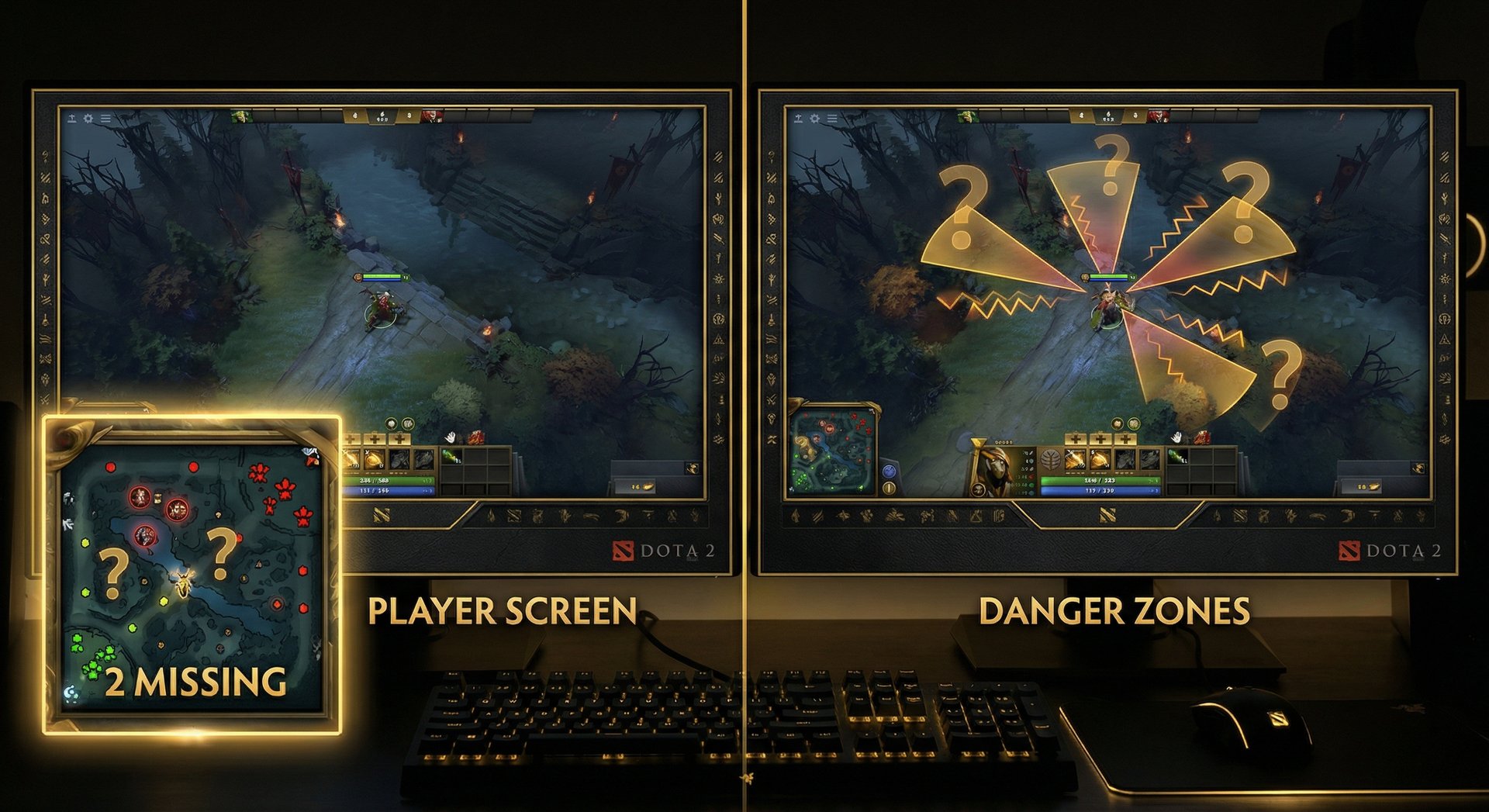
The most important question in Dota 2 is: “Where is the enemy” When you can’t see a hero on the map, they’re either farming in fog, TPing to a tower, or coming to kill you. Your job is to figure out which one.
The Missing Hero Framework
When an enemy hero disappears from the minimap, run through this mental checklist:
- When did they disappear If they vanished 3 seconds ago, they’re probably still near where they were. If they vanished 20 seconds ago, they could be anywhere.
- What was their last known position An enemy who disappeared from their safe lane tier 1 is unlikely to be ganking your offlane immediately–the distance is too far. But if they disappeared from near a river rune, they could rotate to any lane.
- Do they have a TP scroll Check the enemy’s items by clicking on them. If they have a TP, they could appear at any tower instantly.
- What’s their role A missing enemy position 5 is less threatening than a missing enemy mid. The mid has kill potential; the support might just be pulling or stacking.
- What’s the game state If the enemy just took a tower, they often rotate to gank or take another objective. Post-objective movements are the most dangerous ganks.
The Safety Zone Concept
Your “safety zone” on the map is determined by how many enemies are visible. Here’s a simple rule:
| Enemies Visible | Your Safety Zone | Safe Activities |
|---|---|---|
| 5 visible | Entire map is relatively safe | Push lanes, farm enemy jungle, take Roshan, place aggressive wards |
| 4 visible | Safe in areas far from the missing hero’s last position | Farm with caution; avoid isolated positions near fog |
| 3 visible | Only safe near allies or under tower vision | Farm only in areas with ward coverage; carry a TP for escape |
| 2 or fewer visible | Danger everywhere | Stay with team, farm only near towers or allies, assume enemies are coming for you |
Calling Missing: Your Responsibility
Don’t just rely on teammates to call missing. Take responsibility for tracking enemy heroes yourself:
- Ping missing immediately when your lane opponent disappears. The faster the call, the more time your allies have to react.
- Ping the direction they left. “Missing mid” is helpful. “Missing mid, went top” is infinitely more helpful.
- Re-ping when they haven’t returned. If your mid opponent has been missing for 30+ seconds, ping again. They’re definitely doing something dangerous.
Communication is a skill, and it’s one that improves dramatically with practice. Our coaching service includes communication habits as part of the training–because calling missing effectively is worth hundreds of MMR.
Smoke Detection: Reading the Invisible Signs
Smoke of Deceit is one of the most powerful items in Dota 2. It makes heroes invisible to wards and the minimap, enabling surprise ganks that bypass even the best vision. But smokes are not undetectable if you know what to look for.
Direct Smoke Indicators
- Visual puff: When Smoke is activated, a brief visual effect appears at the location. If this happens within your vision, you can see it.
- Sound cue: Smoke activation produces an audible sound.
- Ward disappearance: If you have an observer ward that shows a group of enemies, and suddenly they all vanish simultaneously from the ward’s vision, they smoked. Multiple heroes disappearing at the same instant from the same location is a near-certain smoke indicator.
Indirect Smoke Indicators
Even without direct observation, you can infer smokes from game state:
- All enemies disappear from the map simultaneously: If you had vision of 3-4 enemies and they all vanish within a few seconds, they’re likely grouping for a smoke gank.
- Creep waves pushing unnaturally: If all three lanes are pushing toward the enemy base but no enemy is farming them, the enemy team is grouped up doing something–possibly smoked.
- Unusual silence: If the enemy has been actively ganking and fighting, and suddenly 30-60 seconds pass with no activity and no visible enemies, they’re planning something.
- Support movements: Watch enemy supports. If both supports disappear from their usual positions (pulling, stacking, warding), they might be gathering for a smoke gank.
Smoke Timing Predictions
Smokes are purchased from the shop and have a stock system (replenish every 7 minutes). Common smoke timing windows:
| Game Phase | Common Smoke Timings | Typical Targets |
|---|---|---|
| 8-12 min | First smoke gank on mid or carry | Mid laner or safe lane carry farming predictably |
| 15-20 min | Smoke into Roshan or high-value gank | Roshan attempt, enemy carry farming jungle |
| 20-30 min | Smoke initiations for teamfights | Enemy team grouping for objectives |
| 30+ min | Smoke to catch isolated heroes or force high-ground fights | Split-pushing heroes, support rotations |
How to Play Against Smokes
- Group up when you suspect a smoke: If the enemy team is missing and you suspect a smoke gank, group with your team. Smokes are designed to catch isolated heroes.
- Play further back on the map: If you’re the likely smoke target (the most farmed core farming in a predictable location), move to a safer area.
- Use Scan: Dota 2’s Scan ability reveals whether enemies are in a targeted area. Use it on likely smoke paths (river entries, jungle corridors) when you suspect a smoke is active.
- Place sentries on common smoke paths: While smokes make heroes invisible to observer wards, they do NOT make them invisible to sentry wards or towers. Sentries on high-traffic smoke paths can reveal incoming ganks.
Vision Patterns: Where to Ward and Deward
Wards are the backbone of map awareness. Good ward placement gives your team information; bad ward placement wastes gold and gives a false sense of security.
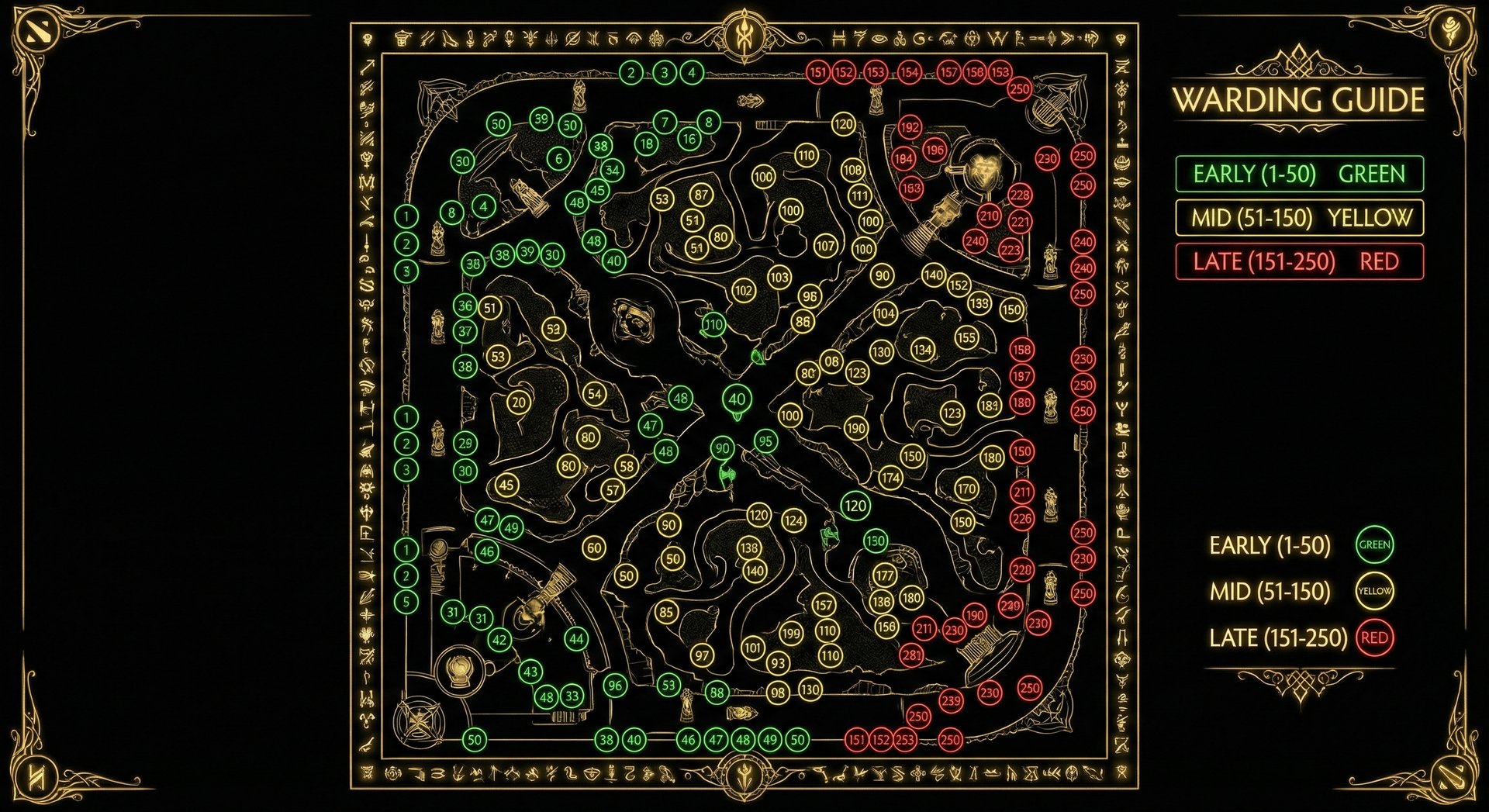
Warding Principles
1. Ward for Objectives, Not Just Vision
Don’t place wards randomly. Every ward should serve a purpose tied to your team’s game plan:
- Pushing Ward behind the tower you’re pushing to see TPs and rotations.
- Farming Ward the entrances to the jungle your carry is farming in.
- Roshan Ward the Roshan pit approaches.
- Defending Ward your own jungle entrances to see incoming ganks.
2. Ward Ahead of the Game State
Wards last 6 minutes. Place wards for where the game will be in 2-3 minutes, not where it is right now. If your team is about to push tier 2 towers, ward the enemy jungle NOW–not after you’ve already started pushing.
3. Vary Your Ward Spots
If you always ward the same location, the enemy will always deward it. Dota 2 has dozens of viable ward spots for each area of the map. Alternate between them to keep the enemy guessing.
Essential Ward Locations by Game Phase
Early Game (0-12 minutes)
- Lane wards: Ward the enemy’s pull camp to disrupt their support’s pull timing and give vision of the lane.
- Rune wards: Ward spots that give vision of power runes (river wards near minute 6).
- Mid high-ground wards: Give your mid vision of the enemy mid’s movements and potential rotations.
Mid Game (12-25 minutes)
- Jungle entrance wards: Control vision of the enemy’s jungle entrances to track their farming patterns.
- Roshan wards: As Roshan becomes relevant, at least one ward should monitor the pit area.
- Aggressive wards: Deep wards in the enemy’s side of the map reveal farming cores and rotations.
Late Game (25+ minutes)
- High-ground wards: Vision of the enemy’s base entrances for push attempts.
- Buyback tracking: Deep wards that show whether enemy heroes are waiting to fight or farming after buyback.
- Defensive wards: If you’re on the defensive, ward your own jungle and base approaches.
Dewarding: The Other Half of Vision
Destroying enemy wards is as important as placing your own. Every enemy ward you kill removes their information AND gives your support gold.
How to deward effectively:
- Buy sentries regularly: Don’t wait until you “suspect” wards. Buy sentries proactively and check common ward spots.
- Read enemy movements: If the enemy consistently reacts to your movements in a specific area, they likely have a ward there. Place a sentry in that zone.
- Mirror warding: Where would YOU ward if you were the enemy Check those spots first.
- Use Smoke to deward: If you need to deward deep in enemy territory, smoke to get there safely.
Tower Aggro and Positioning Awareness
Understanding tower mechanics is fundamental to map awareness–both for diving safely and for avoiding overextension.
Tower Aggro Rules
Towers prioritize targets in this order:
- Closest enemy unit attacking a friendly hero within tower range
- Closest enemy unit attacking the tower
- Closest enemy unit
The aggro swap trick: You can force the tower to change targets by issuing an attack command on an enemy hero (A-clicking them), even if you don’t actually attack. This causes the tower to re-evaluate its targets. This works in reverse too–if the tower is attacking you, you can drop aggro by A-clicking an allied creep near the tower.
Safe Distances and Tower Ranges
Knowing tower attack ranges helps you position safely:
- Tower attack range: 700 units
- Tower true sight range: 700 units (reveals invisible heroes)
- Tower vision range: 1900 units (day), 800 units (night)
A common mistake is underestimating how far tower vision extends. Even if you’re outside tower attack range, the tower might reveal your position to the enemy, enabling them to initiate on you. At night, tower vision drops significantly, making nighttime rotations and ganks much more effective.
Using Allied Towers for Safety
Towers are your safety net. When you’re farming and enemies are missing:
- Stay within TP range of an allied tower
- Keep an ally tower between you and the likely gank direction
- Remember that tier 1 towers provide a significant power advantage in early fights–fight near your towers when possible
Jungle Timings and Camp Awareness
The jungle is a major source of information and a critical aspect of map awareness.
Camp Spawn Timing
Jungle camps spawn every minute at the :00 mark, starting at 1:00. Camps will only spawn if the camp box (a specific area around each camp) is empty of units and wards. This means:
- Stacking: By pulling creeps out of the camp box at :53-:55, you can “stack” the camp–creating a double, triple, or quadruple camp for a carry to farm efficiently.
- Blocking: Placing a ward inside the camp box prevents the camp from spawning. This is a powerful aggressive strategy against enemy farming.
Stacking Timings
| Camp Type | Pull Time | Notes |
|---|---|---|
| Small Camp | :53 | Standard pull time for most small camps |
| Medium Camp | :53-:55 | Varies slightly by camp location and creep type |
| Large Camp | :53-:55 | Some large camp creeps are slower; pull earlier |
| Ancient Camp | :53 | Ancients are critical for carry farming efficiency |
Jungle Awareness for Avoiding Ganks
When farming the jungle, you’re inherently more vulnerable than farming a lane (where you have creep vision and are near a tower). To farm jungle safely:
- Farm camps that are deeper in your territory first. Only farm enemy jungle when you have good map information (multiple enemies visible).
- Alternate between jungle and lane. After clearing a camp, push the nearby lane for a wave, then return to jungle. This creates a less predictable pattern.
- Carry a TP scroll at all times. If you’re ganked in the jungle, TPing to a tower is often your best escape.
- Use hero abilities to speed up farming. The less time you spend at each camp, the less time enemies have to find and kill you.
Efficient jungle farming with map awareness is a skill that high-MMR carries master. It’s also one of the primary focuses when our team provides MMR boosting–our boosters farm at maximum efficiency while maintaining near-perfect survival rates because their map awareness is exceptional.
Rune Control: Timing, Priority, and Safety
Runes provide significant advantages, and controlling them is a key component of map awareness.
Rune Types and Timings
| Rune Type | Spawn Time | Location | Key Details |
|---|---|---|---|
| Bounty Runes | Every 3 minutes (0:00, 3:00, 6:00…) | 4 locations (jungle areas) | Provide gold to the entire team; critical for support economy |
| Power Runes | Every 2 minutes starting at 6:00 | One of two river locations | Provide powerful temporary buffs; contest these aggressively |
| Water Runes | 2:00 and 4:00 only | Both river rune spots | Restore HP and mana; critical for mid lane sustain |
| Wisdom Runes | Every 7 minutes starting at 7:00 | Two locations near each base | Provide XP; prioritize for underleveled supports |
Rune Control as Map Awareness
Rune spawns create predictable moments where heroes move to specific locations. Use this to your advantage:
- Offensive: Place a ward near the enemy’s bounty rune. When their support goes to collect it at 3:00/6:00/etc., gank them.
- Defensive: Be aware that enemy heroes will be near rune locations at spawn times. Avoid being caught out near enemy rune spots.
- Mid lane rune fights: Power runes are heavily contested. Before walking to a rune, check if the enemy mid has allies rotating to help secure it. Many deaths occur at river rune spots.
Bottle Crowing and Rune Priority
For mid players with Bottle, securing power runes is a laning advantage worth fighting for. But never die for a rune. If you don’t have vision of the rune spot and the enemy mid is missing, assume it’s a trap.
Advanced Map Reading: Predicting the Unpredictable
Advanced map awareness goes beyond checking the minimap. It involves predicting enemy movements before they happen based on game state analysis.
Predicting Rotations Through Game State
Ask yourself these questions continuously during the game:
- “What would I do if I were the enemy” Put yourself in their shoes. If their carry just got a big item, they probably want to fight. If their mid just died, they’ll play safe. If they just took Roshan, they’ll push with aegis.
- “What objective is available” The enemy will move toward objectives–towers, Roshan, bounty runes. If a tower is low, expect them to come for it.
- “Who on their team wants to gank” If the enemy has a Spirit Breaker, he WILL charge someone eventually. If they have a Pudge, he WILL try to hook from fog. Be ready for hero-specific threats.
The “Fog Timer” Mental Model
When an enemy enters fog of war, start a mental timer. Based on their hero’s movement speed and the distance to your location, calculate the earliest possible arrival time. If the enemy mid disappeared 15 seconds ago and it takes 20 seconds to walk to your lane, you have a 5-second safety window. After that, assume they could be anywhere.
This mental model becomes intuitive with practice. High-MMR players do this unconsciously–they always know how long ago an enemy was last seen and how far they could have traveled.
Night vs. Day Awareness
Dota 2’s day/night cycle dramatically affects map awareness:
| Factor | Day | Night | Impact |
|---|---|---|---|
| Hero Vision Range | 1800 | 800 | Night vision is less than half; enemies can approach much closer before being seen |
| Tower Vision | 1900 | 800 | Towers see much less at night; nighttime dives are safer |
| Ward Vision | 1400 | 1400 | Observer wards have the same range day and night–wards are proportionally MORE valuable at night |
| Gank Success Rate | Lower | Higher | Night-time ganks are statistically more successful due to reduced vision |
Night-time tips:
- Play more cautiously during night. Your hero sees much less.
- Heroes with night vision bonuses (Night Stalker, Slark, Lycan) are exponentially more dangerous at night.
- Ward coverage becomes critical at night–without wards, your vision is dangerously limited.
Reading Buyback Patterns
In the mid-to-late game, buyback tracking becomes a crucial element of map awareness. After killing an enemy hero:
- Check if they have enough gold for buyback
- If they buy back, their position is reset to the fountain–but they’ll TP to a tower or fight immediately
- Track buyback cooldowns (8-minute cooldown). If a carry used buyback recently, they’re more vulnerable to future kills
Practice Exercises for Better Map Awareness
Map awareness is a skill, and like any skill, it improves with deliberate practice. Here are specific exercises to train your awareness:
Exercise 1: The Commentary Game
Play an unranked game and verbally narrate enemy positions to yourself: “Pudge is mid. CM is pulling. PA is farming safe lane. Two enemies missing–could be in my jungle.” This forces active map processing rather than passive glancing.
Exercise 2: The Death Review
After every death, immediately watch the replay from 30 seconds before your death. Ask: “What information was available on the minimap that I missed Where were the enemies visible What signs did I ignore” Do this for 10 games and your death rate will drop dramatically.
Exercise 3: The Prediction Game
Every 2 minutes, pause the game (or mentally pause) and predict where each enemy hero is. Then check. Over time, your predictions will become more accurate as you develop game sense.
Exercise 4: Support Vision Practice
Play 5 games as position 5 with the sole focus of maintaining perfect ward coverage. Ignore your KDA. Your goal is to always have observer wards active that cover your team’s farming areas and key approaches. Track how many ganks your team avoids because of your vision.
For accelerated improvement, our coaching sessions include live replay analysis where a high-MMR player watches your games and identifies exactly which minimap checks you missed and which deaths were preventable. This targeted feedback is far more efficient than solo practice.
Frequently Asked Questions
Conclusion: See More, Die Less, Win More
Map awareness is the invisible skill that underpins everything in Dota 2. Better map awareness means fewer deaths, more efficient farming, smarter rotations, better warding, and more informed decisions at every moment of the game.
The key takeaways from this guide:
- Check your minimap every 2-3 seconds and count visible enemies.
- When enemies are missing, ask “where could they be” and adjust your position accordingly.
- Ward proactively for objectives, not reactively after dying.
- Use all available information–sound cues, creep waves, tower pings, kill feed–to build a complete picture.
- Practice deliberately with the exercises outlined above.
Map awareness is a skill that transfers across heroes, roles, and patches. Once you develop it, you’ll never lose it–and you’ll wonder how you ever played without it.
If you’re struggling to improve your map awareness on your own, our coaching service provides personalized replay analysis focused on positioning, vision, and decision-making. For players looking for a rank reset to practice at a higher level, our calibration service and MMR boost can get you started. And if low priority games are eating into your practice time, our LP removal service gets you back into ranked fast.
See the map. Read the map. Master the map. The MMR will follow.
Ready to Climb Start Your Boost Today
Team Smurf is the #1 rated Dota 2 boosting service. Immortal-rank boosters, maximum safety, competitive pricing, 24/7 support.
Written by Team Smurf’s Immortal-rank analysts — Last verified February 2026