Archon to Legend: The Skills You Need to Develop to Finally Climb

You’ve made it out of Crusader. Congratulations — you understand the basics of Dota 2 better than most players. But now you’re stuck in Archon (approximately 2,310–3,080 MMR), and the climb has stalled. You can last hit reasonably well. You know your hero’s abilities. You buy wards sometimes. So why aren’t you climbing
Here’s the uncomfortable truth: the Archon bracket is where mechanics stop being enough and decision-making starts to matter. You can have the best last hits in your game and still lose because you fought at the wrong time, pushed the wrong lane, or took a bad teamfight. The gap between Archon and Legend isn’t about pressing buttons better — it’s about pressing them at the right time.
This guide is your complete coaching session for the Archon-to-Legend transition. We’ll break down the specific decision-making failures that keep Archon players stuck, teach you when to fight vs. farm vs. push, fix your map movements, and give you a framework for making better decisions in real time. Whether you play core or support, this guide will change how you think about Dota 2.
For players who want to skip the grind and jump straight to Legend, TeamSmurf’s MMR Boost can handle it. But if you’re here to learn, let’s get into it.
Table of Contents
- The Archon Player Profile
- The Decision-Making Gap
- When to Fight, When to Farm, When to Push
- Fixing Your Map Movements
- Why You Keep Overextending (and How to Stop)
- Objective-Based Dota: Playing to Win, Not to Kill
- The Vision Game: Wards, Smokes, and Information
- Basic Drafting Concepts for Archon
- Mastering the Mid-Game Transition
- Role-Specific Improvements
- How to Analyze Your Own Replays
- Best Heroes for Climbing from Archon
- The Legend Mindset
The Archon Player Profile
To fix the problem, we first need to understand it. The typical Archon player has a specific set of strengths and weaknesses that create a predictable pattern of play.
What Archon Players Do Well
- Decent last-hitting. Most Archon carries can hit 5-7 CS/min, which is serviceable.
- Basic hero mechanics. They know their hero’s combo, can land skill shots reasonably well, and understand basic itemization.
- Some map awareness. They check the minimap occasionally and know that wards exist.
- Lane understanding. They know about pulling, stacking, and basic lane equilibrium concepts.
What Archon Players Do Poorly
- Decision-making under uncertainty. When the map is dark and they don’t know where enemies are, they make bad choices — either playing too aggressively or too passively.
- Transitioning from laning to mid-game. The 10-20 minute window is where Archon games devolve into chaos. Everyone groups up mid and fights for no reason.
- Understanding win conditions. They don’t know what their team needs to do to win — just fight, farm, and hope.
- Spatial awareness. They don’t think about where on the map they should be, they just go where the action is.
- Tempo control. They can’t speed up or slow down the game based on their team’s strengths.
The Archon Paradox
Here’s what makes Archon so frustrating: you’re good enough to know you’re making mistakes, but not experienced enough to know what the right play is. In Crusader, ignorance is bliss — you don’t know what you don’t know. In Archon, you sense that something is wrong, but you can’t articulate what it is. That’s what this guide is here to fix.
Archon vs. Legend: The Key Differences
| Aspect | Archon Player | Legend Player |
|---|---|---|
| After winning a teamfight | Goes back to farming jungle | Takes tower, Roshan, or map control |
| When behind in gold | Groups up and fights (loses more) | Farms safely, waits for power spike |
| When ahead in gold | Farms more (gives enemy time to catch up) | Pressures objectives, chokes the map |
| Map movement | Goes where the fight is happening | Positions before the fight starts |
| Death response | “Teammates didn’t help” | “I shouldn’t have been there” |
| Hero pick | Picks comfort hero regardless of draft | Considers team composition and counters |
| Itemization | Same build every game | Adapts items to the specific game |
The Decision-Making Gap
If you could fix only one thing to climb from Archon to Legend, it would be your decision-making. Not your last hits, not your mechanics, not your hero pool — your decisions.
The Three-Second Rule
Here’s a framework that will instantly improve your decision-making: before making any play, take three seconds to ask yourself three questions:
- “Where are the enemy heroes” Check the minimap. If you can see fewer than 3 enemies, the missing ones could be near you.
- “What’s the best thing I can do right now” Is there a tower to push A camp to farm A fight to take An objective to secure
- “What’s the worst thing that could happen if I do this” If the worst case is you die, ask yourself if the potential reward is worth the risk.
Three seconds. Three questions. This simple framework prevents the vast majority of bad plays that Archon players make. The problem is that Archon players play on autopilot — they move, farm, and fight without thinking about why. Legend players have an internal dialogue constantly running.
Types of Decisions in Dota 2
Every decision in Dota falls into one of these categories:
- Micro decisions: Last-hitting, using abilities in fights, target selection. These are fast, reactive, and mostly mechanical.
- Macro decisions: Where to be on the map, when to fight, which objective to take. These are slow, strategic, and mostly about game sense.
- Meta decisions: Hero picks, item builds, skill builds. These happen outside of active gameplay and set the framework for your game plan.
Archon players are decent at micro decisions. They’re terrible at macro decisions. And they don’t think about meta decisions at all. The climb to Legend requires improvement in all three, but macro decisions have the biggest impact.
When to Fight, When to Farm, When to Push
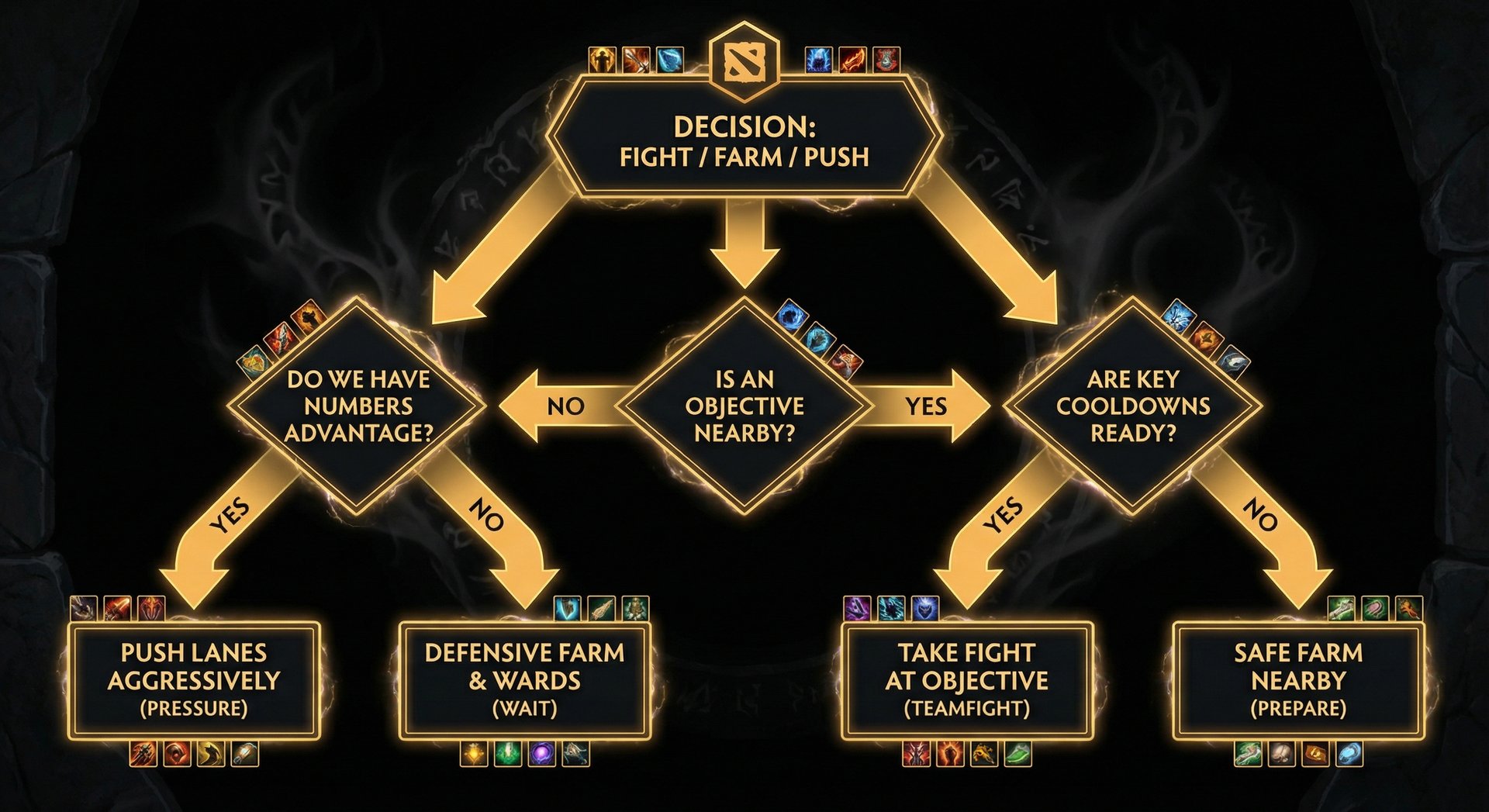
This is the single most impactful concept for climbing from Archon to Legend. The “fight, farm, or push” decision tree governs everything you do after the laning phase.
When to Fight
Take a fight when ALL of these conditions are true:
- You have a numbers advantage (5v4, 4v3, etc.) or a massive item advantage
- Your key abilities are off cooldown (ultimates, BKB, critical spells)
- The fight is near an objective you can take if you win (tower, Roshan, high ground)
- You have vision of where the fight will happen
- Your team is grouped or close enough to respond within 5 seconds
If even one of these conditions is false, think carefully about whether the fight is worth taking.
When NOT to Fight
- You’re behind and don’t have a power spike yet. Fighting from behind without a level or item advantage is throwing.
- Key ultimates are on cooldown. If your Tidehunter’s Ravage is on cooldown, you’ve lost your biggest teamfight ability.
- You’re split up. The enemy is 5-man pushing and your carry is on the opposite side of the map. Don’t fight 4v5 — trade objectives instead.
- The fight is in a bad location. Fighting in the enemy jungle with no vision is almost always a mistake.
- It’s an ego fight. Someone is spam-pinging and calling you to fight. If the conditions above aren’t met, ignore them and mute if needed.
When to Farm
Farm when:
- You’re 500-1,500 gold from a key item. If your BKB is 800 gold away, spend 2 minutes farming to complete it before fighting.
- The enemy is farming too. If both teams are spreading out and farming, you should be farming too — but more efficiently than the enemy.
- There are no objectives to take. All towers are fortified, Roshan is dead, and there’s no reason to force anything. Farm and wait.
- Your hero is a late-game carry. If you’re playing Spectre, Anti-Mage, or Medusa, your job is to farm until you’re strong enough to end the game. Don’t fight unless you have to.
When to Push
Push when:
- You just won a fight. This is the #1 mistake Archon players make — winning a fight and then going back to farming instead of taking a tower or Roshan.
- Key enemy heroes are dead. If their carry is dead for 40 seconds, push into their territory and take objectives.
- You have a pushing lineup. If your team has heroes like Death Prophet, Pugna, or Lone Druid, your win condition is pushing towers, not farming for 40 minutes.
- You’re ahead. When you’re ahead, push your advantage. Don’t let the enemy farm back into the game.
The “After the Fight” Decision
This deserves its own section because it’s where Archon players throw the most games. You win a fight — 3 enemies are dead. What do you do
What Archon players do:
- Go back to farming jungle
- Chase the 2 surviving enemies across the map
- Run back to base to heal (even with full HP)
- Stand around doing nothing
What Legend players do:
- Take the nearest tower
- Take Roshan if possible
- Push into the enemy jungle and take map control
- Place aggressive wards during the window of safety
Every won teamfight should result in an objective. If you won a fight and didn’t get a tower, Roshan, or significant map control out of it, you wasted the fight.
Fixing Your Map Movements
Map movement is where the biggest skill gap between Archon and Legend lives. Archon players move reactively — they go where the action is happening. Legend players move proactively — they position themselves before the action starts.
The Concept of “Map Pressure”
Every lane in Dota has a state:
- Pushed toward the enemy: Pressure. The enemy needs to respond to this lane or lose a tower.
- Pushed toward you: Farm. Free gold and XP close to your safe areas.
- At equilibrium: Neutral. No pressure, no free farm.
The key insight is: pressure creates opportunities. When you push a lane, an enemy hero has to respond to it. That means there’s one fewer hero in the rest of the map. If you push two lanes simultaneously, two enemies have to respond, leaving only three to contest objectives.
How to Create Map Pressure
- Push out all three lanes before fighting. Before you group up for a teamfight or objective, make sure all three lanes are pushing toward the enemy. This means the enemy has to split up to deal with creep waves, giving you a numbers advantage.
- Send your split-pusher to the opposite side of the map from the objective. If you want to take Roshan (which is near one side of the map), send a hero to push the opposite lane. The enemy has to choose: contest Rosh or defend the tower.
- Use TP scroll positioning. Position yourself in a lane far from your team, push it out, and then TP to your team when the fight starts. This gives you farm AND fight participation.
The “Dead Lane” Problem
Archon games are plagued by dead lanes — lanes where creep waves crash into towers with nobody farming them. This is thousands of gold and XP going to waste every minute. A Legend player always has someone farming every lane. An Archon team frequently has 3-4 players grouped mid while the side lanes push into their towers.
Rule of thumb: At any given time, your team should have at least one hero in each of the three lanes, with the remaining two heroes in the jungle or roaming between lanes. If three or more of your heroes are in the same lane and you’re not actively pushing a tower or taking a fight, someone is in the wrong place.
Movement Patterns by Role
| Role | Ideal Position (Mid-Game) | Common Archon Mistake |
|---|---|---|
| Carry | Safe farm lane + triangle jungle | Grouped mid fighting at 15 minutes |
| Mid | Active lane pushing + ganking | Static farming in jungle |
| Offlane | Aggressive lane pushing + team proximity | Farming passively in safe areas |
| Pos 4 | Setting up vision, smoking, stacking | Sitting behind carry doing nothing |
| Pos 5 | Near carry, vision, pulling, stacking | Wandering aimlessly, stealing farm |
Why You Keep Overextending (and How to Stop)
Overextending is the #1 cause of death in Archon games. You push a tower, get greedy for one more wave, and then four enemies appear and kill you. Or you chase a low-HP hero into fog and walk into the rest of their team.
Why Archon Players Overextend
- Greed. “One more wave and I’ll have enough for my item.” That one more wave costs you 40 seconds of death time and 300+ gold. Net loss.
- Kill hunger. The enemy is at 10% HP. You chase. They lead you into their team. You die. This happens multiple times per game.
- No escape plan. You walk into the enemy jungle without considering how you’ll get out if things go wrong.
- Ignoring missing heroes. Three enemies are off the map but you’re still pushing the enemy tier 2 tower. They appear behind you. You die.
The “Escape Route” Rule
Before moving to any position on the map, ask yourself: “If three enemies appear right now, how do I survive”
Your escape route can be:
- A TP scroll (always carry one)
- A mobility spell (Blink, Force Staff, Time Walk)
- Nearby allies who can save you
- Vision showing the enemy is elsewhere
If you can’t identify an escape route, you shouldn’t be there.
Safe vs. Dangerous Areas of the Map
Think of the map as three zones:
- Green Zone: Your side of the map, behind your tier 1 towers. Always safe to farm here.
- Yellow Zone: The river and neutral areas. Safe with vision, dangerous without. Farm here when you can see enough enemies on the map.
- Red Zone: The enemy side of the map. Only go here when you have overwhelming advantage, vision of most enemies, or a specific objective to take.
Archon players spend way too much time in the Red Zone without justification. Stick to Green and Yellow until you have a reason to enter Red.
Objective-Based Dota: Playing to Win, Not to Kill
Here’s a stat that might surprise you: kills don’t win Dota games. Objectives do. You can have 50 kills and still lose if the enemy takes your Ancient. Conversely, you can have fewer kills and win by systematically dismantling towers and barracks.
The Objective Priority List
At any given moment, here are your objectives in priority order:
- Barracks — Taking a lane of barracks creates permanent map pressure
- Roshan — Aegis enables high ground pushes and risky plays
- Towers — Each tower gives gold, map control, and access to the enemy jungle
- Map control — Placing wards in the enemy jungle, taking over their farm
- Kills — Only valuable if they lead to one of the above objectives
Notice that kills are at the bottom. A kill only matters if it enables you to take something. Getting a kill and then farming jungle is almost no different from not getting the kill at all (you got some gold, but the 30-second window to take a tower was wasted).
The “What Do We Get” Question
Before every fight, ask: “If we win this fight, what do we get”
- If the answer is “a tower” or “Roshan” — take the fight
- If the answer is “kills and then we go farm” — maybe don’t take the fight
- If the answer is “I don’t know” — definitely don’t take the fight
This simple question filters out 80% of the pointless fights that Archon players take. Stop fighting for fighting’s sake. Fight for objectives.
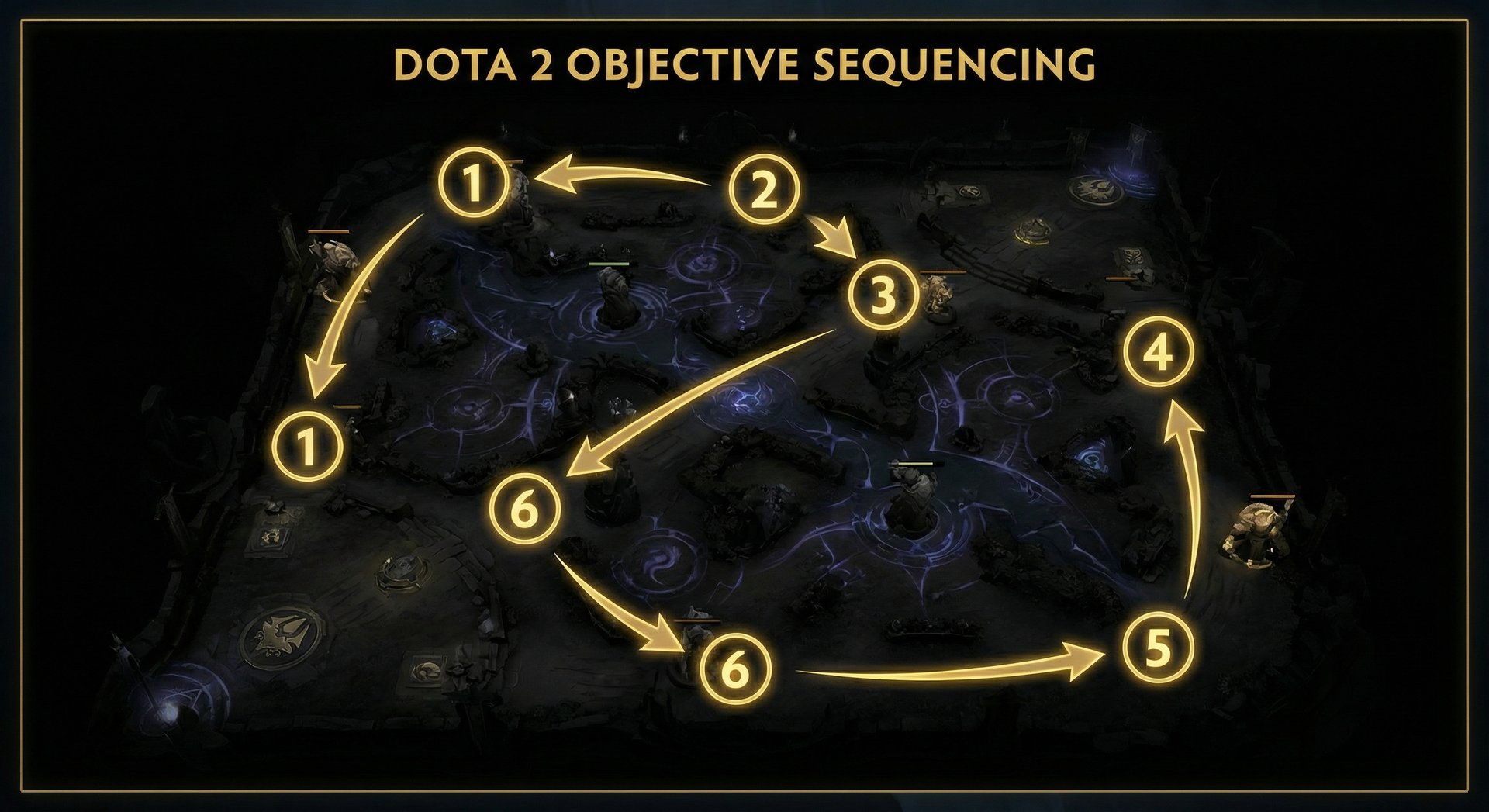
Tower Sequencing
The order in which you take towers matters. Here’s the optimal sequence:
- Enemy safe lane tier 1 — Opens up their jungle for your team to invade
- Enemy mid tier 1 — Controls the center of the map
- Enemy offlane tier 1 — Completes map dominance
- Enemy tier 2 towers — Chokes their farm to the area around their base
- Roshan — Get Aegis before pushing high ground
- High ground — Push with Aegis, take barracks
Archon players skip steps. They try to push high ground without Aegis, or they take the offlane tier 2 while the safe lane tier 1 is still standing. Follow the sequence.
The Vision Game: Wards, Smokes, and Information
Vision is criminally undervalued in Archon. Supports buy wards, but they don’t buy them strategically. And cores never buy wards at all, even when they should.
Ward Placement Principles
Good warding follows one simple principle: place wards where you’re going to be in 2-3 minutes, not where you are now.
- When farming: Ward the entrances to your farming areas to prevent ganks
- When pushing: Ward ahead of where you’re pushing to see incoming TPs and rotations
- When defending: Ward the approaches to your towers so you see the enemy grouping up
- When setting up for Roshan: Ward the Rosh pit entrances and the enemy jungle paths
Smoke of Deceit: The Most Underused Item in Archon
Smoke is purchased in maybe 10% of Archon games. In Legend+, it’s purchased in 80%+ of games. This single item can win games by itself.
When to smoke:
- To initiate a team fight with surprise positioning
- To sneak Roshan without the enemy knowing
- To gank an enemy carry who’s farming their jungle
- When you need to move through warded areas unseen
Smoke rules:
- Smoke as a group (3-5 heroes, never solo smoke unless you’re Spirit Breaker)
- Have a specific target or objective in mind before smoking
- Move quickly — smoke has a limited duration
- If you don’t find anyone within 30 seconds, pivot to an objective instead of wandering
Dewarding
In Archon, players rarely deward. This means the enemy’s wards often survive their full duration, giving the enemy team 6 minutes of free information. Start buying Sentry Wards and placing them in common ward spots. Even as a core player, buying a single Sentry Ward to deward your farming area is worth the 50 gold.
Basic Drafting Concepts for Archon
Archon players pick heroes they want to play, regardless of what their team needs or what the enemy has picked. Learning basic drafting concepts can give you a significant advantage before the game even starts.
Draft Checklist
Before locking in your hero, run through this checklist:
- Does your team have a frontline hero (tanky initiator)
- Does your team have disable/stun (at least 2-3 stuns)
- Does your team have a mix of physical and magical damage
- Does your team have a way to push towers
- Does your pick counter or at least not lose to the enemy heroes you’ve seen
You don’t need to be a drafting genius. Just avoid obvious mistakes like picking 5 physical damage heroes into a Timbersaw, or picking 5 squishy heroes with no frontline.
Simple Counter-Picking
| If the Enemy Picks… | Consider Picking… | Why |
|---|---|---|
| Lots of magic damage | Huskar, Anti-Mage, Pipe builder | Magic resistance shuts down their damage |
| Lots of physical damage | Timbersaw, Crimson Guard builder | Armor stacks reduce physical damage |
| Illusion heroes (PL, CK) | Earthshaker, Sven, AoE heroes | AoE clears illusions instantly |
| Invisible heroes (Riki, BH) | Slardar, Bounty Hunter, Zeus | Detection abilities counter invis |
| Healing-heavy lineup | Ancient Apparition, Spirit Vessel | Healing reduction nullifies their sustain |
| Mobile heroes (Storm, Puck) | Disruptor, Bloodseeker, Silencer | Displacement/silence prevents escape |
Mastering the Mid-Game Transition
The mid-game (10-25 minutes) is where Archon games are won and lost. It’s also where Archon games become the most chaotic. Understanding how to navigate this phase cleanly is the single biggest separator between Archon and Legend.
The “ARAM” Phenomenon
ARAM stands for “All Random All Mid” — it’s a meme format where all 10 players group mid and fight endlessly. This is what happens in most Archon games after the laning phase. Both teams group mid, fight repeatedly, and whoever wins more fights wins the game.
This is not how Dota is supposed to be played.
The mid-game should involve strategic lane pushing, controlled farming, and fights that are taken for specific objectives. Here’s how to break the ARAM pattern:
- As a carry: Don’t join the mid ARAM. Go to the side lanes and farm. Let your team fight 4v5 while you get a massive gold lead. Only TP in if the fight is happening near a key objective.
- As a mid: Create pressure in side lanes. Push waves, force rotations, and then either fight with your team’s numbers advantage or take the tower.
- As an offlaner: You should be the one starting fights — but only good fights. If there’s no objective to take, don’t fight. Push a lane instead.
- As a support: Set up vision for your carry’s farming areas. Stack camps. Smoke with your mid or offlane for ganks. Don’t sit mid and auto-attack creeps.
Timing Windows
Every team composition has windows where it’s strongest relative to the enemy. Identifying your timing window is crucial:
- Early timing (15-25 min): Teams with heroes like Huskar, Death Prophet, Chen. These lineups need to push towers before the enemy carry gets farmed.
- Mid timing (25-35 min): Balanced lineups with heroes like Juggernaut, Puck, Tidehunter. These teams want to group up for key fights around their 2-3 item timings.
- Late timing (35+ min): Teams with heroes like Spectre, Medusa, Anti-Mage. These teams want to delay fights and farm until they’re 6-slotted.
If you have an early timing, you need to be pushing towers at 15-20 minutes, not farming jungle. If you have a late timing, you need to avoid fights and farm efficiently until 30+ minutes.
Role-Specific Improvements for Archon Players
Position 1 (Carry) — Stop Fighting Early
The biggest carry mistake in Archon is fighting too early. Your carry hero needs items to be effective. Every minute you spend fighting before your items are complete is a minute you could have spent farming toward your power spike.
The carry ruleset:
- Farm until your first two major items unless your team is losing a fight at a key objective
- Always push out a lane before entering the jungle (lane creeps give more gold than jungle creeps)
- Carry a TP scroll to join fights near objectives — don’t walk across the map
- If you’re dying more than 3 times before 20 minutes, you’re fighting too early or farming too aggressively
Position 2 (Mid) — Create Tempo
The mid player’s job in the mid-game is to create tempo — to force the enemy to react to you instead of executing their own game plan.
How to create tempo:
- Push out mid lane, then rotate to a side lane for a gank or tower push
- Secure power runes and use them aggressively
- After getting a kill, immediately push the tower — don’t go back to farming
- Be the one calling for smokes and setting up ganks
Position 3 (Offlane) — Be the Team’s Shield
In Archon, offlaners try to be second carries. They farm aggressively, build damage items, and play selfishly. This is wrong.
Your job as an offlaner is to:
- Build utility and aura items that help your whole team (Pipe, Crimson Guard, Vlads, Lotus Orb)
- Be the frontline in fights — absorb damage and create space for your carry
- Initiate fights with Blink Dagger or mobility items
- Push dangerous lanes that your carry can’t safely push
Position 4 (Soft Support) — Roam and Create Chaos
The position 4 role in Archon is often played passively — sitting in lane, leeching XP, and occasionally using abilities. At Legend level, pos 4 players are active across the entire map.
Pos 4 priorities:
- Gank mid or the enemy carry after the first few minutes
- Stack jungle camps for your cores
- Set up vision in aggressive spots
- Buy and use Smoke of Deceit
- Secure runes for your mid player
Position 5 (Hard Support) — Enable Your Carry, Then Your Team
The position 5 in Archon often stops being useful after the laning phase. They don’t know what to do, so they either follow their carry around (stealing XP) or wander aimlessly.
Pos 5 mid-game priorities:
- Maintain constant ward coverage on your carry’s farming areas
- Stack camps when possible
- Stay near your team for fights but don’t stand next to your carry 24/7
- Save your abilities for the right moment in fights (don’t use your save spell offensively)
- Buy utility items like Force Staff, Glimmer Cape, or Aeon Disk to keep yourself and your cores alive
How to Analyze Your Own Replays
Replay analysis is the fastest way to identify and fix mistakes. But most Archon players don’t know what to look for. Here’s a structured approach:
The 15-Minute Replay Review
After every loss (and occasional wins), spend 15 minutes reviewing your replay:
- Minutes 0-10 (Laning): Watch at 2x speed. Note your last hit count at 5 and 10 minutes. Count how many times you took unnecessary damage. Check if you used your regen efficiently.
- Minutes 10-20 (Transition): Watch at normal speed. Where did you go after laning phase Did you have a plan Did you farm efficiently or wander aimlessly
- Every death: Pause on each death. Ask: “Why did I die Where should I have been instead What information did I ignore”
- Key fights: Watch the 2-3 biggest teamfights. Were you positioned correctly Did you use your abilities on the right targets Did you fight at the right time
What to Write Down
Keep a simple log:
- Game ID, hero, result
- CS at 10 minutes
- First major item timing
- Number of deaths
- Biggest mistake (one sentence)
- One thing to focus on next game
After 20 games of doing this, you’ll start to see patterns. Maybe you always die between minutes 12-18 because you overextend after laning phase. Maybe your item timings are consistently 3 minutes late because you fight too much. These patterns are your roadmap for improvement.
If you want professional eyes on your replays, TeamSmurf’s coaching service includes detailed replay analysis from high-MMR players who can identify issues you’d never notice on your own.
Best Heroes for Climbing from Archon to Legend
The best heroes for Archon are heroes that punish poor decision-making and reward good game sense. At this bracket, you want heroes that:
- Can capitalize on enemy mistakes
- Are effective in chaotic teamfights
- Have clear power spikes
- Can take objectives after winning fights
Top Carry Heroes
Juggernaut — Strong at every phase. Healing Ward sustains pushes. Omnislash punishes isolated heroes. Can build damage or survivability flexibly.
Phantom Assassin — Punishes the lack of MKB building in Archon. Massive damage spikes with Desolator. Clear power spike timing at 15-20 minutes.
Wraith King — Two lives. Simple to play. Excellent at taking objectives after fights with strong right-click damage.
Top Mid Heroes
Zeus — Global damage and vision from ultimate. Huge magic damage that goes unpunished in Archon. Can contribute to fights from safe distances.
Death Prophet — Destroys towers with Exorcism. Forces the enemy to deal with you or lose objectives. Tanky in fights with Spirit Siphon.
Viper — Wins almost every mid lane. Tanky, deals consistent damage, and Break disables annoying passives. Simple to execute, devastating in the mid-game.
Top Offlane Heroes
Tidehunter — Ravage is the best teamfight ultimate in the game for its simplicity. Blink → Ravage wins fights. Kraken Shell makes you hard to bully in lane.
Axe — Counter Helix punishes melee carries. Berserker’s Call pierces BKB. Culling Blade deletes heroes below threshold. Builds Blink → Blade Mail and initiates fights.
Underlord — Massive damage aura, tanky, and Firestorm dominates lanes. Build aura items and stand in front of your team. Pit of Malice provides AoE root.
Top Support Heroes
Witch Doctor — Maledict is arguably the most underrated ability in Archon. Death Ward shreds teams in chaotic fights where nobody focuses you. Cask provides multi-target stun.
Ogre Magi — High armor and HP make you a lane bully. Bloodlust accelerates your carry’s farm. Ignite deals insane damage over time.
Shadow Shaman — Hex and Shackles are two of the longest disables in the game. Mass Serpent Ward destroys towers — enabling objective-based play even when your team wants to ARAM.
The Legend Mindset
From Reactive to Proactive
The single biggest mindset shift from Archon to Legend is moving from reactive play to proactive play.
Reactive play (Archon): Something happens → you respond to it. Enemy pushes → you defend. Teammate dies → you fight. You’re always one step behind.
Proactive play (Legend): You make something happen → enemy responds to it. You push a lane → enemy has to defend. You smoke gank → enemy has to play scared. You’re one step ahead.
Start every game by asking: “What is my game plan” Not “what will I do when things happen,” but “what will I make happen” Having a plan — even an imperfect one — puts you ahead of 90% of Archon players who play every game on autopilot.
Stop Playing to Not Lose; Start Playing to Win
Archon players are scared of losing. They play defensively, avoid risks, and wait for the enemy to make mistakes. Legend players play to win. They create pressure, force mistakes, and capitalize on advantages.
This doesn’t mean being reckless. It means being intentional. Every action should have a purpose. Every movement should be toward an objective. Every fight should be for a reason.
The “Two Games” Concept
There are always two games being played simultaneously in Dota:
- The farm game: Who is getting more gold and XP per minute
- The objective game: Who is taking more towers, map control, and Roshan
Archon players only think about one game at a time. Legend players think about both. When you’re farming, you should also be pushing lanes (objectives). When you’re fighting, you should be thinking about what you’ll farm next if the fight doesn’t happen.
Embrace the Grind
Climbing from Archon to Legend takes time. You’re looking at 770+ MMR of improvement (from ~2,310 to ~3,080). At a 55% win rate, that’s roughly 150-200 games. At 3 games per day, that’s 2-3 months of consistent play.
Don’t get discouraged by slow progress. Don’t get tilted by losing streaks. Focus on the process, not the number. If you’re improving at the skills outlined in this guide, the MMR will follow.
Ready to Climb Start Your Boost Today
Team Smurf is the #1 rated Dota 2 boosting service in 2026. Immortal-rank boosters, maximum safety, competitive pricing, 24/7 support.
Get MMR Boost Pro Coaching Calibration ServiceWritten by Team Smurf’s Immortal-rank analysts — Rankings last verified February 2026