Crusader to Archon: What’s Holding You Back and How to Break Through

Stuck in Crusader and wondering what’s going wrong You’re not alone. The Crusader bracket (roughly 1,540–2,310 MMR) is one of the most populated ranks in Dota 2, and for good reason — it’s the first rank where players start to understand the basics of the game, but haven’t yet developed the consistency or game sense to climb higher. The jump from Crusader to Archon in Dota 2 is less about learning flashy new skills and more about eliminating the bad habits that keep dragging you down.
This guide is designed to be a complete coaching session for Crusader players. We’ll dissect the most common mistakes at this bracket, give you specific drills to practice, recommend heroes that exploit Crusader weaknesses, and lay out a roadmap to Archon and beyond. Whether you play carry, mid, offlane, or support, there’s something here for you.
If you’d rather have a professional handle the grind while you focus on improving specific skills, TeamSmurf’s MMR Boost service can get your account to Archon quickly and safely. But if you want to earn it yourself, keep reading.
Table of Contents
- Understanding the Crusader Bracket
- The 7 Core Problems Holding Crusader Players Back
- Problem #1: Poor Farming Efficiency
- Problem #2: Bad Item Timings
- Problem #3: Not Understanding Power Spikes
- Problem #4: Random, Unfocused Hero Picks
- Problem #5: Tunnel Vision and No Map Awareness
- Problem #6: Dying Too Much
- Problem #7: Losing the Laning Phase
- Specific Drills to Practice Every Day
- Best Heroes to Climb from Crusader to Archon
- Role-Specific Tips
- The Mindset Shift You Need
- Your 30-Day Climb Plan
- FAQ
Understanding the Crusader Bracket
Before we fix what’s broken, let’s understand what Crusader actually looks like. The Crusader bracket spans from approximately 1,540 MMR (Crusader 1) to 2,310 MMR (Crusader 5). According to Valve’s rank distribution data, Crusader players make up a significant chunk of the player base — somewhere around 15-18% of all ranked players fall into this bracket.
What Crusader Players Do Right
Credit where it’s due. If you’re in Crusader, you’ve already surpassed the Herald and Guardian brackets. That means you probably:
- Understand basic hero roles (carry, mid, offlane, support)
- Know how to buy items from the shop and follow basic item builds
- Have some idea of how laning works
- Can execute basic hero abilities and combos
- Understand that objectives like towers and Roshan matter
What Crusader Players Do Wrong
Here’s the uncomfortable truth: Crusader players do almost everything at a surface level but nothing with real depth. You know you should farm, but you don’t farm efficiently. You know items matter, but you don’t know when to get them. You know fights happen, but you don’t know when to take them.
The gap between Crusader and Archon isn’t a knowledge gap — it’s an execution and consistency gap. Archon players don’t know secret strategies. They just do the fundamentals slightly better, slightly more often.
MMR Breakdown
| Rank | Approximate MMR | Key Characteristics |
|---|---|---|
| Crusader 1 | ~1,540 | Basic understanding, many bad habits |
| Crusader 2 | ~1,694 | Slightly better laning, still poor farming |
| Crusader 3 | ~1,848 | Can execute some heroes well, inconsistent |
| Crusader 4 | ~2,002 | Decent mechanics, very poor decision-making |
| Crusader 5 | ~2,156 | On the verge of Archon, needs consistency |
| Archon 1 | ~2,310 | Better fundamentals, more consistent play |
The 7 Core Problems Holding Crusader Players Back
After reviewing hundreds of Crusader replays and working with players at this bracket through our Dota 2 coaching service, we’ve identified seven fundamental problems that nearly every Crusader player shares. Fix these, and you will climb.
Problem #1: Poor Farming Efficiency
This is the single biggest issue in Crusader. If you could only fix one thing, fix this.
What “Poor Farming Efficiency” Actually Means
It’s not just about last hits in lane (though that matters too). Poor farming efficiency means:
- Low last hits per minute (LH/min). A Crusader carry averages 4-6 LH/min. An Archon carry averages 6-8. A Divine carry averages 9-11. That difference compounds massively over a 35-minute game.
- Dead time between camps. You kill a wave, then stand around for 3-5 seconds doing nothing before walking to the next camp. Those seconds add up to minutes of wasted farm.
- Not stacking camps. Crusader players almost never stack — not even as supports. A single stacked camp can be worth 150-300 gold.
- Farming in dangerous areas. You push a wave past the river with no vision, die, and lose 40 seconds of farming time plus gold. Net negative.
- Ignoring jungle between waves. Many Crusader carries will stand in lane waiting for the next creep wave instead of clearing a nearby jungle camp in between.
The Math Behind Farming
Let’s do some quick math to show why this matters so much:
| LH/min | Approximate GPM | Gold at 25 min | Item Equivalent |
|---|---|---|---|
| 4 (low Crusader) | ~350 | 8,750 | Treads + BKB + partial next item |
| 6 (high Crusader) | ~450 | 11,250 | Treads + BKB + major item |
| 8 (Archon) | ~550 | 13,750 | Treads + BKB + major item + component |
| 10 (Legend+) | ~650 | 16,250 | Treads + BKB + two major items |
At 25 minutes, the difference between a 4 LH/min Crusader carry and an 8 LH/min Archon carry is 5,000 gold — roughly an entire major item. You’re entering fights with one fewer item than your opponent. No wonder it feels impossible to win.
How to Fix Your Farming
Step 1: Learn farming patterns. After the laning phase ends (around 10-14 minutes), you should be following a loop: push wave → clear jungle camp → push next wave → clear next camp. Never stand still.
Step 2: Use the minimap creep timer. Jungle camps spawn every minute on the minute mark. Know where they are and route your movement to hit them as they spawn.
Step 3: Practice in demo mode. Load up a hero like Anti-Mage or Luna. Set a 10-minute timer. Your goal: 80+ last hits. Once you can do this consistently, try for 100.
Step 4: Watch one high-MMR replay per week. Focus only on the carry player’s movements between minutes 10-25. Notice how they never stop moving, never stand still, and always have a plan for where the next gold is coming from.
Farming Drill: The 10-Minute Challenge
This drill alone can add 500+ MMR if you do it consistently:
- Open a lobby or demo mode
- Pick a farming carry (Anti-Mage, Luna, Juggernaut, Wraith King)
- Buy standard starting items
- Farm the safe lane + nearby jungle for 10 minutes
- Your targets:
- Bronze: 60 last hits
- Silver: 80 last hits
- Gold: 100 last hits
- Immortal: 120+ last hits
- Do this for 15 minutes before every ranked session
This isn’t glamorous. It’s not fun. But it works. The mechanical skill of last-hitting is something you can grind independently, and it directly translates to MMR.
Problem #2: Bad Item Timings
You might know the right items to buy. But do you know when you should have them
What Are Item Timings
Item timings are benchmarks for when you should complete key items. They’re directly connected to farming efficiency — if you farm well, your timings are good. If you farm poorly, your timings are late, and late items mean you’re weaker than you should be at critical moments in the game.
Common Crusader Item Timing Mistakes
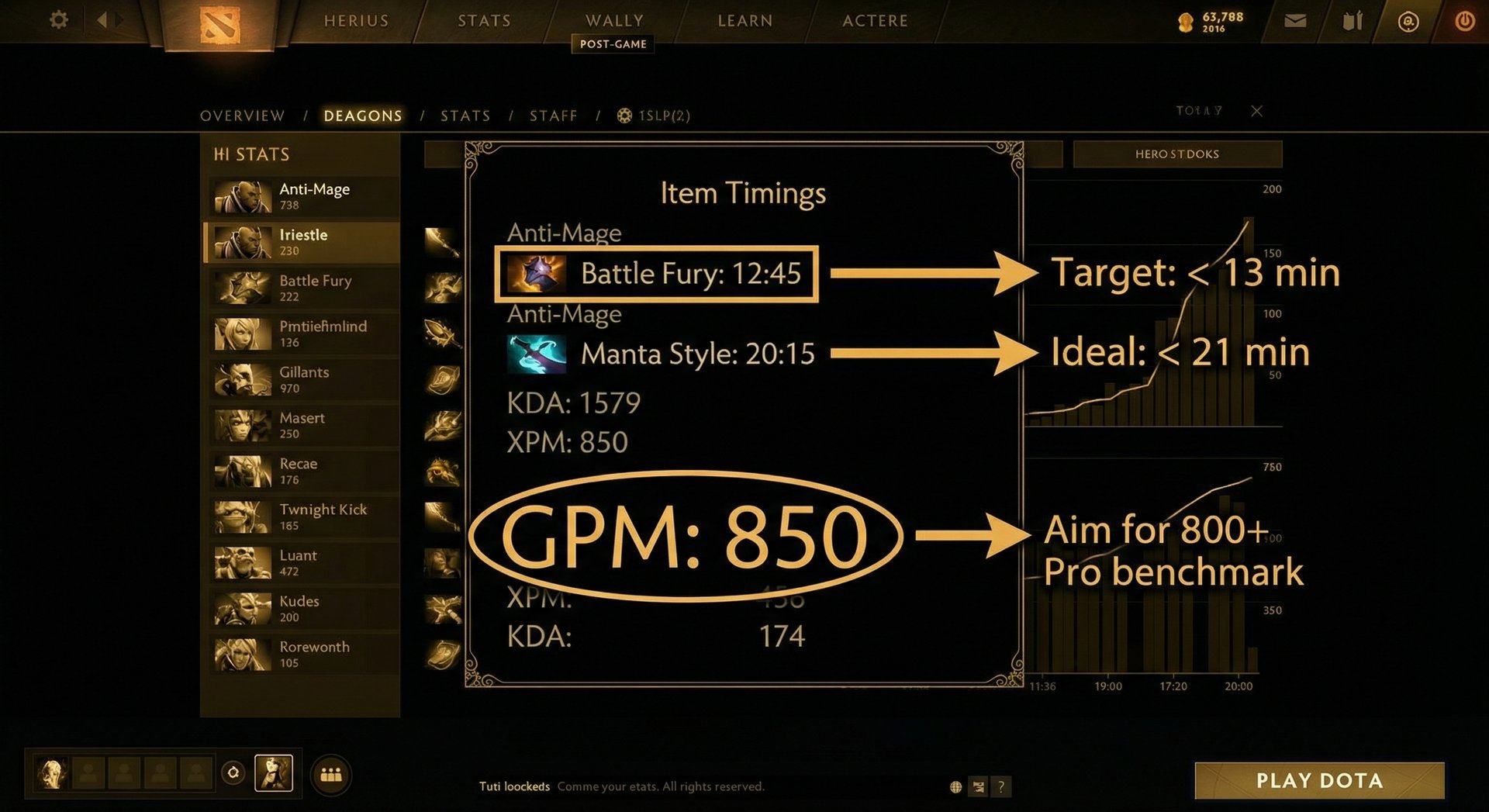
- First major item at 25+ minutes. If your Battlefury on Anti-Mage arrives at 22 minutes, the game might already be over. You need it by 14-16 minutes to be competitive.
- Buying too many small items. Crusaders love buying Wraith Bands, Bracers, and other cheap stat items because they “feel” strong. But every 500 gold spent on a Wraith Band is 500 gold delayed on your Battlefury.
- Not adjusting builds to the game. You follow the same guide every game regardless of matchup. Against a heavy magic damage lineup, you might need early BKB at 18 minutes. Against a physical damage lineup, you might want armor items first.
- Completing items in the wrong order. Buying a Mithril Hammer before Perseverance on Battlefury because you have the gold, even though Perseverance gives you lane sustain.
Item Timing Benchmarks for Core Roles
| Hero | Key Item | Crusader Timing | Target Timing |
|---|---|---|---|
| Anti-Mage | Battlefury | 20-25 min | 14-16 min |
| Juggernaut | Battlefury/Maelstrom | 18-22 min | 13-15 min |
| Phantom Assassin | Desolator | 18-22 min | 14-17 min |
| Luna | Manta Style | 22-26 min | 17-20 min |
| Wraith King | Radiance | 22-28 min | 17-20 min |
If your timings are consistently 5+ minutes behind these targets, the problem is your farming pattern, and you need to go back to Problem #1.
How to Track Your Timings
After every game, check your item timings in the post-game screen or on Dotabuff. Write down your timing for your first major item. Track it over 10 games. You should see it gradually getting earlier as you improve your farming.
Problem #3: Not Understanding Power Spikes
This is the problem that separates players who win games from players who farm all game and still lose.
What Is a Power Spike
A power spike is a moment in the game when your hero becomes significantly stronger relative to the enemy. Power spikes come from three sources:
- Level spikes: Reaching a key level (level 6 ultimate, level 12 talent, level 15 talent, level 20 talent)
- Item spikes: Completing a major item that dramatically increases your fighting ability
- Timing spikes: Moments when your hero is naturally stronger than the enemy’s hero (e.g., Phantom Assassin with Desolator at 15 minutes vs. a Spectre who only has Wraith Bands)
Why Crusader Players Miss Power Spikes
The classic Crusader pattern looks like this:
- Farm for 25 minutes without looking at the map
- Complete a major item
- Continue farming for another 5 minutes because “I’m not ready yet”
- Finally join a fight at 30 minutes
- Realize the enemy carry has been fighting for 10 minutes and is now just as farmed
- Lose the teamfight because the window has passed
The problem isn’t that you farmed. The problem is that you farmed through your power spike instead of using it.
How to Identify Your Power Spikes
For carries: Your power spike is usually when you complete your first or second major item. Phantom Assassin with Desolator + BKB is massively stronger than PA with just Desolator. That’s your “go” button.
For mids: Your power spikes come earlier — usually level 6 and your first item. A Queen of Pain with Orchid at 14 minutes should be solo-killing heroes across the map, not farming jungle.
For offlaners: Your power spike is often your first utility item (Blink Dagger, Pipe of Insight, Crimson Guard) plus a key level. Tidehunter with Blink + level 12 should be looking for fights constantly.
For supports: Your power spikes are level-based. Many supports have their strongest relative power at levels 6-12, when their abilities are maxed but the enemy cores don’t have BKB yet.
Power Spike Drill
Before every game, ask yourself: “At what minute and with what items will I be strongest” Write it on a sticky note. When that moment arrives, stop farming and start fighting. This simple habit will win you more games than any mechanical improvement.
Problem #4: Random, Unfocused Hero Picks
Open the average Crusader player’s Dotabuff profile and you’ll see 50+ heroes played in the last month, most with a 40-50% win rate. This is a massive problem.
Why Hero Pools Matter
Every hero in Dota 2 has nuances that take dozens of games to internalize. When you play a hero for the first time in 20 games, you’re spending mental energy remembering ability interactions, item builds, and timings that should be automatic. That mental energy should be spent on map awareness, decision-making, and game sense.
Archon players don’t have bigger hero pools than Crusader players — they have smaller, more focused ones.
The “Three-Hero Rule”
Pick three heroes per role. That’s it. If you play position 1, pick three carries and play only those three for the next 50 games. Here’s why:
- After 15-20 games on a hero, item builds become automatic
- After 30 games, you start to understand matchups intuitively
- After 50 games, you free up mental bandwidth for macro decision-making
- After 100 games, the hero becomes an extension of your will
Most Crusader players never hit the 30-game threshold on any hero. They play 5-10 games, get bored, and switch. This is why they’re stuck.
Recommended Hero Pools by Role
| Role | Hero 1 (Simple) | Hero 2 (Flexible) | Hero 3 (Backup) |
|---|---|---|---|
| Pos 1 (Carry) | Wraith King | Juggernaut | Luna |
| Pos 2 (Mid) | Zeus | Viper | Death Prophet |
| Pos 3 (Offlane) | Bristleback | Tidehunter | Underlord |
| Pos 4 (Soft Supp) | Spirit Breaker | Mirana | Hoodwink |
| Pos 5 (Hard Supp) | Ogre Magi | Witch Doctor | Crystal Maiden |
These heroes share a common trait: they’re straightforward to execute and effective at all skill levels. You don’t need to outplay your opponents with Invoker or Meepo. You need to out-fundamental them with simple heroes played well.
Problem #5: Tunnel Vision and No Map Awareness
Here’s a test: during your next game, count how many times you look at the minimap in a 5-minute period. If the answer is fewer than 20, you have a map awareness problem — and if you’re in Crusader, you almost certainly do.
Why Crusader Players Don’t Look at the Map
It comes back to mental bandwidth. When last-hitting is hard, when you’re trying to remember your item build, when you’re focused on landing abilities in a fight — there’s no brain power left for the minimap. This is another reason why simplifying your hero pool matters: the less you have to think about mechanically, the more you can think about strategically.
What You Should Be Looking For
Every time you glance at the minimap (which should be every 3-5 seconds), you should be asking:
- Where are the enemy heroes If you can only see 2-3 of them, the missing ones might be coming to gank you.
- Which lanes are pushed A pushed lane means free farm for someone. If it’s on your side, you can safely take it. If it’s on their side, it’s dangerous.
- Is anyone in trouble Can you teleport to save a teammate or counter-gank
- Where is the next objective Is a tower low Is Roshan up
The Glance Drill
This is the single best drill for improving map awareness:
- Set a timer on your phone for every 5 seconds (there are metronome apps that work great)
- Every time it beeps, look at the minimap
- Do this for 5 games straight
- After those 5 games, you’ll notice that you’re glancing at the map automatically
Crusader players who adopt this habit often report gaining 200-400 MMR within a few weeks, simply because they stop dying to ganks they should have seen coming.
Problem #6: Dying Too Much
The average Crusader carry dies 8-12 times per game. An Archon carry dies 5-8 times. A Divine carry dies 3-5 times. Every death costs you 30-60 seconds of farming time plus gold lost. Over a 40-minute game, dying 4 extra times costs you approximately 2-3 minutes of farm time and 500-1,000 gold — the equivalent of an entire item component.
Why Crusader Players Die So Much
- Overextending without vision. Pushing a lane past the river without wards.
- Fighting when behind. Your team lost two fights in a row, but you group up for a third fight anyway because “maybe this time.”
- Not carrying a TP scroll. The number of Crusader players who don’t have a TP scroll in their inventory at all times is staggering.
- Getting caught out of position. Standing in the jungle with no vision on the enemy, walking across the map alone, farming in the enemy’s side of the map without information.
- Ego fights. “I can definitely 1v1 this hero.” You can’t. You die. You buy back. You die again.
The “0 Deaths” Mindset
Before your next game, set a personal goal: 0 deaths. You won’t achieve it — that’s not the point. The point is that when you’re constantly thinking “how do I not die,” you naturally make better decisions about positioning, map awareness, and when to fight.
If you find yourself dying more than 6 times per game as a core, or more than 8 times as a support, something is fundamentally wrong with your positioning and decision-making.
Death Reduction Checklist
- Always carry a TP scroll (always, no exceptions)
- Never farm without vision on at least 3 enemy heroes
- If more than 2 enemies are missing, play safe
- Before committing to a fight, ask: “Can I survive this”
- After dying, pause and think about what you could have done differently
- Buy your own wards if your support isn’t warding (it’s worth the 50 gold)
Problem #7: Losing the Laning Phase
The laning phase (first 10-14 minutes) sets the tone for the rest of the game. A carry who wins lane with 50+ last hits at 10 minutes has a completely different game than a carry who loses lane with 25 last hits. Yet Crusader players treat the laning phase like an afterthought — something to survive until the “real game” begins.
Crusader Laning Mistakes
- Not trading hits efficiently. You either trade too aggressively (taking more damage than you give) or not at all (letting the enemy bully you for free).
- Not using regen. Crusader players hoard their tangoes and salves “for later.” There is no later — use your regen to stay in lane and get last hits.
- Bad creep aggro mechanics. Right-clicking an enemy hero near their creeps draws aggro, tanking unnecessary damage. You need to learn when and how to aggro creeps to manipulate wave position.
- Not pulling (as support). The single-pull and double-pull are fundamental support mechanics that most Crusader supports ignore entirely.
- Not contesting pulls. When the enemy support pulls, most Crusader carries just let it happen, losing an entire wave of experience and gold.
Laning Phase Priorities
For carries: Your ONLY job is to get last hits. Not kills, not harass — last hits. Every last hit you miss is 40-60 gold gone forever. Focus on last hits first, harass second, kills third.
For supports: Your job is to create space for your carry to farm. This means: pulling creep waves, harassing the enemy offlaner, placing a ward for vision, and being ready to rotate if another lane needs help.
For offlaners: Your job is to disrupt the enemy carry’s farm while getting your own levels. You don’t need to kill the carry — just make their life miserable so their item timings are late.
Specific Drills to Practice Every Day
Knowing what’s wrong isn’t enough. You need to actively practice. Here are drills you should do before every ranked session, like a musician warming up before a performance.
Drill 1: Last Hit Trainer (10 minutes)
Use Dota 2’s built-in last hit trainer or start a lobby:
- Pick your main carry hero
- Buy standard starting items
- Farm lane + jungle for 10 minutes
- Target: 80+ CS at 10 minutes
- Track your score and try to beat it each day
Drill 2: Map Awareness Metronome (5 games)
As described above — use a metronome or timer app set to 5-second intervals. Every beep, glance at the minimap. After 5 games, it becomes habitual.
Drill 3: Death Review (5 minutes post-game)
After every ranked game:
- Open the replay
- Find every death
- For each death, write down ONE thing you could have done differently
- Common answers: “should have looked at minimap,” “should have had a TP,” “shouldn’t have been there without vision”
Drill 4: Replay Comparison (30 minutes per week)
Find a high-MMR replay on YouTube or Twitch of someone playing your main hero. Watch the first 15 minutes side-by-side with your own replay of the same hero. Note every difference in farming patterns, movement, and decision-making.
Drill 5: Item Timing Tracking (ongoing)
Keep a spreadsheet or notebook with your first major item timing for every ranked game. If you play carry, track when you complete your farming item (Battlefury, Maelstrom, Midas, etc.). Over 20 games, you should see a clear trend of improvement.
Best Heroes to Climb from Crusader to Archon
Some heroes are simply more effective at this bracket than others. Here’s why these specific heroes work so well in Crusader:
Wraith King (Carry)
Wraith King is the ultimate Crusader-climbing hero. He has one active ability (stun), built-in lifesteal, a crit passive, and an ultimate that gives you a second life. In a bracket where players die a lot, having an extra life is insanely valuable. His farming ability is excellent with skeletons, and his item build is straightforward: Treads → Radiance or Armlet → Blink → BKB.
Juggernaut (Carry)
Juggernaut is strong at every phase of the game. Blade Fury gives you magic immunity for kills in lane, Healing Ward keeps you healthy for farming, and Omnislash is a powerful ultimate that doesn’t require precise targeting. He’s forgiving of positioning mistakes because Blade Fury lets you escape ganks.
Zeus (Mid)
Zeus punishes the lack of defensive items in Crusader. Nobody buys Pipe, nobody buys BKB early, and Zeus’s magic damage goes completely unchecked. His ultimate gives you global vision and damage, which is insanely powerful in a bracket where map awareness is poor.
Ogre Magi (Support)
Ogre Magi is tanky, deals high damage in lane, and has simple abilities that are hard to misuse. Bloodlust your carry to accelerate their farming. Stun enemies in fights. Walk at people and hit them. That’s it. In Crusader, simple and reliable beats complex and flashy every single time.
Bristleback (Offlane)
Bristleback is nearly unkillable when played correctly (just face away from enemies), deals increasing damage in long fights, and builds simple aura items. Crusader players love to chase kills, and chasing a Bristleback is one of the worst things you can do — he just gets stronger.
Role-Specific Tips for Crusader Players
Position 1 (Carry) Tips
- Don’t fight before your first item. Your job is to farm, not to chase kills around the map at 10 minutes.
- Push lanes before jungling. Pushing a lane creates pressure and gives you safe jungle farm on your side of the map.
- Use the triangle. The area between your tier 1 and tier 2 towers, including the jungle camps, is your safe farming space. Stay there unless you have vision of the enemy team.
- Buy BKB. This is the most underbuilt item in Crusader. If the enemy has ANY stun or disable, BKB should be in your first three items.
Position 2 (Mid) Tips
- Win your lane. Mid is the most impactful lane. Winning mid by 10+ last hits gives your team a massive advantage.
- Gank after your power spike. Once you hit level 6 or complete your first item, look for kills in the side lanes. A single kill in a side lane can snowball the game.
- Control runes. Secure the 4-minute and 6-minute power runes. They give you a huge advantage in lane and enable ganks.
Position 3 (Offlane) Tips
- Don’t die in lane. Getting levels is more important than getting kills. If you’re dying in lane, you’re losing.
- Build aura items. Pipe of Insight, Crimson Guard, Vladmir’s Offering — these items help your whole team, and in Crusader, nobody else is building them.
- Initiate fights. Most Crusader teams stand around waiting for someone to start the fight. Be that person. Blink in, use your abilities, and let your team follow up.
Position 4/5 (Support) Tips
- Buy wards. In Crusader, ward stock is almost always full. Use them. Place them. Vision wins games.
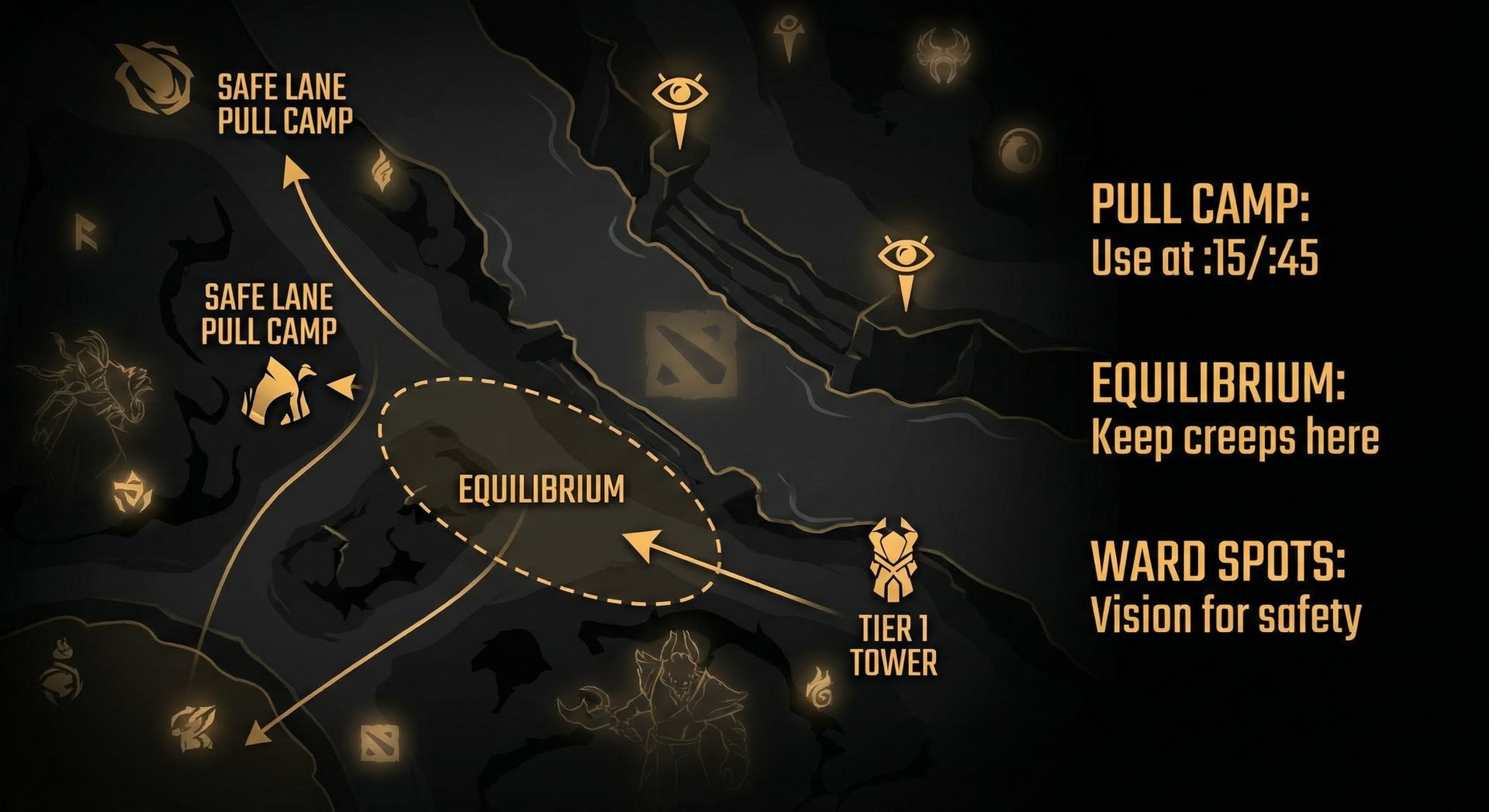
- Pull creep waves. Learn the single-pull (x:15 and x:45) and stack-pull (x:53). This is the single most impactful support skill in Crusader.
- Don’t steal farm. If you’re a support sitting in a lane taking last hits while your carry is there, you’re hurting your team. Go pull, stack, or rotate to help another lane.
- Buy Smoke of Deceit. Crusader supports never buy smoke. A single successful smoke gank can win you the game.
The Mindset Shift You Need
Climbing from Crusader to Archon requires a fundamental change in how you think about the game.
Stop Blaming Teammates
Yes, your teammates make mistakes. So do the enemies. So do you. The difference between Crusader and Archon isn’t teammates — it’s you. Both teams in every Crusader game have the same average skill level. The player who consistently performs above that average will climb.
Here’s a thought experiment: if a Divine player played on your account, they would win 80%+ of your games and reach Archon in a few days. The enemies and teammates would be the same. The only difference would be the player. That means the variable is YOU, not your team.
Focus on Improvement, Not MMR
If you obsess over your MMR number, you’ll tilt when you lose and play scared when you win. Instead, focus on specific metrics:
- “Did I hit my last hit target”
- “Did I complete my first item on time”
- “Did I die fewer than 6 times”
- “Did I look at the minimap every 5 seconds”
If you hit all four of these goals, you played a good game — even if you lost. And if you consistently play good games, the MMR will follow.
Play Fewer Games, Better
Three focused ranked games where you’re actively trying to improve are worth more than ten tilted games where you’re on autopilot. If you lose two in a row and feel frustrated, stop. Do drills. Watch a replay. Come back tomorrow. Consistency over volume.
If you’ve been grinding and feel stuck despite improvement, sometimes a fresh perspective helps. Professional coaching can identify blind spots you can’t see yourself, or a calibration service can help you start fresh at a more accurate rank.
Your 30-Day Climb Plan
Here’s a structured plan to go from Crusader to Archon in 30 days. This assumes you play 2-3 ranked games per day.
Week 1: Foundations
- Pick your 3 heroes per role — commit to them
- Do the last hit trainer for 10 minutes before every session
- Start the minimap glance drill (metronome)
- Goal: 60+ last hits at 10 minutes, fewer than 8 deaths per game
Week 2: Farming Patterns
- Watch 2 high-MMR replays of your main hero
- Focus on farming patterns after laning phase
- Start tracking item timings in a notebook or spreadsheet
- Goal: 70+ last hits at 10 minutes, first item timing improving
Week 3: Game Sense
- Start identifying your power spike before each game
- Practice using your power spike to take objectives (towers, Roshan)
- Do the death review drill after every game
- Goal: 75+ last hits at 10 minutes, fewer than 6 deaths per game
Week 4: Putting It Together
- All habits should be becoming automatic by now
- Focus on decision-making: when to fight, when to farm, when to push
- Start thinking about the enemy’s power spikes, not just your own
- Goal: 80+ last hits at 10 minutes, consistent item timings, fewer than 5 deaths per game
If you follow this plan with discipline, you should gain 300-500 MMR over the month — enough to reach Archon or get very close.

Frequently Asked Questions
Final Thoughts
The climb from Crusader to Archon is one of the most rewarding journeys in Dota 2. It’s the point where you stop being a “beginner” and start being a “real” Dota player. The skills you build here — farming efficiency, map awareness, power spike recognition — are the same skills you’ll refine all the way to Immortal.
Don’t get discouraged by losses. Don’t get tilted by teammates. Focus on yourself, do the drills, play your heroes, and trust the process. Every Immortal player in the world was once stuck in Crusader. The ones who made it out are the ones who chose to improve instead of complain.
Ready to start your climb Visit TeamSmurf for MMR boosting, coaching, calibration, and low priority removal services to accelerate your journey.
Good luck, future Archon. We’ll see you on the other side.
Ready to Climb Start Your Boost Today
Team Smurf is the #1 rated Dota 2 boosting service in 2026. Immortal-rank boosters, maximum safety, competitive pricing, 24/7 support.
Get MMR Boost Pro Coaching Calibration ServiceWritten by Team Smurf’s Immortal-rank analysts — Rankings last verified February 2026