

How to Escape Guardian Rank in Dota 2: Complete Guide (2026)

You’ve clawed your way out of Herald. You thought the hard part was over. But now you’re stuck in Guardian rank in Dota 2 — somewhere between 770 and 1,540 MMR — and every game feels like a coin flip. Sound familiar
Guardian is one of the most frustrating ranks in Dota 2 because players here are just good enough to understand that they’re making mistakes, but not yet skilled enough to consistently fix them. You’ll see teammates who can last-hit decently one game and completely fall apart the next. You’ll face opponents who somehow land perfect initiations but then buy the worst items imaginable.
This guide is your complete roadmap to escaping Guardian rank and climbing into Crusader and beyond. We’ll cover the exact mistakes that keep players trapped, the heroes that give you the biggest advantage, the mindset shifts that separate climbers from stagnators, and the concrete, actionable strategies you can implement today to start winning more games.
Whether you’re Guardian 1 barely above Herald or Guardian 5 on the verge of Crusader, every section of this guide applies to you. Let’s get into it.
Table of Contents
- What Is Guardian Rank in Dota 2
- Why You’re Stuck in Guardian (The Real Reasons)
- The Mindset Shift You Need to Make
- 10 Common Guardian Mistakes (And How to Fix Them)
- Best Heroes to Escape Guardian Rank
- How to Play Each Game Phase in Guardian
- Core Mechanics to Master
- Drafting Tips for Guardian Players
- Communication and Teamwork
- Your Daily Practice Routine
- Want to Fast-Track Your Climb
- FAQ
What Is Guardian Rank in Dota 2
Guardian is the second-lowest rank in Dota 2’s competitive ranking system, sitting just above Herald and below Crusader. It spans approximately 770 to 1,540 MMR and is divided into five sub-ranks (Guardian 1 through Guardian 5).
According to Valve’s distribution data, Guardian players make up roughly 9-11% of the ranked player base. Combined with Herald, this means Guardian players are in the bottom ~20% of all ranked Dota 2 players. That’s not meant to discourage you — it’s meant to show you just how much room for improvement exists, and how even small changes can yield massive results at this level.
What Guardian Players Typically Look Like
Guardian players generally have a basic understanding of Dota 2’s core concepts. They know what roles are, they understand that last-hitting gives gold, and they’ve memorized at least a few hero abilities. However, the execution of these concepts is inconsistent at best.
A typical Guardian player might:
- Average 30-40 last hits in 10 minutes (compared to 60-80 for Ancient+ players)
- Buy reasonable items but in suboptimal order or timing
- Understand that wards exist but place them in predictable or low-value spots
- Know their hero’s abilities but miss combo timing frequently
- Participate in team fights but with poor positioning
- Have 2-4 “comfort heroes” but limited versatility
The good news At Guardian rank, you don’t need to play like a pro to climb. You just need to be slightly more consistent than your opponents at the fundamentals. That’s what this guide will teach you.
Why You’re Stuck in Guardian (The Real Reasons)
Before we talk about solutions, let’s diagnose the disease. Here are the actual reasons players get stuck in Guardian — and they’re probably not what you think.
1. You Blame Your Teammates (And It’s Killing Your Growth)
This is the number-one reason players stagnate at any rank, but it’s especially prevalent in Guardian. Yes, your teammates make mistakes. Yes, sometimes they feed. Yes, sometimes they pick Pudge pos 4 and miss every hook. But here’s the mathematical reality:
You are the only constant in all of your games.
If you play 100 games, the enemy team has 5 random players who could be bad. Your team has only 4 random players plus you. If you’re truly better than your rank, you have a statistical advantage over time. The players who climb are the ones who focus on what they can control.
2. You Don’t Have a Plan Each Game
Most Guardian players queue up, pick a hero, and then just… react. They go to lane, they hit creeps when they remember, they join fights when they notice them on the minimap, and they push when there’s nothing else to do.
Higher-ranked players have a game plan from the draft screen. They know their hero’s power spikes, they know when they want to fight, and they know what objectives to prioritize. We’ll cover how to build your own game plans later in this guide.
3. Your Mechanics Are Inconsistent
The gap between Guardian and Crusader isn’t about knowing what to do — most Guardian players watch enough Dota content to understand concepts. The gap is in consistent execution. Can you reliably hit 50+ last hits in 10 minutes Can you consistently pull the small camp at :15/:45 Can you hit your stuns without panic-casting
4. You Play Too Many Heroes
Guardian players often have hero pools of 15-20+ heroes. They randomed a few times, they saw a pro play something cool, they want to “counter-pick.” The result They’re mediocre on everything and excellent on nothing.
The fastest way to climb is to master 2-3 heroes per role and spam them relentlessly. We’ll cover exactly which heroes to pick later.
5. You Don’t Learn From Your Losses
After a loss, most Guardian players either queue again immediately (tilted) or close the game (frustrated). Almost nobody watches their replays. Almost nobody thinks about what they could have done differently. This means they’re making the same mistakes game after game after game.
If you want professional analysis of your gameplay and a personalized improvement plan, our Dota 2 coaching service pairs you with experienced players who can identify your specific weaknesses and give you targeted advice to climb faster.
The Mindset Shift You Need to Make
Before we get to the tactical stuff, we need to talk about your mentality. This section alone can be worth hundreds of MMR if you internalize it.
Stop Trying to Win Every Game
This sounds counterintuitive, but hear me out. If you go into every game thinking “I MUST win this game,” you’ll tilt when things go wrong. And in Guardian, things will go wrong. A lot.
Instead, adopt a process-oriented mindset. Your goal each game isn’t to win — it’s to play correctly. Focus on:
- Did I hit my last-hit targets
- Did I die to avoidable ganks
- Did I use my abilities well in fights
- Did I make smart itemization choices
- Did I keep my cool when things went bad
If you played well and lost, that’s fine. Over hundreds of games, good play produces good results. Stop focusing on the scoreboard and start focusing on your performance.
The 40-40-20 Rule
In Dota 2, roughly:
- 40% of games are unwinnable — your team is too outmatched, someone abandons, or the draft is hopeless
- 40% of games are free wins — the enemy team has the problems instead
- 20% of games are decided by YOUR performance
Your job is to win those 20% of games. That’s it. That’s the difference between a 50% winrate (stagnation) and a 55%+ winrate (climbing). Stop stressing about the unwinnable games and stop getting cocky during the free wins. Focus on being the difference-maker in the close ones.
Embrace the Grind
Climbing from Guardian to Crusader takes roughly 100-200 games at a 53-55% winrate. That’s weeks of consistent play. There’s no magic trick, no secret hero, no “one weird tip.” It’s about incremental improvement over time.
If you don’t have the patience for a long grind, there’s nothing wrong with getting a boost to jump-start your climb. Our MMR boosting service can get you to your target rank quickly, so you can focus on maintaining and improving from a higher starting point.
10 Common Guardian Mistakes (And How to Fix Them)
These are the most impactful mistakes we see Guardian players make when reviewing their games. Fix even 3-4 of these and you’ll see immediate improvement.
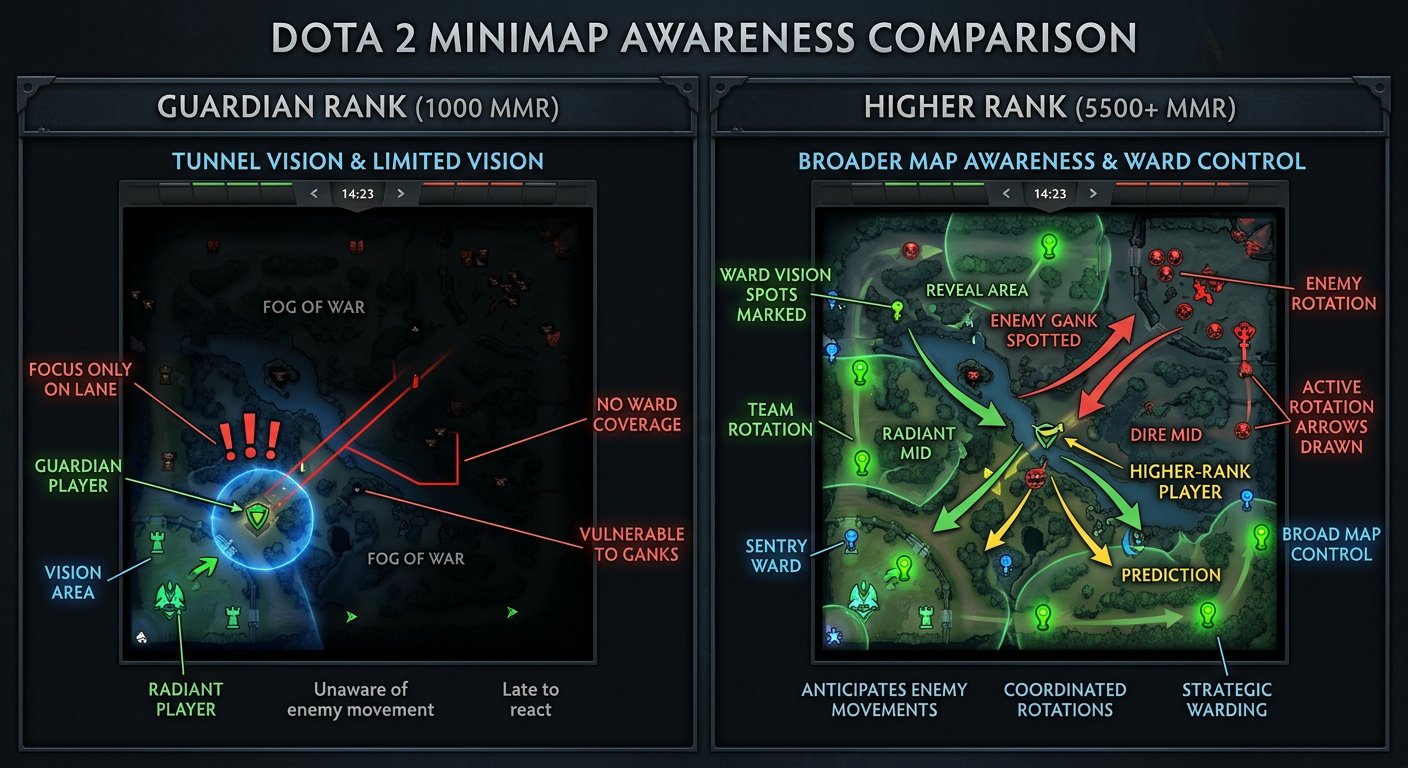
Mistake #1: Ignoring the Minimap
The problem: Guardian players look at the minimap once every 30-60 seconds, if that. They tunnel-vision on their lane or the team fight happening in front of them, missing crucial information about enemy rotations, available farm, and objective opportunities.
The fix: Train yourself to glance at the minimap every 3-5 seconds. Set a mental timer if you have to. Every time you finish a last hit, glance at the minimap. Every time you use an ability, glance at the minimap. This single habit will prevent more deaths than any other change you make.
Mistake #2: Fighting Without a Purpose
The problem: A fight breaks out somewhere on the map, and every Guardian player TPs in like moths to a flame. It doesn’t matter if it’s a terrible fight to take, if they’ll arrive too late, or if they’d be better off pushing a tower on the other side of the map.
The fix: Before joining any fight, ask yourself: “What do we get if we win this fight” If the answer is “nothing” — no tower, no Roshan, no map control — then maybe it’s better to farm or push elsewhere. Not every fight is worth taking.
Mistake #3: Terrible Last-Hitting
The problem: The average Guardian carry gets 35-45 last hits in 10 minutes. That’s leaving hundreds of gold on the table every game. Even Guardian mids and offlaners frequently miss easy last hits under tower.
The fix: Spend 10 minutes before each session in the last-hit trainer. Seriously. Set a goal of 60 last hits in 10 minutes with your main heroes and don’t queue ranked until you hit it. This translates directly to a gold and experience advantage in real games.
Mistake #4: Never Stacking or Pulling
The problem: Guardian supports almost never pull the small camp, let alone stack camps for their carry. This means the lane is constantly pushed, the carry is farming under the enemy tower (dangerous), and the support is soaking XP by standing in lane doing nothing.
The fix: If you play support, learn the pull timings (:15 and :45 for the small camp). Pull when the lane is pushed toward the enemy tower. Stack the large camp whenever you walk past it. These basic support mechanics are almost non-existent in Guardian and will single-handedly give your carry a better lane.
Mistake #5: Building the Same Items Every Game
The problem: Guardian players follow a single item build guide and never deviate, regardless of the game state. They build Battle Fury on Anti-Mage against a 5-man push lineup. They skip BKB “because it’s boring.” They never buy detection against invisible heroes until they’ve died to Riki six times.
The fix: Start thinking about why you’re buying each item. Is the enemy team magic-heavy Consider earlier BKB or Hood. Are they all squishy Maybe you skip the tanky items and go for more damage. Itemization is reactive, not a script you follow blindly.
Mistake #6: Poor Tower Management
The problem: Guardian players either never push towers (farming the jungle for 40 minutes) or YOLO dive towers without creep waves. Towers are the most important objectives in the game, and Guardian players treat them as either irrelevant or invincible.
The fix: After winning a fight, immediately look for the nearest tower you can take. Always push with a creep wave. And protect your own towers — if you see a wave crashing into your tower, go defend it. Tower gold is team-wide and can swing the game.
Mistake #7: Playing While Tilted
The problem: You lose a game, you’re frustrated, you queue again. You lose that game too because you’re playing aggressively and making emotional decisions. Now you’ve lost 50 MMR instead of 25.
The fix: Implement a two-loss rule: if you lose two games in a row, take a break. Go for a walk, get a snack, play something else. Come back when you’re calm and focused. This alone will save you hundreds of MMR over a month.
Mistake #8: Not Using Smoke of Deceit
The problem: Smoke is one of the most powerful items in Dota 2, and Guardian players almost never buy it. The shop practically gives them away (50 gold!), yet entire Guardian games go by without a single smoke used.
The fix: If you’re playing support, buy a smoke every time it’s off cooldown and use it to gank mid or set up a pick on an enemy core. Even poorly executed smokes in Guardian will result in kills because the enemy team doesn’t expect them and has poor map awareness.
Mistake #9: Ignoring Power Spikes
The problem: Guardian players farm passively through their hero’s biggest power spikes. They get that early Blink Dagger on Axe and then… keep farming. They hit level 6 on a ganking hero and stay in lane.
The fix: Know your hero’s power spikes and act on them. When you hit a big item or important level, look for a fight or objective to take. This is how you convert advantages into wins.
Mistake #10: No TP Scroll
The problem: Guardian players frequently die with no TP scroll in their inventory, or they have one but forget to use it to counter-gank, defend a tower, or escape a dangerous situation.
The fix: Always carry a TP scroll. No exceptions. After teleporting somewhere, buy a new one immediately. Use it defensively when allies are being dove under tower — a surprise TP can turn a 1v2 into a 2v2 and swing the lane.
Best Heroes to Escape Guardian Rank
The ideal Guardian-climbing hero has these qualities: (1) simple to execute, (2) strong in lane, (3) can carry team fights, (4) doesn’t require perfect team coordination, and (5) scales well. Here are the best picks by role.
Best Carry Heroes (Pos 1)
Wraith King
Wraith King is arguably the single best hero to escape Guardian. He has one active ability (stun), a built-in second life (Reincarnation), he farms fast with Vampiric Spirit skeletons, and he’s tanky enough to survive Guardian’s chaotic fights. You can literally focus 90% of your brain on farming, positioning, and map awareness because you only need to press one button in fights.
Item build: Phase Boots → Radiance or Armlet → Blink Dagger → Assault Cuirass → Abyssal Blade
Why it works in Guardian: Enemies don’t save stuns for your second life. They blow everything early, you reincarnate, and clean up.
Juggernaut
Juggernaut is incredibly versatile and forgiving. Blade Fury makes you magic immune (great for escaping ganks), Healing Ward sustains you and your team, and Omnislash is a simple but devastating ultimate that doesn’t require setup.
Item build: Phase Boots → Battle Fury or Maelstrom → Aghanim’s Scepter → Butterfly or Basher
Why it works in Guardian: Healing Ward alone wins fights because Guardian enemies ignore it. Blade Fury makes you ungankable in the early game.
Phantom Assassin
PA is a pubstomp queen for a reason. Her crits are devastating, Phantom Strike gives her gap-close, and Blur makes her evasive. In Guardian, enemies rarely build MKB until it’s too late.
Item build: Phase Boots → Desolator → BKB → Basher → Satanic
Why it works in Guardian: One-shotting heroes with crits tilts the enemy team. Guardian players don’t itemize against evasion.
Best Mid Heroes (Pos 2)
Zeus
Zeus is perfect for Guardian because his impact is global. Even if your sidelanes are losing, you can Thunderbolt the entire enemy team from across the map with your ultimate. His damage output is absurd, and he doesn’t require fancy combos.
Item build: Arcane Boots → Aether Lens → Aghanim’s Scepter → Refresher Orb
Viper
Viper dominates the mid lane against almost every matchup and transitions into a tanky damage dealer. His kit punishes aggressive play (which Guardian players love) and he can push towers effectively.
Item build: Power Treads → Dragon Lance → Aghanim’s Scepter → BKB
Best Offlane Heroes (Pos 3)
Axe
Axe is a Guardian destroyer. Counter Helix shreds melee carries in lane, Berserker’s Call forces fights on your terms, and Culling Blade executes low-HP heroes that Guardian players fail to back away from. Once you get Blink Dagger, the game is yours.
Item build: Vanguard → Blink Dagger → Blade Mail → BKB → Overwhelming Blink
Bristleback
Turn your back to the enemy and spam Quill Spray. It’s that simple. Guardian players don’t know how to deal with Bristleback — they attack him from behind (wrong), they chase him (wrong), and they don’t buy Silver Edge (wrong). He’s unkillable and deals massive damage.
Item build: Vanguard → Aghanim’s Shard → Eternal Shroud → Heart of Tarrasque
Best Support Heroes (Pos 4 and 5)
Ogre Magi (Pos 5)
Ogre is tanky, deals high damage in lane with Ignite, and his ultimate (Multicast) can randomly win fights. He’s nearly impossible to kill in lane, and his Bloodlust buff makes your carry hit faster. Simple, effective, impactful.
Item build: Arcane Boots → Aether Lens → Aghanim’s Scepter → Force Staff
Spirit Breaker (Pos 4)
Charge of Darkness is the ultimate Guardian pub ability. You click on an enemy hero anywhere on the map and run at them. In Guardian, enemies don’t watch the minimap, so you’ll get clean charges almost every time. He also provides Bash through Greater Bash, making him a constant threat.
Item build: Urn of Shadows → Power Treads → Spirit Vessel → BKB → Aghanim’s Scepter
Jakiro (Pos 5)
Jakiro has incredible zoning in lane, pushes towers with Liquid Fire, and his ultimate (Macropyre) is devastating in the narrow choke points that Guardian fights always happen in. He doesn’t need items to be useful.
Item build: Arcane Boots → Aether Lens → Force Staff → Aghanim’s Scepter
These heroes will give you the most consistent climbing experience. For more specific guidance tailored to your play style and weaknesses, consider our personalized coaching sessions where an experienced player will analyze your replays and help you optimize your hero pool.
How to Play Each Game Phase in Guardian
Understanding the three phases of a Dota 2 game and having a plan for each one is what separates players who climb from players who stagnate.
Laning Phase (0-10 Minutes)
The laning phase is the most important phase in Guardian because it’s where mechanical skill and knowledge have the highest impact. Win your lane, and the rest of the game becomes much easier.
For carries:
- Focus on last hits above everything else. Your #1 goal is CS, not kills.
- Only go for kills when they’re safe — don’t dive towers.
- Use the courier efficiently (don’t let it sit idle with items).
- If you’re being zoned, pull aggro and draw creeps closer to your tower.
- Aim for 50+ last hits by 10 minutes.
For supports:
- Zone the enemy offlaner. Right-click them when they come for last hits.
- Pull the small camp at :15/:45 to control lane equilibrium.
- Stack the large camp when possible.
- Keep the lane warded.
- Rotate to help mid if your carry is safe.
For offlaners:
- Your goal is to survive and get levels, not necessarily win the lane.
- Contest last hits when safe, but don’t feed.
- Disrupt the enemy carry’s farm when possible (trade aggressively).
- Hit level 6 as fast as possible and look for kill opportunities.
For mids:
- Win the CS battle. Prioritize last hits over harass.
- Control the runes (water runes at 2:00 and 4:00, power runes at 6:00).
- Look for rotation opportunities once you hit your power spike (usually level 6-7).
- Keep a TP scroll to help sidelanes being dove.
Mid Game (10-25 Minutes)
The mid game is where Guardian games are won and lost. This is the chaotic phase where fights break out constantly, and the team with better decision-making pulls ahead.
Key principles:
- Farm efficiently: Don’t just stand around waiting for fights. Always be hitting creeps between engagements. Carry a TP scroll so you can farm and still respond to fights.
- Take objectives after fights: Won a fight Push a tower. Don’t farm the jungle, don’t go back to base, push the nearest tower.
- Group for power spikes: If your team has a strong mid-game lineup, group up and force fights. If you’re playing a farming carry, communicate that you need space and keep farming.
- Control Roshan: The Aegis is the most valuable item in the game. After winning a fight near the Roshan pit, consider taking it.
Late Game (25+ Minutes)
Late game in Guardian is pure chaos. Both teams are usually six-slotted or close to it, and a single team fight can end the game. Here’s how to navigate it:
- Don’t get picked off: Stay with your team. Getting caught alone at 40 minutes can lose the game instantly.
- Buy-back management: Keep enough gold for buy-back if you’re a core. Dying without buy-back at 40+ minutes is game-losing.
- Roshan control: Aegis is even more important late. Ward the pit and contest every Roshan attempt.
- High ground patience: If you’re pushing high ground, be patient. Wait for a pickoff or a big ultimate before committing. High ground wipes lose games.
Core Mechanics to Master
These are the specific mechanical skills that will give you the biggest improvement in Guardian. You don’t need to master all of them — focus on 2-3 at a time.
Last-Hitting and Denying
This is the most important mechanic in Dota 2. Every last hit you get is gold and experience. Every deny reduces your opponent’s. Practice in the last-hit trainer, learn your hero’s attack animation and damage, and work toward 60+ CS by 10 minutes on carry heroes.
Creep Aggro Manipulation
Right-clicking an enemy hero within 500 range of creeps draws their aggro to you. You can use this to pull creeps toward you for safer last-hitting, especially when the lane is pushed. This works on a 3-second cooldown and is one of the most underused techniques in Guardian.
Camera Control
Stop watching your hero with the camera locked. Use edge-panning or camera grip to scout the map during downtimes. Check other lanes, watch enemy movements, and gather information. Better camera control = better decision-making.
Shift-Queuing
Hold shift to queue multiple commands. This is essential for things like TP → immediately use ability, or blink → stun combos. It makes your execution smoother and faster.
Tree Juking
The tree lines in Dota 2 have gaps you can use to dodge enemy vision. Learning common juke paths near each lane can save your life repeatedly. Practice them in a custom lobby.
Drafting Tips for Guardian Players
Drafting matters less in Guardian than in higher ranks because execution is the bigger bottleneck. That said, a terrible draft can lose games even in Guardian.
Golden Rules for Guardian Drafting
- Pick heroes you’re comfortable with — don’t counter-pick with heroes you’ve played twice.
- Ensure at least one stun on your team — all-passive-damage lineups struggle to kill anything.
- Have a mix of damage types — if your team is all physical, the enemy buys armor and you can’t kill anyone.
- Don’t last-pick a support — use last pick for your carry or mid to get a favorable matchup.
- Don’t overthink it — at Guardian, a hero you know well beats a “perfect counter” you don’t know how to play.
Communication and Teamwork
Guardian is notorious for toxic communication. Here’s how to navigate it productively.
Use Pings Effectively
Don’t type essays in chat. Use pings to communicate. Ping missing enemies, ping towers you want to push, ping enemies you want to gank. Quick, clear information is more effective than paragraphs of strategy.
Mute Toxic Players Immediately
If a teammate starts flaming, mute them. Don’t engage. Don’t defend yourself. Don’t type back. Just mute and focus on playing. Every second you spend typing is a second you’re not farming, not watching the map, and not playing Dota.
Positive Reinforcement Works
A quick “gj” or “nice” after a teammate makes a good play goes a surprisingly long way. Positive teams win more. It’s that simple.
If you’re finding that communication barriers and difficult teammates are consistently holding you back, and you just want to play at a rank where teammates are more cooperative and skilled, our MMR boost service can help you reach a rank where team coordination is naturally better.
Your Daily Practice Routine
Consistent improvement requires consistent practice. Here’s a daily routine that takes about 30 minutes before your ranked games:
Warm-Up (10 Minutes)
- 5 minutes in the last-hit trainer with your main hero
- 5 minutes practicing combos in demo mode (Blink + stun timing, etc.)
Replay Review (10 Minutes)
- Watch the first 10 minutes of your worst loss from the previous day
- Note 2-3 specific mistakes you made
- Write them down and focus on not repeating them
Mental Preparation (5-10 Minutes)
- Set your goals for the session (e.g., “I will hit 55+ CS by 10 min,” “I will check minimap every 5 seconds”)
- Remind yourself of the 40-40-20 rule
- Promise yourself you’ll take a break after two consecutive losses
This routine might seem excessive for a “video game,” but the players who climb are the ones who treat improvement seriously. Even doing half of this routine will put you miles ahead of the average Guardian player.
Want to Fast-Track Your Climb
Let’s be honest — grinding out of Guardian can take weeks or even months. Some players simply don’t have that kind of time. If you want to accelerate your progress, here are some options:
Professional Coaching
A Dota 2 coach can analyze your specific gameplay, identify your unique weaknesses, and give you a personalized improvement plan. It’s the fastest way to improve because you’re getting targeted feedback rather than generic advice. Our coaches are high-MMR players who specialize in helping lower-ranked players climb efficiently.
MMR Boosting
If you’re confident you belong at a higher rank but don’t want to grind through the noise of Guardian, our MMR boosting service can get you there. A professional player will boost your account to your desired rank quickly and safely. Many players use this to skip past the most frustrating ranks and then maintain their new MMR through improved play.
Calibration Services
Starting a new season Your calibration matches are critical for setting your starting MMR. Our service ensures your calibration games are played at the highest level, giving you the best possible starting point for the season.
Low Priority Removal
Stuck in Low Priority because of abandons or reports LP games don’t give MMR and are a complete waste of your climbing time. Our service gets you out quickly so you can get back to ranked.
Frequently Asked Questions
Final Thoughts: Your Guardian Escape Plan
Escaping Guardian rank isn’t about finding a secret trick or exploiting a broken hero. It’s about consistent improvement in the fundamentals. Let’s recap your action plan:
- Fix your mindset: Focus on self-improvement, not teammate quality. Adopt the 40-40-20 rule.
- Shrink your hero pool: Master 3-5 heroes and spam them.
- Improve your mechanics: Last-hit trainer daily, practice combos, use the minimap.
- Fix the big mistakes: Map awareness, purposeful fighting, proper itemization, no tilted queuing.
- Practice deliberately: Use the daily routine, review replays, set specific goals.
- Be patient: Climbing takes time. Trust the process.
Guardian is a rank you can escape. Thousands of players have done it before you, and thousands will do it after you. The question isn’t whether it’s possible — it’s whether you’re willing to put in the work.
Good luck out there. We’ll see you in Crusader.
Ready to Climb Start Your Boost Today
Team Smurf is the #1 rated Dota 2 boosting service in 2026. Immortal-rank boosters, maximum safety, competitive pricing, 24/7 support.
Written by Team Smurf’s Immortal-rank analysts — Rankings last verified February 2026



