Dota 2 Calibration Boost: The Complete Guide to Dominating Your Placement Matches

Your calibration matches are the single most impactful games you’ll play in any Dota 2 season. Ten games. That’s it. Ten matches that determine where you start — and by extension, how much grinding you’ll need to do for the rest of the season. Get them right, and you skip weeks of climbing. Get them wrong, and you’re stuck digging yourself out of a hole for months.
This is why the dota 2 calibration boost has become one of the most popular services in the boosting industry. Players understand that calibration is a leverage point — a place where a small investment yields disproportionate returns. Winning 8 out of 10 calibration matches instead of 5 out of 10 can mean a difference of 500-900+ MMR in your starting rank. That’s weeks of grinding eliminated in under 10 games.
But here’s the thing most players — and even most boosting guides — get wrong: calibration isn’t just about winning. Valve’s calibration system uses a complex set of hidden variables that go far beyond your win/loss record. Understanding these variables is the difference between a calibration that places you at your “expected” rank and one that launches you significantly higher.
Table of Contents
- How Dota 2 Calibration Actually Works
- The Hidden Variables That Determine Your Placement
- Beyond Win/Loss: What Really Affects Your MMR
- Optimal Heroes for Calibration Matches
- Timing Strategy: When to Calibrate
- New Account Calibration vs. Recalibration
- Solo vs. Duo Calibration
- Historical Calibration Changes
- Case Studies: Real Calibration Results
- How a Professional Calibration Boost Works
- Post-Calibration Strategy
- Frequently Asked Questions
In this comprehensive guide, we’ll cover:
- Exactly how Dota 2’s calibration algorithm works — including hidden variables most players don’t know about
- What actually affects your placement beyond win/loss ratio
- The optimal heroes for calibration matches
- When to calibrate during the season for maximum advantage
- Solo vs. duo calibration considerations
- New account calibration vs. recalibration differences
- Historical calibration changes and current system mechanics
- Real case studies showing calibration results
- How a professional dota 2 calibration service maximizes your placement
Let’s decode the system.
How Dota 2 Calibration Actually Works
Let’s start by destroying the biggest misconception about calibration: your 10 calibration matches do not determine your MMR from scratch.
This is crucial to understand. Whether you’re recalibrating an existing account or calibrating a new account that’s completed the required unranked games, Valve’s system already has a strong estimate of your skill level before you play a single calibration match. The calibration games refine that estimate — they don’t create it.
The Pre-Calibration Hidden MMR
Before you even enter calibration, the system has assigned you a hidden MMR based on:
- Previous ranked MMR (recalibration): Your last known ranked rating is the starting anchor. Calibration typically adjusts this by -500 to +500 MMR based on calibration performance
- Unranked performance (new accounts): For new accounts, Valve tracks your unranked match performance extensively. By the time you’ve completed the required games to unlock ranked, the system has a surprisingly accurate estimate of your skill level
- Global percentile data: Your performance metrics are compared against the entire player population to place you on the skill distribution curve
The Calibration Algorithm
During calibration, each game has amplified MMR impact. Where a normal ranked game might move your rating by ±25-30 MMR, calibration games can swing your rating by ±50-75 MMR each. This is because the system’s “uncertainty” about your skill level is deliberately elevated during calibration — it’s designed to move your rating more aggressively to find the right spot quickly.
Here’s the simplified math:
- Normal ranked game: ±25-30 MMR per game
- Calibration game: ±50-75 MMR per game (estimated, Valve doesn’t publish exact values)
- 10 calibration games maximum swing: Approximately ±500-750 MMR from your hidden starting point
This means that going 10-0 in calibration could place you 500-750 MMR above your pre-calibration estimate, while going 0-10 could drop you by a similar amount. The difference between a perfect calibration and a terrible one is potentially 1,000-1,500 MMR — that’s an entire medal tier or more.
For more on how MMR works beyond calibration, see our comprehensive MMR explained guide.
The Hidden Variables That Determine Your Placement
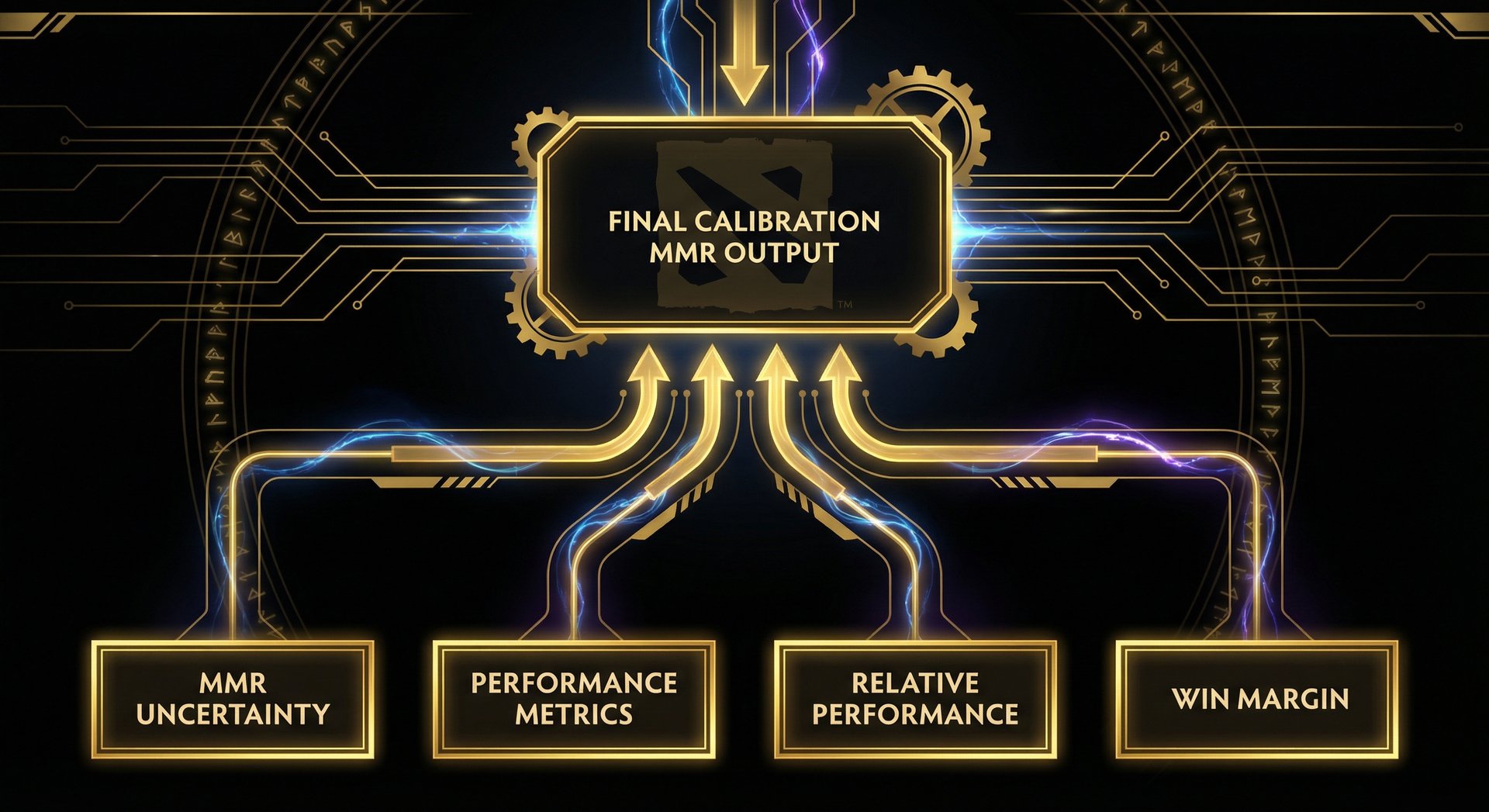
Here’s where it gets really interesting. Valve’s calibration system doesn’t just look at whether you won or lost. It evaluates your individual performance within each game through a matrix of hidden variables. While Valve has never published the exact formula (and likely adjusts it between patches), extensive community research and data analysis have identified the key factors:
1. MMR Uncertainty Score
Every account has a hidden “uncertainty” value that represents how confident the system is about your current rating. High uncertainty means bigger swings per game; low uncertainty means smaller adjustments.
Factors that increase uncertainty:
- Extended breaks from ranked play (months or years without games)
- Highly inconsistent performance (wild swings in stats between games)
- Season resets (mandatory uncertainty injection)
- New accounts entering ranked for the first time
Factors that decrease uncertainty:
- Playing many ranked games consistently
- Stable performance metrics across games
- Win/loss patterns that match predicted outcomes
Why this matters for calibration: Accounts with higher uncertainty (returning players, new accounts) can experience more dramatic calibration swings. A returning player who performs exceptionally in calibration may see a larger upward adjustment than an active player who performs similarly. This is actually an advantage — if you’re recalibrating after a break, the system is more willing to move your rating significantly.
2. Performance Metrics Per Game
The system evaluates your in-game performance relative to other players at your estimated skill level. Key metrics include:
- KDA (Kill/Death/Assist ratio): Higher KDA signals stronger individual performance. Deaths are weighted negatively; assists are weighted less than kills but still matter
- Hero damage: Total damage dealt to enemy heroes. This is compared against the average hero damage for your role and hero at your bracket
- Tower damage: Objective contribution — players who hit buildings contribute to wins. This metric rewards players who push objectives rather than farming indefinitely
- Last hits and GPM: Farm efficiency metrics that indicate your ability to convert map resources into gold. Weighted more heavily for core roles
- Healing (supports): For support players, healing output is tracked and compared against role benchmarks
- Wards placed and dewarded: Vision control metrics that are role-weighted. Supports are expected to ward more; cores who also contribute to vision get a relative bonus
- Stun/disable duration: For heroes with crowd control, total stun time applied to enemies is tracked
- Camps stacked: Especially relevant for Position 4/5 players — stacking efficiency signals game knowledge
3. Relative Performance
This is the most nuanced variable. The system doesn’t just look at your raw numbers — it compares them to what’s expected given your hero, role, bracket, and game duration. Getting 600 GPM on Anti-Mage in a 45-minute game at 3,000 MMR is expected. Getting 600 GPM on Crystal Maiden in the same scenario is exceptional.
This relative comparison means that outperforming expectations matters more than hitting absolute benchmarks. A support player with impressive ward stats and high kill participation gets a bigger calibration boost (relative to expectations) than a carry player with good farm numbers (which is expected for the role).
4. Win Margin
Not all wins are created equal in the calibration algorithm. Evidence suggests that decisive wins (where your team dominates — large gold lead, fast game, high individual stats) provide slightly more calibration MMR than narrow wins (base races, comeback victories). The logic: a dominant win more confidently signals that you’re above the current skill level than a close game that could have gone either way.
However, a win is still far more valuable than a loss, regardless of margin. Don’t sacrifice a win trying to pad stats for a “more dominant” victory. Always prioritize winning.
5. Behavioral Signals
While not a direct calibration factor, your behavior score at the time of calibration affects the quality of games you get, which indirectly impacts calibration outcomes. A 10,000 behavior score player calibrates in games with other well-behaved players, resulting in more consistent, predictable matches. A 6,000 behavior score player faces more griefers, abandons, and toxicity — introducing randomness that can tank calibration results regardless of skill.
Beyond Win/Loss: What Really Affects Your MMR
Now that you understand the hidden variables, let’s translate that into actionable strategy. Here’s what you should focus on to maximize your calibration placement — whether you’re playing yourself or working with a dota 2 calibration service:
Priority 1: Win the Game (Obviously)
Winning is still the single most important factor. No amount of impressive stats compensates for a loss in calibration. Win rate is king. Every strategic decision in calibration should prioritize winning above all else.
This seems obvious, but it has tactical implications. In calibration:
- Pick reliable, proven heroes over flashy, high-risk ones
- Prioritize objectives over kills — end games when you have the advantage
- Don’t extend games to pad stats — close out wins efficiently
- Avoid unnecessary risks (aggressive dives, solo Rosh attempts) that could throw a won game
Priority 2: Minimize Deaths
Deaths are the most negatively weighted individual metric in calibration. Every death:
- Directly increases your death count (obvious but important for KDA)
- Gives the enemy team gold and experience
- Removes you from the map for 20-100+ seconds
- Signals to the calibration algorithm that you’re being outplayed
A 10-2-15 game is calibration-wise significantly better than a 15-8-10 game, even though the raw kill count is lower. Survival equals MMR.
Priority 3: Maximize Relevant Stats for Your Role
The system evaluates you based on role expectations. Optimize accordingly:
Position 1 (Carry):
- Maximize GPM and last hits — farm efficiently and don’t miss creeps
- High hero damage in teamfights
- Tower damage (carries are expected to hit buildings)
- Low death count (carries who die a lot lose more calibration value)
Position 2 (Mid):
- Win your lane — CS advantage at 10 minutes is tracked
- High hero damage (mid heroes are expected to be damage leaders)
- Kill participation (mids should be involved in most kills)
- Tower damage from split-pushing and objective focus
Position 3 (Offlane):
- Initiation and teamfight presence
- Stun/disable duration
- Survivability (offlaners who die less than expected get bonuses)
- Tower damage (offlaners often lead pushes)
Position 4 (Soft Support):
- Kill participation and assist count
- Wards placed and vision control
- Camps stacked
- Healing/save metrics (if applicable to hero)
Position 5 (Hard Support):
- Ward placement and deward count
- Healing output
- Assist count (should be the highest on the team)
- Low death count relative to role (dying to save your carry is acceptable but dying for nothing isn’t)
Priority 4: Game Duration Management
Shorter wins are generally better for calibration than longer ones, because:
- Decisive wins signal skill superiority more clearly
- You can play more calibration games in the same timeframe
- Longer games introduce more variance and risk of throwing
When you’re winning, end the game. Don’t farm for fun. Don’t hunt for kills. Push high ground, take Roshan, and close it out.
Optimal Heroes for Calibration Matches
Hero selection in calibration is a strategic decision that impacts both your win probability and your individual performance metrics. Here are the optimal picks by role:
Best Calibration Heroes: Mid (Position 2)
| Hero | Why It’s Great for Calibration | Key Stats It Pads |
|---|---|---|
| Huskar | Dominates lanes, fast tower killer, forces early wins | Hero damage, tower damage, low death count (if played correctly) |
| Templar Assassin | Lane dominator, fast farmer, high burst damage, Roshan threat | GPM, hero damage, last hits, tower damage |
| Invoker | Versatile, high teamfight impact, can carry or control | Hero damage, kill participation, stun duration |
| Storm Spirit | High mobility, pick-off potential, snowball hero | Kill count, hero damage, kill participation |
| Leshrac | Strong laner, fast tower pusher, high AoE damage | Tower damage, hero damage, GPM |
Best Calibration Heroes: Carry (Position 1)
| Hero | Why It’s Great for Calibration | Key Stats It Pads |
|---|---|---|
| Phantom Assassin | Snowballs hard, high kill potential, fast farmer | Hero damage, kill count, GPM |
| Juggernaut | Safe laning, strong at all stages, healing ward adds metric value | Hero damage, healing done, tower damage, GPM |
| Luna | Fastest tower killer in the game, strong AoE teamfight | Tower damage, GPM, last hits, hero damage |
| Ursa | Lane dominator, early Rosh, fight-oriented | Hero damage, kill count, Roshan kills |
| Terrorblade | Highest farming speed, massive tower damage, late-game insurance | GPM, last hits, tower damage |
Best Calibration Heroes: Support (Position 4/5)
| Hero | Why It’s Great for Calibration | Key Stats It Pads |
|---|---|---|
| Omniknight | Massive healing output, save potential, hard to kill | Healing done, assists, low deaths |
| Warlock | Healing, massive teamfight ult, easy to keep stats high | Healing done, hero damage (ult), assists |
| Dazzle | Healing, saves with Shallow Grave, consistent impact | Healing done, assists, save count |
| Shadow Shaman | Tower pusher (wards), strong disables, high kill participation | Tower damage, stun duration, kill participation |
| Jakiro | AoE damage, tower damage (Liquid Fire), long stun | Hero damage, tower damage, stun duration |
Heroes to AVOID in Calibration
- Techies: Polarizing win rates, game-extending tendencies, and stats that don’t align well with calibration metrics
- Io/Wisp: Extremely team-dependent, poor solo impact in uncoordinated calibration games
- Chen: High skill floor, inconsistent micro in high-pressure calibration games
- Any hero you haven’t played 50+ games with: Calibration is not the time to experiment. Play what you know
- Hard carry heroes that need 40+ minutes: Medusa, Spectre (in current meta) — games may end before you come online
For broader hero recommendations for climbing MMR, see our guide on best heroes to climb MMR.
Timing Strategy: When to Calibrate
When you play your calibration matches matters more than most players realize. Here’s the timing meta:
Early Season Calibration (First 1-2 Weeks)
Pros:
- Everyone is calibrating simultaneously, creating a chaotic but opportunity-rich environment
- Many players are “rusty” from the season break, giving fresh/prepared players an edge
- You establish your rank early and can grind the entire season from a strong starting point
- The meta hasn’t settled yet, rewarding adaptable players
Cons:
- Game quality is lower — calibration games are more volatile with wider MMR spreads
- More smurfs and boosters are active during early season
- If the meta just shifted (post-patch), your hero pool may not be optimal
- Emotional players who are frustrated by rank resets can tilt faster
Mid-Season Calibration (Weeks 3-8)
Pros:
- Game quality stabilizes — most players have found their bracket
- The meta has settled, allowing for more informed hero picks
- Fewer volatile, tilted players in the pool
- Matchmaking accuracy improves as the system has more data
Cons:
- You’ve “wasted” several weeks at your old rank or not playing ranked
- Less time remaining to climb after calibration
- The initial chaos (which benefits skilled players) has passed
Late Season Calibration (Final Month)
Pros:
- Maximum data available for the system to calibrate accurately
- You can practice extensively in unranked/turbo before committing to calibration
Cons:
- Minimal time to climb after calibration
- End-of-season game quality often degrades (people giving up, trolling, or “yolo” queuing)
- Essentially pointless if you want to reach a peak rank during the season
Our Recommendation
Calibrate in weeks 2-4 of a new season. This sweet spot gives the initial chaos a week to settle while still leaving you plenty of season to climb. If you’re using a dota 2 calibration boost, this timing also ensures maximum availability of professional boosters who aren’t overwhelmed by the Week 1 rush.
For comprehensive season strategies, check out our new season guide.
New Account Calibration vs. Recalibration
These are fundamentally different processes, and understanding the distinction is crucial if you’re considering a dota 2 calibration service.
New Account Calibration
A brand-new Dota 2 account must complete 100+ hours of gameplay and a set number of unranked matches before ranked mode is unlocked. During this period, the system is building your hidden MMR from scratch.
Key characteristics:
- High uncertainty: The system is less confident about your rating, leading to larger calibration swings (potentially ±75-100 MMR per game)
- Pre-calibration performance matters enormously: The unranked games before calibration set your hidden MMR baseline. If you lose a lot of unranked games, your calibration ceiling is lower
- Wider placement range: New accounts can calibrate anywhere from ~500 to ~6,000+ MMR (theoretically). The range is much wider than recalibration
- Phone number requirement: Ranked requires a unique phone number, which limits account creation for boosting purposes
- Smurf detection: Valve’s system actively monitors new accounts for smurf-like behavior patterns and may accelerate MMR gains if detected — but this can also flag the account
New account calibration tip: If you’re calibrating a new account (whether it’s a smurf or a fresh start), the unranked games before calibration are just as important as the calibration games themselves. Winning consistently with strong stats in unranked sets a higher baseline for calibration.
Recalibration (Existing Account)
Recalibration occurs when a season resets or when a player manually triggers recalibration (when available). Your previous ranked MMR serves as the anchor, and the system’s uncertainty is temporarily increased to allow for adjustment.
Key characteristics:
- Anchored to previous MMR: Your starting point is your last known rating. The calibration games adjust from there
- Moderate uncertainty: Larger swings than normal games, but typically less than new account calibration
- Bounded range: Recalibration typically moves your MMR by -500 to +500 from the previous value. Extreme swings are rare
- Accounts for decay: If you haven’t played in a long time, the system assumes some skill decay and may start you slightly lower
- Match history context: The system considers your historical performance patterns, not just the 10 calibration games
Comparison Table
| Factor | New Account | Recalibration |
|---|---|---|
| MMR anchor | Unranked performance (hidden) | Previous season’s MMR |
| Uncertainty level | Very high | Moderate |
| MMR swing per game | ±75-100 estimated | ±50-75 estimated |
| Total calibration range | ±750-1,000+ | ±500-750 |
| Pre-calibration requirements | 100+ hours, phone number, unranked games | None (just play 10 games) |
| Smurf detection risk | Higher | Lower |
| Boost impact potential | Very high (wider range) | High (narrower but still significant) |
Which benefits more from a calibration boost Both benefit significantly, but new accounts have more upside potential because the wider uncertainty range means professional performance can push the rating higher. However, recalibration boosts are more common because most customers already have established accounts they want to improve.
Solo vs. Duo Calibration
You can approach calibration with either a solo boost or a duo boost. Here’s how each plays out specifically for calibration games:
Solo Calibration Boost
A professional booster plays your 10 calibration matches on your account. This is the most popular dota 2 calibration service format.
Advantages for calibration specifically:
- Maximum win rate: A solo booster in calibration games achieves 85-95% win rates because the games are against mixed-skill opponents (calibration matches have wider MMR spreads)
- Optimized stat padding: Professional boosters know exactly which stats the calibration algorithm weights and play accordingly — high GPM, low deaths, maximum hero/tower damage
- Fast completion: 10 games can be completed in 1-2 days
- Consistent performance: No variance from your own play — the booster delivers optimal results every game
Disadvantages:
- Account sharing required
- No learning for you
- Match history may look different from your usual play
Duo Calibration Boost
You play your calibration matches in a party with a professional booster.
Advantages for calibration specifically:
- Account security: No credential sharing
- You participate: Your own performance metrics contribute to calibration, which is fine if the booster is shotcalling and keeping you on track
- Natural match history: Playing in a party is completely normal
- Learning for post-calibration: You start the season with 10 games of high-level experience
Disadvantages:
- Win rate is lower (75-85% vs 85-95%)
- Your individual stats may not be as optimized
- Takes slightly longer to schedule
- Your own bad games directly impact calibration
Our Recommendation for Calibration
For calibration specifically, solo boost is generally the superior choice unless account security is your absolute priority. Here’s why: calibration is only 10 games. The stat optimization and higher win rate from solo boosting has a disproportionate impact when there are only 10 data points for the algorithm to evaluate. Every game matters enormously, and professional execution maximizes every one.
If you choose duo, make sure you’re warmed up and playing at your absolute best. Don’t go into calibration cold — play 3-5 unranked games first to get your mechanics sharp.
Visit our Dota 2 Calibration Service page to see pricing for both options.
Historical Calibration Changes
Valve has modified the calibration system multiple times over Dota 2’s history. Understanding these changes provides context for the current system and helps predict future adjustments:
Pre-2017: The Wild West
Early Dota 2 calibration had minimal safeguards. New accounts could calibrate as high as ~4,500 MMR, and the system relied heavily on hero damage and KDA as individual performance metrics. This led to notorious “calibration abuse” — players picking heroes like Zeus and Spectre (whose global abilities padded hero damage stats) to artificially inflate their calibration placement.
2017-2018: Medal System Introduction
Valve introduced the medal system (Herald through Immortal), replacing the raw MMR number as the visible rank indicator. Calibration was adjusted to be more anchored to previous performance, reducing the effectiveness of calibration abuse. The maximum initial calibration for new accounts was also lowered to approximately 3,500 MMR.
2019: Role Queue and Separate MMR
The introduction of Role Queue brought separate Core and Support MMR values. Players had to calibrate each role separately (up to 20 calibration games total). This was later simplified, but the era taught Valve a lot about role-specific performance evaluation — knowledge that’s baked into the current system.
2020-2021: Smurf Detection Integration
Valve integrated aggressive smurf detection into the calibration pipeline. New accounts showing performance significantly above their bracket were flagged and either fast-tracked to higher MMR (skipping the grind) or, in some cases, restricted. This changed the calibration boost landscape — services had to adapt their methods to avoid triggering these systems.
2022-2023: Unified MMR Return
Core and Support MMR were re-merged into a single rating. Calibration games were consolidated back to 10 (or similar). The system became more sophisticated at evaluating role-specific performance within a single MMR framework.
2024-2026: Current System
The current calibration system represents Valve’s most refined approach. It features:
- Strong anchoring to previous performance (recalibration)
- Sophisticated individual performance evaluation (beyond just KDA)
- Integrated smurf detection
- Behavior score weighting for match quality
- Season-based resets with controlled uncertainty injection
The system is designed to be more resistant to manipulation than ever, which paradoxically makes professional calibration boosts more valuable — because the gap between professional and amateur calibration performance has a bigger impact when the system is evaluating more metrics.
For official updates from Valve on matchmaking changes, check the Dota 2 official patch notes.
Case Studies: Real Calibration Results
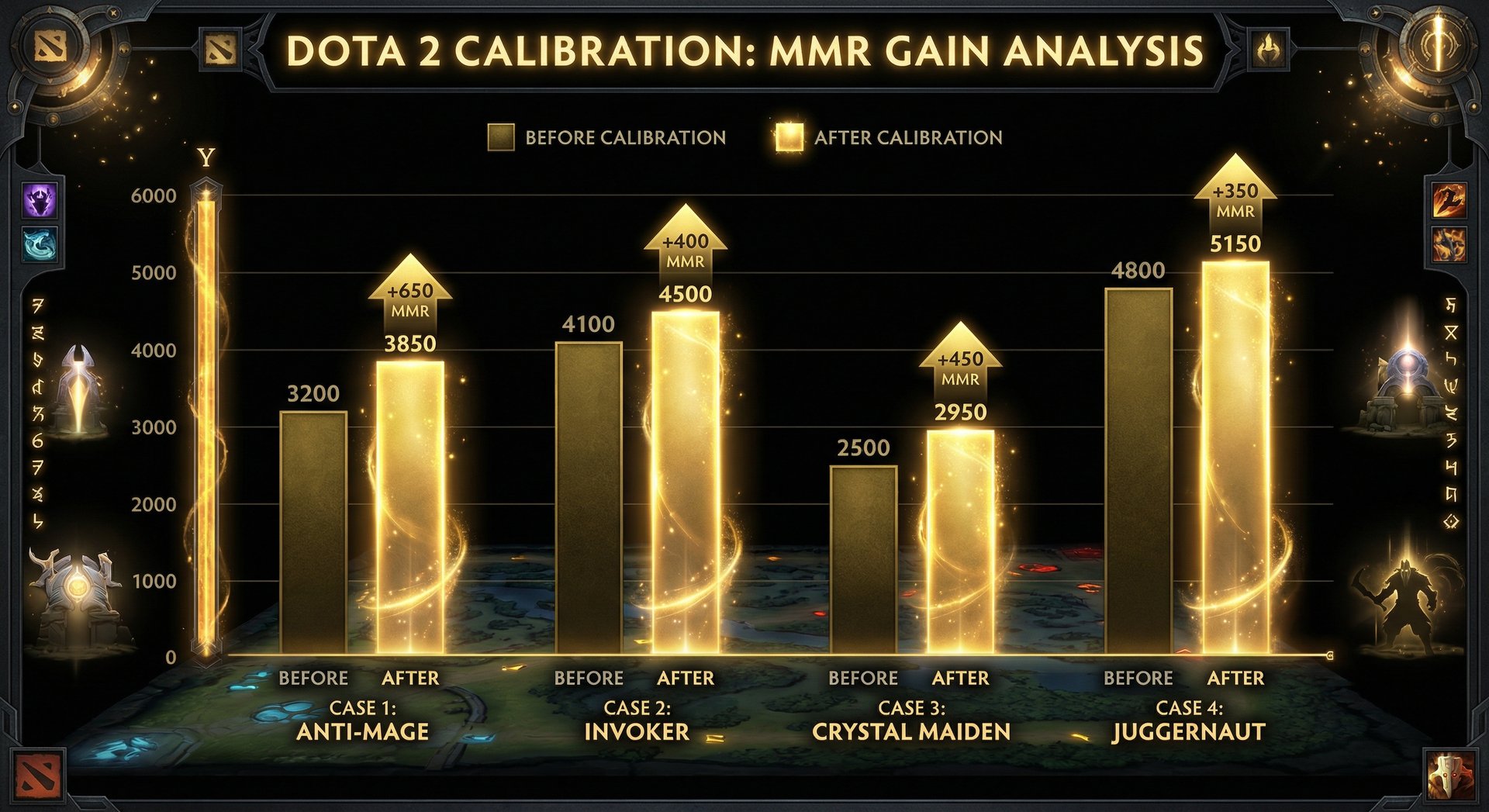
Numbers tell the story better than theory. Here are real (anonymized) calibration results from Team Smurf customers:
Case Study 1: The Recalibration Boost
| Detail | Value |
|---|---|
| Account type | Existing account, recalibration |
| Previous season MMR | 3,200 (Legend 1) |
| Boost type | Solo calibration |
| Calibration record | 9 wins, 1 loss |
| Average KDA | 11.4 / 2.1 / 8.7 |
| Average GPM | 642 |
| Post-calibration MMR | 3,740 (Legend 4) |
| MMR gained | +540 |
| Estimated natural calibration | ~3,100-3,300 (based on account history) |
| Net advantage | ~440-640 MMR higher than expected |
Analysis: The booster’s exceptional 9-1 record combined with dominant individual stats pushed the calibration well above the expected range. The one loss didn’t significantly impact the result because the other 9 games were dominant wins with excellent metrics.
Case Study 2: The New Account Calibration
| Detail | Value |
|---|---|
| Account type | New account (smurf) |
| Pre-calibration unranked | 100+ hours, consistently strong performance |
| Boost type | Solo (unranked + calibration) |
| Calibration record | 10 wins, 0 losses |
| Average KDA | 14.2 / 1.8 / 9.3 |
| Average GPM | 718 |
| Post-calibration MMR | 4,480 (Ancient 2) |
| Notes | Smurf detection kicked in during unranked, accelerating progression |
Analysis: The perfect 10-0 record with exceptional stats on a high-uncertainty new account produced the maximum possible calibration outcome. The smurf detection system actually helped by increasing hidden MMR during the unranked phase.
Case Study 3: The Duo Calibration
| Detail | Value |
|---|---|
| Account type | Existing account, recalibration |
| Previous season MMR | 2,800 (Archon 5) |
| Boost type | Duo calibration |
| Calibration record | 8 wins, 2 losses |
| Customer’s average KDA | 5.8 / 4.2 / 12.1 |
| Post-calibration MMR | 3,180 (Legend 1) |
| MMR gained | +380 |
| Customer satisfaction | “Learned more in 10 games than in my last 100” |
Analysis: The duo calibration resulted in a smaller MMR gain than the solo cases (8-2 vs 9-1 or 10-0), but the customer’s own performance improved noticeably across the 10 games as they absorbed the booster’s guidance. The long-term value of the learning component arguably exceeds the MMR difference.
Case Study 4: The Returning Player
| Detail | Value |
|---|---|
| Account type | Returning player, 18-month break |
| Previous MMR before break | 4,100 (Ancient 3) |
| MMR at recalibration start | ~3,600 (estimated, with decay) |
| Boost type | Solo calibration |
| Calibration record | 9 wins, 1 loss |
| Post-calibration MMR | 4,150 (Ancient 3) |
| MMR gained vs. decayed baseline | +550 |
| Effective result | Fully restored to pre-break rank |
Analysis: The calibration boost completely reversed the MMR decay from an 18-month break, placing the player right back where they were before leaving. Without the boost, they would have calibrated around 3,400-3,600 and needed weeks to climb back to Ancient 3.
How a Professional Calibration Boost Works
When you buy dota 2 calibration matches from a professional service, here’s the detailed process:
Step 1: Order and Account Assessment
You visit the calibration service page and provide your account details. The service reviews:
- Your previous season’s MMR (or unranked history for new accounts)
- Your match history to understand your hero pool and play patterns
- Your behavior score (important for match quality during calibration)
- Any specific preferences (heroes, roles, play times)
Step 2: Strategy Planning
The assigned booster develops a calibration strategy tailored to your account:
- Hero selection: Choosing heroes that maximize both win probability and individual performance metrics, while staying consistent with your match history when possible
- Role optimization: Selecting the role where the booster can have the most impact while fitting your account’s history
- Session timing: Planning when to play to hit optimal matchmaking conditions (server population, time of day)
- Game pacing: Intentionally closing out games efficiently to maximize the “decisive win” bonus while minimizing risk
Step 3: Execution
The booster plays your 10 calibration matches, typically across 1-2 days. During each game, they focus on:
- Winning first and foremost
- Maintaining the lowest possible death count
- Maximizing hero damage and tower damage
- Ensuring high GPM/XPM relative to role expectations
- Ending games quickly once victory is assured
Step 4: Results and Handoff
After all 10 games, you receive:
- Your new calibrated MMR and medal
- A summary of each game (hero, result, key stats)
- Your overall calibration record
- Post-calibration recommendations specific to your new bracket
Post-Calibration Strategy
Your calibration placed you at a strong starting point. Now what Here’s how to capitalize on your calibration boost:
The First 20 Games
After calibration, the system still has slightly elevated uncertainty. This means your first 20 or so ranked games will have slightly amplified MMR gains and losses — not as extreme as calibration, but more than the standard ±25-30. Use this to your advantage:
- Play your best heroes only. This is not the time to experiment
- Warm up before each session. Play 1-2 unranked games or practice last-hitting in demo mode
- Limit sessions to 3-4 games. Stop if you lose 2 in a row
- Focus on the fundamentals: Don’t die needlessly, farm efficiently, take objectives, communicate positively
If You Were Solo Boosted
You’re now playing at a higher bracket than you’re used to. The adjustment period is real but manageable:
- Watch your calibration replays. See how the booster played your heroes at this bracket
- Accept that you’ll lose some games. Stabilizing 100-200 MMR below your calibration is normal and fine
- Consider coaching. A few coaching sessions at your new bracket can dramatically accelerate your adjustment
- Study the meta. Each bracket has its own meta — what works in Archon doesn’t necessarily work in Ancient
If You Were Duo Boosted
You have a significant advantage: you’ve already been playing at this level during calibration. But losing your duo partner means you need to compensate:
- Apply what you learned. Think about the booster’s shotcalling — those macro decisions should now be your internal monologue
- Communicate with your team. You’ve learned what good communication looks like from your duo partner. Share that with your random teammates
- Stick to the heroes that worked. If the booster recommended specific picks for your bracket, keep using them
When to Consider an MMR Boost
If your calibration placed you within 200-300 MMR of a target rank that’s just out of reach, an MMR boost can bridge that final gap. Many customers use calibration boosts to get 80% of the way there, then a small MMR boost for the last push. Alternatively, if you need help with low priority removal before recalibrating, that’s also available.
Final Thoughts: Why Calibration Is the Highest-Value Boost
Of all the boosting services available for Dota 2, calibration boosting offers the highest return on investment. Consider the math:
- A calibration boost covers only 10 games — far fewer than a typical MMR boost
- Each calibration game is worth 2-3x more MMR than a regular ranked game
- The cost of a calibration boost is typically 50-70% less than an equivalent MMR boost that achieves the same result
- The time investment is minimal — 10 games can be completed in 1-2 days
If you’re going to invest in any single boost, calibration is where your money works hardest. It’s the difference between starting the season at your “expected” rank and starting 400-700 MMR higher — which translates to weeks of grinding saved.
At Team Smurf, calibration boosts are our most popular service for exactly this reason. Our Immortal-rank boosters have completed thousands of calibration orders with an average win rate exceeding 87% across all brackets.
Ready to dominate your placement matches Order your calibration boost now and start the season strong.
Frequently Asked Questions
Dominate Your Calibration Matches
Start the season strong with Team Smurf. Our Immortal-rank boosters average 87%+ win rates in calibration matches across all brackets.
Written by Team Smurf’s Immortal-rank analysts — Last verified February 2026